

UK Sponsor Licence Annual Report 2026: At a Glance
UK sponsor licensing in 2026 has been marked by a sharp increase in recorded Home Office enforcement activity, lower sponsorship application volumes and continued growth in the Skilled Worker sponsor population.
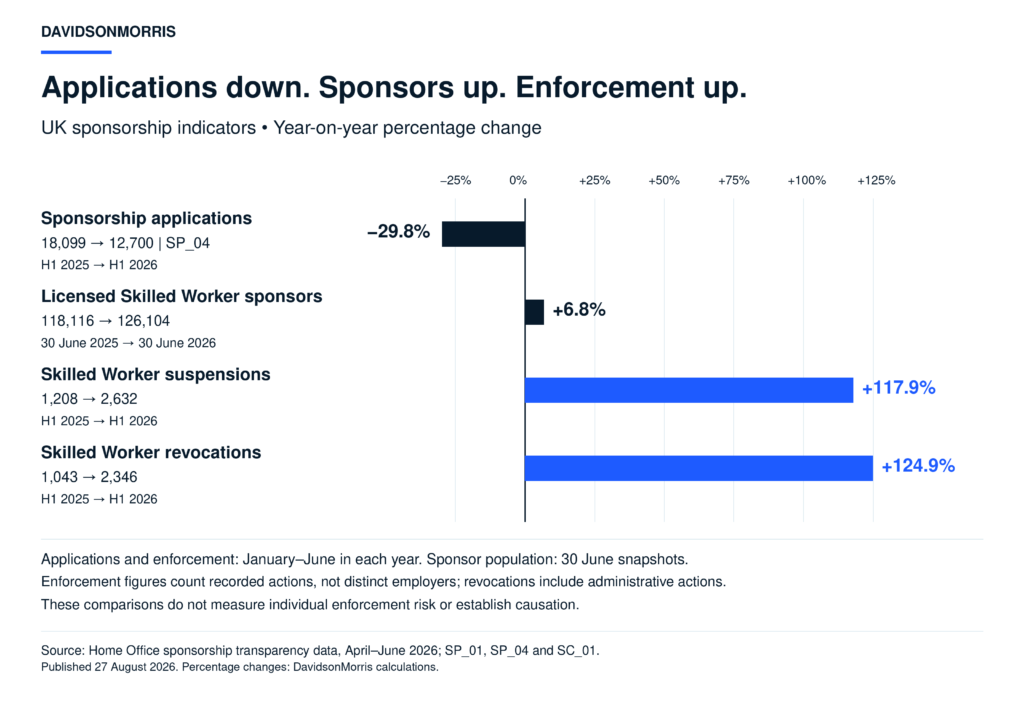
Home Office data for the first half of 2026 records 2,632 Skilled Worker sponsor licence suspensions and 2,346 revocations, representing year-on-year increases of approximately 117.9% and 124.9% respectively. Over the same period, recorded sponsorship application activity fell by around 30%, while the number of organisations licensed under the Skilled Worker category increased by 6.8% between June 2025 and June 2026.1
These measures describe different parts of the sponsorship system. Enforcement figures record administrative actions, application data measures activity over a reporting period and the sponsor population is measured at a particular date. They cannot be combined to calculate an individual employer’s likelihood of suspension or revocation.
The figures nevertheless show a material change in the operating environment for licensed sponsors. Employers are managing sponsorship within a system characterised by substantially higher recorded enforcement activity, changing salary and workforce compliance requirements and tighter operational controls around Sponsor Management System access.
This annual report examines the latest Home Office sponsorship data, the principal legal and operational changes affecting UK sponsors during 2026 and the compliance priorities employers should carry into 2027. Statistical analysis covers the period to 30 June 2026, while legal and policy developments are reviewed through 20 October 2026.
Section A: Executive Summary: UK Sponsor Licensing in 2026
The DavidsonMorris UK Sponsor Licence Annual Report 2026 brings together official Home Office sponsorship transparency statistics, immigration policy developments and sponsor guidance to assess how the UK’s employer sponsorship system changed during 2026.
The central finding is a clear divergence between three key measures. Sponsorship application activity fell substantially, the licensed Skilled Worker sponsor population continued to grow and recorded Home Office enforcement actions increased sharply.
For employers, these trends reinforce the importance of treating a sponsor licence as an ongoing regulatory responsibility. Holding sponsorship permission requires continuing compliance with the applicable sponsor duties, accurate administration and effective governance throughout the life of the licence.2
1. Five Key Findings from the 2026 Sponsor Licence Data
1. Skilled Worker sponsor licence revocations increased by approximately 125%.
The Home Office recorded 2,346 Skilled Worker sponsor licence revocations between January and June 2026, compared with 1,043 during the equivalent period in 2025. This represents an increase of approximately 124.9%.
The longer-term comparison is also significant. The Home Office recorded 167 Skilled Worker revocations during the first half of 2023, making the H1 2026 total approximately fourteen times higher.
These are recorded revocation actions, not necessarily distinct employers found to have breached their sponsor duties. The published series includes administrative revocations and does not provide a complete breakdown of the grounds for every action.
2. Skilled Worker sponsor licence suspensions increased by approximately 118%.
The Home Office recorded 2,632 Skilled Worker sponsor licence suspensions during the first six months of 2026, compared with 1,208 during the corresponding period in 2025, an increase of approximately 117.9%.
A suspended sponsor cannot assign any Certificates of Sponsorship while the suspension remains in effect, although suspension does not necessarily result in permanent loss of the licence.
The quarterly figures also show that enforcement did not rise continuously throughout 2026. Recorded suspensions and revocations fell substantially between Q1 and Q2, so the evidence supports a significant year-on-year increase in first-half enforcement activity rather than a continuously accelerating trend.
3. Sponsorship application activity declined by approximately 30%.
The Home Office SP_04 application-processing dataset recorded 12,700 sponsorship applications during January to June 2026, compared with 18,099 during the equivalent period in 2025, a reduction of approximately 29.8%.
A separate Home Office series, SP_02, recorded 12,701 applications in H1 2026 compared with 18,031 in H1 2025, a reduction of approximately 29.6%.
The two datasets use different reporting definitions and should not be treated as interchangeable. SP_04 includes activity associated with existing sponsors, while both totals include Student/Study and mixed-route categories. The figures therefore do not represent a simple count of businesses applying for their first work sponsor licence.
Reported grants for the H1 2026 receipt cohorts also declined, but some applications remained outstanding in the published extract. The available figures therefore do not establish the eventual approval rate for those cohorts.
4. The licensed Skilled Worker sponsor population continued to grow.
At 30 June 2026, the Home Office recorded 126,104 organisations licensed under the Skilled Worker sponsorship category.
This compared with 118,116 at 30 June 2025, an increase of 7,988 organisations, or approximately 6.8%. The population also increased from 123,911 at the end of December 2025.
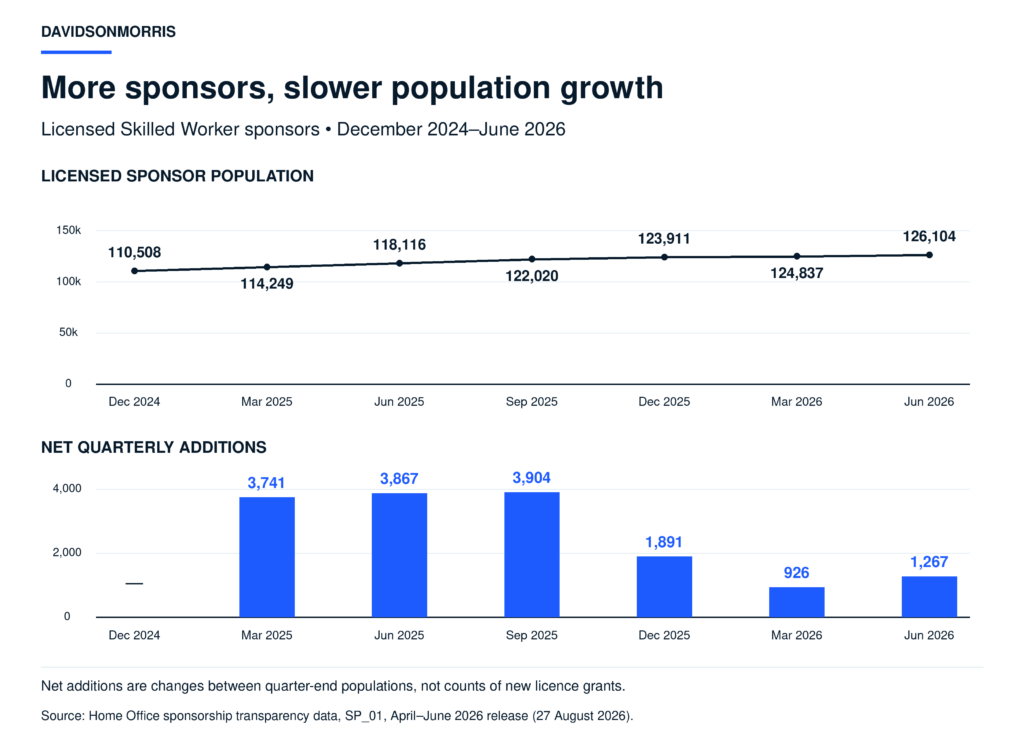
The rate of net quarterly growth was, however, lower than during much of 2025. The sponsor population continued to expand, but more slowly.
5. Enforcement activity increased substantially relative to the size of the licensed sponsor population.
The recorded Skilled Worker sponsor population increased by approximately 6.8% between June 2025 and June 2026. Over the corresponding first-half periods, recorded suspensions increased by approximately 117.9% and revocations by approximately 124.9%.
Recorded enforcement activity therefore increased considerably faster than the size of the licensed sponsor population.
The figures do not establish the probability that an individual sponsor will be suspended or revoked. Enforcement counts are period-based administrative measures, while the sponsor population is measured at a particular reporting date. The report therefore treats the comparison as evidence of the scale of recorded enforcement activity, not as an individual employer risk calculation.
2. UK Sponsor Licence Statistics 2026: Headline Dashboard
The following table summarises the principal findings from the Home Office sponsorship transparency data analysed for this report.
| Measure | H1 2025 | H1 2026 | Change |
|---|---|---|---|
| Skilled Worker sponsor licence suspensions | 1,208 | 2,632 | +117.9% |
| Skilled Worker sponsor licence revocations | 1,043 | 2,346 | +124.9% |
| Sponsorship applications received (SP_04) | 18,099 | 12,700 | -29.8% |
| Applications recorded in SP_02 | 18,031 | 12,701 | -29.6% |
| Grants reported for H1 receipt cohorts (SP_04) | 9,681 | 5,391 | -44.3% |
| Skilled Worker licensed sponsor population (30 June) | 118,116 | 126,104 | +6.8% |
Source: Home Office, UK Visas and Immigration Transparency Data, sponsorship tables SP_01, SP_02, SP_04 and SC_01, April to June 2026 release, published 27 August 2026. Percentage changes calculated by DavidsonMorris. H1 refers to 1 January to 30 June. The sponsor population comparison uses the position at 30 June in each year.
The dashboard brings together measures that answer different questions. Sponsor population data records organisations licensed at a particular date. Application figures measure administrative activity during a period. Suspension and revocation statistics record Home Office actions.
A licence may be suspended and subsequently revoked, while an organisation may also appear under more than one sponsorship category. The figures cannot therefore be added together or converted directly into the proportion of employers affected by enforcement.
3. The Central Finding: Applications Down, Sponsor Population Up, Enforcement Up
The defining finding of the 2026 report is the divergence between application activity, sponsor population growth and enforcement.
Sponsorship application activity was approximately 30% lower during the first half of 2026 than during the same period in 2025. The recorded Skilled Worker sponsor population nevertheless continued to increase, while recorded suspensions and revocations more than doubled year on year.
The movements are not contradictory because the three datasets measure different events. Existing sponsors can remain licensed without submitting new applications, while enforcement actions can affect organisations already within the sponsorship system.
The scale of the divergence is nevertheless significant. It shows that the development of UK sponsorship cannot be assessed from licence numbers or application volumes alone.
The available data do not establish that increased enforcement caused the decline in applications or identify a single reason for the continued growth in the sponsor population. Immigration eligibility, sponsorship costs, employer recruitment needs and Home Office operational activity may all be relevant, but the published statistics do not isolate their individual effects.
Section E examines this relationship in detail, including the limits of comparing enforcement actions with a point-in-time sponsor population.
4. Significant Sponsor Licence and Immigration Changes During 2026
The statistical changes occurred alongside important developments in the legal and operational framework governing sponsored employment.
Amendments to the Immigration Rules3 affected areas including Skilled Worker salary compliance, specified occupational arrangements and certain Global Business Mobility routes.
For Skilled Worker sponsors, new salary provisions introduced pay-period going-rate tests and specified assessment periods for the annual salary requirement, subject to permitted variations.4 The changes increase the importance of coordination between sponsorship, HR and payroll.
The Home Office also changed access arrangements for the Sponsor Management System. Multi-factor authentication began rolling out from September 2026 and the appointment of new Level 2 Users ended on 9 September 2026.5 Existing Level 2 User arrangements must be addressed by 8 March 2027.
Changes to the right to work framework from October 2026 also extended relevant checking responsibilities to specified working arrangements beyond conventional employment relationships.6
Other measures announced during 2026 have commencement dates later in the year or during 2027. Section F examines the principal employer-facing changes and the transitional provisions that determine when they apply.
5. What the 2026 Findings Mean for UK Employers
The main employer implication is the need for effective sponsor governance throughout the life of the licence.
The increase in recorded enforcement activity does not establish that every licensed sponsor faces the same level of exposure. It does, however, strengthen the commercial case for maintaining reliable systems capable of identifying and addressing compliance issues before they become enforcement problems.
These responsibilities extend beyond submitting a sponsor licence application or assigning Certificates of Sponsorship. They include maintaining required records, reporting relevant changes, monitoring sponsored employment and keeping sponsorship administration aligned with developments across the business.
Responsibility should also be clear. HR, payroll, recruitment, operational management and senior leadership may each hold information with immigration consequences. Fragmented ownership or dependence on one individual can create avoidable gaps in reporting and oversight.
For prospective sponsors, lower national application volumes do not change the need to satisfy the eligibility and suitability requirements or demonstrate that the organisation can operate a compliant sponsorship system.
Employers with existing concerns should assess the specific issue against the applicable sponsor guidance and evidence. Further DavidsonMorris guidance is available on sponsor licence compliance and sponsor licence suspension.
6. Research Scope, Sources and Limitations
The statistical analysis is based primarily on the Home Office sponsorship transparency data for April to June 2026, published on 27 August 2026. The principal datasets cover licensed sponsor populations, sponsorship applications, application processing and recorded enforcement actions.
Historical comparisons use equivalent reporting periods wherever possible. The report also draws on the Immigration Rules, Statements of Changes, sponsor guidance and other official government publications relevant to employer sponsorship.
DavidsonMorris has undertaken independent calculations to compare year-on-year changes and examine the relationship between different administrative measures. Those calculations are identified separately from the underlying Home Office statistics.
The analysis does not treat enforcement actions as counts of distinct employers, derive final approval rates from incomplete application cohorts or attribute national enforcement totals to particular industries without supporting evidence. It also does not extrapolate first-half 2026 statistics into a speculative full-year total.
The complete methodology, statistical definitions and limitations are set out in Section I. The underlying official statistics are available from the Home Office UK Visas and Immigration Transparency Data collection.
Section B: The UK Licensed Sponsor Population in 2026
The number of organisations holding UK sponsor licences continued to increase during the first half of 2026, despite a substantial reduction in sponsorship application activity and a marked increase in recorded Home Office enforcement actions.
According to the Home Office’s sponsorship transparency statistics, 126,104 organisations were recorded as licensed under the Skilled Worker sponsorship category at 30 June 2026.
This compared with 118,116 at 30 June 2025 and 123,911 at the end of December 2025.
The figures demonstrate continued growth in the licensed sponsor population, although the rate of quarterly expansion slowed during the first half of 2026.
The distinction between the size of the licensed population and the volume of new sponsorship activity is important. An organisation may continue to hold a sponsor licence without assigning Certificates of Sponsorship during a particular reporting period. Equally, an organisation may hold permission under more than one sponsorship category.
The licensed sponsor population therefore provides a measure of the organisations recorded as authorised to sponsor workers under specified categories, rather than a direct measure of the number of overseas workers recruited or the number of sponsorship transactions undertaken.
1. How Many Skilled Worker Sponsors Were Licensed in 2026?
At 30 June 2026, the Home Office recorded 126,104 organisations holding a Skilled Worker sponsor licence.
This represented an increase of 7,988 organisations compared with June 2025, equivalent to approximately 6.8% year-on-year growth.
Compared with the end of December 2025, the recorded population increased by 2,193 organisations during the first six months of 2026, equivalent to approximately 1.8%.
The continued expansion is significant because it occurred during a period in which recorded sponsor licence suspensions and revocations increased substantially.
However, the increase in the total licensed population does not establish that enforcement actions had little impact on affected employers. The aggregate population measure cannot show the operational or financial consequences experienced by individual organisations whose licences were suspended or revoked.
Nor does it demonstrate that all licensed sponsors were actively recruiting overseas workers.
The population statistic should instead be understood as a measure of the overall scale of the Skilled Worker licensing system at the reporting date.
2. Skilled Worker Sponsor Population: Quarterly Trends, 2024–2026
The Home Office’s SP_01 dataset provides a quarterly record of the number of organisations licensed under the Skilled Worker sponsorship category.
The following table shows the development of the population from December 2024 to June 2026.
| Reporting date | Licensed Skilled Worker sponsors | Net quarterly change | Quarterly growth |
|---|---|---|---|
| 31 December 2024 | 110,508 | — | — |
| 31 March 2025 | 114,249 | +3,741 | +3.4% |
| 30 June 2025 | 118,116 | +3,867 | +3.4% |
| 30 September 2025 | 122,020 | +3,904 | +3.3% |
| 31 December 2025 | 123,911 | +1,891 | +1.5% |
| 31 March 2026 | 124,837 | +926 | +0.7% |
| 30 June 2026 | 126,104 | +1,267 | +1.0% |
Source: Home Office, sponsorship transparency data, table SP_01, April to June 2026 release. Quarterly changes and growth rates calculated by DavidsonMorris from the published end-of-quarter population figures. Figures are rounded to one decimal place where appropriate.
The table reveals three developments.
First, the licensed Skilled Worker sponsor population increased in every quarter shown.
Second, the pace of growth slowed significantly after September 2025. During the first three quarters of 2025, the population increased by approximately 3,700 to 3,900 organisations per quarter. By the first quarter of 2026, the net quarterly increase had fallen to 926.
Third, quarterly growth recovered modestly in the second quarter of 2026, when the recorded population increased by 1,267 organisations. Nevertheless, this remained substantially below the quarterly increases recorded during the first three quarters of 2025.
The figures therefore support two conclusions that should be considered together: the licensed sponsor population continued to expand, but the pace of that expansion was markedly slower than during the earlier period.
The data do not, by themselves, establish why the rate of growth changed.
3. The Slowdown in Net Sponsor Population Growth
Between December 2024 and September 2025, the recorded Skilled Worker sponsor population increased from 110,508 to 122,020.
This represented a net increase of 11,512 organisations over nine months.
Between September 2025 and June 2026, the population increased from 122,020 to 126,104, a net increase of 4,084 organisations over the following nine months.
The comparison demonstrates that net growth during the later period was substantially lower than during the earlier period.
This slowdown is consistent with the reduction in sponsorship application activity identified in Section C, although the published aggregate data do not establish a direct causal relationship between the two trends.
Several factors may influence the net size of the licensed sponsor population.
These include the granting of new licences, the removal of licences following revocation or surrender, administrative changes to licence records and other movements affecting the published population.
However, the available tables do not provide a complete reconciliation of all additions and removals within the Skilled Worker sponsor population.
It would therefore be inappropriate to attribute the slowdown to any single cause or to calculate the precise contribution of enforcement actions to the observed net change.
Net population growth is the result of movements into and out of the recorded population: it is not equivalent to the number of licences granted during the same period.
4. Skilled Worker and Temporary Worker Sponsor Populations
The Home Office also reports the population of organisations licensed under Temporary Worker sponsorship categories.
At 30 June 2026, the recorded Temporary Worker sponsor population was 4,944, compared with 4,758 at 30 June 2025.
This represented an increase of 186 organisations, equivalent to approximately 3.9%.
The Temporary Worker population is considerably smaller than the Skilled Worker population, reflecting the different scope and purpose of the sponsorship categories.
| Sponsorship category | 30 June 2025 | 30 June 2026 | Year-on-year change |
|---|---|---|---|
| Skilled Worker | 118,116 | 126,104 | +6.8% |
| Temporary Worker | 4,758 | 4,944 | +3.9% |
Source: Home Office, sponsorship transparency data, table SP_01, April to June 2026 release. Percentage changes calculated by DavidsonMorris.
The two categories should not simply be added together to produce a national total of distinct licensed employers.
An organisation may be authorised under more than one sponsorship category and may consequently appear in multiple category-level counts.
Adding those counts without adjusting for overlap would risk overstating the number of unique organisations holding sponsorship permission.
For the same reason, comparisons between sponsorship categories should recognise differences in route eligibility, licence structure and the characteristics of the employers using them.
5. Does a Sponsor Licence Mean an Employer Is Actively Sponsoring Workers?
Holding a sponsor licence does not necessarily mean that an organisation is actively recruiting or employing sponsored workers at the reporting date.
A sponsor licence authorises an eligible organisation to sponsor workers under the categories for which it holds permission, subject to the applicable Immigration Rules and sponsor guidance.
An employer may retain its licence while having no immediate recruitment requirement, or may use sponsorship intermittently according to business needs.
Other organisations may assign Certificates of Sponsorship regularly as part of their recruitment and workforce planning arrangements.
The Home Office’s licensed sponsor population statistics do not distinguish between these different patterns of activity.
Consequently, the figure of 126,104 Skilled Worker sponsors should not be interpreted as evidence that 126,104 employers assigned Certificates of Sponsorship or recruited overseas workers during the first half of 2026.
Nor should it be treated as a measure of the number of sponsored employees working in the UK.
Those questions require different statistical measures, including relevant Certificate of Sponsorship and immigration application data.
For employers, this distinction also reinforces an important compliance principle.
Organisations that retain sponsor licences must continue to meet the applicable sponsor requirements even during periods when they are not actively assigning Certificates of Sponsorship.
A reduction in recruitment activity does not, by itself, remove the responsibilities associated with holding a licence.
6. What the Sponsor Population Figures Reveal About the UK Labour Market
The continued growth in the Skilled Worker sponsor population demonstrates that employer sponsorship remained an established component of the UK’s immigration system during the first half of 2026.
However, the statistics should not be treated as a direct measure of labour market demand.
The number of licensed sponsors is influenced by regulatory eligibility, business decisions and administrative changes, as well as recruitment requirements.
A growing sponsor population may coexist with declining sponsorship application activity, lower numbers of Certificates of Sponsorship being assigned or changes in the occupational composition of overseas recruitment.
Similarly, the total number of organisations holding licences does not indicate the number of vacancies they are seeking to fill or the proportion of their workforce recruited internationally.
The slowdown in net sponsor population growth may be relevant when considered alongside changes to Skilled Worker eligibility and sponsorship costs introduced during 2025 and the developments examined in this report.
Nevertheless, the available population data do not establish that those policy changes caused the observed slowdown.
The most defensible interpretation is that the licensed sponsor population continued to grow during 2026, but at a materially slower rate than during the earlier quarters examined.
This finding provides an important context for the application and enforcement statistics discussed in the following sections.
7. Employer Implications: Licence Ownership, Governance and Continuing Duties
For organisations already holding sponsor licences, the population figures reinforce the distinction between obtaining permission to sponsor workers and maintaining that permission over time.
A sponsor licence is an ongoing regulatory authorisation rather than a one-off approval that can be left unattended after an application has been granted.
Licensed sponsors must continue to comply with their applicable duties, including record-keeping, reporting relevant changes and maintaining suitable arrangements for the administration of sponsorship.
The precise obligations depend on the sponsorship category, the circumstances of the organisation and the workers being sponsored.
Employers should ensure that their sponsor licence arrangements remain appropriate as the business changes.
Changes in ownership, corporate structure, trading activities, key personnel or operational arrangements may affect the information that must be reported to the Home Office or the continuing suitability of the licence.
Employers should also review whether access to the Sponsor Management System remains appropriately controlled and whether the individuals responsible for sponsorship have the necessary authority and knowledge to perform their roles.
These governance considerations are particularly relevant in light of the operational changes introduced during 2026 and the increase in recorded enforcement actions.
For organisations considering their first sponsor licence application, the size of the licensed population should not be interpreted as evidence that an application will necessarily succeed.
Each application must satisfy the applicable eligibility and suitability requirements.
Prospective sponsors should therefore assess their ability to meet the ongoing obligations of sponsorship alongside their immediate recruitment requirements.
Further guidance is available in the DavidsonMorris articles on UK sponsor licences, sponsor licence applications and sponsor licence duties.
8. DavidsonMorris Assessment: A Larger but More Slowly Expanding Sponsor Population
The Home Office data establish that the Skilled Worker sponsor population was larger in June 2026 than at any of the earlier quarterly reporting dates examined in this section.
At the same time, net quarterly growth was considerably slower than during the first three quarters of 2025.
This combination is important to the wider findings of the report.
The licensed population continued to expand even as sponsorship application activity declined and recorded enforcement actions increased sharply.
These developments should not be treated as contradictory.
They represent different measures of a system in which organisations may obtain, retain, change or lose sponsorship permission at different times.
What distinguishes 2026 is the scale of the divergence between those measures.
For employers, the significance lies less in the absolute number of licensed sponsors than in the continuing importance of maintaining effective sponsorship governance within a regulatory environment characterised by substantial enforcement activity and evolving operational requirements.
Section C examines the reduction in sponsorship application activity and the available evidence concerning application outcomes and processing times.
Section D then considers Home Office enforcement actions, including the historical increase in recorded suspensions and revocations.
Together, these datasets provide the basis for the original DavidsonMorris analysis presented in Section E.
Section C: Sponsor Licence Applications, Decisions and Processing Times in 2026
Sponsorship application activity declined substantially during the first half of 2026 compared with the equivalent period in 2025.
The Home Office’s sponsorship transparency statistics show a reduction of approximately 30% in recorded applications received, alongside a decline in the number of grants, refusals, rejections and withdrawals recorded in the application-processing dataset.
These developments are important for understanding the operation of the UK sponsor licensing system. However, the published figures require careful interpretation because the Home Office reports different application measures, and applications received during a particular period are not necessarily decided during that same period.
In addition, SP_04 includes application activity associated with existing sponsors. The application totals also include Student/Study and mixed-route categories. They should therefore not automatically be treated as the number of employers applying for their first work sponsor licence.
This section examines the relevant statistics, explains their methodological limitations and considers what employers can reasonably conclude about the sponsor licence application process in 2026.
1. How Many Sponsor Licence Applications Were Made in 2026?
The Home Office’s application-processing dataset, SP_04, recorded 12,700 sponsorship applications received between January and June 2026.
During the corresponding period in 2025, the dataset recorded 18,099 applications.
This represents a reduction of 5,399 applications, equivalent to approximately 29.8%.
A separate Home Office dataset, SP_02, recorded 12,701 applications during the first half of 2026, compared with 18,031 during the equivalent period in 2025.
On that measure, the reduction was 5,330 applications, or approximately 29.6%.
The two series are closely aligned in their overall direction, but they have different reporting structures and should not be used interchangeably.
The SP_02 series reports applications by sponsorship route combination, while SP_04 provides information about applications received, recorded outcomes and outstanding cases.
Both series demonstrate that sponsorship application activity was substantially lower during the first six months of 2026 than during the corresponding period of 2025.
Neither comparison, however, establishes that an equivalent number of entirely new businesses entered or attempted to enter the sponsorship system.
2. Sponsor Licence Application Volumes: H1 2025 Versus H1 2026
The following table compares the two Home Office application series.
| Application measure | H1 2025 | H1 2026 | Numerical change | Percentage change |
|---|---|---|---|---|
| SP_02: applications by sponsorship route combination | 18,031 | 12,701 | -5,330 | -29.6% |
| SP_04: applications received in the processing dataset | 18,099 | 12,700 | -5,399 | -29.8% |
Source: Home Office, sponsorship transparency data, tables SP_02 and SP_04, April to June 2026 release. H1 refers to January to June. Numerical and percentage changes calculated by DavidsonMorris.
The similarity between the two percentage changes provides a consistent picture of declining application activity.
However, the difference between the series demonstrates why the precise statistical definition matters.
SP_02 is presented as a measure of new sponsor applications by route combination, with footnotes 2 and 8; footnote 8 describes the quoted figures as a count of straightforward applications. It counts applications rather than unique employer organisations and includes Student and mixed-route categories.
SP_04 carries footnote 4, which expressly includes new sponsor applications and applications linked to an existing sponsor. It reports received applications, processing outcomes and outstanding cases by receipt quarter, including Study and mixed-route categories.
The most defensible headline conclusion is consequently that recorded sponsorship application activity fell by approximately 30%, rather than that the number of first-time employer applicants necessarily fell by the same proportion.
3. How Many Sponsor Licence Applications Were Granted in 2026?
The Home Office’s SP_04 dataset reported 5,391 grants for sponsorship applications received during the first half of 2026.
This compared with 9,681 grants reported for applications received during the corresponding period in 2025.
The numerical reduction was 4,290, equivalent to approximately 44.3%.
Although this is a substantial difference, it does not establish that applicants were less likely to obtain approval in 2026.
The grant figures are the outcomes reported for the relevant receipt-quarter cohorts at the dataset extract, rather than counts of decisions issued during those quarters.
An application submitted in one quarter may be decided later. In SP_04, the outcome is reported against the receipt cohort; the presence of outstanding cases means the cohort is not yet complete.
Consequently, dividing reported grants by applications received would show only the share recorded as granted at that extract, not the eventual sponsor licence approval rate for the receipt cohorts.
Nor can the decline in recorded grants be attributed solely to stricter decision-making without further evidence concerning application cohorts, processing activity and outstanding cases.
The figures establish fewer reported grants for the H1 2026 receipt cohorts at the extract. They do not establish a corresponding reduction in decisions issued during H1 or explain the change in reported outcomes.
4. Sponsor Licence Applications Refused, Rejected and Withdrawn
The SP_04 dataset also reports applications recorded as refused, rejected or withdrawn.
These categories should be distinguished because they describe different administrative outcomes.
For applications received during the first half of 2026, the Home Office reported 2,209 refusals, 2,620 rejections and 198 withdrawals in the published extract.
The corresponding figures for the first-half 2025 receipt cohorts were 3,329 refusals, 4,616 rejections and 459 withdrawals.
| Recorded outcome | H1 2025 | H1 2026 | Change |
|---|---|---|---|
| Granted | 9,681 | 5,391 | -44.3% |
| Refused | 3,329 | 2,209 | -33.6% |
| Rejected | 4,616 | 2,620 | -43.2% |
| Withdrawn | 459 | 198 | -56.9% |
Source: Home Office, sponsorship transparency data, table SP_04, April to June 2026 release. Percentage changes calculated by DavidsonMorris.
The published figures show reductions across all four recorded outcome categories.
However, the number of applications receiving a particular outcome is affected by the volume and timing of applications being processed.
A lower number of refusals, for example, does not necessarily demonstrate that the Home Office applied less stringent eligibility requirements.
Similarly, a lower number of rejections does not establish that applications were more complete or better prepared.
The published outcome labels must also be interpreted according to the Home Office’s statistical definitions and the applicable sponsor guidance.
In general, refusal and rejection are distinct administrative concepts. However, the report does not infer the precise legal reason for every recorded outcome from the statistical category alone.
For employers, the practical distinction remains important.
An unsuccessful sponsor licence application may raise issues concerning eligibility, suitability, supporting evidence, procedural requirements or the organisation’s ability to meet its sponsorship responsibilities.
The consequences of an unsuccessful application, including whether a further application can be made and whether any restriction applies, depend on the relevant circumstances and Home Office rules.
Employers should therefore identify the actual grounds of the decision rather than assume that every refusal or rejection has the same legal consequences.
Further information is available in the DavidsonMorris guidance on sponsor licence refusals and sponsor licence eligibility.
5. Why the Published Figures Do Not Establish an Approval Rate
A sponsor licence approval rate would require a clearly defined group of applications and information about the final outcomes of those applications.
The SP_04 figures report applications received in each quarter and their processing outcomes and outstanding cases at the dataset extract.
These are receipt-quarter cohorts, some of which still contain outstanding applications.
For example, an application received in June 2026 might remain outstanding at the end of the quarter and receive a decision later in the year.
If an application received in the final quarter of 2025 is granted later, its reported outcome belongs to that receipt cohort rather than becoming a new H1 2026 application.
The Home Office’s Q2 2026 extract also records substantial numbers of outstanding applications.
Within the Skilled Worker category, the relevant Q2 rows include 1,300 outstanding straightforward applications and 459 outstanding non-straightforward applications.
These outstanding cases demonstrate that not every application in the reporting system had reached a final outcome by the reporting date.
Accordingly, a calculation based simply on grants divided by applications received would combine different stages of the administrative process.
It would not measure the proportion of a particular application cohort ultimately granted.
The same limitation applies to calculations that divide refusals or rejections by applications received.
Without complete eventual outcomes for comparable receipt cohorts, the report cannot establish whether the probability of success increased or decreased between the first halves of 2025 and 2026.
Claims that the Home Office was approving a smaller proportion of sponsor licence applications in 2026 would therefore require additional evidence beyond the aggregate figures presented here.
Descriptive shares of outcomes already recorded can be calculated, but must identify their denominator and treatment of rejected, withdrawn and outstanding applications. They must not be presented as the final outcome of an incomplete cohort.
6. Sponsor Licence Processing Times in 2026
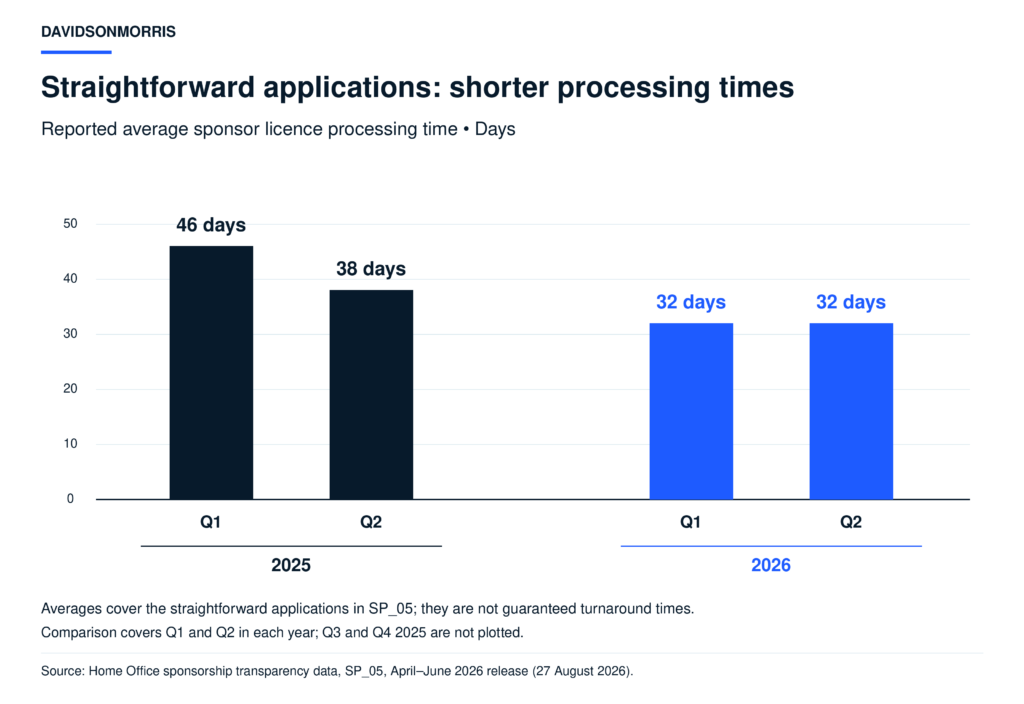
The Home Office’s SP_05 dataset provides quarterly information on sponsor licence application processing times, subject to footnote 8, which identifies the quoted figures as relating to straightforward applications.
The published figures indicate that average processing times were lower during the first half of 2026 than during the equivalent period in 2025.
In the first quarter of 2025, the reported average was 46 days, falling to 38 days in the second quarter.
During 2026, the reported average was 32 days in both the first and second quarters.
Source: Home Office, sponsorship transparency data, table SP_05, April to June 2026 release. Figures are reproduced using the whole-day precision displayed in the published table.
The Q2 comparison indicates a reduction of six days in the reported average processing time between 2025 and 2026.
The first-quarter comparison indicates a reduction of fourteen days.
These figures suggest that the average processing times recorded in the published dataset improved between the equivalent quarters.
However, an average does not establish how long every individual application took to process.
Applications may require additional enquiries, supporting documents or compliance checks, while the complexity of the case and the Home Office’s operational circumstances can affect the time required to reach a decision.
The published averages should therefore not be treated as guaranteed processing periods.
Nor do they establish that every category of sponsor licence application experienced the same improvement.
7. Does Lower Application Volume Mean Faster Sponsor Licence Decisions?
The Home Office data show that application activity declined during the first half of 2026 and that reported average processing times were lower than during the corresponding quarters of 2025.
However, the coexistence of these trends does not establish that the reduction in application volumes caused the improvement in processing times.
Processing performance may be influenced by staffing, operational priorities, application complexity, the allocation of cases and changes in administrative procedures.
The published aggregate statistics do not isolate the effect of each factor.
It would therefore be inappropriate to conclude that the Home Office processed applications faster solely because fewer applications were received.
The evidence supports the narrower conclusion that lower application activity and improved reported average processing times occurred during the same period.
For employers planning recruitment, the distinction is important.
Historical processing averages may assist with understanding recent administrative performance, but they should not be used as the sole basis for setting recruitment start dates or making contractual commitments.
Employers should allow for the possibility of additional enquiries, compliance visits and other circumstances that may delay a particular application.
8. Sponsor Licence Priority Services and Application Planning
The Home Office operates a sponsor licence pre-licence priority service for certain eligible applications, subject to availability and the applicable conditions.
The service is intended to provide a faster consideration process for eligible applications, but it does not guarantee that an application will be granted.
Priority consideration also does not remove the requirement to satisfy the applicable eligibility and suitability criteria.
An application may still require further information or be subject to compliance enquiries.
Employers should distinguish between the administrative speed of a decision and the substantive merits of an application.
Where recruitment depends on obtaining a sponsor licence, planning should take account of the time required to prepare the application, assemble supporting documents, respond to Home Office enquiries and complete subsequent sponsorship steps.
These may include obtaining an appropriate Certificate of Sponsorship allocation, assigning a Certificate of Sponsorship and allowing sufficient time for the worker’s immigration application.
Where an organisation is considering priority processing, it should verify the current eligibility rules, service availability and fee before making operational commitments.
Further information is available in the DavidsonMorris guidance on sponsor licence processing times and sponsor licence priority services.
9. What the Decline in Applications Means for Employers
The reduction in sponsorship application activity is one of the principal findings of the 2026 report.
However, employers should distinguish the national statistical trend from the requirements applicable to their own applications.
A decline in application volumes does not remove the need to demonstrate that an organisation is eligible to hold a sponsor licence.
Applicants must still satisfy the applicable requirements concerning their business operations, the suitability of the organisation and the arrangements in place to comply with sponsorship duties.
The Home Office may examine whether the organisation is capable of meeting its responsibilities and whether the relevant sponsorship arrangements are genuine and compliant.
Supporting evidence should be accurate, consistent and appropriate to the applicant’s circumstances.
Employers should also consider the wider costs and operational implications of sponsorship.
These may include sponsor licence application fees, Certificate of Sponsorship fees, the Immigration Skills Charge where applicable, immigration application costs and the administrative resources required to maintain compliance.
Changes to immigration eligibility and sponsorship costs may affect an employer’s assessment of whether sponsorship is appropriate for a particular role.
Nevertheless, the published application figures do not establish how much of the national decline can be attributed to any particular cost or policy change.
For organisations already holding a licence, the application statistics are also relevant when considering changes to existing sponsorship arrangements.
Some Home Office application activity concerns existing sponsors rather than businesses applying for a licence for the first time.
Employers should therefore identify the specific administrative process required for the action they intend to undertake, rather than assume that all sponsor-related applications are governed by identical requirements.
10. DavidsonMorris Assessment: Lower Application Activity, but No Proven Decline in Approval Prospects
The Home Office’s published statistics establish that sponsorship application activity fell by approximately 30% during the first half of 2026 compared with the equivalent period in 2025.
They also establish that fewer grants, refusals, rejections and withdrawals were recorded in the application-processing dataset.
At the same time, reported average processing times were lower than during the corresponding quarters of 2025.
These findings describe lower application receipts, fewer completed outcomes reported for the first-half receipt cohorts in the published extract and shorter reported average processing times for the covered straightforward applications. They do not measure a fall in decisions issued during H1.
They do not establish that the Home Office became more or less likely to approve an individual application.
Nor do they identify a single cause of the decline in applications.
The distinction between application activity and the population of licensed sponsors is particularly important.
As Section B demonstrates, the recorded Skilled Worker sponsor population continued to increase during the first half of 2026, notwithstanding the decline in applications.
The two trends can coexist because application volumes and the licensed sponsor population measure different aspects of the system.
The application figures also provide context for the enforcement statistics examined in Section D.
While recorded sponsorship application activity declined, the number of recorded Skilled Worker sponsor licence suspensions and revocations increased substantially.
The relationship between these trends is examined in Section E, where DavidsonMorris considers the divergence between application activity, the licensed sponsor population and Home Office enforcement.
Section D: Home Office Sponsor Licence Enforcement in 2026
Home Office sponsor licence enforcement activity increased substantially during the first half of 2026, with recorded Skilled Worker licence suspensions and revocations more than doubling compared with the equivalent period in 2025.
The latest sponsorship transparency statistics record 2,632 Skilled Worker sponsor licence suspensions and 2,346 revocations between January and June 2026.
These figures represent increases of approximately 117.9% and 124.9% respectively compared with the first half of 2025.
The scale of the increase is particularly notable when viewed against the longer-term enforcement series. During the first half of 2023, the Home Office recorded 237 Skilled Worker suspensions and 167 revocations. By the equivalent period in 2026, both measures were more than ten times higher.
However, the statistics require careful interpretation.
Suspensions and revocations are different administrative actions, and the published totals do not necessarily represent distinct employers. The series also includes administrative revocations, meaning that not every recorded revocation can automatically be attributed to a finding of sponsor misconduct.
The quarterly figures reveal a further important distinction: although enforcement activity was considerably higher during the first half of 2026 than during the equivalent period in 2025, recorded actions fell substantially between the first and second quarters of 2026.
The evidence therefore supports a significant year-on-year increase in recorded enforcement activity, rather than a claim that enforcement accelerated continuously throughout 2026.
1. How Many Sponsor Licences Were Suspended in 2026?
The Home Office recorded 2,632 Skilled Worker sponsor licence suspensions during the first six months of 2026.
During the equivalent period in 2025, the recorded total was 1,208.
This represents an increase of 1,424 suspension actions, equivalent to approximately 117.9%.
The first-half 2026 total was also substantially higher than the figures recorded in earlier years.
In H1 2024, the Home Office recorded 833 Skilled Worker suspensions. In H1 2023, the figure was 237, while in H1 2022 it was 238.
The 2026 figure was therefore approximately 11.1 times the corresponding total in 2023.
A sponsor licence suspension is a significant regulatory intervention. It prevents the sponsor from assigning any Certificates of Sponsorship while the suspension remains in effect and may lead to further Home Office action.
However, suspension is not equivalent to revocation.
The Home Office may consider representations and other relevant information before determining whether the licence should be reinstated, downgraded or revoked, depending on the circumstances and applicable guidance.
For employers, suspension can create immediate operational difficulties, particularly where recruitment plans depend on assigning Certificates of Sponsorship or where existing sponsorship arrangements require urgent administrative attention.
The published statistics do not establish how many suspensions ultimately resulted in reinstatement, downgrading or revocation.
They should therefore be interpreted as recorded suspension actions, not as a count of permanently lost sponsor licences.
2. How Many Sponsor Licences Were Revoked in 2026?
The Home Office recorded 2,346 Skilled Worker sponsor licence revocations between January and June 2026.
This compared with 1,043 during the equivalent period in 2025.
The increase was 1,303 recorded revocations, equivalent to approximately 124.9%.
The historical comparison is particularly striking.
In H1 2023, the Home Office recorded 167 Skilled Worker revocations. The H1 2026 figure was approximately fourteen times higher.
Revocation is more serious than suspension because it terminates the organisation’s permission to sponsor workers under the affected licence.
For employers, the consequences may extend beyond future recruitment.
Revocation can affect existing sponsored workers, business continuity, contractual arrangements and the organisation’s ability to obtain sponsorship permission in the future.
However, the immigration consequences for individual workers depend on their circumstances and the applicable Home Office procedures. Revocation should not be described as automatically terminating every sponsored worker’s immigration permission on the date of the sponsor’s licence decision.
The published revocation statistics also require an important qualification.
The Home Office’s enforcement series includes administrative revocations, and the aggregate data do not provide a complete breakdown of the legal or administrative grounds underlying every recorded action.
It would therefore be inaccurate to describe all 2,346 recorded revocations as confirmed instances of employer non-compliance.
Nevertheless, the increase demonstrates a substantial rise in the volume of recorded licence termination actions within the Skilled Worker sponsorship system.
3. Skilled Worker Sponsor Licence Enforcement: Five-Year Comparison
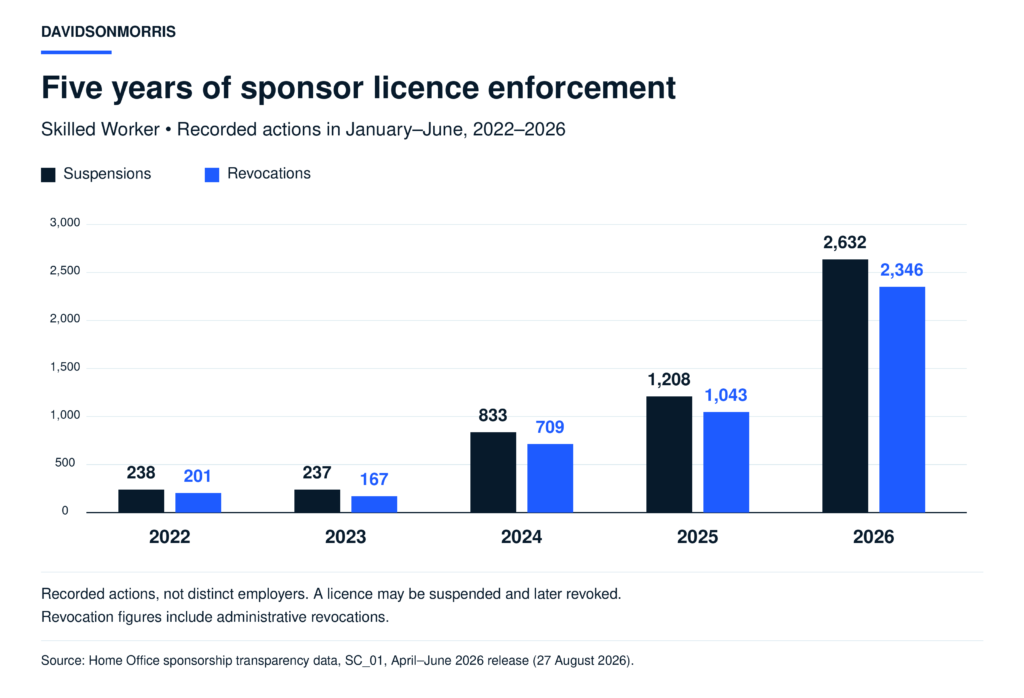
The following table compares recorded Skilled Worker suspensions and revocations during the first six months of each year from 2022 to 2026.
Using equivalent January-to-June periods avoids comparing a partial year with a complete calendar year.
Source: Home Office, sponsorship transparency data, table SC_01, April to June 2026 release. H1 refers to January to June in each year.
The series reveals a substantial change in recorded enforcement activity from 2024 onwards.
Between H1 2023 and H1 2024, recorded suspensions increased from 237 to 833, while revocations increased from 167 to 709.
Both measures increased again in H1 2025 before rising sharply in H1 2026.
Over the full comparison period, H1 suspensions increased from 238 in 2022 to 2,632 in 2026, while revocations increased from 201 to 2,346.
The figures establish that the increase in recorded enforcement activity was not confined to a single quarter or a comparison with an unusually low 2025 base.
However, the data do not establish the reasons for the increase.
Possible influences include changes in Home Office enforcement priorities, operational capacity, the size and composition of the sponsor population, regulatory requirements and administrative processes.
The published series does not isolate the contribution of these factors.
It would therefore be inappropriate to attribute the entire increase to deteriorating employer compliance or to any single policy intervention.
4. Quarterly Enforcement Trends: Q4 2025 to Q2 2026
Although the first-half annual comparison shows a substantial increase in enforcement actions, the quarterly figures reveal that recorded activity did not increase continuously during 2026.
Skilled Worker suspensions and revocations rose between the final quarter of 2025 and the first quarter of 2026, before declining significantly in the second quarter of 2026.
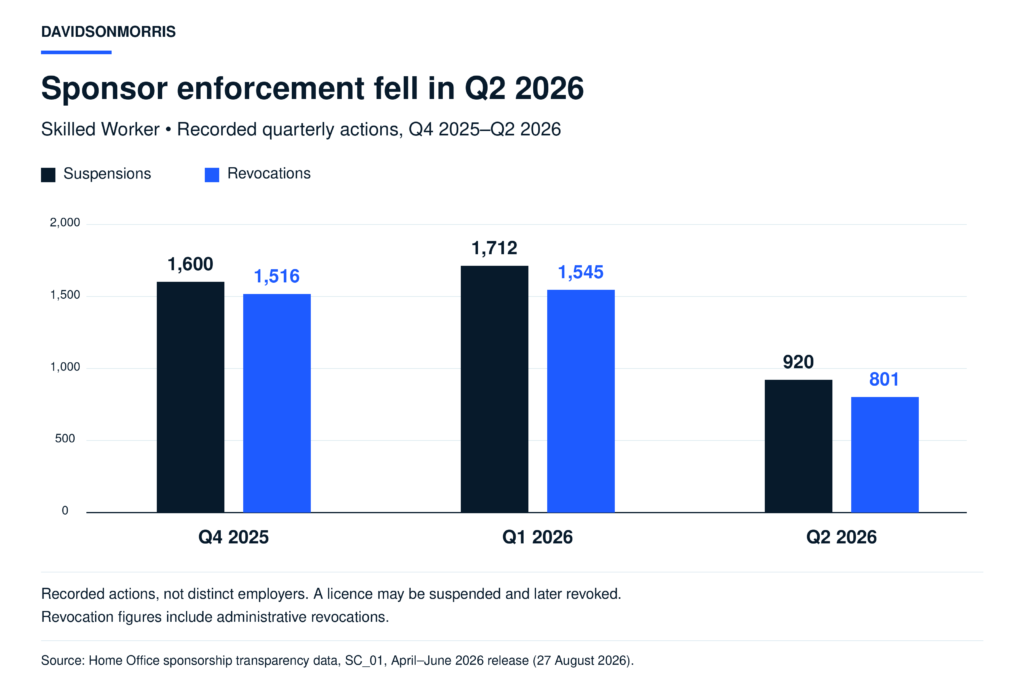
Source: Home Office, sponsorship transparency data, table SC_01, April to June 2026 release.
Between Q1 and Q2 2026, recorded suspensions declined by approximately 46.3%, from 1,712 to 920.
Recorded revocations declined by approximately 48.2%, from 1,545 to 801.
The reduction is substantial.
However, the Q2 figures remained part of a first-half total considerably above the equivalent period in 2025.
This distinction is important when interpreting the direction of enforcement activity.
The available statistics demonstrate both an elevated first-half year-on-year total and a pronounced reduction in recorded actions between the first two quarters of 2026.
They do not establish whether the Q2 reduction represents a sustained change in enforcement policy, a temporary operational fluctuation or another development.
Further quarterly data would be required to assess whether the decline continued during the remainder of 2026.
5. Temporary Worker Sponsor Licence Enforcement in 2026
The increase in recorded enforcement actions was not confined to the Skilled Worker sponsorship category.
The Home Office also recorded substantial year-on-year increases in Temporary Worker sponsor licence suspensions and revocations during the first half of 2026.
Recorded Temporary Worker suspensions increased from 48 in H1 2025 to 162 in H1 2026.
This represents an increase of approximately 237.5%.
Recorded revocations increased from 45 to 157, equivalent to approximately 248.9%.
| Temporary Worker enforcement measure | H1 2025 | H1 2026 | Change |
|---|---|---|---|
| Suspensions | 48 | 162 | +237.5% |
| Revocations | 45 | 157 | +248.9% |
Source: Home Office, sponsorship transparency data, table SC_01, April to June 2026 release. Percentage changes calculated by DavidsonMorris.
The percentage increases were larger than those recorded for Skilled Worker sponsorship, although the absolute number of Temporary Worker actions was considerably smaller.
This illustrates the importance of considering both percentage changes and underlying volumes.
A relatively small numerical increase can produce a substantial percentage change where the starting figure is low.
The Temporary Worker findings also demonstrate that the increase in recorded sponsor enforcement activity extended beyond the principal Skilled Worker category.
However, the available figures do not establish that all Temporary Worker routes experienced equivalent changes or that the same enforcement issues affected each category.
6. Suspension and Revocation: Different Legal and Operational Consequences
Sponsor licence suspension and revocation are distinct regulatory actions with different consequences.
A sponsor cannot assign any Certificates of Sponsorship while its licence is suspended, including for existing sponsored workers, while the Home Office considers the licence position.
The organisation remains subject to its applicable sponsor duties during the suspension period.
Suspension does not necessarily result in revocation, and the Home Office’s subsequent decision depends on the circumstances and relevant guidance.
Revocation terminates the organisation’s sponsorship permission under the affected licence.
The organisation can no longer rely on that licence to sponsor workers, and existing sponsored workers may become subject to further Home Office immigration action.
Under Part 3, C10.10, where a worker was not complicit in the reasons for revocation, the Home Office will normally shorten their permission to 60 calendar days; it will not normally shorten permission with no more than 60 days remaining. The 60-day period is set by the Home Office cancellation decision and does not run automatically from licence revocation. Complicit workers normally have all remaining permission cancelled. Affected workers must make any qualifying application before their permission expires or leave the UK.
The following table summarises the principal distinctions.
| Issue | Suspension | Revocation |
|---|---|---|
| Licence status | Licence remains subject to suspension | Sponsorship permission terminated |
| Assigning Certificates of Sponsorship | No CoS may be assigned during suspension | Not permitted under the revoked licence |
| Existing sponsored workers | Not automatically subject to curtailment solely because of suspension | May be affected by subsequent Home Office immigration decisions |
| Continuing sponsor duties | Applicable duties continue | Licence no longer provides sponsorship permission; other legal obligations may remain |
| Potential outcome | May be followed by reinstatement, downgrading or revocation | Licence permission has ended, subject to any applicable legal challenge or further process |
This table summarises general principles. The precise consequences depend on the relevant sponsor guidance, the grounds for action and the circumstances of the organisation and sponsored workers.
Employers receiving a suspension or revocation notice should identify the precise grounds relied upon by the Home Office and the applicable procedural requirements.
The availability and scope of representations, legal challenge or a subsequent application depend on the circumstances.
Organisations should not assume that all enforcement notices carry the same response procedure or deadline.
Further information is available in the DavidsonMorris guidance on sponsor licence suspension and sponsor licence revocation.
7. Administrative Revocations and the Interpretation of Enforcement Statistics
An important limitation of the Home Office enforcement statistics is the inclusion of administrative revocations.
The published SC_01 series does not provide a complete public breakdown distinguishing every revocation arising from substantive sponsor non-compliance from revocations recorded for administrative reasons.
Consequently, the total number of recorded revocations cannot automatically be interpreted as the number of employers found to have breached their sponsor duties.
Administrative changes may affect the recorded status of a licence for reasons that differ from enforcement following an investigation into alleged misconduct.
The distinction matters when considering the meaning of the increase in recorded revocations.
The statistics establish that the number of recorded licence termination actions increased substantially.
They do not establish the proportion attributable to particular breaches, administrative circumstances or other grounds.
For this reason, the report uses the term “recorded revocations” rather than describing the entire series as proven compliance failures.
This approach preserves the significance of the published figures without attributing legal findings that the aggregate data do not support.
8. Why Suspensions and Revocations Cannot Be Added Together as Distinct Employers
During H1 2026, the Home Office recorded 2,632 Skilled Worker suspensions and 2,346 revocations.
Adding these figures produces 4,978 recorded actions across the two categories.
However, that figure must not be described as 4,978 distinct employers subjected to enforcement.
An organisation may be suspended and subsequently revoked, meaning that its circumstances can contribute to both statistical categories.
The published enforcement series also includes certain immediate-revocation suspensions and administrative revocations.
Without record-level information, the number of unique organisations represented by the combined action totals cannot be established.
For the same reason, the suspension and revocation totals cannot be added together to calculate a national proportion of sponsors that experienced enforcement.
Such a calculation would require information about distinct organisations, the timing of actions and the relevant population at risk.
The absence of those data does not diminish the observed increase in recorded actions, but it limits the conclusions that can be drawn about individual employer exposure.
9. What Triggers Home Office Sponsor Licence Enforcement?
The Home Office has powers to take action against licensed sponsors where the applicable sponsorship requirements are not met.
Potential compliance concerns may arise in connection with sponsored workers’ roles, salary arrangements, reporting obligations, record-keeping, recruitment practices, organisational changes or the sponsor’s continuing suitability.
The circumstances may come to the Home Office’s attention through compliance visits, documentary enquiries, information obtained from other government systems or other relevant sources.
However, the national enforcement statistics examined in this report do not identify the specific trigger for each suspension or revocation.
It would therefore be inappropriate to attribute the 2026 increase to any particular category of sponsor breach without supporting evidence.
For employers, the practical priority is to understand the duties applicable to their licence and maintain systems capable of identifying relevant issues before they develop into more serious compliance problems.
This includes ensuring that sponsored employment remains consistent with the relevant immigration requirements and that material changes are reported when required.
Employers should also maintain suitable evidence of compliance and ensure that the individuals responsible for sponsorship understand their reporting and record-keeping obligations.
Where the Home Office raises concerns, the organisation should assess the specific allegations and supporting evidence rather than rely on assumptions about the general reasons for enforcement action.
Further guidance is available on sponsor licence compliance and Home Office sponsor compliance visits.
10. Does the Increase in Enforcement Mean Employers Face a Higher Risk of Revocation?
The increase in recorded suspensions and revocations is significant, but it should not be converted directly into an individual employer risk estimate.
The published statistics measure administrative actions over a reporting period.
The licensed sponsor population, by contrast, is measured at particular reporting dates.
The two measures have different statistical characteristics and cannot be combined without qualification to calculate the probability that a particular employer will experience enforcement.
The aggregate data also do not identify the characteristics of the organisations affected by enforcement actions.
They do not establish whether enforcement was concentrated among particular types of sponsors, industries, licence sizes or compliance histories.
Nor do they provide a complete breakdown of the grounds for each recorded action.
Consequently, the figures cannot demonstrate that every sponsor faced an equivalent increase in enforcement exposure.
What they do establish is that the volume of recorded Skilled Worker enforcement actions was substantially higher during the first half of 2026 than during the equivalent periods examined.
For employers, this provides a sound reason to review the adequacy of their sponsorship governance and compliance arrangements, without assuming that national enforcement statistics determine the outcome of any individual case.
11. DavidsonMorris Assessment: A Significant Change in Recorded Enforcement Activity
The Home Office’s enforcement statistics demonstrate a substantial increase in recorded Skilled Worker sponsor licence suspensions and revocations during the first half of 2026.
The increase forms part of a longer-term upward trend evident from 2024 onwards.
However, the quarterly figures also show a marked reduction in recorded enforcement actions between Q1 and Q2 2026.
These findings should be considered together.
The evidence supports the conclusion that first-half 2026 enforcement activity was substantially higher than during the corresponding period in 2025, but it does not establish that the pace of enforcement increased continuously throughout the year.
The figures also do not establish the reasons for the increase or the proportion of actions attributable to particular compliance failures.
Nevertheless, the scale of the change is material when assessed against the development of the wider sponsorship system.
As Section B demonstrates, the recorded Skilled Worker sponsor population increased by approximately 6.8% between June 2025 and June 2026.
Over the corresponding first-half periods, recorded suspensions increased by approximately 117.9% and revocations by approximately 124.9%.
At the same time, Section C identifies a reduction of approximately 30% in recorded sponsorship application activity.
These movements provide the basis for the central DavidsonMorris research finding examined in Section E: the divergence between sponsorship application activity, the licensed sponsor population and recorded Home Office enforcement actions.
The next section considers that relationship in detail, including the limitations of comparing enforcement actions with the size of the licensed sponsor population.
Section E: Enforcement–Licensing Divergence: DavidsonMorris Analysis
One of the most significant findings of the DavidsonMorris UK Sponsor Licence Annual Report 2026 emerges from examining three separate Home Office datasets together: sponsorship application activity, the licensed sponsor population and recorded sponsor licence enforcement actions.
During the first half of 2026, sponsorship application activity was approximately 30% lower than during the equivalent period in 2025.
Over the same year-on-year comparison, the recorded population of licensed Skilled Worker sponsors increased by approximately 6.8%.
Meanwhile, recorded Skilled Worker sponsor licence suspensions increased by approximately 117.9% and revocations by approximately 124.9%.
These movements demonstrate a divergence between the principal administrative measures of the sponsorship system.
The number of organisations holding Skilled Worker sponsorship permission continued to grow, even as application activity declined and recorded enforcement actions increased substantially.
The finding is important because each measure describes a different aspect of the system. Considered separately, the datasets provide information about applications, licence ownership and enforcement. Considered together, they reveal a more complex pattern of change.
However, the figures do not establish that one trend caused another. Nor do they provide sufficient information to calculate the probability that an individual sponsor will experience enforcement action.
This section examines the divergence, presents DavidsonMorris’s original calculations and distinguishes the conclusions supported by the evidence from possible explanations that remain unproven.
1. The Three Measures of the UK Sponsorship System
The Home Office publishes several statistical measures relevant to the operation of employer sponsorship.
For this analysis, three are particularly important.
1. Sponsorship application activity.
This measures applications recorded within specified reporting periods. The Home Office publishes separate application series, including SP_02 and SP_04, which have different reporting structures.
The figures include activity associated with existing sponsors and should not automatically be interpreted as the number of organisations seeking their first sponsor licence.
2. The licensed sponsor population.
This measures organisations recorded as holding sponsorship permission under a specified category at a particular reporting date.
It is a point-in-time population measure, rather than a count of applications submitted or workers sponsored during the period.
3. Sponsor licence enforcement actions.
This measures recorded suspensions and revocations within specified reporting periods.
These are administrative action counts, not necessarily counts of distinct employers. The published revocation series also includes administrative revocations.
Because the measures describe different events and reporting structures, they should not be combined as though they form a single accounting series.
Nevertheless, comparing their direction and magnitude provides useful evidence about how the sponsorship system developed during 2026.
2. The 2026 Divergence: Applications Down, Sponsors Up, Enforcement Up
The following table brings together the principal year-on-year findings.
| Measure | Comparison period | Change |
|---|---|---|
| Sponsorship applications received (SP_04) | H1 2025 to H1 2026 | -29.8% |
| Applications by route combination (SP_02) | H1 2025 to H1 2026 | -29.6% |
| Licensed Skilled Worker sponsor population | 30 June 2025 to 30 June 2026 | +6.8% |
| Skilled Worker licence suspensions | H1 2025 to H1 2026 | +117.9% |
| Skilled Worker licence revocations | H1 2025 to H1 2026 | +124.9% |
Source: Home Office, sponsorship transparency data, tables SP_01, SP_02, SP_04 and SC_01, April to June 2026 release. Percentage changes calculated by DavidsonMorris. The sponsor population is measured at 30 June in each year; the other measures cover January to June.
The table demonstrates that the different measures did not move in the same direction.
Application activity declined substantially, while the licensed sponsor population continued to expand.
Recorded enforcement actions increased considerably faster than the population of licensed Skilled Worker sponsors.
This does not mean that the three measures are directly comparable in every statistical respect.
Application activity includes different types of sponsor-related applications, while the population and enforcement measures presented here focus on Skilled Worker sponsorship.
The comparison is therefore a system-level analysis of related indicators, rather than a single-route accounting reconciliation.
Its value lies in identifying the simultaneous direction and scale of the changes, while preserving the distinctions between the underlying datasets.
3. Why the Licensed Sponsor Population Can Grow While Applications Decline
At first sight, declining application activity might appear inconsistent with a growing population of licensed sponsors.
However, the two measures describe different aspects of the sponsorship system.
Application figures record administrative activity over a period. The licensed sponsor population records the number of organisations holding permission at a particular date.
The sponsor population may therefore continue to grow where additions exceed removals, even if the volume of applications is lower than in an earlier period.
Equally, a decline in application activity does not necessarily produce an immediate decline in the population of existing licence holders.
Organisations may retain sponsorship permission for an extended period, including during periods when they are not actively recruiting overseas workers.
The Home Office data demonstrate that the Skilled Worker sponsor population increased from 118,116 in June 2025 to 126,104 in June 2026.
During the first half of 2026, the population also increased from 123,911 at the end of December 2025 to 126,104 at the end of June.
However, the quarterly data show that net growth slowed substantially compared with earlier periods.
The population increased by 926 organisations during Q1 2026 and by 1,267 during Q2 2026, compared with quarterly increases of approximately 3,700 to 3,900 during the first three quarters of 2025.
The figures therefore demonstrate continued expansion at a slower rate.
They do not provide a complete reconciliation of the individual additions and removals responsible for the net population changes.
Consequently, the report cannot establish precisely how much of the slowdown resulted from fewer licence grants, revocations, surrenders or other administrative movements.
4. Enforcement Increased Much Faster Than the Sponsor Population
The difference between sponsor population growth and recorded enforcement activity is particularly notable.
Between June 2025 and June 2026, the recorded Skilled Worker sponsor population increased by approximately 6.8%.
Over the corresponding first-half periods, recorded Skilled Worker suspensions increased by approximately 117.9% and revocations by approximately 124.9%.
The magnitude of the enforcement increases was therefore substantially greater than the growth in the licensed sponsor population.
This suggests that the increase in recorded actions cannot be explained simply by a proportionate expansion in the number of licensed sponsors.
However, the comparison does not identify the reasons for the increase.
The enforcement series may be influenced by Home Office operational activity, administrative processes, changes in the composition of the sponsor population and other factors not separately identified in the published data.
It also includes administrative revocations, meaning that the figures should not be treated as a direct measure of confirmed sponsor misconduct.
The evidence supports a substantial increase in recorded enforcement activity relative to the scale of the licensed population.
It does not establish that an equivalent increase occurred in the underlying prevalence of sponsor non-compliance.
5. Recorded Enforcement Actions per 1,000 Licensed Skilled Worker Sponsors
To provide additional context, DavidsonMorris has calculated the number of recorded first-half Skilled Worker suspension and revocation actions relative to the Skilled Worker sponsor population recorded at 30 June in each year.
The calculation expresses the recorded action count per 1,000 sponsors in the relevant June population.
It is intended as a descriptive comparison of the scale of administrative activity, not as an estimate of the probability that an individual sponsor will be suspended or revoked.
The calculation is:
Recorded H1 enforcement actions ÷ licensed Skilled Worker sponsors at 30 June × 1,000.
The results are shown below.
| Measure | H1 2025 / June 2025 | H1 2026 / June 2026 |
|---|---|---|
| Licensed Skilled Worker sponsors at 30 June | 118,116 | 126,104 |
| Recorded H1 suspensions | 1,208 | 2,632 |
| Suspension actions per 1,000 June-listed sponsors | 10.23 | 20.87 |
| Recorded H1 revocations | 1,043 | 2,346 |
| Revocation actions per 1,000 June-listed sponsors | 8.83 | 18.60 |
Source: DavidsonMorris calculations using Home Office sponsorship transparency tables SP_01 and SC_01, April to June 2026 release. Figures are rounded to two decimal places. These are descriptive action-to-population comparisons, not incidence rates or individual sponsor risk estimates.
The calculation shows that recorded suspension actions increased from approximately 10.23 to 20.87 per 1,000 June-listed Skilled Worker sponsors.
Recorded revocations increased from approximately 8.83 to 18.60 per 1,000.
The comparison provides further evidence that recorded enforcement activity increased substantially relative to the size of the licensed sponsor population.
However, the limitations of the calculation are significant.
The numerator records actions over six months, while the denominator is a point-in-time population measured at the end of that period.
The enforcement figures do not necessarily represent distinct organisations, and the same organisation may contribute to both suspension and revocation totals.
The published data also include administrative revocations and do not identify all movements into and out of the licensed sponsor population during the period.
Accordingly, the figures must not be interpreted as showing that 20.87 in every 1,000 sponsors were suspended, or that 18.60 in every 1,000 sponsors were revoked.
They show the number of recorded actions relative to the June-listed population under the stated calculation.
The distinction is essential to the integrity of the analysis.
6. The Quarterly Data Complicate the Enforcement Narrative
The substantial year-on-year increase in recorded enforcement activity does not mean that enforcement rose continuously throughout 2026.
As Section D demonstrates, recorded Skilled Worker suspensions declined from 1,712 in Q1 2026 to 920 in Q2.
Recorded revocations declined from 1,545 to 801 over the same period.
These represent quarterly reductions of approximately 46.3% and 48.2% respectively.
The figures demonstrate that the first-half total was heavily influenced by the particularly high number of actions recorded during the first quarter.
The quarterly pattern matters because it prevents an overly simplified interpretation of the annual comparison.
It would be inaccurate to describe the available evidence as demonstrating a continuously accelerating enforcement campaign during 2026.
The more precise conclusion is that recorded enforcement activity was substantially higher during H1 2026 than during H1 2025, while falling sharply between the first two quarters of 2026.
The available data do not establish whether the Q2 reduction was temporary or represented the beginning of a sustained change.
Additional quarterly releases would be required to assess the subsequent direction of enforcement activity.
7. Can the Decline in Applications Be Attributed to Increased Enforcement?
The simultaneous decline in sponsorship application activity and increase in recorded enforcement actions raises an important question: did heightened enforcement discourage employers from seeking sponsorship permission?
The published aggregate data do not establish that causal relationship.
The reduction in application activity may reflect several influences, including changes to immigration eligibility, the cost of sponsorship, recruitment requirements, employer confidence and the wider economic environment.
Changes introduced during 2025, including restrictions affecting Skilled Worker eligibility and overseas recruitment into adult social care, may also be relevant to the broader context in which employers made recruitment decisions during 2026.
However, the datasets examined in this report do not identify employers’ reasons for submitting or not submitting applications.
Nor do they establish how many prospective applicants changed their behaviour specifically because of Home Office enforcement activity.
It would therefore be inappropriate to conclude that the decline in applications was caused by increased enforcement.
The evidence supports the narrower finding that application activity declined while recorded enforcement actions increased.
Further research, including employer-level evidence or reliable survey data, would be required to assess whether enforcement expectations influenced application behaviour.
8. Does the Divergence Indicate a More Restrictive Sponsorship System?
The divergence between application activity, sponsor population growth and enforcement may be consistent with a sponsorship system operating under greater regulatory constraint.
However, the term “more restrictive” can refer to several different developments.
It may describe changes to immigration eligibility, higher sponsorship costs, more demanding application requirements, increased enforcement activity or reduced access to particular immigration routes.
These developments should not be treated as interchangeable.
The 2026 statistics establish substantial increases in recorded enforcement actions and a reduction in application activity.
They do not establish that the Home Office applied a higher refusal threshold to individual sponsor licence applications.
Nor do they demonstrate that the underlying rate of sponsor non-compliance increased by the same proportion as recorded enforcement actions.
The wider regulatory environment also reflects policy changes introduced during 2025 and developments implemented or announced during 2026.
Section F examines those changes separately to avoid attributing statistical movements to legal developments without adequate evidence.
The most defensible conclusion is that employers operated within a sponsorship system characterised by substantial recorded enforcement activity, changing eligibility and operational requirements, and slower growth in the licensed sponsor population.
Whether those developments collectively represent a more restrictive system depends on the specific measure being considered.
9. What the Divergence Means for Employer Sponsorship Strategy
For employers, the principal significance of the divergence is that sponsorship planning should not focus exclusively on obtaining a licence or assessing the availability of overseas workers.
The evidence reinforces the importance of considering sponsorship as an ongoing regulatory responsibility.
Organisations seeking a licence should assess their eligibility, recruitment requirements and ability to maintain compliant sponsorship arrangements.
Existing sponsors should ensure that their governance systems remain effective as the organisation changes and as Home Office requirements develop.
The increase in recorded enforcement actions does not justify assuming that every sponsor faces an identical probability of suspension or revocation.
However, it provides a sound basis for reviewing whether the organisation has appropriate arrangements for identifying and addressing compliance issues.
Such arrangements may include clear accountability for sponsorship, reliable payroll and HR records, timely reporting of relevant changes, appropriate Sponsor Management System access controls and periodic internal compliance reviews.
Employers should also ensure that sponsorship considerations are incorporated into wider business decisions.
Corporate transactions, restructurings, changes in ownership, changes to sponsored roles and workforce reorganisations may create immigration compliance implications requiring specific attention.
Where concerns arise, the organisation should assess the applicable rules and guidance rather than rely on general assumptions about enforcement trends.
Further DavidsonMorris guidance is available on sponsor licence compliance, sponsor licence audits and Sponsor Management System administration.
10. DavidsonMorris Conclusion: The Defining Sponsorship Trend of 2026
The available Home Office statistics reveal a notable divergence in the development of the UK sponsorship system during the first half of 2026.
Sponsorship application activity declined by approximately 30% compared with the equivalent period in 2025.
The recorded Skilled Worker sponsor population nevertheless increased by approximately 6.8% between June 2025 and June 2026.
Over the corresponding first-half periods, recorded Skilled Worker suspensions increased by approximately 117.9% and revocations by approximately 124.9%.
These figures establish that the principal measures of application activity, licence ownership and enforcement moved in materially different directions.
The original DavidsonMorris calculations further demonstrate that recorded enforcement actions increased substantially relative to the size of the June-listed Skilled Worker sponsor population.
However, those calculations are descriptive comparisons rather than individual sponsor risk estimates.
The published evidence does not establish a direct causal relationship between declining applications and increasing enforcement, nor does it identify the reasons for every recorded enforcement action.
The central finding is therefore not that a particular proportion of employers became non-compliant or that enforcement caused businesses to abandon sponsorship.
It is that the sponsorship system entered the second half of 2026 with a larger licensed Skilled Worker population, lower recorded application activity and substantially higher first-half enforcement action totals than in the corresponding period of 2025.
This provides an important framework for understanding the legal and operational developments examined in Section F and the employer compliance priorities considered later in the report.
Section F: Sponsor Licence Law, Policy and Operational Changes in 2026
The regulatory framework governing UK employer sponsorship continued to evolve during 2026. Changes to the Immigration Rules, Home Office sponsor guidance and the administration of the sponsorship management system affected how organisations recruit overseas workers, monitor sponsored employment and maintain their sponsor licences.
For employers, the significance of these developments lies not only in the introduction of new immigration requirements but also in the continuing responsibilities associated with holding a sponsor licence.
Some of the changes affect the eligibility of workers for particular immigration routes. Others affect salary compliance, the operation of sponsor management systems, right to work checking responsibilities or the administration of existing licences.
These distinctions matter because an amendment to the Immigration Rules does not necessarily impose a new duty on every licensed sponsor. The effect of a change depends on the route concerned, the relevant commencement provisions, the circumstances of the worker and the organisation’s existing sponsorship arrangements.
Three Statements of Changes to the Immigration Rules were published during 2026 up to the report’s research cut-off of 20 October: HC 1691 in March7, HC 259 in July8 and HC 584 in September9.
The Home Office also issued updated sponsor guidance addressing significant operational changes, including mandatory multi-factor authentication for users of the sponsorship management system and the withdrawal of the Level 2 User role.
Separately, changes to the right to work framework took effect from 1 October 2026, extending the relevant checking obligations to specified additional working arrangements.
This section examines the principal employer-relevant developments, distinguishes changes already in force from future commencement dates and identifies their practical implications for sponsorship and workforce compliance.
1. The 2026 Regulatory Timeline: Principal Employer-Relevant Changes
The following chronology summarises the principal developments affecting employer sponsorship and related workforce compliance responsibilities during 2026.
| Date | Development | Principal employer implication |
|---|---|---|
| 8 January 2026 | Higher English language requirement for specified work routes introduced under earlier Immigration Rules changes10 | Recruitment eligibility and applicant preparation |
| 5 March 2026 | Statement of Changes HC 1691 dated 5 March 2026 | New provisions affecting Skilled Worker, Global Business Mobility and other routes |
| 26 March and 8 April 2026 | Principal employer-relevant commencement dates under HC 1691 | Salary compliance, route eligibility and transitional arrangements |
| 9 July 2026 | Statement of Changes HC 259 published | Targeted amendments, including a Scale-up route change |
| 28 August 2026 | Updated sponsor guidance published | SMS security, inactive accounts and Level 2 User transition |
| 3 September 2026 | Mandatory SMS multi-factor authentication begins phased implementation | System access and user identity controls |
| 3 September 2026 | Statement of Changes HC 584 published | Amendments affecting specified sponsored routes and other immigration categories |
| 9 September 2026 | Appointment of new SMS Level 2 Users ends | Review of existing user permissions and administrative arrangements |
| 1 October 2026 | Right to work checking framework extended to specified additional working arrangements | Review of affected worker, subcontracting and matching-service arrangements |
| 29 October 2026 | Specified Religious Worker changes scheduled to commence | Review of sponsorship eligibility and applicable financial requirements |
| 26 March 2027 | Higher settlement English language requirement scheduled to commence for specified routes | Forward planning for potentially affected sponsored workers |
Sources: Home Office Statements of Changes HC 1691, HC 259 and HC 584; Workers and Temporary Workers sponsor guidance; and the relevant Immigration Rules. The table summarises selected developments and does not replace the commencement or transitional provisions applicable to individual cases.
The chronology also illustrates an important distinction between the date on which a change is announced and the date on which it becomes legally effective.
Some provisions commenced immediately or within weeks of publication, while others contain later implementation dates or transitional protection for specified applications.
Employers should therefore identify the precise provision affecting a worker or sponsorship arrangement rather than assume that all changes contained in a Statement of Changes take effect on the publication date.
2. HC 1691: Skilled Worker Salary Requirements and Pay-Period Compliance
One of the most important employer-relevant changes introduced through HC 1691 concerns the assessment of salary requirements under the Skilled Worker route.
Under SW 14.3B, a Skilled Worker must be paid in pay periods of at least monthly frequency, or as otherwise specified in their contract. Pay in each period must meet the applicable going rate for every hour worked. Subject to the specified variations, the required annual salary is tested over any three-month period for monthly or less frequent pay, or any 12-week period for more frequent pay, at one-quarter or 12/52 of that annual requirement respectively.
The explanatory memorandum states that the change is intended to allow the Home Office to identify and respond to potential underpayment without waiting until a full year of salary has been paid.
This has significant implications for employers because salary compliance cannot necessarily be demonstrated solely by reference to an annual contractual salary figure.
Where the applicable requirement operates by reference to individual pay periods, employers must consider whether the salary actually paid during those periods satisfies the relevant immigration conditions.
For confirmed uneven working patterns, the rule provides a 17-week assessment at 17/52 of the required annual salary, with a further sponsor-confirmation provision for specified salary subtractions made over a shorter period. The assessment must therefore apply these provisions rather than assume that every difference between regular pay periods constitutes a breach.
For sponsors, the practical issue is the relationship between the salary stated on the Certificate of Sponsorship, the worker’s contractual arrangements and the payments actually made through payroll.
Potential difficulties may arise where payroll records, HR systems and sponsorship records are maintained separately.
For example, an organisation may correctly record an annual salary within its HR system but fail to identify a payroll adjustment that has implications for the salary requirement applicable to the sponsored worker.
Similarly, changes to working hours, unpaid absence, salary deductions or remuneration arrangements may require consideration under the relevant Immigration Rules and sponsor guidance.
Not every payroll variation necessarily results in non-compliance. The applicable rules, permitted exceptions and reporting obligations must be considered in the circumstances.
However, employers should not assume that compliance can always be assessed retrospectively by comparing total annual payments with an annual salary threshold.
Employer implications
Organisations sponsoring Skilled Workers should ensure that the relevant payroll and HR functions understand the immigration salary requirements applicable to their sponsored employees.
Where appropriate, controls should be established to identify changes in salary, hours, working arrangements and other circumstances that may affect compliance.
Responsibility for reviewing these changes should be clearly allocated, particularly where payroll processing is outsourced or managed separately from immigration administration.
The change also reinforces the importance of maintaining accurate records capable of demonstrating how sponsored salary requirements have been met.
Employers should refer to the applicable Immigration Rules and sponsor guidance when assessing whether a particular pay arrangement satisfies the requirements.
The relevant changes and their commencement provisions are set out in the Home Office Statement of Changes HC 1691 and its explanatory memorandum.
The SW 14.3B amendment took effect on 8 April 2026. For this amendment, qualifying applications using a CoS issued before that date, or applications not requiring a CoS made before that date, are decided under the Rules in force on 7 April 2026.
3. Time-Limited Skilled Worker Arrangements for Prison Officers
HC 1691 also introduced targeted provisions affecting the sponsorship of prison officers.
These arrangements respond to specific staffing pressures within the prison system and should not be interpreted as general concessions available to all Skilled Worker sponsors.
The changes include time-limited arrangements allowing certain prison officer applicants to rely on the previous RQF 3 skills threshold when switching into the Skilled Worker route from within the UK, subject to the applicable conditions.
The arrangements are restricted in scope and do not provide an equivalent general concession for overseas entry clearance applications.
The relevant provisions also include transitional salary arrangements and specified deadlines.
The Home Office explanatory memorandum identifies a Certificate of Sponsorship deadline of 31 December 2026 for the relevant arrangements, with certain transitional salary and going-rate provisions extending to 31 December 2027.
The operative Rules express these as CoS issued before 1 January 2027 for the initial skill-level provision and before 1 January 2028 for the specified Option F salary provision. The relevant test is the CoS date, rather than an immigration application deadline on those dates.
The arrangements concern SOC 2020 code 3314, Prison service officers (below principal officer). The relevant initial CoS must cover no more than three years. SW 6.1(g)(ii) also protects qualifying subsequent permission-to-stay applications where the applicant was last granted Skilled Worker permission in that occupation on the basis of a CoS assigned before 1 January 2027. The applicable salary and dependant requirements must be assessed separately.
Employer implications
Organisations eligible to sponsor prison officers under these arrangements should verify the worker’s circumstances, the applicable occupation and salary provisions, and the relevant deadlines before assigning a Certificate of Sponsorship.
The initial CoS deadlines must be observed, but they do not remove the express protection for qualifying subsequent applications. The arrangements must not be extended to other occupations by analogy.
The changes also illustrate why employers should assess immigration amendments at the level of individual provisions rather than assume that a change affecting one occupation applies throughout the Skilled Worker route.
4. Global Business Mobility Changes: Secondment Workers and Service Suppliers
HC 1691 introduced changes affecting specified Global Business Mobility routes.
One of the principal amendments reduced the qualifying overseas employment requirement for the Global Business Mobility Secondment Worker route from twelve months to six months.
The change may provide additional flexibility for eligible organisations arranging qualifying international secondments.
However, it does not remove the other requirements of the route.
Employers must still consider the applicable sponsorship conditions, the nature of the overseas employment relationship, the qualifying contractual arrangements and the worker’s individual eligibility.
HC 1691 also introduced provisions affecting the Global Business Mobility Service Supplier route in connection with the UK’s trade commitments involving India.
These amendments are relevant to specified cross-border service arrangements and should be considered according to their route-specific requirements and commencement provisions.
They should not be treated as a general relaxation of immigration requirements for all overseas contractors or international assignments.
Employer implications
Businesses using Global Business Mobility routes should review whether their existing mobility policies reflect the amended eligibility criteria.
For Secondment Workers, the shorter qualifying overseas employment period may affect the timing of eligible assignments.
For Service Suppliers, the applicable trade commitments and immigration conditions must be assessed together.
Employers should also distinguish these routes from Skilled Worker sponsorship, which operates under a different set of requirements and is not interchangeable with temporary business mobility permission.
The relevant changes are described in the HC 1691 explanatory memorandum.
5. Commencement Dates and Transitional Protection Under HC 1691
HC 1691 contains multiple commencement dates and different transitional provisions.
For employer sponsorship, this is an important legal distinction because the rules applicable to a worker may depend on the timing of an immigration application, the assignment of a Certificate of Sponsorship or another event specified in the relevant provision.
Some amendments commenced on 26 March 2026, while others commenced on 8 April 2026.
For specified Skilled Worker amendments taking effect on 8 April, the Statement of Changes provides transitional protection for qualifying applications made using a Certificate of Sponsorship issued before that date.
Other provisions use different transitional tests, including whether an immigration application was submitted before the relevant commencement date.
These arrangements should not be reduced to a single general rule that all Certificates of Sponsorship assigned before 8 April 2026 are governed by the previous Immigration Rules.
The correct position depends on the particular amendment and the transitional wording attached to it.
Employer implications
Where an organisation is assessing a worker’s eligibility around the commencement of new rules, it should identify the specific provisions that apply to the case.
The relevant dates may include when the Certificate of Sponsorship was assigned, when the immigration application was submitted and when the amended rule came into force.
Employers should retain accurate records of these events and avoid assuming that transitional protection applies simply because recruitment began before the relevant change.
The detailed commencement provisions are contained in the HC 1691 Statement of Changes.
6. HC 259: July 2026 Immigration Rules Changes
The Home Office published Statement of Changes HC 259 on 9 July 2026.
The instrument introduced amendments across several areas of the Immigration Rules, including family immigration, protection, suitability and other immigration provisions.
Although relevant to the wider immigration system, HC 259 should not be characterised as a comprehensive reform of Skilled Worker sponsorship.
For employer-facing analysis, its significance is more targeted.
One relevant amendment concerns the Scale-up route, where neonatal leave was added to the types of absence recognised for the applicable earnings requirement.
This matters because the Scale-up route contains requirements concerning qualifying earnings, and certain periods of absence can affect how those requirements are assessed.
Recognising neonatal leave within the relevant provisions helps ensure that qualifying absences are considered according to the amended rules.
Employers and affected workers should distinguish these route-specific requirements from the general salary and sponsorship requirements applicable to Skilled Workers.
Other amendments within HC 259 may affect individual immigration cases, but they should not automatically be presented as changes to the duties of all licensed sponsors.
Employer implications
Organisations employing workers under the Scale-up route should consider the amended provisions where qualifying earnings and relevant periods of absence are material to the worker’s immigration position.
Employers should also identify whether any other changes in HC 259 affect their particular workforce, rather than assume that the instrument introduced general changes to sponsor licence eligibility or enforcement.
The relevant instrument and explanatory material are available in the Home Office HC 259 publication.
7. HC 584: Skilled Worker Protections for Victims of Modern Slavery
Statement of Changes HC 584, published on 3 September 2026, introduced an important amendment affecting certain Skilled Workers identified as victims of modern slavery.
The amendment to SW 18.3 took effect on 8 October 2026.
Under the amended provisions, a Skilled Worker who has been referred into the National Referral Mechanism and received a positive Conclusive Grounds decision during their most recent period of immigration permission may have specified work restrictions amended.
Where the relevant conditions are satisfied and the worker’s permission is amended, the individual may undertake work for another employer, including self-employment and voluntary work, for the remaining duration of that permission.
The amendment retains the restriction on work as a professional sportsperson, including as a sports coach.
The purpose is to reduce the potential for immigration sponsorship arrangements to be used to exploit vulnerable workers.
Ordinarily, a Skilled Worker is subject to restrictions linked to the employment for which sponsorship was granted.
Where an individual is dependent on a particular sponsoring employer for their immigration status, that dependency can create vulnerability if the employment relationship becomes exploitative.
The amended provisions provide a route-specific protection for qualifying individuals who have been formally recognised as victims of modern slavery.
However, the amendment does not remove the sponsorship restrictions applicable to every Skilled Worker.
Its operation depends on the specified National Referral Mechanism decision and the relevant amendment to the individual’s immigration conditions.
Employer implications
Employers should recognise that sponsorship obligations exist alongside wider legal responsibilities concerning worker welfare, exploitation and modern slavery.
Organisations should maintain recruitment and employment practices that do not exploit workers’ dependence on their immigration permission.
Where a worker raises concerns about exploitation, the organisation should assess the circumstances appropriately and avoid assuming that sponsorship arrangements override statutory protections.
The amendment is also relevant to employers considering the recruitment of a qualifying worker whose immigration conditions have been changed following a positive Conclusive Grounds decision.
The worker’s actual immigration permission and applicable restrictions must be checked before employment begins.
The change is explained in the HC 584 explanatory memorandum.
8. Religious Worker and Minister of Religion Changes from 29 October 2026
HC 584 also introduced amendments affecting the Temporary Work – Religious Worker route and the T2 Minister of Religion route.
These changes are scheduled to take effect on 29 October 2026 and are therefore forthcoming at the publication cut-off of this report.
For the Religious Worker route, the amendments remove the previous resident labour consideration advertising requirement. Under the substituted RW 4.2, an applicant must qualify through a supernumerary role, a role involving living mainly within and being a member of a religious order, or at least six months of religious duties outside the UK immediately before the application for the same faith-based organisation to which the sponsor is affiliated, supported by a letter from that overseas organisation. RW 4.1(i) also provides for permission-to-stay applications with the same sponsor as in the last grant.
The purpose is to establish an appropriate connection between the applicant and the sponsoring faith-based organisation.
Where the principal applicant will not be entitled to the National Minimum Wage for the sponsored role, the A-rated sponsor must confirm on the CoS that it will maintain and accommodate the applicant for the duration of permission. Corresponding commitments apply to relevant dependants. The amendments make corresponding provision on the T2 Minister of Religion route.
For the T2 Minister of Religion route, the changes include provisions affecting members of religious orders, financial requirements and the period for which permission may be held under the route.
These are specialist amendments and should not be interpreted as general changes to Skilled Worker sponsorship.
Employer implications
Religious organisations intending to sponsor workers under the affected routes should identify whether an application will be made before or after the relevant commencement date.
Applications submitted before the change may remain subject to earlier requirements, according to the applicable transitional provisions.
Sponsors should therefore assess the correct version of the Immigration Rules and route-specific guidance before assigning Certificates of Sponsorship or advising prospective workers about eligibility.
In particular, the replacement of the advertising requirement should not be interpreted as removing all requirements concerning the relationship between the worker and sponsoring organisation.
The alternative eligibility provisions and any same-sponsor permission-to-stay provision must be considered on their own terms.
9. Mandatory Multi-Factor Authentication for Sponsor Management System Users
One of the most significant operational developments for existing sponsors during 2026 concerns access to the Home Office sponsorship management system, commonly known as SMS.
Updated sponsor guidance published on 28 August 2026 announced the introduction of mandatory multi-factor authentication for SMS users from 3 September 2026.
The Home Office introduced the requirement through a phased implementation process.
Accordingly, 3 September should be understood as the start of mandatory MFA implementation, rather than a date on which every existing sponsor account necessarily changed simultaneously.
Multi-factor authentication provides an additional identity verification requirement when accessing the system.
The change is relevant because SMS is the principal administrative platform through which licensed sponsors manage Certificates of Sponsorship, report specified changes and undertake other sponsorship functions.
Failure to maintain reliable access can interfere with an organisation’s ability to perform time-sensitive sponsorship tasks.
The Home Office guidance requires SMS users to ensure that their personal and contact information is accurate and up to date.
This is particularly important where access arrangements depend on contact details associated with an individual user’s account.
Employer implications
Sponsors should review the individuals who currently hold SMS access and confirm that their recorded details remain correct.
Organisations should also consider whether their arrangements provide sufficient continuity where an SMS user is absent, leaves the business or becomes unable to access the system.
Shared credentials and informal access arrangements should not be treated as substitutes for properly authorised individual user accounts.
Responsibility for maintaining SMS access should be clearly allocated within the organisation’s sponsorship governance structure.
Further details are provided in the Home Office sponsor guidance, Part 1.
10. The Withdrawal of Level 2 Users and the March 2027 Deadline
The Home Office also announced the phased withdrawal of the Level 2 User role within the sponsorship management system.
From 9 September 2026, sponsors could no longer appoint new Level 2 Users.
Existing Level 2 Users may continue during the transitional period, but sponsors must take action by 8 March 2027.
Where an existing Level 2 User continues to require SMS access and meets the eligibility requirements for a Level 1 User, the sponsor may arrange for that individual to be converted to Level 1 status.
Where continued access is unnecessary or the individual is not eligible, the account must be deactivated.
The Home Office has stated that remaining Level 2 User accounts will be deactivated after 8 March 2027.
The distinction between Level 1 and Level 2 permissions is important.
Level 1 Users have broader responsibilities for the administration of a sponsor licence, while Level 2 Users historically held more restricted permissions, including certain Certificate of Sponsorship functions.
Conversion to Level 1 status is not automatic and depends on the individual satisfying the applicable requirements.
For example, the Home Office guidance identifies restrictions affecting temporary staff supplied by an employment business who are not employed by the sponsor.
Such individuals may not be eligible for conversion to Level 1 status.
Employer implications
Licensed sponsors should identify every existing Level 2 User associated with their licence.
For each account, the organisation should determine whether continued access is required and whether the individual qualifies for appointment as a Level 1 User.
The review should also consider the effect of any change on the organisation’s ability to assign Certificates of Sponsorship and fulfil its reporting responsibilities.
Where sponsorship administration depends heavily on a Level 2 User, replacement arrangements may need to be established before the transitional deadline.
Employers should not wait until March 2027 to identify whether their existing arrangements will remain operational.
Further guidance is available from the Home Office sponsorship management roles guidance.
11. Inactive SMS Accounts and Sponsor Licence Governance
The August 2026 sponsor guidance also introduced a more explicit process for managing inactive SMS user accounts.
Under Part 1, L4.72 to L4.79, an account is inactive after 12 months without access. When the Home Office contacts the Authorising Officer and inactive Level 1 Users, the required action must be taken within three months. Level 1 Users retaining access must log in, check their details and update them where necessary; the sponsor must address inactive Level 2 Users and deactivate accounts no longer required.
If the required action is not taken within three months of contact, the Home Office will deactivate the inactive accounts. If no active Level 1 User remains as a result, it will suspend the licence and allow 28 days from suspension to nominate an eligible Level 1 User. Failure normally results in revocation. Where this process is the sole reason for revocation, a subsequent licence application is not subject to a cooling-off period, although a new application and fee are required.
This development is particularly relevant to organisations that have not reviewed their SMS access arrangements for an extended period.
For example, a sponsor may have user accounts associated with employees who have left the business, changed roles or no longer undertake sponsorship responsibilities.
Where an organisation relies on a single individual to manage its licence, the departure or inactivity of that person may also create operational difficulties.
The Home Office’s changes reinforce the importance of treating SMS access as a continuing governance responsibility rather than an administrative arrangement established only when the licence was granted.
Employer implications
Employers should maintain an accurate record of authorised SMS users, their responsibilities and the arrangements for replacing or removing users when circumstances change.
They should also ensure that the Authorising Officer and other relevant personnel understand the organisation’s responsibilities for maintaining appropriate system access.
Where the Home Office identifies inactive accounts or requires action, the sponsor should respond according to the applicable guidance and any relevant deadline.
These arrangements should form part of the organisation’s wider sponsor licence compliance framework.
12. Expanded Right to Work Checking Responsibilities from 1 October 2026
From 1 October 2026, the UK right to work checking framework was extended to specified working arrangements beyond conventional contracts of employment.
The revised framework includes individuals engaged under a worker’s contract, individual subcontractors and certain arrangements involving online matching services.
The changes are significant because businesses may have responsibilities under the right to work scheme even where an individual is not engaged under a conventional employment contract.
However, the legal position depends on the relevant statutory definitions and the actual nature of the working arrangement.
Not every commercial contract with a self-employed person or another business automatically falls within the same checking obligations.
The relevant legislation and Home Office guidance must be applied to the circumstances.
For the newly covered direct arrangements, a civil penalty may be imposed only where employment under the worker’s contract, individual subcontracting or relevant online matching arrangement commenced on or after 1 October 2026. For extended liability under section 15A of the Immigration, Asylum and Nationality Act 2006116, the prescribed requirements apply to relevant contractual arrangements entered into on or after that date. An earlier contract is not brought into scope merely because the work continues.
The right to work framework is also distinct from sponsor licence compliance.
An organisation may have statutory right to work responsibilities without holding a sponsor licence.
Conversely, a licensed sponsor may have additional obligations concerning sponsored workers that extend beyond the requirements necessary to establish a statutory excuse against a civil penalty.
The revised Home Office guidance recognises this distinction.
Where a sponsor is not required to establish a statutory excuse under the right to work scheme in relation to a particular sponsored worker, it must nevertheless check the worker’s permission to undertake the sponsored work, regardless of the nature of the working arrangement. This includes a check before work starts and any necessary follow-up checks under Part 2, S1.40–S1.43.12
Employer implications
Businesses should review working arrangements involving individuals engaged outside conventional employment contracts.
This may include casual working arrangements, personal service contracts, individual subcontracting and relevant online matching activities.
Where the expanded right to work scheme applies, the organisation should ensure that prescribed checks are undertaken at the appropriate time and that the required evidence is retained.
Employers should also review responsibility for checking arrangements where multiple businesses are involved in the supply or engagement of labour.
Extended contractual-chain liability must be assessed separately from the direct employer’s checking responsibilities. Establishing the applicable statutory excuse requires the prescribed contractual terms, controls over substitution and identity verification. An upstream party does not automatically have to repeat the right to work check on every individual in the chain.
The objective should be to identify the actual legal responsibilities arising from the working arrangement, rather than rely exclusively on contractual labels.
The revised requirements and transitional scope are explained in the Home Office Employer’s guide to right to work checks dated 1 October 2026 and the applicable code of practice.
13. Distinguishing 2025 Reforms from Changes Introduced in 2026
Several important developments affecting employer sponsorship during 2026 originated in policy changes introduced during 2025.
These should be distinguished from new legal requirements introduced in 2026.
In July 2025, significant changes to the Skilled Worker route included higher occupational skill requirements and amendments to salary and occupation eligibility.
The restrictions on overseas recruitment into care worker and senior care worker roles also took effect during 2025.
Further changes to sponsorship costs, including increases to the Immigration Skills Charge, took effect in December 2025.
These developments continued to affect recruitment and sponsorship decisions during 2026, even though their commencement dates fell in the preceding year.
The distinction is important when interpreting the decline in sponsorship application activity identified in Section C.
The Home Office statistics do not establish the extent to which any particular 2025 policy change contributed to the reduction in applications recorded during the first half of 2026.
Nevertheless, the changes form part of the regulatory context within which employers made recruitment decisions.
The 2026 annual report therefore considers the continuing effects of earlier reforms without presenting them inaccurately as new measures introduced during 2026.
14. Changes Announced in 2026 for Implementation During 2027
Not all changes announced during 2026 were scheduled to take effect within the same calendar year.
One important forward-looking development concerns the English language requirement for settlement under specified immigration routes.
HC 1691 introduced provisions increasing the relevant settlement English language requirement to CEFR level B2. For Skilled Worker settlement, SW 22A.1 applies to applications made on or after 26 March 2027 and requires speaking and listening at that level unless an exemption applies. This is an application-date requirement and is not a requirement to demonstrate B2 immediately.
The change should not be confused with the higher English language requirement introduced for certain initial work-route applications in January 2026 under earlier amendments.
The two developments affect different stages of the immigration process.
For employers, settlement requirements may be relevant to workforce planning where sponsored employees intend to remain in the UK on a long-term basis.
However, the settlement application is an individual immigration process, and employers should avoid assuming that all sponsored workers will be affected in the same way.
Another significant 2027 deadline concerns the withdrawal of Level 2 SMS users.
Existing Level 2 accounts must be converted where eligible or deactivated by 8 March 2027.
Unlike settlement eligibility, this deadline creates a direct operational requirement for sponsors that retain Level 2 Users.
Employer implications
Organisations should distinguish between future changes requiring immediate administrative preparation and those affecting individual immigration applications at a later date.
SMS access arrangements should be reviewed well before March 2027.
Employers should also ensure that relevant workers receive accurate information about future immigration requirements where those requirements may affect their plans.
Any assessment of settlement eligibility should be based on the Immigration Rules applicable to the individual at the relevant time.
15. DavidsonMorris Assessment: The 2026 Changes Reinforce Ongoing Sponsor Governance
The principal employer-relevant changes introduced during 2026 affected different parts of the sponsorship and workforce compliance framework.
Some amendments changed the substantive eligibility requirements applicable to particular immigration routes.
Others strengthened the operational requirements associated with sponsor licence administration or extended statutory responsibilities concerning the employment and engagement of workers.
The Skilled Worker pay-period provisions are particularly relevant to the relationship between payroll administration and immigration compliance.
The SMS changes reinforce the need for effective user access controls and continuity in sponsorship management.
The withdrawal of Level 2 Users creates a specific transitional deadline for affected sponsors.
The extension of right to work responsibilities also requires businesses to consider the legal nature of working arrangements beyond conventional employment contracts.
Meanwhile, the amendments affecting recognised victims of modern slavery highlight the importance of worker protection within the sponsorship framework.
These developments should not be treated as evidence that every employer is subject to identical new requirements.
The relevant obligations depend on the immigration route, the organisation’s circumstances and the commencement provisions governing each change.
However, taken together, they reinforce the importance of maintaining sponsorship arrangements capable of responding to regulatory developments throughout the life of a licence.
Employers should therefore ensure that immigration compliance is appropriately integrated with payroll, HR administration, recruitment, workforce governance and corporate decision-making.
Section G examines how immigration restrictions, sponsorship enforcement and workforce continuity have interacted within adult social care.
Section H then sets out the principal employer priorities arising from the 2026 findings and the changes scheduled for implementation during the remainder of 2026 and into 2027.
Section G: Sector Case Study: Adult Social Care Sponsorship in 2026
Adult social care provides an important case study of the relationship between immigration policy, employer sponsorship and workforce compliance during 2026.
The sector has experienced significant changes to the availability of overseas recruitment, the eligibility of care workers for sponsorship and the regulatory expectations placed on employers.
These developments have occurred against a background of continuing workforce pressures and concerns about the treatment of internationally recruited care workers.
For care providers, the consequences extend beyond the ability to obtain a sponsor licence. They affect recruitment planning, the management of existing sponsored employees, compliance with sponsorship duties and the response to workers displaced following the loss of sponsorship permission by their employers.
The most significant recent immigration restriction was introduced in July 2025, when the government closed the overseas recruitment route for care workers and senior care workers.
Although that change preceded 2026, its consequences continued to shape the sector during the period examined in this report.
In April 2026, the Department of Health and Social Care announced further support for regional partnerships assisting displaced international care workers, including funding of up to £7.5 million for 2026–27.
These developments illustrate how immigration restrictions, sponsor enforcement and workforce continuity can interact within a particular industry.
However, the Home Office’s published national enforcement statistics do not establish how many of the Skilled Worker sponsor licence suspensions or revocations recorded during the first half of 2026 involved adult social care providers.
The sector case study therefore distinguishes established policy developments and official support measures from conclusions that cannot be drawn from the available enforcement data.
1. The Role of International Recruitment in Adult Social Care
International recruitment has been an important component of workforce planning for many adult social care providers.
Employers operating care homes, domiciliary care services and other regulated care services have used immigration sponsorship to recruit eligible overseas workers into qualifying roles.
The Health and Care Worker visa arrangements provided a route through which eligible care workers and senior care workers could obtain permission to work in the UK, subject to the applicable immigration requirements.
However, international recruitment also introduced additional regulatory responsibilities for employers.
Care providers sponsoring overseas workers must satisfy the relevant sponsor licence requirements and comply with their continuing duties.
These responsibilities may include maintaining appropriate records, reporting specified changes, ensuring that sponsored employment complies with the Immigration Rules and retaining the organisational capacity to fulfil sponsorship obligations.
Employers must also comply with applicable employment, safeguarding and regulatory requirements.
Where a care provider is regulated by the Care Quality Commission in England, the relationship between immigration sponsorship and care-sector regulation can be particularly important.
A business may need to demonstrate compliance with both the sponsorship framework and the regulatory requirements governing the delivery of care services.
These obligations are distinct, even where the same operational circumstances are relevant to both.
2. The Closure of Overseas Recruitment for Care Workers in July 2025
On 22 July 2025, changes to the Immigration Rules closed the route for new overseas applications to work in the UK as care workers and senior care workers under the affected occupation codes.
The change formed part of a wider package of reforms to the Skilled Worker route.
Its practical effect was to remove the ability of care providers to recruit new workers directly from overseas into those roles through the previous sponsorship arrangements.
However, the restriction should not be interpreted as a complete prohibition on every form of care worker sponsorship.
Transitional provisions continued to permit certain applications from workers already in the UK, subject to the applicable requirements and deadlines.
For SOC 2020 codes 6135 and 6136, the application must be for permission to stay. Under SW 6.1B, either the worker must have been legally working for the proposed sponsor in one of those occupations for the three months ending on the CoS issue date, with the application made before 22 July 2028, or the worker must qualify through existing Skilled Worker permission in the specified care occupation codes. The latter pathway permits qualifying changes of sponsor without imposing the three-month employment condition. Other applicable requirements, including salary, switching restrictions and CQC registration for relevant employment in England, still apply, subject to the specific transitional exceptions.13
The precise eligibility of an individual worker depends on the Immigration Rules in force at the relevant time, including any transitional provisions.
For employers, the distinction between overseas recruitment and eligible in-country applications is fundamental.
A care provider may hold a valid sponsor licence but be unable to sponsor a particular overseas applicant into a role that is no longer eligible for entry clearance under the route.
Equally, holding a sponsor licence does not remove the need to satisfy the occupational, salary and other requirements applicable to an individual Certificate of Sponsorship and visa application.
Employer implications
Care providers should ensure that recruitment policies reflect the restrictions introduced in July 2025.
Recruitment teams should distinguish between applicants applying from overseas and individuals already in the UK who may qualify under transitional arrangements.
Employers should also avoid relying on outdated guidance suggesting that a sponsor licence alone provides unrestricted access to overseas care worker recruitment.
The relevant rules and transitional provisions should be checked before recruitment commitments are made.
3. What Changed for Care Providers During 2026?
The principal overseas recruitment restriction affecting care workers was introduced during 2025, but its consequences continued throughout 2026.
Care providers entered the year operating within a more limited immigration recruitment framework.
For organisations previously dependent on overseas recruitment into care worker and senior care worker roles, workforce planning increasingly required consideration of domestic recruitment, retention and any eligible in-country sponsorship arrangements.
At the same time, providers holding sponsor licences remained subject to the applicable Home Office compliance requirements.
The restrictions on new overseas recruitment did not remove existing sponsor duties or automatically terminate the sponsorship arrangements of workers already lawfully employed.
Employers therefore needed to distinguish between restrictions affecting future recruitment and their continuing obligations towards existing sponsored workers.
Changes in workforce requirements, sponsored roles, business operations or employment arrangements could still have implications for sponsor compliance.
Care providers also had to consider the operational consequences of the wider changes introduced during 2026, including Sponsor Management System access requirements and amendments affecting sponsored salary compliance where applicable.
The cumulative effect was a need to manage existing sponsorship arrangements within a more constrained recruitment environment.
However, the available evidence does not establish that every care provider experienced the same recruitment or compliance pressures.
The effect depends on the organisation’s workforce composition, recruitment model, sponsorship history and operating circumstances.
4. Care Worker Visa Grants and the Decline in Overseas Recruitment
Official immigration statistics have recorded a substantial decline in overseas recruitment activity for care workers following the restrictions introduced during 2025.
However, care worker visa statistics must be interpreted according to the particular measure being used.
Entry clearance applications, entry clearance grants, Certificates of Sponsorship and the number of licensed care-sector employers are different measures.
A reduction in overseas visa grants does not necessarily correspond to an equivalent reduction in the number of care providers holding sponsor licences.
Similarly, a decline in new overseas recruitment does not establish how many care workers remain employed in the UK under existing immigration permission.
Some workers may continue in sponsored employment, qualify for an eligible in-country change of employment or pursue other immigration options according to their circumstances.
The published immigration statistics should therefore not be used to infer the number of care providers that have ceased operating or the number of sponsored care workers who have lost their employment.
The direction of the policy change is clear: direct overseas recruitment into the affected care worker occupations was closed in July 2025.
Its precise contribution to subsequent workforce changes requires consideration of separate visa, employment and sector datasets.
5. Sponsor Licence Enforcement and Adult Social Care
Home Office sponsor compliance action has been a significant issue within adult social care.
Care providers can face sponsor licence suspension or revocation where the relevant legal and policy requirements for such action are satisfied.
Potential issues may involve the circumstances of sponsored employment, the accuracy of information supplied to the Home Office, reporting and record-keeping duties, or the organisation’s continuing suitability to hold a licence.
However, the national enforcement statistics examined in Section D are not presented as an industry-by-industry breakdown.
The figures show that the Home Office recorded 2,346 Skilled Worker sponsor licence revocations and 2,632 suspensions during the first half of 2026.
They do not establish how many of those actions involved adult social care providers.
Nor do they establish whether adult social care accounted for the largest share of enforcement activity or whether care providers faced a higher probability of enforcement than sponsors in other industries.
Such conclusions would require reliable sector-specific enforcement data and an appropriate denominator for the relevant sponsor population.
It would therefore be inappropriate to attribute the national increase in revocations to the care sector without additional evidence.
Nevertheless, the sector remains relevant to the report because the consequences of sponsor licence enforcement can extend beyond the employer to workers who depend on sponsorship for their immigration permission and employment.
Where a care provider loses its sponsor licence, affected workers may need to consider their immigration position and the availability of alternative lawful employment.
These consequences have implications for workforce continuity and the delivery of care services.
6. Displaced International Care Workers: The Consequences of Sponsor Licence Loss
A sponsored care worker may become displaced where the sponsoring employer loses its licence or where the employment relationship ends in circumstances affecting the worker’s immigration permission.
Loss of sponsorship can create uncertainty for the worker and practical difficulties for the care provider’s remaining workforce.
However, sponsor licence revocation does not necessarily mean that every affected worker must leave the UK immediately.
The normal position for a worker not complicit in the reasons for revocation is that the Home Office shortens permission to 60 calendar days, unless no more than 60 days remain. That period does not automatically start on the licence-revocation date. Complicit workers normally have all remaining permission cancelled.
The Home Office may take subsequent action concerning the worker’s immigration permission, and the individual may have options depending on their circumstances and the applicable Immigration Rules.
These may include obtaining eligible alternative sponsorship, making another immigration application or taking other lawful steps within the relevant period.
The availability of these options cannot be assumed in every case.
For care workers, the restrictions introduced during 2025 make the distinction between overseas recruitment and eligible in-country sponsorship particularly important.
An individual already in the UK may be subject to different provisions from a prospective worker applying from overseas.
Where alternative sponsorship is available, the prospective employer must still satisfy the relevant sponsor and worker eligibility requirements.
The worker must also hold or obtain immigration permission permitting the proposed employment.
Employer implications
Care providers considering the recruitment of displaced international workers should verify the individual’s current immigration position and the rules applicable to the proposed sponsorship arrangement.
Employers should not assume that a worker previously sponsored by another care provider can automatically begin employment without further immigration steps.
Where an organisation faces sponsor licence enforcement action, it should also consider the implications for existing sponsored workers and ensure that communications about their immigration position are accurate.
The circumstances may require individual immigration advice.
7. Government Support for Displaced International Care Workers in 2026–27
On 14 April 2026, the Department of Health and Social Care announced further funding to support displaced international care workers in England.14
The government stated that up to £7.5 million would be available during 2026–27 for 15 regional partnerships.
The funding was intended to support arrangements helping displaced international care workers find alternative employment within the adult social care sector.
The initiative is significant because it recognises the workforce consequences that can arise when internationally recruited care workers lose their sponsoring employer.
The support arrangements involve regional partnerships rather than a general entitlement to replacement sponsorship for every affected worker.
The availability of assistance does not remove the immigration requirements applicable to an individual worker or the eligibility requirements imposed on a prospective sponsoring employer.
Nor does the funding announcement establish how many care-sector sponsor licences were revoked during the first half of 2026.
The programme should therefore be understood as a policy response to the displacement of internationally recruited care workers, rather than a statistical measure of national sponsor enforcement activity.
Employer implications
Care providers with eligible vacancies may wish to consider whether regional support arrangements can assist with lawful recruitment of displaced workers.
However, employers must assess the individual’s immigration position, the eligibility of the role and their own sponsorship permission before proceeding.
Participation in a regional support programme does not replace the applicable Home Office requirements.
Further information is available through the Department of Health and Social Care and the government’s published announcements concerning support for displaced international care workers.
8. Workforce Continuity and the Risks of Sponsorship Dependency
The adult social care case study illustrates the operational risks that can arise where a service provider depends heavily on immigration sponsorship to maintain staffing levels.
For an organisation with a substantial sponsored workforce, the loss of sponsorship permission may affect its ability to retain employees, recruit replacements and maintain continuity of service.
These consequences can be particularly significant where staffing requirements are linked to regulated service delivery.
However, the scale of the impact depends on the individual provider’s circumstances.
A care organisation with a small number of sponsored workers may experience different operational consequences from a provider whose workforce is heavily dependent on sponsorship.
The relevant risks may also be affected by local labour market conditions, staff retention, recruitment practices and the availability of eligible alternative workers.
For employers, this reinforces the importance of incorporating immigration considerations into wider workforce planning.
Sponsor compliance should not be treated solely as an administrative responsibility concerned with visa applications and Certificates of Sponsorship.
It may have direct implications for business continuity, workforce resilience and the organisation’s ability to deliver services.
Where sponsorship is material to operational capacity, senior management should understand the consequences of licence suspension or revocation and ensure that appropriate compliance arrangements are in place.
9. Recruitment Practices, Worker Protection and Sponsor Compliance
The experience of internationally recruited care workers also highlights the importance of ethical recruitment and worker protection within the sponsorship system.
Employers should ensure that recruitment arrangements comply with the applicable immigration, employment and regulatory requirements.
This includes understanding the responsibilities associated with the recruitment of overseas workers and the circumstances in which particular costs may or may not lawfully be passed to workers.
Care providers should also ensure that sponsored workers are employed in roles and on terms consistent with the applicable immigration requirements.
Where an employer relies on recruitment agencies or other intermediaries, it should consider the risks arising from those arrangements and maintain appropriate oversight.
The involvement of an external recruitment organisation does not automatically remove the sponsor’s own responsibilities under the Home Office sponsorship framework.
Worker protection is also relevant where sponsored employees raise concerns about employment conditions or possible exploitation.
Employers should maintain suitable procedures for identifying and responding to such concerns.
The changes introduced through HC 584 concerning certain recognised victims of modern slavery, discussed in Section F, reinforce the importance of preventing immigration dependency from being used as a means of exploitation.
However, those provisions are not specific to adult social care and should not be interpreted as evidence that every care-sector sponsorship arrangement involves exploitation.
The appropriate conclusion is that worker protection and sponsor compliance are connected responsibilities requiring effective governance.
10. Practical Compliance Priorities for Care Providers
The developments examined in this case study identify several areas requiring particular attention from care providers that hold sponsor licences.
Recruitment eligibility. Providers should ensure that recruitment teams understand the restrictions on overseas care worker recruitment and the circumstances in which in-country sponsorship may remain available.
Sponsored employment. Employers should verify that sponsored workers are employed in roles and on terms consistent with the applicable immigration requirements.
Salary and payroll compliance. Where relevant, payroll arrangements should be capable of demonstrating compliance with the applicable sponsored salary requirements, including changes introduced during 2026.
Record-keeping and reporting. Providers should maintain accurate records and ensure that relevant changes affecting sponsored workers or the organisation are reported when required.
SMS administration. Organisations should review authorised system users, multi-factor authentication arrangements and the withdrawal of Level 2 Users.
Worker protection. Recruitment and employment practices should be reviewed to identify potential exploitation risks and ensure compliance with applicable legal and regulatory requirements.
Workforce continuity. Providers materially dependent on sponsored workers should consider the operational consequences of sponsorship disruption and the arrangements available to maintain lawful staffing.
These priorities are not unique to adult social care.
However, the combination of recruitment restrictions, regulated service delivery and the potential displacement of sponsored workers makes them particularly relevant to the sector.
11. What the Adult Social Care Case Study Can and Cannot Establish
The adult social care case study provides evidence of the practical interaction between immigration policy, employer sponsorship and workforce continuity.
The closure of overseas recruitment into care worker and senior care worker roles in July 2025 materially changed the immigration options available to care providers.
During 2026, the government continued to support arrangements intended to assist displaced international care workers, including the allocation of up to £7.5 million for regional partnerships during 2026–27.
These developments demonstrate that changes affecting sponsor licences and immigration eligibility can have consequences beyond the individual sponsoring organisation.
However, the case study does not establish that adult social care accounted for a particular proportion of national sponsor licence suspensions or revocations.
It also does not establish the probability that a care provider will experience enforcement action or the number of workers displaced by the actions recorded in the national SC_01 series.
Those questions require reliable sector-specific evidence that is not provided by the aggregate enforcement figures examined in this report.
The analysis therefore avoids treating adult social care as a statistical explanation for the national increase in enforcement actions.
Instead, it demonstrates how restrictions on recruitment, the consequences of sponsor licence loss and government support for affected workers can interact within a sector that has relied on international recruitment.
12. DavidsonMorris Assessment: Adult Social Care as a Test of Sponsorship Resilience
Adult social care illustrates why employer sponsorship should be considered as part of wider workforce governance rather than as a standalone immigration administration process.
The restrictions introduced during 2025 reduced the availability of direct overseas recruitment into care worker and senior care worker roles.
During 2026, care providers continued to operate within that framework while managing existing sponsored workers and responding to wider changes in sponsor compliance requirements.
The government’s support for displaced international care workers demonstrates that the loss of sponsorship can create workforce and immigration consequences requiring a response beyond the affected employer.
However, the available national enforcement data do not justify attributing the substantial increase in recorded Skilled Worker revocations to the care sector.
The significance of the case study lies in the relationship between immigration permission, employer compliance and workforce continuity.
For care providers, effective sponsorship governance may be important not only for maintaining the legal ability to employ sponsored workers but also for supporting operational resilience and the continuity of regulated services.
For employers in other sectors, the wider lesson is that dependence on immigration sponsorship creates responsibilities that should be understood and managed at an organisational level.
Section H considers the practical implications of the 2026 findings for employers generally, including the governance, payroll, reporting and workforce compliance priorities that should inform planning for the remainder of 2026 and into 2027.
Section H: Employer Implications and Compliance Priorities for 2027
The findings of the DavidsonMorris UK Sponsor Licence Annual Report 2026 have significant implications for organisations that hold, manage or intend to apply for a UK sponsor licence.
During the first half of 2026, recorded sponsorship application activity declined by approximately 30%, while the Skilled Worker sponsor population continued to grow. At the same time, recorded sponsor licence suspensions and revocations increased substantially compared with the equivalent period in 2025.
The figures do not establish that every employer faces an increased probability of enforcement action. They do, however, demonstrate that sponsor licensing and enforcement developed in materially different directions during the reporting period.
For employers, the practical response should be proportionate, evidence-based and focused on the specific obligations arising from their sponsorship arrangements.
The priority is not simply to obtain or retain a sponsor licence. It is to maintain systems capable of demonstrating continuing compliance with the Immigration Rules, sponsor guidance and related workforce obligations.
Changes introduced during 2026 also create new considerations for employers, particularly in relation to sponsored salary compliance, Sponsor Management System administration and right to work checks.
Further requirements are scheduled to take effect during the remainder of 2026 and in 2027.
This section identifies the principal employer priorities arising from the report and provides a structured framework for reviewing sponsorship arrangements ahead of 2027.
1. Treat Sponsor Licensing as an Ongoing Regulatory Responsibility
A sponsor licence is not simply an administrative permission obtained to recruit an overseas worker.
It establishes an ongoing relationship between the sponsoring organisation and the Home Office, with continuing duties that apply throughout the life of the licence.
These responsibilities may concern sponsored employment, reporting, record-keeping, organisational suitability and the management of sponsorship personnel.
The precise requirements depend on the immigration routes covered by the licence and the circumstances of the organisation.
For employers, the distinction between obtaining a licence and maintaining compliance is fundamental.
An organisation may satisfy the eligibility requirements when its application is granted but subsequently experience changes that affect its ability to comply.
These may include changes in ownership, business operations, HR personnel, payroll arrangements, sponsored roles or the location of sponsored workers.
Compliance systems should therefore be capable of identifying relevant developments after the licence has been granted.
Senior management should also understand that responsibility for sponsor compliance cannot be transferred entirely to an external immigration adviser, recruitment agency or outsourced HR provider.
External support may assist with administration and legal compliance, but the sponsoring organisation remains responsible for meeting its own obligations.
Priority for 2027: Employers should review whether sponsorship responsibilities are clearly allocated and whether appropriate governance arrangements remain in place as the business develops.
2. Establish Clear Accountability for Sponsor Licence Compliance
Effective sponsorship governance requires clear responsibility for the administration of the licence and the monitoring of sponsored employment.
The Home Office requires sponsors to appoint key personnel, including an Authorising Officer, Key Contact and appropriate Level 1 Users.
These roles have different functions and eligibility requirements.
The Authorising Officer is responsible for the organisation’s use of the sponsorship system and the activities of relevant SMS users.
Level 1 Users undertake important administrative functions within the Sponsor Management System.
However, appointing the required personnel is only one aspect of effective governance.
Employers should also establish how information about sponsored workers is communicated between recruitment, HR, payroll, line management and the individuals responsible for immigration compliance.
For example, a change in a sponsored worker’s duties may be agreed by a line manager without the sponsorship team being informed.
Similarly, a payroll adjustment may be processed without consideration of whether the change affects the worker’s immigration salary requirements.
These operational gaps can arise even where the organisation has formally appointed the correct sponsorship personnel.
A governance framework should therefore address both formal responsibility and the practical flow of information within the business.
For larger organisations, this may require documented escalation procedures, regular compliance reporting and periodic review by senior management.
Smaller employers may use less complex arrangements, but they should still ensure that responsibility is clear and that relevant changes are identified promptly.
Priority for 2027: Review the allocation of sponsorship responsibilities and ensure that key personnel have sufficient authority, access to information and operational support to perform their functions.
3. Strengthen Sponsored Salary and Payroll Compliance Controls
The Skilled Worker salary provisions introduced through HC 1691 reinforce the importance of integrating payroll administration with immigration compliance.
Under SW 14.3B, the going rate is assessed for every hour worked in each pay period, while the required annual salary is assessed over specified three-month, 12-week or, for confirmed uneven working patterns, 17-week periods, subject to the applicable variations and transitional provisions described in Section F2.
For employers, this means that an annual salary recorded in an employment contract or Certificate of Sponsorship may not, by itself, establish continuing compliance.
The organisation must consider the payments actually made and the rules applicable to the sponsored worker.
Potential issues may arise where salary payments vary, working hours change, unpaid absence occurs or employment arrangements are amended.
However, not every variation necessarily constitutes a breach. The relevant Immigration Rules and permitted exceptions must be applied to the circumstances.
Employers should also recognise that immigration salary requirements are not necessarily identical to employment law requirements concerning wages and deductions.
Compliance with one framework does not automatically establish compliance with the other.
Where payroll is outsourced, the sponsoring organisation should ensure that relevant changes can be identified and escalated for immigration review.
Where multiple departments are involved, the organisation should establish a process for reconciling sponsored employment records with payroll information.
Useful controls may include periodic checks of sponsored salaries, review of changes to working hours, monitoring of relevant absences and escalation of unusual payroll adjustments.
These arrangements should be proportionate to the size and complexity of the sponsored workforce.
Priority for 2027: Ensure that sponsored salary compliance is monitored through appropriate payroll and HR controls rather than assessed solely when the Certificate of Sponsorship is assigned.
4. Review Sponsor Management System Access Before March 2027
The changes to Sponsor Management System administration introduced during 2026 create specific operational priorities for existing sponsors.
Mandatory multi-factor authentication began phased implementation from 3 September 2026.
From 9 September 2026, sponsors could no longer appoint new Level 2 Users.
Existing Level 2 Users must be converted to Level 1 status where eligible or deactivated by 8 March 2027.
The Home Office has stated that remaining Level 2 User accounts will be deactivated after that date.
These changes are particularly relevant to organisations whose sponsorship administration depends on individuals holding Level 2 permissions.
Where those users undertake routine Certificate of Sponsorship functions, the withdrawal of their access may affect the organisation’s ability to administer sponsorship efficiently.
Employers should therefore identify existing Level 2 Users and determine whether they qualify for conversion to Level 1 status.
Where conversion is not available, alternative arrangements should be established before the deadline.
Organisations should also review whether existing Level 1 Users remain employed, authorised and able to access SMS.
Contact details and authentication arrangements should be accurate and maintained.
Where an organisation relies on a single SMS user, it should consider the operational consequences of that individual becoming unavailable.
Priority for 2027: Complete an SMS user access review, address existing Level 2 accounts and establish reliable arrangements for maintaining authorised access before the March deadline.
5. Reassess Right to Work Checking Responsibilities
The extension of the right to work checking framework from 1 October 2026 creates additional considerations for businesses engaging individuals outside conventional employment contracts.
The expanded arrangements apply to specified categories of workers, individual subcontractors and online matching services.
However, the legal obligations depend on the statutory definitions and the nature of the working arrangement.
Employers should not assume that every business-to-business service contract automatically creates the same right to work checking responsibilities.
Equally, they should not assume that describing an individual as self-employed necessarily removes the arrangement from the relevant framework.
The correct assessment requires consideration of the actual working relationship and the applicable legislation.
The commencement tests differ: the newly covered direct arrangements concern employment commencing on or after 1 October 2026, while extended contractual-chain liability concerns relevant contracts entered into on or after that date. Section F12 explains the applicable contractual controls and the treatment of continuing earlier arrangements.
For businesses using agency labour, contractors or other flexible working arrangements, this may require a review of how individuals are engaged and which organisation is responsible for the relevant checks.
Right to work compliance should also be distinguished from sponsor licence compliance.
A statutory right to work check may be required independently of sponsorship.
Conversely, a licensed sponsor may have duties concerning sponsored workers that extend beyond the checks required to establish a statutory excuse against a civil penalty.
Employers should ensure that relevant HR, recruitment and procurement personnel understand these distinctions.
Priority for 2027: Review the categories of individuals engaged by the business, identify where the expanded right to work framework applies and ensure that appropriate checking and record-retention procedures are in place.
6. Prepare for Home Office Sponsor Compliance Visits
The Home Office may undertake compliance activity to assess whether an organisation satisfies the requirements for holding or maintaining a sponsor licence.
Compliance visits may occur in connection with a licence application or after sponsorship permission has been granted.
The precise scope and purpose of a visit depend on the circumstances.
For existing sponsors, a visit may involve consideration of HR systems, sponsored employment arrangements, reporting practices and the organisation’s ability to meet its duties.
The substantial increase in recorded enforcement actions during the first half of 2026 provides context for the importance of maintaining appropriate compliance arrangements.
However, the published statistics do not establish the number of compliance visits undertaken or the proportion that resulted in enforcement.
Employers should therefore avoid assuming that every sponsor is likely to receive a visit or that every visit will lead to adverse action.
The practical priority is to ensure that compliance can be demonstrated if the Home Office makes enquiries.
Relevant records should be accurate, accessible and consistent with the information held in SMS and other business systems.
Personnel responsible for sponsorship should understand their duties and be able to explain the organisation’s relevant processes.
Where the business has multiple locations, decentralised management or outsourced HR functions, it should consider whether compliance arrangements operate consistently across the organisation.
Priority for 2027: Assess whether the organisation could demonstrate its compliance arrangements through relevant records, personnel and operational systems if the Home Office requested evidence or conducted a visit.
7. Introduce a Risk-Based Sponsor Licence Audit Programme
A sponsor licence audit can help employers identify weaknesses in their compliance arrangements before those weaknesses become more serious.
However, an effective audit should be proportionate to the organisation’s circumstances.
The requirements of a large employer sponsoring workers across multiple sites may differ substantially from those of a smaller organisation with a limited sponsored workforce.
Relevant considerations may include the number of sponsored workers, the immigration routes used, the complexity of payroll arrangements, the number of SMS users and the frequency of organisational change.
Employers should also consider whether previous compliance concerns, changes in key personnel or significant recruitment activity justify a more detailed review.
An audit may examine the accuracy of sponsored worker records, reporting arrangements, salary compliance, right to work procedures and the suitability of the organisation’s sponsorship governance.
Where deficiencies are identified, the organisation should establish a process for determining their significance and addressing them appropriately.
Not every administrative error has the same legal consequences.
Where a potential breach is identified, the applicable sponsor guidance and reporting obligations should be considered before remedial action is taken.
An audit should not be treated simply as a document collection exercise.
Its purpose should be to assess whether the organisation’s actual working practices are consistent with the applicable requirements.
Priority for 2027: Establish a proportionate programme of periodic sponsorship compliance reviews, with clear responsibility for identifying, escalating and resolving relevant issues.
8. Integrate Immigration Compliance into Corporate Change Procedures
Corporate transactions and organisational changes can create significant sponsor licence implications.
Examples may include mergers, acquisitions, changes in ownership, restructuring, transfers of employees, insolvency events and changes to the organisation’s legal structure.
The immigration consequences depend on the nature of the transaction and the relevant sponsorship rules.
A sponsor licence is not transferable between legal entities as a business asset.
Where a transaction changes the identity or structure of the sponsoring organisation, the parties may need to consider whether existing sponsorship permission remains appropriate, whether reporting obligations arise or whether a new licence application is required.
Under Part 3, C4, relevant ownership changes, mergers, takeovers and de-mergers must be reported within 20 working days. Where the incoming organisation needs a licence or an extension of its existing licence to accept sponsored workers under TUPE or similar protection, the relevant valid application must be made within 20 working days of the move. A share transaction can also require a replacement licence where direct ownership changes, even if the employing legal entity remains the same.
These questions should be addressed before the transaction is completed where possible.
Waiting until after completion may create difficulties where sponsored workers are affected and the relevant sponsorship arrangements have not been considered.
Immigration due diligence should therefore form part of the wider legal and operational assessment of a transaction involving a sponsored workforce.
Relevant information may include the identity of the current sponsor, the number and immigration status of sponsored workers, existing compliance issues and the proposed employment arrangements following completion.
Employers should also consider whether changes to work locations, reporting lines, duties or payroll arrangements create separate sponsorship obligations.
Priority for 2027: Include sponsor licence and sponsored worker considerations within corporate transaction planning and ensure that relevant immigration advice is obtained before implementing material organisational changes.
9. Review Recruitment Planning and Sponsorship Costs
The reduction in recorded sponsorship application activity during the first half of 2026 occurred against a background of significant changes to immigration eligibility and sponsorship costs.
However, the published statistics do not establish how much of the decline was attributable to any particular policy or economic factor.
For individual employers, the relevant question is whether sponsorship remains an appropriate and lawful means of meeting workforce requirements.
This requires consideration of the eligibility of the proposed role, the worker’s circumstances, the applicable salary requirements and the costs associated with sponsorship.
Employers should distinguish between the cost of obtaining a sponsor licence and the wider costs associated with sponsoring individual workers.
Depending on the circumstances, these may include Certificate of Sponsorship fees, the Immigration Skills Charge, immigration application fees and other applicable costs.
Organisations should also consider the administrative resources required to maintain sponsor compliance.
Where recruitment is time-sensitive, planning should account for the preparation of a sponsor licence application, the availability of Certificates of Sponsorship and the processing of relevant immigration applications.
The average processing times reported in Section C provide useful historical context but should not be treated as guarantees for individual applications.
Employers should also review whether recruitment assumptions remain consistent with the immigration restrictions introduced during 2025 and the changes taking effect during 2026 and 2027.
Priority for 2027: Ensure that international recruitment plans reflect current eligibility requirements, realistic processing assumptions, sponsorship costs and the organisation’s capacity to maintain compliance.
10. Manage Existing Sponsored Workers Through Regulatory Change
Changes to immigration rules can affect prospective applicants and existing sponsored workers differently.
Some amendments apply only to applications made after a specified date.
Others contain transitional provisions linked to the timing of a Certificate of Sponsorship, the submission of an immigration application or the worker’s existing immigration permission.
Employers should therefore avoid assuming that every change applies immediately and identically to all sponsored employees.
For example, the Skilled Worker reforms introduced during 2025 included transitional arrangements for specified workers.
Further changes introduced during 2026 contain their own commencement and transitional provisions.
The relevant rules must be assessed according to the circumstances of the individual worker.
Employers should also consider whether changes to salary requirements, occupation eligibility or immigration conditions affect future extensions, changes of employment or other applications.
Where sponsored workers intend to apply for settlement, forthcoming changes to the applicable English language requirement may also be relevant.
However, settlement eligibility is an individual immigration matter and should not be assessed solely by reference to the worker’s current sponsorship arrangements.
Priority for 2027: Maintain accurate information about sponsored workers’ immigration permission and identify forthcoming changes that may affect extensions, changes of employment or long-term workforce planning.
11. Develop an Escalation Procedure for Potential Compliance Breaches
Employers should have arrangements for identifying and responding to potential sponsorship compliance problems.
Not every issue will require the same response.
A minor administrative discrepancy may be capable of straightforward correction, while a material issue affecting sponsored employment or organisational suitability may require more detailed assessment.
The relevant action depends on the nature of the issue and the applicable Home Office requirements.
Organisations should therefore avoid treating every discrepancy as a breach requiring identical reporting or remedial action.
Equally, they should not assume that an issue can be ignored because it appears operational rather than immigration-related.
For example, a change in a sponsored worker’s employment arrangements may have implications for salary compliance, reporting duties or the continuing suitability of the sponsorship arrangement.
An escalation procedure should identify who is responsible for assessing such issues and when specialist advice may be required.
Where the Home Office has issued a suspension notice or raised compliance concerns, the organisation should review the actual allegations and any relevant response requirements.
Appropriate records should be maintained of the issue identified, the assessment undertaken and any corrective action.
Priority for 2027: Establish a clear process for escalating potential sponsorship concerns and ensure that decisions are based on the applicable rules, evidence and circumstances.
12. Employer Sponsor Licence Compliance Priorities: 2027 Action Framework
The following framework summarises the principal actions employers should consider when reviewing their sponsorship arrangements ahead of 2027.
The appropriate response will depend on the organisation’s size, sponsorship activities and compliance profile.
| Priority | Employer action | Timing |
|---|---|---|
| Sponsorship governance | Confirm accountability, key personnel and internal reporting arrangements | Review during Q4 2026 |
| SMS access | Review MFA arrangements and authorised users | Immediate and ongoing |
| Level 2 Users | Convert eligible users or deactivate accounts | By 8 March 2027 |
| Sponsored salary compliance | Review payroll monitoring and relevant pay-period requirements | Immediate and ongoing |
| Right to work | Assess affected worker, subcontractor and matching-service arrangements | Following 1 October 2026 changes |
| Sponsored worker records | Review record-keeping, reporting and relevant immigration permissions | Periodic review |
| Compliance audit | Assess whether actual working practices meet sponsor requirements | Risk-based schedule |
| Corporate changes | Include immigration considerations in transactions and restructuring | Before relevant changes |
| Recruitment planning | Review role eligibility, costs and realistic processing assumptions | Before recruitment commitments |
| Future immigration changes | Identify workers potentially affected by forthcoming requirements | Before relevant commencement dates |
Source: DavidsonMorris analysis of the Home Office sponsorship transparency data, Immigration Rules changes and sponsor guidance current to 20 October 2026. This framework identifies practical considerations rather than creating additional statutory duties.
The framework is intended to help employers prioritise areas requiring review.
It should not be interpreted as a universal compliance checklist applying identically to every sponsor.
For example, an organisation with no Level 2 Users will not need to convert those accounts, while an employer that does not engage workers under the arrangements affected by the October 2026 right to work changes may not require the same procedural amendments.
Similarly, the appropriate frequency and scope of a sponsor licence audit depend on the organisation’s circumstances.
Employers should therefore use the framework to identify relevant obligations and develop proportionate controls.
13. Board-Level Questions for Employers Holding Sponsor Licences
For organisations with significant sponsored workforces, sponsorship compliance should be capable of appropriate senior management oversight.
The following questions provide a framework for assessing whether the organisation’s governance arrangements remain effective.
- Does the organisation have clear accountability for sponsor licence compliance, including the responsibilities of its Authorising Officer and SMS users?
- Can the business demonstrate that sponsored workers are employed in accordance with the applicable immigration requirements?
- Are payroll and HR systems capable of identifying changes that may affect sponsored salary compliance?
- Are SMS access arrangements secure, current and resilient to changes in personnel?
- Has the organisation reviewed its arrangements for the withdrawal of Level 2 Users before March 2027?
- Are right to work checking procedures appropriate for the categories of individuals engaged by the business?
- Can the organisation produce accurate sponsorship records and explain its compliance procedures if the Home Office makes enquiries?
- Are immigration implications considered before corporate transactions, restructurings or material changes to sponsored employment?
- Is there a documented process for escalating potential compliance concerns and determining whether action or reporting is required?
- Does the organisation periodically review its sponsorship arrangements against changes in the Immigration Rules and Home Office guidance?
These questions are intended to support governance discussions rather than replace the detailed requirements contained in the applicable sponsor guidance.
Where an organisation identifies deficiencies, the appropriate response should reflect the legal significance of the issue and the relevant circumstances.
14. DavidsonMorris Assessment: From Licence Administration to Workforce Governance
The principal employer lesson from the 2026 findings is that sponsorship should be managed as a continuing regulatory responsibility integrated with wider workforce governance.
The substantial increase in recorded enforcement actions does not establish that every employer faces an equivalent increase in enforcement risk.
However, it reinforces the importance of maintaining arrangements capable of demonstrating compliance throughout the life of a sponsor licence.
The changes introduced during 2026 also demonstrate that sponsorship compliance increasingly intersects with other operational functions.
Sponsored salary requirements create direct connections with payroll administration.
SMS changes require attention to system access, user eligibility and continuity of administration.
Right to work changes affect the assessment of specified working arrangements beyond conventional employment contracts.
Corporate changes, recruitment decisions and workforce restructuring may also create immigration implications requiring consideration before implementation.
For employers, effective sponsorship governance therefore requires more than the ability to submit applications and assign Certificates of Sponsorship.
It requires accurate information, clear accountability, appropriate internal controls and the capacity to respond to changes in the business and the regulatory framework.
The 2027 priorities identified in this section are intended to help organisations assess those arrangements proportionately.
Section I explains the methodology, statistical definitions and limitations underpinning the report’s findings, including the distinction between recorded enforcement actions and individual sponsor risk.
Section I: Methodology, Statistical Definitions and Research Limitations
The DavidsonMorris UK Sponsor Licence Annual Report 2026 combines official Home Office sponsorship statistics with analysis of immigration legislation, Statements of Changes to the Immigration Rules, published sponsor guidance and relevant government policy announcements.
The report’s principal statistical findings relate to the period from 1 January to 30 June 2026, with comparisons against equivalent periods in earlier years.
Legal and policy developments have been reviewed through 20 October 2026, allowing the report to distinguish changes already in force from measures announced but scheduled to commence later.
The statistical analysis is based principally on the Home Office’s UK Visas and Immigration sponsorship transparency data, including the April to June 2026 release published on 27 August 2026.
The report uses official data to identify changes in the licensed sponsor population, sponsorship application activity, application outcomes, processing times and recorded enforcement actions.
DavidsonMorris has also undertaken original calculations to compare year-on-year changes and examine the relationship between recorded enforcement activity and the size of the licensed Skilled Worker sponsor population.
These calculations are descriptive. They do not establish causation, individual employer enforcement probabilities or the reasons for particular Home Office decisions.
This methodology section explains the data sources, definitions, calculations and limitations necessary to interpret the findings accurately.
1. Research Scope and Reporting Period
The report examines developments in UK employer sponsorship during 2026, focusing principally on Skilled Worker sponsorship and related sponsor licence compliance requirements.
Temporary Worker sponsorship is included where relevant, particularly in the analysis of the licensed sponsor population and recorded enforcement actions.
The principal statistical reporting period is the first half of 2026, covering January to June.
This period was selected because it represents the latest complete six-month period available in the Home Office sponsorship transparency data at the report’s publication cut-off.
Where year-on-year comparisons are made, the report generally compares January to June 2026 with January to June 2025.
For longer-term analysis, equivalent first-half periods from 2022 onwards are used where the relevant published data are available.
Point-in-time population figures are compared at equivalent reporting dates, principally 30 June 2025 and 30 June 2026.
The report does not present the first-half statistics as full-year 2026 results.
References to 2026 enforcement, applications and processing activity should therefore be understood in the context of the specified reporting periods.
Legal and policy developments are assessed separately through 20 October 2026.
Where a measure is scheduled to commence after that date, the report identifies it as forthcoming rather than already implemented.
2. Principal Statistical Source: Home Office Sponsorship Transparency Data
The principal statistical source is the Home Office’s UK Visas and Immigration sponsorship transparency data.
The relevant release covers April to June 2026 and includes historical series that allow comparisons with earlier quarters and years.
The report draws on the following published tables.
| Home Office table | Subject | Use in this report |
|---|---|---|
| SP_01 | Licensed sponsor population | Skilled Worker and Temporary Worker sponsor population trends |
| SP_02 | Applications by sponsorship route combination | Application activity comparisons |
| SP_04 | Applications received, processing outcomes and outstanding cases | Applications, grants, refusals, rejections and withdrawals |
| SP_05 | Application processing times | Quarterly average processing time comparisons |
| SC_01 | Sponsor licence suspensions and revocations | Enforcement trends and DavidsonMorris comparative analysis |
Source: Home Office, UK Visas and Immigration sponsorship transparency data, April to June 2026 release.
The relevant data are available through the UK Visas and Immigration transparency data collection.
Different tables measure different administrative activities. Their figures should not automatically be combined or treated as interchangeable.
In particular, the application datasets do not use identical reporting structures, while the sponsor population and enforcement datasets measure different types of statistical events.
The analysis therefore identifies the relevant source table when presenting principal findings.
3. Definition of a Licensed Sponsor
The licensed sponsor population is derived from Home Office table SP_01.
This dataset records organisations holding sponsorship permission under specified categories at particular reporting dates.
For the Skilled Worker population analysis, the report uses the number of sponsors recorded under the relevant Skilled Worker category.
The principal comparison is between 118,116 Skilled Worker sponsors recorded at the end of June 2025 and 126,104 recorded at the end of June 2026.
The increase of 7,988 represents growth of approximately 6.8%.
These figures describe the population recorded at the relevant dates.
They do not establish how many organisations actively assigned Certificates of Sponsorship, recruited workers or employed sponsored workers during the period.
A sponsor may hold permission without undertaking new recruitment activity.
Consequently, the licensed sponsor population should not be interpreted as a count of actively recruiting employers.
The Home Office also reports sponsors under different route categories.
Because organisations may hold permission under more than one route, figures for different sponsorship categories should not automatically be added together to calculate a unique national total.
For example, an organisation may hold both Skilled Worker and Temporary Worker sponsorship permission.
Adding the two route populations without accounting for overlap could therefore double-count organisations.
4. Calculating Changes in the Licensed Sponsor Population
Year-on-year sponsor population growth is calculated by subtracting the earlier population figure from the later figure and dividing the result by the earlier figure.
The calculation is:
Percentage change = ((Later population – Earlier population) / Earlier population) × 100.
For the Skilled Worker population:
((126,104 – 118,116) / 118,116) × 100 = approximately 6.8%.
Quarterly net population movements are calculated by subtracting the previous quarter-end figure from the current quarter-end figure.
These calculations establish net changes in the recorded population.
They do not identify all individual additions and removals underlying the change.
The available aggregate figures therefore cannot be used to produce a complete reconciliation of new licences, revocations, surrenders, administrative removals and other changes affecting the population.
Nor should the difference between consecutive population counts be described as the number of new licences granted during the quarter.
5. Defining Sponsor Licence Application Activity
The report uses two Home Office application datasets: SP_02 and SP_04.
SP_02 reports applications according to sponsorship route combinations, while SP_04 provides information concerning applications received, recorded processing outcomes and outstanding cases.
The two series are similar in their overall direction but differ in their precise totals.
For January to June 2025, SP_02 records 18,031 applications, compared with 18,099 in SP_04.
For January to June 2026, SP_02 records 12,701 applications, compared with 12,700 in SP_04.
These differences reflect the fact that the series are not identical statistical measures.
The report therefore retains their separate definitions and does not combine the figures into a single application total.
An additional qualification concerns the meaning of new sponsor applications.
SP_02 is presented as new sponsor applications by route combination, with footnotes 2 and 8. Footnote 8 describes the quoted figures as a count of straightforward applications. The express qualification about applications linked to existing sponsors is in footnote 4, attached to SP_04.
The report therefore avoids treating the series as a count exclusively of organisations applying for their first sponsor licence.
The figures are described as recorded sponsorship application activity.
The totals include Student/Study and mixed-route categories as well as worker sponsorship. They are not exclusively employer work-sponsorship application totals or counts of unique employer organisations.
On that basis, SP_02 shows a reduction of approximately 29.6% between the first halves of 2025 and 2026.
SP_04 shows a reduction of approximately 29.8%.
The report summarises the consistent direction of these findings as an approximate 30% decline in recorded sponsorship application activity.
6. Applications Received Are Not the Same as Applications Decided
The SP_04 dataset reports applications by receipt quarter, with processing outcomes and outstanding cases for those receipt cohorts at the dataset extract.
Applications received, applications already decided and applications still outstanding are different stages within the receipt cohort.
An application received during one quarter may remain outstanding at the end of that quarter and be decided during a later period.
The outcome of an application received in an earlier quarter is reported against that earlier receipt cohort, even if the decision is made later.
Consequently, the outcome figures should be described as outcomes reported for the relevant receipt cohorts, rather than decisions issued during the quarter or half-year.
This distinction is fundamental to the interpretation of the report’s application statistics.
For H1 2026, SP_04 records 12,700 applications received and 5,391 grants.
Across all included route categories, 2,282 applications in the H1 2026 receipt cohorts remained outstanding, compared with 14 in the H1 2025 cohorts. These figures are as reported in the same extract. The cohorts therefore had materially different levels of completion.
It would be methodologically incorrect to divide 5,391 by 12,700 and describe the result as the eventual sponsor licence approval rate for applications submitted during H1 2026.
The reported grants are only one outcome within a cohort that still includes outstanding applications; they do not establish its eventual approval proportion.
Calculations involving refusals, rejections or withdrawals must likewise distinguish outcomes already recorded from the final outcomes of the whole cohort.
A reliable cohort approval rate would require information linking a defined set of applications to their eventual outcomes.
The published extract does not provide complete eventual outcomes for the H1 2026 receipt cohorts.
Accordingly, the report does not calculate or publish an application approval rate from these figures.
7. Definitions of Granted, Refused, Rejected and Withdrawn Applications
SP_04 reports several application outcome categories, including granted, refused, rejected and withdrawn.
These categories are reproduced as recorded in the Home Office dataset.
They should not be treated as interchangeable.
A grant records an application outcome in which the relevant sponsorship permission or application request was approved.
A refusal and a rejection are distinct administrative outcomes, but the statistical labels do not, by themselves, establish the detailed legal or procedural reason for every individual decision.
Similarly, a withdrawal records an application that was withdrawn, but the aggregate data do not identify the circumstances underlying each withdrawal.
The report therefore does not infer that every rejection resulted from an incomplete application or that every refusal concerned a particular substantive eligibility failure.
Nor does it assume that every withdrawal was initiated for the same reason.
The practical legal consequences of an unsuccessful application depend on the applicable sponsor guidance and the individual circumstances.
The statistics are used to describe the volume of recorded outcomes, not to determine the grounds or legal merits of individual decisions.
8. Treatment of Outstanding Applications
The Home Office application-processing data include outstanding cases.
These are relevant because they demonstrate that applications in a receipt cohort may remain within the administrative process at the dataset extract.
For Q2 2026, the relevant Skilled Worker rows include 1,300 outstanding straightforward applications and 459 outstanding non-straightforward applications.
These figures should not be interpreted as refusals or rejections.
They represent applications recorded as outstanding under the relevant reporting categories.
The distinction between straightforward and non-straightforward cases is also important when considering application processing performance.
Applications may require different levels of examination, and the published aggregate statistics do not establish that every case is processed within the same timeframe.
The report therefore avoids assuming that applications recorded as outstanding in the extract will necessarily receive a decision within a particular subsequent period.
Nor are outstanding cases used to calculate an approval rate without information linking the relevant applications to their eventual outcomes.
9. Methodology for Sponsor Licence Processing Times
Quarterly sponsor licence application processing times are taken from Home Office table SP_05. Its footnote 8 identifies the quoted figures as relating to straightforward applications, rather than every application irrespective of complexity.
The report reproduces the average processing times using the whole-day precision displayed in the published dataset.
For Q1 2025, the reported average was 46 days.
For Q2 2025, the average was 38 days.
For both Q1 and Q2 2026, the reported average was 32 days.
The report does not replace these whole-day figures with reconstructed decimal averages.
The processing time data are historical measures of recorded administrative performance.
They are not guarantees of the time required to decide an individual application.
They should also be distinguished from the Home Office’s published standard service expectations and any priority service arrangements.
An individual application may require additional consideration, supporting information or compliance enquiries.
The report therefore uses processing time averages to compare historical performance rather than predict the decision date of a particular application.
10. Definition of Sponsor Licence Suspension
The enforcement analysis uses Home Office table SC_01.
Within that dataset, suspensions are recorded as administrative actions affecting sponsor licences.
A sponsor cannot assign any Certificates of Sponsorship while its licence remains suspended and must continue to comply with its sponsor duties.
However, a suspension does not necessarily result in revocation.
Depending on the circumstances, the Home Office may subsequently reinstate, downgrade or revoke the licence.
The published aggregate suspension figures do not establish the final outcome of every suspension action.
They also do not necessarily represent distinct employers.
Accordingly, the report refers to recorded suspension actions rather than describing the figures as the number of employers permanently removed from the sponsorship system.
11. Definition of Sponsor Licence Revocation
Revocation terminates sponsorship permission under the affected licence.
The Home Office’s SC_01 dataset records revocations during specified reporting periods.
However, the published series includes administrative revocations.
Consequently, the total number of recorded revocations should not automatically be interpreted as the number of employers found to have breached their sponsor duties.
The aggregate data do not provide a complete breakdown of the grounds underlying every recorded action.
The report therefore distinguishes recorded revocations from confirmed substantive compliance failures.
It also avoids assuming that every revocation was preceded by a suspension or that all revocations followed the same administrative process.
The legal consequences for a particular organisation and its sponsored workers depend on the circumstances and applicable Home Office procedures.
12. Why Suspensions and Revocations Cannot Be Added as Unique Employers
For H1 2026, SC_01 records 2,632 Skilled Worker suspensions and 2,346 revocations.
Adding these figures produces 4,978 recorded actions.
However, this total does not establish that 4,978 distinct employers were subject to enforcement.
An organisation may be suspended and subsequently revoked, meaning that its circumstances may contribute to both categories.
The reporting series also includes certain immediate-revocation suspensions and administrative revocations.
Without record-level information, the number of unique organisations represented by the combined totals cannot be established.
For this reason, the report presents suspensions and revocations separately and does not use their sum as a count of distinct employers.
The same limitation applies when considering the proportion of licensed sponsors affected by enforcement.
A reliable calculation would require distinct organisation-level records and an appropriately defined population at risk.
13. Calculating Year-on-Year Enforcement Changes
The report calculates year-on-year enforcement changes using equivalent January-to-June reporting periods.
The calculation is:
Percentage change = ((H1 2026 actions – H1 2025 actions) / H1 2025 actions) × 100.
For Skilled Worker suspensions:
((2,632 – 1,208) / 1,208) × 100 = approximately 117.9%.
For Skilled Worker revocations:
((2,346 – 1,043) / 1,043) × 100 = approximately 124.9%.
Equivalent calculations are used for Temporary Worker enforcement actions.
Comparing equivalent first-half periods avoids presenting a partial-year total as though it were directly comparable with a complete calendar year.
The report also examines quarterly enforcement figures to identify developments within the reporting period.
For example, recorded Skilled Worker suspensions declined from 1,712 in Q1 2026 to 920 in Q2 2026.
Recorded revocations declined from 1,545 to 801 over the same period.
These quarterly changes are considered alongside the year-on-year increase to avoid implying that enforcement activity rose continuously throughout 2026.
14. DavidsonMorris Original Calculation: Actions per 1,000 Licensed Sponsors
Section E presents an original DavidsonMorris comparison of recorded enforcement actions relative to the size of the Skilled Worker sponsor population.
The calculation divides the number of recorded first-half actions by the population of licensed Skilled Worker sponsors at 30 June in the relevant year and multiplies the result by 1,000.
The formula is:
Recorded H1 actions / June-listed Skilled Worker sponsors × 1,000.
For H1 2025 suspensions:
1,208 / 118,116 × 1,000 = approximately 10.23.
For H1 2026 suspensions:
2,632 / 126,104 × 1,000 = approximately 20.87.
For H1 2025 revocations:
1,043 / 118,116 × 1,000 = approximately 8.83.
For H1 2026 revocations:
2,346 / 126,104 × 1,000 = approximately 18.60.
These calculations provide a descriptive comparison of recorded administrative activity relative to the size of the June-listed sponsor population.
They are not incidence rates or estimates of the probability that an individual sponsor will be suspended or revoked.
The numerator measures actions over six months, while the denominator is a point-in-time population.
The actions do not necessarily represent unique organisations, and the revocation series includes administrative actions.
The calculations therefore cannot establish how many distinct sponsors experienced enforcement or the proportion of sponsors affected.
The report uses the measure only to provide additional context for the scale of recorded enforcement activity.
15. The Limits of Comparing Applications, Sponsor Population and Enforcement
The central analytical finding of the report concerns the divergence between sponsorship application activity, the licensed Skilled Worker sponsor population and recorded enforcement actions.
However, these measures have different statistical characteristics.
Application activity is measured over a reporting period and includes activity associated with different sponsorship arrangements.
The licensed sponsor population is measured at a particular reporting date.
Enforcement figures record administrative actions during a reporting period.
These measures cannot be combined to produce a complete accounting reconciliation of the sponsorship system.
For example, the decline in applications cannot be subtracted from the sponsor population to establish the number of organisations leaving the system.
Similarly, the number of recorded revocations cannot be treated as a direct explanation for the difference between two population counts.
Other changes, including licence grants, surrenders and administrative movements, may affect the population.
The aggregate published data do not identify every relevant movement.
The report therefore uses the datasets to compare the direction and scale of related indicators, rather than claim that they form a single closed statistical system.
16. Correlation Does Not Establish Causation
The report identifies several developments occurring during the same period.
Recorded sponsorship application activity declined, the Skilled Worker sponsor population continued to grow and recorded enforcement actions increased substantially.
However, the simultaneous occurrence of these trends does not establish that one caused another.
For example, the data do not demonstrate that increased enforcement caused employers to submit fewer sponsor licence applications.
Nor do they establish that declining application activity caused the Home Office to process applications more quickly.
Changes in immigration eligibility, sponsorship costs, employer recruitment requirements, administrative capacity and other factors may influence the measures examined.
The published aggregate statistics do not isolate the effect of each factor.
Accordingly, the report distinguishes observed statistical developments from possible explanations.
Where a causal relationship cannot be established from the evidence, the analysis does not present it as a finding.
17. Sector-Specific Limitations
Section G examines adult social care as a case study of immigration policy, sponsor compliance and workforce continuity.
However, the national enforcement data used in the report do not provide a complete sector-by-sector breakdown of Skilled Worker suspensions and revocations.
The report therefore cannot establish how many of the recorded H1 2026 enforcement actions involved adult social care providers.
It also cannot establish whether adult social care accounted for the largest share of enforcement or whether care providers experienced a higher probability of enforcement than sponsors in other industries.
Such conclusions would require reliable sector-specific action counts and an appropriately defined sponsor population.
The adult social care analysis instead focuses on established immigration policy developments, the consequences of sponsorship disruption and the government’s support arrangements for displaced international care workers.
The sector case study is therefore illustrative of operational and policy issues, rather than a statistical explanation for the national enforcement trend.
18. Legal and Policy Sources
The legal analysis draws principally on primary government materials, including the Immigration Rules, Statements of Changes, explanatory memoranda and Home Office sponsor guidance.
The principal Statements of Changes considered are HC 1691, HC 259 and HC 584.
The report also considers relevant Home Office guidance concerning sponsor management, the Sponsor Management System, right to work checks and the continuing duties of licensed sponsors.
Government announcements concerning adult social care and support for displaced international care workers are considered where relevant.
Legal changes are described according to their subject matter, commencement dates and applicable transitional provisions.
The report distinguishes amendments already in force by 20 October 2026 from changes scheduled to commence later.
Where a provision applies only to a particular immigration route, occupation or category of worker, it is not presented as a universal requirement affecting every sponsor.
The legal analysis is intended to explain developments of general relevance to employers.
It does not determine the legal position of any particular organisation or sponsored worker.
19. Publication Cut-Off and Subsequent Developments
The report’s statistical cut-off is 30 June 2026.
The legal and policy research cut-off is 20 October 2026.
These dates are different because the Home Office publishes sponsorship statistics retrospectively, while changes to legislation and guidance may occur between statistical releases.
The report therefore combines the latest complete first-half statistical evidence available at publication with relevant legal and policy developments identified through the October cut-off.
It does not claim to provide full-year 2026 statistical results.
Nor does it assume that every measure announced before 20 October had already commenced.
Subsequent changes to immigration legislation, sponsor guidance or Home Office administrative practice may affect the continuing relevance of particular legal provisions.
Employers should therefore consult the current Immigration Rules and applicable guidance when making decisions after publication.
Future statistical releases may also revise or extend the evidence available for the analysis.
Any subsequent comparison should identify the relevant release and reporting period rather than silently replace the historical figures used in this report.
20. Rounding and Presentation of Statistical Findings
Percentage changes calculated by DavidsonMorris are generally presented to one decimal place.
Where the report uses the expression “approximately 30%”, this summarises the two application series showing declines of approximately 29.6% and 29.8%.
Original enforcement action-to-population comparisons are presented to two decimal places.
Published processing time figures are reproduced in whole days, consistent with the precision of the Home Office SP_05 table.
Rounding may produce small differences where readers recalculate percentages from displayed figures.
The report distinguishes figures reproduced directly from Home Office tables from percentages and ratios calculated by DavidsonMorris.
Where calculations are original to DavidsonMorris, the relevant formula and source data are identified.
21. Research Limitations and Interpretation
The principal limitations of the report can be summarised as follows.
- Partial-year statistics: The principal statistical findings cover January to June 2026 and are not full-year results.
- Different application datasets: SP_02 and SP_04 use different reporting structures and are not interchangeable.
- First-time applicants: Recorded sponsorship application activity should not automatically be treated as the number of organisations applying for their first sponsor licence.
- Application cohorts: SP_04 reports outcomes against receipt-quarter cohorts, some of which remain incomplete at the dataset extract; it is not a decision-date series.
- Approval rates: Incomplete receipt-cohort outcomes do not establish the eventual approval rate for those cohorts.
- Licensed sponsor population: Holding a licence does not necessarily mean that an organisation actively sponsored or recruited workers during the period.
- Route overlap: Sponsor populations recorded under different routes may overlap and should not automatically be added to calculate unique organisations.
- Enforcement actions: Suspensions and revocations are administrative action counts and do not necessarily represent distinct employers.
- Administrative revocations: The revocation series includes administrative actions and cannot be interpreted entirely as confirmed compliance failures.
- Enforcement probability: The original actions-per-1,000 comparison is descriptive and does not estimate individual sponsor risk.
- Causation: The simultaneous movement of applications, sponsor population and enforcement does not establish that one trend caused another.
- Sector analysis: The national enforcement data do not establish the share of actions attributable to adult social care or another particular industry.
- Legal developments: Amendments may have different commencement dates, transitional provisions and route-specific effects.
- Future changes: Measures scheduled after 20 October 2026 are identified as forthcoming rather than already implemented.
These limitations are not incidental qualifications.
They define the boundaries within which the report’s statistical findings can be interpreted reliably.
The analysis seeks to identify material developments in the sponsorship system without attributing conclusions that the underlying evidence cannot support.
22. DavidsonMorris Research Position
The DavidsonMorris UK Sponsor Licence Annual Report 2026 is intended to provide an evidence-based assessment of developments affecting employer sponsorship.
Its principal contribution is the combined analysis of official statistics concerning application activity, the licensed sponsor population and recorded enforcement actions.
The report identifies a substantial decline in sponsorship application activity, continued growth in the Skilled Worker sponsor population and a significant year-on-year increase in recorded enforcement actions.
It also identifies a pronounced reduction in recorded enforcement actions between Q1 and Q2 2026.
These findings are presented together to provide a more complete assessment of the available evidence.
The report does not infer an individual employer enforcement probability from national action counts.
It does not present incomplete receipt-cohort outcomes as an eventual application approval rate.
It does not attribute the increase in enforcement to a particular industry or policy change without supporting evidence.
Nor does it present every recorded revocation as proof of substantive sponsor misconduct.
The resulting analysis provides a foundation for understanding the direction of the sponsorship system while recognising the limits of the published data.
Section J draws together the report’s principal conclusions and considers what the evidence indicates about the development of UK employer sponsorship during 2026.
Section J: Conclusions: The State of UK Sponsor Licensing in 2026
The DavidsonMorris UK Sponsor Licence Annual Report 2026 identifies a significant divergence in the development of the UK employer sponsorship system.
During the first half of 2026, recorded sponsorship application activity declined substantially compared with the equivalent period in 2025, while the population of licensed Skilled Worker sponsors continued to increase.
At the same time, the Home Office recorded considerably more sponsor licence suspensions and revocations than during the corresponding period in the previous year.
These developments occurred against a background of changes to immigration eligibility, sponsor administration, salary compliance and wider workforce obligations.
The combined findings demonstrate that the UK sponsorship system cannot be assessed adequately by examining application volumes or the number of licensed sponsors in isolation.
Application activity, licence ownership and enforcement measure different aspects of the system, and their movements during 2026 were materially different.
For employers, the implications extend beyond decisions about whether to recruit internationally.
They concern the continuing responsibilities associated with holding a sponsor licence, the management of sponsored employment and the ability to demonstrate compliance as the regulatory framework develops.
The report’s conclusions are based on Home Office sponsorship statistics through 30 June 2026 and relevant legal and policy developments identified through 20 October 2026.
1. The Licensed Skilled Worker Sponsor Population Continued to Grow
The Home Office recorded 126,104 licensed Skilled Worker sponsors at the end of June 2026, compared with 118,116 at the end of June 2025.
This represents an increase of 7,988, equivalent to approximately 6.8%.
The increase demonstrates that the recorded Skilled Worker sponsor population continued to expand during the period examined.
However, the quarterly figures show that the pace of net population growth slowed compared with earlier periods.
The population increased by 926 during Q1 2026 and by 1,267 during Q2 2026.
These movements were substantially smaller than the quarterly increases recorded during much of 2025.
The evidence therefore supports two related conclusions.
First, the licensed Skilled Worker sponsor population was larger in June 2026 than in June 2025.
Second, its rate of net expansion had slowed.
Neither conclusion establishes how many licensed organisations actively recruited overseas workers during the period.
Holding a sponsor licence does not necessarily mean that an organisation assigned Certificates of Sponsorship or employed sponsored workers during the relevant quarter.
The population figures should therefore be interpreted as measures of recorded sponsorship permission, rather than direct measures of international recruitment activity.
2. Sponsorship Application Activity Declined by Approximately 30%
The Home Office’s application datasets show a substantial reduction in recorded sponsorship application activity during the first half of 2026.
Table SP_04 recorded 12,700 applications received during H1 2026, compared with 18,099 during H1 2025.
This represents a reduction of approximately 29.8%.
The separate SP_02 series recorded a similar decline of approximately 29.6%.
Although the two series have different reporting structures, they provide consistent evidence of lower application activity.
However, the figures should not automatically be interpreted as the number of organisations applying for their first sponsor licence.
The published application measures include activity associated with existing sponsors.
The report therefore concludes that recorded sponsorship application activity declined by approximately 30%, rather than asserting that the number of first-time employer applicants necessarily declined by the same proportion.
The data also do not establish why application activity fell.
Changes to immigration eligibility, sponsorship costs, recruitment requirements and the wider economic environment may be relevant, but the published aggregate figures do not isolate their effects.
Consequently, the decline cannot reliably be attributed to any single policy development or change in employer behaviour.
3. Fewer Application Grants Do Not Establish a Lower Approval Rate
The Home Office reported 5,391 grants for applications received during the first half of 2026, compared with 9,681 for the corresponding 2025 receipt cohorts.
This represents a reduction of approximately 44.3%.
Recorded refusals, rejections and withdrawals also declined.
However, these figures do not establish that the probability of obtaining sponsorship approval decreased.
SP_04 reports outcomes for receipt-quarter cohorts rather than a separate series of decisions issued during each quarter.
Some applications received during H1 2026 remained outstanding at the extract, so their eventual outcomes are not yet reflected in the reported grants and refusals.
Accordingly, the report does not calculate an approval rate by dividing grants by applications received.
Such a calculation would show the share already recorded as granted, rather than the final outcome of a completed application cohort.
The defensible conclusion is that fewer grants and other outcomes were reported for the H1 2026 receipt cohorts at the extract, not that an equivalent number fewer decisions were issued during H1.
Whether the probability of approval changed would require additional cohort-based evidence.
4. Recorded Sponsor Licence Enforcement Increased Substantially
The most pronounced statistical development identified in the report concerns the increase in recorded Skilled Worker sponsor licence enforcement actions.
During H1 2026, the Home Office recorded 2,632 Skilled Worker suspensions, compared with 1,208 during H1 2025.
This represents an increase of approximately 117.9%.
Recorded revocations increased from 1,043 to 2,346, equivalent to approximately 124.9%.
The increases form part of a longer-term upward trend evident in the Home Office data from 2024 onwards.
However, the quarterly figures also reveal an important qualification.
Recorded Skilled Worker suspensions declined from 1,712 in Q1 2026 to 920 in Q2.
Revocations declined from 1,545 to 801 over the same period.
The report therefore identifies a substantial year-on-year increase in first-half enforcement actions, alongside a pronounced reduction in recorded actions between the first two quarters of 2026.
It does not conclude that enforcement accelerated continuously throughout the year.
The statistics also do not establish that every recorded revocation resulted from substantive employer non-compliance.
The Home Office series includes administrative revocations, while suspension and revocation totals do not necessarily represent distinct employers.
These limitations are essential to interpreting the scale and significance of the enforcement figures.
5. Enforcement Activity Increased Faster Than the Licensed Sponsor Population
The central original finding of the DavidsonMorris analysis is the divergence between the size of the licensed Skilled Worker sponsor population and recorded enforcement activity.
Between June 2025 and June 2026, the licensed Skilled Worker sponsor population increased by approximately 6.8%.
Over the corresponding first-half periods, recorded suspensions increased by approximately 117.9% and revocations by approximately 124.9%.
The increase in recorded enforcement actions was therefore substantially greater than the growth in the sponsor population.
DavidsonMorris also calculated recorded enforcement actions relative to the number of Skilled Worker sponsors listed at the end of June in each year.
On this descriptive measure, suspension actions increased from approximately 10.23 to 20.87 per 1,000 June-listed sponsors.
Revocation actions increased from approximately 8.83 to 18.60 per 1,000.
These calculations demonstrate that recorded enforcement activity increased substantially relative to the size of the licensed sponsor population.
However, they are not individual sponsor risk estimates.
The numerator records actions over six months, while the denominator is a point-in-time population.
The enforcement series also does not necessarily represent unique organisations.
The calculations therefore cannot establish the proportion of employers that experienced enforcement action or the probability that a particular sponsor will be suspended or revoked.
The report’s conclusion is limited to the observed divergence between the administrative measures.
6. The Evidence Does Not Establish Why the Divergence Occurred
The simultaneous decline in application activity, continued growth in the sponsor population and increase in recorded enforcement actions raises questions about the development of the sponsorship system.
However, the published statistics do not establish a direct causal relationship between these trends.
The decline in applications cannot be attributed solely to increased enforcement.
Nor can the increase in enforcement actions be explained simply by growth in the licensed sponsor population.
The available data also do not establish whether the underlying prevalence of sponsor non-compliance increased by the same proportion as recorded enforcement actions.
Changes in Home Office operational activity, administrative processes, immigration policy and the composition of the sponsor population may be relevant.
However, the aggregate statistics do not identify the contribution of each factor.
The report therefore distinguishes the statistical finding from possible explanations.
The observed divergence is established by the published figures.
Its underlying causes remain a question requiring additional evidence.
7. The Regulatory Framework Continued to Develop During 2026
Alongside the statistical developments, employers faced further changes to the immigration and workforce compliance framework during 2026.
HC 1691 introduced amendments affecting Skilled Worker salary compliance, including requirements concerning salary payments during individual pay periods, subject to permitted variations.
The instrument also introduced targeted changes affecting specified occupations and Global Business Mobility routes.
HC 259 made more limited amendments relevant to particular immigration categories, including the Scale-up route.
HC 584 introduced provisions affecting certain Skilled Workers recognised as victims of modern slavery and changes to specialist religious sponsorship routes.
Operational changes to the Sponsor Management System also required attention from existing sponsors.
Mandatory multi-factor authentication began phased implementation in September 2026.
The appointment of new Level 2 Users ended, with existing accounts subject to transitional arrangements concluding in March 2027.
Separately, changes to the right to work framework took effect from 1 October 2026, extending relevant checking responsibilities to specified additional working arrangements.
These developments do not impose identical new requirements on every employer.
Their effect depends on the immigration route, the working arrangement, the organisation’s circumstances and the applicable commencement provisions.
Nevertheless, they reinforce the importance of maintaining systems capable of responding to changes in sponsorship and workforce compliance requirements.
8. Adult Social Care Illustrates the Wider Consequences of Sponsorship Change
The adult social care case study demonstrates how immigration policy and sponsor compliance can affect workforce continuity.
The closure of overseas recruitment into care worker and senior care worker roles in July 2025 materially changed the recruitment options available to care providers.
Those restrictions continued to affect the sector during 2026.
In April 2026, the Department of Health and Social Care announced funding of up to £7.5 million during 2026–27 for regional partnerships supporting displaced international care workers.
The initiative illustrates the consequences that can arise when internationally recruited workers lose their sponsoring employer.
However, the national enforcement statistics examined in the report do not establish how many suspensions or revocations involved adult social care providers.
Nor do they establish that the care sector accounted for the majority of recorded enforcement actions.
The case study therefore provides evidence of the operational relationship between immigration policy, sponsorship and workforce continuity, rather than a statistical explanation for the national enforcement increase.
9. The Principal Employer Priority Is Continuing Compliance
For employers, the report’s findings reinforce the importance of treating sponsorship as an ongoing regulatory responsibility.
Obtaining a sponsor licence is only the beginning of the sponsorship relationship.
Organisations must maintain appropriate arrangements for sponsored employment, record-keeping, reporting, key personnel and other applicable duties.
Changes introduced during 2026 also require employers to consider how immigration compliance interacts with payroll administration, HR systems, recruitment and workforce governance.
The Skilled Worker pay-period provisions are particularly relevant to the monitoring of sponsored salary arrangements.
The SMS changes require attention to authorised users, account security and continuity of sponsorship administration.
The expanded right to work framework requires relevant businesses to assess specified working arrangements beyond conventional employment contracts.
Corporate transactions, restructuring and changes to sponsored employment may also create immigration implications requiring consideration before implementation.
These responsibilities should be addressed through proportionate systems appropriate to the organisation’s sponsorship activities.
The objective is not to assume that every employer faces the same enforcement exposure.
It is to ensure that the organisation understands its obligations and can demonstrate compliance where required.
10. The Outlook for 2027
The developments identified in the 2026 report create several considerations for employers planning ahead to 2027.
Some are linked to specific commencement dates.
Existing SMS Level 2 User arrangements must be addressed before the March 2027 transition deadline.
Changes to the English language requirement for settlement under specified immigration routes are also scheduled to take effect in March 2027.
Other priorities concern continuing compliance rather than a single implementation date.
These include the monitoring of sponsored salaries, the maintenance of accurate sponsorship records, the management of right to work responsibilities and the assessment of immigration implications arising from business changes.
Employers should also continue to monitor changes to the Immigration Rules and Home Office sponsor guidance.
The statistical outlook is less certain.
The available figures do not establish whether the reduction in sponsorship application activity will continue during the second half of 2026 or into 2027.
Nor do they establish whether the decline in quarterly enforcement actions recorded during Q2 2026 will persist.
Future Home Office releases will be required to determine whether the observed trends represent sustained developments.
Employers should therefore distinguish between established legal deadlines, current compliance obligations and statistical developments whose future direction remains uncertain.
11. Final DavidsonMorris Assessment
The UK sponsorship system entered the second half of 2026 with a larger population of licensed Skilled Worker sponsors, substantially lower recorded application activity and considerably higher first-half enforcement action totals than during the equivalent period in 2025.
This combination represents the defining statistical finding of the DavidsonMorris UK Sponsor Licence Annual Report 2026.
The increase in recorded enforcement actions was substantial, both in absolute terms and relative to the size of the June-listed Skilled Worker sponsor population.
However, the published evidence does not establish that every employer faced an equivalent increase in enforcement risk or that the underlying prevalence of sponsor non-compliance increased by the same proportion.
The quarterly figures also show that enforcement actions declined sharply between Q1 and Q2 2026, preventing a simple conclusion that enforcement accelerated continuously throughout the year.
Similarly, the decline in application activity does not establish that obtaining a sponsor licence became more difficult or that the probability of approval decreased.
The principal conclusion is therefore not that the sponsorship system became uniformly more restrictive according to every measure.
It is that the system’s principal administrative indicators moved in different directions, while employers continued to operate within a changing regulatory framework.
For organisations relying on international recruitment, this reinforces the importance of integrating immigration compliance with wider business and workforce governance.
Effective sponsorship arrangements require more than accurate applications and timely Certificates of Sponsorship.
They require continuing oversight of sponsored employment, clear organisational responsibility, reliable administrative systems and the ability to respond appropriately to legal and operational changes.
The 2026 findings provide a foundation for that assessment and a benchmark against which future developments in the UK sponsorship system can be measured.
Section K: UK Sponsor Licence Annual Report 2026: Frequently Asked Questions
The following frequently asked questions address the principal findings of the DavidsonMorris UK Sponsor Licence Annual Report 2026 and their implications for UK employers.
The statistical answers are based on Home Office sponsorship transparency data covering the period to 30 June 2026. References to legal and policy developments reflect the position reviewed to 20 October 2026.
Where the published statistics do not support a definitive conclusion, the relevant limitation is explained.
How many UK employers hold a Skilled Worker sponsor licence in 2026?
According to the Home Office sponsorship transparency data, 126,104 organisations were recorded as licensed Skilled Worker sponsors at the end of June 2026.
This compares with 118,116 at the end of June 2025, representing an increase of 7,988 sponsors, or approximately 6.8%.
The figures show that the recorded population of licensed Skilled Worker sponsors continued to grow during the year to June 2026.
However, the pace of net growth slowed compared with earlier periods.
The population increased from 123,911 in December 2025 to 124,837 in March 2026 and 126,104 in June 2026.
These figures should not be interpreted as the number of employers actively recruiting overseas workers.
An organisation may hold a sponsor licence without assigning new Certificates of Sponsorship or employing additional sponsored workers during a particular period.
The figures also relate specifically to the Skilled Worker sponsor population. They should not automatically be combined with Temporary Worker sponsor figures because organisations may hold permission under multiple sponsorship categories.
For employers considering an application, see the DavidsonMorris sponsor licence guide.
Is the number of UK sponsor licences increasing or decreasing?
The recorded Skilled Worker sponsor population was still increasing at the end of June 2026, but its rate of growth had slowed.
The Home Office recorded 118,116 Skilled Worker sponsors in June 2025 and 126,104 in June 2026.
This represents year-on-year growth of approximately 6.8%.
However, quarterly net increases during the first half of 2026 were smaller than those recorded during much of 2025.
The distinction between the direction of growth and its rate is important.
A population can continue increasing while the number of additional sponsors recorded each quarter becomes smaller.
The available data therefore support the conclusion that the Skilled Worker sponsor population continued to expand, but more slowly.
They do not establish that the overall population was declining.
How many sponsor licence applications were made in the UK during 2026?
Home Office table SP_04 recorded 12,700 sponsorship applications received during the first half of 2026.
This compares with 18,099 during the equivalent period in 2025, representing a reduction of approximately 29.8%.
The separate SP_02 application series recorded 12,701 applications during H1 2026, compared with 18,031 during H1 2025.
That series shows a similar decline of approximately 29.6%.
The two datasets have different reporting structures and should not be treated as identical measures.
Importantly, the figures do not necessarily represent organisations applying for their first sponsor licence.
The published application statistics include activity associated with existing sponsors.
The most accurate conclusion is therefore that recorded sponsorship application activity declined by approximately 30% during the first half of 2026 compared with the same period in 2025.
The figures do not establish why application activity declined.
Is it harder to get a UK sponsor licence in 2026?
The available Home Office statistics do not establish that an individual sponsor licence application became more likely to be refused during 2026.
Although reported grants for the first-half receipt cohorts declined, application volumes also fell substantially and the cohorts had different levels of completion at the extract.
In addition, SP_04 reports outcomes for receipt-quarter cohorts that still contain outstanding applications; it does not record decisions by the quarter in which they were issued.
Dividing grants reported for the H1 2026 receipt cohorts by applications received would not establish their eventual approval rate while applications remain outstanding.
The legal requirements for obtaining a sponsor licence remain significant.
Employers must satisfy the applicable eligibility and suitability requirements, demonstrate appropriate systems for meeting sponsor duties and provide the required supporting information.
The Home Office may also undertake compliance enquiries or a pre-licence visit.
Whether an individual application is likely to succeed depends on the circumstances of the organisation and its ability to satisfy the applicable requirements.
For more information, see the DavidsonMorris guides to sponsor licence applications and sponsor licence eligibility.
What is the UK sponsor licence approval rate in 2026?
The Home Office aggregate statistics examined in this report do not provide a reliable approval rate for the cohort of sponsor licence applications submitted during the first half of 2026.
Table SP_04 records 12,700 applications received during H1 2026 and 5,391 grants reported for those receipt cohorts at the extract.
However, these are grants reported for the H1 receipt cohorts at the dataset extract, not a count of grant decisions issued during H1.
Some applications received during H1 2026 remained outstanding in the published extract, so the eventual approval proportion is not yet known.
Dividing 5,391 grants by 12,700 applications received would show the share already recorded as granted at the extract, not the proportion ultimately approved once the outstanding applications are resolved.
Any refusal or rejection proportion calculated from the extract must identify its denominator and must not be presented as the final outcome of the incomplete cohort.
A reliable approval rate would require information linking a defined group of applications to their eventual outcomes.
The report does not publish a final cohort approval rate because the relevant cohorts are incomplete.
How long did sponsor licence applications take to process in 2026?
The Home Office’s published average sponsor licence application processing time for the straightforward applications covered by SP_05 was 32 days in both Q1 and Q2 2026.
This compares with 46 days in Q1 2025 and 38 days in Q2 2025.
The figures are taken from Home Office table SP_05 and are reproduced using the whole-day precision of the published dataset.
They indicate that the recorded quarterly average was lower during the first half of 2026 than during the corresponding quarters of 2025.
However, the averages are historical statistical measures and do not guarantee that an individual application will be decided within 32 days.
Processing may be affected by the circumstances of the application, supporting evidence, compliance enquiries and other administrative requirements.
Employers should also distinguish historical average processing times from the Home Office’s published standard processing expectations and any available priority services.
See the DavidsonMorris guide to sponsor licence processing times.
How many UK sponsor licences were suspended in 2026?
The Home Office recorded 2,632 Skilled Worker sponsor licence suspension actions during the first half of 2026.
This compares with 1,208 during the first half of 2025, representing an increase of approximately 117.9%.
The quarterly figures show that 1,712 suspensions were recorded during Q1 2026 and 920 during Q2.
Accordingly, recorded suspension activity was substantially higher year on year but declined between the first two quarters of 2026.
The figures represent recorded administrative actions and do not necessarily identify distinct employers.
They also do not establish the eventual outcome of every suspension.
A sponsor licence suspension does not automatically result in revocation. Depending on the circumstances, the Home Office may subsequently reinstate, downgrade or revoke the licence.
For employers facing action, see the DavidsonMorris guide to sponsor licence suspension.
How many UK sponsor licences were revoked in 2026?
The Home Office recorded 2,346 Skilled Worker sponsor licence revocations during the first half of 2026.
This compares with 1,043 during the equivalent period in 2025, representing an increase of approximately 124.9%.
Of the H1 2026 total, 1,545 revocations were recorded during Q1 and 801 during Q2.
The figures therefore show a substantial year-on-year increase alongside a reduction between the first two quarters of 2026.
Importantly, the Home Office’s published revocation series includes administrative revocations.
The total should not automatically be interpreted as the number of employers found to have committed substantive sponsorship breaches.
Nor should revocations and suspensions be added together to establish the number of distinct employers affected.
An organisation may contribute to both action categories.
For more information, see the DavidsonMorris guide to sponsor licence revocation.
Why are UK sponsor licence suspensions and revocations increasing?
The Home Office statistics establish that recorded Skilled Worker sponsor licence suspensions and revocations increased substantially between the first halves of 2025 and 2026.
However, the published aggregate data do not identify the reasons for the overall increase.
Possible influences may include Home Office operational activity, administrative processes, changes in the sponsor population and developments in the regulatory environment.
The data do not establish the contribution of each factor.
Nor do they demonstrate that the underlying prevalence of sponsor non-compliance increased by the same proportion as recorded enforcement actions.
The revocation figures include administrative actions, while the suspension and revocation series do not necessarily represent unique organisations.
It would therefore be inaccurate to attribute the increase entirely to greater employer misconduct or to a particular industry without additional evidence.
The report’s central finding is that recorded enforcement activity increased substantially relative to the size of the licensed Skilled Worker sponsor population.
The underlying causes require further evidence.
What proportion of UK sponsors were suspended or revoked in 2026?
The published aggregate data do not support a reliable calculation of the proportion of distinct Skilled Worker sponsors suspended or revoked during the first half of 2026.
The Home Office recorded 2,632 suspension actions and 2,346 revocation actions during H1 2026.
It also recorded 126,104 licensed Skilled Worker sponsors at the end of June.
However, enforcement actions do not necessarily represent unique organisations, and the sponsor population is measured at a single point in time.
DavidsonMorris calculated descriptive comparisons of 20.87 suspension actions and 18.60 revocation actions per 1,000 June-listed Skilled Worker sponsors.
These are action-to-population comparisons, not percentages of employers affected.
They must not be interpreted as showing that approximately 2.1% of employers were suspended or 1.9% were revoked.
A reliable proportion would require distinct employer-level enforcement records and an appropriately defined population.
The available data do not provide that information.
What is the difference between sponsor licence suspension and revocation?
A sponsor licence suspension and a sponsor licence revocation are different Home Office actions.
A sponsor cannot assign any Certificates of Sponsorship while its licence is suspended and must continue to comply with its sponsor duties while the Home Office considers the relevant concerns.
The licence remains suspended pending the applicable process and outcome.
Revocation terminates the affected sponsorship permission.
Revocation can have significant consequences for the employer and sponsored workers, including the organisation’s ability to continue sponsoring workers and the immigration position of affected employees.
However, suspension does not automatically result in revocation.
The Home Office may reach different outcomes depending on the circumstances and the applicable sponsor guidance.
Employers receiving a suspension or revocation notice should assess the specific grounds, relevant procedures and consequences rather than rely solely on general statistical trends.
See the DavidsonMorris guidance on suspension and revocation.
Can a sponsor licence be revoked without first being suspended?
Yes. The Home Office may revoke a sponsor licence without a preceding suspension where the applicable grounds and procedures permit immediate revocation.
The circumstances in which immediate revocation may occur are addressed in the Home Office sponsor guidance.
Not every revocation therefore follows a separate suspension process.
This distinction also affects the interpretation of enforcement statistics.
The Home Office’s published reporting methodology includes particular treatment of immediate-revocation suspensions and administrative revocations.
Consequently, the recorded suspension and revocation totals cannot be used to reconstruct a complete sequence of enforcement events for individual employers.
Where an employer receives notice of possible revocation, the applicable grounds and procedural position should be considered immediately.
Did the Home Office increase sponsor licence enforcement in every quarter of 2026?
No. Although recorded Skilled Worker enforcement actions were substantially higher during H1 2026 than during H1 2025, the quarterly figures show a decline between Q1 and Q2 2026.
Suspensions decreased from 1,712 in Q1 to 920 in Q2.
Revocations decreased from 1,545 to 801 over the same period.
These represent quarterly reductions of approximately 46.3% and 48.2% respectively.
The figures therefore do not demonstrate continuously increasing enforcement throughout 2026.
The more precise conclusion is that first-half enforcement totals were substantially higher year on year, while recorded actions declined sharply between the first two quarters.
The available data do not establish whether the Q2 reduction will continue during subsequent quarters.
Which industries had the most sponsor licences revoked in 2026?
The national enforcement statistics examined in this report do not provide a sufficiently detailed industry breakdown to establish which sector accounted for the largest number of Skilled Worker sponsor licence revocations during H1 2026.
In particular, the figures do not establish how many of the 2,346 recorded revocations involved adult social care providers.
Although adult social care has experienced significant immigration policy changes and concerns about the displacement of sponsored workers, those developments should not be used to infer its share of national enforcement activity.
Identifying the industries with the highest number or rate of revocations would require reliable sector-specific enforcement counts and appropriate sponsor population data.
The report therefore does not publish an unsupported ranking of industries by enforcement activity.
Can UK care providers still sponsor overseas care workers in 2026?
From 22 July 2025, the Immigration Rules closed the route for new overseas applications to work in the UK as care workers and senior care workers under the affected occupation codes.
That restriction remained relevant during 2026.
However, the change did not remove every possible route for eligible care worker sponsorship.
Transitional provisions continued to permit certain in-country applications, subject to the applicable conditions and deadlines.
The principal pathways concern qualifying existing Skilled Worker care sponsorship, or three months of lawful work for the proposed sponsor in the specified care occupations before CoS issue, with the latter application made before 22 July 2028. Other eligibility and sponsor requirements continue to apply; Section G2 explains the scope.
Care providers must therefore distinguish between new recruitment from overseas and eligible applications by workers already in the UK.
A valid sponsor licence does not, by itself, establish that a particular worker or role qualifies for sponsorship.
Employers should assess the applicable occupation, immigration status, salary requirements and transitional provisions before proceeding.
See the DavidsonMorris guidance on Health and Care Worker visas.
What happens to sponsored care workers when their employer loses its licence?
Where a care provider loses its sponsor licence, affected sponsored workers may need to consider their immigration position and whether they can obtain eligible alternative sponsorship.
However, licence revocation does not necessarily mean that every affected worker must leave the UK immediately.
The Home Office may take subsequent action concerning the worker’s immigration permission, and the available options depend on the individual’s circumstances and the applicable Immigration Rules.
Some workers may qualify for alternative sponsorship or another immigration route.
Others may face restrictions affecting their ability to remain or work in the UK.
In April 2026, the Department of Health and Social Care announced up to £7.5 million for 2026–27 to support 15 regional partnerships assisting displaced international care workers.
The support arrangements do not automatically provide replacement sponsorship or remove the immigration requirements applicable to an individual worker.
Employers considering recruiting displaced care workers must verify their immigration position and the eligibility of the proposed employment.
What changed for Skilled Worker salary compliance in 2026?
Statement of Changes HC 1691 introduced amendments concerning how Skilled Worker salary requirements are assessed.
SW 14.3B requires pay-period compliance with the going rate for every hour worked and uses specified three-month or 12-week assessment periods for the annual salary requirement, with a 17-week provision for confirmed uneven working patterns and specified variations. Section F2 explains the 8 April 2026 commencement and transitional provisions.
For employers, this reinforces the importance of ensuring that sponsored salary compliance is reflected in actual payroll arrangements.
An annual salary recorded in an employment contract or Certificate of Sponsorship may not, by itself, establish compliance with the relevant requirements.
Changes in salary, hours, unpaid absence and other employment arrangements may require consideration under the applicable rules.
However, not every payroll variation necessarily constitutes a breach.
Employers should apply the relevant provisions, including permitted exceptions, to the worker’s circumstances.
Appropriate controls should connect payroll, HR and sponsorship administration so that relevant changes can be identified and assessed.
What happens to SMS Level 2 Users in 2027?
The Home Office ended the appointment of new Sponsor Management System Level 2 Users from 9 September 2026.
Existing Level 2 Users may continue during the transitional period, but sponsors must address their accounts by 8 March 2027.
Where an existing Level 2 User meets the requirements for appointment as a Level 1 User and continued access is necessary, the sponsor may arrange for conversion.
Where conversion is not appropriate or the individual is ineligible, the account must be deactivated.
The Home Office has stated that remaining Level 2 accounts will be deactivated after the transitional deadline.
Employers should therefore review existing SMS users before March 2027 and ensure that appropriate Level 1 access arrangements are in place.
The change is particularly important where an organisation relies on Level 2 Users for routine sponsorship administration.
See the Home Office guidance on sponsorship management roles.
What changed for employer right to work checks in October 2026?
From 1 October 2026, the right to work checking framework was extended to specified additional working arrangements, including certain workers, individual subcontractors and online matching services.
The changes are relevant to businesses engaging individuals outside conventional employment contracts.
However, the legal position depends on the statutory definitions and the actual nature of the arrangement.
Not every commercial contract with another business or self-employed individual automatically creates identical checking obligations.
For the newly covered direct arrangements, the civil penalty provisions concern employment commencing on or after 1 October 2026. Extended contractual-chain liability instead concerns relevant contracts entered into on or after that date; continuing earlier contracts are not automatically brought into scope. The prescribed contractual controls are distinct from repeating each individual check, as explained in Section F12.
Employers should review affected working arrangements and ensure that appropriate checks are completed where the law requires them.
The right to work framework should also be distinguished from sponsor licence duties.
A licensed sponsor may have obligations concerning sponsored workers that extend beyond the requirements necessary to establish a statutory excuse against a civil penalty.
For more information, see the DavidsonMorris guide to right to work checks.
Will sponsor licence enforcement increase again in 2027?
The available Home Office statistics do not establish whether recorded sponsor licence enforcement actions will increase or decrease during 2027.
The first-half 2026 figures show a substantial year-on-year increase in suspensions and revocations.
However, recorded actions declined sharply between Q1 and Q2 2026.
Both developments must be considered when assessing the direction of enforcement activity.
The data do not establish whether the quarterly reduction will continue or whether future enforcement activity will return to higher levels.
Employers should therefore avoid treating a prediction about future national enforcement volumes as a substitute for assessing their own compliance arrangements.
The appropriate priority is to maintain systems capable of demonstrating compliance with the Immigration Rules and sponsor guidance.
Future Home Office statistical releases will provide further evidence about the direction of enforcement activity.
What should UK sponsor licence holders prioritise for 2027?
Employers should prioritise the continuing compliance requirements relevant to their sponsorship arrangements and the changes scheduled to take effect during 2027.
Important areas include sponsor licence governance, sponsored salary monitoring, record-keeping, reporting, SMS access and right to work compliance.
Organisations with existing Level 2 SMS users should address the March 2027 transitional deadline.
Employers should also consider whether forthcoming immigration requirements affect existing sponsored workers, including those intending to apply for settlement.
Where a business is planning a merger, acquisition, restructuring or other significant organisational change, sponsor licence implications should be assessed before implementation.
Periodic compliance reviews may help identify weaknesses in HR systems, payroll arrangements and sponsorship administration.
However, the appropriate scope and frequency of review should reflect the organisation’s size, workforce and sponsorship activities.
The objective is to maintain effective compliance arrangements rather than assume that every sponsor faces identical enforcement risks.
Further guidance is available in the DavidsonMorris resources on sponsor licence compliance and sponsor duties.
Where can employers find official UK sponsor licence statistics?
The Home Office publishes sponsorship statistics through the UK Visas and Immigration transparency data collection.
The April to June 2026 release includes tables covering the licensed sponsor population, sponsorship applications, application outcomes, processing times and sponsor licence enforcement.
The principal tables used in this report are SP_01, SP_02, SP_04, SP_05 and SC_01.
Employers and researchers should identify the specific table and reporting period when citing figures.
They should also distinguish applications received from decisions recorded, point-in-time sponsor populations from administrative activity and enforcement actions from counts of distinct employers.
The official source is the Home Office UK Visas and Immigration transparency data collection.
The DavidsonMorris Annual Report 2026 provides additional calculations and interpretation of the published data, with methodological limitations explained in Section I.
Section L: Glossary, Official Sources and Further Reading
The DavidsonMorris UK Sponsor Licence Annual Report 2026 draws on official Home Office statistics, immigration legislation, published policy documents and sponsor guidance to examine developments in the UK employer sponsorship system.
The following glossary explains the principal legal, administrative and statistical terms used throughout the report.
The source directory identifies the primary government materials underpinning the analysis, while the further reading section provides links to DavidsonMorris guidance on specific aspects of sponsorship and workforce compliance.
The report’s statistical findings cover the period to 30 June 2026, with legal and policy developments reviewed through 20 October 2026.
Glossary
| Term | Meaning |
|---|---|
| Glossary of UK Sponsor Licence and Immigration Terms | |
| Authorising Officer | The senior individual appointed by a sponsoring organisation with responsibility for its use of the sponsorship system and the activities of its sponsorship management personnel. The role is subject to Home Office eligibility and suitability requirements. |
| Certificate of Sponsorship (CoS) | An electronic sponsorship record assigned by a licensed sponsor to an eligible worker. It contains information relevant to the proposed sponsored employment and is used in connection with the worker’s immigration application. Assignment of a Certificate of Sponsorship does not guarantee that immigration permission will be granted. |
| Defined Certificate of Sponsorship | A type of Certificate of Sponsorship generally required for Skilled Worker applicants applying for entry clearance from outside the UK, subject to the applicable rules. The sponsor must obtain the relevant allocation before assigning the certificate. |
| Undefined Certificate of Sponsorship | A Certificate of Sponsorship assigned from a sponsor’s allocation for eligible applications that do not require a Defined Certificate of Sponsorship. The relevant requirements depend on the immigration route and the circumstances of the application. |
| Home Office | The UK government department responsible for immigration control, including the administration and enforcement of the employer sponsorship system. |
| Immigration Rules | The rules governing eligibility for entry to, and permission to stay in, the United Kingdom under different immigration routes. The Immigration Rules are amended through Statements of Changes laid before Parliament. |
| Immigration Skills Charge (ISC) | A charge payable by sponsors when assigning Certificates of Sponsorship in circumstances where the charge applies. The amount depends on the relevant rules, including the sponsor’s classification and the duration of sponsorship. Exemptions may apply. |
| Key Contact | The individual appointed as the principal point of contact between the sponsoring organisation and the Home Office for specified sponsorship matters. |
| Level 1 User | An authorised individual with administrative permissions within the Sponsor Management System. Level 1 Users undertake important functions associated with managing sponsorship records and Certificates of Sponsorship, subject to the applicable system permissions. |
| Level 2 User | A sponsorship management role historically providing more restricted SMS permissions than those available to Level 1 Users. The Home Office stopped permitting new Level 2 User appointments from 9 September 2026, with existing accounts subject to transitional arrangements ending in March 2027. |
| Licensed Sponsor | An organisation holding Home Office permission to sponsor eligible workers under one or more immigration routes. A sponsor licence is subject to continuing requirements and may be suspended or revoked where the applicable grounds are satisfied. |
| Multi-Factor Authentication (MFA) | A security process requiring an additional form of identity verification when accessing an account or system. The Home Office began phased implementation of mandatory MFA for Sponsor Management System users in September 2026. |
| National Referral Mechanism (NRM) | The UK framework for identifying and referring potential victims of modern slavery and human trafficking. Certain immigration provisions may apply to individuals who receive specified decisions under the mechanism. |
| Positive Conclusive Grounds Decision | A decision under the National Referral Mechanism confirming, under the applicable decision-making framework, that an individual is recognised as a victim of modern slavery or human trafficking. |
| Right to Work Check | A check undertaken to establish whether an individual has permission to undertake the relevant work in the UK. The prescribed checking requirements and the availability of a statutory excuse depend on the applicable legislation and Home Office guidance. |
| Skilled Worker Route | An immigration route allowing eligible workers to undertake qualifying employment in the UK where the relevant sponsorship, occupation, salary and other requirements are satisfied. |
| Sponsor Compliance Visit | A Home Office visit or compliance assessment undertaken to examine whether an organisation satisfies relevant sponsorship requirements. Compliance activity may occur before a licence is granted or during the period in which an organisation holds sponsorship permission. |
| Sponsor Duties | The continuing obligations imposed on licensed sponsors under the applicable Home Office guidance. These include relevant reporting, record-keeping and compliance responsibilities. |
| Sponsor Licence | Home Office permission allowing an eligible organisation to sponsor workers under specified immigration routes, subject to continuing requirements. |
| Sponsor Licence Downgrading | Home Office action affecting a sponsor’s licence rating, potentially requiring the organisation to comply with an action plan or other conditions. The consequences depend on the applicable sponsor guidance. |
| Sponsor Licence Revocation | Home Office action terminating sponsorship permission under the affected licence. Revocation may have consequences for the organisation and its sponsored workers. The published enforcement statistics also include administrative revocations. |
| Sponsor Licence Suspension | Home Office action temporarily restricting sponsorship permission while relevant concerns are considered. Suspension does not automatically result in revocation. |
| Sponsor Management System (SMS) | The Home Office’s online platform through which licensed sponsors undertake relevant sponsorship administration, including the assignment of Certificates of Sponsorship and the reporting of specified changes. |
| Statement of Changes | A formal instrument setting out amendments to the Immigration Rules. Different provisions within the same Statement of Changes may have different commencement dates and transitional arrangements. |
| Temporary Worker Sponsorship | Sponsorship permission associated with specified temporary immigration routes. Temporary Worker sponsorship is distinct from Skilled Worker sponsorship, although an organisation may hold permission under more than one category. |
| Transitional Provisions | Legal provisions determining how changes to immigration requirements apply to cases involving earlier applications, Certificates of Sponsorship or existing immigration permission. The applicable protection depends on the wording of the relevant amendment. |
| Glossary of Statistical and Research Terms | |
| Administrative Action | An action recorded by the Home Office within its administrative systems. In this report, sponsor licence suspensions and revocations are analysed as recorded actions rather than necessarily as counts of distinct employers. |
| Application Cohort | A defined group of applications identified by a common characteristic, such as the period in which they were submitted. Cohort-based analysis can be used to examine the eventual outcomes of the same group of applications. |
| Applications Received | Applications recorded as received by the Home Office during a specified reporting period. SP_04 groups applications by receipt quarter and reports processing outcomes and outstanding cases for those cohorts. |
| Applications Decided | Applications with recorded decisions. In SP_04, these are reported against the quarter of receipt, rather than providing a count of decisions issued during that quarter. |
| Approval Rate | The proportion of a defined application cohort that receives approval. Where applications remain outstanding, the share already granted at the extract is not the eventual approval rate for the completed cohort. |
| Descriptive Comparison | A calculation used to compare the scale or direction of recorded measures without necessarily establishing a causal relationship or an individual probability. |
| Enforcement Action Count | The number of suspension or revocation actions recorded during a reporting period. An action count does not necessarily equal the number of distinct organisations affected. |
| First Half (H1) | The period from 1 January to 30 June of a calendar year. |
| Incidence Rate | A measure of new events occurring within a defined population over a specified period. The report’s enforcement action-to-population comparisons should not be interpreted as incidence rates because the available data do not identify distinct affected sponsors or an appropriate population-at-risk measure. |
| Net Population Change | The difference between the number of licensed sponsors recorded at two reporting dates. It does not identify all individual additions and removals underlying the change. |
| Point-in-Time Population | A population measured at a particular date. The sponsor population figures used in this report are principally measured at the end of each reporting quarter. |
| Quarter | A three-month reporting period. Q1 covers January to March, Q2 April to June, Q3 July to September and Q4 October to December. |
| Reporting Period | The period to which a published statistical measure relates. Different measures may cover different periods or record events according to different administrative rules. |
| Route Overlap | A situation in which the same organisation is included in more than one sponsorship category because it holds permission under multiple routes. This means that route-specific sponsor populations cannot automatically be added together to establish a unique total. |
| Statistical Divergence | A situation in which related indicators move in materially different directions. In this report, the term describes the simultaneous decline in sponsorship application activity, growth in the Skilled Worker sponsor population and increase in recorded enforcement actions. |
| Year-on-Year Change | The difference between equivalent reporting periods in successive years, expressed as an absolute amount or percentage. |
Official Sources and Further Reading
| Description | URL |
|---|---|
| Primary Statistical Sources | |
| 1. UK Visas and Immigration Transparency Data Publisher: Home Office. Relevant release: April to June 2026, published 27 August 2026. The collection provides administrative statistics concerning sponsorship and other aspects of UK immigration operations. |
https://www.gov.uk/government/statistical-data-sets/migration-transparency-data |
| 2. Table SP_01 — Licensed Sponsor Population Used to analyse the number of licensed Skilled Worker and Temporary Worker sponsors recorded at specified reporting dates. Principal findings include the increase in the Skilled Worker sponsor population from 118,116 in June 2025 to 126,104 in June 2026. |
https://www.gov.uk/government/statistical-data-sets/migration-transparency-data |
| 3. Table SP_02 — Sponsorship Application Activity Used to examine recorded applications according to sponsorship route combinations and compare application activity between reporting periods. |
https://www.gov.uk/government/statistical-data-sets/migration-transparency-data |
| 4. Table SP_04 — Applications Received and Processing Outcomes Used to analyse applications received, grants, refusals, rejections, withdrawals and outstanding cases. The report distinguishes receipts, reported outcomes and outstanding cases within receipt cohorts and does not present an incomplete cohort as establishing its eventual approval rate. |
https://www.gov.uk/government/statistical-data-sets/migration-transparency-data |
| 5. Table SP_05 — Sponsor Licence Application Processing Times Used to examine quarterly average processing times for the straightforward applications covered by SP_05, including the published averages of 32 days for Q1 and Q2 2026. |
https://www.gov.uk/government/statistical-data-sets/migration-transparency-data |
| 6. Table SC_01 — Sponsor Licence Suspensions and Revocations Used to analyse recorded Skilled Worker and Temporary Worker enforcement actions. The report recognises that action counts do not necessarily represent distinct employers and that the revocation series includes administrative revocations. |
https://www.gov.uk/government/statistical-data-sets/migration-transparency-data |
| Statistical interpretation The figures reproduced from these tables are distinguished from calculations undertaken by DavidsonMorris. Percentage changes and descriptive action-to-population comparisons are calculated from the relevant published values. Further information on the methodology and limitations is provided in Section I. |
https://www.gov.uk/government/statistical-data-sets/migration-transparency-data |
| Primary Immigration Legislation and Home Office Policy Sources | |
| 1. Immigration Rules The Immigration Rules establish the substantive requirements applicable to different immigration routes, including Skilled Worker and Global Business Mobility. |
https://www.gov.uk/guidance/immigration-rules |
| 2. Statement of Changes HC 1691 — March 2026 Relevant to amendments affecting Skilled Worker salary compliance, specified occupational arrangements, Global Business Mobility and other immigration provisions. The instrument contains multiple commencement dates and transitional provisions. |
https://www.gov.uk/government/publications/statement-of-changes-to-the-immigration-rules-hc-1619-5-march-2026 |
| 3. Statement of Changes HC 259 — July 2026 Relevant to targeted amendments across immigration categories, including provisions affecting the Scale-up route. |
https://www.gov.uk/government/publications/statement-of-changes-to-the-immigration-rules-hc-259-9-july-2026 |
| 4. Statement of Changes HC 584 — September 2026 Relevant to amendments affecting specified Skilled Workers recognised as victims of modern slavery and specialist religious sponsorship routes. Some provisions have commencement dates after the report’s research cut-off. |
https://www.gov.uk/government/publications/statement-of-changes-to-the-immigration-rules-hc-584-3-september-2026 |
| 5. Workers and Temporary Workers: Sponsor Guidance The Home Office publishes guidance addressing sponsor licence eligibility, application requirements, sponsorship duties, SMS administration and compliance action. |
https://www.gov.uk/government/collections/sponsorship-information-for-employers-and-educators |
| 6. Sponsorship Management Roles Official guidance concerning sponsor key personnel, including Authorising Officers, Key Contacts and SMS users. |
https://www.gov.uk/uk-visa-sponsorship-employers/sponsorship-management-roles |
| 7. Right to Work Checks Official guidance on checking whether individuals have permission to undertake relevant work in the UK, including the prescribed checking methods and record-retention requirements. |
https://www.gov.uk/government/publications/right-to-work-checks-employers-guide |
| 8. Department of Health and Social Care Government announcements and policy materials relevant to adult social care workforce arrangements, including support for displaced international care workers during 2026–27. |
https://www.gov.uk/government/publications/international-recruitment-regional-fund-for-the-adult-social-care-sector-2026-to-2027/international-recruitment-regional-fund-for-the-adult-social-care-sector-2026-to-2027-guidance-for-regional-partnerships |
| Sponsor Licence Applications and Eligibility | |
| UK Sponsor Licence: Employer Guide | https://www.davidsonmorris.com/sponsor-licence/ |
| Sponsor Licence Application | https://www.davidsonmorris.com/sponsor-licence-application/ |
| Sponsor Licence Eligibility Requirements | https://www.davidsonmorris.com/sponsor-licence/ |
| Sponsor Licence Processing Times | https://www.davidsonmorris.com/sponsor-licence-processing-time/ |
| Sponsor Licence Priority Service | https://www.davidsonmorris.com/sponsor-licence-priority-service/ |
| Sponsor Licence Refusals | https://www.davidsonmorris.com/sponsor-licence-refusal/ |
| Sponsor Licence Compliance and Management | |
| Sponsor Licence Duties | https://www.davidsonmorris.com/sponsor-licence-duties/ |
| Sponsor Licence Compliance | https://www.davidsonmorris.com/sponsor-licence-compliance/ |
| Sponsor Licence Compliance Visits | https://www.davidsonmorris.com/sponsor-licence-compliance-visit/ |
| Sponsor Licence Suspension | https://www.davidsonmorris.com/sponsor-licence-suspension/ |
| Sponsor Licence Revocation | https://www.davidsonmorris.com/sponsor-licence-revocation/ |
| Workforce Compliance and Sponsored Employment | |
| Right to Work Checks | https://www.davidsonmorris.com/right-to-work-checks/ |
| Health and Care Worker Visa | https://www.davidsonmorris.com/health-and-care-visa/ |
| Skilled Worker Visa | https://www.davidsonmorris.com/skilled-worker-visa/ |
1. DavidsonMorris Original Research and Attribution
The DavidsonMorris UK Sponsor Licence Annual Report 2026 includes original analysis of official Home Office sponsorship statistics.
In particular, DavidsonMorris has brought together data concerning the licensed Skilled Worker sponsor population, recorded sponsorship application activity and sponsor licence enforcement actions to examine the divergence between these measures.
The report also includes original calculations of year-on-year percentage changes and descriptive comparisons of recorded enforcement actions relative to the June-listed Skilled Worker sponsor population.
These calculations are identified as DavidsonMorris analysis and are distinguished from figures published directly by the Home Office.
The underlying statistical information remains attributable to the Home Office.
The report’s original analysis should be interpreted together with the methodological qualifications explained in Section I.
In particular, recorded enforcement actions should not be treated as counts of distinct employers, and the action-to-population comparisons should not be interpreted as individual enforcement probabilities.
Suggested citation:
DavidsonMorris (2026), UK Sponsor Licence Annual Report 2026, published October 2026. Statistical analysis based on Home Office UK Visas and Immigration sponsorship transparency data to 30 June 2026.
2. Publication Details and Research Cut-Off
| Publication information | Details |
|---|---|
| Report title | UK Sponsor Licence Annual Report 2026 |
| Publisher | DavidsonMorris |
| Publication date | October 2026 |
| Statistical reporting period | 1 January to 30 June 2026 |
| Principal statistical release | Home Office sponsorship transparency data, April to June 2026 |
| Statistical release publication date | 27 August 2026 |
| Legal and policy research cut-off | 20 October 2026 |
| Primary geographical scope | United Kingdom |
| Principal subject | Employer sponsorship, Skilled Worker licensing and sponsor compliance |
| Canonical URL | https://www.davidsonmorris.com/uk-sponsor-licence-annual-report/ |
The report is published as the DavidsonMorris UK Sponsor Licence Annual Report 2026.
It is not a full-calendar-year statistical review because the Home Office data available at publication cover the period to 30 June 2026.
The report nevertheless provides an annual assessment of the sponsorship system using the latest available official statistics and relevant legal and policy developments identified through the research cut-off.
Subsequent statistical releases and changes to immigration legislation or guidance may affect the position described.
Readers should therefore identify the relevant reporting period and publication date when citing the findings.
3. Important Legal and Statistical Qualifications
This report provides general information and analysis concerning UK employer sponsorship.
It does not constitute legal advice on the circumstances of an individual employer or sponsored worker.
Immigration requirements depend on the applicable Immigration Rules, Home Office guidance and individual circumstances.
Statistical findings are based on the published Home Office datasets identified in the methodology section.
The principal figures relate to the first half of 2026 and should not be interpreted as full-year 2026 results.
Application activity, sponsor population counts and enforcement actions are different administrative measures.
Reported outcomes for an incomplete receipt cohort must not be presented as its eventual approval rate or as a count of decisions issued during the receipt period.
Recorded suspension and revocation actions do not necessarily represent distinct employers.
The published revocation series includes administrative revocations and should not be interpreted entirely as confirmed substantive compliance failures.
Original DavidsonMorris action-to-population comparisons are descriptive measures, not estimates of individual sponsor enforcement risk.
The report does not attribute national enforcement trends to particular industries or policy changes without supporting evidence.
Employers should consult the current Immigration Rules, relevant sponsor guidance and appropriate professional advice when making decisions concerning sponsorship eligibility, compliance or enforcement.
4. About DavidsonMorris
DavidsonMorris is a UK law firm advising employers on business immigration, sponsor licensing and workforce compliance.
The firm’s work includes advising organisations on applications for sponsorship permission, the management of existing sponsor licences, sponsored worker requirements and the response to Home Office compliance and enforcement issues.
DavidsonMorris also advises on the immigration implications of business changes, international recruitment and the management of globally mobile workforces.
The UK Sponsor Licence Annual Report 2026 forms part of the firm’s employer-focused research and guidance concerning developments in the UK immigration sponsorship system.
For further information about employer sponsorship and workforce compliance, visit DavidsonMorris.
5. Final Research Note
The central finding of the DavidsonMorris UK Sponsor Licence Annual Report 2026 is the divergence between recorded sponsorship application activity, the licensed Skilled Worker sponsor population and Home Office enforcement actions.
The official statistics show that application activity declined by approximately 30% during the first half of 2026 compared with the equivalent period in 2025.
Over the year to June 2026, the recorded Skilled Worker sponsor population increased by approximately 6.8%.
Meanwhile, recorded first-half Skilled Worker suspensions increased by approximately 117.9% and revocations by approximately 124.9%.
These findings establish a material difference in the direction and scale of the principal sponsorship indicators.
They do not establish a direct causal relationship between the trends or the probability of enforcement action against an individual sponsor.
The report provides an evidence-based benchmark for assessing the development of UK employer sponsorship and the compliance responsibilities facing organisations during 2026 and into 2027.
Source References / Legal Sources
- Home Office, Sponsorship transparency data, April to June 2026, published 27 August 2026; tables SP_01, SP_02, SP_04, SP_05, SC_01 and accompanying notes. Official source.
- Home Office, Workers and Temporary Workers: guidance for sponsors, Part 3: Sponsor duties and compliance, version 08/26, valid from 28 August 2026; in particular C4, C9.2 and C10.10. Official source.
- Home Office, Immigration Rules, including the route-specific Appendices. Official source.
- Home Office, Immigration Rules Appendix Skilled Worker; in particular SW 4.2(d), SW 6.1(g), SW 6.1B, SW 14.3B, SW 18.3 and SW 22A.1. Official source.
- Home Office, Workers and Temporary Workers: guidance for sponsors, Part 1: Apply for a licence, version 08/26, valid from 28 August 2026; in particular L4.58 to L4.79. Official source.
- Home Office, Employer’s guide to right to work checks, 1 October 2026; in particular the commencement provisions and extended-liability guidance. Official source.
- Statement of Changes to the Immigration Rules, HC 1691, 5 March 2026, including implementation provisions; and accompanying explanatory memorandum. Official source.
- Statement of Changes to the Immigration Rules, HC 259, 9 July 2026, including APP SCU2 and APP SCU4 amending SCU 8.2(a) and SCU 18.3(a) on neonatal leave; and accompanying explanatory memorandum. Official source.
- Statement of Changes to the Immigration Rules, HC 584, 3 September 2026, including implementation provisions, APP SW2, APP MOR1 to APP MOR10 and APP RW1 to APP RW10; and accompanying explanatory memorandum. Official source.
- Statement of Changes to the Immigration Rules, HC 1333, 14 October 2025; implementation provisions for the work-route English language amendments effective from 8 January 2026. Official source.
- Immigration, Asylum and Nationality Act 2006, section 15A: extension of liability under section 15; as amended by section 48 of the Border Security, Asylum and Immigration Act 2025. Official source.
- Home Office, Workers and Temporary Workers: guidance for sponsors, Part 2: Sponsor a worker, version 10/26, valid from 8 October 2026; S1.40–S1.43 on right to work checking duties, including sponsored workers in other working arrangements. Official source.
- Home Office, Workers and Temporary Workers: Sponsor a Skilled Worker, version 04/26, valid from 8 April 2026; in particular SK4, care worker requirements and transitional provisions. Official source.
- Department of Health and Social Care, International recruitment regional fund for the adult social care sector 2026 to 2027: guidance for regional partnerships, published 14 April 2026. Official source.