


Sponsor Licence Changes Timeline: At a Glance
The UK sponsor licence system has changed since Tier 2 was introduced in November 2008. Reforms have affected employer authorisation, sponsored worker eligibility, salary thresholds, sponsorship costs, compliance duties and the administration of sponsor licences.
This UK sponsor licence timeline brings the main changes together by effective date, showing what changed, when it changed and the practical effect on employers. It also identifies transitional provisions and future implementation dates where different rules apply to existing workers or earlier sponsorship decisions.
Historical sponsorship issues need to be assessed against the requirements in force at the relevant time. The current sponsor licence framework may differ materially from the rules that applied to an earlier licence application, Certificate of Sponsorship assignment, worker application or compliance event.
Section A: UK Sponsor Licence Changes Timeline Headlines
The timeline below summarises the principal changes to UK employer sponsorship from the introduction of the points-based system in 2008 to October 2026.
Each reform should be read against the Immigration Rules, sponsor guidance and transitional provisions that applied at the relevant date.13
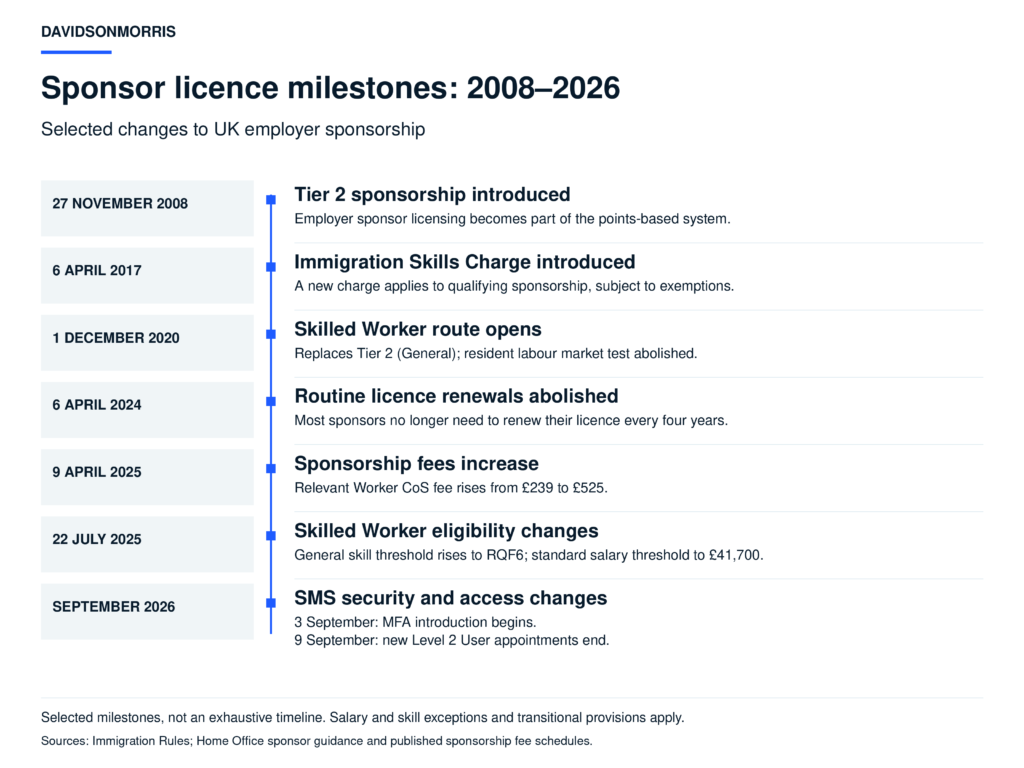
1. Sponsor Licence Reform Timeline: 2008–2026
| Date | Reform | Principal change | Employer significance |
|---|---|---|---|
| 27 November 2008 | Introduction of Tier 2 sponsorship | The points-based system introduced the employer sponsor licence framework for qualifying skilled work categories. | Employers needed Home Office authorisation to sponsor workers under relevant routes and became subject to ongoing sponsorship duties. |
| 2008–2016 | Development of Tier 2 requirements | Changes affected salary thresholds, occupational eligibility, recruitment requirements and sponsor compliance procedures. | Employers had to assess sponsorship against evolving Tier 2 rules, including the resident labour market test where applicable. |
| 6 April 2017 | Immigration Skills Charge introduced | A new charge became payable when sponsoring qualifying workers, subject to exemptions. | International recruitment became more expensive, particularly for longer sponsorship periods. |
| 1 December 2020 | Skilled Worker route introduced | Tier 2 (General) was replaced for new applications. The resident labour market test was abolished and the general occupational skill threshold reduced to RQF level 3. | The process of recruiting eligible overseas workers became more flexible in several respects. |
| 1 January 2021 | Post-Brexit immigration framework | EU free movement ended and the new immigration arrangements applied to newly arriving EU, EEA and Swiss nationals without another qualifying right to work. | Many employers recruiting from Europe needed to consider sponsor licensing for the first time. |
| 11 April 2022 | Global Business Mobility routes introduced | New sponsored routes replaced or reorganised several existing international business mobility arrangements. | Multinational employers needed to assess transfers and overseas assignments under the revised route structure. |
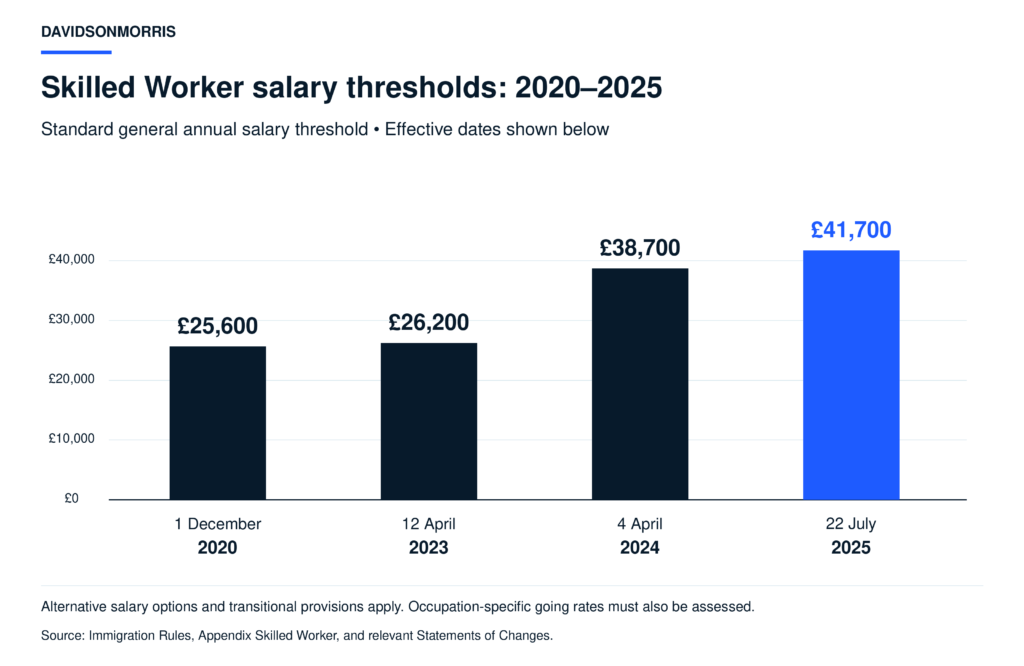
| 12 April 2023 | Skilled Worker salary changes | The standard general salary threshold increased to £26,200, subject to alternative salary options and occupation-specific requirements. | Employers needed to review proposed salaries against the revised framework. |
| 11 March 2024 | Care worker dependant restrictions | New restrictions prevented most newly sponsored care workers and senior care workers from bringing dependants under the affected arrangements. | Care sector recruitment and workforce planning were materially affected. |
| 4 April 2024 | Major Skilled Worker salary reform | The standard general salary threshold increased to £38,700. SOC 2020 occupation codes and the Immigration Salary List were introduced. | Many employers faced higher salary requirements and revised occupational classifications. |
| 6 April 2024 | Routine sponsor licence renewals abolished | Most sponsor licences ceased to require renewal every four years, subject to route-specific exceptions. | Routine administration was reduced, although continuing sponsor duties remained. |
| 31 December 2024 | Skilled Worker sponsorship cost recovery restrictions | New restrictions prevented sponsors from recovering specified licence and CoS costs from sponsored Skilled Workers in the circumstances covered by the guidance. | Employers needed to review repayment clauses, recruitment contracts and sponsorship cost policies. |
| 9 April 2025 | Sponsorship fees increased | Worker sponsor licence fees increased to £574 for qualifying small or charitable sponsors and £1,579 for medium or large sponsors. Relevant Worker CoS fees increased from £239 to £525. | The direct cost of obtaining authorisation and assigning sponsorship increased. |
| 9 April 2025 | Further sponsorship cost recovery restrictions | Restrictions on recovering specified sponsorship costs were extended to additional Worker and Temporary Worker routes. | Employers needed to distinguish prohibited sponsorship costs from other immigration expenditure. |
| 9 April 2025 | Care sector recruitment requirements | Specified care sponsors in England became subject to additional recruitment requirements concerning displaced international care workers. | Care providers had to adjust recruitment procedures before further reforms in July 2025. |
| 12 May 2025 | Immigration white paper | The Government announced a wider programme of immigration reform, including proposals concerning skills, recruitment, settlement and compliance. | Employers were given notice of the policy direction, but proposals were not automatically operative legal requirements. |
| 22 July 2025 | Skilled Worker skill and salary reforms | The general occupational skill threshold increased to RQF level 6 and the standard general salary threshold increased to £41,700, subject to exceptions and transitional provisions. | The range of jobs eligible for new sponsorship narrowed substantially. |
| 22 July 2025 | Care worker overseas recruitment closure | New overseas entry clearance applications for care workers and senior care workers were closed under the affected Skilled Worker arrangements, with specified in-country and transitional exceptions. | Care providers needed to distinguish new overseas recruitment from qualifying in-country sponsorship. |
| 16 December 2025 | Immigration Skills Charge increased | The annual charge increased to £480 for qualifying small or charitable sponsors and £1,320 for medium or large sponsors, subject to exemptions. | Qualifying sponsorship became substantially more expensive, particularly for longer periods. |
| 3 September 2026 | SMS multi-factor authentication | The Home Office began introducing mandatory multi-factor authentication for Sponsor Management System users. | Sponsors needed to comply with revised account security arrangements. |
| 9 September 2026 | Level 2 SMS User phase-out | Sponsors could no longer appoint new Level 2 Users, and transitional arrangements were introduced for existing accounts. | Organisations needed to review user permissions and administrative responsibilities. |
| 1 October 2026 | Expanded right to work requirements | Right to work obligations were extended to specified additional working arrangements, subject to the relevant statutory provisions. | Businesses needed to assess whether their checking procedures covered the affected categories of workers. |
| 29 October 2026 | Scheduled Religious Worker change | A route-specific change concerning resident labour consideration was scheduled to take effect. | Relevant religious organisations needed to check the final commencement arrangements before applying the revised requirements. |
| 8 March 2027 | Scheduled Level 2 SMS account deadline | Existing Level 2 accounts must be upgraded where eligible or deactivated before the transition deadline. | Sponsors should complete account reviews and ensure sufficient authorised SMS access. |
2. How to Read the Sponsor Licence Timeline
The timeline records reforms according to their effective dates wherever possible. Immigration policy announcements, publication dates and legal commencement dates do not always coincide.
For example, the Government published its immigration white paper on 12 May 2025, but the principal Skilled Worker changes discussed in this guide took effect on 22 July 2025. The white paper was a policy document; the operative requirements were introduced through the relevant legal and administrative mechanisms.15
Similarly, the introduction of new SMS arrangements in September 2026 included a future deadline in March 2027. The date of the initial announcement should not be confused with the date by which sponsors must complete the transition.
Where a reform affected existing workers differently from new applicants, the relevant transitional provisions must also be considered.
For historical compliance purposes, employers should identify the date of the relevant action or application and examine the rules applicable at that time. Current Home Office guidance should not automatically be used to assess whether an earlier sponsorship decision complied with the requirements then in force.
3. Sponsor Licence Changes Compared with Sponsored Worker Rule Changes
Not every development in the timeline directly changed the conditions for holding a sponsor licence.
Some reforms concerned the employer’s authorisation, including licence validity, sponsor duties, key personnel and access to the Sponsor Management System.5
Other reforms changed the immigration requirements for the workers being sponsored. Examples include increases in the Skilled Worker salary threshold, changes to eligible occupation codes and restrictions affecting particular sponsored work routes.89
A third category concerns the financial cost of sponsorship, including sponsor licence application fees, Certificate of Sponsorship fees and the Immigration Skills Charge.1011
These categories overlap in practice, but they should be distinguished when assessing the effect of a historical reform.
For example, the July 2025 increase in the general Skilled Worker skill threshold did not mean that every organisation holding a sponsor licence had to apply for a new licence. It changed which occupations could qualify for sponsorship under the revised rules.
Conversely, the September 2026 SMS changes affected the administration of existing sponsor licences without generally altering the occupational eligibility requirements for Skilled Worker applications.
The following sections examine the reforms in chronological order, comparing the previous requirements with the changes introduced and their effects on employers.
Section B: 2008–2019: Establishment of the UK Sponsor Licence System
The modern UK sponsor licence system was introduced in November 2008 as part of the points-based immigration system. Employers wishing to recruit certain categories of overseas workers needed Home Office authorisation.
Before the points-based system, employers recruiting overseas nationals relied on work permit arrangements and other immigration categories. The introduction of Tier 2 created a more structured relationship between employer sponsorship and an individual’s immigration permission.
Employers had to show that a proposed role satisfied the applicable immigration requirements, maintain their own authorisation and comply with continuing sponsorship duties.
Between 2008 and 2019, the sponsorship framework developed through successive changes to occupational eligibility, salary thresholds, recruitment requirements, employer costs and compliance procedures.
Although the principal sponsored work routes were subsequently restructured following Brexit, many features of the current sponsor licence system originated during this period.
1. November 2008: Introduction of Tier 2 Sponsor Licensing
Tier 2 of the points-based system was introduced on 27 November 2008. It provided the principal immigration framework for employers recruiting skilled workers from outside the European Economic Area, subject to the immigration arrangements then in force.
Under the new system, an employer wishing to sponsor a worker under a relevant Tier 2 category generally needed to obtain a sponsor licence before assigning a Certificate of Sponsorship.
Through the sponsor licence application, the Home Office assessed whether an organisation was suitable to sponsor workers.
Applicants were required to demonstrate that they were genuine organisations operating lawfully in the UK and capable of complying with their sponsorship responsibilities.
The Home Office could consider the organisation’s business activities, personnel, recruitment arrangements and ability to monitor sponsored workers.
Successful applicants were placed on the register of licensed sponsors and could undertake sponsorship activities within the scope of their authorisation.
Sponsor licensing placed continuing obligations on the employer alongside the requirements for the worker’s application.
Employer impact: Businesses recruiting workers under the affected immigration categories needed to establish and maintain a compliant sponsorship infrastructure. Obtaining a licence became a prerequisite for many forms of overseas skilled worker recruitment.
2. The Original Tier 2 Sponsorship Categories
The original Tier 2 framework contained several categories designed for different types of employment and international recruitment.
Tier 2 (General) was the principal route for employers recruiting skilled workers to fill eligible vacancies in the UK.
Tier 2 (Intra-Company Transfer) provided arrangements for qualifying multinational organisations transferring employees between related overseas and UK businesses.
Separate categories existed for Ministers of Religion and Sportspersons.
Each category was subject to its own eligibility requirements, including relevant occupational, salary, sponsorship and immigration conditions.
Employers therefore needed to identify the appropriate immigration category before proceeding with sponsorship.
The route also determined the requirements for obtaining and maintaining sponsor authorisation.
For example, an organisation recruiting a worker into a permanent UK vacancy under Tier 2 (General) could be subject to different recruitment requirements from a multinational employer transferring an established overseas employee under the intra-company arrangements.
The requirements for each route continued to evolve throughout the Tier 2 period and influenced the replacement routes introduced in 2020 and 2022.
Employer impact: Sponsor licensing did not provide unrestricted permission to recruit any overseas worker. Employers needed authorisation for the relevant sponsorship category and had to satisfy the requirements applicable to each proposed role.
3. The Resident Labour Market Test Under Tier 2
One of the defining features of the original Tier 2 (General) system was the resident labour market test.
Subject to exemptions, employers had to show that they had completed the prescribed recruitment exercise before sponsoring a worker from outside the resident labour market.
The purpose of the test was to establish whether a suitable settled worker was available to fill the vacancy before the employer recruited through the affected sponsored immigration route.
The detailed requirements changed during the Tier 2 period, but generally involved advertising the vacancy through prescribed channels for a specified period and maintaining evidence of the recruitment exercise.
Employers needed to ensure that advertisements contained the required information and that recruitment decisions were supported by appropriate records.
Where a suitable settled worker applied for the vacancy, the employer could not disregard that applicant in favour of a sponsored worker.
Exemptions applied in specified circumstances, including certain shortage occupations and other qualifying arrangements.
The resident labour market test created an additional procedural stage in recruitment and could affect how quickly an employer was able to assign sponsorship.
It also created compliance risks where advertising, record keeping or candidate assessment did not satisfy the prescribed requirements.
The test remained a central feature of many Tier 2 (General) applications until its abolition when the Skilled Worker route opened in December 2020.7
Employer impact: Employers needed to plan recruitment around the applicable advertising requirements and retain sufficient evidence to demonstrate compliance if the Home Office subsequently examined the sponsorship decision.
4. Certificates of Sponsorship and Employer Responsibility
The points-based system used the Certificate of Sponsorship to record individual sponsorship arrangements.
Licensed sponsors assigned an electronic sponsorship record containing information about the worker and proposed employment, rather than issuing a paper certificate.
The worker then relied on the Certificate of Sponsorship reference when making the relevant immigration application.
The sponsor was responsible for ensuring that the information entered into the sponsorship system was accurate and that the proposed role satisfied the applicable requirements.
This included matters such as the job description, occupation classification, salary, employment arrangements and relevant sponsorship dates.
The Home Office could examine the information supplied by the employer and assess whether the sponsorship was genuine and compliant.
Over time, the rules governing the allocation and assignment of Certificates of Sponsorship became more detailed.
Under the later Tier 2 arrangements, employers had to use the correct restricted or unrestricted Certificate of Sponsorship procedure.
Restricted Certificates were subject to a separate allocation process for specified applications, while unrestricted Certificates could be assigned within the sponsor’s relevant allocation and eligibility requirements.
These arrangements were subsequently replaced by the Defined and Undefined Certificate of Sponsorship framework introduced with the Skilled Worker route.
Employer impact: Sponsors became directly responsible for the accuracy and legitimacy of the sponsorship information supporting workers’ immigration applications. Errors or misuse could affect individual applications and the organisation’s sponsor licence.
5. Sponsor Licence Ratings and the Development of Compliance Controls
The sponsor licence framework incorporated a system of ratings and continuing Home Office oversight.
Licensed sponsors were generally expected to maintain an A-rating, indicating that they met the relevant sponsorship requirements.
Where the Home Office identified certain compliance deficiencies, a sponsor could be downgraded to a B-rating and required to undertake remedial action.
The precise consequences depended on the guidance applicable at the time, but downgrading could restrict the sponsor’s ability to undertake further sponsorship activity.
Action plans and compliance requirements were used to address identified deficiencies.
The Home Office also developed procedures for suspending or revoking sponsor licences where the relevant grounds were established.
These powers reflected the principle that sponsor authorisation was conditional on continuing compliance.
Obtaining a licence did not guarantee that an organisation would retain it regardless of its subsequent conduct.
Compliance action could have consequences extending beyond the employer. Sponsored workers could also be affected where the organisation lost its authorisation.
The Home Office could use sponsor licence downgrading, suspension or revocation to respond to compliance concerns under the applicable provisions.
Employer impact: Sponsor licensing created an ongoing regulatory relationship with the Home Office. Employers needed to maintain compliance throughout the period in which they held the licence.
6. Sponsor Duties: Record Keeping, Monitoring and Reporting
The original sponsorship system imposed continuing obligations on licensed employers to maintain records, monitor sponsored workers and report specified events to the Home Office.
These requirements were intended to support immigration control and enable the Home Office to assess whether sponsored employment remained consistent with the conditions of the relevant immigration permission.
Employers were required to maintain prescribed records concerning sponsored workers, including identity information, relevant employment details and evidence associated with the sponsorship arrangement.
They also needed systems capable of identifying reportable events.
Depending on the rules applicable at the time, these could include a sponsored worker failing to commence employment, prolonged unauthorised absence, termination of employment or material changes to the worker’s role or circumstances.
Separate obligations applied to changes affecting the sponsoring organisation itself.
These could include changes to business ownership, corporate structure, key personnel or other information held by the Home Office.
Many reporting functions were carried out through the Sponsor Management System.
Employers had to coordinate immigration compliance across recruitment, human resources, payroll and corporate administration.
Failure to maintain appropriate records or submit required reports could lead to Home Office enforcement action.
The exact reporting deadlines and documentary requirements were governed by the sponsor guidance applicable during the relevant period.
Employer impact: Businesses needed effective internal processes for monitoring sponsored workers and communicating relevant changes to those responsible for administering the sponsor licence.
7. The Sponsor Management System and Key Personnel
Licensed sponsors used the Sponsor Management System to administer their authorisation.
Employers used the system to assign Certificates of Sponsorship, maintain specified licence information and submit reports concerning sponsored workers and the sponsoring organisation.
Access to the system was controlled through designated users and permissions.
The sponsor licence framework also required organisations to appoint key personnel with responsibility for different aspects of sponsorship administration.
These included the Authorising Officer, Key Contact and Level 1 User.
The Authorising Officer held overall responsibility for the organisation’s sponsorship activities.
The Key Contact acted as the principal contact for specified communications with the Home Office.
Level 1 Users were responsible for carrying out relevant administrative functions within the Sponsor Management System.
The system also developed restricted Level 2 User permissions for specified functions.
The eligibility requirements and permitted responsibilities of these individuals were subject to Home Office guidance and evolved over time.
These arrangements established the foundations of the modern sponsor governance model.
Individual SMS permissions governed what each user could do, while the organisation retained overall responsibility for compliance.
Employer impact: Employers needed to appoint suitable personnel and maintain effective control over access to sponsorship systems. Internal delegation did not remove the organisation’s responsibility for complying with sponsor duties.
8. April 2017: Introduction of the Immigration Skills Charge
On 6 April 2017, the Government introduced the Immigration Skills Charge, creating a substantial additional cost for employers sponsoring qualifying workers.
The charge was intended to support domestic workforce skills and training objectives while increasing the financial contribution required from employers recruiting through specified sponsored immigration routes.
At introduction, the standard annual charge was £1,000 for medium and large sponsors and £364 for qualifying small or charitable sponsors.
The amount payable depended on the duration of sponsorship, the sponsor’s classification and the applicable exemptions.
The charge was generally payable when the employer assigned a qualifying Certificate of Sponsorship.
It was separate from the sponsor licence application fee and the Certificate of Sponsorship fee.
For example, a medium or large employer sponsoring a qualifying worker for three years could face an Immigration Skills Charge of £3,000, in addition to other sponsorship and immigration costs.
Exemptions applied to specified workers, occupations and circumstances under the relevant regulations.12
The charge was an employer liability and could not lawfully be passed on to the sponsored worker.
The Immigration Skills Charge added to the cost of qualifying sponsorship.
Employers had to budget for a charge that increased with the proposed duration of sponsorship.
The original charge rates remained relevant for historical comparisons until the increase introduced on 16 December 2025.
Employer impact: Employers needed to include the Immigration Skills Charge in recruitment budgets and understand the exemptions and calculation rules applicable to the proposed sponsorship arrangement.
9. Changes to Tier 2 Salary and Occupational Requirements
Throughout the Tier 2 period, employers were required to satisfy occupational eligibility and salary requirements when sponsoring workers.
The relevant rules were designed to restrict sponsorship to qualifying skilled employment and to ensure that sponsored workers received the salary required for the relevant role and immigration category.
These requirements were amended periodically.
Changes affected general salary thresholds, occupation-specific salary rates, occupational classifications and the treatment of certain categories of workers.
Employers were required to consider both the general requirements and the salary applicable to the particular occupation.
Meeting a general salary threshold did not necessarily establish that the salary requirement for an individual occupation had been satisfied.
Different arrangements could apply to specified workers, including those qualifying under particular transitional provisions or other exceptions.
Under Tier 2, employers had to assess occupational eligibility and salary compliance together. That approach continued under the Skilled Worker route.
Historical salary requirements should be considered according to the rules applicable when the relevant application was made.
It would be incorrect, for example, to assess a qualifying Tier 2 application made in 2018 by applying the standard general Skilled Worker salary threshold introduced in July 2025.
Employer impact: Employers needed to monitor changes to occupation codes and salary requirements and ensure that each sponsorship decision satisfied the rules applicable at the relevant time.
10. Sponsor Licence Renewals Under the Original Framework
During the Tier 2 period, sponsor licences were generally granted for a fixed period of four years.
Employers wishing to continue sponsoring workers beyond the licence expiry date ordinarily needed to submit a renewal application and pay the applicable fee.
The renewal process provided an additional point at which the Home Office could examine the sponsor’s continued eligibility and compliance arrangements.
Failure to renew within the applicable period could result in the loss of sponsorship authorisation.
The four-year renewal cycle remained an established feature of the system for many years after the replacement of Tier 2 (General) by the Skilled Worker route.
It was eventually abolished for most sponsors on 6 April 2024, although separate time-limited arrangements remained relevant to specified routes, including UK Expansion Worker and Scale-up.
Historical reviews of sponsorship records from before April 2024 need to account for the renewal requirement.
An employer’s present licence status does not necessarily establish whether its licence was valid at every earlier point.
Employer impact: Sponsors needed to monitor licence expiry dates, budget for renewals and ensure that authorisation remained valid throughout the relevant sponsorship period.
11. Home Office Compliance Visits and Enforcement During 2008–2019
The development of sponsor licensing was accompanied by Home Office powers to investigate whether organisations satisfied the requirements for holding and maintaining a licence.
Compliance visits could be undertaken in connection with sponsor licence applications or after authorisation had been granted.
The Home Office could examine whether the organisation was genuinely operating, whether sponsored roles were legitimate and whether the employer maintained the records and systems required by the sponsorship framework.
Visits could involve examination of recruitment records, employment documentation, payroll information and procedures for monitoring sponsored workers.
Home Office officials could also seek information from individuals responsible for sponsorship administration.
Where deficiencies were identified, the Home Office could take action under the relevant sponsor guidance.
Depending on the circumstances, this could include requiring improvements, downgrading the licence, suspension or revocation.
Not every compliance concern necessarily resulted in revocation. The applicable response depended on the nature of the breach, the relevant guidance and the circumstances of the sponsor.
However, serious breaches could have substantial consequences for both the organisation and its sponsored workforce.
Compliance visits and enforcement procedures allowed the Home Office to check whether sponsors continued to satisfy the conditions of their authorisation.
Employers increasingly needed to show how their day-to-day processes supported immigration compliance.
Employer impact: Organisations needed to maintain records and procedures capable of withstanding Home Office scrutiny, including evidence supporting the original recruitment decision and ongoing sponsored employment.
12. Position at the End of 2019: The Sponsorship System Before Brexit
By the end of 2019, the UK had an established sponsor licensing framework built around Tier 2 and associated sponsored immigration categories.
The system required employers to obtain Home Office authorisation, appoint responsible personnel, assign Certificates of Sponsorship and comply with ongoing monitoring, reporting and record-keeping duties.
Tier 2 (General) continued to impose occupational and salary requirements, while the resident labour market test remained relevant to many recruitment decisions.
The Immigration Skills Charge had become an additional financial consideration for qualifying sponsorship arrangements.
Most sponsor licences remained subject to a four-year renewal cycle.
Home Office compliance and enforcement powers provided the mechanism through which sponsors could be held accountable for failures to satisfy their obligations.
However, EU free movement meant that many EU, EEA and Swiss nationals could work in the UK without requiring sponsorship under Tier 2.
Employers recruiting internationally therefore faced different immigration procedures depending on the worker’s rights under the arrangements then in force.
Recruitment from within the European labour market could often proceed under free movement arrangements, while recruitment of workers requiring Tier 2 permission involved the sponsor licensing framework.
The end of free movement fundamentally changed this position.
From January 2021, many employers that had previously recruited EU workers without sponsorship needed to consider whether the new immigration arrangements required a sponsor licence.
The reforms introduced in December 2020 and January 2021 therefore represented the most substantial restructuring of employer sponsorship since the original introduction of Tier 2.
13. Summary: How the 2008–2019 Reforms Changed Employer Sponsorship
The first decade of sponsor licensing established the authorisation requirements, sponsor duties and enforcement procedures that continue within the UK sponsorship system.
The principal developments can be summarised as follows:
- Employer authorisation: Organisations recruiting through relevant sponsored work routes were required to obtain a sponsor licence.
- Recruitment controls: The resident labour market test restricted many Tier 2 (General) sponsorship decisions, subject to exemptions.
- Certificates of Sponsorship: Employers became responsible for assigning electronic sponsorship records supporting individual immigration applications.
- Ongoing compliance: Sponsors were required to maintain records, monitor workers and report specified events.
- Governance: Key personnel and SMS user permissions established internal accountability for sponsorship administration.
- Employer costs: The Immigration Skills Charge introduced in April 2017 substantially increased the cost of qualifying sponsorship.
- Licence validity: Most sponsors operated under a four-year renewal cycle.
- Enforcement: Home Office compliance visits, downgrading, suspension and revocation provided continuing regulatory oversight.
This period established sponsorship as an ongoing employer compliance responsibility alongside the creation of the Tier 2 immigration categories.
Subsequent reforms altered the immigration routes, salary thresholds, occupational requirements and administrative procedures. The underlying principle remained that employers sponsoring overseas workers must hold appropriate authorisation and comply with the conditions attached to that authorisation.
Section C: 2020–2023: Brexit, the Skilled Worker Route and the New Sponsorship Framework
The period from 2020 to 2023 marked the most substantial restructuring of UK employer sponsorship since the introduction of the points-based system in 2008.
The end of EU free movement changed which workers required immigration permission to take employment in the UK. At the same time, the Government replaced Tier 2 (General) with the Skilled Worker route and introduced a revised framework for sponsored recruitment.
More employers needed to consider sponsor licensing, while some recruitment procedures became simpler.
The resident labour market test was abolished, the general occupational skill threshold was reduced and the former restricted and unrestricted Certificate of Sponsorship arrangements were replaced.
However, the new system retained the requirement for employers to hold appropriate Home Office authorisation and comply with continuing sponsor duties.
Subsequent changes between 2021 and 2023 introduced additional sponsored immigration routes, expanded access to sponsorship in parts of the care sector and revised salary requirements.
1. January 2020: Brexit and the Transition Towards a New Immigration System
The United Kingdom formally left the European Union on 31 January 2020.
However, EU free movement arrangements continued during the transition period, which ended on 31 December 2020.
Historical reviews need to account for the continued operation of free movement during the transition period.
Brexit did not mean that every EU national working in the UK immediately required employer sponsorship from 31 January 2020.
During the transition period, the existing arrangements continued to apply, while the Government prepared the replacement immigration framework.
Employers therefore needed to distinguish between the date of the UK’s formal departure from the EU and the later date on which the new immigration arrangements became fully applicable.
For organisations with substantial EU workforces, the transition created two separate considerations.
The first concerned the immigration position of existing EU, EEA and Swiss employees, including their eligibility for status under the EU Settlement Scheme.
The second concerned the recruitment of new workers after the end of free movement.
Employees holding appropriate status under the EU Settlement Scheme did not generally require sponsorship merely because free movement had ended.
Likewise, Irish citizens continued to benefit from separate rights under the Common Travel Area arrangements.
Employers therefore needed to assess the individual’s immigration position rather than assuming that nationality alone determined whether sponsorship was necessary.
Employer impact: Businesses recruiting from Europe needed to prepare for changed immigration requirements while identifying existing employees who could continue working without sponsorship.
2. December 2020: Introduction of the Skilled Worker Route
The Skilled Worker route opened on 1 December 2020, replacing Tier 2 (General) for new applications.
The new route formed part of the UK’s post-Brexit points-based immigration system.
It retained the principle that employers sponsoring qualifying workers must hold an appropriate sponsor licence and assign a Certificate of Sponsorship.
Several eligibility and recruitment requirements changed.
The general occupational skill threshold was reduced to RQF level 3, making a wider range of occupations potentially eligible for sponsorship than under the immediately preceding Tier 2 (General) framework.
The resident labour market test was removed.
The revised salary framework introduced different salary options for qualifying applicants.
The general salary threshold under the initial Skilled Worker framework was £25,600, subject to the applicable occupation-specific going rate and alternative salary provisions.
Employers could not assume that every role paying £25,600 automatically qualified for sponsorship.
The role still needed to fall within an eligible occupation, meet the relevant skill requirements and satisfy the applicable salary and other immigration conditions.
Under the new system, the applicant also needed to meet the applicable English language requirement and other conditions for immigration permission.
The route opened in December 2020. From January 2021, it also became relevant to newly arriving EU, EEA and Swiss nationals without another qualifying right to work, following the end of free movement.13
Employer impact: The Skilled Worker route widened potential sponsorship eligibility in some occupations and simplified recruitment procedures, while extending the practical relevance of sponsor licensing to employers that had previously recruited extensively from the EU.
3. December 2020: Abolition of the Resident Labour Market Test
The Skilled Worker route abolished the resident labour market test.
Under the former Tier 2 (General) framework, employers had often been required to advertise a vacancy through prescribed channels and demonstrate that no suitable settled worker was available before sponsoring an overseas applicant.
From 1 December 2020, this prescribed recruitment exercise was no longer a general requirement for Skilled Worker sponsorship.
The removal of the test reduced the administrative burden associated with qualifying international recruitment.
It also removed a procedural stage that could delay the assignment of sponsorship.
However, the abolition of the resident labour market test did not remove the requirement for the sponsored role to be genuine.
Employers still needed to demonstrate that the vacancy was legitimate and that the proposed employment satisfied the relevant immigration and sponsorship requirements.
The Home Office retained powers to examine whether the role existed, whether the stated duties were accurate and whether the sponsorship arrangement complied with the rules.
Employers could not use the removal of prescribed advertising requirements to justify artificial roles or employment that did not meet the applicable sponsorship requirements.
Employers also remained responsible for maintaining relevant recruitment and employment records required by sponsor guidance.
Employer impact: Employers gained greater flexibility in recruiting eligible overseas workers, but remained responsible for ensuring that the sponsored vacancy was genuine and compliant.
4. December 2020: Reduction of the General Skill Threshold to RQF Level 3
The Skilled Worker reforms reduced the general occupational skill threshold to RQF level 3.
Under the immediately preceding Tier 2 (General) framework, the general skill requirement had been set at a higher occupational level, subject to exceptions.
Reducing the threshold expanded the range of occupations potentially eligible for sponsorship.
RQF level 3 broadly corresponds to the skill classification associated with A-level standard occupations, although eligibility depends on the occupation code and Immigration Rules rather than the individual worker’s academic qualifications alone.
A worker was not necessarily required to hold an A-level qualification simply because the occupation was classified at RQF level 3.
The relevant question was whether the sponsored employment fell within an eligible occupation and satisfied the applicable requirements.
Employers in sectors that had previously recruited outside the Tier 2 framework could consider sponsorship for a wider range of roles.
However, the lower skill threshold did not remove salary requirements, sponsorship duties or the need for the employer to hold appropriate authorisation.
The RQF level 3 framework remained a central feature of Skilled Worker sponsorship until the general threshold was increased to RQF level 6 on 22 July 2025, subject to exceptions and transitional arrangements.
Employer impact: More occupations became potentially eligible for sponsorship, allowing employers in a wider range of sectors to consider international recruitment through the Skilled Worker route.
5. January 2021: End of EU Free Movement and Expansion of Sponsor Licensing
EU free movement ended at 11pm on 31 December 2020, and the new immigration arrangements applied from 1 January 2021.
More employers needed to consider whether their recruitment required a sponsor licence.
Before Brexit, many EU, EEA and Swiss nationals could take employment in the UK without requiring sponsorship under Tier 2.
Following the end of free movement, newly arriving nationals from those countries generally needed an appropriate immigration status permitting work.
Where the individual did not qualify under another immigration route or existing status, employer sponsorship could be necessary.
The new framework therefore placed many EU recruitment decisions within the same broad immigration system governing recruitment from other countries.
Exceptions remained.
Irish citizens continued to benefit from Common Travel Area arrangements.
Qualifying individuals with settled or pre-settled status under the EU Settlement Scheme could work in accordance with their immigration rights without requiring Skilled Worker sponsorship.
Other immigration categories could also provide permission to work without employer sponsorship.
Employers therefore needed to distinguish between a worker’s nationality and their actual immigration status.
Employers also needed to review right to work checks, workforce planning and immigration compliance procedures.
For employers previously unfamiliar with sponsorship, obtaining a licence could require new systems for record keeping, reporting, key personnel appointments and SMS administration.
Employer impact: Sponsor licensing became relevant to a much wider group of employers, particularly organisations that had historically relied on recruitment from EU labour markets.
6. December 2020–2021: Defined and Undefined Certificates of Sponsorship
The introduction of the Skilled Worker route was accompanied by changes to the Certificate of Sponsorship allocation framework.
Under the former Tier 2 arrangements, employers had used restricted and unrestricted Certificates of Sponsorship in specified circumstances.
These categories were replaced by Defined and Undefined Certificates of Sponsorship.
A Defined Certificate of Sponsorship is generally required for a Skilled Worker applying for entry clearance from outside the UK.
Employers must request the Defined CoS through the Sponsor Management System and obtain approval before assigning it to the worker.
Undefined Certificates of Sponsorship are used for specified applications, including many Skilled Worker applications made from within the UK and sponsorship under other relevant routes.
The CoS category determines how the employer obtains permission to assign the sponsorship record.
It does not remove the obligation to ensure that the worker and role satisfy the relevant Immigration Rules.
The Home Office can examine the information supplied in a Defined CoS request and may require additional evidence before granting approval.
Employers should also distinguish the approval of a Defined CoS request from the grant of the worker’s immigration application.
A Certificate of Sponsorship is a necessary part of many sponsored work applications, but it does not guarantee that the worker will receive immigration permission.
Employers continue to use the Defined and Undefined CoS procedures when administering Skilled Worker sponsorship.
Employer impact: Employers needed to adopt new CoS request and assignment procedures, particularly when recruiting Skilled Workers from outside the UK.
7. 2021: The Graduate Route and Its Effect on Employer Recruitment
The Graduate immigration route opened on 1 July 2021.
It allowed qualifying international graduates to remain in the UK for a period after completing eligible studies, subject to the relevant immigration requirements.
The route did not require employer sponsorship.
For employers, this created an alternative means of recruiting certain international graduates without immediately obtaining or using a sponsor licence.
Graduates holding valid permission under the route could generally undertake employment within the conditions of their immigration status.
However, the Graduate route did not itself provide a direct route to settlement and was subject to a limited period of permission.
Employers wishing to retain an individual beyond their permitted Graduate period could therefore need to consider whether the worker qualified for another immigration route, including Skilled Worker sponsorship.
Employers could recruit without immediate sponsorship while still needing to plan for the end of the Graduate permission.
An employer could initially recruit a qualifying graduate without assigning a Certificate of Sponsorship but later require a sponsor licence to retain the employee under the Skilled Worker route.
The Graduate route changed the immigration options available to employers and prospective workers without changing sponsor licence eligibility itself.
Employer impact: Employers gained access to an additional pool of international graduates who could work without immediate sponsorship, although longer-term retention could require immigration planning.
8. April 2022: Introduction of the Global Business Mobility Routes
On 11 April 2022, the Government introduced the Global Business Mobility framework.
The reforms reorganised several sponsored immigration arrangements used by international businesses.
The new framework included routes for Senior or Specialist Workers, Graduate Trainees, UK Expansion Workers, Service Suppliers and Secondment Workers.
These routes were designed to address different forms of international business activity, including intra-company assignments, overseas business expansion and specified contractual arrangements.
The Senior or Specialist Worker route replaced the former Intra-Company Transfer arrangements for new applications.
However, the Global Business Mobility routes were not interchangeable alternatives to Skilled Worker sponsorship.
Each route contained distinct eligibility requirements relating to matters such as the overseas business relationship, the nature of the assignment, occupational eligibility, salary and previous overseas employment.
The routes also differed in their immigration consequences.
In particular, Global Business Mobility permission did not generally provide a direct route to settlement.
Employers needed to consider whether a proposed assignment was genuinely temporary or whether longer-term UK employment and settlement planning made a different immigration route more appropriate.
The reforms also affected sponsor licence administration.
Organisations needed authorisation for the relevant Global Business Mobility route and had to satisfy the sponsorship requirements applicable to that category.
Multinational businesses had separate routes for different international assignments and needed to assess eligibility for the route they intended to use.
Employer impact: International businesses needed to review their mobility programmes and ensure that transfers, secondments and overseas expansion arrangements were supported by the correct sponsorship route.
9. February 2022: Expansion of Health and Care Sponsorship Eligibility
On 15 February 2022, care workers and home carers became eligible for sponsorship under the Skilled Worker route, subject to the applicable requirements.
The reform was introduced in response to workforce pressures in the adult social care sector.
It expanded the range of care occupations potentially eligible for international recruitment and allowed qualifying workers to benefit from the Health and Care Worker visa arrangements.
Employers seeking to recruit eligible care workers needed to hold an appropriate sponsor licence and comply with the relevant immigration and sponsorship requirements.
Care providers that had previously been unable to sponsor workers into those occupations could now consider qualifying international recruitment.
However, sponsorship eligibility did not remove the need to demonstrate that the role was genuine or that the employment arrangements complied with applicable requirements.
Care providers also remained subject to sector-specific regulatory obligations where relevant.
The expansion of care worker sponsorship was followed by substantial changes in 2024 and 2025.
These included restrictions affecting dependants, additional requirements for care providers in England and the closure of the affected occupations to new overseas entry clearance applications in July 2025.
The 2022 expansion describes the eligibility available at that time. Later reforms changed those recruitment options.
Employer impact: Eligible care providers gained access to a wider international recruitment route, but also assumed the costs, administration and compliance responsibilities associated with licensed sponsorship.
10. April 2023: Skilled Worker General Salary Threshold Increased to £26,200
On 12 April 2023, the standard general salary threshold for Skilled Worker sponsorship increased from £25,600 to £26,200.
The reform formed part of wider amendments to salary requirements across relevant sponsored work routes.
Employers needed to ensure that proposed salaries satisfied the applicable general threshold and occupation-specific going rate.
Alternative salary arrangements continued to apply in specified circumstances.
These could include qualifying workers who met the conditions for particular salary options, subject to the requirements in force at the relevant time.
The general threshold therefore did not operate as a universal minimum salary for every Skilled Worker application.
Historical salary assessments need to use the framework applicable at the relevant date.
A worker sponsored under the rules applicable in early 2023 could have been subject to a different salary framework from an applicant sponsored after the April 2023 change.
Further substantial salary increases followed in April 2024 and July 2025.
Employers reviewing historic sponsorship arrangements should therefore identify the relevant application date, occupation code, salary option and transitional provisions rather than applying the latest headline threshold retrospectively.
Employer impact: Employers needed to update recruitment budgets and salary assessments to reflect the revised requirements, while considering any applicable alternative salary provisions.
11. 2020–2023: Continuing Sponsor Duties Under the New Framework
Although the post-Brexit reforms changed the immigration routes and simplified certain recruitment procedures, they did not remove the continuing obligations associated with holding a sponsor licence.
Licensed sponsors remained responsible for maintaining appropriate records, monitoring sponsored workers and reporting specified changes to the Home Office.
These obligations continued to be administered principally through the Sponsor Management System and the relevant sponsor guidance.
Employers needed to ensure that the sponsored role remained consistent with the information supplied when the Certificate of Sponsorship was assigned.
They also needed to identify changes that required reporting, including specified changes to employment, worker circumstances and the sponsoring organisation.
The Home Office retained powers to undertake compliance visits and investigate potential breaches.
Depending on the circumstances, failures could result in licence downgrading, suspension or revocation.
The removal of the resident labour market test did not mean that the Home Office ceased scrutinising recruitment arrangements.
Instead, compliance continued to focus on matters including genuine vacancies, appropriate employment arrangements, salary requirements, accurate reporting and the sponsor’s ability to meet its obligations.
Employers were therefore required to integrate immigration compliance into their ordinary workforce management procedures.
Relevant functions could include recruitment, HR, payroll, legal, finance and corporate administration.
Where responsibilities were divided between departments, the sponsor still needed effective systems to ensure that reportable events were identified and appropriate action taken.
Employer impact: The post-Brexit system made sponsor licensing relevant to more organisations while preserving the regulatory responsibilities and enforcement risks associated with holding a licence.
12. Comparison: Tier 2 Before Brexit and Skilled Worker After Brexit
The following table compares the principal features of the Tier 2 (General) framework immediately before its replacement with the Skilled Worker system introduced in December 2020.
| Requirement | Tier 2 (General) before December 2020 | Skilled Worker from December 2020 |
|---|---|---|
| Principal immigration route | Tier 2 (General) | Skilled Worker |
| Employer sponsor licence | Required for relevant sponsorship | Required for relevant sponsorship |
| General occupational skill threshold | Generally RQF level 6, subject to exceptions | Generally RQF level 3 |
| Resident labour market test | Required for many applications, subject to exemptions | Abolished |
| General salary threshold | £30,000 under the principal pre-reform framework, subject to exceptions | £25,600 initially, subject to salary options and going rates |
| Certificate of Sponsorship framework | Restricted and unrestricted CoS arrangements | Defined and Undefined CoS arrangements |
| EU recruitment | Many EU, EEA and Swiss nationals could work under free movement arrangements | Newly arriving nationals generally required appropriate immigration permission from January 2021, subject to exceptions |
| Immigration Skills Charge | Applicable to qualifying sponsorship | Continued to apply to qualifying sponsorship |
| Sponsor duties | Continuing record-keeping, monitoring and reporting requirements | Continuing record-keeping, monitoring and reporting requirements |
| Home Office enforcement | Compliance visits, downgrading, suspension and revocation | Compliance visits, downgrading, suspension and revocation |
The post-Brexit reforms changed access to sponsored work and recruitment procedures while retaining employer sponsorship responsibilities.
The Skilled Worker route initially broadened occupational eligibility and reduced certain procedural barriers.
However, the employer remained responsible for ensuring that each sponsored worker satisfied the relevant requirements and that the organisation continued to comply with its sponsor duties.
The greater flexibility introduced in December 2020 was subsequently modified by the more restrictive salary and occupational reforms introduced in 2024 and 2025.
13. Summary: How the 2020–2023 Reforms Changed Employer Sponsorship
The reforms introduced between 2020 and 2023 fundamentally altered the scope and operation of UK employer sponsorship.
The principal developments were:
- Brexit: The end of free movement brought many newly arriving EU, EEA and Swiss workers within the UK’s immigration permission framework.
- Skilled Worker: Tier 2 (General) was replaced for new applications from December 2020.
- Recruitment flexibility: The resident labour market test was abolished.
- Occupational eligibility: The general skill threshold was reduced to RQF level 3.
- CoS administration: Defined and Undefined Certificates of Sponsorship replaced the former restricted and unrestricted arrangements.
- Graduate recruitment: The Graduate route provided qualifying international graduates with a period of permission to work without employer sponsorship.
- Global mobility: The Global Business Mobility routes reorganised international business transfers and assignments from April 2022.
- Care sector: The inclusion of care workers in February 2022 expanded international recruitment opportunities for eligible care providers.
- Salary requirements: The standard general Skilled Worker threshold increased to £26,200 in April 2023.
- Continuing compliance: Sponsor duties, SMS administration and Home Office enforcement remained central features of the system.
By the end of 2023, sponsor licensing had become a more widely used mechanism for international recruitment across the UK economy.
The Skilled Worker framework initially provided greater flexibility than the immediately preceding Tier 2 arrangements in occupational eligibility and recruitment procedures.
However, the next period of reform moved in a different direction.
From 2024, the Government introduced substantial increases in salary requirements, restrictions affecting care sector sponsorship and changes to the occupational classification framework.
These reforms increased the financial and eligibility barriers associated with sponsorship, even as other administrative changes, including the abolition of routine sponsor licence renewals, reduced certain obligations on employers.
Section D: 2024: Salary Reform, Care Worker Restrictions and Sponsor Licence Renewal Changes
UK sponsorship policy became more restrictive in 2024. Following the expansion of sponsored work eligibility under the post-Brexit immigration system, the Government introduced reforms intended to reduce migration levels, increase salary requirements and restrict access to certain sponsored work routes.
The main changes affected the Skilled Worker route and the health and social care sector.
From March 2024, new restrictions prevented most newly sponsored care workers and senior care workers from bringing dependants to the UK. Additional regulatory requirements also applied to relevant care providers in England.
In April 2024, the standard general Skilled Worker salary threshold increased from £26,200 to £38,700, while the occupational classification system moved from SOC 2010 to SOC 2020.
The Shortage Occupation List was replaced by the Immigration Salary List, changing the arrangements under which specified occupations could benefit from alternative salary requirements.
At the same time, the Home Office abolished routine four-year sponsor licence renewals for most sponsors, reducing one of the longstanding administrative requirements of the sponsorship framework.
Further changes introduced at the end of 2024 restricted the ability of employers to recover specified sponsorship costs from Skilled Workers.
Employers faced higher requirements for some individual sponsorship applications alongside simpler licence administration.
1. March 2024: Restrictions on Care Worker Dependants
On 11 March 2024, the Government introduced restrictions affecting dependants of care workers and senior care workers sponsored under the Skilled Worker route.
Under the revised arrangements, most new applicants sponsored in the affected care occupations could no longer bring partners and children to the UK as dependants.
The restrictions formed part of the Government’s wider programme of immigration reforms announced in December 2023.
Care worker sponsorship had expanded in February 2022, allowing eligible care providers to recruit internationally into occupations that had previously fallen outside the general Skilled Worker framework.
Between 2022 and early 2024, the availability of dependant permission had been a consideration for some overseas workers considering employment in the UK care sector.
The March 2024 reform substantially changed that position for new applicants.
However, the restrictions did not apply identically to every worker already sponsored in the affected occupations.
Transitional provisions were introduced for qualifying workers who had obtained relevant permission before the changes took effect.
Employers therefore needed to distinguish between new applicants and existing sponsored workers who qualified for transitional arrangements.
Whether dependants could continue to qualify depended on the relevant immigration history and application dates.
The reform affected individual immigration eligibility rather than removing the requirement for care providers to hold an appropriate sponsor licence.
Nevertheless, it had substantial practical consequences for employers recruiting internationally.
Employer impact: Care providers needed to explain the revised dependant restrictions accurately during recruitment and distinguish new applications from qualifying transitional cases.
2. March 2024: CQC Registration Requirement for Care Sponsors in England
From 11 March 2024, additional sponsorship requirements applied to relevant care providers in England seeking to sponsor care workers and senior care workers.
Where the sponsor was undertaking a regulated activity in England, it was generally required to be registered with the Care Quality Commission (CQC) and undertaking the regulated activity covered by that registration.
The reform was intended to strengthen oversight of employers recruiting internationally into the adult social care sector.
The requirement linked immigration sponsorship eligibility more closely to the regulatory arrangements governing care provision in England.
The requirement did not apply to every organisation employing someone in a care-related role regardless of its activities.
The application of the requirement depended on the nature of the sponsoring organisation, the relevant occupation and whether the employer was undertaking regulated activities within the scope of the applicable rules.
Employers also needed to distinguish the position in England from the separate regulatory arrangements applying in Scotland, Wales and Northern Ireland.
Transitional provisions were relevant to specified existing sponsorship arrangements.
Employers needed to check both their regulatory status and the immigration requirements applicable to the worker.
Sponsor licence eligibility could therefore depend on compliance with the regulation of the employer’s sector.
Employer impact: Relevant care providers in England needed to ensure that their CQC registration and regulated activities satisfied the applicable sponsorship requirements before recruiting affected workers.
3. April 2024: Skilled Worker Salary Threshold Increased to £38,700
On 4 April 2024, the standard general salary threshold for Skilled Worker sponsorship increased from £26,200 to £38,700.
This represented one of the largest increases to the headline salary requirement since the introduction of the Skilled Worker route in December 2020.
The reform substantially increased the minimum salary required for many new sponsored work applications.
However, the £38,700 figure did not apply universally to every Skilled Worker.
The Immigration Rules continued to provide alternative salary options for specified categories of applicants, including qualifying new entrants, relevant PhD holders and certain workers benefiting from transitional provisions.
Separate arrangements also applied to eligible health and education occupations subject to the relevant national pay scales or other specified salary provisions.
Employers needed to consider the general salary threshold alongside the occupation-specific going rate.
Meeting the headline threshold did not necessarily establish that the proposed salary was sufficient for the relevant occupation.
For example, where the applicable going rate exceeded £38,700, the employer could be required to satisfy the higher occupation-specific requirement, subject to the salary option applicable to the worker.
Employers also needed to establish whether an existing sponsored worker qualified for transitional salary arrangements.
Workers who had previously held qualifying immigration permission could be treated differently from new applicants, depending on the relevant conditions.
Employers therefore needed to assess the worker’s immigration history, proposed occupation, working hours and applicable salary option.
The salary increase did not require every organisation holding a sponsor licence to apply for new authorisation.
It changed the requirements governing relevant individual sponsorship applications.
Employer impact: Employers needed to review recruitment budgets, salary structures and the viability of sponsoring roles that had previously satisfied the lower general threshold.
4. April 2024: Introduction of SOC 2020 Occupation Codes
On 4 April 2024, the Skilled Worker framework adopted occupation codes based on the Standard Occupational Classification 2020 system.
The change replaced the previous SOC 2010 occupational classification arrangements used for relevant sponsorship decisions.
The occupation code helps determine whether a role qualifies for sponsorship.
They also affect the applicable occupational skill classification and salary going rate.
The transition to SOC 2020 therefore required employers to review how sponsored roles were classified.
In some cases, an occupation previously identified under a SOC 2010 code was mapped to a different SOC 2020 code.
However, employers could not assume that every former occupation code had a direct one-to-one equivalent.
The revised classification system could involve changes to the grouping or description of occupations.
Employers needed to identify the code that most accurately reflected the duties of the proposed employment.
The appropriate code was not determined solely by the job title used in the employment contract.
Employers needed to assess the actual responsibilities and nature of the role.
Incorrect occupational classification could affect whether the job met the Skilled Worker eligibility requirements and whether the correct salary going rate had been applied.
Historical reviews need to identify whether an application was governed by the occupation coding framework used before or after 4 April 2024.
An occupation code recorded on a Certificate of Sponsorship assigned under the earlier framework should not automatically be treated as incorrect merely because the current system uses a different code.
Equally, employers making new sponsorship applications needed to use the classification requirements applicable to those applications.
Employer impact: Employers needed to update occupation coding procedures and review the classification of sponsored roles against the revised SOC 2020 framework.
5. April 2024: Shortage Occupation List Replaced by the Immigration Salary List
On 4 April 2024, the Shortage Occupation List was replaced by the Immigration Salary List.
The former Shortage Occupation List identified occupations recognised as experiencing labour shortages and provided specified immigration advantages under the relevant rules.
These arrangements included salary concessions for qualifying applications.
The Immigration Salary List introduced a revised framework for identifying occupations eligible for particular salary treatment.
The change was part of the Government’s wider approach to restricting salary concessions within the Skilled Worker system.
Inclusion on the Immigration Salary List did not remove the requirement to satisfy the relevant occupation-specific salary provisions.
Nor did it mean that every role in the occupation automatically qualified for sponsorship.
Employers still needed to establish that the proposed role was eligible, that the relevant salary requirements were met and that the worker satisfied the other applicable Immigration Rules.
The Immigration Salary List should also be distinguished from the Temporary Shortage List introduced in July 2025.
Although both lists affect aspects of Skilled Worker eligibility, they serve different functions within the immigration framework.
For historical purposes, the April 2024 reform marked the end of the former Shortage Occupation List arrangements and the beginning of a revised approach to salary-related occupational exceptions.
Employer impact: Employers needed to reassess whether occupations previously appearing on the Shortage Occupation List remained eligible for any salary concessions under the revised Immigration Salary List.
6. April 2024: Changes to Skilled Worker Going Rates
The April 2024 reforms also revised the occupation-specific salary going rates applicable to Skilled Worker sponsorship.
The changes accompanied the introduction of SOC 2020 occupation codes and the increase in the standard general salary threshold.
Skilled Worker salary eligibility is not determined exclusively by the general threshold.
Employers must also satisfy the relevant occupation-specific salary requirement, subject to the salary option applicable to the worker.
The April 2024 reforms introduced a revised methodology and updated rates for relevant occupations.
Different arrangements applied to specified categories of workers, including those qualifying for transitional provisions.
Employers therefore needed to distinguish between the salary framework for new applicants and the arrangements applicable to qualifying existing sponsored workers.
Working hours also remained relevant to the calculation of salary eligibility.
A proposed salary could not necessarily be assessed by considering annual remuneration in isolation without regard to the applicable going rate and relevant working-hour provisions.
The changes increased the complexity of salary assessments for employers sponsoring workers across multiple occupations.
They also created additional challenges when reviewing historical sponsorship decisions.
An occupation-specific going rate introduced in April 2024 should not automatically be applied to a sponsorship decision governed by the earlier rules.
Employer impact: Employers needed to reassess salary compliance using the correct SOC 2020 occupation code, applicable going rate, working hours and relevant salary option.
7. April 2024: Abolition of Routine Sponsor Licence Renewals
On 6 April 2024, the Home Office abolished routine four-year sponsor licence renewals for most sponsors.
Before the reform, sponsor licences were generally granted for four years.
Employers wishing to continue sponsoring workers beyond the expiry date ordinarily needed to apply for renewal and pay the relevant fee.
The renewal process required sponsors to monitor licence expiry dates and maintain appropriate administrative arrangements to ensure that authorisation did not lapse.
From 6 April 2024, most sponsor licences no longer required routine renewal.
For affected sponsors, the Home Office extended licence validity without requiring the organisation to submit the usual four-year renewal application.
The change reduced recurring administrative work and removed the routine renewal fee for most sponsors.
However, the reform did not apply identically to every sponsorship category.
Separate time-limited arrangements continued to apply to specified routes, including UK Expansion Worker and Scale-up sponsorship.
The abolition of routine renewals did not remove sponsor compliance obligations.
Employers remained responsible for maintaining accurate records, reporting specified changes and complying with the requirements applicable to their sponsored workers.
The Home Office also retained powers to undertake compliance visits and take enforcement action.
A licence could still be downgraded, suspended or revoked where the relevant grounds were established.
The reform therefore changed the administrative validity arrangements for most sponsor licences rather than converting sponsorship authorisation into an unconditional or permanent entitlement.
Employers reviewing historic licence records should also distinguish the position before and after April 2024.
For example, a sponsor licence that required renewal in 2022 was governed by different validity arrangements from a qualifying licence held after the abolition of routine renewals.
Employer impact: Most sponsors no longer needed to submit routine four-year renewal applications, but remained subject to continuing compliance duties and Home Office enforcement powers.
8. April 2024: Changes to Sponsor Licence Administration
The abolition of routine renewals altered the administrative lifecycle of most sponsor licences.
Previously, employers had to incorporate licence renewal into their compliance calendars and ensure that applications were submitted before the relevant expiry date.
Following the reform, sponsors generally no longer needed to plan for recurring four-year renewal applications.
However, other administrative responsibilities remained.
Organisations still needed to maintain appropriate key personnel, ensure that authorised SMS users remained eligible and report specified changes affecting the sponsoring organisation.
Relevant corporate changes could include alterations to ownership, business structure or the organisation’s operating arrangements.
Employers also needed to ensure that their sponsorship authorisation continued to cover the routes under which they intended to sponsor workers.
The absence of a routine renewal requirement did not automatically authorise sponsorship under additional immigration routes.
Where an organisation wished to expand its sponsorship activities, it needed to follow the applicable procedures for adding the relevant route or otherwise changing its authorisation.
The reform therefore reduced one recurring administrative requirement while preserving the need for active sponsor licence management.
Employer impact: Sponsors could remove routine renewal applications from their compliance calendars but still needed systems for maintaining licence information, reporting changes and managing authorised personnel.
9. December 2024: Restrictions on Recovering Sponsorship Costs from Skilled Workers
From 31 December 2024, the Home Office introduced restrictions preventing employers from recovering specified sponsorship costs from workers sponsored under the Skilled Worker route.
The changes addressed the practice of passing certain employer sponsorship expenses to sponsored workers.
The restrictions applied to specified sponsor licence costs and associated administrative expenses in the circumstances covered by the revised guidance.
They also applied to relevant Certificate of Sponsorship fees and associated administrative costs where the Certificate was assigned on or after the applicable commencement date.
The precise scope of the restrictions depended on the category of cost, the sponsorship route and the relevant effective-date provisions.
Employers therefore needed to distinguish between costs prohibited from recovery and other immigration-related expenditure that might be subject to different rules.
The Immigration Skills Charge was already subject to a separate prohibition on recovery from sponsored workers.
The December 2024 reform should not therefore be described as the first occasion on which employers were prohibited from transferring any sponsorship costs to workers.
Instead, it extended the protection against recovery to additional categories of employer sponsorship expenditure.
The restrictions were particularly relevant to repayment agreements and contractual clawback clauses.
Some employers had previously used provisions requiring workers to repay specified recruitment or immigration costs if they left employment within a particular period.
Following the change, employers needed to ensure that such provisions did not require repayment of prohibited sponsorship costs.
The existence of a contractual repayment obligation did not override restrictions imposed by the Home Office sponsor guidance.
Further changes in April 2025 extended specified cost recovery restrictions to additional Worker and Temporary Worker sponsorship routes.
Employer impact: Employers needed to review sponsorship repayment arrangements, recruitment contracts and internal cost allocation policies to ensure that prohibited sponsorship expenditure was not recovered from Skilled Workers.
10. Comparison: Sponsor Requirements Before and After the 2024 Reforms
The following table compares the principal employer sponsorship arrangements immediately before and after the major reforms introduced in 2024.
| Requirement | Before the 2024 reforms | Following the relevant 2024 reform |
|---|---|---|
| Standard general Skilled Worker salary threshold | £26,200 | £38,700 from 4 April 2024, subject to salary options and transitional provisions |
| Occupation classification | SOC 2010 | SOC 2020 from 4 April 2024 |
| Shortage occupation arrangements | Shortage Occupation List | Immigration Salary List from 4 April 2024 |
| Occupation-specific salary going rates | Previous salary tables and classification framework | Revised going rates and occupational classifications |
| Care worker dependants | Dependants generally permitted where the relevant requirements were met | Restrictions for most new applicants from 11 March 2024, subject to transitional provisions |
| Care provider regulation in England | Previous sponsorship eligibility framework | Additional CQC registration requirements for relevant care sponsors from 11 March 2024 |
| Routine sponsor licence renewal | Generally required every four years | Abolished for most sponsors from 6 April 2024, subject to route-specific exceptions |
| Sponsorship cost recovery | Existing restrictions, including prohibition on recovering the Immigration Skills Charge | Additional restrictions on recovering specified Skilled Worker sponsorship costs from 31 December 2024 |
| Continuing sponsor duties | Record keeping, monitoring and reporting required | Continuing obligations retained |
| Home Office enforcement | Compliance visits and licence enforcement powers | Continuing powers to downgrade, suspend or revoke licences |
The 2024 reforms affected individual sponsorship applications and licence administration in different ways.
Employers had to assess individual sponsorship applications against the revised salary requirements, occupation codes and care worker eligibility provisions.
By contrast, the abolition of routine renewals reduced the administrative burden associated with maintaining sponsor authorisation for most organisations.
The December 2024 cost recovery restrictions also required employers to review sponsorship payment and repayment arrangements.
These reforms should therefore be assessed individually rather than characterised simply as an overall tightening or relaxation of sponsor licensing.
11. How the 2024 Changes Affected Existing Sponsored Workers
The treatment of workers who already held immigration permission under earlier requirements was a separate part of the 2024 reforms.
The increase in the standard general Skilled Worker salary threshold did not necessarily mean that every existing sponsored worker immediately needed to receive a salary of £38,700.
The relevant Immigration Rules included transitional arrangements for qualifying workers.
These provisions could affect the salary requirements applicable to subsequent applications, including extensions or changes of employment.
However, transitional protection was not automatic in every case.
Eligibility depended on the relevant immigration history and the conditions specified in the rules.
Similarly, the March 2024 restrictions affecting care worker dependants included provisions distinguishing qualifying existing workers from new applicants.
Employers therefore needed to consider the individual worker’s circumstances rather than applying the headline reform without qualification.
Historical analysis also required attention to the date of the relevant Certificate of Sponsorship and immigration application.
Some reforms included commencement provisions or transitional arrangements linked to particular dates.
These could determine whether an application was assessed under the previous framework or the revised requirements.
Employers should not assume that the rules governing a worker’s original application necessarily continued unchanged for every subsequent immigration application.
Equally, it would be incorrect to apply new requirements retrospectively to an earlier sponsorship decision where the relevant provisions did not have that effect.
Employer impact: Employers needed to review the immigration history and applicable transitional provisions for existing sponsored workers before making extension, change of employment or other sponsorship decisions.
12. Summary: How the 2024 Reforms Changed Employer Sponsorship
The reforms introduced during 2024 substantially changed the requirements governing UK employer sponsorship.
The principal developments were:
- Care worker dependants: New restrictions applied from 11 March 2024, subject to transitional arrangements.
- Care provider regulation: Relevant care sponsors in England became subject to additional CQC registration requirements.
- Skilled Worker salaries: The standard general salary threshold increased from £26,200 to £38,700 on 4 April 2024.
- Occupation codes: SOC 2020 replaced SOC 2010 for relevant sponsorship purposes.
- Immigration Salary List: The former Shortage Occupation List was replaced.
- Going rates: Revised occupation-specific salary requirements were introduced.
- Licence renewals: Routine four-year renewals ended for most sponsors from 6 April 2024.
- Sponsorship costs: New restrictions on recovering specified sponsorship costs from Skilled Workers took effect from 31 December 2024.
- Continuing compliance: Sponsor duties and Home Office enforcement powers remained in place.
Employers faced more complex eligibility and financial requirements for sponsored recruitment during 2024.
Most sponsors no longer needed routine licence renewals, but still had to assess salaries, occupation codes, workforce plans and sponsorship cost arrangements under the revised requirements.
The changes also established the foundations for further reforms in 2025.
Those subsequent measures increased sponsorship fees, introduced additional restrictions affecting care sector recruitment, raised the general Skilled Worker skill threshold to RQF level 6 and increased the Immigration Skills Charge.
The combined effect was a substantial change in both the accessibility and cost of employer sponsorship compared with the framework introduced after Brexit.
Section E: 2025: Higher Sponsorship Costs, RQF6 and Restrictions on International Recruitment
During 2025, employers faced further restrictions under the Skilled Worker route introduced in December 2020. A series of reforms increased the direct cost of sponsorship, restricted occupational eligibility and introduced further controls affecting international recruitment.
The changes followed the substantial salary increases introduced in April 2024 and continued the shift towards a more restrictive sponsored work framework.
From 9 April 2025, employers faced higher sponsor licence application fees and substantially increased Certificate of Sponsorship fees. Additional restrictions also limited the recovery of specified sponsorship costs from sponsored workers.
Care providers in England became subject to additional recruitment requirements, while the Government’s immigration white paper in May 2025 announced a wider programme of proposed reform.
On 22 July 2025, the general Skilled Worker occupational skill threshold increased from RQF level 3 to RQF level 6, subject to specified exceptions and transitional arrangements. The standard general salary threshold also increased to £41,700.
The same reforms closed the affected care worker occupations to new overseas entry clearance applications, while preserving specified in-country and transitional arrangements.
Finally, the Immigration Skills Charge increased on 16 December 2025, substantially increasing the cost of qualifying sponsorship for employers.
These reforms affected different aspects of the sponsorship framework. Some changed the requirements for holding or administering a sponsor licence, while others altered the eligibility of individual workers or the costs associated with sponsoring them.
1. April 2025: Sponsor Licence Application Fees Increased
On 9 April 2025, revised Home Office immigration and nationality fees increased the cost of applying for a sponsor licence.
For relevant Worker sponsor licence applications, the fee for qualifying small or charitable sponsors increased from £536 to £574.
The fee for medium and large sponsors increased from £1,476 to £1,579.
Different fees continued to apply to certain other sponsorship categories and services.
An organisation’s classification as small, charitable, medium or large determined the relevant fee.
Employers could not choose the lower rate simply because they considered their sponsorship requirements limited or intended to recruit only a small number of workers.
The applicable classification needed to be established under the relevant Home Office criteria.
The increase affected organisations applying for sponsorship authorisation after the revised fees took effect.
It did not mean that every existing licensed sponsor was required to pay a new application fee in April 2025.
Routine sponsor licence renewals had already been abolished for most sponsors in April 2024.
Consequently, the 2025 increase primarily affected relevant new licence applications and other chargeable transactions rather than reinstating the former four-year renewal cycle.
Employers reviewing historical sponsorship expenditure should identify the fee schedule applicable when the relevant application was submitted.
Employer impact: Organisations seeking new sponsorship authorisation faced higher application costs, with the amount payable determined by the relevant sponsor category and size classification.
2. April 2025: Certificate of Sponsorship Fees Increased Substantially
The 9 April 2025 fee reforms also substantially increased the cost of assigning Certificates of Sponsorship.
For relevant Worker routes, including Skilled Worker sponsorship, the Certificate of Sponsorship fee increased from £239 to £525.
This represented an increase of approximately 120%.
For relevant Temporary Worker and other specified sponsorship routes, the applicable Certificate of Sponsorship fee increased from £25 to £55.
Employers assigning large numbers of Certificates of Sponsorship faced higher costs across their recruitment programmes.
Unlike the sponsor licence application fee, which is generally associated with obtaining authorisation, a Certificate of Sponsorship fee can arise each time an employer assigns a chargeable sponsorship record.
Consequently, the financial impact of the increase depended heavily on recruitment volumes.
For example, an employer assigning 20 qualifying Skilled Worker Certificates of Sponsorship would previously have paid £4,780 in CoS fees at £239 per certificate.
At the revised rate of £525, the equivalent cost became £10,500.
This represented an additional £5,720 for the same number of certificates.
The increase was separate from the Immigration Skills Charge, which remained payable for qualifying sponsorship arrangements under its own rules.
It was also separate from the visa application fee and Immigration Health Surcharge, where applicable.
Employers therefore needed to distinguish the different components of sponsorship expenditure when calculating the total cost of international recruitment.
Incorrect Certificate of Sponsorship assignments could also become more costly following the April 2025 increase.
Where an employer assigned a certificate incorrectly or needed to make a further chargeable assignment, additional expenditure could arise.
Employer impact: Employers faced substantially higher per-worker sponsorship administration costs, particularly where recruitment programmes involved multiple sponsored workers.
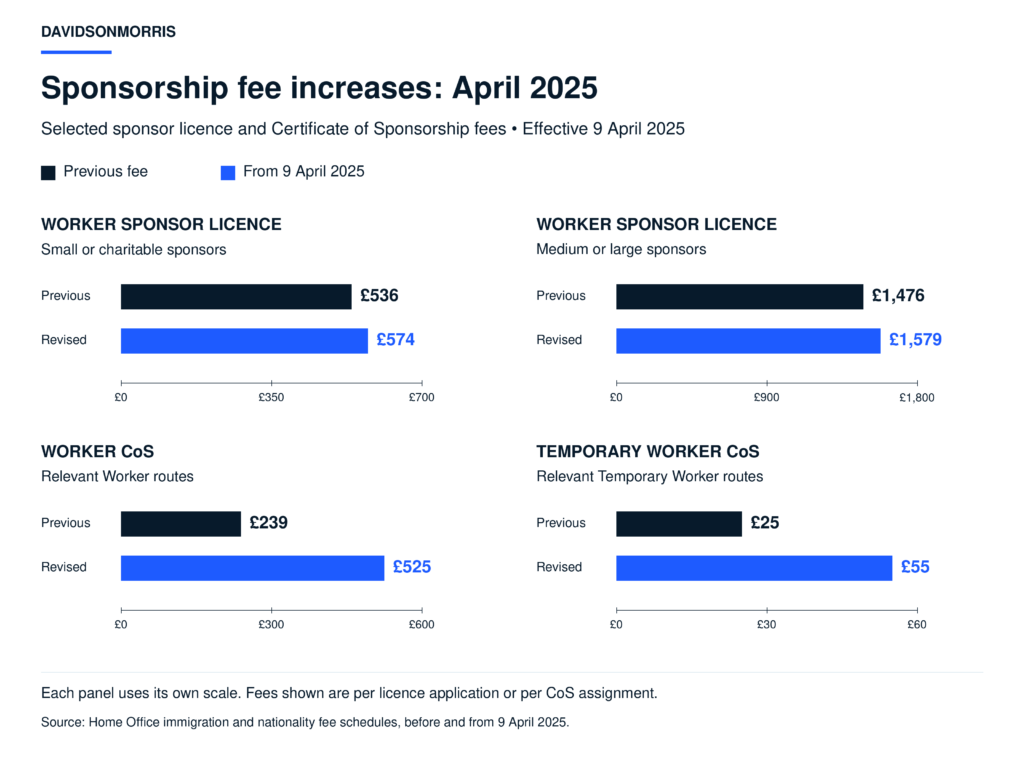
3. April 2025: Extension of Restrictions on Recovering Sponsorship Costs
From 9 April 2025, the Home Office extended restrictions on the recovery of specified sponsorship costs from sponsored workers.
The reforms followed restrictions introduced for Skilled Worker sponsorship from 31 December 2024.
The changes addressed arrangements under which employers sought to transfer certain costs of sponsorship authorisation or Certificate of Sponsorship administration to workers.
The restrictions were not identical for every sponsorship route or category of expenditure.
Employers needed to distinguish between sponsor licence application fees, Certificate of Sponsorship fees, associated administrative costs and the Immigration Skills Charge.
For Skilled Worker sponsorship, restrictions introduced from 31 December 2024 applied to specified licence and CoS costs in the circumstances covered by the guidance.
From 9 April 2025, relevant restrictions were extended to additional Worker and Temporary Worker routes.
The extension included specified restrictions affecting sponsorship under routes such as Global Business Mobility, Minister of Religion, International Sportsperson, Scale-up and Seasonal Worker.
The precise application of a prohibition depended on the sponsorship route, the relevant category of cost and the applicable commencement provisions.
For example, restrictions concerning Certificate of Sponsorship costs could depend on when the certificate was assigned.
Employers therefore needed to consider the relevant effective date rather than assuming that all restrictions applied retrospectively to every existing sponsorship arrangement.
The Immigration Skills Charge was already subject to a separate prohibition on recovery from sponsored workers.
The 2025 reforms extended the categories of sponsorship expenditure that employers could not recover. They did not introduce a prohibition on recovering every immigration-related cost.
The changes were particularly relevant to contractual repayment arrangements.
Employers sometimes include repayment clauses in employment contracts or separate agreements requiring workers to reimburse specified costs if they leave employment within a defined period.
Following the reforms, such arrangements needed to be reviewed to ensure that they did not require repayment of prohibited sponsorship expenditure.
A contractual agreement between employer and worker could not override a restriction imposed by the applicable sponsor guidance.
However, employers should not assume that every immigration-related expense was subject to identical restrictions.
The legal treatment of visa application fees, Immigration Health Surcharge payments, relocation expenditure and other employment-related costs may differ from the treatment of prohibited sponsor licence, CoS and Immigration Skills Charge expenditure.
Employer impact: Sponsors needed to review recruitment contracts, repayment agreements and internal cost policies to ensure that prohibited sponsorship costs were not transferred to workers.
4. April 2025: Additional Care Worker Recruitment Requirements in England
On 9 April 2025, additional recruitment requirements were introduced for relevant care providers in England seeking to sponsor care workers and senior care workers.
The changes required affected sponsors to consider recruitment from the pool of international care workers who had become displaced from previous sponsored employment.
The policy was intended to support workers already in the UK who had lost sponsorship and to reduce reliance on further overseas recruitment while those workers remained available for employment.
Under the relevant arrangements, affected care providers needed to demonstrate that they had followed the prescribed recruitment process before undertaking specified sponsorship activity.
The requirements were connected to the Government’s wider response to concerns about exploitation, poor recruitment practices and sponsor compliance within the adult social care sector.
The change followed the March 2024 introduction of additional CQC registration requirements for relevant care sponsors in England.
However, the April 2025 recruitment provisions were distinct from the CQC requirements.
The CQC provisions concerned the sponsor’s regulatory status and eligibility to sponsor affected care occupations.
The April 2025 measures concerned the recruitment process and the consideration of displaced international care workers.
These arrangements were subsequently superseded by the July 2025 reforms, which closed the affected care occupations to new overseas entry clearance applications and introduced revised in-country sponsorship conditions.
The April recruitment requirements need to be read alongside the later changes.
They should not be presented as an unchanged requirement continuing indefinitely after the July 2025 reforms.
Employer impact: Affected care providers needed to adjust recruitment procedures from April 2025 and then reassess their sponsorship arrangements following the more restrictive July 2025 changes.
5. May 2025: Immigration White Paper Announced Wider Reform
On 12 May 2025, the Government published the immigration white paper, Restoring Control over the Immigration System.
The document set out a programme of proposed reforms affecting sponsored work, skills policy, English language requirements, settlement and immigration compliance.
The white paper indicated that the Government intended to take a more restrictive approach to international recruitment.
Proposals included raising the general occupational skill threshold for Skilled Worker sponsorship, reviewing arrangements for occupations below the revised threshold and strengthening the relationship between overseas recruitment and domestic workforce development.
The white paper also addressed wider immigration policy, including potential changes to settlement requirements.
However, the publication of a white paper does not itself amend the Immigration Rules.
The proposals required implementation through the relevant legal and administrative mechanisms before becoming operative requirements.
Some measures were subsequently introduced through the July 2025 Immigration Rules changes.
Other proposals remained subject to further development, consultation or later implementation.
Employers therefore needed to distinguish the Government’s policy announcements from the requirements actually applicable to sponsorship decisions.
For example, the proposed increase in the Skilled Worker skill threshold did not become an operative requirement simply because it appeared in the May white paper.
The relevant change took effect on 22 July 2025 under the applicable Immigration Rules amendments.
Employers could use the policy direction set out in the white paper to assess potential effects on workforce planning.
Employer impact: Employers needed to assess the potential implications of proposed reforms while continuing to make sponsorship decisions according to the requirements legally in force.
6. July 2025: Skilled Worker Skill Threshold Increased to RQF Level 6
On 22 July 2025, the general occupational skill threshold for new Skilled Worker sponsorship increased from RQF level 3 to RQF level 6.
The reform reversed one of the principal eligibility changes introduced when the Skilled Worker route replaced Tier 2 (General) in December 2020.
Under the initial post-Brexit framework, occupations generally classified at RQF level 3 or above could potentially qualify for Skilled Worker sponsorship, subject to the relevant occupation and other requirements.
From 22 July 2025, the general framework restricted new sponsorship to eligible occupations classified at RQF level 6 or above, subject to specified exceptions.
RQF level 6 broadly corresponds to graduate-level occupational skill classification.
However, the requirement concerns the skill classification of the occupation rather than a universal requirement for every sponsored worker personally to hold a university degree.
Employers needed to assess whether the proposed role fell within an eligible occupation code under the revised framework.
Job titles alone were insufficient to establish eligibility.
Employers needed to assess the actual duties of the role and the relevant occupational classification.
The reform significantly reduced the range of occupations available for new Skilled Worker sponsorship.
However, it did not create an absolute prohibition on every sponsorship arrangement involving an occupation below RQF level 6.
Specified occupations remained eligible under particular list-based arrangements and transitional provisions.
Employers also needed to distinguish between new applicants and qualifying existing sponsored workers.
The fact that an occupation had qualified under the previous RQF level 3 framework did not establish that it remained eligible for a new applicant after 22 July 2025.
Equally, the revised general threshold did not automatically terminate the immigration permission of every existing worker sponsored in an occupation below RQF level 6.
Employer impact: Employers needed to reassess occupational eligibility before undertaking new Skilled Worker recruitment and identify whether any exception or transitional provision applied.
7. July 2025: Skilled Worker Salary Threshold Increased to £41,700
The July 2025 reforms also increased the standard general Skilled Worker salary threshold from £38,700 to £41,700.
The revised threshold took effect on 22 July 2025, subject to the relevant commencement and transitional provisions.
The change followed the substantial salary increase introduced in April 2024.
However, £41,700 was not the minimum salary applicable to every Skilled Worker application.
The Immigration Rules continued to provide different salary options for qualifying applicants.
These options depended on factors including the worker’s immigration circumstances, relevant qualifications, occupation and eligibility for transitional provisions.
The general thresholds introduced under the relevant salary options included:
| Salary option | General threshold from 22 July 2025 | Application |
|---|---|---|
| Option A | £41,700 | Standard general salary option, subject to the applicable going rate. |
| Option B | £37,500 | Specified qualifying applicants, including relevant PhD-related arrangements. |
| Options C, D and E | £33,400 | Specified alternative salary arrangements, subject to individual eligibility requirements. |
| Option F | £31,300 | Specified transitional salary arrangements for qualifying workers. |
| Option G | £28,200 | Specified transitional or alternative arrangements under the relevant rules. |
These figures must not be treated as interchangeable salary thresholds.
Each option has its own eligibility conditions and relevant occupation-specific salary requirements.
Employers must identify the salary option applicable to the worker and ensure that the proposed remuneration satisfies the relevant general threshold and going rate.
Different arrangements also apply to specified health and education occupations and other categories covered by particular salary provisions.
The worker’s immigration history can determine whether transitional salary provisions are available.
A worker who previously qualified under an earlier salary framework may be eligible for different requirements from a new applicant, but only where the conditions for the relevant transitional provision are satisfied.
Employers should not assume that a worker automatically retains every previous salary concession indefinitely.
Nor should they assume that the standard £41,700 threshold applies to every extension or change of employment application.
Employer impact: Employers needed to review salary budgets, occupation-specific going rates and the eligibility conditions for alternative salary options before assigning sponsorship.
8. July 2025: Introduction of the Temporary Shortage List
The July 2025 reforms introduced the Temporary Shortage List as part of the revised Skilled Worker eligibility framework.
The list provided a mechanism through which specified occupations below the new general RQF level 6 threshold could remain eligible for sponsorship under particular conditions.
It was introduced alongside the broader restriction of Skilled Worker sponsorship to occupations generally classified at RQF level 6 or above.
The Temporary Shortage List should be distinguished from the Immigration Salary List introduced in April 2024.
The Immigration Salary List concerns specified salary-related arrangements for listed occupations.
The Temporary Shortage List addresses the eligibility of certain occupations below the revised general skill threshold.
Inclusion on the Temporary Shortage List did not remove the requirement for the worker and employer to satisfy the other applicable immigration and sponsorship conditions.
Relevant salary requirements continued to apply.
Additional restrictions could also affect whether workers sponsored in particular below-RQF6 occupations were permitted to bring dependants.
Employers therefore needed to consider the complete eligibility framework rather than treating inclusion on the list as automatic permission to sponsor.
The temporary nature of the list also meant that employers could not assume that the same occupations would remain eligible indefinitely.
Future changes to list membership or the conditions attached to listed occupations could affect recruitment planning.
Employer impact: Employers recruiting into occupations below RQF level 6 needed to establish whether the role qualified under the Temporary Shortage List or another applicable exception and whether additional conditions applied.
9. July 2025: Transitional Protection for Existing Skilled Workers
The July 2025 reforms included transitional provisions intended to address the position of specified workers who had already obtained immigration permission under earlier Skilled Worker requirements.
The provisions addressed the increase in the general occupational skill threshold from RQF level 3 to RQF level 6.
Without transitional arrangements, workers previously sponsored in occupations below the new threshold could have faced substantial difficulties when seeking further permission.
The Immigration Rules therefore provided specified arrangements for qualifying existing Skilled Workers.
However, transitional eligibility depended on the worker’s circumstances and the conditions set out in the relevant provisions.
The fact that an individual had previously worked in an occupation below RQF level 6 was not, by itself, sufficient to establish eligibility for every subsequent application.
Employers needed to consider the worker’s immigration history, the timing of relevant applications and whether the individual satisfied the applicable continuity or other requirements.
The commencement provisions also addressed specified applications supported by Certificates of Sponsorship assigned before 22 July 2025.
Consequently, the date on which a Certificate of Sponsorship was assigned could be relevant to determining which requirements applied.
However, employers should not assume that assigning a Certificate of Sponsorship before the reform automatically preserved every previous requirement in all circumstances.
The effect depended on the wording of the applicable commencement and transitional provisions.
Separate transitional salary arrangements could also apply to qualifying workers.
Employers therefore needed to consider occupational eligibility and salary eligibility together.
For example, a worker who qualified for continued sponsorship in an occupation below RQF level 6 might still need to satisfy a particular salary option and occupation-specific going rate.
Historical sponsorship decisions should be assessed under the requirements applicable at the relevant time.
Subsequent extensions or changes of employment needed to be assessed under the provisions governing those applications, including any available transitional protection.
Employer impact: Employers needed to review the immigration history and applicable transitional provisions for existing sponsored workers before proceeding with extensions or changes of employment.
10. July 2025: Closure of New Overseas Care Worker Recruitment
On 22 July 2025, the Government closed the affected care worker and senior care worker occupations to new overseas entry clearance applications under the Skilled Worker route.
The reform represented a substantial reversal of the February 2022 expansion of care worker sponsorship.
Between February 2022 and July 2025, qualifying care providers had been able to recruit eligible workers from overseas into the relevant occupations, subject to the immigration and sponsorship requirements.
The July 2025 reforms ended that route for new overseas entry clearance applications.
However, the changes did not immediately prohibit every form of sponsorship involving care workers already in the UK.
Specified in-country and transitional arrangements remained available.
These included provisions for qualifying existing Skilled Workers in the affected occupations and certain individuals already working legally for the sponsoring employer.
For relevant in-country switching arrangements, the rules included a requirement for the worker to have undertaken qualifying employment for the sponsor for at least three months before the relevant application.
The three-month employment provision was subject to specified conditions and a transitional period ending on 22 July 2028.
Employers therefore needed to distinguish between a new applicant seeking entry clearance from overseas and an individual already in the UK who might qualify under the relevant in-country provisions.
The reform also interacted with the care sector restrictions introduced in March 2024 and April 2025.
Those earlier changes had restricted dependant eligibility, introduced additional CQC-related sponsorship requirements and imposed temporary recruitment requirements concerning displaced international care workers.
The July 2025 closure changed the recruitment options available to care providers.
Employers could no longer assume that overseas recruitment into the affected care occupations remained available simply because the organisation held a sponsor licence.
The sponsor licence itself did not override restrictions imposed by the Immigration Rules on the relevant occupation or application category.
Employer impact: Care providers needed to discontinue affected new overseas recruitment arrangements and assess whether proposed in-country sponsorship qualified under the relevant transitional provisions.
11. July 2025: Restrictions Affecting Dependants of Certain Skilled Workers
The July 2025 reforms also introduced restrictions affecting dependant eligibility for certain workers sponsored in occupations below RQF level 6.
The changes accompanied the revised occupational skill threshold and the introduction of arrangements allowing specified below-RQF6 occupations to remain eligible for sponsorship.
However, eligibility for the principal applicant to obtain Skilled Worker permission did not necessarily mean that their partner or children could qualify for dependant permission.
Additional restrictions applied to specified categories of workers, subject to the relevant exceptions and transitional provisions.
Employers therefore needed to distinguish between the worker’s eligibility for sponsorship and the separate immigration requirements governing dependants.
Dependant eligibility could also affect whether an overseas candidate accepted a role.
Workers considering relocation to the UK could base their decision on whether family members would be permitted to accompany them.
Incorrect information about dependant eligibility could therefore affect recruitment decisions and workforce planning.
The July 2025 restrictions should also be distinguished from the earlier dependant restrictions introduced for care workers and senior care workers in March 2024.
Although both reforms affected family migration, they applied under different provisions and commencement arrangements.
Employers needed to consider the occupation, application date, worker’s immigration history and any applicable transitional provisions.
Employer impact: Employers recruiting into affected occupations needed to ensure that information provided to prospective workers accurately reflected the applicable dependant restrictions.
12. December 2025: Immigration Skills Charge Increased
On 16 December 2025, the Immigration Skills Charge increased under the Immigration Skills Charge (Amendment) Regulations 2025.
The reform increased the charge payable by employers sponsoring qualifying workers, subject to the applicable exemptions.
For medium and large sponsors, the annual charge increased from £1,000 to £1,320.
For qualifying small or charitable sponsors, the annual charge increased from £364 to £480.
The charge for each additional six-month period increased from £500 to £660 for medium and large sponsors and from £182 to £240 for qualifying small or charitable sponsors.
The revised rates represented an increase of approximately 32% for medium and large sponsors and approximately 31.9% for small or charitable sponsors.
The Immigration Skills Charge remained separate from the sponsor licence application fee and Certificate of Sponsorship fee.
The amount payable depended on the duration of sponsorship, the sponsor’s classification and the relevant exemptions.
The following table compares the previous and revised charge rates.
| Sponsor category | Before 16 December 2025 | From 16 December 2025 |
|---|---|---|
| Small or charitable sponsor: first 12 months | £364 | £480 |
| Small or charitable sponsor: each additional six months | £182 | £240 |
| Medium or large sponsor: first 12 months | £1,000 | £1,320 |
| Medium or large sponsor: each additional six months | £500 | £660 |
The additional cost increased with the duration of sponsorship.
For example, a medium or large sponsor assigning a qualifying Certificate of Sponsorship for five years would previously have paid an Immigration Skills Charge of £5,000.
At the revised rate, the equivalent charge became £6,600.
This represented an additional £1,600 for a single qualifying five-year sponsorship arrangement.
For an employer sponsoring ten qualifying workers for five years, the aggregate Immigration Skills Charge increased from £50,000 to £66,000.
The reform therefore had substantial implications for employers undertaking larger international recruitment programmes.
However, the charge did not apply to every sponsored worker or every immigration route.
Specified exemptions remained relevant, and employers needed to assess whether the charge was payable under the rules applicable to the proposed sponsorship.
The Immigration Skills Charge was an employer liability and could not lawfully be recovered from the sponsored worker.
The December 2025 increase also needs to be distinguished from the April 2025 increases to sponsor licence and Certificate of Sponsorship fees.
Although both reforms increased employer sponsorship expenditure, they concerned separate charges and took effect on different dates.
Employer impact: Employers needed to revise international recruitment budgets to reflect the higher Immigration Skills Charge, particularly for longer sponsorship periods and recruitment programmes involving multiple workers.
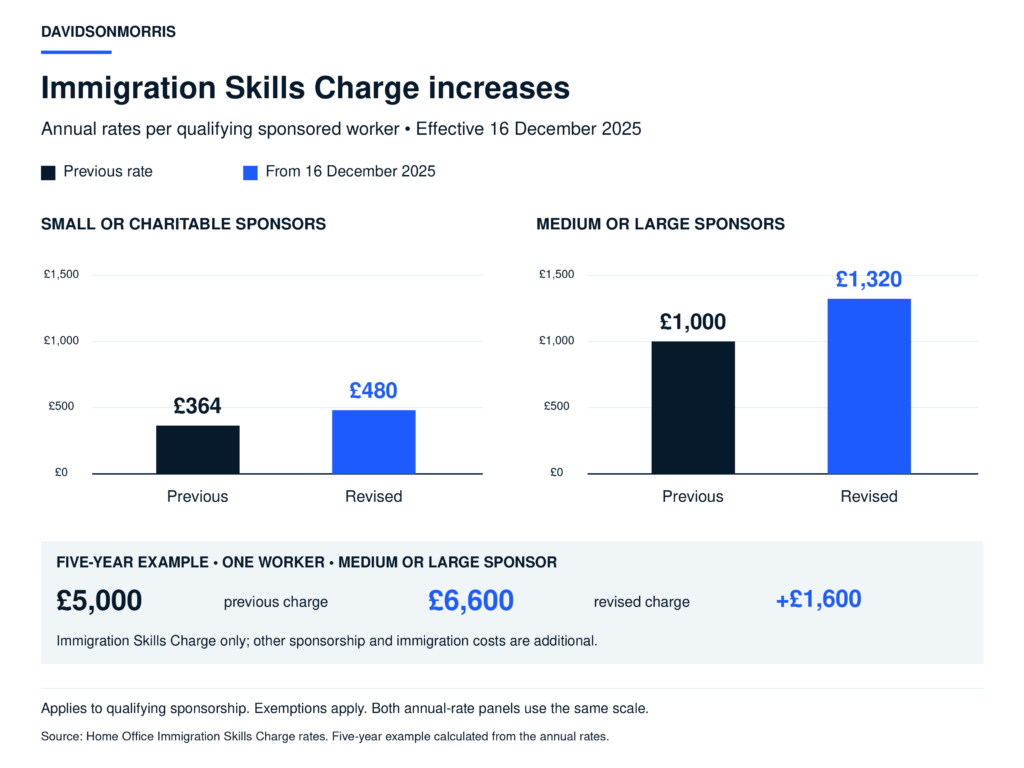
13. Comparison: Sponsorship Costs Before and After the 2025 Reforms
The combined effect of the April and December 2025 reforms was a substantial increase in the direct costs associated with qualifying employer sponsorship.
The following table compares the principal charges before and after the relevant 2025 changes.
| Charge | Previous rate | Rate following 2025 reform | Effective date |
|---|---|---|---|
| Worker sponsor licence: small or charitable | £536 | £574 | 9 April 2025 |
| Worker sponsor licence: medium or large | £1,476 | £1,579 | 9 April 2025 |
| Relevant Worker Certificate of Sponsorship | £239 | £525 | 9 April 2025 |
| Relevant Temporary Worker Certificate of Sponsorship | £25 | £55 | 9 April 2025 |
| Immigration Skills Charge: small or charitable, annual | £364 | £480 | 16 December 2025 |
| Immigration Skills Charge: medium or large, annual | £1,000 | £1,320 | 16 December 2025 |
The 2025 reforms increased several separate sponsorship charges.
Employers applying for new licences faced higher authorisation fees.
Organisations assigning Certificates of Sponsorship faced substantially higher per-certificate charges.
Employers sponsoring qualifying workers also faced increased Immigration Skills Charge expenditure from December 2025.
The combined financial effect depended on the sponsor’s size, the immigration route, the number of workers and the proposed duration of sponsorship.
Employers should therefore distinguish the cost of obtaining a sponsor licence from the cost of sponsoring an individual worker.
The relevant fees and charges also need to be considered alongside other expenditure associated with international recruitment.
14. How the 2025 Reforms Affected Employer Recruitment Planning
The 2025 reforms affected the commercial viability and practical administration of international recruitment.
For employers recruiting into occupations below RQF level 6, the July changes created a new eligibility barrier.
Roles that had qualified under the previous Skilled Worker framework could cease to be eligible for new sponsorship unless an exception or transitional provision applied.
For employers recruiting into occupations that remained eligible, the increased salary requirements could affect recruitment budgets and internal pay structures.
Where a business employed both sponsored and non-sponsored workers in comparable roles, the revised salary requirements could also create wider workforce planning considerations.
The April and December cost increases added further financial pressure.
Employers needed to consider the sponsor licence fee where new authorisation was required, the Certificate of Sponsorship fee for each relevant assignment and the Immigration Skills Charge for qualifying sponsorship.
The restrictions on recovering sponsorship costs also affected how those expenses could be allocated.
Care providers faced further restrictions because the July 2025 reforms closed the affected occupations to new overseas entry clearance applications.
For existing sponsored workers, transitional provisions created additional complexity.
Employers needed to consider whether a worker qualified for continued sponsorship under the relevant occupational and salary arrangements.
These assessments could not safely be made by applying the headline RQF level 6 and £41,700 requirements without considering exceptions.
Organisations therefore needed more detailed workforce planning and immigration compliance procedures.
Recruitment teams, HR departments, finance personnel and those responsible for sponsor licence administration needed to coordinate decisions about eligibility, costs and immigration timing.
Employer impact: International recruitment increasingly required integrated consideration of occupational eligibility, salary requirements, sponsorship expenditure and the immigration position of individual workers.
15. Summary: How the 2025 Reforms Changed Employer Sponsorship
The reforms introduced during 2025 substantially changed both the accessibility and cost of UK employer sponsorship.
The principal developments were:
- Sponsor licence fees: Worker sponsor licence application fees increased on 9 April 2025.
- Certificate of Sponsorship fees: Relevant Worker CoS fees increased from £239 to £525, while specified other CoS fees also increased.
- Cost recovery restrictions: Additional prohibitions limited the recovery of specified sponsorship costs from workers across relevant sponsorship routes.
- Care sector recruitment: Additional recruitment requirements were introduced in England in April 2025 before being superseded by the July reforms.
- Immigration white paper: The Government announced a wider programme of proposed immigration reforms in May 2025.
- Occupational eligibility: The general Skilled Worker skill threshold increased from RQF level 3 to RQF level 6 on 22 July 2025.
- Salary requirements: The standard general Skilled Worker salary threshold increased to £41,700, subject to alternative salary options and transitional provisions.
- Temporary Shortage List: Specified occupations below RQF level 6 remained eligible under particular conditions.
- Transitional protection: Qualifying existing Skilled Workers could benefit from specified arrangements concerning continued sponsorship.
- Care worker sponsorship: New overseas entry clearance applications for affected care occupations were closed from 22 July 2025, with specified in-country exceptions.
- Dependant restrictions: Additional restrictions affected certain workers sponsored in occupations below RQF level 6.
- Immigration Skills Charge: The annual charge increased to £480 for qualifying small or charitable sponsors and £1,320 for medium or large sponsors from 16 December 2025.
Employers had fewer recruitment options and higher costs than under the Skilled Worker framework introduced in December 2020.
The general occupational skill threshold had returned to RQF level 6, while salary requirements and direct sponsorship costs had increased substantially.
However, the 2025 reforms did not remove the underlying sponsor licence framework or create a single set of requirements applicable identically to every sponsored worker.
Employers continued to need careful assessment of the relevant immigration route, occupation code, salary option, application date and transitional provisions.
Employers also had to account for the further administrative and compliance changes introduced in 2026.
Section F: 2026: Sponsor Guidance, SMS Security and Compliance Changes
During 2026, the emphasis of UK sponsorship reform shifted towards the administration, security and governance of existing sponsor licences, alongside wider changes to the prevention of illegal working.
Unlike the major Skilled Worker eligibility reforms introduced in July 2025, the principal sponsor administration changes in 2026 did not generally involve a further wholesale restructuring of occupational skill thresholds or the sponsor licence system.
Instead, the Home Office updated sponsor guidance, introduced stronger security arrangements for the Sponsor Management System (SMS), began phasing out Level 2 User accounts and introduced procedures addressing inactive SMS users.
From 1 October 2026, the statutory right to work checking framework also extended to additional categories of working arrangements, including specified worker contracts, individual subcontractors and online matching services.
Further changes were scheduled for 29 October 2026, affecting sponsorship under the Religious Worker route.
Employers needed to maintain sponsorship governance after obtaining a licence. Authorised personnel needed access to the SMS, user accounts needed to remain accurate and active, and right to work procedures needed to reflect the applicable legal requirements.
Employers also needed to identify whether a change arose from legislation, the Immigration Rules or Home Office operational guidance.
1. March 2026: Sponsor Guidance and SMS Administration Updates
In March 2026, the Home Office updated its published guidance concerning the Sponsor Management System and the administration of user access.
The revised introductory SMS manual clarified aspects of managing access and included updates to the arrangements for reporting changes in a sponsor’s circumstances.
These updates changed the published instructions for administering an existing sponsor licence.
Revised guidance may explain existing procedures without introducing a new statutory sponsorship obligation.
Not every guidance update creates a new legal requirement. Some amendments explain existing procedures, remove outdated references or clarify how sponsors should comply with obligations already in force.
Employers need to assess what the update changes in their own sponsorship procedures.
A revision to the process for requesting a new SMS user, for example, may require an administrative response without changing the eligibility requirements for the workers being sponsored.
Similarly, changes to guidance concerning sponsor suitability may clarify how the Home Office assesses existing criteria rather than creating an entirely new category of disqualification.
Employers reviewing a historical sponsorship decision should therefore identify the version of the guidance applicable at the relevant date.
Archived guidance can help establish whether a requirement existed when an earlier decision was made.17
The Home Office maintains publication histories for relevant sponsor guidance, while older versions can be accessed through the National Archives where available.
Employer impact: Sponsors needed to maintain awareness of changes to published administrative guidance and update internal procedures where the revised instructions affected their sponsorship activities.
2. August 2026: Announcement of Major SMS User Changes
On 28 August 2026, the Home Office published updated sponsor licence guidance announcing changes to SMS user account management.
The guidance introduced three changes:
- The phased introduction of mandatory multi-factor authentication for SMS users from 3 September 2026.
- The withdrawal of the ability to appoint new Level 2 Users from 9 September 2026, followed by the removal of the role after 8 March 2027.
- New procedures for identifying and managing inactive SMS user accounts.
These changes affected the administration of sponsor licences rather than the fundamental eligibility requirements for Skilled Worker sponsorship.
These changes affected access to the SMS, the principal system employers use to carry out sponsorship functions.
These functions include assigning Certificates of Sponsorship, submitting specified reports and maintaining relevant sponsor licence information.
Employers therefore need sufficient authorised personnel with appropriate system access.
A sponsor that cannot access its SMS account may be unable to complete time-sensitive sponsorship activities.
Employers needed accurate user details and access arrangements that did not depend on people who had left the organisation or no longer managed sponsorship.
Employer impact: Organisations needed to review SMS user accounts, assess the implications of the Level 2 User phase-out and prepare for stronger account authentication requirements.
3. September 2026: Mandatory Multi-Factor Authentication for SMS Users
From 3 September 2026, the Home Office began introducing mandatory multi-factor authentication (MFA) for users of the Sponsor Management System.
The implementation was phased rather than applied simultaneously to every existing sponsor.
The Home Office indicated that mandatory MFA was expected to be introduced across existing sponsors by November 2026.
For organisations granted a sponsor licence on or after 9 September 2026, mandatory MFA was enabled under the revised arrangements.
Multi-factor authentication adds an additional verification step when an authorised user accesses the SMS.
Instead of relying solely on a username and password, the user must also provide a one-time passcode sent to the contact details registered with the Home Office.
The applicable verification method depends on the user’s account details and role.
For Level 1 Users with a valid registered mobile telephone number, the passcode is generally sent by text message.
Where a Level 1 User does not have a valid mobile number, email verification arrangements may apply.
Existing Level 2 Users also require valid registered email details during the transitional period.
Level 1 Users may additionally need to verify their date of birth in specified circumstances.
Users therefore need accurate registered information to complete authentication.
An outdated mobile number, inaccessible email account or incorrect personal information may prevent an authorised user from completing the authentication process.
For sponsors, this creates a direct connection between routine personnel administration and the ability to perform immigration sponsorship functions.
For example, where the organisation’s only active Level 1 User cannot access the SMS, the sponsor may experience difficulties assigning Certificates of Sponsorship or submitting required reports.
SMS accounts remain personal to the authorised user under the MFA arrangements.
Employers should not treat an individual’s login credentials as a shared organisational account.
Account access should be limited to appropriately authorised users, with procedures for updating permissions when responsibilities change.
Employer impact: Sponsors needed to verify the contact and personal details of SMS users, ensure that individuals could complete MFA and maintain sufficient authorised access for essential sponsorship functions.
4. September 2026: Withdrawal of New Level 2 User Appointments
From 9 September 2026, sponsors could no longer appoint new Level 2 Users to the Sponsor Management System.
Before the change, the SMS framework allowed organisations to appoint Level 1 Users and, where appropriate, Level 2 Users with more restricted permissions.
Level 1 Users were responsible for the principal day-to-day administration of the sponsor licence through the SMS.
Level 2 Users had a narrower range of permissions, including specified Certificate of Sponsorship assignment and worker reporting functions.
The September 2026 change began the removal of the Level 2 User role.
Existing Level 2 Users were not all immediately removed on 9 September 2026.
Instead, the Home Office introduced transitional arrangements allowing sponsors time to review existing accounts and determine whether continued SMS access was necessary.
Where an existing Level 2 User continued to require access and satisfied the requirements for appointment as a Level 1 User, the sponsor could arrange for the account to be converted.
Where continued access was unnecessary or the individual did not qualify for Level 1 User status, the account needed to be deactivated.
The change therefore required more than a simple administrative renaming of user roles.
Level 1 Users have broader permissions and are subject to the applicable eligibility requirements.
Employers needed to assess whether the proposed individual was suitable for the responsibilities associated with that role.
The reform also affected organisations that had relied on Level 2 Users to distribute routine sponsorship administration across HR or recruitment teams.
Such organisations needed to consider whether their existing Level 1 User arrangements provided sufficient operational capacity.
Employer impact: Sponsors could no longer appoint new Level 2 Users and needed to begin reviewing whether existing users should be converted to Level 1 status or deactivated.
5. March 2027 Deadline for Existing Level 2 Users
The September 2026 Level 2 User reform included a future implementation deadline.
Existing Level 2 Users must be converted to Level 1 Users, where eligible and required, or have their accounts deactivated by 8 March 2027.
After that date, the Home Office will deactivate remaining Level 2 User accounts.
As at 23 October 2026, the deadline had not yet passed.
The prohibition on appointing new Level 2 Users was already in force, while the final removal of existing Level 2 accounts remained a future event.
Employers therefore had a transitional period in which to review user permissions and complete the necessary administrative changes.
However, sponsors should not assume that every existing Level 2 User can automatically be converted to Level 1 status.
The individual must satisfy the applicable eligibility requirements.
The sponsor also needs to consider whether granting broader permissions is appropriate for the person’s responsibilities.
For example, an employee previously authorised only to assign certain Certificates of Sponsorship may not require the full range of Level 1 User permissions.
Where that employee no longer needs access, the sponsor may need to deactivate the account.
Where the individual performs essential sponsorship functions, the organisation may need to appoint or retain another suitable Level 1 User.
Employers should also consider operational continuity.
If a sponsor relies heavily on a small number of users, account changes can affect its ability to meet reporting deadlines and manage sponsorship activity.
Employer impact: Sponsors needed to complete a structured review of existing Level 2 accounts before 8 March 2027 and ensure that appropriate Level 1 User arrangements would remain in place.
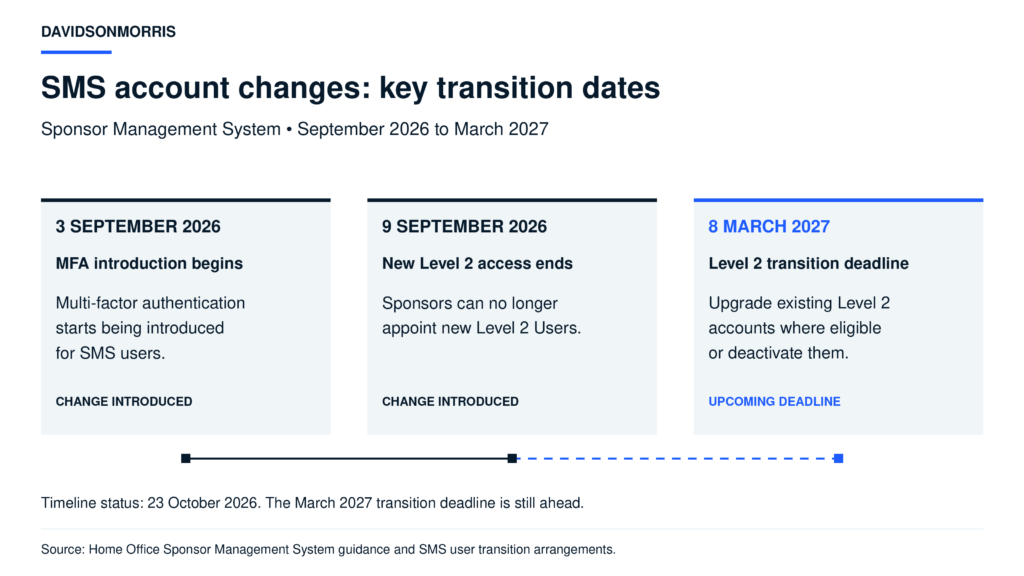
6. September 2026: New Procedures for Inactive SMS Accounts
The August 2026 sponsor guidance update also introduced procedures addressing inactive Sponsor Management System user accounts.
The Home Office indicated that inactive accounts would be subject to review and potential removal.
These changes were intended to strengthen account security and ensure that sponsors maintained appropriate control over authorised users.
Inactive accounts can arise for several reasons.
An employee may leave the organisation without their access being removed.
A user may change responsibilities and no longer require sponsorship permissions.
Alternatively, an organisation may retain accounts for individuals who rarely access the system or whose contact information is no longer accurate.
Such arrangements create both administrative and security risks.
An organisation may believe that it has sufficient authorised users when, in practice, some accounts are inaccessible or no longer controlled by appropriate personnel.
The Home Office guidance therefore places greater emphasis on reviewing user access and keeping account details up to date.
The guidance recommends that a Level 1 User accesses the SMS at least once a month.
This recommendation should be distinguished from a universal statutory requirement to log in on a particular date each month.
Nevertheless, regular access supports compliance by allowing sponsors to review messages, account information and relevant administrative requirements.
The Home Office guidance identifies circumstances in which failure to maintain appropriate SMS users may place the sponsor licence at risk.
Managing inactive accounts also affects sponsor compliance.
It forms part of the wider governance arrangements associated with holding sponsorship authorisation.
Employer impact: Sponsors needed to identify inactive users, remove unnecessary access, maintain accurate account information and ensure that sufficient eligible personnel could administer the licence.
7. October 2026: Updated Right to Work Checking Requirements
On 1 October 2026, changes to the right to work framework extended relevant checking responsibilities beyond traditional contracts of employment to specified additional working arrangements.
The revised arrangements covered individuals engaged under qualifying worker contracts, individual subcontractors and specified online matching service arrangements.
The statutory right to work framework had historically focused principally on individuals employed under contracts of employment.
The expanded arrangements required affected organisations to consider whether their responsibilities extended to individuals who were not employees in the traditional contractual sense.
For example, an organisation engaging an individual to provide personal services under a qualifying worker contract could fall within the revised framework.
Similarly, the changes addressed specified arrangements involving individual subcontractors.
Online matching services providing details of individual service providers to potential customers were also brought within the relevant provisions.
However, the revised framework should not be interpreted as imposing identical checking duties on every commercial relationship involving an independent business or supplier.
The scope depends on the statutory definitions and the nature of the working arrangement.
Employers and other affected organisations need to establish whether the arrangement falls within the categories covered by the relevant legislation and guidance.
The Home Office also published revised right to work guidance and an updated code of practice on avoiding unlawful discrimination.14
The revised code applies to relevant employment commencing on or after 1 October 2026 and to applicable repeat checks undertaken from that date.
Sponsors need to assess right to work compliance alongside their separate sponsorship obligations.
Holding a sponsor licence does not remove the requirement to conduct prescribed right to work checks.
Equally, an organisation may have right to work responsibilities even where it does not sponsor any workers.
The October 2026 reforms therefore had implications extending beyond the population of licensed sponsors.
Employer impact: Businesses needed to review the categories of individuals they engaged and determine whether their right to work checking procedures covered the additional working arrangements within the revised framework.
8. October 2026: Right to Work Compliance and Sponsor Licence Risk
Organisations holding sponsor licences also need to comply with applicable right to work requirements.
Employers must ensure that individuals undertaking employment have permission to perform the relevant work in the UK.
Failure to comply with applicable right to work requirements can expose an organisation to civil penalties and, in more serious circumstances, criminal liability.
For licensed sponsors, illegal working concerns may also have implications for sponsor licence suitability and continuing compliance.
The Home Office can consider relevant breaches when assessing whether an organisation remains suitable to hold sponsorship authorisation.
Following the October 2026 expansion, organisations also needed to review arrangements involving individuals outside conventional employment contracts.
However, the legal consequences depend on the applicable statutory provisions and the facts of the particular arrangement.
An organisation should not assume that every subcontracting relationship is treated identically.
Nor should it assume that an individual has an unrestricted right to work merely because they are described as self-employed or engaged through a platform.
The relevant immigration permission must allow the work being undertaken.
Where the prescribed requirements apply, carrying out the appropriate check can establish a statutory excuse against liability for a civil penalty.
Employers must also ensure that checks are conducted consistently and without unlawful discrimination.
The revised Home Office code of practice provides guidance on avoiding discriminatory practices when checking immigration status.
Right to work compliance concerns both immigration requirements and the way an organisation manages its workforce.
Employer impact: Licensed sponsors needed to review right to work policies alongside sponsorship procedures, particularly where their workforce included contractors, personally engaged workers or platform-based service providers.
9. October 2026: Updated Home Office Sponsor Guidance
In October 2026, the Home Office updated its published sponsor guidance to reflect changes to the Immigration Rules and the revised right to work framework.
The updates included references to changes taking effect on 8 October 2026 and provisions scheduled to take effect on 29 October 2026.
Employers need to identify the commencement date of each underlying requirement separately from the publication date of the guidance.
A single version of Home Office guidance may refer to provisions that are already in force and others that will apply only to applications made on or after a future date.
Employers should therefore not assume that every change described in an updated guidance document became operative on the date the document was published.
The same principle applies when reviewing historical sponsorship decisions.
The relevant version of the Immigration Rules and sponsor guidance should be identified by reference to the date of the application or sponsorship activity.
Where guidance has been revised, the employer may need to consult archived versions to establish the requirements that applied previously.
For example, the Home Office may remove references to an obligation because it is being abolished for future applications.
The absence of a requirement from current guidance does not necessarily mean that the requirement was never applicable.
Employer impact: Sponsors needed to monitor guidance updates, identify the effective dates of substantive changes and avoid applying future provisions prematurely.
10. October 2026: Scheduled Changes to Religious Worker Sponsorship
Changes to the Temporary Work – Religious Worker route were scheduled to take effect on 29 October 2026.
As at 23 October 2026, these changes had not yet commenced.
The reforms included changes to the resident labour consideration requirements applicable to the route.
Under the previous arrangements, sponsors were required to satisfy specified resident labour consideration provisions, including relevant advertising requirements.
The revised framework was designed to remove the advertising requirement and replace it with an affiliation requirement intended to demonstrate an established connection with the sponsoring faith-based organisation.
The change revised the recruitment requirements for this route.
It should not be confused with the abolition of the resident labour market test for Skilled Worker sponsorship in December 2020.
Although both reforms concerned recruitment-related requirements, they applied to different immigration routes and at different times.
The October 2026 changes also included amendments concerning financial requirements for specified religious workers and their dependants.
Employers and religious organisations needed to distinguish applications made before 29 October 2026 from those governed by the revised arrangements.
For applications submitted before the commencement date, the previous applicable requirements continued to be relevant.
The Home Office sponsor guidance specifically identified the need to consult the earlier Religious Worker guidance for relevant applications made before 29 October 2026.
Organisations should therefore avoid applying the revised affiliation requirement retrospectively to earlier sponsorship decisions.
Employer impact: Religious organisations sponsoring workers under the affected route needed to identify the application date and apply the appropriate recruitment and eligibility requirements.
11. Comparison: Principal Sponsor Administration Changes in 2026
The following table summarises the principal changes to sponsor administration and related employer compliance requirements during 2026.
| Date | Change | Previous position | Revised position | Employer action |
|---|---|---|---|---|
| March 2026 | SMS guidance updates | Earlier published administrative instructions | Revised guidance on SMS access and related procedures | Review changes relevant to internal administration |
| 28 August 2026 | Publication of revised sponsor guidance | Previous SMS user arrangements | Announcement of MFA, Level 2 phase-out and inactive user procedures | Review user accounts and prepare for implementation |
| 3 September 2026 | Mandatory MFA phased introduction | Existing login arrangements | Additional verification required as MFA is enabled | Check registered user details and access |
| 9 September 2026 | New Level 2 appointments prohibited | New Level 2 Users could be appointed | No new Level 2 appointments | Review account permissions and staffing arrangements |
| September 2026 onward | Inactive SMS account management | Previous account management arrangements | Enhanced procedures for identifying and removing inactive users | Maintain active and accurate SMS user records |
| 1 October 2026 | Expanded right to work framework | Checking duties focused principally on traditional employment arrangements | Specified additional worker, subcontractor and online matching arrangements covered | Review workforce engagement and checking procedures |
| October 2026 | Updated sponsor guidance | Earlier guidance versions | Guidance reflecting operative and scheduled Immigration Rules changes | Identify the applicable effective date |
| 29 October 2026 | Scheduled Religious Worker changes | Previous resident labour consideration requirements | Revised affiliation-based arrangements for relevant applications | Apply the appropriate rules according to application date |
| 8 March 2027 | Final Level 2 transition deadline | Existing Level 2 accounts remain during transition | Accounts must be converted where eligible or deactivated | Complete account review before the deadline |
The principal 2026 reforms covered sponsor administration, system security and wider workforce compliance.
They did not generally replace the sponsor licence framework or introduce a further universal increase in the Skilled Worker occupational skill threshold.
Nevertheless, the reforms created new operational requirements for organisations managing sponsorship authorisation.
12. What Employers Needed to Review Following the 2026 Changes
The 2026 changes created several practical priorities for organisations holding sponsor licences.
First, employers needed to review the accuracy of their SMS user records.
Registered telephone numbers, email addresses and other required details needed to support the revised MFA arrangements.
Second, sponsors needed to identify existing Level 2 Users and determine whether each account should be converted to Level 1 status or deactivated.
Where conversion was proposed, the individual needed to satisfy the applicable Level 1 User requirements.
Third, organisations needed to ensure that sufficient active SMS users remained available to carry out essential sponsorship functions.
This included assigning Certificates of Sponsorship, maintaining relevant licence information and submitting required reports.
Fourth, employers needed procedures for reviewing inactive accounts and removing access that was no longer appropriate.
Fifth, businesses affected by the October 2026 right to work reforms needed to consider whether their checking procedures covered the additional categories of working arrangements.
Sixth, organisations sponsoring under specialist routes needed to identify route-specific changes and their commencement dates.
For Religious Worker sponsorship, this included distinguishing the requirements applicable before and after 29 October 2026.
Finally, employers needed to ensure that immigration compliance policies were based on the current applicable rules rather than outdated guidance or future proposals.
These priorities should be considered alongside the sponsor’s continuing obligations to maintain records, report specified changes and ensure that sponsored employment satisfies the relevant requirements.
Employer impact: Sponsors needed to manage authorised personnel, SMS security and workforce compliance procedures as part of their continuing licence administration.
13. Summary: How the 2026 Reforms Changed Employer Sponsorship
The principal sponsorship developments during 2026 concerned administration, security and the wider compliance environment rather than another comprehensive restructuring of Skilled Worker eligibility.
The key developments were:
- SMS guidance: Updated Home Office instructions clarified aspects of user access and sponsorship administration.
- Multi-factor authentication: Mandatory MFA began phased implementation from 3 September 2026.
- Level 2 Users: New appointments ceased from 9 September 2026.
- Transition deadline: Existing Level 2 accounts must be converted where eligible or deactivated by 8 March 2027.
- Inactive accounts: Sponsors became subject to revised procedures concerning inactive SMS users.
- Right to work: The statutory checking framework expanded to specified additional working arrangements from 1 October 2026.
- Guidance updates: October 2026 publications reflected changes already in force and further reforms scheduled for implementation.
- Religious Worker route: Changes to resident labour consideration and related requirements were scheduled for 29 October 2026.
Employers needed reliable compliance systems to carry out the revised licence administration procedures.
Holding valid authorisation did not, by itself, satisfy all the sponsor’s immigration compliance responsibilities.
Organisations also needed to maintain accurate records, ensure that authorised users could access the SMS and comply with the requirements applicable to their workforce.
Changes in 2026 took effect at different times and arose through legislation, the Immigration Rules, sponsor guidance and administrative procedures.
Employers reviewing historical decisions should therefore identify both the nature of the change and the date on which the relevant requirement became applicable.
Section G: How Sponsor Licence Requirements Changed Across 2008–2026
The UK sponsorship framework has changed substantially since its introduction in November 2008. However, the reforms have not affected every aspect of sponsorship in the same way.
Some changes have altered which employers can obtain or retain a sponsor licence. Others have changed which occupations qualify for sponsorship, the salaries employers must pay, the costs associated with international recruitment or the procedures for administering an existing licence.
Throughout the period, the underlying principle has remained consistent: organisations wishing to sponsor workers under relevant immigration routes must hold appropriate Home Office authorisation and comply with the conditions attached to that authorisation.
The most substantial changes have concerned the scope of eligible employment, the financial requirements associated with sponsorship and the administrative processes used to manage sponsored workers.
Historical reviews need to assess the employer’s authorisation and the individual worker’s immigration requirements separately.
1. Employer Eligibility: From Tier 2 Authorisation to the Modern Sponsor Licence
When sponsor licensing was introduced in November 2008, employers seeking to recruit workers under relevant Tier 2 categories generally needed to demonstrate that they were genuine organisations capable of meeting their sponsorship obligations.
The Home Office assessed matters including the organisation’s business activities, suitability and ability to maintain appropriate immigration compliance systems.
These principles continued under the Skilled Worker framework introduced in December 2020.
Although the immigration routes changed, the requirement for the employer to demonstrate suitability and compliance capability remained.
Employers continued to be assessed against requirements concerning their lawful operation, relevant personnel, sponsorship systems and compliance history.
Some sectors also became subject to additional regulatory conditions.
For example, the March 2024 reforms introduced additional CQC registration requirements for relevant care providers in England seeking to sponsor care workers and senior care workers.
Sponsor eligibility can therefore depend on both the general sponsorship framework and regulation of the employer’s activities.
However, changes to occupational eligibility do not necessarily alter an organisation’s underlying eligibility to hold a sponsor licence.
For example, the July 2025 increase in the general Skilled Worker skill threshold did not mean that every existing sponsor needed to obtain a new licence.
Instead, it changed which occupations could qualify for new sponsorship under the revised Immigration Rules.
A sponsor may remain appropriately licensed while being unable to sponsor a particular proposed role.
Historical comparison: Employer suitability and the ability to comply with sponsorship duties have remained central requirements since 2008, while the immigration routes and certain sector-specific eligibility conditions have changed.
2. Occupational Eligibility: Tier 2, RQF3 and the Return to RQF6
Occupational eligibility has been one of the most substantially revised aspects of UK employer sponsorship.
Under the later Tier 2 (General) framework, the general occupational skill threshold was ordinarily RQF level 6, subject to specified exceptions.
The introduction of the Skilled Worker route in December 2020 reduced the general threshold to RQF level 3.
This expanded the range of occupations potentially eligible for sponsorship.
Following the end of EU free movement, employers could consider sponsorship for a wider range of roles.
However, the wider eligibility framework was subsequently restricted.
On 22 July 2025, the general Skilled Worker occupational skill threshold increased to RQF level 6.
This reversed the principal skill threshold reduction introduced in December 2020.
Nevertheless, the July 2025 reform did not create a universal prohibition on sponsorship below RQF level 6.
Specified exceptions, including arrangements involving the Temporary Shortage List and qualifying transitional provisions, remained relevant.
The historical position can therefore be summarised as follows:
- 2008–2020: Tier 2 occupational eligibility generally focused on higher-skilled employment, with applicable exceptions.
- December 2020–July 2025: The Skilled Worker framework generally permitted eligible occupations at RQF level 3 or above.
- From 22 July 2025: The general threshold returned to RQF level 6, subject to specified exceptions and transitional provisions.
The occupational classification system also changed.
The move from SOC 2010 to SOC 2020 in April 2024 altered the coding framework used for relevant sponsorship applications.
Employers therefore need to identify both the skill threshold and occupation code applicable at the relevant date.
An occupation that qualified for sponsorship in 2022 may not qualify for a new application under the general rules introduced in July 2025.
Conversely, the fact that an occupation no longer qualifies for new sponsorship does not automatically establish that an earlier sponsorship decision was non-compliant.
Historical comparison: Occupational eligibility expanded substantially in December 2020 before being restricted again in July 2025. Each sponsorship decision needs to be assessed under the requirements applicable at the relevant date.
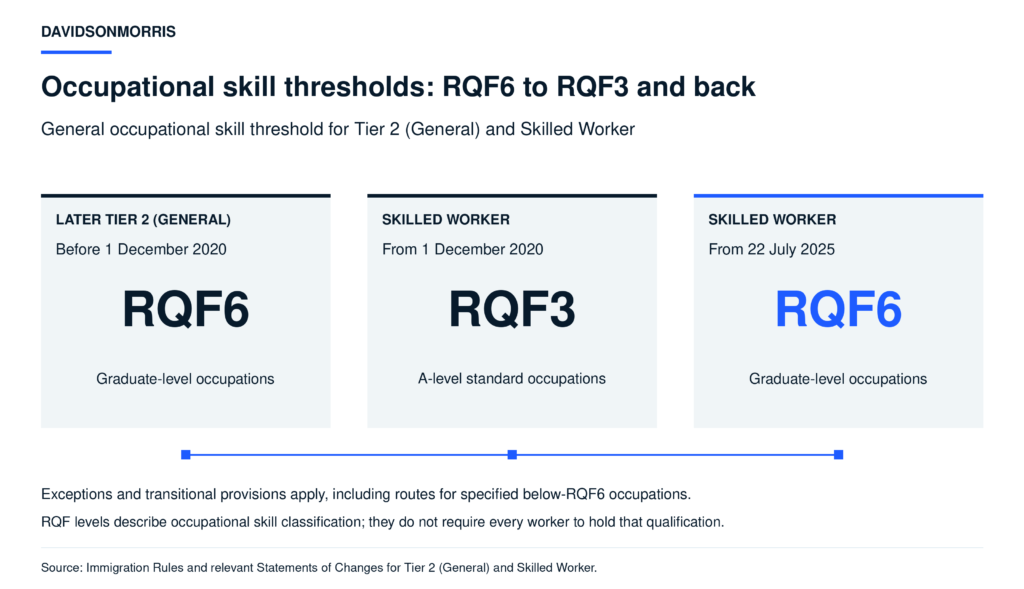
3. Salary Requirements: From Tier 2 Thresholds to the 2025 Framework
Salary requirements have also changed substantially across the history of employer sponsorship.
Under Tier 2, employers were required to satisfy the applicable general salary threshold and occupation-specific requirements, subject to relevant exceptions.
The general Tier 2 salary framework evolved over time, with different requirements applying to specified categories of workers.
Immediately before the introduction of the Skilled Worker route, the principal general Tier 2 threshold was £30,000, subject to exceptions.
The Skilled Worker route introduced in December 2020 initially reduced the standard general threshold to £25,600.
This was followed by an increase to £26,200 in April 2023.
More substantial increases followed in 2024 and 2025.
On 4 April 2024, the standard general threshold increased to £38,700.
On 22 July 2025, it increased again to £41,700.
However, these figures represent the standard general thresholds rather than universal minimum salaries for every sponsored worker.
Different salary options, occupation-specific going rates and transitional provisions have applied throughout the development of the framework.
For example, the July 2025 rules included alternative general thresholds of £37,500, £33,400, £31,300 and £28,200 for specified qualifying applicants.
These options were subject to their own eligibility requirements and relevant occupation-specific salary provisions.
Separate arrangements also applied to certain health and education occupations.
The principal historical changes are summarised below.
| Period | Standard general salary threshold | Important qualification |
|---|---|---|
| Later Tier 2 (General) framework | £30,000 | Subject to relevant exceptions and occupation-specific requirements |
| 1 December 2020 | £25,600 | Initial Skilled Worker framework with alternative salary options |
| 12 April 2023 | £26,200 | Applicable going rates and alternative provisions remained relevant |
| 4 April 2024 | £38,700 | Revised salary framework and transitional provisions |
| 22 July 2025 | £41,700 | Alternative salary options, going rates and transitional provisions |
Employers reviewing historical sponsorship should not compare salary figures without considering the relevant occupation, working hours and salary option.
A salary that satisfied the requirements for a qualifying application in 2021 may not satisfy the requirements for a new application in 2026.
Equally, a worker who qualifies under a transitional provision may be subject to different requirements from a new applicant.
Historical comparison: The standard general Skilled Worker salary threshold initially fell following the replacement of Tier 2, but increased substantially in 2024 and 2025.
4. Recruitment Requirements: From the Resident Labour Market Test to Genuine Vacancy Assessment
The former Tier 2 (General) framework included the resident labour market test.
Subject to exemptions, employers were required to undertake a prescribed recruitment exercise before sponsoring a worker from outside the resident labour market.
The test generally involved advertising the vacancy through specified channels and retaining evidence of the recruitment process.
Its purpose was to establish whether a suitable settled worker was available for the role.
The requirement created an additional procedural stage in recruitment and could affect the timing of sponsorship.
On 1 December 2020, the resident labour market test was abolished for Skilled Worker sponsorship.
This removed the general requirement to complete the prescribed advertising exercise before sponsoring an eligible worker.
However, the abolition did not remove the requirement for the vacancy to be genuine.
Employers continued to be responsible for ensuring that the role existed, that its duties were accurately described and that the sponsorship arrangement complied with the applicable rules.
The Home Office retained powers to investigate whether the proposed employment was genuine.
Further route-specific recruitment requirements also remained relevant in particular circumstances.
For example, additional requirements concerning displaced international care workers were introduced for specified care providers in England in April 2025 before being superseded by the July 2025 reforms.
Changes scheduled for the Religious Worker route in October 2026 also concerned route-specific resident labour consideration requirements.
The abolition of the Skilled Worker resident labour market test did not remove every recruitment-related requirement from the sponsorship framework.
Historical comparison: The general Skilled Worker recruitment process became more flexible in December 2020, but genuine vacancy requirements and certain route-specific recruitment controls continued to apply.
5. Sponsorship Costs: Fees, Certificates of Sponsorship and the Immigration Skills Charge
The direct cost of sponsorship has increased substantially since the original introduction of sponsor licensing.
Employers have historically faced different categories of expenditure, including sponsor licence application fees, Certificate of Sponsorship fees and other immigration-related charges.
The introduction of the Immigration Skills Charge in April 2017 created an additional employer liability for qualifying sponsorship.
At introduction, the annual charge was £1,000 for medium and large sponsors and £364 for qualifying small or charitable sponsors.
These rates remained in place until December 2025.
Meanwhile, sponsor licence and Certificate of Sponsorship fees changed through amendments to the Home Office fee regulations.
On 9 April 2025, the Worker sponsor licence application fee increased to £574 for qualifying small or charitable sponsors and £1,579 for medium and large sponsors.
The relevant Worker Certificate of Sponsorship fee increased from £239 to £525.
On 16 December 2025, the Immigration Skills Charge increased to £480 annually for qualifying small or charitable sponsors and £1,320 annually for medium and large sponsors.
The financial impact of these changes depended on the sponsor’s size, the immigration route, the number of workers and the duration of sponsorship.
For example, the Immigration Skills Charge for a qualifying five-year sponsorship arrangement undertaken by a medium or large sponsor increased from £5,000 to £6,600 in December 2025.
Employers also needed to consider restrictions on recovering sponsorship expenditure from workers.
The Immigration Skills Charge was already an employer liability that could not be passed on to the sponsored worker.
Further restrictions introduced from December 2024 and April 2025 prohibited recovery of specified sponsor licence and Certificate of Sponsorship costs in relevant circumstances.
These restrictions changed not only the amount of expenditure incurred but also how the employer could allocate the financial burden.
Historical comparison: Sponsorship became progressively more expensive, particularly following the introduction of the Immigration Skills Charge and the substantial fee increases during 2025.
6. Sponsor Licence Validity: From Four-Year Renewals to Continuing Authorisation
For much of the sponsorship system’s history, sponsor licences were generally granted for four years.
Employers wishing to continue sponsoring workers ordinarily needed to submit a renewal application before the licence expired.
The renewal process created a recurring administrative requirement and associated fee.
Failure to renew within the applicable period could result in the loss of sponsorship authorisation.
This arrangement continued after the replacement of Tier 2 (General) by the Skilled Worker route.
On 6 April 2024, routine sponsor licence renewals were abolished for most sponsors.
For affected organisations, licence validity was extended without requiring the usual four-year renewal application.
However, the reform did not apply identically to every route.
Specified categories, including UK Expansion Worker and Scale-up, retained separate time-limited arrangements.
The abolition of routine renewals also did not mean that sponsor licences became unconditional or immune from enforcement.
Employers remained subject to continuing sponsor duties.
The Home Office retained powers to downgrade, suspend or revoke a licence where the relevant grounds were established.
After April 2024, most sponsors no longer had a routine renewal date but still had to meet the conditions of their licence.
An organisation could hold a licence without a routine expiry date while still being required to satisfy the conditions attached to its authorisation.
Historical comparison: Routine four-year renewals were a longstanding feature of sponsor licensing until April 2024, when they were abolished for most sponsors without removing continuing compliance obligations.
7. Sponsor Administration: From the Original SMS to Enhanced Account Security
Employers have used the Sponsor Management System to administer sponsor licences since the points-based system was introduced.
Licensed employers use the system to undertake relevant sponsorship functions, including assigning Certificates of Sponsorship and reporting specified changes.
The system has also provided a mechanism for maintaining information about the sponsoring organisation and its authorised personnel.
The original framework established key personnel roles, including the Authorising Officer, Key Contact and Level 1 User.
Level 2 User permissions subsequently provided a more restricted category of SMS access.
These arrangements allowed sponsors to allocate administrative responsibilities while maintaining organisational accountability.
In December 2020, the introduction of the Skilled Worker route changed the Certificate of Sponsorship framework.
Defined and Undefined Certificates of Sponsorship replaced the former restricted and unrestricted arrangements.
Further administrative changes followed in 2026.
Mandatory multi-factor authentication began phased implementation from 3 September 2026.
From 9 September 2026, sponsors could no longer appoint new Level 2 Users.
Existing Level 2 accounts became subject to a transition deadline of 8 March 2027.
Additional procedures also addressed inactive SMS accounts.
Sponsors needed accurate user information and sufficient authorised access to operate under the revised arrangements.
For employers, SMS administration therefore evolved from a system focused principally on sponsorship transactions and reporting into one requiring more detailed attention to account security and user governance.
Historical comparison: The SMS remained the principal sponsorship administration platform, but its user permissions, security requirements and operational procedures developed substantially between 2008 and 2026.
8. Sponsor Duties: Continuing Record Keeping, Monitoring and Reporting
Despite substantial changes to the immigration routes and administrative framework, the core duties of licensed sponsors have remained relatively consistent.
From the introduction of sponsor licensing, employers were required to maintain prescribed records, monitor sponsored workers and report specified events to the Home Office.
These obligations were designed to support immigration control and enable the Home Office to assess whether sponsored employment remained compliant.
Employers needed to maintain records relating to sponsored workers and identify relevant changes to employment or personal circumstances.
They also needed to report specified changes affecting the sponsoring organisation.
The detailed requirements evolved through amendments to sponsor guidance.
However, the underlying responsibility remained that the sponsor must operate effective systems capable of identifying and addressing relevant compliance events.
The introduction of the Skilled Worker route in December 2020 did not remove these duties.
Nor did the abolition of routine sponsor licence renewals in April 2024.
The 2026 SMS security changes also required sponsors to review authorised personnel and access arrangements.
Employers should therefore distinguish changes to the procedures used to comply with sponsor duties from changes to the underlying obligations themselves.
For example, the introduction of multi-factor authentication changed how authorised users accessed the SMS.
It did not remove the requirement to submit reports or maintain prescribed sponsorship records.
Historical comparison: The core responsibilities of record keeping, monitoring and reporting remained central to sponsorship throughout 2008–2026, although the detailed procedures and guidance changed.
9. Home Office Enforcement: Downgrading, Suspension and Revocation
The sponsor licence framework has included Home Office enforcement powers since its introduction.
The sponsorship system was designed to provide employers with authorisation to recruit qualifying overseas workers while allowing the Home Office to take action where sponsors failed to comply with the relevant requirements.
The framework developed procedures for licence downgrading, suspension and revocation.
Downgrading generally involved reducing a sponsor’s rating where specified compliance deficiencies were identified.
Suspension could restrict sponsorship activity while the Home Office considered relevant concerns.
Revocation resulted in the loss of sponsorship authorisation and could have substantial consequences for sponsored workers.
The precise grounds and procedures were governed by the sponsor guidance applicable at the relevant time.
Changes to the immigration routes did not remove these enforcement powers.
Following the introduction of the Skilled Worker route, sponsors continued to be subject to compliance visits and investigations.
The Home Office could examine whether sponsored roles were genuine, whether salary requirements were satisfied and whether the organisation maintained appropriate compliance systems.
Later changes to sponsorship requirements gave employers further compliance issues to assess.
For example, restrictions on recovering specified sponsorship costs from workers created additional matters that employers needed to consider when reviewing their practices.
The expansion of right to work requirements in October 2026 also affected the wider compliance environment for organisations engaging workers under specified arrangements.
However, not every breach necessarily resulted in the same enforcement outcome.
The applicable consequences depended on the relevant rules, guidance and circumstances.
Historical comparison: Home Office enforcement powers remained central to the sponsor licence framework, with changing immigration requirements creating additional areas in which compliance could be assessed.
10. Employer Responsibility: From Immigration Administration to Workforce Governance
Managing sponsorship increasingly required involvement from the teams responsible for recruitment, employment and wider organisational governance.
When sponsor licensing was introduced in 2008, employers needed to establish systems for managing sponsorship records, recruitment requirements and reporting obligations.
Over time, the framework became more closely connected to HR administration, payroll, recruitment planning and corporate governance.
The end of EU free movement increased the number of employers for whom sponsorship became relevant.
The salary and occupational reforms introduced in 2024 and 2025 required closer coordination between immigration compliance and workforce planning.
Changes to sponsorship costs also required input from finance and procurement teams.
The 2026 SMS security reforms placed additional emphasis on authorised personnel, account access and administrative continuity.
For larger organisations, effective sponsorship management increasingly required coordination between multiple departments.
Recruitment teams needed to identify whether proposed roles qualified for sponsorship.
HR personnel needed to maintain accurate employment records and identify reportable changes.
Payroll teams needed to ensure that sponsored workers received the remuneration required under the applicable rules.
Finance personnel needed to account for sponsorship charges and restrictions on recovering specified costs.
Those responsible for sponsor licence administration needed to maintain accurate SMS information and submit required reports.
Corporate management also needed to consider whether business changes affected sponsorship authorisation.
The organisation remained responsible for compliance even where individual tasks were delegated internally or to external advisers.
Historical comparison: Sponsorship developed from a specialised immigration administration function into a broader area of workforce governance requiring coordinated organisational oversight.
11. Cross-Era Comparison of UK Sponsor Licence Requirements
The following table compares the principal characteristics of the sponsorship framework across four historical periods.
| Requirement | 2008–2019 | 2020–2023 | 2024 | 2025–2026 |
|---|---|---|---|---|
| Principal sponsored skilled work route | Tier 2 (General) | Skilled Worker | Skilled Worker | Skilled Worker |
| General occupational skill threshold | Generally RQF6 under later Tier 2 arrangements, subject to exceptions | RQF3 | RQF3 | RQF6 from 22 July 2025, subject to exceptions |
| Standard general salary threshold | Varied; £30,000 under the later principal Tier 2 framework | £25,600 initially; £26,200 from April 2023 | £38,700 from April | £41,700 from July 2025, subject to alternative salary options |
| Resident labour market test | Applicable to many Tier 2 applications, subject to exemptions | Abolished for Skilled Worker | Not required for Skilled Worker | Not required for Skilled Worker |
| Occupation classification | Earlier SOC frameworks | SOC 2010 | SOC 2020 from April | SOC 2020 framework |
| Certificate of Sponsorship categories | Restricted and unrestricted under later Tier 2 arrangements | Defined and Undefined | Defined and Undefined | Defined and Undefined |
| Immigration Skills Charge | Introduced April 2017 | Continued | Continued | Increased December 2025 |
| Routine licence renewals | Generally every four years | Generally every four years | Abolished for most sponsors from April | No routine renewal for most sponsors |
| Care worker overseas sponsorship | Earlier occupational eligibility arrangements | Expanded February 2022 | Dependant and CQC restrictions | New overseas entry clearance closed July 2025, subject to relevant exceptions |
| SMS security | Original user access arrangements | Continuing SMS administration | Continuing SMS administration | MFA phased from September 2026 |
| Level 2 SMS Users | Restricted user permissions | Available | Available | No new appointments from September 2026; transition deadline March 2027 |
| Sponsor duties | Record keeping, monitoring and reporting | Continuing duties | Continuing duties | Continuing duties |
| Home Office enforcement | Downgrading, suspension and revocation | Continuing enforcement powers | Continuing enforcement powers | Continuing enforcement powers |
Worker eligibility, salary requirements and employer costs have changed substantially across the periods compared.
By contrast, the requirement for employers to maintain sponsorship authorisation and comply with continuing duties has remained consistent.
The reforms have also produced periods of expansion and restriction.
The Skilled Worker framework introduced in December 2020 expanded occupational eligibility and removed the resident labour market test.
The reforms introduced in 2024 and 2025 subsequently increased salary requirements and restricted the range of occupations available for new sponsorship.
Administrative changes have followed a different pattern.
Routine sponsor licence renewals were abolished for most sponsors in April 2024, while the 2026 reforms strengthened SMS account security and user governance.
Employers should therefore avoid treating the development of the sponsor licence system as a single continuous movement towards either greater restriction or greater flexibility.
12. How Employers Should Interpret Historical Sponsorship Requirements
Historical sponsorship compliance must be assessed by reference to the requirements applicable at the relevant time.
An employer reviewing a previous recruitment decision, responding to a Home Office enquiry or assessing an existing worker’s immigration position needs to identify those historical requirements.
The first step is to identify the relevant sponsorship activity.
This may involve an original sponsor licence application, a Certificate of Sponsorship assignment, a worker’s immigration application, a change of employment or a reportable event.
The relevant date should then be established.
Different reforms have used different commencement provisions.
Some changes apply to applications submitted on or after a specified date.
Others may depend on the date a Certificate of Sponsorship was assigned or the worker’s existing immigration status.
Employers should then identify the Immigration Rules, sponsor guidance and relevant fee regulations applicable to that activity.
Where necessary, archived guidance should be consulted.
Transitional provisions must also be considered.
For example, the July 2025 increase in the general Skilled Worker skill threshold included arrangements affecting qualifying existing sponsored workers.
It would therefore be incorrect to assume that every worker sponsored below RQF level 6 immediately became ineligible for further sponsorship.
Similarly, the April 2024 salary reforms included transitional salary arrangements for specified workers.
Employers should also distinguish the legal requirements from Home Office operational guidance.
Guidance explains how the Home Office administers the sponsorship system, but the applicable legal basis may be found in the Immigration Rules, regulations or other relevant legislation.
Where a historical decision is disputed, the assessment may turn on the precise wording of the applicable provisions.
The fact that current guidance describes a different procedure does not necessarily establish that the earlier procedure was incorrect.
Equally, the fact that a historical arrangement was lawful does not mean that an equivalent new application would satisfy the requirements currently in force.
Employer impact: Historical compliance reviews require a date-specific assessment of the relevant rules, guidance and transitional provisions rather than reliance on the current sponsorship framework alone.
13. Summary: The Principal Changes to Sponsor Licensing Between 2008 and 2026
The development of the UK sponsor licence system between 2008 and 2026 can be understood through several principal changes.
- Employer authorisation: The requirement for relevant employers to hold a sponsor licence remained central throughout the period.
- Occupational eligibility: The general skill threshold moved from the higher-skilled Tier 2 framework to RQF3 in December 2020 before returning to RQF6 in July 2025, subject to exceptions.
- Salary requirements: The standard general Skilled Worker salary threshold increased substantially in 2024 and 2025.
- Recruitment procedures: The resident labour market test was abolished for Skilled Worker sponsorship in December 2020.
- Employer costs: The Immigration Skills Charge was introduced in 2017 and increased in December 2025, while sponsor licence and CoS fees also increased.
- Licence administration: Routine four-year renewals were abolished for most sponsors in April 2024.
- SMS governance: The 2026 reforms introduced stronger authentication requirements and began the removal of Level 2 User accounts.
- Continuing duties: Record keeping, monitoring and reporting remained fundamental sponsor responsibilities.
- Enforcement: The Home Office retained powers to investigate non-compliance and take action against sponsor licences.
Changes to worker eligibility and sponsorship administration need to be assessed separately.
An employer may remain eligible to hold a sponsor licence even where the immigration requirements for a proposed worker have changed.
Conversely, the fact that an occupation remains eligible for sponsorship does not remove the employer’s obligation to comply with sponsor licence conditions.
Organisations reviewing past decisions or planning future recruitment need to check the relevant effective dates and transitional provisions to establish which requirements apply.
Section H: The Most Consequential UK Sponsorship Reforms Since 2008
UK sponsorship reforms have affected employers in different ways. Some changed the conditions for recruiting overseas workers. Others altered sponsorship costs, licence administration or the consequences of non-compliance.
This comparison considers the reforms’ effects on four areas: access to international recruitment, the financial cost of sponsorship, the administrative responsibilities of licensed employers and the regulatory risks associated with holding a sponsor licence.
Viewed across the period from 2008 to 2026, the introduction of sponsor licensing, the end of EU free movement, the creation of the Skilled Worker route and the 2024–2025 salary and occupational reforms stand out as structural changes.
The introduction and subsequent increase of the Immigration Skills Charge, the abolition of routine sponsor licence renewals and restrictions on recovering sponsorship costs primarily affected employers’ finances or administration.
The following analysis compares these developments and their effects on UK employers.
1. November 2008: Creation of the Modern Sponsor Licence System
The introduction of Tier 2 sponsorship on 27 November 2008 was the foundational reform in the history of the modern UK sponsor licence system.
It established a formal relationship between employer authorisation and the immigration permission granted to qualifying overseas workers.
Before the points-based system, employers recruiting overseas nationals relied on work permit arrangements and other immigration categories. The new framework placed greater emphasis on the employer’s suitability to participate in sponsorship and its continuing responsibility for immigration compliance.
Organisations wishing to recruit under relevant sponsored work categories generally needed to obtain a licence before assigning a Certificate of Sponsorship.
The sponsor licence also created a continuing regulatory relationship with the Home Office.
Employers were required to maintain records, monitor sponsored workers, report specified events and appoint personnel responsible for administering sponsorship.
These duties were not confined to the original recruitment decision.
The Home Office could examine the sponsor’s activities and take enforcement action where the relevant grounds were established.
Immigration compliance became an ongoing employer responsibility alongside the requirements for an individual worker’s application.
Many features introduced under the original system remain recognisable today, including sponsor authorisation, Certificates of Sponsorship, the Sponsor Management System, key personnel and compliance visits.
Why it mattered: The 2008 reforms established the regulatory architecture upon which subsequent UK sponsorship policy has been built.
2. December 2020 and January 2021: Brexit and the Skilled Worker System
The introduction of the Skilled Worker route and the end of EU free movement substantially expanded the employers and recruitment decisions potentially affected by the sponsor licensing framework established in 2008.
The Skilled Worker route opened on 1 December 2020, replacing Tier 2 (General) for new applications.
EU free movement ended at 11pm on 31 December 2020, with the new immigration arrangements applying from 1 January 2021.
Before Brexit, many EU, EEA and Swiss nationals could take employment in the UK without requiring employer sponsorship under Tier 2.
Following the end of free movement, newly arriving nationals from those countries generally needed appropriate immigration permission, subject to exceptions including the EU Settlement Scheme and Common Travel Area arrangements.
This substantially increased the number of employers for whom sponsor licensing became relevant.
The Skilled Worker route also changed the requirements for qualifying sponsorship.
The general occupational skill threshold was reduced to RQF level 3.
The resident labour market test was abolished.
The initial standard general salary threshold was set at £25,600, subject to alternative salary options and occupation-specific going rates.
These changes widened occupational eligibility and removed the prescribed resident labour market test from recruitment.
However, employers still needed to hold an appropriate sponsor licence and satisfy continuing compliance duties.
More workers potentially needed sponsorship, while employers had greater flexibility over which roles they could sponsor.
Why it mattered: The post-Brexit reforms changed which employers needed to consider sponsorship and which occupations could potentially qualify for sponsored recruitment.
3. April 2017 and December 2025: The Immigration Skills Charge
The Immigration Skills Charge introduced on 6 April 2017 added to employers’ sponsorship costs.
The charge created an additional employer liability when sponsoring qualifying workers, subject to exemptions.
At introduction, the annual rate was £1,000 for medium and large sponsors and £364 for qualifying small or charitable sponsors.
The amount payable depended on the duration of sponsorship and the applicable charging provisions.
This meant that longer sponsorship periods could result in substantial upfront expenditure.
For example, a qualifying five-year sponsorship arrangement undertaken by a medium or large sponsor attracted an Immigration Skills Charge of £5,000 at the original rate.
On 16 December 2025, the charge increased to £1,320 annually for medium and large sponsors and £480 annually for qualifying small or charitable sponsors.
The equivalent five-year charge for a medium or large sponsor increased to £6,600.
The Immigration Skills Charge is separate from the sponsor licence application fee and Certificate of Sponsorship fee.
It is also an employer liability that cannot be recovered from the sponsored worker.
The charge therefore affects the commercial cost of international recruitment and the allocation of that expenditure between employer and worker.
For organisations recruiting multiple sponsored workers, the cumulative cost can be substantial.
For example, ten qualifying five-year sponsorship arrangements undertaken by a medium or large sponsor would attract an aggregate Immigration Skills Charge of £66,000 at the rates introduced in December 2025.
Employers must establish whether the charge applies to the relevant route and worker, including whether an exemption is available.
Why it mattered: The Immigration Skills Charge added to international recruitment costs, with the December 2025 increase raising the amount employers needed to budget for qualifying sponsorship.
4. April 2024: The Skilled Worker Salary Threshold Increased to £38,700
The increase in the standard general Skilled Worker salary threshold from £26,200 to £38,700 on 4 April 2024 was a major change in the financial eligibility requirements for sponsored recruitment.
The reform increased the headline salary requirement by £12,500.
For employers recruiting into occupations where salaries were close to the previous threshold, the increase could substantially affect whether sponsorship remained commercially viable.
However, the £38,700 threshold was not universally applicable to every Skilled Worker.
Alternative salary options, occupation-specific going rates and transitional provisions remained relevant.
Separate arrangements also applied to specified health and education occupations.
The reform therefore required individual assessment rather than a simple assumption that every sponsored worker needed to earn £38,700.
The salary increase was accompanied by the introduction of SOC 2020 occupation codes and the replacement of the Shortage Occupation List with the Immigration Salary List.
These changes required employers to reassess occupational classification and the relevant salary going rates.
The reform also had implications for existing sponsored workers.
Qualifying individuals could benefit from transitional salary arrangements, depending on their immigration history and the applicable rules.
Employers needed to account for both the higher general threshold and the revised occupation-specific rates when planning sponsorship.
Why it mattered: The April 2024 reforms increased the salary requirements for many new Skilled Worker applications and changed the occupation coding and salary assessment framework.
5. July 2025: Return to RQF Level 6 and the £41,700 Salary Threshold
The reforms introduced on 22 July 2025 restricted access to Skilled Worker sponsorship under the route opened in December 2020.
The general occupational skill threshold increased from RQF level 3 to RQF level 6.
This reversed the principal skill threshold reduction introduced under the post-Brexit system.
The reform substantially reduced the range of occupations eligible for new Skilled Worker sponsorship under the general framework.
However, specified exceptions and transitional arrangements remained available.
The Temporary Shortage List provided a mechanism through which certain occupations below RQF level 6 could continue to qualify under particular conditions.
Qualifying existing sponsored workers could also benefit from transitional provisions.
At the same time, the standard general salary threshold increased from £38,700 to £41,700.
Alternative salary options continued to apply to specified qualifying applicants.
Employers therefore needed to assess both occupational eligibility and salary eligibility under the revised rules.
A role could satisfy the relevant salary requirement but still be ineligible because it did not fall within an eligible occupation.
Conversely, a role could be occupationally eligible but fail to satisfy the applicable salary threshold or going rate.
The reforms also affected care sector sponsorship.
New overseas entry clearance applications for care workers and senior care workers were closed under the affected arrangements, subject to specified in-country and transitional provisions.
Care worker sponsorship had expanded in February 2022, before the later closure of new overseas recruitment.
The July 2025 reforms changed which workers employers could recruit internationally as well as the cost of doing so.
Why it mattered: The July 2025 reforms restricted the occupations available for new sponsorship, increased the standard salary threshold and changed overseas care worker recruitment.
6. April 2024: Abolition of Routine Sponsor Licence Renewals
The abolition of routine four-year sponsor licence renewals on 6 April 2024 reduced recurring administration for affected sponsors.
Before the reform, most sponsors needed to apply for renewal every four years and pay the relevant fee.
Failure to renew within the applicable period could result in the loss of sponsorship authorisation.
From April 2024, most sponsor licences no longer required routine renewal.
This reduced recurring administration and removed the need for affected organisations to submit the usual four-year renewal applications.
However, the reform did not apply identically to every sponsorship route.
Separate time-limited arrangements remained relevant to specified categories, including UK Expansion Worker and Scale-up.
The change also did not remove continuing sponsor duties.
Employers remained responsible for record keeping, monitoring, reporting and maintaining appropriate sponsorship systems.
The Home Office retained powers to downgrade, suspend or revoke licences where the relevant grounds were established.
The reform therefore changed the administrative validity of most licences without removing the regulatory conditions attached to sponsorship authorisation.
Why it mattered: The abolition of routine renewals substantially reduced recurring sponsor administration while preserving continuing Home Office oversight.
7. December 2024 and April 2025: Restrictions on Sponsorship Cost Recovery
The restrictions introduced from 31 December 2024 and extended from 9 April 2025 changed how employers could allocate specified sponsorship costs.
The reforms prohibited the recovery of certain sponsor licence and Certificate of Sponsorship costs from workers under the affected routes and circumstances.
The restrictions followed the longstanding prohibition on recovering the Immigration Skills Charge from sponsored workers.
Some employers had previously used contractual repayment arrangements to recover specified immigration-related expenditure where a worker left within a defined period.
The revised sponsor guidance restricted the use of such arrangements for prohibited sponsorship costs.
The scope of the prohibition depended on the sponsorship route, category of expenditure and relevant commencement provisions.
Employers therefore needed to distinguish between prohibited sponsorship expenditure and other costs that might be subject to different rules.
The existence of a contractual repayment clause did not override the applicable sponsorship restrictions.
Employers also needed to review recruitment agreements and internal policies.
Employers needed to ensure that prohibited costs were not indirectly transferred to sponsored workers through repayment obligations or other arrangements.
Why it mattered: The reforms changed the financial allocation of sponsorship costs and required employers to review contractual and recruitment practices.
8. 2008–2026: The Growing Importance of Sponsor Compliance and Enforcement
Although the sponsorship framework has undergone substantial changes, Home Office compliance and enforcement powers have remained central to the system.
From the introduction of sponsor licensing, employers were required to maintain appropriate records, monitor sponsored workers and report specified events.
The Home Office developed procedures for compliance visits, licence downgrading, suspension and revocation.
These powers continued after the replacement of Tier 2 (General) by the Skilled Worker route.
Changes to occupational eligibility, salary requirements and sponsorship costs also created additional matters requiring employer compliance.
For example, the 2024 and 2025 salary reforms required employers to review occupation coding and payroll arrangements.
The restrictions on sponsorship cost recovery introduced further requirements concerning employer expenditure and contractual arrangements.
The 2026 SMS reforms required sponsors to maintain accurate user information and appropriate system access.
Sponsor compliance therefore involved the teams responsible for wider workforce management.
Recruitment, HR, payroll, finance and corporate administration can all affect an organisation’s ability to comply with its sponsor duties.
The Home Office does not necessarily take the same action in response to every breach.
The consequences depend on the applicable rules, guidance and circumstances.
Why it mattered: Sponsor compliance evolved into an ongoing organisational responsibility, with failures potentially affecting both the employer’s authorisation and its sponsored workforce.
9. Comparison: The Most Consequential Sponsorship Reforms
The following table compares the principal reforms according to their primary effect on employers.
| Reform | Effective date | Principal effect | Why it was consequential |
|---|---|---|---|
| Introduction of sponsor licensing | 27 November 2008 | Created employer authorisation and continuing sponsorship duties | Established the modern regulatory framework |
| Immigration Skills Charge | 6 April 2017 | Introduced an additional employer sponsorship charge | Increased the direct cost of international recruitment |
| Skilled Worker route | 1 December 2020 | Replaced Tier 2 (General), reduced the general skill threshold and abolished the resident labour market test | Expanded occupational eligibility and simplified recruitment procedures |
| End of EU free movement | 1 January 2021 | Changed immigration requirements for many newly arriving EU, EEA and Swiss workers | Extended the practical importance of sponsor licensing to more employers |
| Care worker sponsorship expansion | 15 February 2022 | Expanded eligibility for specified care occupations | Opened additional international recruitment opportunities in the care sector |
| Skilled Worker salary reform | 4 April 2024 | Increased the standard general salary threshold to £38,700 | Raised the salary requirements for many new applications |
| Abolition of routine renewals | 6 April 2024 | Removed routine four-year renewals for most sponsors | Reduced recurring sponsor administration |
| Sponsorship cost recovery restrictions | 31 December 2024 and 9 April 2025 | Restricted recovery of specified employer sponsorship costs | Changed recruitment contracts and cost allocation arrangements |
| Certificate of Sponsorship fee increase | 9 April 2025 | Increased relevant Worker CoS fees to £525 | Substantially increased per-worker sponsorship costs |
| RQF6 and salary reforms | 22 July 2025 | Increased the general skill threshold to RQF6 and standard salary threshold to £41,700 | Restricted occupational eligibility and increased salary requirements |
| Care worker overseas recruitment closure | 22 July 2025 | Closed affected occupations to new overseas entry clearance applications | Fundamentally changed international care sector recruitment |
| Immigration Skills Charge increase | 16 December 2025 | Increased annual charge rates | Raised the cost of qualifying sponsorship, particularly for longer periods |
| SMS security and user reforms | September 2026 onward | Introduced MFA and began phasing out Level 2 Users | Changed sponsor administration and account governance |
The effect of each reform depends on the employer’s recruitment and sponsorship activities.
For example, the July 2025 occupational restrictions were particularly consequential for organisations recruiting into roles below RQF level 6.
The December 2025 Immigration Skills Charge increase had a greater direct financial effect on employers undertaking larger volumes of qualifying sponsorship.
The abolition of routine licence renewals benefited most sponsors administratively, regardless of the number of workers they sponsored.
The 2026 SMS changes were relevant to the management of existing licences even where an organisation was not undertaking new international recruitment.
The employer’s sector, workforce composition, sponsorship routes and recruitment activities determine which reforms have the greatest effect on its operations.
10. Which Reforms Had the Greatest Structural Impact?
From a historical perspective, three developments stand out as having the greatest structural effect on the UK sponsorship framework.
The first was the introduction of sponsor licensing in November 2008.
This created the employer authorisation system and continuing compliance responsibilities that remain central to sponsorship.
The second was the combined effect of Brexit and the introduction of the Skilled Worker route in December 2020 and January 2021.
These reforms substantially changed which workers required sponsorship and expanded the range of occupations potentially eligible under the new framework.
The third was the series of restrictions introduced in April 2024 and July 2025.
These increased salary requirements and returned the general Skilled Worker occupational skill threshold to RQF level 6.
Together, these developments changed the conditions under which employers could recruit internationally.
Other reforms affected costs and administration.
The Immigration Skills Charge and subsequent fee increases materially affected sponsorship expenditure.
The abolition of routine renewals changed the administrative lifecycle of most sponsor licences.
The restrictions on recovering sponsorship costs altered employer financial responsibilities.
The 2026 SMS changes strengthened the security and governance requirements associated with administering sponsorship authorisation.
UK sponsorship reforms have expanded some recruitment options and restricted others, while changing costs and administration.
Some changes expanded eligibility or simplified administration, while others increased costs or restricted access to sponsored employment.
Employers therefore need to assess each reform according to its specific effect rather than treating every change as part of a uniform tightening of the system.
11. Summary: The Long-Term Effect of Sponsorship Reform
The most consequential sponsorship reforms since 2008 have changed the relationship between employer authorisation, worker eligibility and immigration compliance.
The introduction of sponsor licensing created a continuing regulatory framework.
Brexit and the Skilled Worker route brought more recruitment decisions within the sponsorship framework and initially widened occupational eligibility.
The 2024 and 2025 reforms subsequently increased salary requirements, restricted occupational eligibility and raised the financial cost of international recruitment.
At the same time, administrative reforms removed routine licence renewals for most sponsors while introducing stronger SMS security and user management requirements.
Employers therefore need to assess the following questions:
- Whether the organisation holds appropriate sponsorship authorisation.
- Whether the proposed occupation qualifies under the applicable Immigration Rules.
- Whether the worker satisfies the relevant immigration and salary requirements.
- Whether the employer can meet the financial costs of sponsorship.
- Whether the organisation maintains the systems required to comply with its continuing sponsor duties.
For historical reviews, these questions must be answered by reference to the rules applicable at the relevant date.
A sponsorship arrangement that was lawful under an earlier framework may not satisfy the requirements for a new application.
Equally, the introduction of more restrictive requirements does not necessarily mean that an earlier compliant sponsorship decision becomes retrospectively unlawful.
Historical reviews therefore need to identify the requirements in force at the relevant time, while new applications need to be assessed under the rules and transitional provisions that govern them.
Section I: How to Identify Which Sponsor Licence Rules Applied at a Particular Date
UK sponsorship requirements have changed repeatedly since the introduction of the points-based system in 2008. As a result, employers reviewing historical sponsorship arrangements must establish which Immigration Rules, legislation and Home Office guidance applied at the relevant time.
This assessment may be needed when reviewing a previous Certificate of Sponsorship assignment, an existing worker’s immigration position, a Home Office compliance enquiry or an earlier sponsorship decision.
The current Immigration Rules cannot always be applied retrospectively to historical decisions.
Equally, the fact that an arrangement was permitted under an earlier framework does not necessarily mean that the same arrangement remains available for a new application.
Historical analysis therefore requires a structured approach to identifying the relevant activity, applicable date, legal provisions and transitional arrangements.
1. Identify the Sponsorship Decision Being Reviewed
The first step is to identify precisely which sponsorship decision or compliance activity is being assessed.
Different activities may be governed by different commencement provisions and legal requirements.
For example, the relevant issue may concern:
- An original sponsor licence application.
- An application to add a sponsorship route to an existing licence.
- A request for a Defined Certificate of Sponsorship.
- The assignment of a Certificate of Sponsorship.
- A worker’s entry clearance application.
- An application to extend existing immigration permission.
- A change of employment or sponsor.
- The salary paid during a period of sponsored employment.
- A reportable change affecting the worker or sponsoring organisation.
- A Home Office compliance visit or enforcement decision.
These activities should not automatically be treated as occurring on the same date.
For example, an employer may assign a Certificate of Sponsorship before a change to the Immigration Rules, while the worker submits their immigration application after the change takes effect.
The applicable legal position may depend on the commencement and transitional provisions governing the particular reform.
Similarly, a worker may have obtained immigration permission under an earlier salary framework but later apply for an extension under rules containing different salary requirements and transitional provisions.
Employers should therefore identify the exact decision under review before determining which version of the rules applies.
Employer action: Define the relevant sponsorship activity and establish the dates of all associated decisions and applications.
2. Distinguish Announcement Dates from Effective Dates
Immigration reforms are frequently announced before they become legally effective.
The Government may publish a policy statement, consultation, white paper or announcement outlining its intention to change the sponsorship framework.
However, the announcement does not necessarily amend the Immigration Rules or create an immediately enforceable requirement.
For example, the immigration white paper published on 12 May 2025 announced proposals affecting the Skilled Worker route and wider immigration policy.
The general increase in the Skilled Worker occupational skill threshold to RQF level 6 did not take effect simply because it was proposed in the white paper.
The relevant change commenced on 22 July 2025 under the applicable Immigration Rules amendments.
Likewise, the 2026 changes affecting Level 2 SMS Users involved different dates.
The prohibition on appointing new Level 2 Users took effect on 9 September 2026.
Existing Level 2 accounts remained subject to a transitional period ending on 8 March 2027.
Employers therefore needed to distinguish the operative prohibition on new appointments from the future deadline for dealing with existing accounts.
Similar considerations arise where the Home Office publishes guidance referring to requirements scheduled to take effect on a later date.
The publication of updated guidance does not necessarily mean that every provision described within it is already operative.
Employer action: Identify the legal commencement date of the relevant change rather than relying solely on the date of a Government announcement or guidance publication.
3. Check the Relevant Statement of Changes to the Immigration Rules
Statements of Changes are a primary source for identifying amendments to the Immigration Rules.2
They set out changes to the immigration framework and generally identify the relevant commencement arrangements.
Where a sponsorship reform concerns worker eligibility, salary requirements, occupation codes or immigration permission, the applicable Statement of Changes may help establish which requirements applied.
Employers should identify the Statement of Changes introducing the relevant reform and examine the provisions affecting the immigration route in question.
The commencement provisions should then be reviewed.
These may specify that changes apply to applications made on or after a particular date.
They may also contain exceptions for applications supported by Certificates of Sponsorship assigned before the commencement date.
In other circumstances, transitional arrangements may depend on the applicant’s previous immigration permission or continuous sponsorship history.
Employers should not assume that every amendment within a Statement of Changes commences on the same date.
A single document may introduce changes with different effective dates.
Some provisions may also be subject to subsequent amendment.
The Government publishes Statements of Changes and associated explanatory material through official channels.
Relevant primary material can be accessed through the Home Office collection of Statements of Changes to the Immigration Rules.
Employer action: Identify the relevant Statement of Changes, read the commencement provisions and determine whether any transitional exception affects the application.
4. Review the Immigration Rules Applicable at the Relevant Date
Once the relevant reform and commencement date have been identified, the employer should establish the Immigration Rules applicable to the proposed or historical application.
The Immigration Rules contain the requirements governing relevant immigration routes.
For Skilled Worker applications, these include provisions concerning sponsorship, occupation eligibility, salary requirements and other conditions for immigration permission.
However, the current published version may differ from the rules applicable to an earlier application.
Employers should therefore avoid assuming that the latest version accurately describes the requirements governing a historical decision.
Where necessary, previous versions should be consulted.
The relevant provisions should also be read alongside any commencement or transitional arrangements.
For example, an occupation may have been eligible under the general RQF level 3 framework in 2023 but become ineligible for a new application under the general RQF level 6 framework introduced in July 2025.
The later restriction does not automatically establish that the original 2023 sponsorship was unlawful.
Equally, the worker’s earlier eligibility does not automatically establish eligibility for a new application after the change.
The relevant legal position depends on the rules and transitional provisions applicable to the particular application.
The current Immigration Rules are available through the official Immigration Rules collection.
Employer action: Establish the version of the Immigration Rules applicable to the decision and assess the relevant provisions in their historical context.
5. Consult Archived Home Office Sponsor Guidance
Home Office sponsor guidance provides detailed instructions concerning sponsor licence eligibility, administration, compliance duties and enforcement.
The guidance is revised periodically to reflect changes in legislation, Immigration Rules and operational procedures.
It may also be updated to clarify existing requirements or remove outdated references.
Historical compliance reviews may require the sponsor guidance version applicable at the relevant date.
For example, a sponsor reviewing a reporting obligation arising in 2021 should not automatically assume that the wording of the latest guidance accurately reflects the requirement in force at that time.
Similarly, the abolition of routine sponsor licence renewals in April 2024 means that current guidance may not describe the renewal procedures previously applicable to earlier periods.
Archived guidance can also be relevant where the Home Office has amended the procedures for SMS access, key personnel or licence administration.
The Government maintains publication histories for many guidance documents.
Older versions may also be available through the UK Government Web Archive.16
Employers should identify the guidance version applicable when the relevant event occurred.
However, guidance should not be treated as interchangeable with legislation or the Immigration Rules.
The legal status and effect of a particular requirement depend on its source and the applicable legal framework.
Where there is a dispute concerning historical compliance, it may be necessary to examine the underlying legal provisions as well as the published guidance.
Employer action: Retain or obtain the relevant historical sponsor guidance and distinguish administrative instructions from requirements established in legislation or the Immigration Rules.
6. Establish the Certificate of Sponsorship Assignment Date
The Certificate of Sponsorship assignment date can affect which requirements apply to a worker’s immigration application.
Some changes to the Immigration Rules include commencement provisions that refer to Certificates of Sponsorship assigned before a specified date.
In these circumstances, the CoS assignment date may affect whether the worker qualifies for treatment under earlier requirements.
However, employers should not assume that the assignment date is always the decisive date.
The relevant commencement provisions must be examined.
For some reforms, the date on which the immigration application was submitted may be determinative.
For others, the worker’s existing immigration permission or sponsorship history may be relevant.
The Certificate of Sponsorship itself should also be reviewed.
Relevant information may include:
- The date of assignment.
- The sponsorship route.
- The occupation code.
- The stated job duties.
- The proposed salary and working hours.
- The intended employment dates.
- The sponsor’s licence details.
- Any relevant sponsorship notes or subsequent amendments.
Employers should also distinguish between the date a Defined CoS request was submitted, the date the request was approved and the date the certificate was assigned.
These are separate administrative events.
The approval of a Defined CoS request does not itself establish that the worker has been granted immigration permission.
Further information about the current distinction between CoS categories is available in our Defined and Undefined Certificate of Sponsorship guide.
Employer action: Record the relevant CoS dates and determine which, if any, are expressly referenced in the commencement or transitional provisions.
7. Identify the Immigration Application Date
The worker’s immigration application date can also determine which requirements apply.
Changes to the Immigration Rules commonly specify that revised requirements apply to applications made on or after a particular date.
Where this is the case, the application date may determine whether the worker is assessed under the previous or revised framework.
Employers should therefore establish when the relevant application was made.
The date of the Home Office decision is not necessarily the same as the application date.
For example, an application submitted before a change takes effect may be decided after the commencement date.
The applicable requirements depend on the relevant provisions governing that application.
Employers should not assume that the rules in force on the decision date automatically apply.
Similarly, a worker may receive a Certificate of Sponsorship before a reform but submit their immigration application after it.
The treatment of that application depends on the wording of the commencement and transitional arrangements.
Historical records should therefore distinguish between the CoS assignment date, immigration application date and decision date.
Employer action: Establish the application date and assess it against the relevant commencement provisions rather than relying solely on the date permission was granted.
8. Check Transitional Provisions for Existing Sponsored Workers
Transitional provisions may preserve specified options for qualifying existing workers when a reform introduces more restrictive requirements.
They may allow specified existing workers to continue under arrangements that differ from those applicable to new applicants.
For example, the April 2024 Skilled Worker salary reforms included transitional arrangements for qualifying workers.
The July 2025 increase in the general occupational skill threshold to RQF level 6 also included provisions affecting specified existing Skilled Workers.
Some affected workers had obtained immigration permission under the earlier RQF level 3 framework.
However, transitional protection is not necessarily automatic.
Eligibility depends on the conditions specified in the relevant provisions.
These may include the worker’s immigration history, the timing of previous applications, continuity of permission and other qualifying requirements.
Employers should therefore avoid assuming that every worker sponsored before a reform remains eligible for all future applications.
Equally, it would be incorrect to assume that every existing worker immediately becomes ineligible when the general requirements change.
Transitional arrangements may also have specified expiry dates.
For example, the July 2025 care worker reforms introduced particular in-country arrangements with a transitional period extending to 22 July 2028.
The relevant provisions must be examined to establish whether an individual qualifies.
Employer action: Review the worker’s immigration history and the precise eligibility conditions attached to any claimed transitional protection.
9. Apply the Correct Historical Salary Requirements
Salary requirements are among the most frequently changed elements of Skilled Worker sponsorship.
Historical salary analysis requires more than identifying the standard general threshold applicable in a particular year.
The employer must also consider the relevant occupation-specific going rate, working hours, salary option and transitional provisions.
For example, the standard general Skilled Worker threshold was £25,600 when the route opened in December 2020.
It increased to £26,200 in April 2023, £38,700 in April 2024 and £41,700 in July 2025.
However, these headline figures did not apply identically to every worker.
Different salary options could apply to specified categories of applicants.
The relevant occupation-specific going rate could also exceed the standard general threshold.
Employers reviewing historical salaries should establish:
- The relevant application date.
- The immigration route and salary option.
- The occupation code applicable at that date.
- The relevant occupation-specific going rate.
- The worker’s contracted working hours.
- The remuneration that could be counted under the applicable rules.
- Any transitional salary provisions.
Salary eligibility at the time of the immigration application must be assessed separately from the sponsor’s continuing obligations during employment.
A worker may have satisfied the salary requirements when permission was granted, but subsequent changes to their employment arrangements may create separate compliance issues.
Employers should therefore review both the original sponsorship decision and any relevant changes during the period of employment.
Employer action: Reconstruct the salary assessment using the rules and occupation-specific requirements applicable to the relevant application, while separately considering continuing salary compliance.
10. Check the Historical Occupation Code
The occupation code helps determine whether a role qualifies for sponsorship and which salary going rate applies.
However, the occupational classification framework has changed over time.
Historical occupation coding assessments need to account for the transition from SOC 2010 to SOC 2020 in April 2024.
Employers should not assume that an occupation code used under SOC 2010 has an identical equivalent under SOC 2020.
Some occupations were reclassified or grouped differently.
The relevant duties and occupational description must therefore be considered.
For a historical sponsorship decision, the employer should identify the occupation code applicable under the framework in force at the relevant date.
For a new application, the current applicable classification requirements must be used.
Where an employer is reviewing a worker originally sponsored under an earlier code, it may be necessary to establish how the occupation maps to the revised classification system.
However, a change in occupation code does not necessarily mean that the worker’s underlying duties have changed.
Similarly, a job title alone does not determine the correct occupation code.
Employers need to assess the actual responsibilities of the role.
Employer action: Identify the historical occupation code and assess any later application under the classification framework applicable at that time.
11. Identify the Correct Historical Fees and Charges
Employers reviewing historical sponsorship expenditure should establish the fee schedule applicable when the relevant charge arose.
Sponsor licence fees, Certificate of Sponsorship fees and the Immigration Skills Charge have changed at different times.
For example, Worker sponsor licence application fees increased on 9 April 2025.
The relevant Worker Certificate of Sponsorship fee also increased from £239 to £525 on that date.
The Immigration Skills Charge increased separately on 16 December 2025.
These changes should not be treated as having the same commencement date.
The relevant fee may depend on the date of the application, assignment or other chargeable transaction.
Employers should also consider the sponsor’s classification as small, charitable, medium or large where relevant.
For the Immigration Skills Charge, the duration of sponsorship and applicable exemptions must also be considered.
The rules concerning recovery of sponsorship costs from workers require separate analysis.
Restrictions introduced from December 2024 and April 2025 applied to specified categories of expenditure under the relevant routes and commencement provisions.
Employers should therefore distinguish the amount of a historical charge from whether that expenditure could lawfully be recovered from the worker.
Employer action: Establish the date and nature of each charge, apply the correct historical fee schedule and separately assess any restrictions on cost recovery.
12. Review Sponsor Duties at the Date of the Relevant Event
Sponsors have had continuing compliance duties since 2008, but the detailed guidance governing those obligations has changed.
Historical compliance reviews should therefore identify the requirements applicable when the relevant event occurred.
For example, an employer may need to establish whether a particular change in employment was reportable under the guidance applicable at that time.
The relevant issue may concern the reporting deadline, the information required or the procedure for submitting the report.
Where the applicable guidance treats them separately, employers should identify both the date an event occurred and the date on which the sponsor became aware of it.
They should also identify whether the reporting obligation arose under the Immigration Rules, sponsor guidance or another legal provision.
Changes to SMS procedures may affect how reports are submitted without necessarily changing the underlying duty.
For example, the introduction of multi-factor authentication in September 2026 changed the access arrangements for SMS users.
It did not remove existing reporting obligations.
Similarly, the abolition of routine sponsor licence renewals in April 2024 did not remove the duty to report specified organisational changes.
Employers reviewing historical compliance should therefore avoid treating administrative simplification as evidence that continuing sponsor obligations were abolished.
Employer action: Identify the relevant event, applicable reporting requirements and historical guidance before determining whether the sponsor complied.
13. Historical Compliance Visits and Home Office Enforcement
Responding to a Home Office compliance enquiry or reviewing an earlier enforcement decision may require an assessment of the historical legal framework.
The Home Office has long retained powers to undertake sponsor compliance visits and take action against organisations that fail to satisfy the applicable requirements.
Potential outcomes include licence downgrading, suspension and revocation.
However, the grounds and procedures applicable to enforcement have been revised through changes to sponsor guidance and the wider immigration framework.
An employer reviewing a historical allegation should therefore establish which requirements applied when the relevant conduct occurred.
It may also be necessary to distinguish the rules governing the underlying conduct from the procedures applicable when the Home Office makes its enforcement decision.
These are not necessarily the same question.
For example, a historical salary assessment may depend on the Immigration Rules applicable to the worker’s sponsorship.
The Home Office’s subsequent decision-making process may be governed by different procedural provisions or guidance.
Employers should therefore avoid assuming that one historical date determines every aspect of the legal analysis.
Relevant evidence may include Certificates of Sponsorship, payroll records, employment contracts, recruitment documentation, SMS reports and correspondence with the Home Office.
The organisation’s internal compliance records may also provide relevant evidence.
Further information is available in our guidance on sponsor licence compliance audits, sponsor licence suspension and sponsor licence revocation.
Employer action: Separate the historical conduct under review from the legal and procedural framework governing any subsequent Home Office enforcement decision.
14. Historical Sponsorship Scenarios
The following examples show how dates and transitional provisions can affect a historical sponsorship assessment.
15. Scenario One: A Skilled Worker Sponsored in 2021
An employer sponsored a worker in 2021 under the Skilled Worker framework introduced in December 2020.
The occupation was eligible under the general RQF level 3 arrangements, and the salary satisfied the requirements applicable to the worker’s application.
In July 2025, the general occupational skill threshold increased to RQF level 6.
The employer subsequently wished to extend the worker’s sponsorship.
The correct approach would not be to assume that the original 2021 sponsorship became unlawful because the general skill threshold had changed.
Instead, the employer would need to assess the worker’s eligibility for the proposed extension under the rules governing that application.
This would include consideration of any transitional provisions available to qualifying existing Skilled Workers.
The salary requirements applicable to the extension would also need to be assessed.
The worker’s previous eligibility would be relevant but would not automatically establish that every subsequent application satisfied the current requirements.
Key point: Historical compliance and eligibility for a new application are separate questions.
16. Scenario Two: A Certificate of Sponsorship Assigned Before a Rule Change
An employer assigned a Certificate of Sponsorship shortly before a substantial change to the Skilled Worker requirements.
The worker submitted their immigration application after the revised rules took effect.
The employer needed to determine whether the relevant commencement provisions contained an exception for Certificates of Sponsorship assigned before the change.
If the provisions included such an exception, the worker might qualify for treatment under the earlier requirements, subject to the applicable conditions.
If no relevant exception applied, the revised requirements might govern the application.
The employer could not determine the outcome solely by identifying the date on which the Certificate of Sponsorship was assigned.
The immigration application date and the precise wording of the commencement provisions also needed to be considered.
Key point: A pre-commencement CoS assignment may be relevant, but its legal effect depends on the applicable transitional provisions.
17. Scenario Three: A Salary Assessment Spanning the April 2024 Reforms
An employer sponsored a worker before 4 April 2024, when the standard general Skilled Worker salary threshold was £26,200.
The worker subsequently required an extension after the standard threshold increased to £38,700.
The employer needed to determine whether the worker qualified for a transitional salary arrangement.
The assessment would also require identification of the relevant occupation-specific going rate and salary option.
It would be incorrect to assume that the worker automatically needed to satisfy the standard £38,700 threshold without considering transitional provisions.
Equally, the worker’s previous salary would not necessarily remain sufficient for every later application.
The correct position depended on the rules applicable to the extension and the worker’s individual circumstances.
Key point: Historical salary compliance does not automatically determine the salary requirements for a later application.
18. Scenario Four: Care Worker Recruitment Before and After July 2025
A care provider recruited eligible workers from overseas in 2023 under the sponsorship arrangements introduced in February 2022.
In July 2025, the Government closed the affected care occupations to new overseas entry clearance applications.
The employer could not assume that the closure made its earlier recruitment unlawful.
However, the employer also could not rely on the previous recruitment framework to sponsor new overseas applicants after the closure took effect.
Where an individual was already in the UK, the employer needed to assess whether the worker qualified under the relevant in-country or transitional provisions.
For specified switching arrangements, these included a qualifying period of employment with the sponsoring organisation and a transitional period ending on 22 July 2028.
The applicable conditions needed to be considered in full.
Key point: The July 2025 closure changed future recruitment eligibility while preserving specified arrangements for qualifying individuals already in the UK.
19. Scenario Five: Sponsorship Costs Before and After December 2025
An employer assigned a qualifying Certificate of Sponsorship in November 2025.
At that time, the Immigration Skills Charge remained £1,000 annually for medium and large sponsors and £364 annually for qualifying small or charitable sponsors.
The charge increased on 16 December 2025.
The employer subsequently reviewed its historical sponsorship expenditure.
The correct approach would be to identify when the relevant charge became payable and apply the fee regulations governing that transaction.
The later increase should not automatically be applied retrospectively to a charge properly incurred under the earlier rates.
However, a subsequent chargeable sponsorship transaction could be subject to the revised rates.
The employer would also need to distinguish the Immigration Skills Charge from Certificate of Sponsorship fees and other immigration expenditure.
Key point: Historical sponsorship charges must be assessed using the rates and charging provisions applicable to the relevant transaction.
20. Historical Sponsorship Review Checklist
Employers reviewing a historical sponsorship arrangement should follow a structured process.
- Identify the relevant activity: Establish whether the review concerns a sponsor licence application, CoS assignment, immigration application, employment change, compliance event or enforcement decision.
- Establish the relevant dates: Record the dates of the sponsorship activity, CoS assignment, immigration application and any subsequent decision.
- Identify the legal change: Determine which reform may affect the historical position.
- Check the Statement of Changes: Review the relevant commencement and transitional provisions.
- Review the applicable Immigration Rules: Establish the requirements governing the particular application.
- Consult historical sponsor guidance: Identify the administrative and compliance instructions applicable at the relevant time.
- Check occupational eligibility: Apply the correct occupation code and skill threshold.
- Check salary eligibility: Review the general threshold, occupation-specific going rate, working hours and salary option.
- Assess transitional protection: Determine whether the worker qualifies for any relevant exception or transitional arrangement.
- Review historical charges: Apply the fee regulations and Immigration Skills Charge provisions applicable to the transaction.
- Examine continuing duties: Identify any reporting, record-keeping or monitoring obligations arising during the relevant period.
- Retain supporting evidence: Maintain relevant records, correspondence and copies of historical guidance where appropriate.
This process helps employers avoid applying current requirements retrospectively or relying on outdated provisions for new sponsorship activity.
It also supports a more accurate assessment of potential compliance risks.
21. Summary: Why Effective Dates Matter in Sponsor Licence Compliance
Effective dates and transitional provisions determine which sponsorship requirements apply to a particular decision.
Employers should distinguish between the announcement of a reform, the date it becomes operative and the particular applications or activities to which it applies.
They should also distinguish between the original sponsorship decision and any later immigration application or compliance event.
The relevant Certificate of Sponsorship date, immigration application date, occupation code, salary option and worker’s immigration history may all affect the analysis.
Where a historical compliance issue arises, archived Home Office guidance and the applicable Immigration Rules may be necessary to establish the requirements in force at the time.
New applications need to be assessed under the applicable current framework, which does not automatically determine whether an earlier sponsorship arrangement was compliant.
Equally, an arrangement that satisfied the rules in an earlier period may not qualify under the requirements governing a new application.
Employers need to assess each sponsorship activity against the legal and administrative requirements applicable to it, including any relevant commencement and transitional provisions.
Section J: Future Sponsor Licence Changes and Reforms to Monitor
The UK sponsorship framework continues to evolve through changes to the Immigration Rules, legislation, Home Office guidance and administrative procedures. Employers should therefore distinguish between reforms that have already taken effect, changes with confirmed future implementation dates and policy proposals that have not yet become operative requirements.
As at 23 October 2026, several developments were particularly relevant to organisations holding or considering a sponsor licence.
These included changes to the Temporary Work – Religious Worker route scheduled for 29 October 2026, the continuing rollout of multi-factor authentication for the Sponsor Management System and the removal of existing Level 2 User accounts by March 2027.
Employers also needed to monitor the implementation of wider immigration policy proposals, including measures announced in the May 2025 immigration white paper.
However, not every proposal concerning immigration, settlement or workforce policy directly changes the requirements for obtaining or retaining a sponsor licence.
Some measures affect the immigration eligibility of individual workers, while others concern employer authorisation, sponsorship administration or the wider legal framework governing employment.
For effective planning, employers should identify the precise nature of each proposed change and the circumstances in which it would affect their organisation.
1. Confirmed Changes and Policy Proposals: Legal Status and Effective Dates
Immigration policy announcements can create uncertainty for employers undertaking international recruitment.
The Government may announce an intention to change salary requirements, occupational eligibility, settlement conditions or sponsorship procedures before the relevant legal amendments have been introduced.
However, a policy announcement does not necessarily create an immediate legal obligation.
For changes to immigration eligibility, implementation will generally require amendments to the Immigration Rules or another appropriate legal mechanism.
Changes to sponsor administration may instead be introduced through revised Home Office guidance or system procedures.
Legislative changes affecting illegal working, fees or other statutory obligations may require regulations or primary legislation.
Employers should therefore distinguish between three categories of development:
- Changes already in force: Requirements that have commenced and apply to relevant sponsorship activities.
- Confirmed future changes: Reforms with published implementation arrangements that have not yet taken effect.
- Policy proposals: Announced intentions that remain subject to further decisions, consultation, legislation or implementation.
Recruitment planning needs to account for the status of each development.
An employer should not refuse to consider an otherwise eligible sponsorship application solely because a future restriction has been proposed.
Equally, an employer should not assume that a proposed reform will never be implemented simply because it has not yet taken effect.
Employers need to comply with the current rules while assessing how confirmed or potential changes could affect future decisions.
Employer action: Classify each development according to its legal status and effective date before changing sponsorship procedures or recruitment plans.
2. October 2026: Changes to the Religious Worker Route
Changes to the Temporary Work – Religious Worker route were scheduled to take effect on 29 October 2026.
As at 23 October 2026, the revised requirements had not yet commenced.
The changes included the removal of the previous resident labour consideration advertising requirement and its replacement with an affiliation requirement.
The revised arrangements were intended to establish an appropriate connection between the applicant and the sponsoring faith-based organisation.
The reforms also included changes affecting specified financial requirements for religious workers and their dependants.
Organisations need to identify the relevant application date.
Applications governed by the previous framework needed to be assessed against the requirements applicable before the change.
Applications falling within the revised framework would need to satisfy the new provisions.
The change should not be confused with the abolition of the resident labour market test for Skilled Worker sponsorship in December 2020.
Although both reforms concern recruitment-related requirements, they affect different immigration routes.
Religious organisations should therefore ensure that their sponsorship procedures reflect the rules applicable to the particular route and application date.
Relevant official material is available through the Home Office sponsorship guidance collection.
Employer action: Organisations sponsoring Religious Workers should review the revised requirements before submitting applications affected by the 29 October 2026 commencement date.
3. November 2026: Completion of the SMS Multi-Factor Authentication Rollout
The Home Office began phasing in mandatory multi-factor authentication for Sponsor Management System users from 3 September 2026.
The rollout was expected to extend across existing sponsors by November 2026.
As at 23 October 2026, the phased implementation process was still relevant to sponsors whose accounts had not yet been migrated to the revised authentication arrangements.
Multi-factor authentication requires users to complete an additional verification step when accessing the SMS.
The process depends on the contact and account information registered with the Home Office.
For employers, the principal risk is that an authorised user may be unable to access the system because their registered information is inaccurate or inaccessible.
This could affect the organisation’s ability to assign Certificates of Sponsorship, submit reports or undertake other sponsorship functions.
Sponsors should therefore ensure that relevant user details are accurate and that individuals understand the authentication procedure.
Organisations should also consider whether they have sufficient authorised personnel to maintain access if a particular user is unavailable.
The implementation of MFA does not remove existing sponsorship duties.
Employers remain responsible for complying with reporting and administrative requirements even where access difficulties arise.
Employer action: Check SMS user details, test access when MFA becomes active and maintain suitable arrangements for administrative continuity.
4. March 2027: Deadline for Removing Level 2 SMS Users
Existing Level 2 User accounts were subject to a confirmed future removal deadline.
From 9 September 2026, sponsors could no longer appoint new Level 2 Users.
Existing Level 2 Users were permitted to remain during a transitional period.
However, sponsors must convert relevant accounts to Level 1 User status, where the individual is eligible and continued access is required, or deactivate them by 8 March 2027.
After that date, the Home Office will deactivate remaining Level 2 User accounts.
For employers, the transition requires a review of existing SMS permissions.
Not every Level 2 User will necessarily qualify for Level 1 User status.
The relevant eligibility requirements must be satisfied.
Organisations should also consider whether an individual requires the broader permissions associated with Level 1 access.
For example, an employee who previously used a Level 2 account for limited administrative tasks may not require continued access under the revised framework.
Where that employee performs essential sponsorship functions, the employer may need to identify another eligible Level 1 User or make appropriate changes to the organisation’s administration arrangements.
Sponsors that had relied on multiple Level 2 Users across teams or business locations needed to plan for the deadline across those operations.
Such organisations may need to revise internal responsibilities and access permissions.
Further information about the administration of sponsor licences is available in our Sponsor Management System guide and sponsor licence key personnel guide.
Employer action: Complete an audit of Level 2 accounts and implement the necessary conversions or deactivations before 8 March 2027.
5. July 2028: Transitional Care Worker Sponsorship Arrangements
The July 2025 reforms closing the affected care occupations to new overseas entry clearance applications included specified transitional arrangements for qualifying individuals already in the UK.
These arrangements are relevant to employers considering continued or new in-country sponsorship under the affected occupations.
For specified switching arrangements, the rules included a requirement for the worker to have undertaken qualifying employment with the sponsoring organisation for at least three months before the relevant application.
The transitional period was provided until 22 July 2028, subject to the applicable Immigration Rules and any subsequent amendments.
Employers should not interpret the existence of the transitional period as unrestricted permission to sponsor any care worker already present in the UK.
Eligibility depends on the individual’s circumstances and the requirements governing the relevant application.
The worker’s existing immigration permission, employment history and proposed sponsorship arrangements may all be relevant.
Care providers should also distinguish between applications to extend existing sponsorship and applications to switch into the route from another immigration category.
Different conditions may apply.
The 2028 date is therefore relevant to workforce planning, but it does not remove the need to assess individual eligibility.
Organisations should also monitor subsequent changes to the Immigration Rules rather than assuming that the transitional framework will remain unchanged in every respect until its stated end date.
Employer action: Care providers should identify workers relying on transitional arrangements and assess future sponsorship needs against the applicable eligibility requirements and deadlines.
6. Future Changes to Skilled Worker Occupational Eligibility
The increase in the general Skilled Worker occupational skill threshold to RQF level 6 on 22 July 2025 substantially restricted the range of occupations available for new sponsorship.
However, specified occupations below RQF level 6 remained eligible under particular arrangements.
These included occupations appearing on the Temporary Shortage List and other qualifying exceptions.
The Temporary Shortage List was introduced as part of the revised framework and was intended to address specified workforce needs while broader policy changes were considered.
Employers should therefore monitor whether occupations remain eligible under the relevant list arrangements.
Changes to list membership or the conditions attached to listed occupations could affect recruitment plans.
For example, an employer recruiting into a role below RQF level 6 may be able to sponsor a qualifying applicant while the occupation remains eligible under an applicable exception.
If that exception is subsequently withdrawn, the employer may be unable to sponsor a new applicant into the same role.
However, the effect on existing sponsored workers would depend on the relevant commencement and transitional provisions.
Employers should also monitor changes to occupation codes and the descriptions of eligible roles.
A job title alone is insufficient to establish sponsorship eligibility.
The relevant duties and occupational classification must be assessed under the rules applicable to the proposed application.
Employer action: Organisations recruiting into occupations below RQF level 6 should monitor list eligibility and avoid assuming that temporary exceptions will remain available indefinitely.
7. Future Salary Threshold and Going Rate Changes
Salary requirements have been among the most frequently amended elements of Skilled Worker sponsorship.
The standard general threshold increased from £26,200 to £38,700 in April 2024 and then to £41,700 in July 2025.
Salary requirements may change between the start of a recruitment programme and a later application.
Future amendments could affect the standard general threshold, alternative salary options or occupation-specific going rates.
However, employers should distinguish confirmed changes from proposals or expectations.
A possible future salary increase should not be treated as an operative requirement until the relevant provisions have been introduced and commenced.
Employers should also avoid relying exclusively on the headline general threshold.
Salary eligibility may depend on the relevant occupation-specific going rate and the salary option applicable to the worker.
For qualifying existing workers, transitional provisions may also affect the relevant requirements.
Workforce planning should therefore consider the potential financial consequences of future salary changes without assuming that every worker will be subject to identical requirements.
Further information about the salary framework is available in our Skilled Worker minimum salary guide.
Employer action: Review salary requirements before assigning sponsorship and monitor official changes affecting general thresholds, going rates and transitional arrangements.
8. Workforce Strategy and Domestic Recruitment Policy
The May 2025 immigration white paper placed greater emphasis on the relationship between international recruitment and domestic workforce development.
The Government’s stated policy direction included reducing reliance on overseas recruitment in certain sectors and encouraging investment in domestic skills.
Employers needed to consider how future immigration policy and sector-specific recruitment requirements might affect their workforce plans.
However, policy statements concerning domestic workforce development should not automatically be interpreted as creating a universal obligation for every sponsor to demonstrate that no UK worker is available.
The general resident labour market test for Skilled Worker sponsorship was abolished in December 2020.
Any new recruitment-related requirement would need to be assessed according to its specific legal basis, scope and commencement provisions.
Employers should therefore distinguish between broader Government policy objectives and the requirements applicable to a particular immigration route.
For organisations operating in sectors with substantial international recruitment needs, the policy direction nevertheless supports longer-term workforce planning.
This may involve reviewing domestic recruitment, training arrangements, workforce retention and the availability of sponsored occupations.
Such planning should be based on the organisation’s operational needs and the applicable legal framework rather than assumptions about future immigration restrictions.
Employer action: Monitor the development of workforce-related immigration policy while maintaining recruitment procedures that comply with the requirements currently in force.
9. English Language and Settlement Reform Proposals
The May 2025 immigration white paper also included proposals concerning English language requirements and settlement.
These measures are relevant to employers because they can affect the attractiveness of sponsored employment and the long-term immigration plans of international workers.
However, they should be distinguished from the requirements for obtaining a sponsor licence.
An amendment to a worker’s English language eligibility does not necessarily alter the employer’s underlying authorisation to sponsor workers.
Similarly, changes to settlement policy may affect an individual’s route to indefinite leave to remain without directly changing the sponsor licence application process.
Employers should nevertheless monitor the implications for recruitment and retention.
For example, a change to settlement eligibility may influence whether an overseas candidate regards employment in the UK as a viable long-term opportunity.
Changes to English language requirements may affect whether a candidate qualifies for immigration permission under the relevant route.
However, the effect depends on the actual rules introduced, their commencement dates and any transitional provisions.
Employers should not present a proposal as an existing requirement merely because it has been announced by the Government.
Nor should they assume that all proposed changes will be implemented in their original form.
Employer action: Monitor developments affecting worker eligibility and retention while distinguishing individual immigration requirements from sponsor licence obligations.
10. Future Sponsor Licence Fees and Immigration Skills Charge Changes
Sponsorship costs have increased substantially over time, particularly following the reforms introduced in April and December 2025.
Employers should therefore monitor future changes to Home Office fees and the Immigration Skills Charge.
However, no additional increase should be assumed without reference to the relevant regulations and effective date.
Different charges are governed by different provisions.
Sponsor licence application fees concern the cost of obtaining relevant sponsorship authorisation.
Certificate of Sponsorship fees arise when assigning chargeable sponsorship records.
The Immigration Skills Charge applies to qualifying sponsorship arrangements under its own charging framework.
Changes to one category do not necessarily mean that the others have increased at the same time.
Employers should also consider the sponsor’s classification as small, charitable, medium or large where relevant.
The duration of sponsorship and applicable exemptions also affect the Immigration Skills Charge.
Financial planning should therefore distinguish confirmed fee increases from possible future changes.
Where an employer is considering a substantial international recruitment programme, it may be appropriate to model the potential effect of higher charges.
However, such modelling should be clearly identified as a planning scenario rather than a statement of the current legal requirement.
Further information is available in our sponsor licence fees guide and Immigration Skills Charge guide.
Employer action: Use confirmed fee schedules for actual sponsorship decisions and review budgets when official regulations introduce revised charges.
11. Future Sponsor Compliance and Enforcement Developments
The Home Office retains extensive powers to investigate sponsor compliance and take action where the relevant grounds are established.
These include powers to downgrade, suspend or revoke sponsor licences.
Employers should therefore monitor changes to sponsor guidance affecting compliance expectations, reporting procedures and enforcement.
Future updates may concern the evidence required to demonstrate compliance, the operation of sponsorship systems or the circumstances in which enforcement action may be taken.
However, changes to operational guidance should be distinguished from new statutory duties.
Some updates clarify existing requirements rather than introducing additional obligations.
Employers need effective compliance arrangements that can be updated when the requirements change.
These arrangements should include accurate worker records, appropriate monitoring, timely reporting and effective internal oversight.
Organisations should also consider how corporate changes may affect their sponsor licence.
Changes involving ownership, restructuring, mergers or acquisitions can create separate sponsorship issues.
The relevant obligations depend on the circumstances and the applicable Home Office guidance.
Further information is available in our guidance on sponsor compliance audits and sponsor licence downgrading.
Employer action: Maintain regular compliance reviews and monitor substantive changes to sponsor duties and enforcement guidance.
12. How Employers Should Monitor Future Sponsor Licence Changes
Employers should adopt a structured process for identifying and responding to changes in sponsorship requirements.
Organisations recruiting internationally on a regular basis or using multiple sponsorship routes need to cover those activities in their monitoring process.
A suitable monitoring process should distinguish between changes affecting new applications, existing workers and continuing sponsor licence duties.
The following checks help employers identify changes affecting their sponsorship activities.
- Monitor Statements of Changes: Identify amendments to the Immigration Rules affecting sponsored work routes.
- Check commencement provisions: Establish when each change takes effect and which applications it affects.
- Review sponsor guidance: Identify substantive changes to licence eligibility, administration, reporting and compliance duties.
- Monitor fee regulations: Check for changes to sponsor licence fees, CoS charges and the Immigration Skills Charge.
- Assess occupational eligibility: Review changes to eligible occupation codes and relevant shortage arrangements.
- Review salary requirements: Identify changes to general thresholds, going rates and alternative salary options.
- Check transitional provisions: Determine whether existing sponsored workers qualify for different arrangements.
- Review SMS administration: Ensure that authorised users and internal procedures comply with current requirements.
- Assess workforce implications: Identify whether changes affect recruitment plans, existing workers or sponsorship budgets.
- Update internal policies: Amend relevant procedures, contracts and compliance documents where necessary.
Not every published update will require immediate action.
Some changes may be purely editorial or concern immigration routes that the organisation does not use.
Employers should assess whether each development affects their own sponsorship activities and procedures.
Changes affecting the ability to sponsor a worker, the amount payable, reporting obligations or Home Office enforcement risk may require action.
Employer action: Maintain a documented process for reviewing material sponsorship changes and identifying the personnel responsible for implementation.
13. Official Sources for Future Sponsorship Updates
The Home Office and other Government departments publish primary materials relevant to sponsorship reform.
Employers should prioritise official sources when determining whether a change has been introduced and when it takes effect.
The principal sources include:
- Statements of Changes to the Immigration Rules – formal amendments and relevant commencement provisions.
- Immigration Rules – the requirements governing relevant immigration applications.
- Sponsorship information for employers and educators – Home Office sponsor guidance and administrative instructions.
- Home Office immigration and nationality fees – published fee information.
- UK legislation – relevant Acts and statutory instruments.
- UK Government Web Archive – archived Government guidance and publications.
Employers should distinguish between the publication of a document and the legal commencement of the requirements it describes.
Where an announcement concerns a proposed reform, the relevant legislation or Immigration Rules amendment should be checked before the measure is treated as operative.
Historical guidance may also be needed when reviewing decisions made before a change.
14. Future Reform Monitoring: Employer Priority Table
The following table identifies developments relevant to employers as at 23 October 2026 and distinguishes confirmed implementation dates from areas requiring continued monitoring.
| Development | Status as at 23 October 2026 | Relevant date | Employer priority |
|---|---|---|---|
| Religious Worker route changes | Scheduled reform | 29 October 2026 | Review requirements for affected applications |
| SMS multi-factor authentication | Phased implementation underway | From 3 September 2026; rollout expected by November 2026 | Verify user details and access arrangements |
| New Level 2 User appointments | Prohibition already in force | 9 September 2026 | Do not attempt new Level 2 appointments |
| Existing Level 2 User accounts | Transition period underway | 8 March 2027 deadline | Convert eligible users or deactivate accounts |
| Care worker transitional arrangements | Specified arrangements remain relevant | Transitional period to 22 July 2028 | Assess individual eligibility and future sponsorship needs |
| Temporary Shortage List | Existing framework subject to future changes | Monitor official amendments | Check continued eligibility of affected occupations |
| Skilled Worker salary requirements | Current requirements apply; future changes require confirmation | Monitor official amendments | Review thresholds and going rates before sponsorship |
| Immigration white paper proposals | Implementation varies by measure | Subject to individual commencement provisions | Distinguish enacted reforms from outstanding proposals |
| Sponsorship fees and Immigration Skills Charge | Current published rates apply | Monitor fee regulations | Update recruitment budgets when confirmed changes commence |
| Sponsor compliance guidance | Continuing updates | As published and commenced | Identify material changes affecting sponsor duties |
The table should not be treated as a substitute for checking the current legal position before undertaking sponsorship activity.
Future amendments may change the status or implementation arrangements of particular measures.
Employers should therefore confirm the relevant requirements at the time of the proposed application or compliance decision.
15. Summary: Preparing for Future Sponsor Licence Reform
The future development of UK sponsorship policy is likely to continue through a combination of Immigration Rules amendments, legislative changes and updates to Home Office sponsor guidance.
As at 23 October 2026, employers needed to prepare for confirmed changes affecting Religious Worker sponsorship and SMS user administration.
Organisations sponsoring care workers also needed to consider the transitional arrangements introduced following the July 2025 closure of new overseas entry clearance applications.
Beyond these confirmed arrangements, employers should monitor changes affecting occupational eligibility, salary requirements, sponsorship costs and continuing compliance duties.
However, Government policy proposals should not be treated as operative legal requirements before the necessary implementation steps have taken place.
For employers, effective preparation involves three distinct activities.
First, the organisation must comply with the rules currently applicable to its sponsorship activities.
Second, it should identify confirmed future changes and take appropriate steps before the relevant commencement dates.
Third, it should monitor proposed reforms and assess their potential effect on recruitment and workforce planning without assuming that every proposal will be implemented in its original form.
This approach allows employers to maintain compliant sponsorship arrangements while responding proportionately to changes in immigration policy.
Section K: Conclusion: How UK Sponsor Licensing Has Changed Since 2008
The UK sponsor licence system has undergone substantial reform since its introduction in November 2008. It regulates employer authorisation to recruit through sponsored work routes and the continuing immigration compliance responsibilities of licensed sponsors.
Although the underlying requirement for employers to hold appropriate sponsorship authorisation has remained consistent, the rules governing which workers can be sponsored, the salaries they must receive and the costs incurred by employers have changed significantly.
Tier 2 sponsorship introduced the modern sponsor authorisation system in 2008. Employers became responsible for maintaining prescribed records, monitoring sponsored workers, reporting specified changes and demonstrating continuing compliance with Home Office requirements.
The introduction of the Immigration Skills Charge in April 2017 added a substantial financial component to sponsorship.
Further structural changes followed Brexit.
On 1 December 2020, the Skilled Worker route replaced Tier 2 (General), reducing the general occupational skill threshold to RQF level 3 and abolishing the resident labour market test.
The end of EU free movement on 31 December 2020 also brought more international recruitment decisions within the sponsor licensing framework.
However, the period of wider occupational eligibility was followed by increasingly restrictive requirements.
In April 2024, the standard general Skilled Worker salary threshold increased to £38,700. The same year saw the introduction of SOC 2020 occupation codes and the abolition of routine four-year sponsor licence renewals for most organisations.
Further eligibility and cost changes followed during 2025.
Certificate of Sponsorship fees increased substantially in April, while the July reforms raised the general Skilled Worker occupational skill threshold to RQF level 6 and increased the standard general salary threshold to £41,700.
The July 2025 changes also closed the affected care worker occupations to new overseas entry clearance applications, subject to specified in-country and transitional arrangements.
In December 2025, the Immigration Skills Charge increased, further raising the cost of qualifying sponsorship.
During 2026, reforms increasingly concerned the administration and security of existing sponsor licences, including the phased introduction of mandatory multi-factor authentication for the Sponsor Management System and the removal of Level 2 User accounts.
The wider right to work framework also changed, extending relevant checking requirements to specified additional working arrangements from October 2026.
Employers need to assess immigration eligibility, sponsorship costs and continuing compliance together.
However, the reforms have not all operated in the same direction.
Some changes have simplified administration, including the abolition of routine licence renewals. Others have restricted occupational eligibility, increased salary requirements or raised sponsorship costs.
Historical sponsorship must be assessed by reference to the relevant date and the nature of the activity.
An arrangement that satisfied the rules when it was originally undertaken may not qualify under the requirements governing a new application.
Equally, a subsequent change to the Immigration Rules does not automatically establish that an earlier sponsorship decision was unlawful.
Employers should therefore distinguish between historical requirements, current rules and any applicable transitional provisions.
Organisations undertaking international recruitment should also maintain effective procedures for monitoring changes to the Immigration Rules, sponsor guidance, fees and compliance obligations.
Employers managing an existing sponsor licence need to ensure that current sponsorship activities comply with the requirements applicable to them.
Where historical decisions, transitional provisions or complex workforce arrangements create uncertainty, a detailed review of the relevant legal framework may be necessary.
Section L: Frequently Asked Questions About UK Sponsor Licence Changes
When was the UK sponsor licence system introduced?
The modern UK sponsor licence system was introduced on 27 November 2008 as part of the points-based immigration framework.
It established a system under which employers needed Home Office authorisation to sponsor qualifying overseas workers under relevant immigration categories.
The original framework included Tier 2 sponsorship, Certificates of Sponsorship, the Sponsor Management System and continuing duties relating to record keeping, monitoring and reporting.
Although the immigration routes have changed, the underlying principle of employer authorisation remains central to the current sponsorship system.
What was the difference between Tier 2 and the Skilled Worker route?
Tier 2 (General) was the principal sponsored skilled work route before December 2020.
The Skilled Worker route replaced Tier 2 (General) for new applications on 1 December 2020.
The new route introduced several significant changes, including reducing the general occupational skill threshold to RQF level 3 and abolishing the resident labour market test.
The initial standard general salary threshold was £25,600, subject to alternative salary options and occupation-specific going rates.
The Skilled Worker route also introduced Defined and Undefined Certificates of Sponsorship in place of the previous restricted and unrestricted arrangements.
Employers continued to require appropriate sponsor licence authorisation and remained subject to Home Office compliance duties.
How did Brexit change UK sponsor licence requirements?
The end of EU free movement substantially increased the practical importance of sponsor licensing.
Before Brexit, many EU, EEA and Swiss nationals could work in the UK without requiring employer sponsorship under Tier 2.
Following the end of free movement on 31 December 2020, newly arriving nationals from those countries generally needed appropriate immigration permission, subject to relevant exceptions.
These exceptions included arrangements under the EU Settlement Scheme and the Common Travel Area.
As a result, employers that had previously recruited freely from the EU increasingly needed to consider whether they required a sponsor licence.
However, Brexit did not mean that every EU national working in the UK required sponsorship.
The individual’s immigration status and applicable rights remained important.
When was the resident labour market test abolished?
The resident labour market test was abolished for Skilled Worker sponsorship when the route opened on 1 December 2020.
Under the former Tier 2 framework, employers were generally required to undertake a prescribed recruitment exercise before sponsoring a worker, unless an exemption applied.
The Skilled Worker route removed that general requirement.
However, employers continued to be responsible for ensuring that sponsored roles were genuine and satisfied the applicable immigration requirements.
The abolition of the resident labour market test did not remove every recruitment-related condition from all sponsored work routes.
Different arrangements have continued to apply to certain specialist categories.
What was the original Skilled Worker salary threshold in 2020?
When the Skilled Worker route opened on 1 December 2020, the standard general salary threshold was £25,600.
However, this was not the minimum salary applicable to every worker.
Alternative salary options and occupation-specific going rates applied in relevant circumstances.
The general threshold subsequently increased to £26,200 in April 2023, £38,700 in April 2024 and £41,700 in July 2025.
Employers reviewing historical applications must identify the relevant salary option and occupation-specific requirements rather than relying solely on the headline threshold.
When did the Skilled Worker salary threshold increase to £38,700?
The standard general Skilled Worker salary threshold increased from £26,200 to £38,700 on 4 April 2024.
The reform substantially increased the salary requirements for many new Skilled Worker applications.
However, different salary arrangements continued to apply to specified qualifying applicants, including workers covered by transitional provisions.
Separate arrangements also applied to certain health and education occupations.
The applicable salary requirement therefore depended on the worker’s circumstances, occupation and relevant Immigration Rules.
Further information is available in our Skilled Worker minimum salary guide.
When did the Skilled Worker salary threshold increase to £41,700?
The standard general Skilled Worker salary threshold increased to £41,700 on 22 July 2025.
The change formed part of wider reforms affecting occupational eligibility and international recruitment.
However, £41,700 is not a universal minimum salary for every Skilled Worker application.
The Immigration Rules provide alternative salary options for specified qualifying applicants, subject to their individual eligibility requirements and relevant occupation-specific going rates.
Employers must therefore identify the correct salary option before assigning sponsorship.
When did the Skilled Worker skill threshold return to RQF level 6?
The general Skilled Worker occupational skill threshold increased from RQF level 3 to RQF level 6 on 22 July 2025.
This reversed the principal skill threshold reduction introduced when the Skilled Worker route replaced Tier 2 (General) in December 2020.
However, the revised framework included specified exceptions and transitional provisions.
Certain occupations below RQF level 6 remained eligible under arrangements including the Temporary Shortage List.
Qualifying existing sponsored workers could also benefit from transitional provisions.
The RQF level 6 requirement concerns the occupational skill classification and does not automatically mean that every sponsored worker must personally hold a university degree.
Can employers still sponsor workers in occupations below RQF level 6?
Some sponsorship arrangements involving occupations below RQF level 6 remain possible, subject to the applicable exceptions and transitional provisions.
The July 2025 reforms increased the general Skilled Worker skill threshold to RQF level 6 but did not prohibit every form of sponsorship below that level.
Specified occupations remained eligible under particular list-based arrangements.
Qualifying existing sponsored workers could also benefit from transitional provisions.
However, an occupation that qualified before July 2025 does not necessarily remain eligible for a new applicant.
Employers must check the occupation code, applicable list arrangements, salary requirements and any relevant restrictions.
What is the Temporary Shortage List?
The Temporary Shortage List was introduced as part of the July 2025 Skilled Worker reforms.
It provides a mechanism through which specified occupations below the general RQF level 6 threshold can remain eligible for sponsorship under particular conditions.
The list is distinct from the Immigration Salary List.
Inclusion on the Temporary Shortage List does not automatically remove salary requirements or other immigration conditions.
Additional restrictions, including those affecting dependant eligibility, may apply to specified workers.
Employers should also avoid assuming that an occupation will remain eligible indefinitely.
The applicable list and conditions must be checked when the relevant sponsorship decision is made.
When did sponsor licence renewals stop?
Routine four-year sponsor licence renewals were abolished for most sponsors on 6 April 2024.
Before the reform, employers generally needed to renew their licence every four years and pay the relevant fee.
The abolition of routine renewals reduced recurring administration for affected organisations.
However, separate time-limited arrangements continued to apply to certain sponsorship categories, including UK Expansion Worker and Scale-up.
The reform also did not remove continuing sponsor duties or Home Office enforcement powers.
A sponsor licence may remain valid without routine renewal while still being subject to downgrading, suspension or revocation where the relevant grounds are established.
How much did sponsor licence fees increase in April 2025?
On 9 April 2025, the relevant Worker sponsor licence application fee increased from £536 to £574 for qualifying small or charitable sponsors.
For medium and large sponsors, the fee increased from £1,476 to £1,579.
Different fees may apply to other sponsorship categories and services.
The fee payable depends on the relevant sponsor classification and application.
The increase did not reinstate routine four-year sponsor licence renewals for organisations covered by the April 2024 abolition.
Further information is available in our sponsor licence application fee guide.
When did the Certificate of Sponsorship fee increase to £525?
The relevant Worker Certificate of Sponsorship fee increased from £239 to £525 on 9 April 2025.
This represented an increase of approximately 120%.
The change substantially increased the cost of sponsorship for employers assigning multiple Certificates of Sponsorship.
For example, 20 qualifying Worker CoS assignments cost £10,500 at the revised rate, compared with £4,780 at the previous rate.
The CoS fee is separate from the Immigration Skills Charge and other applicable immigration fees.
Further information is available in our Certificate of Sponsorship guide.
When was the Immigration Skills Charge introduced?
The Immigration Skills Charge was introduced on 6 April 2017.
It created an additional employer liability for qualifying sponsorship arrangements, subject to relevant exemptions.
At introduction, the annual charge was £1,000 for medium and large sponsors and £364 for qualifying small or charitable sponsors.
The amount payable depended on the duration of sponsorship and the applicable charging rules.
The charge was introduced separately from the sponsor licence application fee and Certificate of Sponsorship fee.
It also became an employer cost that could not be recovered from the sponsored worker.
How much is the Immigration Skills Charge following the December 2025 increase?
From 16 December 2025, the annual Immigration Skills Charge increased to £1,320 for medium and large sponsors and £480 for qualifying small or charitable sponsors.
The charge for each additional six-month period increased to £660 for medium and large sponsors and £240 for qualifying small or charitable sponsors.
The total amount depends on the duration of sponsorship and any applicable exemptions.
For example, a qualifying three-year sponsorship arrangement attracts an Immigration Skills Charge of £3,960 for a medium or large sponsor at the revised rates.
The equivalent charge for a qualifying small or charitable sponsor is £1,440.
Further information is available in our Immigration Skills Charge guide.
Can employers recover sponsor licence costs from sponsored workers?
Restrictions introduced from 31 December 2024 and extended from 9 April 2025 prohibit employers from recovering specified sponsorship costs from workers under the affected routes and circumstances.
The restrictions include relevant sponsor licence and Certificate of Sponsorship expenditure.
The Immigration Skills Charge is separately subject to a prohibition on recovery from sponsored workers.
However, not every immigration-related expense is governed by identical rules.
Visa application fees, Immigration Health Surcharge payments and other employment-related expenditure may require separate assessment.
Employers should therefore review contractual repayment arrangements and ensure that prohibited sponsorship costs are not transferred to workers.
When did overseas care worker sponsorship close?
New overseas entry clearance applications for the affected care worker and senior care worker occupations were closed from 22 July 2025.
The reform followed earlier restrictions introduced in March 2024 and April 2025.
However, the July 2025 closure did not immediately end every form of sponsorship involving care workers already in the UK.
Specified in-country and transitional arrangements remained available.
For relevant switching arrangements, these included conditions concerning qualifying employment with the sponsoring organisation and a transitional period ending on 22 July 2028.
Care providers must assess the worker’s circumstances against the applicable Immigration Rules rather than assuming that every in-country application is permitted.
Do existing Skilled Workers retain their previous immigration requirements?
Existing Skilled Workers may qualify for transitional provisions when immigration requirements change.
However, transitional protection is not automatic and does not necessarily preserve every previous requirement indefinitely.
Eligibility depends on the relevant provisions and the worker’s individual circumstances.
For example, the April 2024 salary reforms and July 2025 occupational reforms included arrangements affecting specified existing sponsored workers.
Employers must consider the worker’s immigration history, application date, occupation and salary requirements.
A worker who qualified under an earlier framework may be subject to different requirements when applying for an extension or change of employment.
The applicable transitional provisions must therefore be reviewed before sponsorship is assigned.
What changed to the Sponsor Management System in 2026?
During 2026, the Home Office introduced significant changes to SMS account security and user administration.
Mandatory multi-factor authentication began phased implementation from 3 September 2026.
From 9 September 2026, sponsors could no longer appoint new Level 2 Users.
Existing Level 2 accounts became subject to a transition deadline of 8 March 2027.
The Home Office also introduced revised procedures concerning inactive SMS accounts.
These changes increased the importance of maintaining accurate user information and ensuring that appropriate personnel could access the system.
Further information is available in our Sponsor Management System guide.
What happens to existing Level 2 SMS Users in March 2027?
Existing Level 2 SMS Users must be converted to Level 1 User status, where eligible and continued access is required, or have their accounts deactivated by 8 March 2027.
After that date, the Home Office will deactivate remaining Level 2 User accounts.
As at 23 October 2026, the deadline had not yet passed.
However, the prohibition on appointing new Level 2 Users had already taken effect on 9 September 2026.
Sponsors should review existing accounts and determine whether individuals qualify for Level 1 status.
They should also ensure that sufficient authorised users remain available to undertake essential sponsorship functions.
Did the right to work rules change in October 2026?
Yes. From 1 October 2026, the right to work framework extended relevant checking responsibilities to specified additional working arrangements.
These included qualifying worker contracts, individual subcontractors and certain online matching service arrangements.
The changes extended the framework beyond its traditional focus on contracts of employment.
However, the revised provisions do not necessarily apply identically to every commercial relationship involving a contractor or supplier.
Organisations must assess whether the arrangement falls within the relevant statutory definitions.
For licensed sponsors, right to work compliance remains distinct from, but closely related to, continuing sponsorship obligations.
Further information is available in our right to work checks guide.
Can the Home Office revoke a sponsor licence without a renewal application?
Yes. The abolition of routine four-year sponsor licence renewals for most sponsors did not remove the Home Office’s enforcement powers.
Licensed employers remain subject to continuing sponsorship duties.
Where the relevant grounds are established, the Home Office may take action including licence downgrading, suspension or revocation.
The applicable outcome depends on the circumstances and the relevant sponsor guidance.
Employers should therefore not interpret the absence of a routine renewal date as evidence that their licence is permanently secure.
Further information is available in our guidance on sponsor licence suspension and sponsor licence revocation.
How can employers check which sponsor licence rules applied in a previous year?
Employers should identify the relevant sponsorship activity and establish the date on which it occurred.
They should then review the Immigration Rules, Statements of Changes, legislation and sponsor guidance applicable at that time.
Where a worker’s immigration application is involved, the Certificate of Sponsorship assignment date and immigration application date may both be relevant.
Transitional provisions must also be considered.
For historical salary assessments, employers should identify the applicable salary option, occupation code and going rate.
Archived Home Office guidance may be required to establish the administrative requirements in force when the relevant event occurred.
The current rules should not automatically be applied retrospectively to an earlier sponsorship decision.
What future sponsor licence changes should employers monitor?
As at 23 October 2026, employers needed to monitor confirmed changes affecting SMS administration and specified immigration routes, alongside wider policy developments.
These included the scheduled Religious Worker changes from 29 October 2026, the continuing rollout of SMS multi-factor authentication and the 8 March 2027 deadline for existing Level 2 User accounts.
Care providers also needed to consider the transitional arrangements introduced following the July 2025 closure of affected overseas recruitment routes.
More broadly, employers should monitor changes to occupational eligibility, salary thresholds, sponsorship fees, the Immigration Skills Charge and Home Office compliance guidance.
However, Government proposals should be distinguished from changes that have been legally implemented.
Employers should rely on the applicable Immigration Rules and official guidance when making sponsorship decisions.
Section M: Glossary of UK Sponsor Licence Changes and Terminology
The UK sponsorship system has undergone substantial changes in terminology, eligibility requirements and administrative procedures since its introduction in 2008.
Some terms remain in use, while others relate to immigration routes or procedures that have been replaced or abolished.
The following glossary explains the principal terms used throughout the history of UK sponsor licensing, including their relevance to the current framework.
| Term | Meaning |
|---|---|
| Sponsor Licence |
A sponsor licence is the authorisation granted by the Home Office allowing an eligible organisation to sponsor qualifying overseas workers under specified immigration routes. The modern system was introduced in November 2008 as part of the points-based immigration framework. Licensed sponsors must comply with continuing duties concerning record keeping, monitoring, reporting and other relevant requirements. Most sponsor licences no longer require routine four-year renewal following the reforms introduced in April 2024. Further information is available in our sponsor licence guide. |
| Tier 2 (General) |
Tier 2 (General) was the principal sponsored skilled work immigration category under the original points-based system. It was introduced in November 2008 and operated until the Skilled Worker route replaced it for new applications on 1 December 2020. The later Tier 2 framework generally focused on higher-skilled occupations and included requirements concerning salary, sponsorship and, in many cases, the resident labour market test. References to Tier 2 in historical documents should be distinguished from the current Skilled Worker framework. |
| Skilled Worker Route |
The Skilled Worker route replaced Tier 2 (General) on 1 December 2020. It initially reduced the general occupational skill threshold to RQF level 3 and removed the resident labour market test. Subsequent reforms increased salary requirements and restored the general occupational skill threshold to RQF level 6 from 22 July 2025, subject to specified exceptions and transitional arrangements. The route remains a principal mechanism through which UK employers sponsor qualifying overseas workers. Further information is available in our Skilled Worker employer guide. |
| Certificate of Sponsorship (CoS) |
A Certificate of Sponsorship is an electronic sponsorship record assigned by an authorised sponsor to a qualifying worker. It contains information relevant to the worker’s proposed employment and immigration application. A CoS is not itself a visa or grant of immigration permission. The worker must satisfy the requirements of the relevant immigration route and obtain the necessary permission. Further information is available in our Certificate of Sponsorship guide. |
| Defined Certificate of Sponsorship |
A Defined Certificate of Sponsorship is used for relevant Skilled Worker entry clearance applications from outside the UK. The Defined CoS framework was introduced when the Skilled Worker route replaced Tier 2 (General) in December 2020. Sponsors must obtain approval for a Defined CoS request before assigning the certificate. The applicable requirements depend on the proposed role and relevant Immigration Rules. |
| Undefined Certificate of Sponsorship |
An Undefined Certificate of Sponsorship is used for relevant sponsorship applications that do not require a Defined CoS. This includes specified Skilled Worker applications made from within the UK and sponsorship under other relevant routes. Sponsors manage their allocation of Undefined Certificates of Sponsorship through the Sponsor Management System. The distinction between Defined and Undefined certificates replaced the former restricted and unrestricted arrangements. |
| Restricted Certificate of Sponsorship |
A Restricted Certificate of Sponsorship was a category used under the former Tier 2 (General) framework. It was subject to allocation procedures and restrictions applicable to qualifying sponsorship arrangements. The category was replaced by the Defined Certificate of Sponsorship framework when the Skilled Worker route opened in December 2020. Historical references to Restricted Certificates of Sponsorship should therefore be interpreted according to the earlier Tier 2 rules. |
| Unrestricted Certificate of Sponsorship |
An Unrestricted Certificate of Sponsorship was used under the former Tier 2 framework for specified sponsorship arrangements that did not require a Restricted CoS. The category was replaced by the Undefined Certificate of Sponsorship framework in December 2020. The previous and current categories are not necessarily identical in every procedural respect. Employers reviewing historical sponsorship should therefore identify the rules applicable to the relevant certificate. |
| Sponsor Management System (SMS) |
The Sponsor Management System is the Home Office’s online platform through which licensed sponsors undertake relevant sponsorship administration. Functions include assigning Certificates of Sponsorship, reporting specified changes and maintaining sponsor licence information. In September 2026, the Home Office began introducing mandatory multi-factor authentication and stopped permitting new Level 2 User appointments. Further information is available in our Sponsor Management System guide. |
| Authorising Officer |
The Authorising Officer is the senior person appointed by a sponsoring organisation with overall responsibility for its sponsorship arrangements. The role forms part of the sponsor licence key personnel framework. The Authorising Officer is expected to be appropriately senior and suitable for the responsibilities associated with sponsorship oversight. The role should not be confused with the Level 1 User, who undertakes relevant day-to-day SMS administration. |
| Key Contact |
The Key Contact is the person nominated to act as the principal point of contact between the sponsoring organisation and the Home Office concerning its sponsor licence. The role forms part of the sponsor licence key personnel framework. The individual must satisfy the applicable suitability and eligibility requirements. The Key Contact role is distinct from the Authorising Officer and Level 1 User, although certain roles may be held by the same individual where permitted. |
| Level 1 User |
A Level 1 User is an authorised individual responsible for undertaking relevant sponsor licence administration through the SMS. Level 1 Users have permissions to carry out specified sponsorship functions, including assigning Certificates of Sponsorship and submitting reports. The applicable eligibility requirements must be satisfied. The 2026 SMS reforms increased the importance of maintaining accurate Level 1 User information and appropriate access arrangements. |
| Level 2 User |
A Level 2 User was an SMS user category with more restricted permissions than a Level 1 User. From 9 September 2026, sponsors could no longer appoint new Level 2 Users. Existing Level 2 accounts became subject to a transition period ending on 8 March 2027. Sponsors must convert relevant accounts to Level 1 status, where eligible and required, or deactivate them before the deadline. After the deadline, the Home Office will deactivate remaining Level 2 accounts. |
| Multi-Factor Authentication (MFA) |
Multi-factor authentication is a security process requiring an additional verification step when accessing an online account. The Home Office began phasing in mandatory MFA for SMS users from 3 September 2026. The arrangements require authorised users to complete verification using registered contact information. For sponsors, MFA increases the importance of maintaining accurate user details and ensuring that authorised personnel can access the SMS. |
| Resident Labour Market Test (RLMT) |
The resident labour market test was a recruitment requirement under the former Tier 2 framework. Subject to exemptions, employers generally needed to undertake a prescribed recruitment exercise before sponsoring a worker. The requirement was abolished for Skilled Worker sponsorship on 1 December 2020. However, the abolition did not remove the requirement for sponsored employment to be genuine. Different recruitment-related requirements may continue to apply under specified specialist immigration routes. |
| Genuine Vacancy |
A genuine vacancy is a role that satisfies the relevant Home Office requirements concerning the authenticity and nature of sponsored employment. The Home Office may assess whether the position exists, whether the stated duties accurately reflect the proposed employment and whether the sponsorship arrangement complies with the applicable rules. The genuine vacancy requirement remained important after the abolition of the resident labour market test. Employers must not assume that the absence of a prescribed advertising requirement removes scrutiny of the proposed role. |
| Regulated Qualifications Framework (RQF) |
The Regulated Qualifications Framework is used as a reference point for occupational skill levels within the sponsorship system. Under the Skilled Worker route introduced in December 2020, the general occupational skill threshold was RQF level 3. From 22 July 2025, the general threshold increased to RQF level 6, subject to specified exceptions. The occupational skill threshold concerns the classification of the role and does not automatically mean that the worker must personally hold a qualification at the corresponding level. |
| Standard Occupational Classification (SOC) |
Standard Occupational Classification is the framework used to categorise occupations for immigration sponsorship purposes. Occupation codes help determine whether a role is eligible for sponsorship and which salary going rate applies. The sponsorship framework moved from SOC 2010 to SOC 2020 occupation codes in April 2024. Employers reviewing historical sponsorship must identify the classification framework applicable at the relevant date. |
| Going Rate |
The going rate is the occupation-specific salary requirement applicable to a sponsored role under the relevant Immigration Rules. It operates alongside the applicable general salary threshold and salary option. The relevant amount may depend on the occupation code, working hours and applicable transitional provisions. Employers should not assume that satisfying the headline general salary threshold is sufficient where the relevant going rate is higher. |
| Immigration Salary List (ISL) |
The Immigration Salary List replaced the Shortage Occupation List in April 2024. It identifies specified occupations for which particular salary arrangements may be available under the relevant Immigration Rules. Inclusion on the list does not remove the need to satisfy the other applicable requirements of the immigration route. The list should also be distinguished from the Temporary Shortage List introduced in July 2025. |
| Shortage Occupation List (SOL) |
The Shortage Occupation List was a feature of earlier sponsored work arrangements. It identified occupations considered to be in shortage and provided specified immigration advantages under the applicable rules. The list was replaced by the Immigration Salary List in April 2024. Historical references to shortage occupation status should therefore be assessed against the list and immigration requirements applicable at the relevant date. |
| Temporary Shortage List (TSL) |
The Temporary Shortage List was introduced as part of the July 2025 Skilled Worker reforms. It allows specified occupations below the general RQF level 6 threshold to remain eligible for sponsorship under particular conditions. The list is distinct from the Immigration Salary List. Eligibility may be subject to additional restrictions, including those affecting dependants. Employers must check the applicable list and requirements when undertaking sponsorship. |
| Immigration Skills Charge (ISC) |
The Immigration Skills Charge is an employer charge payable in connection with qualifying sponsorship arrangements, subject to relevant exemptions. It was introduced on 6 April 2017. From 16 December 2025, the annual rates increased to £1,320 for medium and large sponsors and £480 for qualifying small or charitable sponsors. The charge is separate from sponsor licence and Certificate of Sponsorship fees. Employers cannot recover the Immigration Skills Charge from sponsored workers. Further information is available in our Immigration Skills Charge guide. |
| Immigration Health Surcharge (IHS) |
The Immigration Health Surcharge is a charge payable by many immigration applicants as part of the process of obtaining relevant UK immigration permission. It is separate from the Immigration Skills Charge. The Immigration Health Surcharge generally concerns the applicant’s access to relevant NHS services during their immigration permission. Different rates and exemptions apply depending on the applicant’s circumstances and immigration route. Employers should not confuse the Immigration Health Surcharge with employer sponsorship charges. |
| Sponsor Licence Renewal |
Sponsor licence renewal was the process through which employers extended their sponsorship authorisation before the expiry of the previous four-year licence period. Routine renewals were abolished for most sponsors on 6 April 2024. Separate time-limited arrangements remained relevant to specified sponsorship categories. The abolition of routine renewals did not remove continuing sponsor duties or Home Office enforcement powers. Further information is available in our sponsor licence renewal guide. |
| Sponsor Licence Compliance Visit |
A sponsor licence compliance visit is an assessment undertaken by the Home Office to examine whether an organisation satisfies relevant sponsorship requirements. Visits may take place in connection with a sponsor licence application or during the period in which an organisation holds sponsorship authorisation. The Home Office may examine records, systems, employment arrangements and other matters relevant to sponsor compliance. The outcome may affect the sponsor’s ability to obtain or retain authorisation. |
| Sponsor Licence Downgrading |
Sponsor licence downgrading is an enforcement outcome under which the Home Office reduces a sponsor’s rating where the relevant grounds are established. Downgrading can affect the organisation’s ability to undertake specified sponsorship activities and may require compliance improvements. The applicable procedures depend on the relevant sponsor guidance. Further information is available in our sponsor licence downgrading guide. |
| Sponsor Licence Suspension |
Sponsor licence suspension is an enforcement measure through which the Home Office restricts relevant sponsorship activities while considering concerns about an organisation’s compliance. Suspension does not necessarily mean that the licence has already been revoked. The sponsor may be required to respond to allegations or provide relevant evidence. The consequences depend on the circumstances and applicable guidance. Further information is available in our sponsor licence suspension guide. |
| Sponsor Licence Revocation |
Sponsor licence revocation is the withdrawal of an organisation’s sponsorship authorisation by the Home Office. Revocation may arise where the relevant grounds are established under the applicable sponsor guidance. The consequences can be substantial, including the loss of the organisation’s ability to sponsor workers and potential implications for existing sponsored employees. The abolition of routine sponsor licence renewals did not remove the Home Office’s power to revoke licences. Further information is available in our sponsor licence revocation guide. |
| Transitional Provisions |
Transitional provisions are arrangements that determine how changes to the Immigration Rules affect specified existing applicants or workers. They may allow qualifying individuals to continue under requirements that differ from those applicable to new applicants. For example, the April 2024 salary reforms and July 2025 occupational reforms included transitional arrangements affecting specified existing Skilled Workers. Eligibility depends on the precise conditions of the relevant provisions. Employers should not assume that transitional protection applies automatically or indefinitely. |
| Statement of Changes |
A Statement of Changes is a formal document setting out amendments to the UK Immigration Rules. Statements of Changes may introduce new eligibility requirements, amend existing provisions or establish transitional arrangements. They also identify relevant commencement provisions. Employers reviewing historical sponsorship should consult the Statement of Changes introducing the relevant reform to determine when and how it applied. |
| Right to Work Check |
A right to work check is a prescribed process used to establish whether an individual has permission to undertake relevant work in the UK. Where the applicable requirements are satisfied, a prescribed check can establish a statutory excuse against liability for a civil penalty. From 1 October 2026, the statutory framework extended to specified additional working arrangements beyond traditional employment contracts. Right to work obligations are distinct from, but closely related to, sponsor licence duties. Further information is available in our right to work checks guide. |
| Civil Penalty for Illegal Working |
A civil penalty for illegal working is a financial sanction that may be imposed where an organisation is liable under the applicable illegal working provisions. The statutory framework includes prescribed right to work checking requirements and provisions concerning the establishment of a statutory excuse. Illegal working concerns may also affect an organisation’s suitability to hold a sponsor licence. The applicable liability and penalty framework depends on the relevant legislation and circumstances. |
| Immigration White Paper |
An immigration white paper is a Government policy document outlining proposed changes to immigration policy. The May 2025 immigration white paper included proposals affecting skilled migration, domestic workforce development, English language requirements and settlement. However, publication of a white paper does not automatically amend the Immigration Rules. Individual proposals require appropriate implementation before they become operative requirements. Employers should distinguish between announced policy intentions and legally effective changes. |
| Home Office Sponsor Guidance |
Home Office sponsor guidance explains the requirements and procedures applicable to organisations holding or applying for sponsor licences. It covers matters including eligibility, key personnel, SMS administration, sponsor duties and enforcement. The guidance is revised periodically. Employers reviewing historical sponsorship should identify the version applicable at the relevant date and distinguish guidance updates from amendments to legislation or the Immigration Rules. |
Section N: Useful Links: Official UK Sponsor Licence Rules and Historical Sources
The following official sources provide access to the legal framework, policy documents and Home Office guidance relevant to the development of UK sponsorship from 2008 to 2026.4
For historical research, employers should identify the version of the relevant material applicable at the date of the sponsorship activity.
Current guidance may differ from the requirements that applied when an earlier application was submitted or compliance event occurred.
| Description | URL |
|---|---|
| Immigration Rules
UK Immigration Rules – GOV.UK The Immigration Rules set out the requirements governing immigration applications, including relevant sponsored work routes. They are a primary source for assessing worker eligibility, salary requirements, occupational eligibility and transitional arrangements. Employers should consult the version applicable to the relevant application. |
https://www.gov.uk/guidance/immigration-rules |
| Statements of Changes to the Immigration Rules
Statements of Changes – Home Office Statements of Changes formally introduce amendments to the Immigration Rules. They are particularly important for identifying commencement dates and transitional provisions. Employers reviewing historical reforms should consult the Statement of Changes introducing the relevant requirement. |
https://www.gov.uk/government/collections/immigration-rules-statement-of-changes |
| Sponsorship Guidance for Employers and Educators
Sponsorship Information for Employers and Educators – GOV.UK This collection provides access to Home Office sponsor guidance, including requirements concerning sponsor licence applications, administration and compliance. It is a principal source for organisations holding or seeking sponsorship authorisation. |
https://www.gov.uk/government/collections/sponsorship-information-for-employers-and-educators |
| Workers and Temporary Workers Sponsor Guidance
Workers and Temporary Workers Sponsor Guidance – Home Office Collection The Workers and Temporary Workers guidance sets out detailed requirements for sponsors under relevant immigration routes. It includes provisions concerning eligibility, sponsorship administration, sponsor duties and compliance. Historical versions may be needed where the requirements have changed. |
https://www.gov.uk/government/collections/sponsorship-information-for-employers-and-educators |
| Sponsor Management System Guidance
Sponsor Management System Guidance – Home Office The SMS guidance explains procedures for administering sponsorship through the Home Office system. It is relevant to Certificates of Sponsorship, user permissions, reporting and account management. Updates during 2026 introduced important changes concerning multi-factor authentication and Level 2 Users. |
https://www.gov.uk/government/collections/sponsorship-information-for-employers-and-educators |
| Sponsor Licence Application Guidance
UK Visa Sponsorship for Employers – GOV.UK This guidance provides an overview of sponsor licence requirements for employers. It explains the principal stages involved in obtaining sponsorship authorisation and links to further official materials. For historical applications, the requirements applicable at the original application date should be identified. |
https://www.gov.uk/uk-visa-sponsorship-employers |
| Skilled Worker Visa Requirements
Skilled Worker Visa – GOV.UK This guidance explains the principal requirements for individuals applying under the Skilled Worker route. It is relevant to employer sponsorship because the proposed worker must satisfy the applicable immigration requirements. The guidance should be read alongside the relevant Immigration Rules and sponsor guidance. |
https://www.gov.uk/skilled-worker-visa |
| Skilled Worker Eligible Occupations
Skilled Worker Eligible Occupations – GOV.UK The official occupation guidance identifies relevant occupation codes and associated eligibility information. It is important when determining whether a proposed role qualifies for sponsorship. Historical applications may require reference to earlier occupation lists and classification frameworks. |
https://www.gov.uk/government/publications/skilled-worker-visa-eligible-occupations |
| Skilled Worker Salary Requirements
Skilled Worker Job and Salary Requirements – GOV.UK This guidance provides information concerning occupation eligibility and salary requirements. Employers should identify the applicable general threshold, occupation-specific going rate and salary option. Transitional provisions may apply to qualifying existing workers. |
https://www.gov.uk/skilled-worker-visa/your-job |
| Immigration Skills Charge
Immigration Skills Charge – GOV.UK The official guidance explains when the Immigration Skills Charge applies and how the amount payable is calculated. It also identifies relevant exemptions. Historical sponsorship reviews should use the charge rates applicable when the relevant transaction occurred. |
https://www.gov.uk/uk-visa-sponsorship-employers/immigration-skills-charge |
| Home Office Immigration and Nationality Fees
Home Office Immigration and Nationality Fees – GOV.UK This source provides published fee information for relevant immigration and nationality services. Employers should check the applicable fee schedule when assessing sponsor licence application fees and other chargeable services. Historical fees may differ from current amounts. |
https://www.gov.uk/government/publications/visa-regulations-revised-table |
| UK Legislation
UK Legislation – legislation.gov.uk This official database provides access to Acts of Parliament and statutory instruments. It is relevant to sponsorship fees, the Immigration Skills Charge, illegal working provisions and other statutory requirements. Employers should identify the legislation and version applicable to the relevant period. |
https://www.legislation.gov.uk/ |
| Right to Work Checks
Right to Work Checks: Employer’s Guide – Home Office This guidance explains the prescribed right to work checking procedures and related employer responsibilities. It is relevant to organisations holding sponsor licences and to other employers subject to the applicable illegal working framework. Employers should consult the guidance applicable to the relevant checking date. |
https://www.gov.uk/government/publications/right-to-work-checks-employers-guide |
| Code of Practice on Avoiding Unlawful Discrimination
Right to Work Guidance and Related Publications – Home Office The Home Office publishes guidance concerning the avoidance of unlawful discrimination when undertaking right to work checks. This material is relevant to ensuring that checking procedures are applied consistently and lawfully. Employers should identify the code applicable at the relevant date. |
https://www.gov.uk/government/publications/right-to-work-checks-code-of-practice-on-avoiding-discrimination |
| Immigration Policy and Government White Papers
Restoring Control Over the Immigration System – Immigration White Paper The May 2025 immigration white paper outlined proposed changes to the UK’s immigration framework. It is relevant to understanding the policy direction behind subsequent reforms. However, proposals contained in a white paper do not automatically become operative legal requirements. Employers should identify the relevant implementing measures and commencement dates. |
https://www.gov.uk/government/publications/restoring-control-over-the-immigration-system-white-paper |
| UK Government Web Archive
UK Government Web Archive – The National Archives The UK Government Web Archive provides access to archived Government websites and publications. It can be particularly useful when reviewing historical sponsor guidance or immigration policy documents. Employers may need archived materials to establish the requirements applicable when an earlier sponsorship decision was made. |
https://www.nationalarchives.gov.uk/webarchive/ |
| Historical Immigration Rules and Archived Guidance
Archived UK Government Websites – The National Archives Archived Government material can assist with identifying earlier versions of the Immigration Rules, sponsor guidance and administrative instructions. This is particularly relevant where a historical decision is being assessed against requirements that have since been amended or abolished. The archived material should be considered alongside the applicable legislation and Statements of Changes. |
https://webarchive.nationalarchives.gov.uk/ |
| DavidsonMorris Sponsor Licence Guidance
Sponsor Licence: Employer Guide – DavidsonMorris Our sponsor licence guidance explains the current framework for obtaining and managing sponsorship authorisation. It covers employer eligibility, applications, compliance duties and the practical responsibilities associated with holding a licence. Employers reviewing historical arrangements should also consider the rules applicable at the relevant date. |
https://www.davidsonmorris.com/sponsor-licence/ |
| DavidsonMorris Sponsor Compliance Guidance
Sponsor Licence Compliance Audits – DavidsonMorris Our compliance guidance addresses the systems and procedures employers need to maintain when holding a sponsor licence. It is relevant to organisations reviewing sponsorship records, reporting arrangements and potential Home Office compliance risks. |
https://www.davidsonmorris.com/sponsor-licence-compliance-audit/ |
| DavidsonMorris Skilled Worker Employer Guidance
Skilled Worker Visa: Employer Guide – DavidsonMorris Our Skilled Worker guidance explains the current sponsorship requirements for employers recruiting qualifying overseas workers. It addresses occupational eligibility, salary requirements, Certificates of Sponsorship and relevant immigration considerations. Employers should distinguish the current framework from historical arrangements and any applicable transitional provisions. |
https://www.davidsonmorris.com/skilled-worker-visa-employer-guide/ |
Source References / Legal Sources
| Source | Official URL |
|---|---|
| 1. Immigration Rules UK Immigration Rules – GOV.UK The Immigration Rules set out the requirements governing immigration applications, including relevant sponsored work routes. They are a primary source for assessing worker eligibility, salary requirements, occupational eligibility and transitional arrangements. Employers should consult the version applicable to the relevant application. | https://www.gov.uk/guidance/immigration-rules |
| 2. Statements of Changes to the Immigration Rules Statements of Changes – Home Office Statements of Changes formally introduce amendments to the Immigration Rules. They are particularly important for identifying commencement dates and transitional provisions. Employers reviewing historical reforms should consult the Statement of Changes introducing the relevant requirement. | https://www.gov.uk/government/collections/immigration-rules-statement-of-changes |
| 3. Sponsorship Guidance for Employers and Educators Sponsorship Information for Employers and Educators – GOV.UK This collection provides access to Home Office sponsor guidance, including requirements concerning sponsor licence applications, administration and compliance. It is a principal source for organisations holding or seeking sponsorship authorisation. | https://www.gov.uk/government/collections/sponsorship-information-for-employers-and-educators |
| 4. Workers and Temporary Workers Sponsor Guidance Workers and Temporary Workers Sponsor Guidance – Home Office Collection The Workers and Temporary Workers guidance sets out detailed requirements for sponsors under relevant immigration routes. It includes provisions concerning eligibility, sponsorship administration, sponsor duties and compliance. Historical versions may be needed where the requirements have changed. | https://www.gov.uk/government/collections/sponsorship-information-for-employers-and-educators |
| 5. Sponsor Management System Guidance Sponsor Management System Guidance – Home Office The SMS guidance explains procedures for administering sponsorship through the Home Office system. It is relevant to Certificates of Sponsorship, user permissions, reporting and account management. Updates during 2026 introduced important changes concerning multi-factor authentication and Level 2 Users. | https://www.gov.uk/government/collections/sponsorship-information-for-employers-and-educators |
| 6. Sponsor Licence Application Guidance UK Visa Sponsorship for Employers – GOV.UK This guidance provides an overview of sponsor licence requirements for employers. It explains the principal stages involved in obtaining sponsorship authorisation and links to further official materials. For historical applications, the requirements applicable at the original application date should be identified. | https://www.gov.uk/uk-visa-sponsorship-employers |
| 7. Skilled Worker Visa Requirements Skilled Worker Visa – GOV.UK This guidance explains the principal requirements for individuals applying under the Skilled Worker route. It is relevant to employer sponsorship because the proposed worker must satisfy the applicable immigration requirements. The guidance should be read alongside the relevant Immigration Rules and sponsor guidance. | https://www.gov.uk/skilled-worker-visa |
| 8. Skilled Worker Eligible Occupations Skilled Worker Eligible Occupations – GOV.UK The official occupation guidance identifies relevant occupation codes and associated eligibility information. It is important when determining whether a proposed role qualifies for sponsorship. Historical applications may require reference to earlier occupation lists and classification frameworks. | https://www.gov.uk/government/publications/skilled-worker-visa-eligible-occupations |
| 9. Skilled Worker Salary Requirements Skilled Worker Job and Salary Requirements – GOV.UK This guidance provides information concerning occupation eligibility and salary requirements. Employers should identify the applicable general threshold, occupation-specific going rate and salary option. Transitional provisions may apply to qualifying existing workers. | https://www.gov.uk/skilled-worker-visa/your-job |
| 10. Immigration Skills Charge Immigration Skills Charge – GOV.UK The official guidance explains when the Immigration Skills Charge applies and how the amount payable is calculated. It also identifies relevant exemptions. Historical sponsorship reviews should use the charge rates applicable when the relevant transaction occurred. | https://www.gov.uk/uk-visa-sponsorship-employers/immigration-skills-charge |
| 11. Home Office Immigration and Nationality Fees Home Office Immigration and Nationality Fees – GOV.UK This source provides published fee information for relevant immigration and nationality services. Employers should check the applicable fee schedule when assessing sponsor licence application fees and other chargeable services. Historical fees may differ from current amounts. | https://www.gov.uk/government/publications/visa-regulations-revised-table |
| 12. UK Legislation UK Legislation – legislation.gov.uk This official database provides access to Acts of Parliament and statutory instruments. It is relevant to sponsorship fees, the Immigration Skills Charge, illegal working provisions and other statutory requirements. Employers should identify the legislation and version applicable to the relevant period. | https://www.legislation.gov.uk/ |
| 13. Right to Work Checks Right to Work Checks: Employer’s Guide – Home Office This guidance explains the prescribed right to work checking procedures and related employer responsibilities. It is relevant to organisations holding sponsor licences and to other employers subject to the applicable illegal working framework. Employers should consult the guidance applicable to the relevant checking date. | https://www.gov.uk/government/publications/right-to-work-checks-employers-guide |
| 14. Code of Practice on Avoiding Unlawful Discrimination Right to Work Guidance and Related Publications – Home Office The Home Office publishes guidance concerning the avoidance of unlawful discrimination when undertaking right to work checks. This material is relevant to ensuring that checking procedures are applied consistently and lawfully. Employers should identify the code applicable at the relevant date. | https://www.gov.uk/government/publications/right-to-work-checks-code-of-practice-on-avoiding-discrimination |
| 15. Immigration Policy and Government White Papers Restoring Control Over the Immigration System – Immigration White Paper The May 2025 immigration white paper outlined proposed changes to the UK’s immigration framework. It is relevant to understanding the policy direction behind subsequent reforms. However, proposals contained in a white paper do not automatically become operative legal requirements. Employers should identify the relevant implementing measures and commencement dates. | https://www.gov.uk/government/publications/restoring-control-over-the-immigration-system-white-paper |
| 16. UK Government Web Archive UK Government Web Archive – The National Archives The UK Government Web Archive provides access to archived Government websites and publications. It can be particularly useful when reviewing historical sponsor guidance or immigration policy documents. Employers may need archived materials to establish the requirements applicable when an earlier sponsorship decision was made. | https://www.nationalarchives.gov.uk/webarchive/ |
| 17. Historical Immigration Rules and Archived Guidance Archived UK Government Websites – The National Archives Archived Government material can assist with identifying earlier versions of the Immigration Rules, sponsor guidance and administrative instructions. This is particularly relevant where a historical decision is being assessed against requirements that have since been amended or abolished. The archived material should be considered alongside the applicable legislation and Statements of Changes. | https://webarchive.nationalarchives.gov.uk/ |