


Home Office Sponsor Guidance: At a Glance
Home Office sponsor guidance sets out the requirements UK employers need to follow when applying for, holding and using a sponsor licence. It governs how organisations sponsor overseas workers, manage their licence and meet their continuing compliance duties.
The guidance is spread across several documents, including the main Workers and Temporary Workers guidance, route-specific requirements and supporting appendices. Employers may also need to consult the Immigration Rules and relevant legislation before making a sponsorship decision.
For businesses, the practical issue is identifying which requirements apply to the decision in hand. Recruitment, Certificates of Sponsorship, changes to sponsored employment, reporting, record keeping and corporate changes can each engage different parts of the sponsorship framework.
Sponsor duties also operate alongside separate statutory right to work obligations. From 1 October 2026, the statutory Right to Work Scheme extends to specified working arrangements beyond conventional employment, while licensed sponsors remain subject to their own checking and record-keeping responsibilities.
Failure to meet sponsor requirements can expose the organisation to Home Office compliance action, including licence downgrading, suspension or revocation, with potential consequences for sponsored workers and future recruitment.
This guide explains how Home Office sponsor guidance is structured, how it interacts with the Immigration Rules and wider legal framework, and how employers should apply current requirements to sponsorship decisions, compliance and Home Office scrutiny.
Section A: What Is Home Office Sponsor Guidance?
Home Office sponsor guidance is the official framework used by UK Visas and Immigration (UKVI) to regulate organisations applying for or holding a sponsor licence.
It explains the requirements employers are expected to meet when obtaining sponsorship authorisation, assigning Certificates of Sponsorship, managing sponsored workers and retaining their licence.
Sponsor licence compliance is continuing. Approval of the original application does not confirm permanent compliance, and licensed sponsors remain responsible for meeting the requirements that apply throughout the life of the licence.
1. What Does Home Office Sponsor Guidance Cover?
The guidance covers the main stages of an employer’s participation in the sponsorship system.
It addresses:
- Sponsor licence applications and organisational eligibility.
- The routes under which an organisation may sponsor workers.
- The allocation and assignment of Certificates of Sponsorship.
- The employment and monitoring of sponsored workers.
- Reporting and record-keeping duties.
- Changes affecting workers, the organisation or its sponsor licence.
- Home Office compliance activity and potential enforcement action.
These requirements often overlap in practice. A change to a sponsored worker’s role, for example, can raise questions about immigration eligibility, sponsor reporting and whether further sponsorship action is required.
Employers should therefore assess the complete sponsorship consequences of a decision before implementation.
2. Who Is Responsible for Following Sponsor Guidance?
The sponsoring organisation is responsible for complying with the requirements attached to its licence.
The Authorising Officer has overall responsibility for the organisation’s sponsorship arrangements, while Level 1 Users carry out relevant functions through the Sponsor Management System (SMS).
Operational responsibility is often spread more widely. HR, recruitment, payroll, legal, line managers and senior management can all make decisions that affect sponsor compliance.
For larger employers, the main challenge is often ensuring that locally made employment decisions reach the people responsible for sponsorship before action is taken. Delegating administration to an employee, adviser or group company does not transfer the sponsor’s responsibility for compliance.
Clear ownership, escalation routes and training are therefore central to effective sponsor governance.
3. Which Sponsor Guidance Documents Apply?
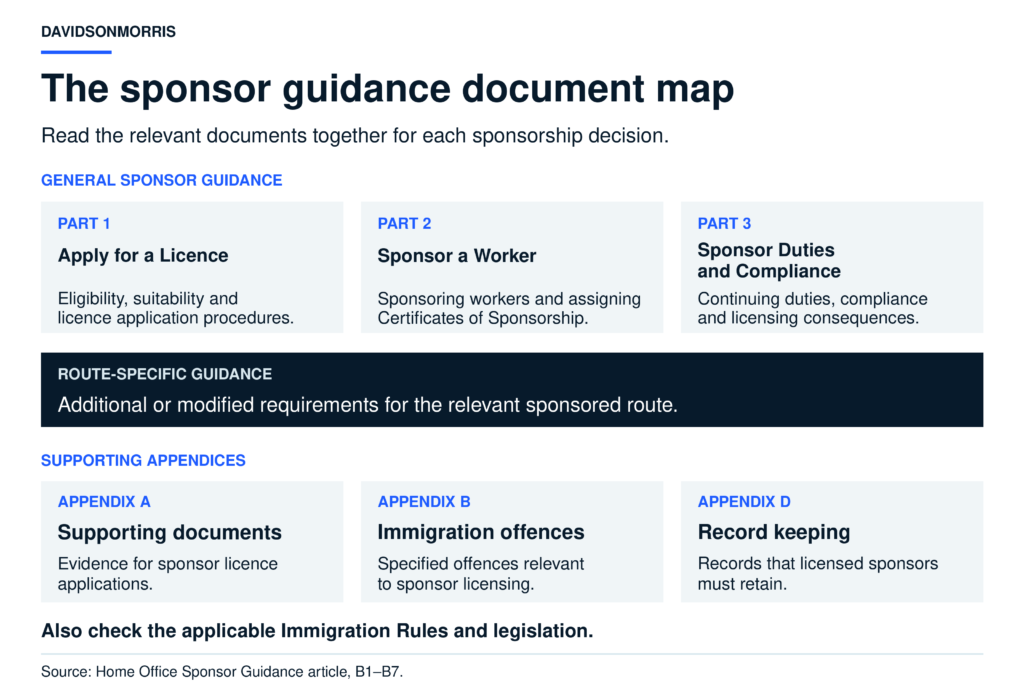
Home Office sponsor guidance is published across several documents because different parts of the sponsorship system address different decisions and immigration routes.
The general guidance sets out the core licensing and compliance framework. Route-specific guidance adds requirements for particular categories of sponsored worker, while supporting appendices deal with matters such as documentary evidence and record keeping.
An employer sponsoring a Skilled Worker may, for example, need to consider:
- The general sponsor guidance governing the licence.
- The Skilled Worker route-specific sponsor guidance.
- Appendix Skilled Worker to the Immigration Rules.
- Relevant occupation and salary provisions.
- Applicable sponsor reporting, monitoring and record-keeping duties.
The appropriate sources depend on the decision being made. Assessing whether a role qualifies for sponsorship is different from deciding whether a change in duties requires a Home Office report or a new immigration application.
Employers should start with the decision or event requiring assessment, then identify the guidance and legal provisions that govern it.
4. How Does Sponsor Guidance Fit With the Immigration Rules and Right to Work Law?
Sponsor guidance operates alongside the Immigration Rules and wider immigration legislation.
The Immigration Rules principally determine whether an individual qualifies for immigration permission under a sponsored route. Sponsor guidance governs the organisation’s authority to sponsor and the conditions attached to that authorisation.
A worker can satisfy the Immigration Rules while the employer fails to meet a sponsor duty. Equally, a business can hold a valid sponsor licence while a proposed worker or role does not qualify under the relevant immigration route.
Separate statutory right to work obligations may also apply. The Right to Work Scheme regulates prescribed checks and, where the requirements are met, the availability of a statutory excuse against civil penalty liability.
From 1 October 2026, the statutory scheme extends to specified additional working arrangements, including certain worker contracts, individual subcontracting arrangements and qualifying online matching arrangements. Licensed sponsors may also have separate checking and evidence-retention duties under sponsor guidance.
Employers should therefore assess immigration eligibility, sponsor compliance and right to work obligations as separate but connected issues where the same worker or arrangement engages more than one framework.
Where guidance appears unclear or inconsistent with another source, the employer should identify the legal basis, wording and purpose of each requirement before deciding how it applies. The legal status of sponsor guidance is considered further in Section C.
Section B: How Is Home Office Sponsor Guidance Structured?
The Home Office publishes its principal worker sponsorship guidance through the Workers and Temporary Workers: Guidance for Sponsors collection.
The collection is organised around the main functions of the sponsorship system, with additional documents addressing individual immigration routes and specialist requirements.
Understanding this structure allows employers to identify the appropriate starting point for a particular question and recognise when additional guidance must be consulted.
1. Part 1: Apply for a Licence
Part 1 addresses the requirements and procedures involved in obtaining a sponsor licence.
It explains the general eligibility and suitability requirements for organisations seeking permission to sponsor workers, including the information the Home Office may consider when assessing an application.
The guidance also addresses matters such as the sponsor licence application process, key personnel, supporting documentation and the Home Office’s assessment of an organisation’s ability to meet sponsorship responsibilities.
For employers, Part 1 is particularly relevant when preparing an initial application, seeking permission to sponsor under an additional route or considering whether changes to their business arrangements affect licensing requirements.
It should be read alongside the applicable supporting-document requirements and any route-specific provisions.
Importantly, the application guidance is not relevant only to organisations without a sponsor licence. Existing sponsors may need to revisit it when making changes to their sponsorship arrangements or assessing the implications of corporate restructuring.
Part 1 also addresses the management of sponsor licence key personnel and access to the Sponsor Management System. Changes introduced in September 2026 included the phased introduction of mandatory multi-factor authentication for SMS users from 3 September and the start of the withdrawal of the Level 2 User role. Sponsors should ensure that their current SMS user arrangements reflect the applicable requirements and the timetable for completing the transition.
Detailed treatment of the application process is available in the DavidsonMorris Sponsor Licence Application guide.
2. Part 2: Sponsor a Worker
Part 2 explains the general framework governing the sponsorship of workers by licensed organisations.
It addresses the relationship between a sponsor licence, the relevant immigration route and the employer’s ability to assign Certificates of Sponsorship.
The guidance is relevant when an employer is considering whether sponsorship is appropriate for a particular worker, what information must be provided in connection with sponsorship and how the general sponsorship rules interact with route-specific requirements.
Employers should not assume that the ability to assign a Certificate of Sponsorship automatically establishes that a proposed worker or role meets every immigration requirement.
The worker must satisfy the applicable route requirements, while the employer must ensure that its sponsorship activity complies with the conditions of its licence.
This distinction is particularly important where roles, working arrangements or sponsorship circumstances are unusual.
Part 2 should therefore be considered alongside the guidance for the relevant immigration route and the corresponding Immigration Rules.
The October 2026 updates also addressed the interaction between sponsorship and right to work checking requirements. Sponsors must establish the checks required for sponsored workers, including where working arrangements fall outside a conventional employment contract. These obligations must be distinguished from the separate question of which organisation bears statutory liability under the expanded Right to Work Scheme.
3. Part 3: Sponsor Duties and Compliance
Part 3 is a principal source for understanding the continuing responsibilities of licensed sponsors and the Home Office’s approach to sponsor compliance.
It addresses obligations that may apply throughout the sponsorship relationship, including record keeping, reporting, monitoring, cooperation with the Home Office and the consequences of failing to comply with sponsor duties.
For existing licence holders, Part 3 is especially important because many sponsorship failures arise after the initial licence has been granted.
Examples include failing to report a relevant organisational change, maintaining incomplete records, overlooking changes in a sponsored worker’s circumstances or being unable to demonstrate effective monitoring arrangements during a Home Office compliance visit.
Employers should translate the relevant requirements into documented procedures rather than relying on individual employees to consult the guidance whenever a problem arises.
Part 3 also helps employers understand the circumstances in which compliance concerns may lead to licence-related enforcement action.
The August 2026 revisions to Part 3 anticipated the expanded statutory Right to Work Scheme taking effect from 1 October 2026 and addressed its interaction with sponsor compliance. Employers should recognise that failure to undertake checks required under sponsor guidance may create licensing risks, while liability for a statutory illegal-working civil penalty depends on the separate statutory framework.
However, the detailed requirements for particular sponsor duties and enforcement processes should be considered through the relevant specialist guidance.
See also the DavidsonMorris Sponsor Licence Compliance guide.
4. Route-Specific Sponsor Guidance
In addition to the general guidance, the Home Office publishes requirements for individual sponsored immigration routes.
These documents explain how the broader sponsorship framework applies to particular categories of workers and identify additional or modified conditions that sponsors may need to satisfy.
For example, Skilled Worker sponsor guidance addresses route-specific requirements concerning eligible employment, occupation classifications and salary arrangements.
Other sponsored routes may operate under different eligibility criteria, sponsorship conditions or permitted employment arrangements.
Employers sponsoring workers under multiple routes should avoid assuming that a requirement applicable to one category automatically applies in the same way to another.
This is particularly relevant for organisations operating international mobility programmes, graduate recruitment arrangements or specialist overseas recruitment activities.
The appropriate approach is to identify the relevant route, consult its current sponsor guidance and cross-check the corresponding Immigration Rules.
Where an employer holds permission to sponsor under more than one route, its internal compliance procedures should recognise the differences between those routes.
5. Sponsor Guidance Appendices
The Home Office publishes appendices containing additional information relevant to particular aspects of sponsorship.
These documents should be consulted where the main guidance refers to them or where the employer’s circumstances engage their subject matter.
| Appendix | Principal subject | Employer relevance |
|---|---|---|
| Appendix A | Supporting documents for sponsor licence applications | Establishing the documentary evidence required for an application |
| Appendix B | Immigration offences | Understanding specified immigration offences relevant to sponsor licensing |
| Appendix D | Record-keeping duties | Identifying records that sponsors must retain |
Parts 1 and 2 and the relevant route-specific guidance should be read together with the applicable appendices. The current Worker and Temporary Worker sponsor guidance identifies Appendices A, B and D as the supporting appendices sponsors must read. A separate historic Appendix C on civil penalties remains published on GOV.UK, but it is not identified as part of the current core guidance set.
The appendices should not be regarded as optional background reading where their requirements apply.
For example, an employer preparing a sponsor licence application may understand the general eligibility requirements but still submit inadequate evidence if it fails to apply the relevant provisions of Appendix A.
Similarly, a licensed sponsor may understand its general duty to maintain records but fail to retain the particular documents required under Appendix D.
Appendix D is especially relevant to right to work evidence. Its October 2026 updates should be considered alongside the expanded statutory Right to Work Scheme and the sponsor’s separate record-keeping obligations, including where a sponsored worker is employed or engaged by another organisation.
Employers should ensure that internal checklists and compliance procedures reflect the relevant appendices, including any amendments that affect documentary requirements.
6. The Sponsor Guidance Glossary
The Home Office also provides a glossary explaining terminology used within the sponsor guidance framework.
Defined terms are important because ordinary commercial or employment terminology does not always carry the same meaning within immigration policy.
A word or expression used in a sponsor guidance provision may have a particular definition that affects how the requirement operates.
Employers should therefore check relevant definitions before relying on an interpretation based solely on the ordinary meaning of the wording.
This is particularly important where the guidance distinguishes between different categories of worker, sponsorship activity, organisational relationship or immigration permission.
The October 2026 right to work reforms reinforce the importance of precise terminology. Expressions such as worker’s contract and individual subcontractor must be considered against the relevant statutory definitions rather than the commercial label used by the parties.
The glossary supports interpretation, but it should be used alongside the substantive provisions rather than as a substitute for them.
7. Which Sponsor Guidance Document Should an Employer Read First?
The appropriate starting document depends on the decision the employer needs to make.
An organisation preparing its first sponsor licence application will ordinarily begin with Part 1 and the relevant supporting-document requirements.
An existing sponsor considering a new overseas recruitment arrangement will generally need Part 2, the applicable route-specific guidance and the relevant Immigration Rules.
An employer investigating a reporting failure, record-keeping concern or potential compliance breach will usually need to consult Part 3, together with any associated route-specific provisions.
Where the issue involves a corporate change, an enforcement decision or an earlier sponsorship event, additional sources may be required.
The following table provides a practical starting point.
| Employer question | Initial guidance to consult |
|---|---|
| Can our organisation obtain a sponsor licence? | Part 1 and Appendix A |
| Can we sponsor this particular worker? | Part 2 and relevant route-specific guidance |
| What records must we keep? | Part 3 and Appendix D |
| Do we need to report a change? | Part 3 and any applicable route-specific provisions |
| What right to work checks must we undertake? | Parts 2 and 3, Appendix D, the statutory right to work employer guide and the applicable code of practice |
| What happens if we breach a sponsor duty? | Part 3 and relevant enforcement provisions |
| Which rules applied to an earlier decision? | The historical guidance and Immigration Rules applicable at the relevant time |
The table identifies starting points, not an exhaustive list of legal sources.
Employers should establish the complete set of requirements applicable to the particular facts before making a consequential sponsorship decision.
Section C: Is Home Office Sponsor Guidance Legally Binding?
Home Office sponsor guidance is an important part of the UK’s sponsorship framework, but its legal status requires careful distinction from legislation and the Immigration Rules.
The guidance is published by the Home Office to explain the requirements, conditions and administrative arrangements governing sponsor licensing. It also sets out the standards against which the Home Office assesses organisations applying for or holding a sponsor licence.
For employers, the practical significance is substantial. A failure to comply with applicable sponsor requirements can result in enforcement action, even where the relevant obligation is explained principally through Home Office guidance rather than reproduced in full within the Immigration Rules.
However, this does not mean that every statement in sponsor guidance has the same legal status or that the guidance can independently override legislation.
Employers need to understand the source of a requirement, the legal basis on which the Home Office may enforce it and whether the relevant wording imposes a mandatory obligation, describes an administrative process or explains how discretion may be exercised.
1. What Is the Legal Status of Sponsor Guidance?
Home Office sponsor guidance is official government policy and operational guidance governing participation in the sponsorship system.
It is not, in itself, primary legislation or a statutory instrument. Nor does every provision have the same legal force as an Immigration Rule.
Nevertheless, sponsor guidance has significant legal and practical consequences because organisations are granted and retain sponsor licences subject to the requirements and conditions of the sponsorship framework.
The Home Office uses the guidance to communicate those requirements, explain how compliance is assessed and identify circumstances in which action may be taken against a sponsor.
Part 1 of the Workers and Temporary Workers guidance makes clear that organisations participating in the sponsorship system must comply with the applicable sponsorship requirements and remain aware of relevant changes to the guidance.
Compliance with applicable guidance requirements can therefore be a condition of holding a sponsor licence, even though the guidance itself is not legislation.
In R (New London College Ltd) v Secretary of State for the Home Department [2013] UKSC 51, paragraphs 28 to 29, the Supreme Court examined the administrative basis and legal limits of sponsor participation conditions in the context of educational sponsorship.
This creates an important distinction between the formal legal status of a document and its operational significance.
An employer should not dismiss a requirement merely because it appears in guidance rather than in an Act of Parliament. Equally, the Home Office’s publication of a policy statement does not automatically establish that every interpretation or proposed action is legally correct.
The enforceability of a particular requirement depends on the underlying legal framework, the applicable sponsorship conditions and the facts of the case.
Where a sponsor faces a refusal, suspension, revocation or another adverse decision, it may be necessary to examine whether the Home Office has correctly interpreted and applied its published policy and whether the decision is otherwise lawful.
2. How Does Sponsor Guidance Relate to the Immigration Rules?
The Immigration Rules, made under section 3(2) of the Immigration Act 1971, establish much of the framework governing immigration permission and the requirements applicable to particular visa routes.
Sponsor guidance performs a related but different function.
The Immigration Rules determine matters such as the eligibility conditions for sponsored immigration routes. Sponsor guidance explains the licensing and operational requirements that organisations must satisfy to participate in the sponsorship system.
The two frameworks frequently interact.
For example, the Skilled Worker Immigration Rules address the requirements that an applicant must satisfy to qualify for permission under that route. The sponsor guidance addresses the employer’s responsibilities when sponsoring the worker, including the circumstances in which sponsorship may be undertaken and the obligations associated with the sponsor licence.
A proposed sponsorship arrangement can therefore raise two separate questions:
- Does the worker meet the relevant immigration requirements?
- Is the employer entitled to sponsor the worker in the proposed circumstances, and will doing so comply with its sponsor obligations?
An affirmative answer to one question does not necessarily resolve the other.
Employers should also recognise that route-specific sponsor guidance may cross-refer to the Immigration Rules or explain how particular provisions operate in practice.
Where a guidance document summarises an Immigration Rule, the underlying Rule should be checked if the precise legal requirement is material to the decision.
3. Can Home Office Guidance Override the Immigration Rules?
Home Office guidance cannot lawfully amend or override legislation or the Immigration Rules merely by stating a different requirement.
Where there appears to be a conflict, the employer must establish whether the documents genuinely contradict one another or whether they address different legal questions.
An apparent inconsistency may arise because:
- The documents govern different aspects of sponsorship or immigration permission.
- A guidance document has been updated to reflect a change that takes effect on a different date.
- A transitional provision applies to certain workers or sponsors.
- The guidance summarises a more detailed legal requirement.
- The employer is comparing documents from different publication periods.
- A genuine drafting error or policy inconsistency exists.
These possibilities should be investigated before concluding that the Home Office has imposed an unlawful requirement.
For example, an Immigration Rule may permit a worker to qualify for a particular route, while sponsor guidance imposes separate conditions on the organisation seeking to sponsor that worker. These requirements may operate alongside one another rather than conflict.
Where a genuine inconsistency remains, employers should identify the relevant legal provisions, record the issue and obtain appropriate advice before proceeding.
A business should not assume that it can disregard a sponsor guidance requirement simply because its legal status is open to question. Equally, it should not accept an adverse Home Office interpretation without examining the applicable legal authority.
4. What Is the Difference Between Mandatory Requirements and Home Office Discretion?
Sponsor guidance contains different forms of wording, and those distinctions can affect an employer’s obligations and the Home Office’s decision-making powers.
A provision may establish a requirement that must be satisfied, describe circumstances in which the Home Office will normally take a particular action or identify a matter on which an official may exercise discretion.
The precise wording matters.
Terms such as must, will, may and normally can indicate different types of requirement or decision-making approach. However, their meaning should always be assessed in context.
For example, a statement that a sponsor must report a specified change ordinarily indicates a mandatory requirement within the sponsorship framework.
A statement that the Home Office may take a particular enforcement action indicates that a power or discretion may be available, although its exercise may be subject to further policy criteria and public law principles.
A statement that the Home Office will normally adopt a particular approach may indicate a general policy position while allowing for circumstances in which a different outcome is appropriate.
Employers should not interpret discretionary wording as meaning that compliance is optional.
Similarly, the existence of discretion does not mean that the Home Office can exercise it arbitrarily.
Where discretion is relevant, decision-makers may be required to consider the applicable policy, relevant facts and any circumstances that justify departing from the usual approach.
For sponsors, the practical task is to identify whether a provision imposes an obligation, describes a consequence or sets out how the Home Office intends to exercise its powers.
5. Is the Home Office Required to Follow Its Own Published Guidance?
As a matter of public law, government decision-makers are generally expected to apply their published policies consistently and lawfully, while recognising circumstances in which departure may be justified.
See Mandalia v Secretary of State for the Home Department [2015] UKSC 59, paragraphs 29 to 31, on the application of policy and departure where there are good reasons.
This principle can be important in sponsor licensing decisions.
An employer may have grounds to question a decision where the Home Office has applied the wrong policy, misunderstood a material provision, failed to consider relevant circumstances or departed from its stated approach without adequate justification.
However, the existence of published guidance does not guarantee a particular outcome.
The Home Office may have discretion under the relevant framework, and the lawfulness of its decision will depend on the applicable requirements and the individual circumstances.
Employers should also distinguish between a disagreement about the merits of a decision and a potential legal error.
A business may consider a Home Office decision commercially disproportionate or unnecessarily severe without that assessment, by itself, establishing that the decision is unlawful.
Where an adverse sponsor licence decision has significant consequences, the relevant guidance, decision letter, evidence and legal framework should be reviewed together.
This is particularly important because the availability and scope of challenge may differ according to the type of sponsor licence decision.
6. What Happens If Sponsor Guidance Is Ambiguous?
Ambiguity arises where a provision reasonably permits more than one interpretation or does not clearly address the employer’s circumstances.
The appropriate response is not simply to adopt whichever interpretation is most commercially convenient.
Employers should consider the wording of the provision, its purpose, surrounding requirements and any relevant definitions or cross-references.
It may also be necessary to examine the underlying Immigration Rules, legislation or other published Home Office material.
An ambiguity can be especially important where the decision concerns:
- Whether a worker may lawfully be sponsored in a particular role.
- Whether a change of employment circumstances requires a new application.
- Whether a reporting obligation has arisen.
- Whether an organisational change affects the sponsor licence.
- Whether a sponsor has complied with a requirement that may carry enforcement consequences.
- Whether an engagement falls within the statutory Right to Work Scheme or gives rise to separate sponsor checking obligations.
The October 2026 right to work reforms provide a practical example. An organisation engaging an individual as a contractor may need to establish whether the arrangement falls within one of the categories now covered by the statutory scheme. Where the individual is also sponsored, the organisation must separately consider its sponsor licence duties.
The commercial description of the arrangement is not conclusive. The relevant statutory definitions, actual working arrangements and applicable sponsor guidance must be considered.
In these situations, employers should record the interpretation adopted, the sources considered and the reasons supporting the decision.
Where the consequences of an incorrect interpretation are significant, legal advice may be appropriate before action is taken.
A documented interpretation does not guarantee that the Home Office will agree with the employer’s position. It can, however, demonstrate that the organisation identified the issue and considered its obligations rather than overlooking them.
7. Can Employers Rely on Previous Home Office Guidance?
Previous versions of sponsor guidance may remain relevant when assessing historical events, earlier decisions or compliance obligations arising at a particular point in time.
However, employers should distinguish between the guidance applicable when an event occurred and the requirements governing a decision being made now.
A historical version may help establish what the Home Office required when a Certificate of Sponsorship was assigned, a worker’s circumstances changed or a particular report became due.
It does not necessarily authorise an employer to continue following an earlier policy after the relevant requirements have changed.
The position may also be affected by transitional provisions or implementation arrangements.
Employers should therefore avoid assuming either that the latest guidance applies retrospectively to every historical event or that earlier guidance continues to govern all arrangements established before a policy change.
The October 2026 right to work reforms illustrate this distinction. The relevant commencement date depends on the statutory provision. For newly covered direct working arrangements, the guidance addresses employment commencing on or after 1 October 2026. For extended liability under section 15A, the relevant date is when the contractual arrangements were entered into; an arrangement entered into before 1 October 2026 is not brought within scope solely because work continues afterwards. Any required follow-up checks must be assessed separately under the applicable provisions. Historical checking arrangements must be assessed against the requirements that applied at the relevant time.
Employers must also distinguish the commencement of a statutory checking requirement from any continuing obligation arising under their sponsor licence.
The relevant dates and legal provisions must be identified.
The practical approach to determining which version applies is examined in Section E.
Section D: How Should Employers Interpret Sponsor Guidance?
Correct interpretation of Home Office sponsor guidance requires more than reading a single paragraph and applying its wording in isolation.
Sponsor guidance is a connected framework of general requirements, route-specific provisions, definitions, exceptions and cross-references. The meaning of a particular instruction may depend on the type of sponsor, the immigration route, the worker’s circumstances and the date of the relevant event.
Employers should therefore use a structured approach to interpretation, particularly where the decision could affect immigration permission, sponsorship compliance or the continued operation of a sponsor licence.
The objective is to reach a reasoned, evidence-based conclusion that can be explained and supported if subsequently questioned by the Home Office.
1. Start With the Employer Decision, Not the Guidance Document
The first step is to define precisely what the organisation needs to establish.
A broad question such as ‘Can we sponsor this employee?’ may involve several distinct issues.
The employer may need to determine whether the role qualifies under the relevant route, whether the proposed salary satisfies the applicable requirements, whether the worker needs new immigration permission and whether the organisation is authorised to sponsor under that route.
Each question may require different sources.
Similarly, asking whether an employer must report a change is insufficient without identifying what has changed, when it occurred and which sponsorship obligations may be engaged.
A useful starting point is to record:
- The proposed decision or event requiring assessment.
- The immigration route involved.
- The relevant sponsor licence arrangements.
- The worker’s current immigration and employment circumstances, where applicable.
- The dates on which the relevant events occurred or will occur.
- The potential consequences of an incorrect decision.
This prevents an employer from selecting guidance based on a general topic rather than the actual compliance issue.
2. Identify the Applicable Sponsorship Route
The requirements governing one sponsored route should not automatically be applied to another.
The Home Office’s general guidance establishes the broader sponsorship framework, but route-specific guidance may impose additional conditions or explain how general requirements operate for a particular category of worker.
For example, the questions relevant to sponsoring a Skilled Worker may differ from those arising under a Global Business Mobility route or another sponsored work route.
Employers should establish the relevant route before determining which requirements apply.
Where an organisation sponsors workers under several routes, this distinction should be reflected in its internal processes.
A single generic recruitment checklist may be inadequate if it fails to recognise route-specific eligibility conditions, reporting obligations or employment restrictions.
The same issue can arise when a worker changes immigration category.
The employer should not assume that requirements associated with the worker’s previous route continue to apply unchanged.
3. Read the Relevant Provision in Context
A common interpretation error is to rely on an isolated sentence without examining the surrounding provisions.
Sponsor guidance frequently uses cross-references, defined terminology and conditions that qualify an apparently straightforward requirement.
A paragraph may state a general rule, while a subsequent paragraph identifies an exception or a different approach for particular circumstances.
Similarly, a requirement may apply only to a defined category of sponsor, worker or employment arrangement.
Employers should therefore read the relevant provision together with:
- The heading and section in which it appears.
- Any definitions affecting its meaning.
- The conditions or qualifications attached to the requirement.
- Relevant exceptions and transitional arrangements.
- Cross-references to other sponsor guidance.
- The applicable Immigration Rules or legislation.
This is particularly important when the guidance uses broad terminology that may appear familiar from employment law or commercial practice.
The meaning intended within the immigration framework may be narrower or more specific.
4. Distinguish Sponsor Obligations From Worker Eligibility Requirements
Sponsor compliance and worker immigration eligibility are closely connected but legally distinct.
A worker may satisfy certain immigration criteria while the employer remains subject to separate requirements governing sponsorship.
Conversely, an organisation may hold an appropriate sponsor licence without every proposed worker or employment arrangement qualifying under the relevant route.
This distinction matters when assessing recruitment arrangements, changes in employment and ongoing compliance.
For example, an employer considering a change in a sponsored worker’s role may need to assess whether the change affects the worker’s immigration permission and whether the sponsor has a separate reporting obligation.
These are related but not necessarily identical questions.
A conclusion that no new immigration application is required does not, by itself, establish that no report is necessary.
Equally, submitting a sponsor report does not necessarily resolve whether the worker needs to make a new immigration application.
Employers should identify and answer each question independently before reaching an overall compliance decision.
The same principle applies to right to work compliance. The organisation should distinguish the worker’s immigration permission, any statutory obligation to undertake a prescribed right to work check and the sponsor’s separate obligation to check or retain evidence of permission to work.
The October 2026 reforms make this distinction especially important for non-standard working arrangements. An organisation should not assume that describing an individual as self-employed removes statutory checking obligations, or that a check performed by another organisation automatically satisfies all sponsor record-keeping requirements.
5. Check Definitions, Exceptions and Transitional Provisions
Definitions and exceptions can materially alter the outcome of a sponsor guidance assessment.
A requirement that appears to apply generally may be restricted by the meaning of a defined term or qualified by provisions relating to particular categories of worker.
Transitional arrangements can also be significant where the Home Office changes immigration or sponsorship requirements.
A new requirement may apply immediately to certain cases, while existing workers or arrangements may be subject to different provisions.
Employers should not assume that every policy change affects all sponsored workers in the same way.
The relevant analysis may require consideration of:
- The date of the worker’s original immigration application.
- The date permission was granted.
- The date a Certificate of Sponsorship was assigned.
- The date of an extension or change of employment application.
- The date on which the new requirement took effect.
- Any express transitional protection or exception.
The importance of these dates depends on the particular provision.
A transitional arrangement should never be inferred merely because an employee has worked for the organisation for several years.
It must be established from the applicable rules or policy.
For right to work compliance, employers should also consider when the relevant employment commenced, when any contractual arrangements relevant to extended liability were entered into and whether a repeat check is required. The October 2026 statutory changes should not be applied indiscriminately to historical arrangements without considering the applicable commencement provisions.
6. Distinguish Mandatory Duties From Recommended Practice
Not every operational suggestion in sponsor guidance is necessarily expressed as a separate mandatory obligation.
Some provisions identify what sponsors must do. Others explain how compliance may be demonstrated or describe administrative practices that support the sponsorship framework.
Employers should distinguish between these categories without underestimating the practical importance of the guidance.
For example, an employer may have a mandatory duty to maintain specified records. Its internal method of organising those records may involve additional procedures adopted to make compliance more reliable.
Those additional procedures can be sensible governance measures without every individual step necessarily being prescribed by the Home Office.
The distinction matters when designing compliance systems.
Businesses should identify the underlying obligation and then establish proportionate internal controls to ensure it is met.
They should also avoid presenting an internal policy preference as though it were a statutory or Home Office requirement.
Doing so can create unnecessary restrictions, confuse employees and make it more difficult to distinguish genuine compliance failures from departures from internal practice.
7. Consider How the Requirement Applies to the Employer’s Actual Operations
Sponsor guidance is published for a wide range of organisations, from small businesses sponsoring their first overseas employee to multinational groups operating across multiple locations.
The same general requirement may create different operational challenges depending on the employer’s structure.
A small employer may rely on a limited number of individuals to manage sponsorship activity.
A larger organisation may distribute recruitment, payroll, employee relations and immigration administration across different departments or jurisdictions.
The legal obligation remains relevant, but the systems needed to satisfy it may differ.
For example, a requirement to identify and report relevant changes in sponsored workers’ circumstances depends on the organisation having a reliable way to detect those changes.
Where line managers approve role changes without informing the central immigration team, the employer may fail to identify a reporting obligation.
Where payroll changes are processed separately from sponsorship administration, relevant changes may not be assessed before implementation.
Employers should therefore interpret sponsor guidance in the context of their actual decision-making processes.
The question is not only what the guidance requires, but how the organisation will ensure that the requirement is met consistently.
Following the October 2026 right to work changes, organisations should also review how they engage individuals outside conventional employment contracts. Procurement, contractor management and online engagement processes may need to identify when statutory right to work checks are required and which party is responsible for carrying them out.
Where sponsored workers are involved, the organisation must separately establish the checks and evidence required by sponsor guidance.
8. Do Not Treat Previous Home Office Acceptance as Permanent Approval
An employer may assume that a particular sponsorship practice is acceptable because the Home Office has previously granted a licence, approved an application or taken no action following a compliance visit.
Such assumptions can be unsafe.
Previous acceptance does not necessarily establish that the practice complies with current requirements or that the Home Office has examined every relevant aspect of the arrangement.
The applicable rules may have changed. The facts may differ. A previous decision may also have been made without full information about the employer’s arrangements.
Similarly, the absence of enforcement action does not amount to formal approval of every sponsorship practice.
Employers should assess current decisions against the applicable requirements rather than relying solely on historical outcomes.
Where a previous Home Office decision or communication is relevant, it should be retained and considered as part of the evidence, but not treated as an automatic exemption from subsequent requirements.
9. Record the Interpretation and Supporting Evidence
Where sponsor guidance requires interpretation, employers should maintain an appropriate record of the decision-making process.
The level of documentation should reflect the significance and complexity of the issue.
Routine administrative decisions may be addressed through established procedures and checklists.
More consequential matters, such as an unusual sponsorship arrangement, a disputed reporting requirement or a corporate restructuring, may justify a formal written assessment.
A useful record should identify the relevant facts, the guidance and legal sources consulted, the applicable dates, the conclusion reached and the reasons supporting it.
Where advice has been obtained, the organisation should retain an appropriate record of the advice and any resulting action.
The purpose is not to create unnecessary paperwork.
It is to ensure that material sponsorship decisions can be understood, reviewed and supported if circumstances change or the Home Office raises questions.
A clear audit trail can also assist when responsibility for sponsorship administration passes between employees or departments.
For right to work matters, the organisation should distinguish evidence retained to establish a statutory excuse from evidence required under its sponsor duties. The applicable retention requirements and the identity of the organisation responsible for the check should be recorded.
10. When Should Employers Obtain Legal Advice on Sponsor Guidance?
Not every question arising under sponsor guidance requires external legal advice.
Many routine sponsorship activities can be managed through properly trained personnel, current procedures and reliable internal controls.
However, legal advice may be appropriate where the requirements are unclear, the facts are unusual or the consequences of an incorrect interpretation could be significant.
Examples include situations involving a potential sponsor duty breach, conflicting guidance, complex corporate structures, changes affecting sponsored workers’ immigration status or threatened Home Office enforcement action.
Advice may also be valuable before implementing a business decision that could have irreversible sponsorship consequences.
For example, proceeding with a restructuring, worker transfer or material change to employment arrangements before establishing the immigration implications may limit the options available to the organisation later.
The October 2026 expansion of the Right to Work Scheme creates an additional reason to review complex engagement models. Organisations using individual subcontractors, specified worker contracts or qualifying online matching arrangements may need to establish whether the statutory scheme applies, who must undertake the prescribed checks and whether separate sponsorship obligations arise.
The most effective approach is to identify these issues before the relevant action is taken.
Employers should also ensure that advice is based on the correct version of the guidance and the full factual circumstances, rather than an isolated extract from a Home Office document.
Section E: How Do Employers Know Which Sponsor Guidance Applies?
Identifying the correct Home Office sponsor guidance is not always straightforward. Different documents apply to different aspects of sponsorship, and individual publications may be updated at different times.
For employers, the relevant question is not simply which version of the guidance is currently available. It is which requirements apply to the particular decision, worker, sponsorship arrangement or historical event under consideration.
This distinction is important because changes to the Immigration Rules, sponsor guidance and associated legislation may take effect on different dates. Transitional provisions may also preserve particular arrangements for specified categories of workers or applications.
Employers should therefore establish both the relevant sources and the period during which the applicable requirements operated.
1. Use the Official Home Office Guidance Collection
The starting point for identifying current sponsor guidance should be the official GOV.UK sponsorship guidance collection.
The collection provides access to the principal sponsor guidance documents, route-specific publications and supporting material.
Employers should use official publications rather than relying exclusively on downloaded copies, internal summaries or third-party explanations.
Secondary sources can assist with understanding the requirements, but they may not reflect the latest amendments or the full wording of the applicable provisions.
Where a decision has significant immigration or compliance consequences, the employer should identify the relevant official document and confirm that the version being used is appropriate.
The same approach should be followed when checking associated sources, including the Immigration Rules, statutory right to work guidance and relevant codes of practice.
2. Distinguish Publication Dates From Effective Dates
A document’s publication or update date does not necessarily establish when every requirement within it became legally or operationally applicable.
The Home Office may publish guidance in advance of a forthcoming change, amend guidance after a change has taken effect or update a document to clarify an existing policy.
Employers should therefore distinguish between:
- The date a guidance document was published.
- The date the document was last updated.
- The date a particular legal or policy change took effect.
- The date of the employer’s relevant decision or event.
- Any transitional or commencement provisions affecting the circumstances.
These dates may be different.
For example, an amendment published in October may reflect legislation that commenced on 1 October, while a separate provision in the same document may explain an operational change introduced earlier.
An employer should not assume that every paragraph in a newly updated document first became applicable on its publication date.
Equally, the publication of revised guidance does not necessarily mean that every earlier requirement has ceased to apply to historical circumstances.
3. Identify the Guidance Applicable to the Particular Decision
The applicable guidance should be determined by reference to the issue being assessed.
For a new sponsorship decision, employers will generally need to identify the requirements currently applicable to the proposed action.
For a historical event, the assessment may require examination of the rules and guidance in force when the relevant conduct occurred.
Some matters involve both historical and current requirements.
For example, an employer investigating whether a report should have been submitted several months earlier may need to establish the reporting obligation applicable at that time.
However, if the employer is now considering corrective action, it must also identify any current procedures or requirements governing that action.
Similarly, a worker’s earlier immigration history may be relevant to a transitional provision governing a new application.
The employer should establish the complete chronology rather than selecting a guidance version solely by reference to the date of the latest application.
4. Use Historical Guidance Where Necessary
Historical versions of Home Office guidance can be important when assessing earlier sponsorship activity.
They may help establish what an employer was required to do at a particular time and whether subsequent amendments changed the applicable position.
Historical guidance may be relevant during:
- Internal sponsor compliance audits.
- Investigations into earlier reporting failures.
- Reviews of historical Certificate of Sponsorship assignments.
- Home Office compliance visits or enforcement investigations.
- Disputes concerning the requirements applicable to an earlier decision.
- Assessments of transitional arrangements affecting existing sponsored workers.
Where historical wording is material, employers should obtain a reliable copy of the relevant document and establish its applicable period.
The GOV.UK publication history may provide useful information, although it may also be necessary to examine archived versions or other official records.
Employers should avoid reconstructing historical requirements solely from the latest guidance or from a secondary summary published after the event.
5. Check Transitional Provisions
Transitional provisions determine how changes apply to particular categories of existing or prospective applicants, workers and circumstances.
They are especially important where immigration eligibility requirements change.
A new requirement may apply to applications made from a specified date while different arrangements continue for certain workers who previously held permission under the route.
However, transitional protection is not automatic simply because a worker is already employed or sponsored.
The employer must establish whether the individual satisfies the relevant conditions.
These may depend on the date of an earlier application, the worker’s immigration history, the nature of the proposed application or other specified criteria.
Employers should also distinguish transitional provisions contained in the Immigration Rules from operational implementation arrangements described in Home Office guidance.
The two may address different aspects of a change.
Where a transitional provision is relevant, the employer should record the provision relied upon and the evidence establishing that its conditions are satisfied.
6. Do Changes to Sponsor Guidance Apply Retrospectively?
A change to sponsor guidance does not automatically apply retrospectively to every earlier event.
Its effect depends on the nature of the amendment, the underlying legal framework and any commencement or transitional provisions.
Some changes introduce new requirements for future conduct.
Others clarify an existing obligation, amend the Home Office’s operational procedures or explain how a continuing duty should be performed.
Employers should therefore avoid treating every guidance amendment as either wholly prospective or automatically retrospective.
The October 2026 right to work reforms illustrate the importance of this distinction.
The relevant commencement date depends on the statutory provision. For newly covered direct working arrangements, the guidance addresses employment commencing on or after 1 October 2026. For extended liability under section 15A, the relevant date is when the contractual arrangements were entered into; an arrangement entered into before 1 October 2026 is not brought within scope solely because work continues afterwards. Any required follow-up checks must be assessed separately under the applicable provisions.
That does not mean that every historical engagement must automatically be assessed as though the expanded statutory scheme had applied when the work originally commenced.
However, employers must separately consider whether current statutory obligations or continuing sponsor duties require action in relation to existing arrangements.
Where an employer is investigating a historical compliance concern, the relevant legal and policy requirements should be established before deciding whether a breach occurred.
7. Maintain Organisational Version Control
Employers should maintain appropriate version control over the guidance and internal procedures used to manage sponsorship.
Without a controlled process, different employees or departments may rely on different versions of the same requirement.
This can be particularly problematic where an organisation has multiple sites, decentralised HR functions or a large sponsored workforce.
For example, one department may update its recruitment checklist following a Home Office amendment while another continues using an earlier version.
The organisation may then apply inconsistent standards to comparable sponsorship decisions.
Version control should identify the source document, relevant update date, internal procedure affected and date on which the revised procedure was implemented.
Superseded instructions should be withdrawn from active use or clearly identified as historical material.
Where a previous version remains relevant for historical assessments, it should be retained in a way that prevents it being mistaken for current guidance.
Responsibility for maintaining these records should be allocated to an appropriate individual or function.
8. What If the Applicable Guidance Remains Unclear?
There may be circumstances in which the employer cannot confidently establish the applicable requirements from the published material.
This can arise where guidance has been amended several times, the legal commencement date differs from the publication date or the facts do not fit clearly within a stated category.
Employers should first establish the relevant chronology and identify the precise provision creating uncertainty.
The assessment should then consider the underlying legislation, Immigration Rules, related guidance and any express transitional arrangements.
Where uncertainty remains, the organisation should assess the consequences of proceeding on each possible interpretation.
For material decisions, legal advice may be appropriate.
The employer should retain an appropriate record of the issue, the sources considered and the conclusion adopted.
This is particularly important where the interpretation could affect the sponsor licence, a worker’s immigration permission or exposure to illegal-working enforcement.
Section F: What Happens When Home Office Sponsor Guidance Changes?
Changes to Home Office sponsor guidance can affect an employer’s recruitment processes, sponsorship decisions, internal compliance procedures and exposure to enforcement action.
However, not every amendment has the same significance.
Some changes introduce or reflect substantive legal requirements. Others alter operational procedures, clarify existing policy or make editorial corrections.
Employers need a process for identifying relevant changes, assessing their practical consequences and ensuring that affected procedures are updated.
The October 2026 right to work reforms provide an important example of how a legislative change can require employers to examine several connected sources rather than relying on a single updated guidance document.
1. What Types of Changes Can Affect Sponsor Guidance?
Home Office sponsor guidance may change for several reasons.
Substantive changes can arise from amendments to legislation, the Immigration Rules or sponsorship policy.
Operational changes may affect the processes employers use to administer their licences, assign Certificates of Sponsorship or communicate with the Home Office.
Clarificatory amendments may explain how an existing requirement should be interpreted or applied.
Editorial changes may correct terminology, update references or reorganise the document without materially altering the underlying obligations.
The classification matters because it informs the employer’s response.
A minor correction may require little more than updating an internal reference.
A substantive change affecting worker eligibility, reporting requirements or right to work checks may require immediate operational review.
Employers should not determine the significance of an amendment solely by the length of the revised text.
A short change to a mandatory requirement can have greater consequences than extensive editorial revisions.
2. Compare the New Guidance With the Previous Version
When a material update is identified, employers should establish what has actually changed.
The Home Office’s published update summary is a useful starting point, but it may not provide a complete explanation of every operational consequence.
Where the amendment affects an important requirement, the employer should compare the revised wording with the previous version.
The review should identify:
- Which provisions have been added, removed or amended.
- Whether the change reflects legislation, the Immigration Rules or Home Office policy.
- The date on which the relevant requirement applies.
- Whether transitional provisions or exceptions are available.
- Which workers, sponsorship routes or organisational activities are affected.
- Whether existing internal procedures remain adequate.
This comparison should distinguish a genuine change in requirements from a clarification of the Home Office’s existing position.
Where the distinction is unclear, the employer should avoid assuming that the amendment either creates an entirely new duty or merely restates an earlier one.
3. Assess the Impact on the Employer
Once the change has been identified, the employer should determine whether it affects its sponsorship arrangements.
Not every sponsor guidance amendment will be relevant to every organisation.
The assessment should consider the immigration routes used, the categories of sponsored workers employed and the business activities that may engage the amended requirement.
For example, a change concerning a particular sponsored route may have limited relevance to an employer that does not use that route.
However, a change affecting general sponsor duties or right to work checking arrangements may have broader implications.
The employer should also consider whether the amendment affects future decisions only or requires action in relation to existing workers and arrangements.
Where the change has consequences beyond the immigration function, relevant departments should be involved in the assessment.
For example, an amendment affecting contractor engagement may require input from procurement, HR, legal and operational management.
4. Case Study: The 1 October 2026 Right to Work Changes
The reforms to the statutory Right to Work Scheme effective from 1 October 2026 illustrate why employers must consider sponsor guidance alongside legislation, statutory codes of practice and related Home Office publications.
Before the reforms, the statutory checking framework was principally associated with employment under contracts of employment or apprenticeship.
From 1 October 2026, the scheme was extended to additional categories of working arrangements, including specified worker contracts, individual subcontracting arrangements and qualifying online matching arrangements.
Section 48 of the Border Security, Asylum and Immigration Act 2025 inserted section 14A and section 15A into the Immigration, Asylum and Nationality Act 2006. The extension commenced on 1 October 2026 under regulation 2 of S.I. 2026/683. Section 15A addresses extended civil penalty liability beyond the direct contractual employer in specified arrangements.
The expansion means that organisations may have statutory checking obligations in circumstances that do not involve a conventional contract of employment.
However, the changes do not create a universal requirement to check every contractor or every person providing services through a commercial arrangement.
The applicable statutory definitions, exclusions and factual circumstances must be considered.
The reforms are particularly important for organisations that engage individuals through non-standard working arrangements or operate business models involving individual subcontractors or online platforms.
Employers should review the substance of the working arrangement rather than relying solely on the terminology used in the contract.
A person described as self-employed may fall within a category covered by the statutory scheme, depending on the applicable legal requirements and the actual engagement.
Conversely, the existence of a commercial services agreement does not automatically establish that every individual involved is subject to a statutory checking obligation on the part of the contracting organisation.
The reforms therefore require a more detailed classification of relevant working arrangements.
5. How Do the October 2026 Reforms Affect Sponsor Duties?
The statutory Right to Work Scheme and the sponsor licensing framework are separate but overlapping systems.
The statutory scheme establishes obligations relating to the prevention of illegal working and provides a statutory excuse against civil penalty liability where prescribed checking requirements are satisfied.
Sponsor guidance imposes requirements on organisations participating in the sponsorship system, including obligations relating to the permission of sponsored workers to undertake their employment and the retention of relevant evidence.
Following the 1 October 2026 reforms, Part 2 was updated in October 2026 to address the expanded statutory framework.
Part 2, including paragraphs S1.40 to S1.43, addresses right to work checks in the context of sponsored workers and the relationship between statutory checking requirements and sponsor obligations.
Part 3 had already been updated in August 2026 in anticipation of the 1 October changes, including paragraph C7.27.
For employers, the important distinction is that an organisation may be required to undertake or obtain evidence of checks under its sponsor duties even where another organisation is responsible for a statutory check.
This can be relevant where sponsored workers are employed or engaged by another organisation in circumstances permitted under the applicable sponsorship framework.
Employers should not assume that the absence of a conventional employment contract removes all sponsorship checking obligations.
Nor should they assume that a statutory check carried out by another organisation automatically satisfies every record-keeping requirement imposed on the sponsor.
The sponsor must establish what the applicable guidance requires and retain the evidence specified for the particular arrangement.
6. What Do the Changes Mean for Contractors and Non-Employees?
The October 2026 reforms require organisations to examine working arrangements that may previously have been treated as falling outside the statutory Right to Work Scheme.
This is particularly relevant to individual subcontractors, certain worker contracts and online matching arrangements covered by the expanded legislation.
The employer or engaging organisation should determine whether the relevant arrangement falls within the statutory scheme and identify the party responsible for undertaking the prescribed checks.
This requires consideration of the applicable legal definitions and the actual relationship between the parties.
For example, a business engaging an individual subcontractor directly may need to consider whether the arrangement is covered by the expanded statutory provisions.
A business purchasing services from another corporate supplier may present different questions, depending on the nature of the arrangement and the applicable statutory provisions.
Employers should avoid making decisions solely by reference to contractual labels such as contractor, consultant or self-employed.
The relevant analysis concerns the legal character of the arrangement and whether it falls within the statutory categories.
Where the individual is also sponsored, the organisation must separately consider the requirements of the relevant sponsorship route and its continuing sponsor duties.
The right to work reforms do not, by themselves, authorise sponsorship arrangements that would otherwise be prohibited under the immigration framework.
7. Digital Right to Work Verification Changes
The October 2026 changes under S.I. 2026/700 also affect the framework for digital right to work verification.
Where an employer uses a Right to Work Digital Verification Service Provider (RtW DVSP) to establish a statutory excuse, the provider must satisfy the applicable certification and registration requirements under the relevant trust framework and supplementary code.
The updated framework also provides for specified additional forms of evidence and identity re-verification in relevant extended-liability arrangements. Identity re-verification confirms that the person carrying out the work is the person whose right to work was checked; it is separate from a follow-up immigration-status check required because permission is time-limited.
Employers should distinguish between the different methods of conducting a right to work check.
These include the Home Office online checking service, permitted manual document checks and the use of an authorised Right to Work Digital Verification Service Provider (RtW DVSP) where applicable.
Not every checking method is available for every individual or immigration status.
Organisations should therefore ensure that their checking procedures identify the appropriate method and retain the evidence required to establish the relevant statutory excuse.
Where an external verification provider is used, the employer should confirm that the provider satisfies the applicable requirements and that the checking process is appropriate for the individual concerned.
Use of an external service does not remove the need to comply with the statutory conditions for establishing an excuse.
Detailed procedures should be maintained through the organisation’s dedicated right to work compliance policy rather than relying solely on general sponsor guidance.
8. Right to Work Record Keeping and Appendix D
The October 2026 updates to sponsor guidance also have implications for the records that licensed sponsors must maintain.
Appendix D sets out documentary retention requirements relevant to sponsored workers.
These requirements should be considered alongside the statutory right to work guidance, particularly where the organisation is relying on a prescribed check to establish a statutory excuse.
Employers should distinguish between:
- Evidence required to demonstrate that a statutory right to work check was conducted correctly.
- Documents and records that must be retained under the sponsor licensing framework.
- Evidence obtained from another organisation where the sponsorship arrangement requires the sponsor to obtain or retain confirmation of checks.
These obligations may overlap, but they should not be assumed to be identical.
Where sponsored workers are employed or engaged by another organisation, the sponsor should establish what Appendix D requires in relation to the relevant checks and supporting evidence.
Internal procedures should identify which organisation conducts the check, what evidence the sponsor must obtain and how the records will be retained.
The organisation should also ensure that records remain accessible if the Home Office requests evidence during a compliance assessment.
9. What Are the Enforcement Risks Following the October 2026 Changes?
Failure to comply with right to work obligations can create different forms of legal and regulatory exposure.
Under the statutory framework, an organisation may face civil penalty liability for illegal working where the relevant legal conditions are satisfied and no statutory excuse is available.
Under the sponsorship framework, failures to undertake required checks or maintain relevant evidence may also constitute breaches of sponsor duties.
The Home Office’s October 2026 sponsor guidance expressly identifies serious licensing consequences associated with failures to undertake required right to work checks and the issue of illegal-working civil penalties.
Part 2, paragraph S1.43, indicates that such circumstances are likely to lead to sponsor licence revocation.
However, employers should not treat every administrative error as automatically producing the same outcome.
Where a sponsor licence is suspended, the sponsor cannot assign any Certificates of Sponsorship. Existing sponsored workers with valid permission are generally unaffected unless and until further Home Office action is taken.
The consequences depend on the applicable requirement, the facts and the relevant enforcement framework.
The distinction between statutory civil penalty liability and sponsor licence enforcement is important because the legal basis, decision-making process and potential consequences are not identical.
An organisation may therefore need to assess both forms of exposure when investigating a right to work compliance concern.
Where a potential breach is identified, the employer should establish the relevant facts, determine which obligations applied and consider the appropriate corrective response without delay.
10. How Should Employers Respond to the October 2026 Right to Work Reforms?
Employers should assess the reforms against their actual workforce and engagement arrangements rather than assuming that existing employment-based checking procedures remain sufficient.
A proportionate review should consider:
- Whether the organisation engages individuals through arrangements covered by the expanded statutory scheme.
- Whether existing procedures correctly distinguish employees, workers, individual subcontractors and other relevant categories.
- Which organisation is responsible for conducting prescribed checks in each arrangement.
- Whether the appropriate checking method is being used.
- Whether any Right to Work Digital Verification Service Provider (RtW DVSP) used satisfies the applicable requirements.
- Whether records are retained in accordance with the statutory framework and sponsor guidance.
- Whether sponsored workers are engaged through arrangements requiring additional sponsor checks or evidence.
- Whether procurement, HR, payroll and operational teams understand when a right to work assessment is required.
- Whether existing policies reflect the applicable commencement and repeat-check provisions.
Where changes are necessary, the organisation should allocate responsibility for implementation and document the revised procedures.
The assessment should also identify whether particular existing arrangements require further review.
The reforms should be considered as part of the employer’s wider right to work compliance framework rather than treated solely as an amendment to sponsor licence administration.
11. How Do Guidance Changes Affect Existing Sponsored Workers?
A change to sponsor guidance does not necessarily affect every worker already sponsored by an organisation.
The impact depends on the subject of the amendment, the relevant immigration route and any applicable commencement or transitional provisions.
Some changes affect only future applications or sponsorship decisions.
Others alter continuing sponsor duties or operational requirements that may apply to existing sponsorship arrangements.
Employers should therefore identify whether the change affects:
- Workers already holding immigration permission.
- Future extensions or changes of employment applications.
- New Certificates of Sponsorship.
- Existing reporting or record-keeping obligations.
- Internal compliance procedures.
- Working arrangements involving third parties or non-standard engagements.
The October 2026 right to work reforms provide an example of why this analysis matters.
The statutory commencement provisions determine when the expanded checking framework applies, while sponsor guidance may impose continuing obligations that require separate consideration.
Employers should not assume that existing workers are automatically exempt from all new requirements or that every historical arrangement must be reassessed under the latest statutory provisions.
12. Update Internal Sponsorship Procedures
Once a relevant guidance change has been assessed, employers should ensure that their internal procedures reflect the applicable requirements.
This may involve revising recruitment checklists, sponsor reporting procedures, record-keeping instructions, training materials or approval processes.
Changes affecting the Sponsor Management System may also require amendments to user access arrangements and internal responsibilities.
For example, the Home Office’s September 2026 changes to SMS administration included the phased introduction of mandatory multi-factor authentication from 3 September and the phased withdrawal of the Level 2 User role.
New Level 2 User appointments ceased on 9 September 2026. Existing Level 2 Users must be converted to Level 1 Users, where eligible, or deactivated by 8 March 2027, after which the Level 2 role will cease to exist.
These changes illustrate that sponsor guidance updates can affect the practical administration of a licence even where the underlying immigration eligibility requirements remain unchanged.
Employers should ensure that revised procedures are communicated to the personnel responsible for implementing them.
Simply updating a written policy will not necessarily achieve compliance if the relevant employees continue using earlier practices.
13. Who Should Monitor Changes to Sponsor Guidance?
Responsibility for monitoring sponsor guidance should be clearly allocated within the organisation.
The appropriate arrangements will depend on the employer’s size, structure and level of sponsorship activity.
For smaller organisations, monitoring may be undertaken by the Authorising Officer or another suitably trained individual responsible for immigration compliance.
Larger employers may allocate responsibility to a central immigration, HR compliance or legal function.
External advisers may assist with identifying and interpreting material changes.
However, the sponsoring organisation remains responsible for meeting its applicable obligations.
The monitoring function should have a reliable way to communicate relevant developments to the departments affected.
For example, a change concerning sponsored workers’ employment conditions may require action by HR and payroll, while a change affecting contractor right to work checks may also require procurement and operational involvement.
The objective is to ensure that material changes lead to appropriate business action rather than remaining isolated within an immigration update.
14. How Often Should Employers Review Sponsor Guidance?
There is no single review frequency appropriate for every organisation.
The frequency and depth of review should reflect the employer’s sponsorship activity, workforce arrangements and compliance exposure.
Organisations sponsoring workers regularly may require ongoing monitoring of relevant Home Office publications.
Employers with limited sponsorship activity may adopt a less intensive routine, provided that they check current requirements before significant decisions and maintain arrangements for identifying material changes.
Additional reviews may be appropriate when:
- The Home Office publishes a significant sponsor guidance update.
- The Immigration Rules change.
- The organisation begins sponsoring under a new route.
- A corporate transaction or restructuring is proposed.
- The employer changes its workforce engagement model.
- A compliance concern or Home Office investigation arises.
- Internal audits identify weaknesses in existing procedures.
Periodic review should be supplemented by event-driven checks where a particular decision creates new sponsorship or right to work implications.
15. What Happens If an Employer Misses a Guidance Update?
Missing a material guidance update can create compliance risks where the organisation continues operating under superseded requirements.
The consequences depend on the nature of the change and whether the employer has failed to meet an applicable obligation.
An outdated internal procedure does not necessarily establish that a breach has occurred, but it may increase the likelihood of errors.
Where an employer discovers that it has missed a relevant update, it should establish when the change took effect and which activities were affected.
The review should identify whether any sponsorship decisions or operational practices need to be reconsidered.
Where a potential breach is identified, the organisation should determine the applicable requirements and consider corrective action.
It should also examine why the update was missed and whether changes to its monitoring arrangements are necessary.
Employers should avoid assuming that a lack of awareness of the update will automatically excuse non-compliance.
16. Maintain a Sponsor Guidance Change Log
A change log provides a practical method of recording material Home Office updates and the organisation’s response.
It can help demonstrate that the employer has a structured process for identifying changes, assessing their implications and implementing revised procedures.
The log should be proportionate to the organisation’s circumstances and should focus on changes relevant to its sponsorship activities.
| Field | Information to record |
|---|---|
| Guidance document | The relevant Home Office publication and section |
| Publication date | The date the updated guidance was published |
| Effective date | The date the relevant requirement became applicable |
| Nature of change | Substantive, operational, clarificatory or editorial |
| Employer impact | Workers, routes, departments or processes affected |
| Required action | Procedural, operational or legal steps identified |
| Responsible person | Individual or function accountable for implementation |
| Completion date | When the required action was implemented |
| Evidence | Updated procedures, training records or other supporting material |
| Further review | Any outstanding issue or future review trigger |
The log should not be treated as a substitute for actual implementation.
Its purpose is to support a reliable process in which material changes are identified, assessed and translated into effective operational controls.
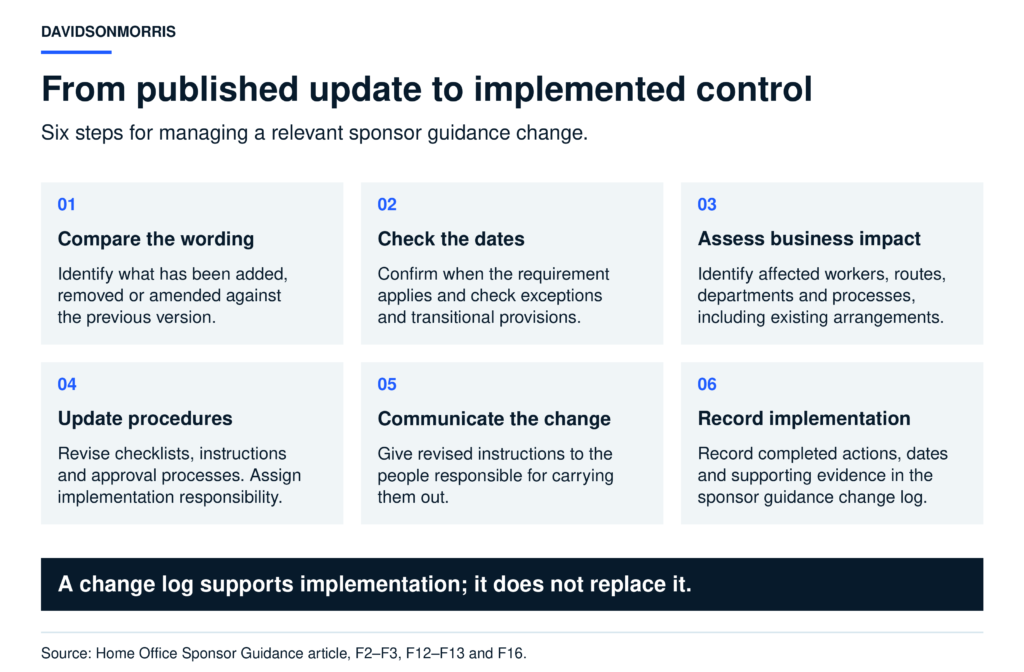
17. What If Home Office Guidance Is Changed Again or Reversed?
Home Office guidance may be amended more than once in relation to the same issue.
In some circumstances, a provision may be clarified, replaced or reversed following further policy consideration or operational developments.
Employers should not assume that a later amendment automatically resolves every question arising under an earlier version.
The effect depends on the nature of the change, the applicable legal framework and the relevant dates.
For example, an employer may have altered its internal procedures in response to an earlier Home Office publication.
If that publication is subsequently revised, the organisation should establish whether the earlier changes remain necessary, whether further amendments are required and whether any historical decisions need review.
Where the earlier guidance gave rise to a compliance concern, the employer may also need to consider whether the later amendment affects the interpretation of the requirement that applied at the time.
The appropriate approach is to preserve the relevant chronology, compare the different versions and identify the legal effect of each change.
Employers should avoid assuming that the latest wording can be applied indiscriminately to every earlier event.
Where the issue involves a potentially serious sponsor compliance consequence, specialist legal review may be appropriate.
Section G: Common Sponsor Guidance Interpretation Problems
Home Office sponsor guidance is extensive, regularly updated and divided across several documents. Even employers with established sponsorship procedures can encounter difficulties when interpreting requirements or applying them to particular circumstances.
Many compliance problems arise not because an employer has deliberately disregarded the guidance, but because a requirement has been misunderstood, applied incompletely or overlooked during an operational decision.
However, an employer’s intention does not determine whether a sponsor duty has been breached. The Home Office may take compliance action where the applicable requirements have not been met, regardless of whether the failure resulted from a misunderstanding, inadequate procedures or deliberate conduct.
The following scenarios illustrate common interpretation risks and how employers can address them.
1. Relying on One Guidance Document Without Checking Related Requirements
A common problem is treating a single sponsor guidance document as a complete statement of the requirements applicable to a decision.
For example, an employer considering sponsorship under the Skilled Worker route may consult the general guidance on sponsoring workers without examining the route-specific requirements and the relevant Immigration Rules.
The employer may correctly understand how to assign a Certificate of Sponsorship but overlook a separate requirement affecting the worker’s eligibility or proposed employment.
Similarly, an organisation may consult Part 3 when assessing its reporting duties but fail to consider a route-specific provision relevant to the worker concerned.
This creates a risk of reaching a technically incomplete conclusion.
The solution is to identify the complete set of sources governing the decision.
Employers should establish whether the issue involves the sponsor licence, the worker’s immigration eligibility, ongoing sponsor duties or a combination of these matters.
Where multiple sources apply, the assessment should address each relevant requirement before the employer proceeds.
2. Confusing Sponsor Licence Requirements With Visa Requirements
The sponsor licensing system and the immigration requirements applicable to sponsored workers are closely connected but serve different purposes.
An employer may assume that because a worker qualifies for a particular visa route, the proposed sponsorship arrangement must also be acceptable.
Alternatively, the employer may assume that holding a valid sponsor licence is sufficient to establish that any proposed worker can be sponsored.
Neither assumption is reliable.
The Immigration Rules establish the requirements for obtaining or retaining immigration permission. The sponsor guidance establishes requirements governing the employer’s participation in the sponsorship system.
For example, a worker’s eligibility under a particular route does not remove the sponsor’s obligation to ensure that the employment arrangements comply with applicable sponsorship requirements.
Conversely, the fact that an employer is licensed to sponsor workers does not establish that a particular role meets the relevant occupation, salary or other immigration conditions.
Employers should therefore assess sponsor compliance and worker eligibility separately, even where the same facts are relevant to both.
This distinction should be reflected in recruitment approval procedures.
3. Applying Outdated Guidance to a Current Sponsorship Decision
An employer may continue using internal instructions developed under an earlier version of Home Office sponsor guidance.
This is particularly likely where sponsorship administration is undertaken infrequently or where operational checklists have remained unchanged for several years.
The problem may not be apparent because the procedures are familiar and have previously produced successful outcomes.
However, a process that complied with earlier requirements may no longer reflect the current position.
For example, an employer may rely on an outdated understanding of the information required for a sponsorship decision, the conditions governing a particular route or the reporting obligations arising from an employment change.
The risk is increased where different departments maintain their own copies of guidance and internal procedures.
Employers should ensure that operational materials are subject to version control and that current requirements are checked before significant sponsorship decisions.
Where a material update is identified, affected procedures should be reviewed and superseded instructions withdrawn.
4. Applying Current Guidance to Historical Events Without Checking Earlier Requirements
The opposite problem arises where an employer assesses a historical sponsorship event solely against the latest published guidance.
This can occur during an internal audit, a Home Office investigation or a review of earlier Certificates of Sponsorship.
A requirement introduced after the event may not have applied when the employer originally acted.
Equally, a later amendment may clarify an existing obligation rather than introduce a new one.
The distinction matters because the employer needs to establish the requirements properly applicable to the historical conduct.
For example, where the Home Office questions whether a particular change should have been reported, the assessment may require examination of the reporting obligation applicable when the change occurred.
The current guidance may also be relevant to ongoing obligations or the present enforcement process, but it should not automatically replace the historical framework.
The October 2026 right to work reforms provide another example. The relevant commencement date depends on the statutory provision. For newly covered direct working arrangements, the guidance addresses employment commencing on or after 1 October 2026. For extended liability under section 15A, the relevant date is when the contractual arrangements were entered into; an arrangement entered into before 1 October 2026 is not brought within scope solely because work continues afterwards. Any required follow-up checks must be assessed separately under the applicable provisions. An earlier engagement should not automatically be assessed as though the expanded statutory requirements applied when it began.
However, current checking obligations and continuing sponsor duties may still require consideration.
Employers should establish a timeline of the relevant events, guidance versions and legal changes before reaching a conclusion.
5. Misunderstanding Mandatory and Discretionary Wording
Sponsor guidance uses language that may establish an obligation, describe a normal policy approach or identify circumstances in which the Home Office may exercise discretion.
Employers can encounter difficulties where they interpret these expressions without considering their context.
For example, a provision stating that a sponsor must undertake a particular action should not be treated as an optional recommendation merely because the guidance is not itself primary legislation.
Conversely, a provision stating that the Home Office may take enforcement action does not necessarily mean that the action must follow in every case.
The relevant legal framework and policy wording determine the position.
Problems can also arise where employers interpret the word normally as establishing an absolute rule.
Such wording may indicate a general approach while allowing for exceptions, although the circumstances in which departure is permitted must be assessed carefully.
Employers should identify whether a provision establishes a sponsor duty, a condition of sponsorship, an administrative process or a Home Office decision-making policy.
Where the distinction affects a significant decision, the precise wording and legal basis should be examined.
6. Overlooking Exceptions and Transitional Arrangements
Sponsor guidance may state a general requirement and then qualify its application through exceptions, route-specific provisions or transitional arrangements.
An employer relying only on the general rule may reach the wrong conclusion.
This is particularly important following changes to immigration eligibility requirements.
For example, an employer assessing a sponsored worker’s eligibility for an extension may need to consider whether the worker qualifies under a transitional provision.
Applying a requirement intended for new applicants without checking the worker’s immigration history could produce an unnecessarily restrictive assessment.
The reverse risk also exists.
An employer may assume that an existing worker benefits from transitional protection without establishing that the relevant conditions are satisfied.
Transitional arrangements are not a general exemption for all existing sponsored workers.
Their application depends on the wording of the relevant provisions and the worker’s individual circumstances.
Employers should check the applicable dates, eligibility conditions and any limitations before relying on an exception.
7. Assuming a Home Office Compliance Visit Confirms Full Compliance
Some employers regard a previous successful compliance visit as evidence that their sponsorship arrangements have been approved in their entirety.
This assumption can be problematic.
A Home Office compliance visit may examine particular records, processes or circumstances. It does not necessarily involve a comprehensive assessment of every sponsorship decision or internal procedure.
The absence of adverse findings does not amount to permanent approval of the organisation’s practices.
Requirements may also change after the visit.
An employer should therefore continue reviewing its compliance arrangements and should not rely exclusively on previous Home Office engagement when making new decisions.
Where the Home Office has provided specific written findings or instructions, these should be retained and considered.
However, employers should distinguish between what was actually examined or communicated and broader assumptions about the organisation’s compliance status.
8. Failing to Recognise the Sponsorship Implications of Business Decisions
Not every event affecting sponsor compliance originates within the immigration or HR function.
Commercial and operational decisions can have immigration consequences even where sponsorship is not their primary purpose.
Examples include business acquisitions, reorganisations, changes in ownership, employee transfers, changes to work locations and material adjustments to sponsored workers’ roles.
A commercial team may implement a transaction without recognising that the sponsor licence position needs to be assessed.
Similarly, a line manager may change a sponsored worker’s responsibilities without considering whether the change affects immigration eligibility or reporting obligations.
The difficulty is not necessarily that the sponsor guidance is unclear. It may be that the relevant decision-maker does not recognise that the guidance applies.
Employers should therefore establish internal triggers requiring sponsorship review before specified business changes are implemented.
These triggers should be integrated into existing approval processes rather than relying on employees to identify immigration issues independently.
9. Treating Sponsor Guidance as an HR Administration Manual
Sponsor guidance is sometimes treated primarily as a set of administrative instructions for the employees responsible for operating the Sponsor Management System.
This understates its significance.
Sponsorship compliance can involve recruitment decisions, employment arrangements, payroll information, organisational governance and commercial transactions.
A reporting obligation may depend on information held by a line manager. A record-keeping requirement may involve payroll or recruitment personnel. A corporate change may require input from directors or the legal team.
If sponsorship responsibilities are confined to one administrator without appropriate access to relevant business information, the organisation may fail to identify matters requiring action.
Employers should therefore treat sponsorship as a governance and compliance function supported by HR administration, rather than an administrative process operating separately from the business.
The internal allocation of responsibilities should reflect the actual sources of sponsorship risk.
10. Misclassifying Contractors and Non-Employee Working Arrangements
The expansion of the statutory Right to Work Scheme from 1 October 2026 creates an important additional interpretation risk for organisations using non-standard working arrangements.
An employer may assume that an individual described as self-employed or engaged as a contractor falls outside the statutory checking framework.
That assumption may no longer be correct.
The expanded scheme covers specified categories of working arrangements, including certain worker contracts, individual subcontractors and qualifying online matching arrangements.
However, it does not impose an identical checking obligation on every commercial arrangement involving an external supplier or contractor.
The correct assessment depends on the applicable statutory definitions, the nature of the engagement and the relationship between the parties.
For example, an organisation directly engaging an individual subcontractor may need to establish whether the arrangement falls within the expanded statutory scheme.
A business obtaining services from another corporate supplier may raise different questions.
Employers should not determine their obligations solely by reference to contractual labels such as consultant, contractor or self-employed.
Where the individual is sponsored, the organisation must also consider the separate requirements of the sponsorship framework.
A statutory right to work check and compliance with sponsor duties are not necessarily the same exercise.
The sponsor may be required to obtain or retain evidence of relevant checks even where another organisation is responsible for the statutory checking process.
The employer should therefore establish:
- The legal classification of the working arrangement.
- Whether the arrangement falls within the statutory Right to Work Scheme.
- Which organisation is responsible for undertaking the prescribed check.
- Which checking method is applicable.
- Whether separate sponsor duties apply.
- What evidence must be obtained and retained.
Where the arrangement is complex or its classification is uncertain, legal review may be appropriate before the engagement begins.
11. Confusing Statutory Right to Work Checks With Sponsor Record-Keeping Duties
Employers may also misunderstand the relationship between the statutory Right to Work Scheme and the record-keeping requirements imposed on licensed sponsors.
The statutory scheme establishes the conditions under which an organisation may obtain a statutory excuse against civil penalty liability for illegal working.
Sponsor guidance imposes additional obligations relevant to sponsored workers, including requirements to undertake or retain evidence of appropriate checks.
These frameworks can overlap, but they should not be treated as identical.
For example, a sponsor may have obligations concerning a sponsored worker who is employed or engaged by another organisation.
In those circumstances, the sponsor must establish what the relevant guidance and Appendix D require concerning evidence of the worker’s permission to work.
It should not assume that the other organisation’s statutory responsibilities automatically satisfy all sponsor obligations.
Equally, retaining sponsorship records does not necessarily establish that a statutory right to work check was performed in the prescribed manner.
Employers should therefore maintain procedures that identify the purpose, method and evidential requirements of each relevant check.
This distinction is especially important following the October 2026 reforms, because a wider range of working arrangements may now engage statutory checking requirements.
12. Relying on Informal Advice or Secondary Summaries
Employers may obtain information about sponsorship requirements from professional articles, industry publications, online discussions, artificial intelligence tools or informal communications.
These sources can help identify relevant issues and explain complex requirements.
However, they should not replace the authoritative legal and policy materials where a consequential decision is being made.
A secondary summary may omit an exception, simplify a technical distinction or reflect an earlier version of the guidance.
Similarly, informal comments attributed to the Home Office may not establish the applicable legal position.
Where a requirement is material, employers should identify the relevant official source and confirm that the interpretation is consistent with the current framework.
Professional advice can assist with that assessment, particularly where the guidance is complex or unclear.
The important distinction is between using secondary material to understand an issue and relying on it as the sole authority for a sponsorship decision.
13. Failing to Document the Reasoning Behind a Sponsorship Decision
An employer may reach a reasonable interpretation of sponsor guidance but fail to retain evidence explaining how it reached that conclusion.
This can create difficulties if the decision is questioned months or years later.
The employees involved may have left the organisation. The guidance may have changed. Relevant records may be dispersed across departments.
Without an adequate audit trail, it may be difficult to establish which requirements were considered or why the employer acted as it did.
For material decisions, employers should retain a proportionate record of the relevant facts, sources, interpretation and approval.
The record should distinguish between the underlying requirement and the employer’s judgement about how it applies.
This is particularly important where the decision involves unusual facts, ambiguous wording or a potentially significant compliance consequence.
Documentation does not establish compliance by itself, but it can support accountability, internal review and a clearer response to Home Office scrutiny.
14. Assuming That a Later Guidance Change Resolves an Earlier Compliance Problem
Where the Home Office revises or reverses a guidance provision, employers may assume that earlier compliance concerns automatically disappear.
The position is not necessarily that straightforward.
A later change may remove a requirement prospectively, clarify the Home Office’s interpretation or correct an earlier drafting problem.
Its effect on historical conduct depends on the underlying legal framework, the applicable dates and the nature of the amendment.
For example, an employer that changed its procedures in response to a published update may need to establish whether those procedures remain appropriate following a subsequent revision.
An organisation facing a historical compliance allegation may also need to consider whether the later change affects the interpretation of the earlier requirement.
Neither issue can be resolved solely by observing that the latest guidance uses different wording.
Employers should establish the chronology and legal effect of the changes before deciding whether remedial action or further review is required.
Section H: DavidsonMorris Employer Guidance Review Framework
Employers need a consistent method for converting Home Office sponsor guidance into reliable operational decisions.
The challenge is not simply identifying the correct document. It is establishing the applicable requirement, understanding its legal and policy context, applying it to the employer’s circumstances and ensuring that the resulting decision can be implemented and evidenced.
DavidsonMorris recommends approaching material sponsor guidance questions through a structured review framework.
The framework is intended to support informed decision-making and reduce the risk of inconsistent interpretation across an organisation. It does not replace the need to consider the specific legal requirements or obtain advice where the circumstances warrant it.
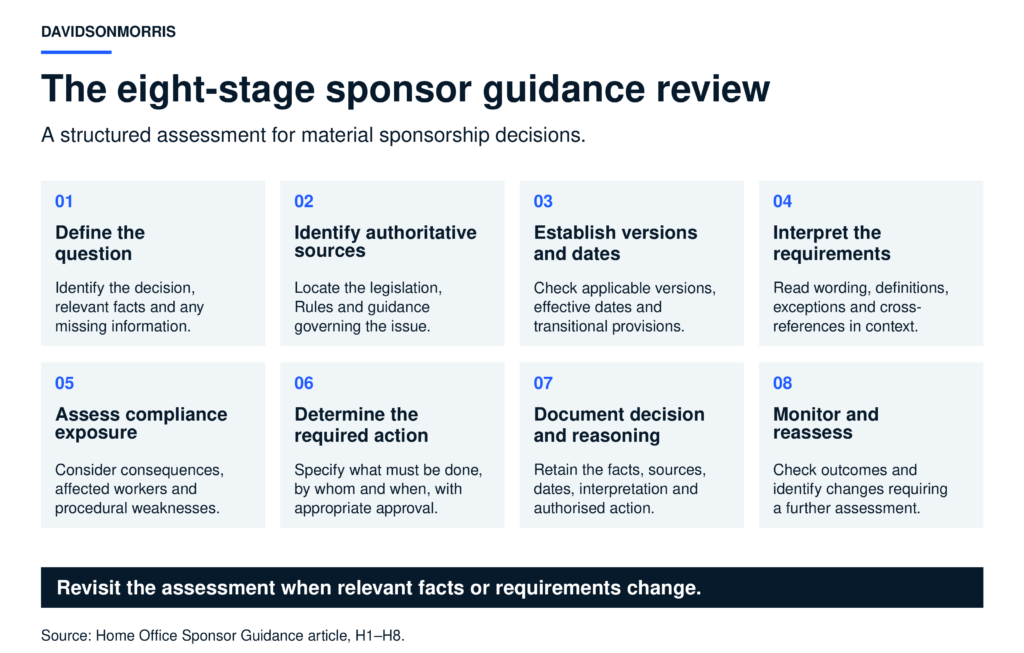
1. Stage One: Define the Sponsorship Question
The first stage is to identify the precise decision, event or compliance concern requiring assessment.
A question framed too broadly may lead to unnecessary research or an incomplete conclusion.
For example, asking whether a sponsored employee can change roles may conceal several separate issues.
The employer may need to establish whether the new role remains eligible under the worker’s immigration route, whether a new immigration application is required, whether a sponsor report must be submitted and whether the proposed change affects any other sponsorship condition.
Each issue should be identified explicitly.
The review should establish the relevant facts, including the worker’s immigration category, employment arrangements, relevant dates and proposed action.
Where facts remain uncertain, the employer should identify the missing information before reaching a conclusion.
The output of this stage should be a clearly defined question supported by an accurate factual record.
2. Stage Two: Identify the Authoritative Sources
The second stage is to establish which legal and policy sources govern the issue.
The relevant materials may include legislation, the Immigration Rules, general sponsor guidance, route-specific guidance, appendices and official Home Office publications.
The sources should be selected according to the question being considered.
For example, an issue concerning a sponsor’s reporting obligations may principally engage Part 3 of the sponsor guidance, while a question about a worker’s immigration eligibility may require detailed examination of the relevant Immigration Rules.
Some decisions will require both.
Where the issue involves right to work checking, the employer should also identify the applicable statutory provisions, Home Office employer guidance and code of practice.
The review should establish whether the guidance incorporates or cross-refers to another document.
Employers should avoid treating a summary or isolated paragraph as the complete authority where the underlying requirement is contained elsewhere.
The output should be a source list identifying the provisions relevant to the decision.
3. Stage Three: Establish the Applicable Version and Dates
The third stage is to determine which version of each relevant source applies.
This requires identifying the date of the event or proposed decision and checking whether the requirements changed before, during or after that period.
The review should distinguish publication dates from effective dates.
It should also identify any transitional arrangements affecting existing workers, earlier applications or particular sponsorship circumstances.
For historical matters, previous guidance versions may need to be examined.
For future decisions, the employer should consider whether an announced change will take effect before the proposed action is completed.
This stage is particularly important where the Home Office has published several updates within a short period.
For example, when considering the October 2026 right to work reforms, the organisation should establish when the relevant employment commenced, when any contractual arrangements relevant to extended liability were entered into and whether a repeat check is required under the applicable provisions.
The output should be a documented chronology identifying the requirements applicable to the relevant facts.
4. Stage Four: Interpret the Requirements
Once the relevant sources and dates have been established, the employer should determine what the requirements mean.
The interpretation should consider the precise wording, definitions, qualifications, exceptions and cross-references.
The review should distinguish between mandatory obligations, administrative procedures and provisions governing Home Office discretion.
Where different sources appear inconsistent, the employer should establish whether they address different questions or whether a genuine conflict exists.
The analysis should also distinguish the worker’s immigration eligibility from the organisation’s separate sponsor obligations.
Where right to work requirements are involved, the employer should separately establish whether the statutory scheme applies and whether sponsor guidance imposes additional checking or evidence-retention obligations.
Where the guidance is ambiguous, the employer should identify the competing interpretations and assess their legal and operational consequences.
The objective is to reach a reasoned conclusion based on the applicable framework rather than an assumption about how the Home Office is likely to respond.
5. Stage Five: Assess the Employer’s Compliance Exposure
The fifth stage is to consider the practical significance of the interpretation for the organisation.
Not every sponsorship question carries the same level of risk.
A routine administrative clarification may have limited consequences.
A decision affecting a worker’s immigration permission, a material reporting obligation or the sponsor’s continued eligibility to hold a licence may require a more detailed assessment.
The review should consider the likelihood and consequences of non-compliance, the number of workers potentially affected and whether the issue indicates a wider procedural weakness.
It should also identify whether the employer has already acted in a manner that may require review or correction.
Where a potential breach has occurred, the organisation should establish the facts and applicable obligations before determining its response.
For right to work matters, the assessment should distinguish exposure to statutory illegal-working penalties from the consequences of breaching sponsor duties.
The Home Office’s October 2026 sponsor guidance identifies serious licensing consequences associated with failures to undertake required checks and the issue of illegal-working civil penalties. However, the legal basis and consequences of each form of enforcement must be assessed separately.
The purpose is to ensure that the employer’s action is proportionate to the seriousness and complexity of the issue.
6. Stage Six: Determine the Required Action
The sixth stage is to translate the legal and policy assessment into an operational decision.
Depending on the circumstances, this may involve proceeding with a sponsorship arrangement, modifying a proposed employment change, submitting a required report, obtaining further information or changing an internal procedure.
Where the issue concerns a guidance update, the employer may need to amend checklists, training materials or approval processes.
Where a possible compliance failure has been identified, corrective action should be considered in light of the applicable requirements and the potential consequences.
The organisation should identify the person responsible for implementation and any relevant deadlines.
For material matters, the proposed action should be approved at an appropriate level before implementation.
Where the decision concerns a contractor or another non-standard engagement, the required action may include confirming the legal classification of the arrangement, identifying the organisation responsible for statutory right to work checks and establishing any separate sponsor record-keeping requirements.
The output should be a clear decision identifying what must be done, by whom and when.
7. Stage Seven: Document the Decision and Supporting Reasoning
The seventh stage is to preserve an appropriate record of the assessment.
The record should be proportionate to the significance of the issue.
For a material sponsorship decision, it should ordinarily identify the facts considered, applicable guidance and legal sources, relevant dates, interpretation adopted and action authorised.
Where uncertainty remains, the record should explain how it was addressed.
Where external advice has been obtained, the organisation should retain appropriate evidence of the advice and resulting decision, subject to relevant confidentiality and privilege considerations.
The record should also identify any follow-up action required.
This documentation supports consistency, accountability and continuity when personnel or guidance requirements change.
It may also assist the organisation in explaining its decisions during a future compliance review.
8. Stage Eight: Monitor the Outcome and Reassess When Necessary
The final stage is to determine whether the issue requires further monitoring.
Some decisions are complete once the relevant action has been taken.
Others involve continuing obligations or depend on future developments.
For example, an employer may need to review a sponsorship arrangement if the worker’s duties change, immigration permission is extended or the Home Office publishes a relevant policy amendment.
Similarly, an internal procedure introduced following a guidance change should be reviewed to ensure that it has been implemented effectively.
The organisation should identify any events that would require the assessment to be revisited.
The objective is to avoid treating a sponsorship interpretation as permanently valid regardless of subsequent changes in facts or requirements.
9. Practical Sponsor Guidance Review Checklist
The following checklist brings together the principal questions employers should address when interpreting or implementing sponsor guidance.
| Review question | Employer action |
|---|---|
| What decision or event requires assessment? | Define the precise sponsorship issue. |
| Which immigration route is involved? | Identify the relevant route and sponsorship arrangements. |
| Which official sources apply? | Check legislation, Immigration Rules, sponsor guidance and appendices as relevant. |
| Which version applies? | Confirm relevant dates, updates and transitional provisions. |
| What does the requirement mean? | Review wording, definitions, exceptions and cross-references. |
| Does it concern the sponsor, worker or both? | Assess separate legal and operational obligations. |
| Does the statutory Right to Work Scheme apply? | Assess the engagement model and applicable statutory definitions. |
| Who is responsible for right to work checks? | Identify the responsible organisation, checking method and evidence requirements. |
| Are there additional sponsor checking obligations? | Check Parts 2 and 3 and Appendix D. |
| What is the compliance risk? | Identify potential consequences and affected arrangements. |
| What action is required? | Allocate responsibilities, approvals and deadlines. |
| What evidence should be retained? | Document the sources, reasoning, decision and implementation. |
| When should the position be reviewed? | Identify relevant future events and guidance changes. |
The checklist should be adapted to the organisation’s circumstances and the significance of the decision.
It is not intended to replace specialist analysis where the legal position is disputed or the potential consequences are substantial.
10. Integrating Sponsor Guidance Review Into Corporate Governance
For employers with established sponsorship programmes, the greatest value of a structured guidance review framework lies in its integration with wider business governance.
Sponsor compliance should not operate solely through periodic checks undertaken by an immigration administrator.
Relevant immigration questions should be identified when business decisions are proposed.
Recruitment approvals should incorporate appropriate sponsorship eligibility checks.
Changes to sponsored workers’ roles or employment arrangements should trigger immigration review where necessary.
Corporate transactions should include consideration of sponsor licence implications.
Material changes to Home Office guidance should be assessed for their effect on existing policies and processes.
The October 2026 right to work reforms also demonstrate the importance of involving procurement and operational teams in compliance governance where organisations use contractors or other non-standard engagement arrangements.
The Authorising Officer should have appropriate oversight of significant sponsorship risks and the organisation’s arrangements for managing them.
For larger employers, the framework may also support internal assurance, management reporting and periodic compliance audits.
The aim is to create a system in which sponsorship obligations are considered before decisions are implemented, rather than only after a compliance concern emerges.
11. When Should a Sponsor Guidance Review Be Escalated?
An internal review should be escalated where the issue cannot be resolved confidently through established procedures or where the potential consequences justify specialist scrutiny.
Examples include:
- A genuine inconsistency between Home Office guidance and the applicable legal framework.
- Uncertainty about the effect of a policy change on existing sponsored workers.
- A suspected breach that may expose the sponsor licence to enforcement action.
- A complex corporate transaction affecting the identity or structure of the sponsoring organisation.
- A disputed Home Office interpretation or adverse sponsor licence decision.
- A proposed employment arrangement that does not fit clearly within published sponsorship requirements.
- Uncertainty about whether a contractor, worker or online engagement falls within the expanded statutory Right to Work Scheme.
- A right to work compliance concern that may create both statutory civil penalty exposure and sponsor licence consequences.
Escalation may involve the Authorising Officer, senior management, in-house legal personnel or external immigration solicitors, depending on the circumstances.
The organisation should avoid allowing a significant issue to remain unresolved simply because no individual has been assigned responsibility for making the final decision.
A defined escalation process supports timely action and ensures that consequential sponsorship decisions receive appropriate oversight.
Section I: Conclusion
Home Office sponsor guidance is fundamental to the operation of the UK’s employer sponsorship system. It explains the requirements that organisations must satisfy when obtaining a sponsor licence, sponsoring overseas workers and maintaining compliance with their continuing obligations.
However, the guidance should not be treated as a single, self-contained set of instructions. Employers must understand how the general sponsor guidance, route-specific requirements, appendices, Immigration Rules and relevant legislation interact.
The correct interpretation may depend on the particular sponsorship activity, the worker’s circumstances, the date of the relevant event and any applicable exceptions or transitional provisions.
For employers, the principal risk is not simply failing to locate a requirement. It is applying an incomplete, outdated or incorrect interpretation to a business decision.
This can affect recruitment, workforce management, reporting obligations and the organisation’s ability to retain its sponsor licence.
The expansion of the statutory Right to Work Scheme from 1 October 2026 illustrates the importance of understanding the interaction between different legal and policy frameworks. Organisations must now consider whether specified non-standard working arrangements fall within the expanded statutory checking requirements, while licensed sponsors must continue to meet their separate obligations concerning sponsored workers.
The distinction between statutory right to work obligations and sponsor duties is particularly important where workers are engaged through contractors, third-party arrangements or other non-standard employment structures.
A reliable approach therefore requires employers to identify the authoritative sources, establish which provisions apply, interpret them in context and translate the resulting requirements into effective internal procedures.
Because sponsor guidance changes over time, organisations also need arrangements for identifying material updates, assessing their implications and ensuring that operational practices remain current.
The strongest sponsorship compliance frameworks integrate these activities into wider corporate governance. Recruitment, HR, payroll, procurement, management and legal functions should understand when their decisions may have sponsorship consequences and when specialist review is necessary.
DavidsonMorris advises UK employers on the interpretation and application of Home Office sponsor guidance, including sponsor licence requirements, compliance obligations, changes to sponsorship policy and responses to Home Office scrutiny.
Early assessment of complex or uncertain requirements can help organisations make informed decisions, address potential compliance weaknesses and reduce the risk of avoidable disruption to their sponsorship arrangements.
Section J: Home Office Sponsor Guidance FAQs
What is Home Office sponsor guidance?
Home Office sponsor guidance is the official policy and operational guidance published by UK Visas and Immigration for organisations applying for or holding a sponsor licence.
It explains the requirements governing sponsor licensing, the sponsorship of overseas workers, ongoing sponsor duties and the circumstances in which the Home Office may take compliance or enforcement action.
The guidance is divided into general documents, route-specific guidance and supporting appendices. Employers may need to consult several sources to establish the requirements applicable to a particular sponsorship decision.
Where can I find the latest Home Office sponsor guidance?
The latest published sponsor guidance is available through the official GOV.UK sponsorship guidance collection.
Employers should use the official publication and check the relevant document’s version, update history and applicable effective dates.
Downloaded copies and third-party summaries may not reflect subsequent amendments.
Where a decision concerns a historical event, the employer may also need to examine the guidance that applied at the relevant time.
Is Home Office sponsor guidance legally binding?
Home Office sponsor guidance is not itself primary legislation, and its provisions do not all have the same legal status as the Immigration Rules.
However, it sets out requirements and conditions associated with participation in the sponsorship system, and failures to comply with applicable sponsor obligations can have significant consequences.
Compliance with applicable guidance requirements can be a condition of holding a sponsor licence.
The enforceability of a particular requirement depends on the relevant legal framework and sponsorship conditions.
Employers should not assume that a requirement is optional simply because it appears in guidance rather than legislation.
What are Parts 1, 2 and 3 of the sponsor guidance?
The principal worker sponsor guidance is divided into three parts.
Part 1, Apply for a Licence, addresses the requirements and procedures involved in obtaining a sponsor licence.
Part 2, Sponsor a Worker, explains the general framework governing the sponsorship of workers under relevant immigration routes.
Part 3, Sponsor Duties and Compliance, addresses ongoing sponsor obligations and the Home Office’s approach to compliance and enforcement.
These documents should be read alongside applicable route-specific guidance, appendices and Immigration Rules.
Does sponsor guidance apply to employers that already have a sponsor licence?
Yes. Sponsor guidance applies throughout an organisation’s participation in the sponsorship system.
Obtaining a sponsor licence does not end the employer’s obligations.
Licensed sponsors must continue to comply with relevant requirements concerning sponsorship activity, record keeping, reporting, monitoring and cooperation with the Home Office.
Changes to the organisation or its sponsored workforce may also trigger additional obligations.
Existing sponsors should therefore maintain current procedures and review material guidance changes.
What happens if an employer does not follow sponsor guidance?
The consequences depend on the nature of the requirement, the circumstances of the failure and the applicable enforcement framework.
Where an employer breaches its sponsor duties, the Home Office may take action affecting the licence. Depending on the circumstances, this can include downgrading, suspension or revocation.
Not every departure from an administrative recommendation necessarily constitutes a breach of a mandatory sponsor obligation.
However, employers should investigate suspected non-compliance promptly and establish the applicable requirements before deciding what corrective action is necessary.
How often does Home Office sponsor guidance change?
There is no fixed interval at which all sponsor guidance documents are updated.
The Home Office may revise guidance following changes to the Immigration Rules, sponsorship policy, operational procedures, legislation or other developments.
Different documents may be updated at different times.
Employers should therefore maintain arrangements for identifying relevant changes and should check current requirements before significant sponsorship decisions.
The appropriate monitoring arrangements depend on the organisation’s sponsorship activity and compliance exposure.
How do I know which version of sponsor guidance applies?
The applicable version depends on the decision or event being assessed and the commencement provisions governing the relevant requirement.
For a new decision, the starting point is ordinarily the requirements currently applicable.
For a historical event, the employer may need to examine the guidance and legal provisions applicable when the event occurred.
Publication dates, effective dates and transitional arrangements should be distinguished.
The latest document should not automatically be applied retrospectively to earlier conduct.
Can Home Office sponsor guidance override the Immigration Rules?
No. Home Office guidance cannot lawfully amend or override legislation or the Immigration Rules merely by stating a different requirement.
However, an apparent conflict may arise because the documents govern different matters.
For example, the Immigration Rules may establish requirements for a worker’s immigration permission, while sponsor guidance imposes separate obligations on the employer.
Where a genuine inconsistency exists, the relevant provisions and legal framework should be examined before the employer proceeds.
What is the difference between sponsor guidance and Skilled Worker guidance?
General sponsor guidance explains the overarching sponsorship framework, including sponsor licensing, worker sponsorship and continuing compliance obligations.
Skilled Worker sponsor guidance addresses additional requirements applicable to sponsorship under that particular immigration route.
Employers sponsoring Skilled Workers may also need to consult Appendix Skilled Worker and other relevant provisions of the Immigration Rules.
The documents operate together rather than as alternatives.
Does a sponsor licence holder need to follow every sponsor guidance document?
Not every provision will be relevant to every sponsor.
The applicable requirements depend on the organisation’s licence, the immigration routes it uses and the circumstances of its sponsorship activities.
For example, an employer sponsoring workers under the Skilled Worker route will need to consider the relevant general and route-specific requirements.
It may not need to apply provisions concerning a route it does not use.
However, employers should not assume that a document is irrelevant without checking whether it contains requirements applicable to their circumstances.
Can employers rely on old Home Office sponsor guidance?
Previous guidance may be relevant when assessing historical decisions, earlier sponsorship events or compliance obligations arising at a particular time.
It should not automatically be relied upon for current decisions.
An employer must establish which requirements apply to the particular circumstances, including any transitional provisions.
Where earlier guidance is material, the organisation should retain or obtain a reliable copy and establish the period during which the relevant provisions applied.
What should an employer do if sponsor guidance is unclear?
The employer should identify the precise issue, examine the relevant wording in context and check applicable definitions, exceptions, cross-references and legal sources.
Where more than one interpretation remains possible, the organisation should consider the consequences of each interpretation and document its reasoning.
For significant or unusual matters, legal advice may be appropriate before action is taken.
An employer should avoid relying on an isolated extract or adopting an interpretation solely because it is commercially convenient.
Does a change to sponsor guidance affect existing sponsored workers?
Not necessarily.
The effect depends on the nature of the change, the relevant immigration route, the worker’s circumstances and any commencement or transitional provisions.
Some amendments may affect future sponsorship decisions without altering existing immigration permission.
Others may create or modify obligations relevant to current sponsorship arrangements.
Employers should assess the particular change before deciding whether existing workers, internal procedures or future applications are affected.
Who is responsible for ensuring that an employer follows sponsor guidance?
The sponsoring organisation is responsible for meeting its applicable sponsor obligations.
The Authorising Officer has overall responsibility within the sponsor’s arrangements, while Level 1 Users and other personnel may perform particular sponsorship functions.
HR, recruitment, payroll, line management and legal teams may also have responsibilities relevant to compliance.
Delegating administration to an employee or external adviser does not remove the sponsoring organisation’s own obligations.
Can a sponsor licence be revoked for misunderstanding the guidance?
A misunderstanding does not automatically result in revocation.
However, where the misunderstanding causes a breach of applicable sponsor duties, the Home Office may take action in accordance with the relevant enforcement framework.
The outcome depends on the requirement breached, the facts and the applicable policy.
Employers should not assume that an inadvertent error will be excused, but neither should they assume that every interpretation mistake automatically results in licence revocation.
Potentially serious issues should be assessed promptly.
Does a successful Home Office compliance visit mean the employer is fully compliant?
Not necessarily.
A compliance visit may examine particular aspects of the employer’s sponsorship arrangements and does not amount to permanent approval of every procedure or sponsorship decision.
The employer must continue meeting its obligations after the visit.
Requirements may change, and new circumstances may create additional compliance responsibilities.
Employers should retain any written Home Office findings but should not treat the absence of adverse action as a guarantee of future compliance.
How can employers keep their sponsor guidance procedures up to date?
Employers should assign responsibility for monitoring relevant guidance, maintain controlled versions of internal procedures and assess material Home Office updates.
Changes should be translated into operational requirements, with appropriate communication to affected teams.
For significant amendments, a change log can record the applicable dates, affected processes, required actions and implementation evidence.
The objective is to ensure that current requirements are reflected in actual sponsorship decisions rather than simply maintained in a policy document.
Do the 1 October 2026 right to work changes apply to contractors?
The statutory Right to Work Scheme was expanded from 1 October 2026 to cover specified working arrangements beyond conventional contracts of employment, including certain worker contracts, individual subcontracting arrangements and qualifying online matching arrangements.
However, the changes do not mean that every contractor or individual working through a commercial services arrangement automatically falls within the statutory checking framework.
The applicable statutory definitions, exclusions and factual circumstances must be considered.
Employers should establish whether the particular arrangement is covered and identify the organisation responsible for undertaking the prescribed check.
Where the individual is sponsored, separate sponsor licence obligations may also apply.
Are statutory right to work checks the same as sponsor licence checks?
No. The statutory Right to Work Scheme and sponsor licence requirements are separate but overlapping frameworks.
The statutory scheme establishes the conditions under which an organisation may obtain a statutory excuse against civil penalty liability for illegal working.
Sponsor guidance imposes obligations on licensed sponsors concerning sponsored workers, including requirements relating to checks and the retention of relevant evidence.
An organisation may therefore have sponsor obligations even where another organisation is responsible for a statutory right to work check.
Employers should assess both frameworks where relevant and should not assume that compliance with one automatically establishes compliance with the other.
Can an employer use a digital verification provider for right to work checks?
Employers may use a Right to Work Digital Verification Service Provider (RtW DVSP) where the applicable statutory checking framework permits that method.
From 1 October 2026, providers used to establish a statutory excuse must satisfy the relevant certification and registration requirements under the applicable trust framework and supplementary code.
The permitted checking method depends on the individual’s circumstances and the applicable Home Office requirements.
Employers should confirm that the provider is appropriately authorised and that the check is conducted and recorded in the prescribed manner.
Using an external provider does not remove the need to satisfy the statutory conditions for establishing an excuse.
What happens if a sponsor fails to carry out required right to work checks?
Failure to undertake required checks may create both statutory and sponsor licence consequences, depending on the circumstances.
Where the relevant legal conditions are satisfied, illegal working can result in civil penalty liability under the statutory framework.
Separately, failure to comply with sponsor checking obligations can expose the organisation to Home Office sponsor licence enforcement.
The October 2026 sponsor guidance warns that failures to undertake required checks or the issue of an illegal-working civil penalty are likely to lead to sponsor licence revocation.
However, the consequences must be assessed under the applicable legal and policy framework. Not every checking error automatically results in the same outcome.
Employers should investigate potential failures promptly and obtain appropriate advice where the exposure is significant.
Is the Home Office abolishing the Level 2 User role?
Yes. The Home Office introduced changes to Sponsor Management System user arrangements in September 2026.
New Level 2 User appointments ceased on 9 September 2026.
Existing Level 2 Users must be converted to Level 1 Users, where eligible, or deactivated by 8 March 2027.
The Level 2 User role will cease to exist after that date.
Sponsors should review their current SMS user arrangements, confirm that appropriate individuals hold the necessary permissions and complete the transition within the applicable timetable.
Section K: Home Office Sponsor Guidance Glossary
The following glossary explains terminology commonly encountered when working with Home Office sponsor guidance. It is intended as an employer reference and does not replace definitions contained in the Immigration Rules, legislation or official Home Office publications.
| Term | Meaning |
|---|---|
| Authorising Officer (AO) | The senior individual responsible for the organisation’s sponsorship arrangements and the conduct of personnel involved in managing its licence. |
| Certificate of Sponsorship (CoS) | An electronic sponsorship record assigned by a licensed sponsor to support an eligible worker’s immigration application. It is not a physical certificate or a visa. |
| Compliance visit | A Home Office assessment of an organisation’s suitability or compliance with applicable sponsorship requirements, which may involve examining records, systems and employment arrangements. |
| Defined Certificate of Sponsorship | A category of CoS used for specified Skilled Worker applications from outside the UK, subject to the applicable allocation and approval requirements. |
| Right to Work Digital Verification Service Provider (RtW DVSP) | A provider used for specified digital identity and right to work verification processes, subject to the applicable certification, registration and checking requirements. |
| Effective date | The date on which a particular requirement, amendment or policy change becomes applicable. |
| Home Office | The UK government department responsible for immigration policy and administration, including the employer sponsorship system. |
| Immigration Rules | The rules governing immigration permission and relevant eligibility requirements, made under section 3(2) of the Immigration Act 1971. |
| Individual subcontractor | A category of individual engagement relevant to the expanded statutory Right to Work Scheme from 1 October 2026. Whether an arrangement falls within the scheme depends on the applicable statutory definition and circumstances. |
| Key Contact | The person designated as the principal point of contact with the Home Office for specified sponsor licensing matters. |
| Level 1 User | An authorised individual with responsibility for managing relevant sponsor licence functions through the Sponsor Management System. |
| Level 2 User | A category of SMS user being phased out, with more limited permissions than a Level 1 User. New appointments ceased on 9 September 2026, and existing users must be converted or deactivated by 8 March 2027. |
| Licence downgrading | Home Office action changing a sponsor’s licence rating, potentially restricting sponsorship activity and requiring corrective measures. |
| Licence revocation | Withdrawal of an organisation’s sponsor licence by the Home Office, removing its permission to sponsor workers under that licence. |
| Licence suspension | Temporary suspension of a sponsor licence while the Home Office considers relevant compliance concerns or further action. While the licence is suspended, the sponsor cannot assign any Certificates of Sponsorship. Existing sponsored workers with valid permission are generally unaffected unless and until further Home Office action is taken. |
| Mandatory requirement | An obligation that must be satisfied under the applicable legal or sponsorship framework. |
| Online matching service | A person who, in the course of a business, keeps a register of service providers, provides an online service through which potential clients or customers submit matching enquiries, and charges a fee or commission for making matches, as defined in section 14A of the Immigration, Asylum and Nationality Act 2006. |
| Reporting duty | A requirement to notify the Home Office of specified changes or events within the applicable rules and deadlines. |
| Right to Work Scheme | The statutory framework governing the prevention of illegal working and prescribed checking arrangements, including the expanded categories of working arrangements effective from 1 October 2026. |
| Route-specific guidance | Home Office sponsor guidance addressing additional requirements for a particular sponsored immigration route. |
| Skilled Worker | A sponsored immigration route for eligible employment meeting the applicable requirements under the Immigration Rules. |
| Sponsor duties | Continuing obligations imposed on licensed sponsors, including relevant record-keeping, reporting, monitoring and cooperation requirements. |
| Sponsor guidance | Official Home Office policy and operational material explaining the requirements governing sponsor licensing and sponsorship activity. |
| Sponsor licence | Home Office authorisation permitting an eligible organisation to sponsor workers under specified immigration routes. |
| Sponsor Management System (SMS) | The Home Office’s online system through which authorised users administer relevant sponsor licensing and sponsorship functions. |
| Sponsorship route | An immigration category under which an authorised organisation may sponsor eligible workers. |
| Statement of Changes | A formal instrument setting out amendments to the Immigration Rules, including relevant commencement arrangements. |
| Statutory excuse | A defence against civil penalty liability for illegal working available where an organisation satisfies the prescribed right to work checking requirements under the applicable statutory framework. |
| Transitional provisions | Rules or arrangements determining how changes apply to particular categories of existing or prospective applicants, workers or circumstances. |
| UK Visas and Immigration (UKVI) | The Home Office organisation responsible for administering relevant visa and immigration functions. |
| Undefined Certificate of Sponsorship | A CoS used for relevant Skilled Worker applications from within the UK and other cases falling within the applicable undefined CoS arrangements. |
| Version control | The process of identifying, recording and managing different versions of guidance or internal procedures to ensure that the appropriate requirements are used. |
| Worker’s contract | A contract other than a contract of service or apprenticeship under which an individual undertakes personally to perform work or services, subject to the conditions and exclusions in section 14A of the Immigration, Asylum and Nationality Act 2006. The contractual label alone does not determine whether it falls within the scheme. |
Section L: Useful Links and Official Sources
Employers should consult the official Home Office publications and legal materials applicable to their particular circumstances.
The following resources provide starting points for identifying current sponsor guidance, related immigration requirements and relevant legal provisions.
| Description | URL |
|---|---|
| Home Office Sponsorship Guidance Collection
The official GOV.UK collection provides access to sponsorship guidance and supporting publications for organisations seeking to sponsor workers and other eligible categories. It should be the starting point for locating current guidance and checking publication updates. |
https://www.gov.uk/government/collections/sponsorship-information-for-employers-and-educators |
| Sponsor Guidance Part 1: Apply for a Licence
Part 1 explains the requirements and procedures for obtaining a sponsor licence, including eligibility, suitability, application arrangements and related licensing matters. Employers preparing an application should also consult the relevant supporting-document requirements. |
https://www.gov.uk/government/publications/workers-and-temporary-workers-guidance-for-sponsors-part-1-apply-for-a-licence |
| Sponsor Guidance Part 2: Sponsor a Worker
Part 2 explains the general framework governing the sponsorship of workers. It should be read alongside the applicable route-specific sponsor guidance and Immigration Rules. The October 2026 updates address the relationship between sponsorship and right to work checking requirements. |
https://www.gov.uk/government/publications/workers-and-temporary-workers-guidance-for-sponsors-part-2-sponsor-a-worker |
| Sponsor Guidance Part 3: Sponsor Duties and Compliance
Part 3 addresses continuing sponsor obligations and the Home Office’s approach to compliance and enforcement. It is particularly relevant to existing licence holders reviewing their reporting, monitoring and record-keeping responsibilities. |
https://www.gov.uk/government/publications/workers-and-temporary-workers-guidance-for-sponsors-part-3-sponsor-duties-and-compliance |
| Sponsor Guidance Appendix A: Supporting Documents
Appendix A identifies documentary evidence requirements relevant to sponsor licence applications. Employers should check the provisions applicable to their organisation and application circumstances. |
https://www.gov.uk/government/publications/supporting-documents-for-sponsor-applications-appendix-a |
| Sponsor Guidance Appendix D: Record-Keeping Duties
Appendix D sets out documentary retention requirements relevant to licensed sponsors. The October 2026 updates should be considered when reviewing right to work evidence and sponsor record-keeping procedures. |
https://www.gov.uk/government/publications/keep-records-for-sponsorship-appendix-d |
| Immigration Rules
The Immigration Rules establish the requirements governing immigration permission, including sponsored immigration routes. Employers should consult the relevant provisions where a sponsorship decision involves worker eligibility or immigration conditions. |
https://www.gov.uk/guidance/immigration-rules |
| Immigration Rules Appendix Skilled Worker
Appendix Skilled Worker sets out the Immigration Rules applicable to the Skilled Worker route. It should be read alongside the relevant sponsor guidance when assessing Skilled Worker sponsorship arrangements. |
https://www.gov.uk/guidance/immigration-rules/immigration-rules-appendix-skilled-worker |
| Statements of Changes to the Immigration Rules
This collection provides access to formal amendments to the Immigration Rules. It is relevant when establishing the legal basis, commencement date and potential transitional effect of immigration rule changes. |
https://www.gov.uk/government/collections/immigration-rules-statement-of-changes |
| Immigration Act 1971
The Immigration Act 1971 provides part of the statutory framework governing UK immigration control, including the legal basis for the Immigration Rules. Employers examining the legal status of immigration requirements may need to consider relevant statutory provisions alongside the Immigration Rules and Home Office guidance. Right to work legislation:
|
https://www.legislation.gov.uk/ukpga/1971/77/section/3 |
| Right to Work Checks: An Employer’s Guide
The Home Office’s employer guidance explains the prescribed methods for conducting right to work checks and establishing a statutory excuse against civil penalty liability. The guidance was updated for the statutory changes effective from 1 October 2026, including the expanded categories of working arrangements covered by the scheme. Employers should consult the current version when designing or reviewing their checking procedures. Digital verification sources: UK digital verification services trust framework; Supplementary code for digital right to work checks (1.1). The applicable version and commencement conditions must be checked alongside the prescribed requirements under S.I. 2026/700. |
https://www.gov.uk/government/publications/right-to-work-checks-employers-guide |
| Code of Practice on Preventing Illegal Working
The statutory code of practice explains the relevant civil penalty framework and should be considered when assessing right to work checking obligations and potential illegal-working liability. Employers should identify the version applicable to the relevant work and checking circumstances, including the October 2026 changes. |
https://www.gov.uk/government/publications/illegal-working-penalties-codes-of-practice-for-employers |
| Employers’ Right to Work Checklist
The Home Office checklist provides a practical reference for employers undertaking prescribed right to work checks. The October 2026 update reflects the expanded statutory scheme and associated checking arrangements. The checklist should be used alongside the full employer guidance rather than as a substitute for the applicable legal requirements. |
https://www.gov.uk/government/publications/right-to-work-checklist |