

Sponsor Licence Enforcement Trends: At a Glance
Home Office enforcement against UK sponsor licence holders has become a significant regulatory and operational concern for employers recruiting overseas workers. The consequences of non-compliance extend beyond immigration administration, potentially affecting workforce availability, recruitment plans, commercial contracts and an organisation’s ability to continue sponsoring international employees.
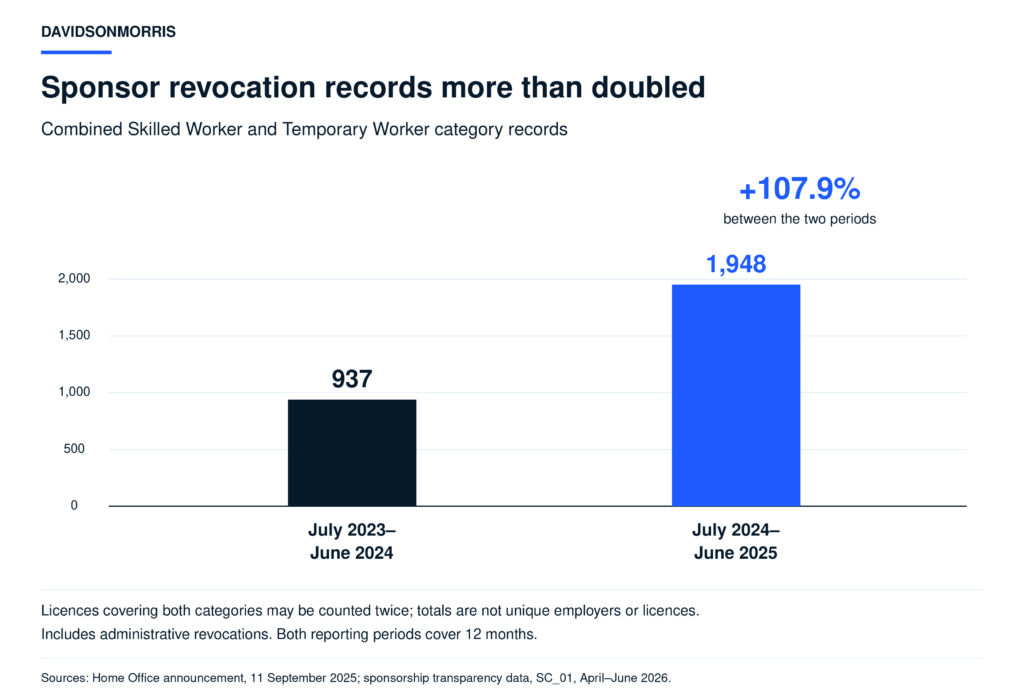
The scale of enforcement activity increased substantially during the 2023–2025 reporting periods. According to Home Office figures published in September 2025, 1,948 sponsor licences were revoked between July 2024 and June 2025, compared with 937 during the preceding 12 months. This represented an increase of approximately 108%, demonstrating a marked escalation in licence revocations over those comparable periods.1
These headline totals reproduce the Home Office announcement and correspond to combined Skilled Worker and Temporary Worker revocation records in table SC_01. Licences covering both categories can be counted in both, so these are not deduplicated counts of employers or unique licences.2
These figures are significant, but they do not tell the whole story. Understanding sponsor licence enforcement requires consideration of how the Home Office identifies non-compliance, the types of conduct attracting regulatory intervention, changes in government enforcement priorities and the distinction between different forms of action against sponsors.
For employers, the central issue is not simply whether enforcement activity is increasing. It is whether their existing sponsorship governance arrangements remain adequate in an environment where the Home Office has demonstrated a willingness to withdraw sponsorship privileges and use information obtained through sources beyond conventional compliance visits.
This analysis examines the available enforcement evidence, developments in Home Office policy and compliance practice, and the implications for organisations holding or seeking a UK sponsor licence.
Evidence position: This analysis reflects the regulatory framework and official sources identified as at 23 October 2026. The principal numerical comparison concerns the 12-month periods ending June 2024 and June 2025. Although later sponsorship transparency data have been published, those figures have not been incorporated into the comparative analysis below. The historical increase should not therefore be interpreted as proof that revocations continued to rise throughout 2026.
Section A: Key Findings: Home Office Sponsor Licence Enforcement
The available evidence supports several important conclusions about the direction of sponsor licence enforcement and its implications for employers.
| Finding | Evidence and employer implications |
|---|---|
| Revocations increased substantially | The Home Office reported 1,948 revocations between July 2024 and June 2025, compared with 937 in the preceding 12 months, an increase of approximately 108%. These combined category records can count a licence in both categories and are not a count of unique employers. |
| Enforcement extends beyond physical visits | The Home Office has identified improved data and intelligence sharing as contributing to enforcement activity. Sponsor monitoring also includes regular checks with HMRC concerning sponsored workers’ pay.3 |
| Revocation does not always follow suspension | The sponsor guidance distinguishes mandatory revocation grounds, grounds where revocation will normally occur unless exceptional circumstances apply, and discretionary grounds. |
| Sector exposure requires careful interpretation | Public attention to enforcement in particular industries does not establish a reliable national ranking of sectors by sponsor licence revocation rates. |
| Administrative failures can create regulatory exposure | Serious or systematic failures in monitoring, record keeping and reporting can place a licence at risk, even where an employer has no intention of abusing the sponsorship system. |
| Sponsor compliance is a business governance issue | Employers should assess the effectiveness of their HR, payroll, recruitment and operational controls, together with the potential consequences of losing sponsorship privileges. |
The historical revocation figures were published by the Home Office in September 2025. For the latest statistical releases, employers should consult the Home Office Migration Transparency Data.
Section B: Home Office Sponsor Licence Enforcement: Current Position
The Home Office operates the sponsorship system on the basis that employers granted permission to sponsor overseas workers must continue to satisfy the requirements of their licence. Approval to become a sponsor is not a permanent assurance of suitability. The organisation remains responsible for demonstrating compliance throughout the period in which it holds sponsorship privileges.
The Home Office sponsor duties and compliance guidance provides a range of regulatory responses where an employer fails to meet its obligations or is no longer considered suitable to hold a licence. These include reducing its Certificate of Sponsorship allocation, downgrading its licence rating, suspending its licence while concerns are investigated and revoking the licence altogether.
The appropriate response depends on the circumstances, the applicable provisions of the guidance and the seriousness of the concerns. The Home Office is not required to follow a fixed sequence of progressively more serious sanctions. In certain circumstances, revocation can take place without an earlier suspension or downgrade.
Employers accustomed to receiving a warning or an improvement period under other regulatory regimes cannot assume that sponsor licence enforcement will follow the same approach.
1. Enforcement Activity Has Increased Significantly
The clearest published evidence of intensified sponsor licence enforcement is the increase in revocations recorded between the 2023–24 and 2024–25 reporting periods.
| Reporting period | Revocation records: combined Skilled Worker and Temporary Worker categories |
|---|---|
| July 2023 to June 2024 | 937 |
| July 2024 to June 2025 | 1,948 |
| Percentage change | +107.9% |
Source: Home Office announcement, 11 September 2025, reconciled against table SC_01 of the April–June 2026 sponsorship transparency release. These totals combine Skilled Worker and Temporary Worker revocation records; a licence covering both categories can appear in both. They are not deduplicated employer or unique-licence totals and do not measure suspensions or compliance visits.
The increase has three implications for employers assessing sponsor licence risk.
First, revocation is among the most consequential interventions available to the Home Office. It removes the employer’s authority to sponsor workers, with potential consequences for both existing sponsored employees and future recruitment.
Second, the scale of the increase indicates a material change in enforcement outcomes over the periods compared. It cannot reasonably be dismissed as a minor statistical fluctuation.
Third, the Home Office connected its enforcement results with improved data and intelligence sharing across government and law enforcement agencies. Its September 2025 announcement described an approach less dependent on physical compliance visits, suggesting that employers should not regard an absence of visits as evidence that their sponsorship arrangements are unlikely to attract scrutiny.
Nevertheless, the revocation figures must be interpreted carefully. An increase in the number of licences revoked does not, by itself, establish that the proportion of non-compliant employers has increased by the same amount. Nor does it demonstrate that every sector or category of sponsor faces an equivalent level of enforcement exposure.
Changes in the number of licensed sponsors, the composition of the sponsor population, investigative priorities and enforcement capacity can all influence the number of recorded outcomes.
The available figures establish a substantial historical increase in revocations. They do not, without further comparable data, establish the direction or rate of enforcement throughout 2026.
For further historical context, see DavidsonMorris’s earlier analysis of the surge in sponsor licence suspensions and revocations.
2. Enforcement Is Not Confined to Deliberate Immigration Abuse
Public announcements about sponsor enforcement frequently emphasise deliberate wrongdoing, including the exploitation of sponsored workers, underpayment and the use of sponsorship arrangements to circumvent immigration requirements.
These concerns form an important part of the government’s stated enforcement priorities. However, employers should not assume that sponsor licence revocation is reserved for organisations engaged in deliberate misconduct.
The sponsor guidance also provides for action where organisations fail to maintain adequate systems, do not fulfil reporting and record-keeping obligations, or commit serious or systematic breaches of their sponsor duties.
The guidance recognises that some grounds for revocation do not require the employer to have acted deliberately or knowingly.
A sponsor can therefore face enforcement even where there was no deliberate misconduct.
An employer may have legitimate vacancies, genuinely employ its sponsored workers and have no intention of breaching immigration rules, yet still face regulatory action if its systems are insufficient to meet the standards required of a licensed sponsor.
Sponsor enforcement risk concerns both conduct and internal systems. Employers need to demonstrate that their working practices meet their sponsorship obligations, regardless of their intentions.
Employers should therefore consider the adequacy of their wider sponsor licence compliance arrangements, rather than concentrating exclusively on the prevention of deliberate immigration abuse.
3. Sponsorship Compliance Is Becoming a Wider Governance Issue
For organisations employing sponsored workers, immigration compliance cannot safely be treated as a function limited to assigning Certificates of Sponsorship or maintaining records within the Sponsor Management System.
The information relevant to sponsorship compliance is commonly distributed across several business functions.
Human resources may hold attendance, absence and personnel records. Payroll teams maintain salary and payment information. Line managers supervise workers and may approve changes to duties, locations or working patterns. Recruitment teams determine how vacancies are described and filled. Corporate management may make decisions about restructuring, acquisitions or changes in ownership.
Each function can generate information relevant to whether the employer continues to meet its sponsor obligations.
The risk arises when these functions operate independently and relevant changes are not identified, checked or reported through the appropriate sponsorship processes.
For example, a change in a sponsored worker’s actual duties may be agreed operationally without being reviewed for its immigration implications. A payroll adjustment may alter the worker’s remuneration without the sponsorship team being consulted. A corporate transaction may proceed without sufficient consideration of its consequences for the organisation’s sponsor licence.
These are illustrations of potential governance weaknesses, not findings about the most common causes of revocation nationally.
Effective sponsorship compliance therefore increasingly depends on teams coordinating their work, with clear responsibility for identifying relevant changes and referring them for review.
The Authorising Officer remains a central figure in that governance structure, but effective compliance also depends on the quality of the processes and information available to those responsible for managing the licence.4
Section C: Understanding the Evidence Behind Sponsor Licence Enforcement Trends
A reliable assessment of sponsor licence enforcement must distinguish between the various types of Home Office activity reported in official publications.
The terms suspension, revocation, downgrading, compliance visit and immigration enforcement action are sometimes used together in public commentary. They do not, however, measure the same event or carry the same legal consequences.
An apparent increase in enforcement activity may reflect a rise in one category of action without an equivalent change in another. Each measure needs to be assessed separately.
1. What the Official Enforcement Statistics Measure
The Home Office publishes sponsorship transparency data that include action taken against sponsors, specifically suspensions and revocations.
The April–June 2026 sponsorship transparency release was published on 27 August 2026. It provides an official source for examining enforcement activity over time, although the latest figures must be extracted and compared on a consistent basis before making claims about the most recent trend.
The principal categories measure different aspects of enforcement and should be assessed separately.
Table SC_01 must be read with its Sponsor Compliance notes. Licences covering more than one category can be counted in both. From Q2 2016, the series includes administrative revocations and records a suspension when immediate revocation is completed. Comparisons across that reporting change are not directly comparable; the two historical periods used here both fall after it. Recorded suspensions are therefore not all separate investigation stages, and revocation totals cannot all be treated as findings of employer misconduct.
| Measure | What it indicates |
|---|---|
| Licence suspensions | Sponsors whose ability to assign Certificates of Sponsorship is temporarily restricted while the Home Office considers compliance concerns. |
| Licence revocations | Sponsors whose authority to sponsor workers has been withdrawn. |
| Licence downgrades | Sponsors moved to a B-rating and subject to an action plan where the relevant guidance permits this response. |
| Compliance checks | Regulatory checks undertaken to assess sponsor suitability and compliance, including relevant documentary and operational enquiries. |
| Immigration enforcement activity | Broader interventions, including illegal-working operations, which are not necessarily sponsor licence actions. |
A further distinction is necessary between enforcement outcomes and changes to the public register of licensed sponsors.
A sponsor may cease to appear on the public register for reasons that do not amount to revocation. Consequently, comparing successive versions of the register and treating every disappearance as a licence revocation would produce a potentially misleading assessment of enforcement activity.
Use the Home Office’s published enforcement series for suspension and revocation figures. The register and other official publications can provide context, but they cannot substitute for enforcement data.
2. Why Headline Enforcement Figures Need Context
The number of licences revoked in a particular year provides an important indication of regulatory activity. However, it is not a complete measure of the likelihood that an individual employer will face enforcement.
A meaningful assessment should consider several additional questions.
- Has the number of licensed sponsors increased or decreased?
- Are figures being compared over equivalent reporting periods?
- Have the definitions or reporting methods changed?
- Does the data distinguish initial enforcement action from final outcomes?
- Are any sector-level conclusions supported by sufficiently detailed official information?
These questions are particularly important when assessing percentage increases.
For example, the increase from 937 to 1,948 revocations between the two 12-month periods establishes that the absolute number of revocations more than doubled. It does not automatically establish that an individual sponsor’s probability of revocation doubled.
Calculating a meaningful enforcement rate would require an appropriate denominator, a consistent reporting methodology and an understanding of the limitations of the underlying data.
The increase remains significant, but employers need to understand what it measures before using it to assess their own exposure to enforcement.
3. Enforcement Statistics and Enforcement Priorities Are Different Evidence
Home Office announcements can help explain why enforcement is being undertaken and which forms of non-compliance the government intends to prioritise.
However, a statement that a particular activity is a priority does not necessarily establish that it accounts for the largest proportion of enforcement outcomes.
Similarly, an announcement about increased illegal-working visits or arrests does not establish that sponsor licence revocations have increased by a corresponding amount.
For example, the wider immigration enforcement activity examined in DavidsonMorris’s analysis of immigration enforcement activity and its impact on employers should not be treated as interchangeable with sponsor licence suspension or revocation statistics.
This analysis therefore treats three categories of evidence separately:
- Recorded enforcement outcomes: official statistics showing action taken against sponsor licences.
- Government enforcement priorities: published statements, policies and guidance explaining the objectives of regulatory activity.
- DavidsonMorris analysis: professional interpretation of the evidence and its implications for employer compliance and business risk.
Policy intentions should be identified as such, and practitioner interpretation should remain clearly separate from official statistical findings.
Section D: How Home Office Sponsor Licence Enforcement Priorities Are Changing
The increase in sponsor licence revocations has taken place against a wider shift in the government’s approach to immigration enforcement. The Home Office has placed greater emphasis on preventing abuse of the sponsorship system, identifying employers who do not comply with immigration requirements and taking action against organisations that exploit overseas workers.
Licensed sponsors need to consider both the volume of enforcement activity and the conduct attracting scrutiny.
Sponsor licence compliance has always extended beyond the administrative requirements of holding a licence. Employers must be able to demonstrate that sponsored roles are genuine, that workers undertake appropriate duties, that applicable salary requirements are satisfied and that the organisation has adequate systems to meet its reporting, monitoring and record-keeping obligations.
Recent enforcement policy has brought greater attention to the relationship between those obligations and the realities of employment.
An organisation’s sponsorship records may appear complete while its actual employment arrangements raise concerns. Conversely, an employer may have a genuine business need for international recruitment but expose itself to enforcement because its internal controls are inadequate.
The following areas are particularly relevant to understanding the direction of sponsor licence enforcement.
1. Greater Scrutiny of Genuine Employment and Sponsored Roles
The sponsorship system depends on sponsored employment being genuine.
A sponsor must not assign a Certificate of Sponsorship for a role that does not satisfy the relevant requirements. The Home Office can examine whether the vacancy is genuine, whether the worker is undertaking the role described and whether the arrangements comply with the applicable immigration rules.
These requirements are not confined to identifying entirely fictitious jobs.
Concerns may arise where the duties performed by a sponsored worker differ materially from those described in the sponsorship application, where the position has been created principally to facilitate immigration permission or where the actual employment arrangements do not correspond with the information provided to the Home Office.5
The assessment therefore considers the actual employment arrangements as well as the supporting documentation.
Employers face a particular risk where a central team makes sponsorship decisions while individual departments, branches or line managers control the work undertaken.
A Certificate of Sponsorship may accurately describe a role when assigned. However, the worker’s responsibilities, location or working arrangements may subsequently change. If those changes are not reviewed against the applicable sponsorship requirements, the organisation may become non-compliant without the sponsorship team recognising the issue.
This is especially relevant to businesses experiencing rapid growth, restructuring or frequent changes in workforce deployment.
DavidsonMorris analysis: The increasing policy emphasis on sponsorship abuse makes the relationship between the role originally sponsored and the work actually undertaken an important area for internal assurance. Employers should be able to demonstrate that the information supporting sponsorship remains consistent with the worker’s employment arrangements.
Not every operational change constitutes a breach. Its legal significance depends on the nature of the change and the applicable sponsor guidance. Employers need processes that identify changes early enough for their immigration implications to be assessed.
2. Salary Compliance and Underpayment
Salary compliance is another significant area of sponsor enforcement exposure.
Under the Skilled Worker route, employers must satisfy the salary requirements applicable to the sponsored worker’s circumstances. These can involve a general salary threshold, an occupation-specific going rate and any relevant transitional or discounted provisions.6
Compliance is not necessarily established simply because the salary stated on the Certificate of Sponsorship met the applicable requirements when the certificate was assigned.
The Home Office can consider whether the worker is actually receiving the required remuneration and whether the employer continues to comply with the conditions under which sponsorship was authorised.
The Home Office’s sponsor guidance expressly confirms that it makes regular checks with HMRC to establish whether sponsored workers are being paid appropriately. This provides a documented example of sponsor monitoring that does not depend solely on a physical compliance visit.
Discrepancies can arise through changes to contractual pay, unpaid absence, working hours, payroll arrangements or other circumstances affecting remuneration.
The relevant rules are detailed, and not every reduction or variation in pay produces the same immigration consequences. Certain forms of absence and changes in circumstances are subject to specific provisions.7
The Home Office therefore looks at whether the employer meets the salary requirements in practice, as well as the salary originally declared.
Payroll controls consequently form part of the arrangements needed to maintain immigration compliance.
Where payroll decisions are made without reference to sponsorship requirements, an employer may inadvertently create a discrepancy between its sponsorship records and the worker’s actual remuneration.
The problem can be compounded where the organisation employs large numbers of sponsored workers under different immigration routes, salary provisions or transitional arrangements.
A standardised payroll policy may not adequately reflect the different immigration requirements applicable to individual employees.
Payroll information can therefore provide evidence of whether a sponsor is meeting its obligations.
Employers should ensure that payroll, HR and those responsible for sponsorship compliance exchange relevant information, particularly where pay or working arrangements change.
Employers should also ensure that their processes reflect the applicable Skilled Worker salary requirements, including any relevant transitional provisions.
3. Worker Exploitation and Misuse of Sponsorship
The protection of sponsored workers has become a prominent feature of government policy concerning immigration sponsorship.
The sponsorship relationship can create particular vulnerabilities because a worker’s immigration position is connected to their sponsoring employer.
The loss of employment or withdrawal of sponsorship can have consequences extending beyond ordinary employment termination. Sponsored workers may face uncertainty over their immigration permission, their ability to remain in the UK and their capacity to secure alternative sponsored employment.
This dependence can increase the potential for abuse.
Government concerns have included situations in which workers are charged improper recruitment fees, subjected to exploitative employment conditions or recruited into arrangements that do not reflect the employment originally promised.
Such conduct can raise issues under several legal and regulatory regimes, including immigration sponsorship requirements and, depending on the facts, employment law, criminal law and modern slavery legislation.
For sponsor licence enforcement purposes, the relevant question is whether the employer’s conduct breaches its sponsorship obligations or otherwise demonstrates that it is unsuitable to hold a licence.
The Home Office’s sponsorship guidance provides grounds for regulatory action in circumstances involving abuse of the sponsorship system and conduct inconsistent with the responsibilities of a licensed sponsor.
Employers should therefore distinguish between the minimum requirements necessary to obtain a sponsor licence and the continuing standards expected of organisations permitted to sponsor overseas workers.
DavidsonMorris analysis: The growing emphasis on worker protection means that sponsorship governance should consider the wider employment relationship, not simply immigration documentation. Recruitment practices, employment arrangements, worker complaints and management oversight can all become relevant to the assessment of sponsor suitability.
This is particularly important where recruitment is undertaken through intermediaries or overseas agents.
An employer may delegate elements of recruitment, but it should not assume that outsourcing recruitment activity eliminates its own regulatory exposure.
The organisation needs sufficient oversight to identify practices that could compromise its sponsorship responsibilities.
4. Intelligence-Led Enforcement and Information Sharing
The Home Office has placed greater emphasis on using information and intelligence to identify potential non-compliance by sponsors.
In September 2025, the Home Office attributed its increased sponsor licence revocations partly to improved data and intelligence sharing between government departments and law enforcement agencies.
Employers have traditionally associated sponsor compliance with Home Office compliance visits, so they need to consider how concerns may arise through other channels.
Visits remain an important regulatory mechanism, but they are not the only means through which concerns may be identified.
Information obtained from immigration applications, sponsorship records, other government functions, regulatory activity or intelligence sources may lead the Home Office to examine an organisation’s compliance.
The Home Office’s regular checks with HMRC concerning sponsored workers’ pay provide a specific example of how information held outside an employer’s sponsorship team can be relevant to compliance monitoring.
The precise use of particular datasets and the frequency with which they generate enforcement action are not established by the published revocation figures alone. Employers should therefore avoid assuming that every discrepancy automatically triggers an investigation.
The absence of a recent Home Office visit therefore gives a sponsor no reliable assurance that its arrangements have escaped regulatory scrutiny.
An organisation may become the subject of enquiries because information available to the Home Office raises questions about its sponsorship activities.
Employers need to consider whether their records and reported information accurately reflect the actual employment arrangements. Being able to produce documents during a scheduled audit addresses only part of that assessment.
This creates a stronger case for continuous compliance assurance rather than preparation concentrated around anticipated visits.
For further guidance on the inspection process, see DavidsonMorris’s employer guidance on sponsor licence compliance visits.
5. Sponsor Management System Accuracy and Reporting
The Sponsor Management System (SMS) is the principal mechanism through which licensed sponsors manage key aspects of their sponsorship responsibilities.
Employers use the system to assign Certificates of Sponsorship, report relevant changes and maintain information required by the Home Office.
The sponsor guidance establishes reporting obligations concerning specified changes to sponsored workers and to the sponsoring organisation itself.
Failures in these areas can expose employers to regulatory action, particularly where they are serious, repeated or demonstrate inadequate compliance systems.
From an enforcement perspective, SMS accuracy matters because the Home Office relies on sponsor-reported information when administering and monitoring the sponsorship system.
If a sponsor’s records do not reflect relevant changes, the Home Office may be working with information that is incomplete or inaccurate.
An isolated administrative error and a broader failure of sponsorship governance require separate assessment.
The consequences of a reporting breach depend on the applicable guidance and the circumstances. Not every late or incorrect report automatically results in suspension or revocation.
The greater concern arises where inaccurate reporting reflects systemic weaknesses, insufficient oversight or a failure to understand the organisation’s obligations.
DavidsonMorris analysis: Employers should assess SMS reporting as part of a wider information-management process. Relevant changes need to be recognised within the business and communicated to those responsible for sponsorship in sufficient time to meet the reporting requirements.
6. Corporate Changes and Continuing Sponsor Suitability
Sponsor compliance can become particularly complex when organisations undergo changes in ownership, structure or operations.
Mergers, acquisitions, restructurings, transfers of employment and other corporate changes may have implications for sponsor licence arrangements.
The Home Office’s requirements depend on the nature of the transaction and the circumstances of the sponsor. In some cases, changes must be reported. In others, the existing licence may not be capable of continuing in the form anticipated by the business.
These issues are distinct from routine changes in employee details because they can affect the identity, structure or suitability of the sponsoring organisation itself.
For employers involved in corporate transactions, sponsorship should therefore form part of immigration due diligence and transaction planning.
Failure to identify the immigration consequences of a transaction may leave the organisation unable to sponsor workers as expected, or expose it to compliance concerns after completion.
There is insufficient published evidence to conclude that corporate transactions are among the leading causes of sponsor licence revocation nationally. They nevertheless represent a material category of employer risk because of the potential consequences of failing to manage the sponsorship implications correctly.
Sponsor licence compliance must therefore be considered when significant business decisions are being made, before those decisions are implemented.
Section E: Which Employers and Sectors Face Greater Enforcement Exposure?
Sponsor licence enforcement does not affect every employer in the same way.
The nature of an organisation’s workforce, the complexity of its operations, its recruitment practices and the maturity of its compliance systems can all influence the types of sponsorship risk it encounters.
However, employers need to distinguish between sectors that have attracted public enforcement attention and sectors that official statistics establish as having the highest rates of sponsor licence sanctions.
These are not necessarily the same.
Public statements may highlight enforcement activity in particular industries without providing the data needed to calculate sector-specific suspension or revocation rates.
Employers should therefore be cautious about claims that a particular sector is definitively the most heavily targeted unless those claims are supported by comparable official evidence.
1. Health and Social Care
Health and social care sponsorship has attracted significant government attention, particularly in relation to recruitment practices, the treatment of overseas workers and the integrity of sponsored employment.
The expansion of international recruitment into parts of the care sector created substantial reliance on immigration sponsorship among employers with differing levels of experience in managing sponsor obligations.
Government scrutiny has included concerns about exploitation, recruitment arrangements and situations in which sponsored workers have not received the employment anticipated.
These issues have particular significance in a sector where some employers operate across multiple locations, use variable working patterns or depend on complex staffing arrangements.
Potential sponsorship risks can include inconsistencies between sponsored roles and actual duties, failures to maintain appropriate worker records, salary or working-hours discrepancies and inadequate oversight of recruitment intermediaries.
The precise legal consequences depend on the applicable immigration rules, sponsor guidance and the circumstances of the individual employer.
It would nevertheless be misleading to suggest that every care provider faces the same level of enforcement exposure or that the sector’s public prominence establishes a statistically verified national revocation rate.
DavidsonMorris analysis: Care-sector employers should give particular attention to the relationship between recruitment commitments, actual work availability, remuneration, operational deployment and sponsorship records.
The central governance question is whether the employer can demonstrate that the sponsored employment arrangements are genuine, compliant and adequately supervised.
2. Hospitality and Other Labour-Intensive Industries
Hospitality and other labour-intensive sectors can encounter distinct immigration compliance challenges because of their staffing models.
Businesses may operate across multiple sites, experience seasonal fluctuations in demand or use management structures in which employment decisions are made locally.
These characteristics can complicate the monitoring of sponsored workers and the identification of changes relevant to their immigration status.
For example, an organisation may need to consider whether changes in work location, duties, hours or remuneration have consequences under the applicable sponsorship rules.
Where responsibility is distributed across several managers, there is a risk that operational changes will not be communicated to the sponsorship team.
However, these characteristics do not establish that hospitality employers are subject to a higher rate of sponsor licence revocation than other sectors.
These operating models create compliance challenges that employers need to address through proportionate controls.
An employer with well-developed systems may be better placed to manage those challenges than a smaller organisation with less complex operations but inadequate oversight.
3. Employers With Large Sponsored Workforces
Organisations sponsoring substantial numbers of overseas workers can face increased administrative complexity.
A larger sponsored workforce may involve more Certificates of Sponsorship, greater volumes of reportable changes, different salary arrangements and a wider range of operational managers.
The resulting compliance workload can be significant.
Nevertheless, the number of sponsored workers alone should not be treated as evidence of non-compliance or as proof that the Home Office is more likely to take enforcement action.
The relevant issue is whether the employer’s governance arrangements are appropriate for the scale and complexity of its sponsorship activities.
A large organisation may have sophisticated HR systems and dedicated immigration compliance personnel. A smaller sponsor may rely on a limited number of employees who manage immigration responsibilities alongside unrelated duties.
Both models can work, but both require effective accountability and appropriate controls.
DavidsonMorris analysis: The greater the volume and complexity of sponsorship activity, the stronger the case for formalised reporting processes, periodic assurance and management information capable of identifying emerging compliance weaknesses.
4. Multi-Site and Decentralised Organisations
Multi-site organisations face particular challenges where sponsorship responsibilities are managed centrally but employees work across different establishments.
The central sponsorship team may be responsible for Home Office reporting while local managers control attendance, duties, working patterns and other aspects of employment.
This separation can create gaps between what the organisation knows operationally and what it records for immigration purposes.
Managers may understand sponsor duties but still fail to pass relevant information to the people responsible for acting on it.
For example, a line manager may regard a change in an employee’s duties as a routine operational matter without recognising that it requires immigration review.
A central HR team may similarly be unaware of a change implemented locally.
These risks are relevant to employers in sectors ranging from healthcare and hospitality to logistics, manufacturing and professional services.
The common factor is organisational structure rather than industry classification.
Employers should therefore assess enforcement exposure by examining how sponsorship responsibilities are carried out across the business.
5. Employers Undergoing Rapid Growth or Restructuring
Rapidly expanding businesses may increase their sponsorship activities faster than their compliance arrangements develop.
The appointment of new managers, opening of additional locations, changes to reporting lines and increased recruitment activity can all place pressure on existing processes.
Corporate restructuring can introduce additional risks, particularly where the legal identity or ownership of the sponsor changes or sponsored employees transfer between entities.
These developments do not necessarily result in non-compliance.
However, they can create circumstances in which established controls no longer reflect the organisation’s operating model.
A sponsor licence compliance framework designed for a business with one location and a small workforce may be inadequate after the organisation expands across several sites.
Employers need to check whether their sponsorship controls have kept pace with changes in the business.
DavidsonMorris analysis: Growth and restructuring should trigger a reassessment of sponsor licence governance. The organisation should consider whether its allocation of responsibilities, reporting processes and internal assurance arrangements remain appropriate.
6. Enforcement Exposure Is Not the Same as Enforcement Probability
The characteristics described above can help employers identify where sponsorship risks may arise.
They should not be interpreted as a statistical ranking of sectors or business models according to the likelihood of Home Office enforcement.
Published information does not provide a sufficiently complete basis for assigning reliable comparative probabilities of sponsor licence suspension or revocation across every sector.
Moreover, an organisation’s exposure to compliance risk depends on factors that are not readily captured by sector classification.
These include management competence, the accuracy of employment records, the quality of recruitment practices, the effectiveness of internal reporting and the employer’s willingness to identify and correct problems.
Two businesses operating in the same industry may therefore have materially different compliance risk profiles.
Employers should assess the particular vulnerabilities created by their own workforce and operating arrangements.
A sector-wide enforcement headline may provide a reason to review compliance. It cannot replace an assessment of the organisation’s actual obligations and controls.
Section F: What Is Driving Home Office Sponsor Licence Enforcement?
The increase in sponsor licence enforcement activity needs to be understood within the wider objectives of the UK’s immigration system.
Employer sponsorship operates as a controlled route through which organisations can recruit eligible overseas workers. The system depends on employers accepting responsibilities that extend beyond those ordinarily associated with recruitment and employment.
The Home Office grants sponsorship privileges on the understanding that licensed organisations will help maintain the integrity of immigration controls, comply with the conditions of sponsorship and provide accurate information about the workers they sponsor.
Enforcement addresses administrative failures and is also one of the principal ways in which the government seeks to regulate access to sponsored employment.
Several overlapping policy objectives help explain the direction of enforcement.
1. Protecting the Integrity of the Sponsorship System
The sponsorship system gives employers an important role in determining whether overseas workers can access particular UK immigration routes.
Before a worker can apply for permission under a sponsored work route, an appropriately licensed employer must generally assign a valid Certificate of Sponsorship.
That certificate provides information relevant to the worker’s immigration application, including the proposed employment, occupation and remuneration.
The Home Office consequently relies on information supplied by sponsors when deciding whether individuals meet immigration requirements.
The reliability of those decisions therefore depends in part on the information employers provide.
If an employer provides inaccurate information, sponsors workers for roles that do not satisfy the relevant requirements or fails to report material changes, the Home Office may be unable to rely on the sponsorship information as intended.
The Home Office sponsor duties and compliance guidance addresses this risk by imposing continuing obligations on licensed organisations and providing for action where those obligations are not met.
The government’s interest in enforcement therefore extends beyond individual employers. It concerns the reliability of the sponsorship system as a whole.
For employers, this explains why the Home Office may regard apparently internal employment decisions as matters of immigration compliance.
A change in a sponsored worker’s duties, remuneration or employment circumstances may affect the basis on which sponsorship was authorised. The employer needs to assess whether the change remains consistent with the applicable immigration requirements, alongside its commercial reasons for making it.
DavidsonMorris analysis: Sponsor licence holders should regard the accuracy of sponsorship information as a continuing regulatory obligation. The information provided when sponsorship begins must be supported by appropriate records and processes throughout the employment relationship.
2. Preventing the Misuse of Immigration Routes
A second driver is the government’s objective of preventing sponsorship arrangements from being used to circumvent immigration controls.
The sponsorship system is intended to facilitate eligible employment. It is not intended to provide a route to immigration permission where the underlying employment does not meet the applicable requirements.
Potential misuse can take several forms.
These include sponsorship for jobs that are not genuine, arrangements under which workers do not undertake the duties described, and employment structures designed to avoid salary or other immigration requirements.
More serious cases may involve deliberately misleading information, improper financial arrangements or the exploitation of workers who depend on their sponsoring employer.
The Home Office’s enforcement powers allow it to respond to conduct that undermines the conditions under which sponsorship privileges were granted.
However, deliberate abuse and inadvertent non-compliance should not be treated as interchangeable.
The sponsor guidance distinguishes between different breaches and provides for different regulatory consequences depending on the applicable grounds and circumstances.
An employer that deliberately creates fictitious employment arrangements presents a different factual situation from an organisation that fails to report a relevant change because of inadequate internal communication.
Both may raise compliance concerns, but the legal analysis and potential regulatory response will depend on the relevant guidance.
Public enforcement announcements often concentrate on serious abuse. Legitimate employers nevertheless have day-to-day compliance responsibilities that extend well beyond preventing deliberate misuse of sponsorship.
3. Worker Protection and the Sponsorship Relationship
Worker protection has become an increasingly prominent consideration in government policy concerning sponsored employment.
The relationship between a sponsored worker and their employer differs in important respects from ordinary domestic recruitment.
Where an individual’s immigration permission depends on sponsorship, the employer’s decisions can have consequences for the worker’s ability to continue working and remaining in the UK.
This dependency may create vulnerabilities, particularly where workers have incurred substantial recruitment costs, have limited access to alternative employment or are unfamiliar with UK employment protections.
Government concern about exploitation within sponsored employment has therefore become closely connected with the regulation of sponsor licence holders.
The relevant issues may include the circumstances in which workers were recruited, the employment actually provided, remuneration arrangements and whether workers are subjected to practices inconsistent with the responsibilities of a licensed sponsor.
Some conduct may engage employment law or criminal law in addition to immigration sponsorship requirements.
Employers therefore need to consider wider workforce practices when assessing immigration compliance.
An organisation may maintain the required sponsorship records but still encounter regulatory problems where its recruitment or employment arrangements breach sponsor requirements.
Equally, an allegation of poor employment practice does not automatically establish grounds for sponsor licence revocation. The Home Office must act within the applicable legal and policy framework.
DavidsonMorris analysis: Employers should ensure that oversight of international recruitment extends beyond visa eligibility and document collection. The conditions under which sponsored workers are recruited, employed and managed can be relevant to sponsor suitability.
4. Political Accountability and Immigration Control
Immigration enforcement also operates within a broader political and public-policy environment.
Governments are accountable for the administration of immigration controls, including the extent to which immigration routes operate in accordance with their stated purposes.
Employer sponsorship has particular significance because decisions made by private organisations directly affect access to sponsored work routes.
The Home Office may therefore use enforcement activity to demonstrate that sponsorship privileges are conditional and that employers failing to meet their obligations can lose access to the system.
Public announcements of suspensions, revocations and wider immigration enforcement operations can serve this accountability function.
However, employers should distinguish between political statements about enforcement and the legal rules governing individual sponsorship decisions.
A government commitment to stronger enforcement does not, by itself, change the grounds on which a sponsor licence may be suspended or revoked.
Those grounds must be identified in the applicable Immigration Rules, sponsor guidance and other relevant legal provisions.
Similarly, political statements should not be treated as proof that every announced enforcement initiative has produced measurable changes in sponsor licence outcomes.
Employers should check whether policy commitments are reflected in published guidance, operational changes or reliable enforcement statistics.
For a wider perspective on the distinction between sponsorship action and other immigration enforcement measures, see DavidsonMorris’s analysis of immigration enforcement activity and its impact on employers.
5. Maintaining Confidence in Employer Sponsorship
The sustainability of the sponsorship system depends partly on confidence that employers granted licences are suitable to participate.
If the system is perceived as vulnerable to widespread abuse, the government may face pressure to impose additional restrictions, strengthen compliance requirements or narrow access to particular routes.
Effective enforcement can therefore serve a wider regulatory purpose by distinguishing compliant employers from organisations that misuse sponsorship privileges.
For legitimate sponsors, this creates both risks and potential benefits.
The immediate risk is that more intensive scrutiny can increase the consequences of weak governance, particularly where employers have previously relied on informal processes.
The potential benefit is that effective enforcement may help protect the credibility of the sponsorship system by addressing conduct that undermines confidence in employer-sponsored immigration.
These outcomes are not guaranteed. Their practical significance depends on whether enforcement is proportionate, legally sound and directed towards genuine compliance concerns.
Holding a sponsor licence therefore carries continuing responsibilities throughout international recruitment and employment, beyond the initial administrative approval.
6. Why These Drivers Matter to Employers
The combined effect of these policy objectives is to place greater emphasis on the reliability of the employer as a sponsor.
The Home Office is concerned not only with whether an individual worker qualifies for immigration permission, but also with whether the sponsoring organisation can be trusted to operate within the requirements of the system.
This involves several connected considerations: the genuineness of sponsored employment, the accuracy of information provided, the organisation’s treatment of sponsored workers and the effectiveness of its compliance arrangements.
An employer’s regulatory exposure therefore cannot be assessed solely by reference to the number of visas it sponsors or whether it has previously passed a compliance visit.
Employers need to assess whether their controls, management oversight and records are sufficient to demonstrate continuing compliance.
That provides the context for understanding changes in how the Home Office monitors and investigates sponsors.
Section G: How Home Office Sponsor Licence Enforcement Is Evolving
Sponsor licence enforcement has traditionally been associated with Home Office compliance visits, during which officials may examine records, interview relevant personnel and assess whether an organisation is meeting its sponsorship obligations.
Compliance visits remain an important part of the regulatory framework.
However, the Home Office’s published emphasis on intelligence sharing and the use of information from different sources indicates that employers should not view physical inspections as the sole mechanism through which compliance concerns arise.
The developing enforcement approach combines sponsor monitoring, information analysis, compliance checks and decisions on regulatory action.
The available evidence supports a shift in enforcement emphasis, although it does not establish that every sponsor is subject to continuous automated monitoring or that any particular data-matching process invariably results in enforcement action.
1. From Periodic Inspection to Broader Compliance Monitoring
A conventional approach to regulatory assurance might involve preparing for an inspection, demonstrating compliance on the day and responding to any findings.
For sponsor licence holders, this approach is inadequate because compliance obligations continue between visits.
Employers must maintain relevant records, monitor sponsored workers and report specified changes within the applicable requirements.
The Home Office can examine compliance concerns that arise outside a scheduled visit, and a sponsor’s regulatory position may be affected by information obtained through other processes.
This means that the organisation’s ability to demonstrate compliance should not depend on advance notice of an inspection.
Records need to be accurate as part of ordinary business operations. Relevant changes need to be identified when they occur. Responsibilities need to be understood by those managing sponsored workers.
DavidsonMorris analysis: Employers should move away from treating sponsor compliance as an occasional audit exercise and towards a system of continuing assurance.
This does not necessarily require a large compliance department. The appropriate arrangements will depend on the scale and complexity of the organisation.
The employer needs to be able to identify relevant events, determine their immigration implications and keep evidence of the action taken.
2. Greater Use of Government Information and Intelligence
The Home Office’s September 2025 announcement concerning sponsor licence revocations expressly referred to improved data and intelligence sharing.
Information relevant to sponsorship may be held outside an employer’s immigration team and its records.
For example, payroll information, employment arrangements, company details and immigration records may each contain information relevant to whether sponsorship requirements are being met.
The Home Office may have access to information obtained through different government functions or lawful information-sharing arrangements.
A specific example is the Home Office’s use of HMRC information. The Home Office sponsor licence application and suitability guidance confirms that the department makes regular checks with HMRC to establish whether sponsored workers are being paid appropriately.
This means that salary compliance is not assessed solely by examining the remuneration stated on a Certificate of Sponsorship or the records produced during a physical inspection.
Information held by HMRC may also be relevant to the Home Office’s assessment of whether a sponsor is meeting its obligations.
Employers should therefore ensure that the remuneration recorded for sponsorship purposes is consistent with the actual employment arrangements and applicable salary requirements.
However, the existence of government information sharing does not mean that all records are routinely matched in a single system, nor that discrepancies automatically establish non-compliance.
The published evidence does not justify those conclusions.
Nevertheless, employers should recognise that inaccurate or inconsistent information may create questions requiring explanation.
An organisation’s compliance framework should therefore be capable of reconciling the information it provides to the Home Office with the records maintained across its business.
This is particularly relevant where different teams are responsible for immigration reporting, payroll, recruitment and corporate administration.
A failure to coordinate these functions can produce inconsistencies even where no individual deliberately provides incorrect information.
3. The Continuing Importance of Compliance Visits
Although enforcement can involve information obtained outside physical inspections, compliance visits remain an established Home Office mechanism.
Visits may take place before a sponsor licence is granted or after approval, depending on the circumstances.
The Home Office may use a visit to examine whether the organisation is genuine, whether its sponsorship systems are adequate and whether it is complying with the duties associated with its licence.
The scope of a visit can include personnel records, sponsored workers’ employment arrangements, reporting processes and the organisation’s understanding of its responsibilities.
Officials may also seek information from individuals involved in managing sponsorship or from sponsored workers.
A compliance visit allows the Home Office to test whether employers follow their documented procedures in practice.
A written compliance policy may be relevant evidence, but it does not necessarily establish that the policy is followed.
Likewise, the existence of accurate individual records does not always demonstrate that the organisation has effective systems for identifying and reporting changes.
The Home Office may examine whether the employer’s processes operate consistently across the business.
This is particularly relevant to organisations with several locations or decentralised management arrangements.
DavidsonMorris analysis: Employers should evaluate compliance readiness by considering what an inspection would reveal about ordinary business practices, rather than simply whether a set of documents could be assembled for inspection.
Employers requiring practical guidance on the inspection process can refer to DavidsonMorris’s article on sponsor licence compliance visits.
4. Remote Checks and Documentary Scrutiny
Not every compliance concern requires the Home Office to conduct a physical visit.
The sponsor guidance and associated compliance procedures allow for information and documentation to be considered in assessing whether an employer satisfies sponsorship requirements.
Depending on the circumstances, enquiries may involve requests for records, explanations of particular arrangements or other forms of compliance checking.
Employers therefore need to be able to respond accurately to regulatory enquiries as well as prepare for visits.
An employer may be asked to explain an apparent discrepancy without the opportunity to prepare through a conventional inspection process.
The organisation therefore needs to understand where relevant information is held, who is responsible for it and how the accuracy of that information can be established.
Remote or documentary scrutiny should not be assumed to follow a uniform procedure in every case.
The appropriate process and any opportunity to provide representations will depend on the type of action being considered and the applicable guidance.
Sponsor enforcement can therefore proceed without officials physically attending an employer’s premises.
5. Enforcement Outcomes Are Not Necessarily Progressive
A common misconception is that the Home Office must first identify a problem, issue a warning, downgrade the licence and suspend sponsorship before revocation becomes possible.
The sponsor enforcement framework does not require that sequence.
The Home Office’s sponsor guidance distinguishes between different grounds for regulatory action, including circumstances in which revocation can take place without a preceding downgrade or suspension.
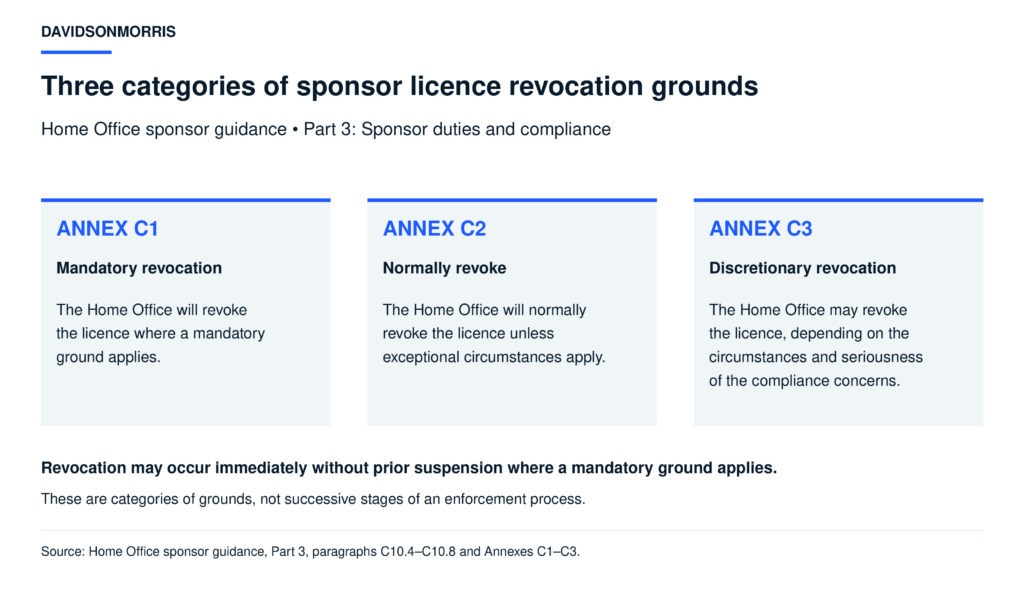
Part 3 of the sponsor guidance identifies three principal categories of revocation grounds.
| Guidance provision | Revocation category | Regulatory significance |
|---|---|---|
| Annex C1 | Mandatory revocation grounds | Under the published sponsor guidance, the Home Office will revoke the licence where the relevant mandatory ground applies. Revocation may occur immediately without prior suspension. |
| Annex C2 | Grounds where revocation will normally occur | The Home Office will normally revoke the licence unless exceptional circumstances apply. |
| Annex C3 | Discretionary revocation grounds | The Home Office may revoke the licence, depending on the relevant circumstances and the seriousness of the compliance concerns. |
These distinctions are set out in the Home Office sponsor duties and compliance guidance, including paragraphs C10.4 to C10.8 and the associated annexes.
Each category determines the nature of the Home Office’s decision-making powers and the scope for considering the circumstances of the individual case.
A sponsor licence downgrade may be appropriate where the relevant guidance permits an action plan and the Home Office considers that the deficiencies can be addressed through that process.
Downgrading is generally associated with breaches that the Home Office considers capable of correction through an action plan. A sponsor downgraded to a B-rating is subject to restrictions on assigning Certificates of Sponsorship for new workers until its A-rating is restored, subject to the detailed provisions of the guidance.
However, a downgrade is not a guaranteed preliminary stage before suspension or revocation.
Sponsor licence suspension may be used while compliance concerns are investigated or considered. During suspension, the sponsor cannot assign further Certificates of Sponsorship, although the position of workers already sponsored is governed by separate provisions.
Sponsor licence revocation removes the organisation’s authority to sponsor workers and may be required or permitted under the applicable grounds.
These measures are not interchangeable, and they do not form a mandatory sequence.
Employers need to account for the possibility of direct revocation when assessing sponsor licence risk.
An organisation should not assume that it will necessarily receive an opportunity to correct every serious breach before its licence is withdrawn.
Equally, it would be inaccurate to suggest that every compliance failure results in immediate revocation.
The applicable ground, seriousness of the breach, relevant facts and Home Office guidance determine the available response.
DavidsonMorris analysis: Employers should distinguish between issues that can be addressed through routine corrective action and failures capable of threatening the organisation’s continued suitability to hold a licence.
The purpose of internal assurance is to identify and manage problems before they develop into circumstances requiring regulatory intervention.
6. Increased Importance of Organisational Evidence
As sponsorship compliance becomes more closely connected with wider employment and corporate information, the quality of an organisation’s evidence becomes increasingly important.
A sponsor may be required to demonstrate not only that it has written policies but also that its employment arrangements satisfy the applicable requirements.
Relevant evidence can include employment contracts, payroll records, attendance information, recruitment documentation, records of changes to sponsored workers’ circumstances and evidence of internal compliance decisions.
The precise records required depend on the sponsor guidance, including the applicable record-keeping provisions.8
Employers should not interpret this as an obligation to retain every possible item of workforce information indefinitely. Record retention must be managed in accordance with the relevant immigration requirements and data protection obligations.
The objective is to maintain accurate, accessible and appropriate evidence of compliance.
An organisation that cannot readily explain how a sponsored worker’s duties, salary or employment arrangements correspond with its sponsorship records may encounter difficulties even where the underlying employment is genuine.
This is particularly relevant where information is fragmented across different systems or departments.
Compliance records and processes should enable the employer to establish the relevant facts reliably, without depending entirely on individual managers’ recollections.
For employers reviewing their existing controls, a structured sponsor compliance assessment can help identify discrepancies between documented procedures and operational practice.
7. Enforcement Risk Following Business Change
Changes in an employer’s corporate or operational arrangements can expose weaknesses in sponsorship governance.
Mergers, acquisitions, changes in ownership, restructuring and transfers of employment may affect the basis on which a sponsor licence is held or the arrangements under which sponsored workers are employed.
The applicable sponsor guidance contains specific requirements concerning relevant organisational changes.
Failure to recognise those requirements can result in a business making assumptions about the continued availability of sponsorship that are not supported by the rules.
For example, the acquisition of a business does not necessarily mean that its sponsor licence can simply be treated as an asset transferred to the purchaser.
The legal and immigration consequences depend on the transaction structure and the relevant sponsorship requirements.
Sponsor compliance should therefore form part of transaction planning, before completion.
There is no sufficient basis in the published national enforcement figures to quantify how frequently corporate changes lead to licence revocation.
However, the potential consequences make this a material area of risk for employers undergoing structural change.
8. What the Changing Enforcement Model Means in Practice
The developments described concern how the Home Office uses its existing sponsor enforcement powers.
Many of the underlying obligations and regulatory mechanisms have existed for some time.
Established sponsorship duties are being applied alongside a stronger government emphasis on enforcement and the use of information from a wider range of sources.
For employers, this changes the practical assumptions on which compliance arrangements should be based.
A sponsor cannot safely assume that compliance will be assessed only during an announced visit, that a history of successful sponsorship applications demonstrates continuing suitability or that serious problems will necessarily be preceded by a warning.
Nor should employers assume that maintaining accurate SMS records is sufficient where the underlying employment arrangements do not comply with the relevant requirements.
Employers should treat sponsorship as an ongoing regulatory responsibility, with business systems that support it consistently.
That requires clarity over who is accountable, how information moves between departments, how changes are assessed and how the organisation satisfies itself that its sponsorship arrangements remain compliant.
The effectiveness of those arrangements also affects how well the business can manage the commercial consequences of enforcement.
Section H: What Sponsor Licence Enforcement Trends Mean for UK Employers
Stronger sponsor licence enforcement can affect employers’ operations as well as their regulatory position.
A sponsor licence is an operational dependency for any organisation that relies on sponsored workers to fill positions requiring employer sponsorship. Its continued availability can affect recruitment, workforce stability, service delivery and the organisation’s capacity to execute its business plans.
Where sponsorship is concentrated in a small number of specialist positions, the loss of a licence may threaten access to skills that are difficult to replace. Where an organisation sponsors substantial numbers of employees, the consequences may be considerably wider.
The commercial importance of sponsor compliance therefore depends not only on the probability of regulatory intervention, but also on the consequences if sponsorship privileges are restricted or withdrawn.
Employers should consider both the likelihood and the potential consequences of enforcement when deciding what resources to devote to immigration compliance.
An organisation may consider its historical record of successful sponsorship applications evidence that its systems are adequate. However, previous approvals do not establish that current employment arrangements satisfy all applicable sponsor requirements.
The increase in recorded revocations reinforces the importance of assessing sponsorship as an ongoing business risk rather than a series of individual immigration transactions.
1. Sponsor Licence Enforcement as a Board-Level Risk
Sponsor licence compliance is frequently managed within HR, recruitment or global mobility functions.
Those teams may be responsible for day-to-day sponsorship administration, but the consequences of serious non-compliance can extend beyond their operational remit.
The loss of sponsorship privileges may affect an organisation’s ability to recruit overseas workers, retain existing sponsored employees and meet workforce commitments.
Depending on the business, the consequences could include disruption to projects, increased recruitment costs, pressure on existing employees or difficulty fulfilling commercial obligations.
These potential effects make sponsorship compliance relevant to senior management and, where the organisation’s dependence on sponsored labour is material, board-level risk oversight.
This does not mean that every sponsor licence issue requires board intervention.
Routine administrative responsibilities should remain with appropriately trained personnel. However, senior management should understand the organisation’s exposure to sponsorship disruption and have confidence that the systems used to manage that exposure are effective.
A board-level assessment should consider the extent of the organisation’s reliance on sponsored workers, the consequences of losing sponsorship privileges and the adequacy of the arrangements used to prevent, identify and escalate compliance failures.
It should also establish whether responsibility for sponsorship compliance is sufficiently clear.
The Home Office requires sponsors to appoint key personnel, including an Authorising Officer. The Authorising Officer has overarching responsibility for the organisation’s sponsorship activities and compliance with sponsor duties.
However, the existence of an appointed Authorising Officer does not eliminate the need for effective organisational governance.
An individual cannot reliably discharge oversight responsibilities without access to accurate information, appropriate authority and functioning internal processes.
DavidsonMorris analysis: Employers with significant sponsorship exposure should include sponsor licence risk within their wider regulatory risk framework, with defined accountability, escalation arrangements and periodic reporting to senior management.
Sponsorship risks that could affect business continuity need appropriate management attention, supported by reporting and oversight proportionate to the exposure.
2. Workforce Continuity and Operational Dependency
One of the most significant commercial consequences of sponsor licence enforcement is the potential disruption to an employer’s sponsored workforce.
Where a licence is suspended, the employer cannot assign further Certificates of Sponsorship while the suspension remains in effect. This restricts its ability to sponsor additional workers and can affect recruitment plans.
However, workers already sponsored who hold valid immigration permission are not ordinarily affected solely because the employer’s licence has been suspended. They may generally continue working for the sponsor, provided their immigration permission and employment arrangements otherwise remain valid.
A separate issue arises where a Certificate of Sponsorship was assigned before suspension but the associated immigration application has not yet been decided. Under the Home Office’s sponsor guidance, decisions on applications supported by a valid certificate assigned before suspension, and on supported settlement applications, will be held until the reason for suspension is resolved, unless the application falls for refusal on other grounds.
Suspension therefore has different immediate consequences for existing sponsored workers and recruitment processes, depending on the circumstances.
Revocation has more serious consequences.
Where a sponsor licence is revoked, the employer loses its authority to sponsor workers. Certificates of Sponsorship assigned by that sponsor cease to be valid for sponsorship purposes, and the Home Office may take action affecting the immigration permission of existing sponsored employees.
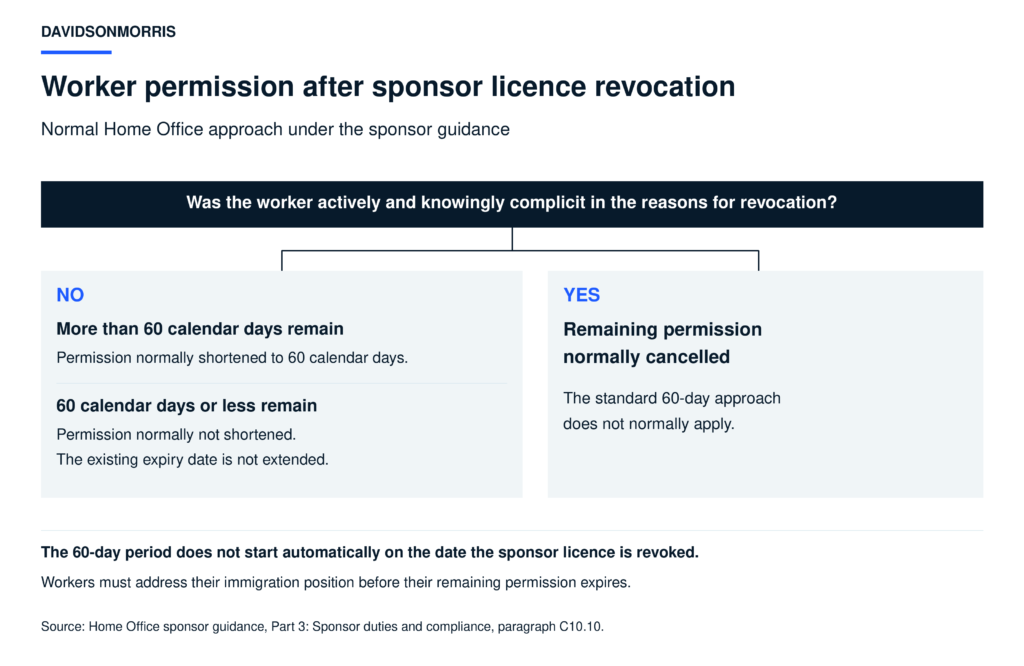
Under the current sponsor guidance, where a sponsored worker was not actively and knowingly complicit in the circumstances leading to revocation, the Home Office will normally shorten their immigration permission to 60 calendar days. It will not normally shorten permission if no more than 60 calendar days remain when cancellation action is considered.
Where a worker was actively and knowingly complicit in the reasons for revocation, the Home Office will normally cancel their remaining permission rather than apply the standard 60-day approach.
The position also depends on the worker’s individual circumstances, including the validity and remaining duration of their permission and any applicable exceptions.
Employers should therefore not assume that every sponsored worker’s permission ends immediately upon revocation. Equally, they should not assume that existing employees can continue indefinitely under the sponsorship arrangements that previously applied. The 60-day approach does not create a fresh visa or restart a period of permission automatically on the revocation date. Workers must address their position before the expiry of their remaining permission, including making a valid application on a route for which they qualify or leaving the UK.
The practical implications depend on the circumstances, including the workers’ immigration positions and any action taken by the Home Office.
For organisations with a substantial sponsored workforce, the resulting uncertainty can affect operational planning before any individual employee actually leaves the business.
Managers may need to consider recruitment alternatives, workforce allocation, project commitments and the availability of suitably qualified replacement employees.
The commercial impact can be particularly significant where sponsored workers occupy specialist or difficult-to-fill roles.
Employers therefore need to assess the effects on business continuity alongside the immigration consequences.
An employer’s assessment of sponsor licence risk should consider not merely whether it is likely to face enforcement, but how dependent its operations are on the continued availability of sponsorship.
For the detailed regulatory consequences, employers should refer to the Home Office sponsor duties and compliance guidance and DavidsonMorris’s specialist guidance on sponsor licence suspension and revocation.
3. Recruitment and International Workforce Planning
Stronger enforcement has implications for employers planning to expand their international recruitment.
The sponsorship system is often incorporated into medium- and long-term workforce strategies, particularly where domestic recruitment does not provide sufficient access to the required skills.
Businesses may make investment decisions, enter commercial arrangements or commit to growth plans on the assumption that they can continue sponsoring overseas workers.
However, a sponsor licence is conditional on continuing compliance.
Employers should therefore avoid treating sponsorship capacity as a guaranteed resource independent of regulatory performance.
The organisation’s ability to recruit internationally depends partly on maintaining the systems and standards required to retain its licence.
This is particularly relevant where recruitment volumes increase significantly.
An employer that expands its sponsored workforce without strengthening the processes used to monitor workers, manage salary compliance and identify reportable changes may create risks that were less apparent when sponsorship activity was limited.
The same issue can arise when businesses enter new locations or introduce unfamiliar operating models.
DavidsonMorris analysis: International recruitment strategies should include an assessment of whether sponsorship governance is capable of supporting the intended scale and complexity of recruitment.
This requires coordination between recruitment planning, HR operations, finance and those responsible for immigration compliance.
4. The Financial Consequences of Sponsor Licence Enforcement
The financial implications of sponsor licence enforcement can extend beyond the immediate costs of responding to Home Office enquiries.
Where an organisation loses its ability to sponsor workers, it may face recruitment disruption, additional professional costs and the expense of developing alternative staffing arrangements.
Existing investments in international recruitment may also be affected.
These can include recruitment expenditure, immigration application costs, relocation support, training and the management time associated with bringing overseas workers into the organisation.
The extent to which these costs can be recovered or reused will depend on the circumstances.
Some employers may also face contractual or commercial consequences where staffing disruption affects their ability to deliver services.
However, such losses are not automatic consequences of every sponsor licence sanction. Their occurrence and scale depend on the employer’s operations and the nature of the enforcement action.
The financial significance of compliance therefore needs to be assessed in proportion to the organisation’s reliance on sponsorship.
For a business sponsoring only a small number of workers, the direct operational impact may be limited, although the consequences for those workers and the business may still be serious.
For an organisation whose workforce model depends heavily on international recruitment, the potential exposure can be substantial.
Investment in preventive compliance arrangements should reflect that potential financial exposure.
The cost of maintaining effective systems should be considered against the potential consequences of losing sponsorship privileges, rather than assessed solely as an administrative overhead.
5. The Limitations of Reactive Compliance
A reactive approach to sponsor compliance typically concentrates resources on problems after they have been identified.
This may involve correcting records following an internal discovery, preparing for a Home Office visit or responding to allegations of non-compliance.
Such activities can be necessary, but they are not a substitute for effective ongoing controls.
The difficulty with a purely reactive model is that some sponsorship failures may already have regulatory consequences by the time they are discovered.
For example, an employer may identify that a sponsored worker’s duties changed several months earlier without the relevant immigration implications being considered.
Similarly, a payroll discrepancy may have persisted across several reporting periods before the sponsorship team becomes aware of it.
Corrective action may still be appropriate, but the existence of a retrospective correction does not necessarily eliminate the underlying breach or prevent the Home Office from considering it.
Employers should identify relevant changes when they occur and assess their consequences early enough to prevent avoidable compliance failures.
This requires internal processes that operate as part of ordinary workforce management.
DavidsonMorris analysis: The principal weakness in reactive compliance is not necessarily a lack of immigration knowledge. It is often the failure to integrate that knowledge into the decisions and processes that determine how sponsored workers are employed.
6. Compliance Assurance and Internal Audit
Internal compliance audits can provide employers with a structured means of assessing whether their sponsorship arrangements remain consistent with Home Office requirements.
An audit may examine the accuracy of sponsorship records, the organisation’s reporting processes, salary compliance, right to work documentation and the operation of relevant internal controls.
However, the value of an audit depends on its scope and methodology.
A review limited to confirming that specified documents exist may fail to identify discrepancies between the records and the underlying employment arrangements.
For example, a personnel file may contain a valid employment contract while the worker’s actual duties or remuneration differ from those recorded.
Similarly, an organisation may have a written procedure for reporting changes without evidence that managers understand or consistently follow it.
An effective assurance exercise should therefore examine both documentary compliance and the operation of the systems used to maintain it.
The findings should also be considered in context.
Not every deficiency carries the same regulatory significance. Some may require routine administrative correction, while others may indicate more serious weaknesses affecting the employer’s suitability to hold a licence.
The organisation should prioritise remedial action according to the nature of the issue, the applicable sponsor requirements and the potential consequences.
Internal audits do not guarantee that the Home Office will regard a sponsor as compliant. Nor do they prevent regulatory action where breaches have occurred.
Their value lies in helping employers identify weaknesses, understand their exposure and take appropriate action before problems become more serious.
Employers should assess the scope of any internal review against the relevant sponsor licence compliance requirements, rather than relying exclusively on generic HR audit procedures.
7. Management Information and Accountability
Senior management needs enough information to assess whether the organisation’s sponsorship compliance arrangements are working effectively.
This requires information that goes beyond the number of sponsored workers or Certificates of Sponsorship assigned.
Useful management information may include the completion of periodic compliance reviews, unresolved reporting issues, changes affecting sponsored workers, identified salary discrepancies and the progress of corrective actions.
The appropriate measures will vary according to the size and complexity of the business.
However, the underlying purpose is consistent: management should be able to identify emerging problems rather than relying solely on assurances that the organisation is compliant.
The reporting framework should also distinguish between administrative activity and regulatory risk.
For example, the completion of a large number of sponsorship transactions does not necessarily indicate that compliance controls are effective.
Likewise, the absence of identified breaches may reflect strong controls, but it may also indicate that the organisation lacks adequate processes for detecting problems.
DavidsonMorris analysis: Employers should assess whether their sponsorship management information provides meaningful assurance about compliance outcomes, rather than merely recording the volume of immigration administration undertaken.
8. Reputational and Commercial Considerations
Sponsor licence enforcement may also create reputational concerns.
Public information about enforcement action can affect perceptions of an organisation’s governance, employment practices and regulatory reliability.
The extent of any reputational impact will depend on the circumstances, including whether the action becomes public, the reasons for intervention and the organisation’s response.
A sponsor licence suspension or revocation should not automatically be treated as proof of wider corporate misconduct.
Nevertheless, serious enforcement action may prompt questions from employees, commercial partners, investors or other stakeholders.
For employers operating in regulated industries or relying on public-sector contracts, the potential consequences may require particular consideration.
Sponsor compliance can therefore affect the organisation’s wider commercial standing.
This provides another reason for ensuring that immigration risk is appropriately integrated into corporate governance.
Section I: Sponsor Licence Enforcement Outlook: What Employers Should Expect
Future sponsor licence enforcement volumes cannot be predicted reliably from the historical increase alone.
The increase in recorded revocations between July 2023–June 2024 and July 2024–June 2025 demonstrates a substantial change in enforcement outcomes over those periods.
Government statements also establish that preventing sponsorship abuse and strengthening immigration enforcement have been policy priorities.
However, neither the historical increase nor the government’s stated intentions establish that revocations will continue rising indefinitely.
Future enforcement activity may be influenced by changes in immigration policy, the number and composition of licensed sponsors, enforcement resources, operational priorities and the effectiveness of compliance measures.
Employers should distinguish between developments already reflected in the regulatory framework and assessments of how that framework may be applied.
1. Continued Emphasis on Sponsor Accountability
The existing sponsorship framework places substantial responsibility on employers to monitor sponsored workers and maintain compliance with the conditions of their licence.
Under the established framework, sponsorship carries continuing responsibilities beyond the initial administrative approval.
The Home Office retains powers to examine sponsor suitability and take action where the applicable requirements are not met.
For employers, the prudent assumption is that continuing compliance will remain central to participation in the sponsorship system.
This does not depend on predicting the number of future revocations.
Even if enforcement volumes were to stabilise or decline, the underlying legal obligations would remain significant.
DavidsonMorris outlook: Sponsor accountability is likely to remain an important feature of immigration regulation, particularly where the government seeks to demonstrate that employer-sponsored routes are being used for their intended purposes.
This is an assessment of regulatory direction, not a prediction of a specific future enforcement outcome.
2. Greater Importance of Reliable Workforce Information
The Home Office’s stated emphasis on improved data and intelligence sharing suggests that the consistency and reliability of employer information will remain important.
For sponsors, this means that information held in HR, payroll, recruitment and immigration systems should accurately reflect the underlying employment arrangements.
The principal risk is not simply that different systems contain different information.
Differences may be legitimate and explicable.
The concern arises where discrepancies reveal that the employer has failed to comply with sponsorship requirements or cannot demonstrate the basis on which relevant decisions were made.
Employers should therefore prioritise information quality and effective internal communication.
The Home Office’s documented use of HMRC checks concerning sponsored workers’ pay reinforces the importance of maintaining consistency between sponsorship information and actual payroll arrangements.
DavidsonMorris outlook: Organisations with fragmented workforce information may find it increasingly difficult to demonstrate compliance efficiently where the Home Office raises questions about their sponsorship arrangements.
This does not establish that the Home Office will introduce any particular new automated monitoring process. It reflects the practical implications of the enforcement approach already described in official guidance and announcements.
3. Continued Scrutiny of Sponsored Employment Arrangements
Government concerns about misuse of sponsorship and the treatment of overseas workers provide a basis for expecting continued attention to the substance of sponsored employment.
Relevant issues include whether sponsored roles are genuine, whether workers perform the duties associated with their sponsorship and whether remuneration and employment arrangements satisfy the applicable requirements.
These matters are already addressed within the sponsorship framework.
Further scrutiny may therefore reflect a change in enforcement emphasis without necessarily creating new duties.
Employers should be cautious about assuming that technically accurate sponsorship documentation will resolve concerns where the underlying employment arrangements are inconsistent with the information provided.
DavidsonMorris outlook: The relationship between declared sponsorship arrangements and actual employment practices is likely to remain an important area of regulatory scrutiny.
The implication is that employers should maintain oversight of the employment relationship throughout sponsorship, rather than concentrating exclusively on the initial immigration application.
4. The Possibility of Further Regulatory Change
Sponsor licence requirements can change through amendments to immigration policy, sponsor guidance and the Immigration Rules.
Changes may affect eligibility for particular routes, salary requirements, sponsorship processes or the obligations imposed on employers.
However, proposed reforms and government announcements should not be treated as legally operative until their status and commencement arrangements have been established.
Employers planning compliance changes need to establish which requirements have taken effect and which remain proposals.
A consultation proposal may indicate the government’s intended direction without creating an immediate legal obligation.
Similarly, an announced reform may be subject to implementation dates, transitional provisions or further guidance.
The appropriate response is to monitor developments through official sources and assess their practical implications once sufficient detail is available.
Employers can monitor formal amendments through the Immigration Rules and the Home Office’s sponsorship guidance collection.
DavidsonMorris outlook: Employers should anticipate that sponsorship policy will continue to evolve, but should avoid making operational decisions on the assumption that unimplemented proposals are already binding.
5. Why Enforcement Volumes May Fluctuate
It would be misleading to assume that a period of increased revocations must necessarily be followed by further increases.
Enforcement statistics are influenced by several factors beyond the underlying prevalence of non-compliance.
A targeted enforcement initiative may produce a temporary increase in recorded outcomes. Changes in the number of licensed sponsors may alter the population subject to regulation. The resolution of investigations initiated in earlier periods may affect the timing of reported sanctions.
Changes in immigration routes or sponsorship eligibility may also influence the composition of the sponsor population.
Consequently, a reduction in revocations would not necessarily demonstrate that the Home Office had relaxed its approach.
Equally, a further increase would not automatically establish that employers had become less compliant.
The most useful analysis considers the figures alongside policy developments, the sponsor population and the limitations of the available data.
A reliable assessment of future enforcement trends needs to explain changes in the evidence, including the context behind each new headline figure.
The Home Office Migration Transparency Data provides the official statistical source for monitoring changes in sponsorship enforcement outcomes.
6. The Strategic Direction for Employers
The available evidence gives employers reason to review any sponsorship compliance arrangements that rely on limited Home Office intervention.
The Home Office has demonstrated its willingness to revoke substantial numbers of sponsor licences, and its published policy places continuing emphasis on preventing abuse and maintaining the integrity of sponsored employment.
Employers can prepare for scrutiny without assuming that enforcement action is inevitable.
They should test whether their sponsorship arrangements can withstand scrutiny and establish whether they can rely on their compliance systems.
For employers, this means treating sponsor licence governance as an ongoing management responsibility, ensuring that immigration requirements are reflected in relevant business processes and maintaining appropriate evidence of compliance.
Organisations that depend heavily on sponsored workers should also consider the potential consequences of disruption to their sponsorship privileges.
DavidsonMorris assessment: Employers need a reliable system of workforce management and oversight to support sponsorship throughout their operations, alongside obtaining a sponsor licence and administering Certificates of Sponsorship.
Employers reviewing their response to these enforcement trends should assess how consistently sponsorship requirements are applied across the business.
Section J: Employer Compliance Priorities in an Era of Stronger Enforcement
Employers responding to sponsor licence enforcement trends should assess whether their arrangements identify relevant obligations, support compliance and provide evidence that those obligations have been met. Increasing the volume of administration alone will not establish that.
The Home Office expects licensed sponsors to maintain compliance throughout the period in which they hold a licence. Employers should therefore assess whether their internal processes remain appropriate for the scale and complexity of their sponsorship activities.
Employers can use the following priorities to assess whether their existing arrangements are adequate.
1. Establish Clear Ownership of Sponsor Compliance
Effective sponsorship governance begins with clear responsibility for compliance.
The Home Office requires licensed sponsors to appoint key personnel, including an Authorising Officer, Key Contact and appropriate SMS users. These roles are subject to specific requirements and responsibilities.
However, compliance cannot depend exclusively on the individuals appointed to those positions.
Operational decisions affecting sponsored workers may be made by HR teams, payroll personnel, line managers, recruitment departments or senior management.
The organisation therefore needs a clear framework identifying who is responsible for recognising relevant changes, assessing their immigration implications and ensuring that any necessary action is taken.
Those assigned responsibilities need to understand how to carry them out, as well as having them documented in a policy.
For example, a line manager who approves changes to a sponsored worker’s duties should know when those changes need to be referred to the sponsorship team. Payroll personnel should understand when proposed remuneration adjustments require immigration review.
Clear escalation procedures are particularly important where an organisation operates across several locations or business units.
The objective is to ensure that relevant information reaches the individuals responsible for sponsorship before avoidable compliance failures occur.
Employers should also review whether their appointed sponsor licence key personnel have sufficient authority, resources and access to information to discharge their responsibilities effectively.
2. Maintain Accurate Sponsored Worker Information
The accuracy of sponsored worker information is fundamental to continuing compliance.
Employers should maintain records that reflect the worker’s actual employment arrangements and satisfy the applicable Home Office requirements.
This includes information concerning the sponsored role, remuneration, work location, relevant employment changes and other matters subject to record-keeping or reporting obligations.
However, the existence of records does not necessarily demonstrate compliance.
The organisation must also ensure that the information remains accurate as circumstances change.
A sponsored worker’s duties may evolve. Working arrangements may be altered. A change in remuneration may affect compliance with the relevant salary requirements.
These developments should be identified and reviewed through appropriate internal processes.
Where reporting is required, the employer must ensure that the relevant information is submitted through the Sponsor Management System in accordance with the applicable requirements.
Employers should also consider whether information held in different systems is consistent.
Discrepancies between HR, payroll and sponsorship records may be explicable, but they should not remain unidentified simply because responsibility for the information is divided between departments.
Compliance priority: Maintain a reliable connection between the employment arrangements recorded for sponsorship purposes and the worker’s actual position within the organisation.
3. Review Salary and Employment Arrangements
Salary compliance should form part of ongoing sponsorship assurance.
Employers need to consider whether sponsored workers continue to receive remuneration that satisfies the requirements applicable to their immigration circumstances.
The relevant assessment may involve general salary thresholds, occupation-specific requirements and any applicable transitional or discounted provisions.
Changes in working arrangements, unpaid absence or remuneration can also have immigration implications.
The applicable rules contain specific provisions for different circumstances, so employers should not assume that every salary variation is prohibited or that every reduction produces the same consequences.
Nevertheless, the Home Office’s documented use of HMRC checks concerning sponsored workers’ pay makes accurate payroll governance particularly important.
Employers should ensure that proposed changes affecting sponsored workers receive any necessary review before implementation.
Payroll and HR personnel should know when specialist immigration input is required.
Where the organisation sponsors workers under different routes or salary provisions, it may be necessary to distinguish between employees rather than applying a single assumption to the entire sponsored workforce.
Compliance reviews should also consider whether the worker’s actual duties and employment arrangements remain consistent with the basis of sponsorship.
Compliance priority: Integrate immigration salary and employment requirements into ordinary payroll and workforce management processes.
4. Test Whether Compliance Procedures Work in Practice
Written policies are important, but their effectiveness depends on implementation.
An organisation may have a comprehensive sponsorship compliance manual while individual managers remain unaware of their responsibilities.
Similarly, a reporting procedure may exist without a reliable mechanism for identifying the changes that trigger it.
Employers should therefore test whether their procedures operate as intended.
This may involve reviewing a sample of sponsored worker records, examining how recent employment changes were managed or assessing whether relevant information was escalated correctly.
Internal assurance should consider both the accuracy of records and the processes used to maintain them.
Where weaknesses are identified, the employer should assess their significance and take proportionate corrective action.
Some findings may require additional training or administrative improvements. Others may indicate more serious concerns requiring detailed legal assessment.
Testing helps identify weaknesses before they create more serious regulatory exposure, although it cannot guarantee that the Home Office will find no deficiencies.
Employers can use a structured sponsor compliance review to evaluate the relationship between their documented procedures and actual employment practices.
5. Integrate Sponsorship Into Corporate Decisions
Business decisions can have immigration consequences even where sponsorship is not their primary purpose.
Corporate acquisitions, restructurings, changes in ownership, transfers of employees and the opening or closure of business locations may all require consideration of sponsor licence requirements.
The relevant obligations depend on the circumstances and the applicable Home Office guidance.
Employers need to identify sponsorship implications before implementing those decisions.
An organisation should not assume that a sponsor licence automatically transfers with a business or that changes in corporate structure have no effect on its sponsorship arrangements.
Similarly, changes to operational management or employment structures may affect the organisation’s ability to monitor sponsored workers and fulfil its duties.
Employers should therefore ensure that relevant corporate decisions trigger immigration compliance review.
This is particularly important where the business relies heavily on sponsored employees.
Compliance priority: Include sponsorship considerations within corporate transaction planning, restructuring processes and significant workforce decisions.
6. Prepare for Home Office Scrutiny Without Waiting for a Visit
Employers should maintain compliance arrangements capable of responding to Home Office scrutiny when required.
This includes ensuring that relevant records can be located, that responsibilities are understood and that the organisation can explain its sponsorship processes accurately.
However, preparation should not be limited to assembling documents in anticipation of a compliance visit.
The Home Office may identify concerns through information obtained outside a physical inspection, including relevant government information-sharing arrangements.
Consequently, the organisation’s ordinary records and employment practices need to be capable of supporting its compliance position.
Employers should consider whether they could explain the basis on which sponsored workers were recruited, how their duties and remuneration are monitored, and how relevant changes are identified and reported.
Where information is held across different departments, there should be a reliable process for obtaining and reconciling it.
The employer should also understand how it would respond if the Home Office raised concerns requiring investigation or explanation.
Readiness for scrutiny does not depend on expecting imminent enforcement action.
The organisation should be able to demonstrate compliance without depending on a period of advance preparation.
Compliance priority: Maintain inspection readiness as a consequence of effective day-to-day governance, rather than treating it as a separate exercise undertaken only when scrutiny is expected.
7. Keep Sponsorship Governance Under Review
Compliance arrangements should evolve as the organisation changes.
A framework that was appropriate when a business sponsored a small number of workers may become inadequate after substantial expansion.
New locations, management structures, recruitment models or payroll arrangements can introduce additional compliance challenges.
Changes in immigration rules and Home Office guidance may also require employers to amend existing procedures.
Periodic governance reviews should therefore consider whether responsibilities remain appropriate, whether relevant personnel have sufficient training and whether internal processes continue to reflect the organisation’s activities.
Employers should also assess whether previous compliance findings have been addressed effectively.
A recurring issue may indicate that an underlying process has not been corrected, even where individual errors have been resolved.
Management information can help identify such patterns.
Reporting should help management assess whether controls work and whether problems have been resolved.
Compliance priority: Review sponsorship governance whenever significant organisational or regulatory changes occur, supported by periodic assurance appropriate to the business.
8. Apply a Proportionate Approach to Compliance
Effective sponsorship compliance does not require every employer to operate the same governance model.
The arrangements appropriate for a large organisation sponsoring hundreds of workers may differ from those required by a smaller business sponsoring a limited number of employees.
The Home Office’s substantive requirements nevertheless apply according to the relevant licence and sponsorship arrangements.
Proportionality concerns how the employer organises its compliance systems, not whether it can disregard its obligations.
A smaller sponsor may use straightforward procedures supported by appropriately trained personnel and external advice where necessary.
A larger organisation may require formal reporting structures, dedicated compliance functions and more extensive internal assurance.
Both approaches can be effective if they provide reliable oversight of the relevant duties.
The key consideration is whether the organisation’s arrangements are sufficient for its actual sponsorship activities and risks.
DavidsonMorris assessment: Employers should develop clear, proportionate and effective controls that support compliance throughout the employment relationship. Additional administration is useful only where it helps those controls work.
Section K: Home Office Sponsor Licence Enforcement FAQs
The following questions address common employer concerns about sponsor licence enforcement trends, regulatory powers and the consequences of Home Office action.
Is Home Office Sponsor Licence Enforcement Increasing?
Official Home Office figures show that sponsor licence revocations increased substantially between July 2023–June 2024 and July 2024–June 2025.
Revocations rose from 937 to 1,948 over those comparable 12-month periods, an increase of approximately 108%. These are combined Skilled Worker and Temporary Worker category records; licences covering both can be counted in both, so they are not counts of unique employers.
This establishes a significant historical increase in revocation outcomes.
However, the figures do not, by themselves, demonstrate that revocations continued increasing throughout 2026. A current assessment requires examination of the latest comparable sponsorship transparency data.
Employers should also distinguish between revocations, suspensions, compliance visits and broader immigration enforcement activity.
How Many Sponsor Licences Does the Home Office Revoke Each Year?
The number varies according to the reporting period.
In September 2025, the Home Office reported that 937 sponsor licences had been revoked between July 2023 and June 2024, compared with 1,948 between July 2024 and June 2025.
These figures relate to the stated 12-month periods rather than calendar years. They combine Skilled Worker and Temporary Worker revocation records, with possible double counting of licences covering both categories.
For more recent figures, employers should consult the official Migration Transparency Data.
Changes in the absolute number of revocations should be interpreted alongside the size and composition of the licensed sponsor population.
What Is the Difference Between Sponsor Licence Suspension and Revocation?
Suspension temporarily restricts a sponsor’s ability to assign Certificates of Sponsorship while the Home Office considers compliance concerns.
Workers already sponsored who hold valid immigration permission are not ordinarily affected solely by the suspension, although pending applications and future sponsorship activity may be affected.
Revocation removes the employer’s authority to sponsor workers.
It can have serious consequences for existing sponsored employees, including action affecting their immigration permission.
The Home Office is not required to suspend a licence before revoking it where the applicable grounds permit or require direct revocation.
For detailed guidance, see sponsor licence suspension and sponsor licence revocation.
Which Industries Are Most Likely to Face Sponsor Licence Enforcement?
Government attention has included sectors such as health and social care, particularly in connection with concerns about sponsored worker exploitation and misuse of immigration routes.
However, public enforcement attention does not establish a reliable national ranking of industries by sponsor licence suspension or revocation rates.
The available evidence should not be used to assign comparative probabilities without suitable sector-level data.
An employer’s compliance exposure depends on its particular activities, workforce arrangements, management systems and adherence to sponsorship requirements.
Employers should therefore assess their own circumstances rather than relying solely on sector-wide enforcement headlines.
How Does the Home Office Identify Non-Compliant Sponsors?
The Home Office can identify compliance concerns through several mechanisms, including compliance visits, documentary enquiries, sponsorship records and information obtained through government functions or lawful information-sharing arrangements.
The Home Office has expressly confirmed that it makes regular checks with HMRC concerning the pay of sponsored workers.
Government announcements have also referred to improved data and intelligence sharing as contributing to sponsor enforcement activity.
However, employers should not assume that every discrepancy automatically results in enforcement action or that all government records are continuously matched through a single system.
The relevant question is whether the information available to the Home Office raises concerns under the applicable sponsorship requirements.
Can the Home Office Revoke a Sponsor Licence Without a Compliance Visit?
Yes. A physical compliance visit is not a universal prerequisite to sponsor licence revocation.
The Home Office’s powers depend on the applicable revocation grounds and the relevant guidance.
Some grounds require revocation, while others provide for revocation in specified circumstances or permit the Home Office to exercise discretion.
The appropriate procedure depends on the particular grounds and facts.
Employers should not assume that they will necessarily receive a physical inspection or an opportunity to implement an action plan before revocation becomes possible.
Can Administrative Failures Lead to Sponsor Licence Revocation?
Yes. Serious or systematic failures to meet sponsorship obligations can place a licence at risk, even where an employer has not deliberately attempted to abuse the immigration system.
Relevant issues may include failures in record keeping, monitoring, reporting or other sponsor duties.
However, not every administrative mistake results in revocation.
The legal consequences depend on the applicable guidance, the nature and seriousness of the breach and the circumstances of the individual case.
The Home Office’s guidance distinguishes mandatory revocation grounds, grounds where revocation will normally occur unless exceptional circumstances apply, and discretionary grounds.
Employers should therefore assess administrative deficiencies according to their regulatory significance rather than assuming that all errors carry equivalent consequences.
Where Can Employers Find Official Sponsor Licence Enforcement Statistics?
The Home Office publishes sponsorship enforcement information through its Migration Transparency Data.
The sponsorship transparency releases include information concerning action taken against sponsors, including suspensions and revocations.
Employers should use comparable reporting periods and distinguish between different types of enforcement outcome.
The public register of licensed sponsors should not be used as a direct substitute for official revocation statistics, because removal from the register does not necessarily mean that a licence was revoked. The statistical notes also provide for counting a multi-category licence in both categories and for administrative revocations and suspensions recorded on immediate revocation.
Do Sponsored Workers Have to Stop Working if Their Employer’s Licence Is Suspended?
Not ordinarily solely because of the suspension.
Under the Home Office’s sponsor guidance, workers already sponsored who hold valid immigration permission are generally not affected merely because the sponsor’s licence has been suspended.
However, suspension prevents the employer from assigning further Certificates of Sponsorship, and applications supported by previously assigned certificates may be affected while the suspension remains unresolved.
The position is different following revocation.
Where a sponsor licence is revoked, the Home Office may shorten or cancel sponsored workers’ immigration permission according to the applicable guidance and individual circumstances.
For workers who were not actively and knowingly complicit in the circumstances leading to revocation, the normal approach is to shorten permission to 60 calendar days. Permission will not normally be shortened if no more than 60 calendar days remain when cancellation action is considered; this does not extend the existing expiry date.
Employers and affected workers should obtain advice on their individual circumstances rather than assuming that every case has the same outcome.
What Should Employers Do in Response to Stronger Sponsor Licence Enforcement?
Employers should review whether their sponsorship governance arrangements are appropriate for the scale and complexity of their activities.
Priorities include clear accountability, accurate sponsored worker records, effective coordination between HR and payroll, appropriate reporting processes and periodic compliance assurance.
Organisations should also assess the potential operational consequences of suspension or revocation, particularly where they depend heavily on sponsored workers.
The objective is not simply to prepare for a Home Office visit. It is to maintain reliable compliance throughout the period in which the organisation holds sponsorship privileges.
Where material weaknesses are identified, employers should assess their legal significance and take appropriate corrective action.
Section L: Sponsor Licence Enforcement Glossary
The following terms are used throughout this analysis and in the Home Office’s sponsorship framework.
| Term | Meaning |
|---|---|
| Authorising Officer | The senior person appointed by a sponsor with overarching responsibility for the organisation’s sponsorship activities and compliance with sponsor duties. |
| B-Rating | A sponsor licence rating that may be imposed where the Home Office identifies deficiencies capable of being addressed through an action plan under the applicable guidance. A B-rated sponsor is subject to restrictions on assigning Certificates of Sponsorship for new workers until its A-rating is restored, subject to the detailed rules. |
| Certificate of Sponsorship (CoS) | An electronic sponsorship record assigned by a licensed sponsor to an eligible worker. It contains information relevant to the worker’s sponsored immigration application. |
| Compliance Visit | A Home Office inspection or assessment undertaken to examine whether an organisation satisfies sponsorship requirements. Visits may occur before or after a sponsor licence is granted. |
| Enforcement Outcome | A regulatory action or result arising from the Home Office’s consideration of sponsor compliance, such as licence downgrading, suspension or revocation. Different outcomes have different legal consequences. |
| Genuine Vacancy | A role that satisfies the applicable requirements for sponsored employment, including the relevant Home Office provisions concerning whether the position and proposed employment arrangements are genuine. |
| Home Office | The UK government department responsible for immigration administration and enforcement, including the regulation of licensed immigration sponsors. |
| Immigration Skills Charge (ISC) | A charge payable by sponsors in specified circumstances when sponsoring workers under relevant immigration routes. The amount and applicability depend on the rules in force and the circumstances of sponsorship. |
| Sponsor Licence Revocation | The withdrawal of an organisation’s authority to sponsor workers. Revocation may be mandatory, normally required unless exceptional circumstances apply, or discretionary, depending on the relevant grounds in the sponsor guidance. |
| Sponsor Licence Suspension | A temporary restriction on sponsorship privileges while the Home Office considers compliance concerns. During suspension, the employer cannot assign further Certificates of Sponsorship, although existing sponsored workers with valid permission are not ordinarily affected solely by the suspension. |
| Sponsor Duties | The continuing obligations imposed on licensed sponsors, including relevant record-keeping, monitoring and reporting requirements and compliance with the conditions of sponsorship. |
| Sponsor Management System (SMS) | The Home Office’s online system through which licensed sponsors manage key sponsorship functions, including assigning Certificates of Sponsorship and reporting specified changes. |
| Sponsor Suitability | The assessment of whether an organisation meets the standards required to hold and retain a sponsor licence, including its compliance history, systems, conduct and other relevant matters under the sponsor guidance. |
| Sponsorship Transparency Data | Official Home Office statistical publications containing information about the sponsorship system, including action taken against sponsors through suspensions and revocations. Category overlap and the published reporting definitions must be considered when interpreting the figures. |
Section M: Useful Links and Official Sources
The following official resources provide the legal, policy and statistical framework for understanding Home Office sponsor licence enforcement.
| Resource | URL |
|---|---|
| Home Office Migration Transparency Data
Official statistical releases covering aspects of the immigration system, including sponsorship transparency information and action taken against licensed sponsors. |
https://www.gov.uk/government/statistical-data-sets/migration-transparency-data |
| Sponsorship Information for Employers and Educators
Home Office Sponsorship Guidance Collection The central collection of Home Office guidance relevant to organisations sponsoring workers and students, including sponsor duties, compliance requirements and regulatory action. |
https://www.gov.uk/government/collections/sponsorship-information-for-employers-and-educators |
| Workers and Temporary Workers: Sponsor Duties and Compliance
Sponsor Guidance Part 3: Sponsor Duties and Compliance The principal guidance concerning ongoing sponsor duties, compliance monitoring, licence downgrading, suspension and revocation. This includes the categories of revocation grounds and the consequences of enforcement action. |
https://www.gov.uk/government/publications/workers-and-temporary-workers-guidance-for-sponsors-part-3-sponsor-duties-and-compliance |
| Workers and Temporary Workers: Applying for a Sponsor Licence
Sponsor Guidance Part 1: Apply for a Licence Home Office guidance concerning sponsor licence eligibility, suitability and the requirements for obtaining permission to sponsor workers. |
https://www.gov.uk/government/publications/workers-and-temporary-workers-guidance-for-sponsors-part-1-apply-for-a-licence |
| Register of Licensed Sponsors
Register of Licensed Sponsors: Workers The public register of organisations licensed to sponsor workers under relevant immigration routes. The register is not, by itself, a definitive record of sponsor licence revocations. |
https://www.gov.uk/government/publications/register-of-licensed-sponsors-workers |
| Immigration Rules
The Immigration Rules governing relevant immigration routes, including the requirements applicable to sponsored workers and associated immigration applications. |
https://www.gov.uk/government/collections/immigration-rules |
About This Enforcement Analysis
This article provides an employer-focused analysis of Home Office sponsor licence enforcement, drawing on published enforcement statistics, official sponsor guidance and government policy statements.
It distinguishes between recorded enforcement outcomes, stated government priorities and DavidsonMorris’s interpretation of the implications for employers.
The historical statistical comparison concerns the 12-month periods ending June 2024 and June 2025. Later Home Office sponsorship transparency releases should be consulted when assessing the most recent enforcement volumes. The headline totals combine Skilled Worker and Temporary Worker category records and may count the same licence in both. Table SC_01 includes administrative revocations and, from Q2 2016, suspensions recorded when immediate revocation is completed; the totals should not be read as counts of unique employers proved to have committed misconduct.
The legal and regulatory position reflects the sources identified as at 23 October 2026. Immigration rules, sponsor guidance and enforcement policy may change, and employers should verify the requirements applicable to their circumstances.
The article is intended as general information and analysis. It does not constitute legal advice on an individual sponsor licence investigation, suspension, downgrade or revocation.
Employers facing Home Office compliance concerns should obtain advice based on the relevant facts, applicable guidance and any correspondence received from the Home Office.
Source References / Legal Sources
| Source | Official URL |
|---|---|
|
1 Home Office, Record numbers of visa sponsor licences revoked for rule breaking, 11 September 2025. Historical totals and enforcement approach. Official source. |
https://www.gov.uk/government/news/record-numbers-of-visa-sponsor-licences-revoked-for-rule-breaking |
|
2 Home Office, Sponsorship transparency data: April to June 2026, published 27 August 2026, table SC_01 and Notes: Sponsor Compliance notes 1–2. Official source. |
https://assets.publishing.service.gov.uk/media/6a8c3bc8d166fab554a3c3fe/sponsorship-transparency-data-apr-to-jun-2026.ods |
|
3 UKVI, Workers and Temporary Workers: guidance for sponsors, Part 3: sponsor duties and compliance, version 08/26, valid from 28 August 2026. C1–C2; C4; C7–C10; Annexes C1–C3. In particular C7.6–C7.17, C8.12–C8.21, C9.2–C9.4, C9.19–C9.21 and C10.4–C10.15. Official source. |
https://www.gov.uk/government/publications/workers-and-temporary-workers-guidance-for-sponsors-part-3-sponsor-duties-and-compliance/workers-and-temporary-workers-guidance-for-sponsors-part-3-sponsor-duties-and-compliance-accessible |
|
4 UKVI, Workers and Temporary Workers: guidance for sponsors, Part 1: apply for a licence, version 08/26, valid from 28 August 2026. L2–L4, particularly L3.11, L4.1–L4.3 and L4.32–L4.38. Official source. |
https://www.gov.uk/government/publications/workers-and-temporary-workers-guidance-for-sponsors-part-1-apply-for-a-licence/workers-and-temporary-workers-guidance-for-sponsors-part-1-apply-for-a-licence-accessible |
|
5 Home Office, Immigration Rules, Appendix Skilled Worker, SW 5.1–SW 5.6A (sponsorship and genuine employment) and SW 4, SW 8–SW 14 (salary provisions). Official source. |
https://www.gov.uk/guidance/immigration-rules/immigration-rules-appendix-skilled-worker |
|
6 UKVI, Workers and Temporary Workers: sponsor a Skilled Worker, SK5–SK8: salary requirements, calculations and compliance monitoring. Official source. |
https://www.gov.uk/government/publications/sponsor-a-skilled-worker/workers-and-temporary-workers-sponsor-a-skilled-worker-accessible |
|
7 UKVI, Workers and Temporary Workers: guidance for sponsors, Part 2: sponsor a worker, version 10/26. S1–S2 (sponsorship), S4 (salary, absence and reductions), S5 (Immigration Skills Charge), S9 (changes of employment). Official source. |
https://assets.publishing.service.gov.uk/media/6ac6118ad9c21d62c0226814/Sponsor_guidance-part-2-sponsor-a-worker-10-26-v1.0.pdf |
|
8 UKVI, Appendix D: record-keeping duties, version 10/26. Introduction: retention and data protection; Parts 1–3: worker and recruitment records. Official source. |
https://assets.publishing.service.gov.uk/media/6ac62285e635a394acb92387/Sponsor-guidance-Appendix-D-10-26-v1.0__1_.pdf |