Workforce planning in an era of immigration uncertainty
Organisations that rely on international recruitment have traditionally considered immigration policy alongside demand forecasts, skills gaps and the availability of UK workers. Sponsorship helps meet recruitment needs where the available UK workforce cannot do so.
That approach becomes harder to sustain when immigration policy changes faster than employers can recruit or train the people they need.
The availability, cost and conditions of international recruitment can shift within months, while replacing specialist skills, redesigning roles or developing domestic talent pipelines may take several years. Businesses therefore face a mismatch between the timescale over which workforce decisions are made and the timescale over which immigration policy can change.
Few organisations can predict with confidence what the immigration system will look like three or five years from now. Delaying workforce decisions until the policy position settles is no more realistic.
Employers can build that uncertainty into their workforce plans by testing how changes in access to international labour would affect recruitment and delivery.
Section A: The planning horizon and the policy horizon have diverged
Changes introduced since 2025 show how quickly recruitment conditions can change.
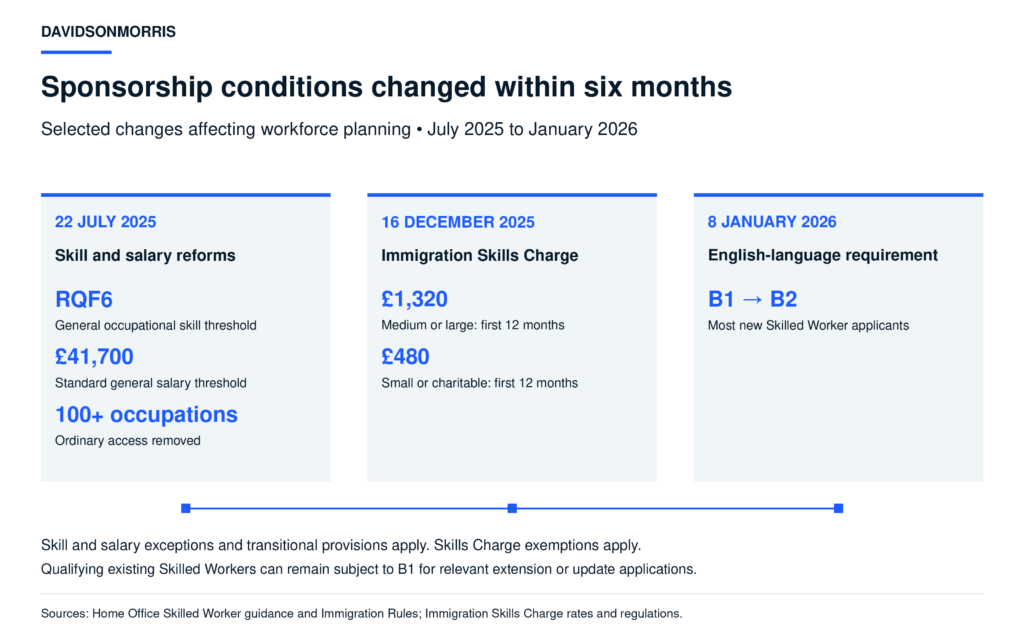
Since 22 July 2025, jobs sponsored under the Skilled Worker route have normally needed to be skilled to RQF level 6 or above, unless a specific exception or transitional provision applies. The usual general salary threshold is £41,700, subject to the applicable going rate and the various exceptions within the route. The July 2025 reforms also removed ordinary Skilled Worker access from more than 100 occupations.[1, 2, 3]
Further changes followed within months. The Immigration Skills Charge increased by 32% for Certificates of Sponsorship assigned from 16 December 2025. Where the Immigration Skills Charge is payable, medium and large sponsors now pay £1,320 for the first 12 months of sponsorship, while the corresponding charge for small or charitable sponsors is £480.[4, 5]
From 8 January 2026, most new Skilled Worker applicants also became subject to a B2 rather than B1 English-language requirement. Applicants who held Skilled Worker permission before that date and fall within the relevant extension or update provisions can continue to be subject to the B1 standard.[6, 2]
Employers already have to account for those measures in their workforce plans. Other parts of the immigration system remain less settled.
The interim Temporary Shortage List is time-limited. Under the current Rules, an occupation qualifies through that list only where the relevant application uses a Certificate of Sponsorship issued before 31 December 2026. Most occupations on the Immigration Salary List have the same removal date.[2, 7]
Care workers and senior care workers sit under separate transitional arrangements. Their eligibility is restricted and the current Immigration Salary List gives those occupations a removal date of 22 July 2028.[7, 2]
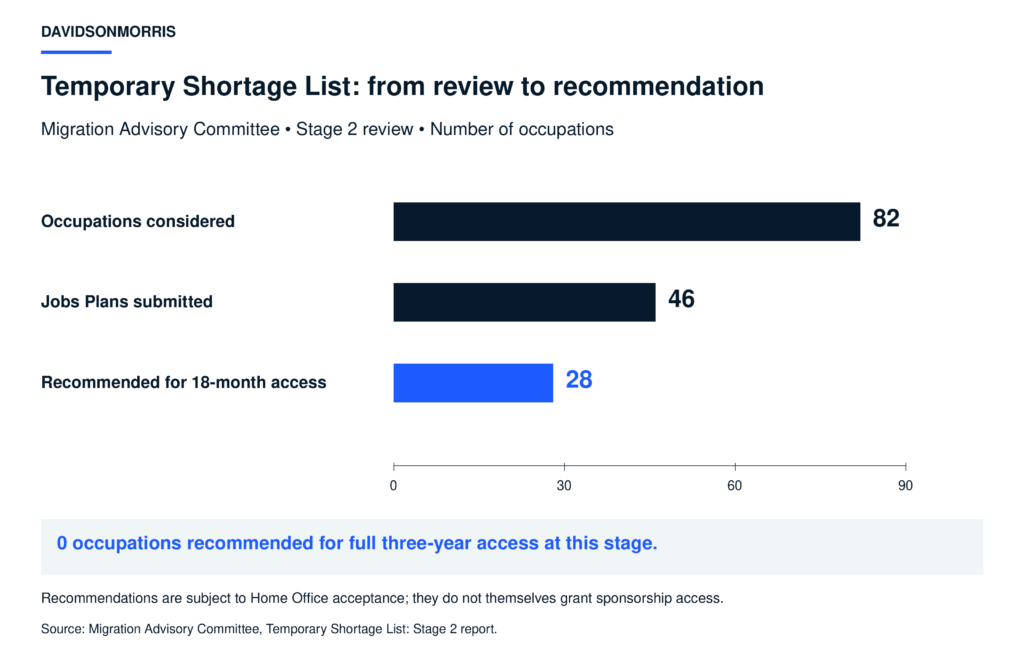
What follows the interim lists is still being determined. The Migration Advisory Committee has recommended 28 occupations for 18 months of Temporary Shortage List access. If the Home Office accepts those recommendations, the MAC expects access to run from January 2027 until the end of June 2028. No occupation was recommended for full three-year access at this stage.[8]
Settlement carries a different type of uncertainty. The government’s closed earned-settlement consultation proposed a ten-year baseline qualifying period for most migrants, capable of adjustment according to specified characteristics. It also consulted specifically on increasing the qualifying period to 15 years for Skilled Workers who have worked in occupations below RQF level 6.[9]
Those proposals have not replaced the existing Skilled Worker settlement framework. As at 24 October 2026, Appendix Skilled Worker continues to require a five-year continuous qualifying period for settlement. The Statement of Changes published on 3 September 2026 did not introduce the proposed wholesale earned-settlement model.[2, 10]
A workforce plan therefore needs to distinguish between rules already in force, time-limited provisions, formal recommendations and policy proposals that may never be implemented in their current form. At the same time, unresolved policy cannot become a reason to postpone planning where the business already knows that replacement skills would take years to develop.
Section B: Sponsored work migration has already contracted
Recent immigration data show a substantial fall in sponsored work migration.
In the year ending June 2026, 234,841 work visas were granted across all work categories, including dependants. That was 62% below the peak reached in the year ending December 2023. Grants across the longer-term sponsored Worker routes also remained well below their peak levels.[3]
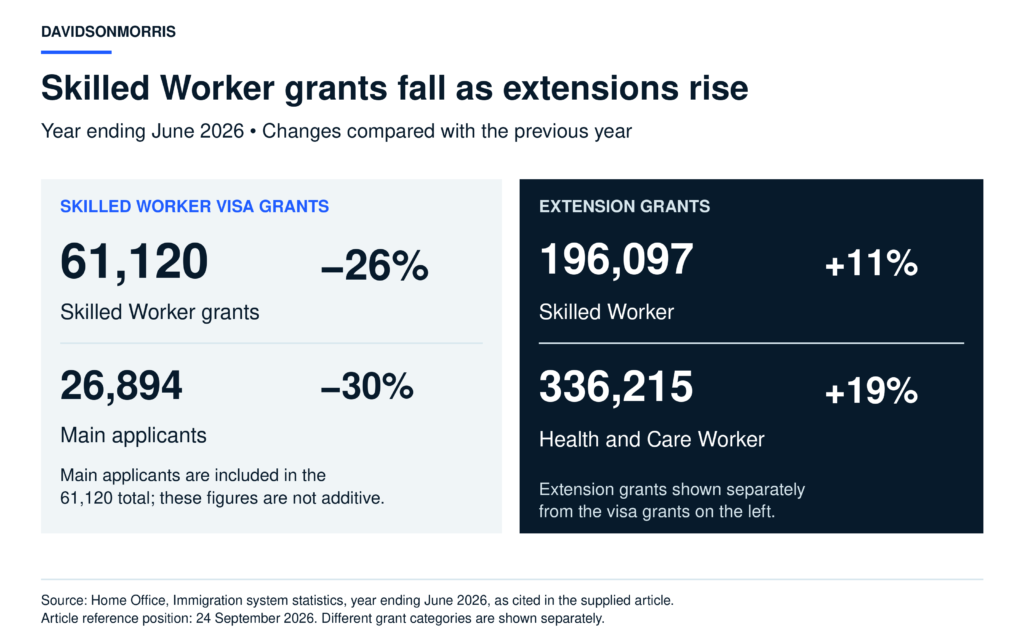
Skilled Worker grants fell by 26% year on year to 61,120. Grants to main applicants were down 30% at 26,894. Home Office analysis attributes much of the recent decline to policy changes affecting which occupations can be sponsored.[3]
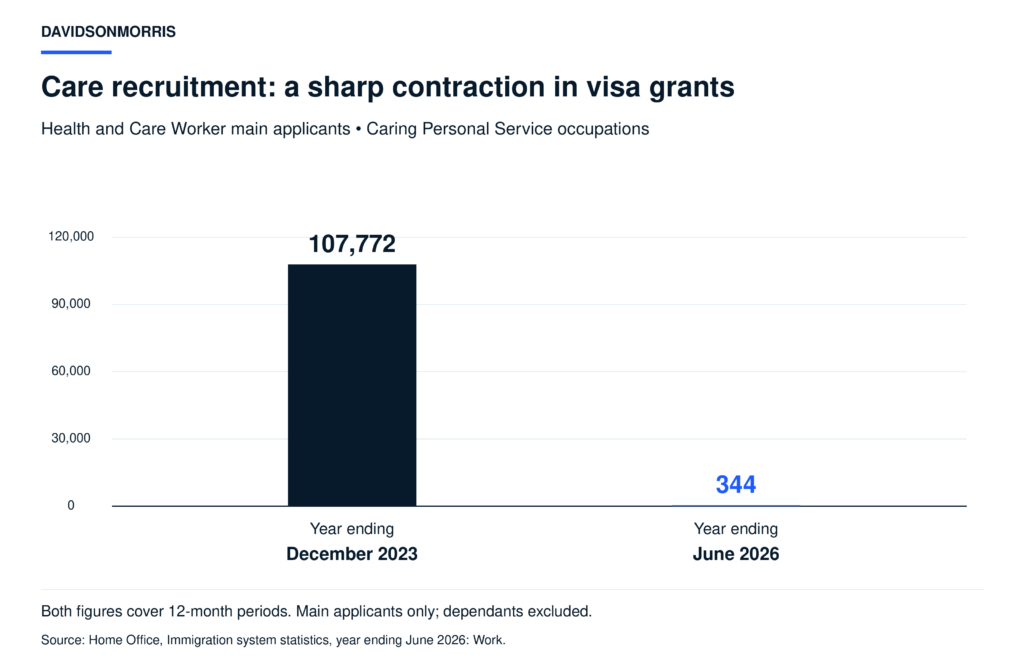
Social care shows the scale of adjustment that can occur when an established recruitment channel is closed. Health and Care Worker visas issued to main applicants in Caring Personal Service occupations fell from 107,772 in the year ending December 2023 to just 344 in the year ending June 2026 following the closure of overseas recruitment for care workers and senior care workers.[3]
Other sectors should not assume that they will face an intervention of the same scale. A business relying on continued access to a particular immigration route could nevertheless lose that recruitment option while still needing the same number of workers.
Whether an occupation can be sponsored today is therefore only part of the planning question. Businesses also need to consider what happens to operating capacity if the same recruitment channel becomes more expensive, contracts materially or closes before another source of skills is capable of replacing it.
Section C: A softer labour market does not remove skills risk
Falling vacancy numbers might suggest that employers will find it easier to recruit alternatives in the UK.
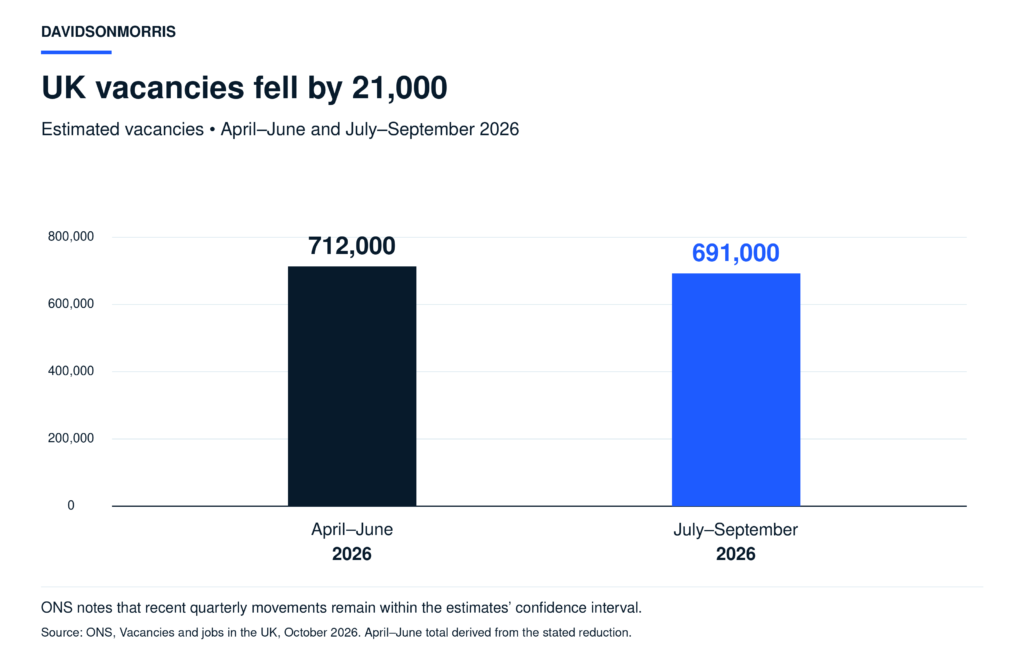
The Office for National Statistics estimated 691,000 UK vacancies in July to September 2026, down 21,000 from April to June 2026. Vacancy levels are materially below their post-pandemic peak and have fallen to levels last seen during the pandemic period, although the ONS also notes that recent quarterly movements remain within the confidence interval around its estimates.[11]
National labour-market figures reveal little about whether an employer can recruit someone with the required skill, in the right location, at an affordable salary and in time to meet its needs.
Shortages are occupational, geographic and sector-specific. The MAC’s work on the Temporary Shortage List illustrates the point. Its initial review identified 82 RQF 3 to 5 occupations considered potentially important to the Industrial Strategy or critical infrastructure. Jobs Plans were ultimately submitted for 46 of those occupations and the MAC recommended 28 for provisional 18-month access.[8]
The recommendations cover occupations connected with Advanced Manufacturing, Clean Energy, Digital and Technology and Foundational Industries/Critical Infrastructure. The evidence of shortage was far from uniform. Some occupations had relatively strong current shortage indicators. Elsewhere, the case depended more heavily on expected future demand, local or sector-specific recruitment problems, ageing workforces or lengthy training periods.
Workforce plans need that detail. Employers need people with particular skills, in particular locations, at viable salary levels and often within a limited timeframe. Even when recruitment conditions ease nationally, a business may still struggle to fill roles on which its operations depend.
Section D: Sponsored headcount does not show workforce exposure
Most employers with established sponsorship programmes already know how many sponsored workers they employ. That figure is useful for immigration compliance and administration, but it says relatively little about the business’s underlying workforce exposure.
One organisation might employ 500 sponsored workers in roles for which replacements can be recruited or trained reasonably quickly. Another might employ only 30 sponsored specialists in functions where it takes two years to recruit or train people to do the same work.
Headcount alone would suggest that the first organisation has greater immigration exposure. Operationally, the second may be far more vulnerable.
Assessing immigration dependency at role level gives the business a clearer picture.
For each significant occupation or workforce segment, the organisation needs to assess how much it relies on international recruitment and how realistically it could obtain the skills elsewhere.
Roles with limited sponsorship dependence and readily available alternatives generally create relatively little immediate exposure. Low overall dependence can still conceal concentration risk, however, where a small number of internationally recruited employees hold specialist skills that are difficult to replace.
High sponsorship dependence presents a different problem where alternatives exist but cannot be deployed immediately. Domestic recruitment, training, automation, outsourcing, job redesign or relocation may all provide substitutes, but each carries its own cost and lead time.
Roles that depend heavily on international recruitment and have few realistic alternatives create the greatest exposure. Restrictions affecting those occupations can quickly reduce the business’s ability to deliver its work.
That assessment considers the business’s longer-term needs alongside the role’s current eligibility under the Skilled Worker requirements.
Section E: Stress-test the workforce plan rather than forecasting immigration policy
Trying to predict the content of the next Statement of Changes is unlikely to produce a reliable workforce strategy. Scenario testing helps employers assess whether the business could continue to operate under several plausible immigration outcomes.
One scenario could assume continuity, with international recruitment remaining available for the occupation broadly within the existing framework, although costs and qualifying conditions may continue to change.
A second could model constraint, where sponsorship remains available but covers fewer occupations or carries higher costs and tighter salary, skill or other requirements.
A third could test loss of access, where a material occupation or recruitment channel is no longer available for new overseas hiring.
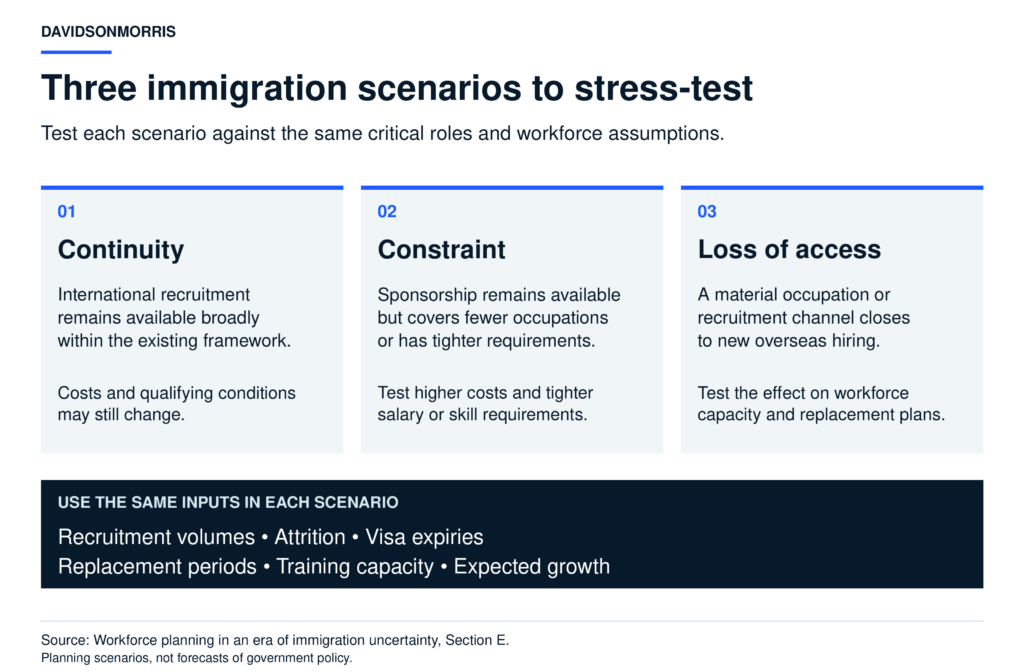
The modelling exercise should focus on how each scenario would affect the people and skills available to the business, whatever legal change might bring it about.
For each critical role, an organisation can test recruitment volumes, attrition, visa expiries, replacement periods, training capacity and expected growth against all three scenarios. Testing the same assumptions against different scenarios can reveal weaknesses that a single forecast would miss.
A five-year headcount plan might, for example, assume that the business will continue internationally recruiting 100 technicians each year. Current rules may allow that recruitment. If those occupations later lose access to sponsorship, however, an apprenticeship programme launched only after the rule change could take several years to deliver comparable capacity.
The plan needs to account for the gap between international recruitment stopping and replacement workers becoming productive.
The model also needs to include cost. Sponsorship is already more expensive than it was a year ago following the increase in the Immigration Skills Charge, while higher salary thresholds have changed the economics of sponsoring some roles.
Different occupations may therefore justify different responses. Continuing to sponsor at higher cost may remain commercially sensible for some specialist positions. For other roles, investment in job redesign, automation, relocation, accelerated training or a different sourcing model may be more viable.
Applying the same response to every internationally recruited role could divert investment from the positions that would be hardest to replace.
Section F: Retention becomes part of workforce resilience
Employers also need to plan for retaining their existing workforce.
A substantial sponsored workforce is already established in the UK. In the year ending June 2026, Skilled Worker extension grants increased by 11% to 196,097, while Health and Care Worker extension grants rose by 19% to 336,215. The Home Office attributes those high extension volumes in part to workers who originally entered during the high-volume recruitment years of 2022 and 2023. These totals include main applicants and dependants and can include people changing immigration category within the UK; they are not counts of existing sponsored employees renewing with the same employer.[3, 12]
Existing sponsored employees may be able to meet needs that would be difficult to fill through new overseas recruitment.
Where recruiting a replacement from overseas is becoming more difficult or expensive, retaining a trained, productive employee who knows the organisation may be worth more to the business than its previous recruitment assumptions allowed for.
Workforce planners therefore need to account for visa expiry dates, extension eligibility, settlement timing and the rate at which sponsored workers leave the organisation, alongside the immigration or global mobility teams managing those matters.
The risk is greater where several employees’ visas expire around the same time and they work in roles that take a long time to fill and rely heavily on international recruitment.
Settlement uncertainty can also influence retention before any proposed reform enters the Rules. Internationally mobile employees make career, family and location decisions over several years. A substantial change in their expected route to permanent residence could affect those decisions even where the employer’s formal ability to continue sponsoring them remains unchanged.
Employers cannot remove that policy uncertainty, but they can identify the parts of their workforce where its effect would be most disruptive.
Section G: Time-to-substitute may be the most useful metric
Workforce plans can overstate how readily the business could replace international recruits with workers or skills from another source.
Finding or developing those alternatives can take considerable time. Domestic recruitment may require different pay or location strategies. Apprenticeship and training programmes can take years before employees become fully productive. Automation requires investment and implementation time. Outsourcing changes the organisation’s operational and compliance profile, while offshoring can affect organisational design, data controls and customer delivery.
The MAC’s Temporary Shortage List work considers similar questions about how sectors can develop the skills they need.
Jobs Plans were submitted for 46 of the 82 occupations considered at Stage 2. The MAC recommended 28 occupations for 18-month access, but concluded that none had a sufficiently strong Jobs Plan to justify full three-year access. Before that provisional period expires, the Committee proposes reviewing whether the relevant plans have improved sufficiently to support continued access.[8]
For some middle-skilled occupations, continued access to migration is therefore becoming more closely connected with evidence that sectors are developing the domestic workforce, expanding training, addressing the causes of shortages and managing exploitation risk.
Employers can use time-to-substitute to measure how long it would take to replace the skills they currently obtain through international recruitment.
For each critical occupation, the measure is the time the organisation would need to create equivalent capacity elsewhere if international recruitment stopped tomorrow.
A replacement period of weeks can usually be managed through ordinary workforce arrangements. Where replacement takes years, the business needs to consider investment and recruitment decisions much earlier.
Section H: Workforce planning needs immigration triggers
Scenario modelling should help the business decide when to act.
Employers with material reliance on sponsorship can identify the indicators that would cause them to act before a policy restriction takes effect. Depending on the business, those indicators might include increasing dependence on one immigration route, rising attrition among sponsored workers, narrowing salary headroom, occupations moving onto or off shortage lists, longer domestic recruitment times, concentrations of approaching visa expiries or evidence that training programmes will not produce capacity quickly enough.
The workforce plan can then specify when those indicators should prompt a review or decision.
That gives the business a clearer basis for assessing investment. If loss of sponsorship access to one occupation would leave a two-year capacity deficit, investment in training can be considered against the cost and consequences of that gap. The same approach can be applied to automation, retention incentives, location strategy and alternative sourcing.
The business can then account for immigration policy changes when planning its workforce and investment.
Section I: The objective is resilience, not certainty
Government policy increasingly connects immigration access with skills policy, domestic workforce development and economic contribution. The 2025 immigration white paper expressly linked the immigration, skills and visa systems with growing the domestic workforce and reducing reliance on overseas labour. The Temporary Shortage List process is one practical expression of that policy.[13, 8]
The future rules remain uncertain, and employers should plan for further change.
Organisations that need years to recruit or train replacements have reason to begin planning while policy remains unsettled. Once a future restriction is confirmed, the period available before implementation may be far shorter than the time needed to train, recruit or redesign the affected workforce.
Employers need to identify where business performance depends on continued access to international recruitment and test what would happen if that access changed.
That requires data for each role: which occupations depend on immigration, how long it would take to develop alternative capacity, which existing sponsored employees would be particularly difficult to replace, how much additional sponsorship cost the organisation could absorb and when investment in training, retention, automation, redesign or alternative sourcing would need to begin.
Workforce plans need to account for immigration uncertainty over the full period in which recruitment, training and investment decisions will take effect.
Where a plan depends on immigration rules remaining unchanged, the business should test whether it could still meet its staffing needs if those assumptions no longer held.
Section J: Sources
Article text reviewed for the regulatory and statistical position as at 24 October 2026. Immigration Rules and policy can change. Organisations should verify the position applicable when making a workforce or sponsorship decision.