

Rethinking the Economics of Recruitment
Recruitment decisions taken before the end of 2026 will help determine how quickly businesses can expand, introduce new services and develop the skills they need in the UK next year. Employers have choices about where to recruit, which skills to bring into the organisation and how to combine experienced appointments with people who can develop into larger roles. Making those choices early gives the business more control over its investment and delivery timetable.
Immigration rules influence the options. They affect the roles available for sponsored recruitment, the employment terms required and the period over which a particular staffing arrangement can support the business. For an overseas company entering the UK, they also influence how the initial management and specialist team can be deployed.
There is already enough confirmed information to make substantial decisions for 2027. Employers can use that information to compare recruitment options against their business plans and decide which commitments they can support. Where policy remains unresolved, they need to identify the specific recruitment or investment decision affected.
Section A: Establish the recruitment assumptions behind the growth plan
A recruitment budget should explain what the people being hired will enable the business to do. A new regional operation might require people who can win customers, others who can deliver the service and a smaller number with the technical knowledge needed to make the whole operation productive. Those roles may call for different recruitment approaches even when they are covered by the same headcount approval.
Planning for 2027 should start with the business commitments that require additional people. Management can then establish which appointments need established expertise, which require knowledge of the organisation and which could be filled by someone developing their skills. Employers can then decide which roles are best filled through international recruitment, local hiring or internal deployment.
The current Skilled Worker framework normally requires a role at degree level, subject to specified exceptions and transitional provisions. The usual salary requirement is at least £41,700 or the occupation’s going rate, whichever is higher. Different requirements apply in qualifying cases. The skill threshold concerns the job, rather than a universal requirement for applicants to hold a degree.[1]
Those requirements may leave some roles in a proposed team easier to recruit for than others. A business recruiting highly paid professional specialists may have considerable scope to proceed. An operation built around technical or operational occupations needs a closer assessment of the available recruitment channels. Raising the budget alone will not establish occupational eligibility.
The initial assessment should identify which appointments have a realistic recruitment plan and which still need work on sourcing, terms or timing. Finance and operational leaders can use that information to allocate investment. They can approve recruitment where the evidence supports it while resolving the gaps elsewhere in the plan.
Section B: Decide which capabilities to recruit internationally
International recruitment can bring scarce expertise, experience of another market or knowledge of a particular technology. Within a multinational group, an internal deployment can also bring familiarity with systems, products and management expectations. The value of the appointment depends on what the person helps the wider organisation achieve.
Decisions about sponsoring particular grades should take that contribution into account. One experienced specialist might train a team, establish a new service or make equipment productive. In another function, spending the same amount on international recruitment might offer little advantage over a well-planned UK search.
Employers should therefore compare the contribution expected from each recruitment channel. Evidence can include recent searches for comparable positions, the availability of candidates in the relevant location, salary expectations and the time new employees need to become effective. A national vacancy figure cannot establish those conditions for a particular business.
Technical and operational recruitment needs particular attention before 2027 commitments are finalised. Under the current Temporary Shortage List provision, eligibility depends on using a Certificate of Sponsorship issued before 31 December 2026. Many Immigration Salary List entries have the same removal date, although occupation-specific provisions differ.[2][3]
The Migration Advisory Committee’s July 2026 report recommended 28 occupations for 18 months of Temporary Shortage List access. A recommendation does not amend the Immigration Rules. Any plan relying on access beyond the current provisions needs an identified legal basis when the recruitment proceeds.[4]
Employers need to establish whether they can complete eligible recruitment under the existing provisions and identify any plans that depend on the same channel remaining open throughout 2027. Any acceleration needs to be supported by a real vacancy, an eligible candidate and compliant timing. The relevant deadline may concern the sponsorship certificate rather than the employee’s first day at work.
The business might proceed with an available specialist appointment, fund a UK search for another position and defer a later hiring decision until occupational access is confirmed. Each decision should reflect the role’s contribution and the evidence available.
Section C: Test the economics of the proposed workforce
The budget needs to cover the full cost of recruiting and employing the proposed team. It includes the pay needed to attract suitable people, any changes to established salary relationships, recruitment and relocation expenditure, management time and the cost of bringing the team into productive work.
Some proposed packages also need revision before they can support sponsorship. The Skilled Worker salary calculation excludes several elements that employers may regard as part of remuneration, including bonuses, overtime pay and accommodation allowances. A commercially attractive package can therefore require a different basic-pay structure.[2]
Salary changes can also affect the existing team. Increasing the salary of a new recruit may affect the expectations of experienced colleagues or narrow the gap between technical and supervisory grades. Finance needs to understand those effects when assessing the cost of the appointment.
Immigration expenditure also has a cash-flow profile. Where the Immigration Skills Charge applies, the current rate for medium or large sponsors is £1,320 for the first year and £660 for each additional six months. Small or charitable sponsors pay £480 and £240 respectively. The charge is paid upfront for the sponsorship period, and exemptions can apply.[5]
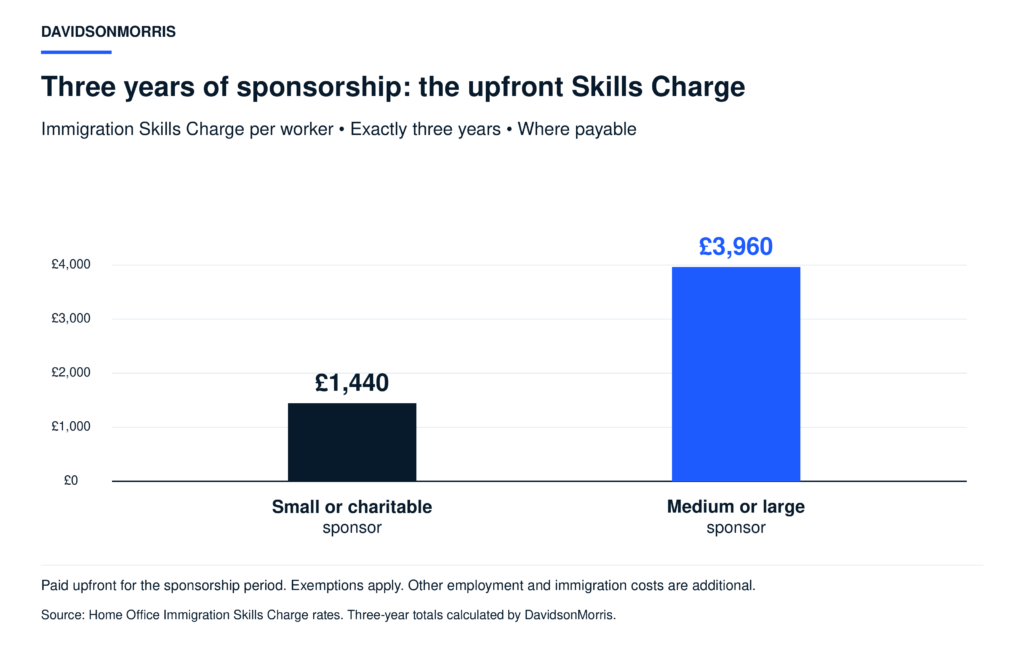
Employers should compare those costs with the work the proposed team is expected to deliver. A more expensive appointment may be justified if it lets the team become productive sooner or allows other employees to perform higher-value work. A lower initial recruitment bill may prove less attractive once training costs and the time needed to reach full output are taken into account.
The same approach applies to early-career hiring. Graduate permission offers access to international graduates without immediate employer sponsorship for most jobs. For non-doctoral applicants applying from 1 January 2027, permission lasts 18 months, compared with two years for applications made by 31 December 2026. Doctoral graduates retain three years. Graduate permission cannot be extended.[6]
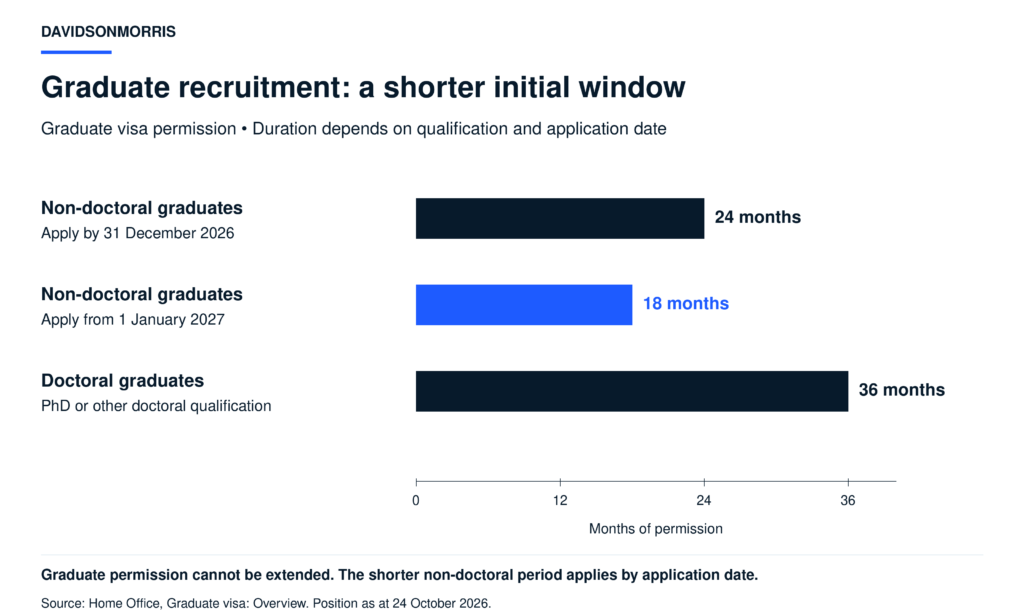
Employers recruiting into development programmes should assess the expected progression of the role and pay alongside that timetable. A successful initial appointment can still require a later immigration decision before the employee has completed the planned programme. Where a qualifying new-entrant salary provision is available, its duration also needs to be reflected in the budget. The four-year limit includes permission as a Graduate, Skilled Worker or Tier 2 migrant, whether continuous or not, so it is not four additional years after the Graduate route.[7]
Accounting for those costs and timescales helps the business compare recruiting established expertise with developing it internally. The comparison should account for supervision, progression and future employment costs across the period in which the business expects to benefit.
Section D: Let talent availability inform location and expansion choices
A business establishing or enlarging a UK operation needs to assess whether it can recruit the proposed team before fixing a location and launch date. Property, customer proximity and operating costs may favour one site, while the proposed workforce could be easier to assemble elsewhere.
A lower premises cost needs to be assessed alongside the pay, relocation support and recruitment effort required to staff the location. These are company-specific comparisons. They require evidence about the relevant occupations and catchment area, including the willingness of candidates and existing employees to work there.
The business also needs to decide how to appoint its initial leadership team. An overseas entrant may want group employees to establish systems and transfer knowledge, while building a permanent UK team through local recruitment. Another business may need a long-term UK leadership appointment from the outset.
The available immigration arrangements serve different purposes. UK Expansion Worker permission is designed for eligible senior managers or specialist employees establishing a UK presence for an overseas business that has not yet started trading here. The route allows an initial period of up to 12 months, with an extension taking the maximum to two years, subject to the applicable conditions and limits on previous stays under this and related routes.[8]
For an established UK operation, eligible group assignments may be possible through the Senior or Specialist Worker route. That route does not itself lead to settlement. Skilled Worker sponsorship may be relevant for qualifying longer-term employment, but each option requires its own eligibility assessment.[9][2]
The commercial choice should take account of the work required, the expected assignment period and the employee’s objectives. The business also needs to plan for what follows the establishment phase, including which responsibilities will transfer to a UK team and which positions will remain permanent.
The time needed to assemble the team can influence how quickly the business invests. A smaller initial operation may let a company validate demand while recruiting a permanent team. A larger launch may be justified where the necessary appointments and deployments are sufficiently advanced. The business needs evidence that it can staff the operation at the scale proposed.
Section E: Compare recruitment options against the same business objective
Management needs enough information to compare the alternatives on equal terms. Different proposals should be assessed against the same required output, service standard and delivery period. Otherwise, apparent savings may simply reflect a smaller team or a later start.
Consider an illustrative business requiring six experienced specialists for a new UK service. It could recruit all six internationally, combine two sponsored appointments with four UK hires who do not require sponsorship, or phase the mixed team as customer demand develops.
The following figures are hypothetical, apart from the published Immigration Skills Charge rate. Assume each position carries a £55,000 annual basic salary, each sponsored appointment covers exactly three years, the employer is a medium or large sponsor and no charge exemption applies. Occupational eligibility and salary compliance are assumed to have been separately confirmed; £55,000 is not a universal qualifying salary.
| Recruitment option | Illustrative salary commitment | Immigration Skills Charge | Commercial issue to resolve |
|---|---|---|---|
| Six sponsored appointments, all starting in January | £330,000 in first-year basic salaries | £23,760 upfront | Whether the proposed recruitment can deliver the required team and launch date. |
| Two sponsored appointments and four UK hires requiring no sponsorship, all starting in January | £330,000 in first-year basic salaries | £7,920 upfront | Whether the UK candidate pool supports the same timetable and capability. |
| The same mixed team, with three starting in January and three in July | £247,500 in calendar-year basic salaries | £7,920 across the two sponsored appointments | Whether reduced first-year capacity matches customer demand. |
The charge calculations are six or two workers multiplied by £3,960 for three years. The phased salary calculation assumes three employees receive a full year’s salary and three receive six months. All six roles retain the same annual salary once filled.[5]
The table deliberately separates a three-year immigration commitment from first-year pay. It excludes employer National Insurance, pensions, recruitment fees, sponsorship certificate fees, licence expenditure, relocation and any visa or health-surcharge costs the employer agrees to meet. It is a comparison of selected costs, not a total employment budget.
The £15,840 charge difference between the first two options establishes one part of the decision. It does not prove that the mixed team offers better value. A longer UK search, higher agency fees or a delayed service launch could outweigh that difference. The phased option reduces first-year salary expenditure by £82,500, but also provides fewer months of work.
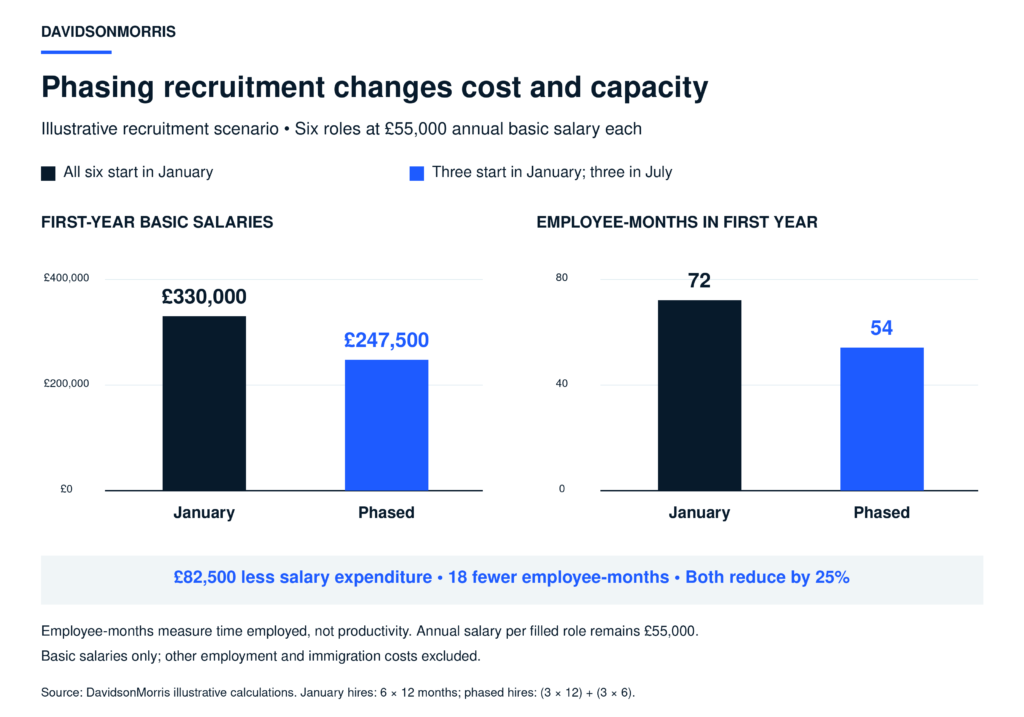
The decision needs evidence about candidate availability, realistic appointment dates, expected productivity and the revenue or service capacity each option would support. Recruitment and finance teams should agree those assumptions before management selects an approach.
The comparison may also show how different appointments could support one another. Two internationally recruited specialists might provide the expertise needed for four other employees to become effective more quickly. The investment case would then need to explain how the specialists would pass on their knowledge and whether they would have enough time to supervise the other employees.
Section F: Commit where the evidence supports action
A 2027 recruitment proposal should give management a clear choice. It should explain what the proposed employees would enable the business to do, how they could be recruited, the full financial commitment and the work they would be expected to deliver.
Where roles, employment terms and recruitment arrangements have been assessed against current requirements, employers can proceed with the relevant budget and preparation. Where a planned appointment depends on an unresolved occupational rule, the proposal should identify the vacancy and investment commitment affected. It need not hold up unrelated hiring.
Early preparation can give the business more recruitment options. Testing a UK candidate market, establishing whether a group employee is suitable for an assignment or confirming the sponsorship basis for a priority role gives management information it can use before making a larger commitment.
For an existing employer, the resulting decision might be to recruit a small number of specialists internationally while expanding a UK development programme. For an overseas entrant, it could be to deploy an establishment team and release further investment once there is a realistic plan for recruiting the operational team. Both approaches require HR, finance and business leaders to agree who is responsible for the decisions and their implementation.
Planning now gives the business time to adjust how it recruits, how much it spends and the scale and timing of its plans. Leadership can then decide how much growth to commit to in 2027 with a clearer view of the people needed to deliver it.
Source References / Legal Sources
| Source | Official URL |
|---|---|
| 1 Home Office, Workers and Temporary Workers: sponsor a skilled worker (accessible), version 04/26. SK4: occupational skill level; SK5–6: salary requirements. | https://www.gov.uk/government/publications/sponsor-a-skilled-worker/workers-and-temporary-workers-sponsor-a-skilled-worker-accessible |
| 2 Home Office, Immigration Rules Appendix Skilled Worker. SW 5–6: sponsorship and occupational eligibility, including SW 6.1A on the Temporary Shortage List; SW 12.3: aggregate new-entrant duration limit; SW 14: salary calculation. Rules accessed 24 October 2026. | https://www.gov.uk/guidance/immigration-rules/immigration-rules-appendix-skilled-worker |
| 3 Home Office, Immigration Rules Appendix Immigration Salary List. Occupational and geographical restrictions and removal dates. Accessed 24 October 2026. | https://www.gov.uk/guidance/immigration-rules/immigration-rules-appendix-immigration-salary-list |
| 4 Migration Advisory Committee, Temporary Shortage List: Stage 2 report, published 23 July 2026. Committee foreword and recommendations concerning provisional occupational access. | https://www.gov.uk/government/publications/temporary-shortage-list-stage-2-report/temporary-shortage-list-stage-2-report-accessible |
| 5 Home Office, UK visa sponsorship for employers: Immigration skills charge. Rates, exemptions and payment timing. The article’s illustrative calculations apply the published medium or large sponsor rate. | https://www.gov.uk/uk-visa-sponsorship-employers/immigration-skills-charge |
| 6 Home Office, Graduate visa: Overview. Duration by application date, doctoral exception, permitted work and inability to extend Graduate permission. | https://www.gov.uk/graduate-visa |
| 7 Home Office, Skilled Worker visa: When you can be paid less. Qualifying salary provisions, including new-entrant conditions and duration limits. | https://www.gov.uk/skilled-worker-visa/when-you-can-be-paid-less |
| 8 Home Office, UK Expansion Worker visa (Global Business Mobility): Overview. Purpose, applicant profile and maximum route duration. | https://www.gov.uk/uk-expansion-worker-visa |
| 9 Home Office, Senior or Specialist Worker visa (Global Business Mobility): Overview. Group assignments and settlement restriction. | https://www.gov.uk/senior-specialist-worker-visa |
Regulatory position checked as at 24 October 2026. Figures in the recruitment comparison are illustrative assumptions and calculations, rather than observed employer or labour-market data.