


Right to Work compliance has moved on
Right to Work compliance has traditionally centred on the prescribed check. Employers seeking to establish a statutory excuse against a civil penalty must carry out the appropriate check before employment starts, confirm that the individual is permitted to undertake the work in question, retain the required evidence and complete any necessary follow-up where the statutory excuse is time-limited. [1]
Those requirements remain central to the regime. What the latest Home Office research adds is a view of how control can weaken once work moves beyond the initial verification stage.
Published on 1 October 2026, Worker and Employer Perspectives of Illegal Working examines two groups: platform-based workers and businesses operating in sectors perceived by the Home Office research team as vulnerable to illegal working. The study comprised 24 depth interviews with platform workers, 19 interviews with businesses, two interviews with legal firms and one interview with a professional representative body. The business sample included 11 construction businesses, six beauty businesses and two car washes. [2]
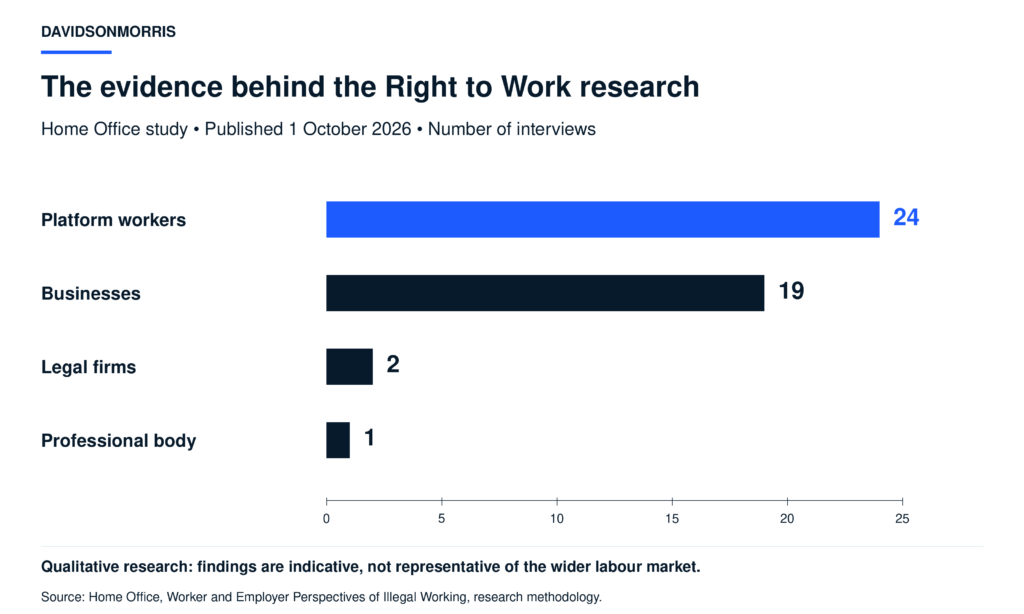
The Home Office is explicit about the limits of the evidence. The study is qualitative and the findings are indicative rather than representative of the wider labour market. Platform workers’ immigration status was based on their own account, and the researchers could not determine lawful or unlawful working with complete confidence in every case. [2]
The report therefore says nothing definitive about the prevalence of account sharing, identity substitution or weak Right to Work controls across the UK economy. It does, however, provide useful evidence of how a compliant checking process can become detached from what happens later in practice.
Account sharing is the clearest example. Fewer than half of the 24 platform workers interviewed reported using or sharing another person’s account to obtain work. The practice was considerably more common among those who believed they were not authorised to work in the UK. Friends, relatives, roommates and wider community networks were among the routes through which shared accounts were arranged. [3]
Controls varied between platforms. Workers described profile-photo checks and facial-recognition measures during work. Some reported that repeated facial-recognition checks had prevented them from using a shared account on particular occasions. None of the platform workers with their own accounts recalled being asked to re-upload or re-verify the documents submitted at registration, although some were subject to other forms of identity verification while working. [3]
The significance for employers is practical. A person may pass a check correctly and have valid permission to work, yet a later failure can still arise if another individual gains access to the work.
The legal context changed on the same day the research was published.
Section 48 of the Border Security, Asylum and Immigration Act 2025 extends the Right to Work Scheme beyond conventional contracts of employment to specified wider working arrangements. These include individuals engaged under worker’s contracts, individual subcontractors and certain arrangements involving online matching services. The provision came into force on 1 October 2026. [4][12]
The new regime also introduces extended civil-penalty liability in defined contractual arrangements, including certain contractual chains and arrangements permitting substitution. [4]
The commencement provisions require careful treatment. For employment under a worker’s contract, engagement as an individual subcontractor and relevant online matching arrangements, liability under the expanded scheme applies where the employment began on or after 1 October 2026. For extended liability under section 15A of the Immigration, Asylum and Nationality Act 2006, the prescribed contractual requirements apply to relevant arrangements entered into on or after that date. Existing arrangements are not brought within scope simply because the work continues beyond 1 October. [5]
The research itself predates the new regime. Platform-worker interviews ran from December 2025 to mid-February 2026, while business interviews took place in March 2026. Comments in the report about subcontracting and checking obligations therefore reflect the earlier legal framework, not the position now in force. [2]
Taken together, the research and the new regime put more emphasis on whether the identity verified at the start of an engagement remains connected to the person actually carrying out the work.
Verification is not the same as identity continuity
Identity already forms part of a prescribed Right to Work check.
The final Home Office Employer’s Guide requires employers to take reasonable and proportionate steps, at the time of the check, to verify the worker’s identity and ensure that the individual being checked is the person to whom the evidence relates. For an online check, for example, the employer must ensure that the photograph on the Home Office output is of the individual concerned and that the employment offered is consistent with any applicable restrictions. [1]
The difficulty arises later. Point-in-time verification does not, by itself, guarantee that the same individual will remain connected to the work throughout the engagement.
That is the issue captured here by identity continuity: the ability to maintain a reliable connection between the identity whose Right to Work was checked and the person actually carrying out the work.
The platform research shows how that connection can weaken. Some participants reported working through accounts established in another person’s name. Almost all of the participants who believed they were unauthorised to work and who were account sharing used an account belonging to another platform worker who was authorised to work. Others reported continuing to use accounts created when they previously had permission. [3]
In practical terms, the original verification may be sound while the later activity is not. The failure sits between the two.
The new extended-liability framework now addresses that issue directly in certain arrangements. Where the relevant provisions apply, a person contracted to provide work or services, an online matching service or an employer operating a contractual substitution clause must have proportionate systems and processes designed to ensure that the person carrying out the work or services is the person on whom the Right to Work check was conducted. [6]
The Home Office gives examples including workplace passes, identity cards, facial-recognition technology, biometric or attendance-management systems, checks against training records, qualifications or licences and identity re-verification at defined intervals. It describes the purpose of re-verification as providing reasonable ongoing assurance that the person carrying out the work remains the person whose Right to Work was checked. [6]
The requirement does not amount to a general duty on every employer to monitor every worker’s identity continuously. It applies within the particular extended-liability and substitution arrangements covered by the regime.
Even so, the regulatory treatment is significant. It gives formal recognition to a control problem that sits beyond the initial check: whether the verified identity remains connected to the work.
Complex workforce models create more points of failure
Complexity is not evidence of non-compliance. It does, however, increase the number of places where responsibility, information and operational control can become separated.
The Home Office business research provides several examples. Construction participants described urgent labour demand, time pressure and complex subcontracting chains as factors capable of weakening checking practices. They reported workers being recruited informally and at short notice, with checks sometimes rushed or delegated to staff with limited knowledge. [7]
Participants also described uncertainty over who owned immigration compliance. Agencies, site managers and administrative staff could all become involved. High turnover, weak handovers and unclear responsibility were seen as creating gaps, particularly where follow-up activity was required. [8]
Organisational capacity varied as well. Micro and smaller businesses were described as having less confidence and less administrative capacity to interpret and operate checking requirements. Larger organisations were more commonly associated with formalised HR processes, training and dedicated compliance capability. [8]
Those findings should not be used to categorise businesses by size or sector as compliant or non-compliant. They come from a small qualitative sample. They are more useful as illustrations of how operational pressure and fragmented responsibility can affect control quality.
A worker may be recruited by one function, checked through another, deployed by an operational manager and paid through a separate process. In a labour-supply chain, several organisations may control different stages of recruitment, engagement and workplace access. Legal responsibility for the Right to Work check or for extended-liability compliance depends on the contractual structure and cannot simply be inferred from which organisation controls the workplace. [5]
The final Home Office guidance takes the same fact-sensitive approach. No single feature determines whether an arrangement falls within scope. Contractual terms need to be considered alongside the way the arrangement operates in practice. [5]
For larger employers, the challenge may be less about the quality of an individual system than the connections between systems.
Recruitment may hold one identity record. HR may hold another set of information. Scheduling, access management and payroll may record operational activity separately. A labour supplier may have contractual responsibility for checks while the end user has limited visibility over how consistently those controls are applied.
Each part of the process can operate reasonably on its own while the organisation still struggles to establish who actually performed the work.
From process compliance to control architecture
The Home Office research also gives a more nuanced picture of how businesses perceive non-compliance.
Participants in the sampled sectors associated it more often with operational pressure, gaps in knowledge and weak processes than with deliberate avoidance. Short-notice recruitment, informal hiring, incomplete awareness of checking requirements and delegation without sufficient expertise were all identified as circumstances in which mistakes or “corner cutting” could occur. Some participants also believed deliberate non-compliance could arise where a business saw a financial advantage. [7]
There are limits to that evidence. All participating businesses described themselves as compliant, so much of their commentary on non-compliance elsewhere reflected perception rather than admission or independently verified fact. [2]
For workforce governance, however, the distinction between policy and execution is useful.
An organisation may have a sound written procedure and still apply it inconsistently. A central Right to Work process may exist while local recruitment bypasses it. Supplier contracts may require checks without anyone testing how those checks operate in practice. Immigration records may be accurate while the business has little visibility over substitution after onboarding.
A more mature control environment therefore looks beyond whether the prescribed check was completed correctly. It also considers whether identity, permission and actual work remain connected where the operating model creates scope for them to diverge.
Comparable logic is already familiar in other areas of corporate governance.
Authentication establishes identity. Authorisation determines what that identity is allowed to do. Auditability allows an organisation to reconstruct what happened.
Right to Work compliance is not cybersecurity or financial control, but the comparison is useful because the underlying control problem is similar. A valid verification event does not necessarily provide continuing assurance over later activity.
Applied to workforce compliance, the relevant components are identity, permission, operational assurance and auditability. Each deals with a separate question: who the individual is, whether they are permitted to undertake the work, whether that person is actually carrying it out and whether the organisation can evidence how the controls operated.
The final element becomes particularly important under the extended-liability regime.
Where extended liability applies, contractual wording alone is not enough. The Home Office may consider how the arrangement worked in practice when deciding whether a statutory excuse has been established. The guidance identifies evidence including audit records, records showing who carried out the work and when, identity-verification measures and records of compliance activity. [9]
In those arrangements, the operation of the control matters as much as its design.
What workforce identity assurance looks like
Workforce identity assurance builds around the prescribed Right to Work check rather than replacing it.
The model has several connected elements: identity assurance, permission verification, work authorisation, continuing control and auditability.
Identity assurance
The prescribed check is the starting point.
The Employer’s Guide requires reasonable and proportionate steps to ensure that the person being checked is the person to whom the evidence relates. [1]
For organisations with a realistic risk of impersonation or substitution, the next issue is whether that identity remains reliably connected to the work after onboarding.
The Home Office guidance recognises this outside the specific mandatory extended-liability provisions. Employers may choose to operate proportionate measures suited to their own operating model to manage impersonation, imposter and fraudulent-identity risks. [10]
Permission verification
Identity establishes who the individual is. It does not establish what they are permitted to do.
The prescribed process must confirm that the individual has permission to undertake the work in question and that the proposed employment complies with any restrictions attached to their immigration status. [1]
For employers, the operational issue is whether the result of that check remains visible to the people and systems making subsequent workforce decisions.
A restriction recorded accurately in one system is of little practical use if those allocating work cannot see it.
Work authorisation
What the individual is actually doing also matters.
Some forms of immigration permission restrict the type of work or the number of hours that may be worked. Working in breach of applicable conditions can amount to illegal working. [1]
Where those restrictions apply, employers need a reliable connection between the immigration record and the work being allocated.
The greater the distance between the two, the greater the possibility that practice will drift away from the original permission.
Continuing control
Legally prescribed follow-up checks and wider internal monitoring should not be conflated.
A repeat Right to Work check is not required merely because an individual moves between ordinary assignments. Where the worker remains engaged by the same employer, the final guidance confirms that a new check is not required before each intermittent assignment provided the employer holds the relevant statutory excuse and completes any legally required follow-up. Additional monitoring may be carried out for internal compliance purposes, but it is separate from the prescribed checking requirements. [11]
The extended-liability identity provisions operate differently. Where they apply, the guidance envisages proportionate identity controls capable of giving continuing assurance over who is actually performing the work. [6]
The distinction is important. Some checks are legally required. Some identity controls arise only in specific extended-liability arrangements. Others are additional measures an organisation may choose because its workforce model creates a particular exposure.
Auditability
Effective controls should produce evidence.
Under the extended-liability arrangements, the Home Office identifies records of Right to Work checks, authorised substitutions, the identity of the person who carried out the work, periods worked, identity-verification measures and compliance or audit activity as potentially relevant evidence when establishing a statutory excuse. [9]
For employers with complex workforce models, auditability goes further than retaining evidence of the initial check. The organisation needs to be able to establish who was checked, who performed the work, what permission applied and what happened between those points.
Where that information sits across several systems or organisations, the strength of the assurance depends on whether those records can be brought together reliably.
Where control exposure is most likely to sit
Flexible, outsourced and decentralised workforce models should not be treated as inherently high risk. Exposure depends on how the model operates and where responsibility is held.
The Home Office evidence points to several areas that merit closer attention.
Decentralised or informal recruitment can weaken consistency where hiring decisions are taken locally or under time pressure. [7]
High turnover and weak handovers can disrupt ownership of follow-up activity and other compliance responsibilities. [8]
Contractual chains and subcontracting can reduce visibility over who completed checks and who is actually doing the work. Under the post-1 October framework, whether that creates legal responsibility for a particular organisation depends on the contractual arrangement and the statutory tests for direct or extended liability. [5]
Substitution arrangements require particular scrutiny where the new provisions apply. The final guidance requires prescribed Right to Work checks on permitted substitutes and specified substitution and identity controls where the statutory conditions are met. [9]
Account-based work can create a direct identity-continuity problem where the account holder and the individual carrying out the activity diverge. The platform-worker research provides qualitative evidence of that occurring among some of the participants interviewed. [3]
Fragmented workforce systems create a different problem. The necessary information may exist, but not in a form that exposes a disconnect between verified identity, immigration permission and operational activity.
The practical exercise for employers is to trace where identity and work activity could separate within their own operating model.
For one organisation, the weak point may be local recruitment. For another, it may sit within the labour-supply chain. A platform operator may be more exposed to account integrity and substitution. A large multisite business may have rigorous onboarding controls but less visibility once workers move between locations.
Control design needs to reflect those differences.
From Right to Work compliance to workforce assurance
The Home Office research does not demonstrate widespread identity substitution across the UK labour market. It was deliberately qualitative, based on a small number of participants and focused on specific forms of platform work and selected business sectors. The Home Office expressly warns against treating its findings as representative. [2]
What the research does show is how the assumptions surrounding a compliant process can weaken in practice.
Account sharing can separate the verified account holder from the person performing work. Informal recruitment can reduce the consistency of checks. Delegation and poor handovers can obscure ownership. Contractual chains can reduce visibility. [3][7][8]
The legal framework now reaches further into some of those arrangements.
From 1 October 2026, the Right to Work Scheme covers specified forms of work beyond conventional employment and establishes extended liability within defined contractual structures. In parts of that regime, the Home Office now expressly requires identity-verification systems designed to provide assurance that the person carrying out the work is the person whose Right to Work was checked. [4][6]
There is no general requirement for every employer to operate continuous identity monitoring. The change is narrower than that.
What has become harder to ignore is the relationship between identity, permission and actual work activity.
For organisations with complex workforce models, the prescribed check remains the legal foundation. The quality of the wider control environment will increasingly depend on how responsibility is allocated, how substitution is governed, how identity remains connected across systems and whether the organisation can show that its controls operated in practice.
The compliance test still begins with the Right to Work check. In some workforce models, the assurance exercise now extends beyond it.
The more demanding standard is whether the organisation can show that the people carrying out the work are the people whose identity and permission its systems have verified.
That is the basis of a workforce identity-assurance model.
Sources
| Source | Reference |
| [1] Employer’s guide to Right to Work checks | Home Office, final version dated 1 October 2026. Sets out the statutory-excuse framework, identity-verification requirements, work-permission checks, evidence-retention requirements and follow-up checking requirements. |
| [2] Worker and employer perspectives of illegal working | Home Office, published 1 October 2026. Research comprising 24 platform-worker interviews, 19 business interviews, two legal-firm interviews and one professional representative body. The findings are expressly described as indicative rather than representative. |
| [3] Worker and employer perspectives of illegal working | Home Office, chapters 2 and 3. Covers account sharing, informal networks, legacy accounts, profile-image and facial-recognition checks and experiences of identity verification during platform work. |
| [4] Border Security, Asylum and Immigration Act 2025, section 48 | Extends the prohibition on illegal employment to specified wider working arrangements. Section 48 was brought into force on 1 October 2026 by the Border Security, Asylum and Immigration Act 2025 (Commencement No. 4) Regulations 2026. |
| [5] Employer’s guide to Right to Work checks | Home Office, 1 October 2026. Guidance on commencement of the extended scheme, relevant contractual arrangements and the treatment of pre-existing arrangements. |
| [6] Employer’s guide to Right to Work checks | Home Office guidance on identity verification, including proportionate systems and processes within relevant extended-liability arrangements. |
| [7] Worker and employer perspectives of illegal working | Home Office, chapter 5. Covers reported links between potential non-compliance and time pressure, informal recruitment, knowledge gaps, weak processes and complex subcontracting arrangements. |
| [8] Worker and employer perspectives of illegal working | Home Office, chapter 6. Covers compliance capacity, delegation, staff turnover, handovers and responsibility for Right to Work checks. |
| [9] Employer’s guide to Right to Work checks | Home Office guidance on extended liability, including evidence relevant to demonstrating how applicable controls operated in practice. |
| [10] Employer’s guide to Right to Work checks | Home Office guidance on impersonation, imposters and proportionate measures employers may use to manage fraudulent-identity risks. |
| [11] Employer’s guide to Right to Work checks | Home Office, Annex C. Addresses repeat Right to Work checks, intermittent assignments and the distinction between prescribed checking requirements and additional internal monitoring. |
| [12] SI 2026/700 | The Immigration (Restrictions on Employment and Residential Accommodation) (Prescribed Requirements and Codes of Practice) (Amendment) Regulations 2026, made 24 June 2026 and in force from 1 October 2026. The Regulations amend prescribed requirements relating to immigration-status checks, including digital verification provisions, and bring revised codes of practice into force. |