


Sponsor Licence Enforcement Statistics: At a Glance
Home Office sponsor licence enforcement has increased sharply, with Skilled Worker suspensions and revocations rising substantially through 2024, 2025 and the first half of 2026.
Official Home Office sponsorship transparency data records 3,100 Skilled Worker sponsor licence revocations in 2025, compared with 1,494 in 2024. Suspensions rose from 1,693 to 3,416 over the same period. Between January and June 2026, the Home Office recorded a further 2,346 revocations and 2,632 suspensions.
The figures show a marked increase in recorded enforcement activity across the Skilled Worker sponsorship system. They do not, on their own, establish that a greater proportion of licensed sponsors are breaching their obligations. Enforcement volumes can also be affected by changes in the sponsor population, Home Office activity, intelligence and the way potential compliance failures are identified.
This report examines the latest sponsor licence enforcement statistics, including annual and quarterly trends, and explains what the figures can reasonably tell employers about sponsorship compliance, regulatory exposure and workforce continuity.
The analysis uses official Home Office sponsorship transparency data, with figures presented according to their original reporting periods and sponsorship categories. The principal dataset is the Home Office’s Sponsorship transparency data: April to June 2026, published on 27 August 2026. The statistical analysis covers enforcement actions recorded up to 30 June 2026.
Section A: Key Findings: Sponsor Licence Enforcement Statistics
The latest Home Office data shows a substantial increase in recorded Skilled Worker sponsor licence enforcement, with the sharpest growth occurring during 2024 and 2025 and high levels of activity continuing into the first half of 2026.
1. Skilled Worker sponsor licence revocations more than doubled in 2025.
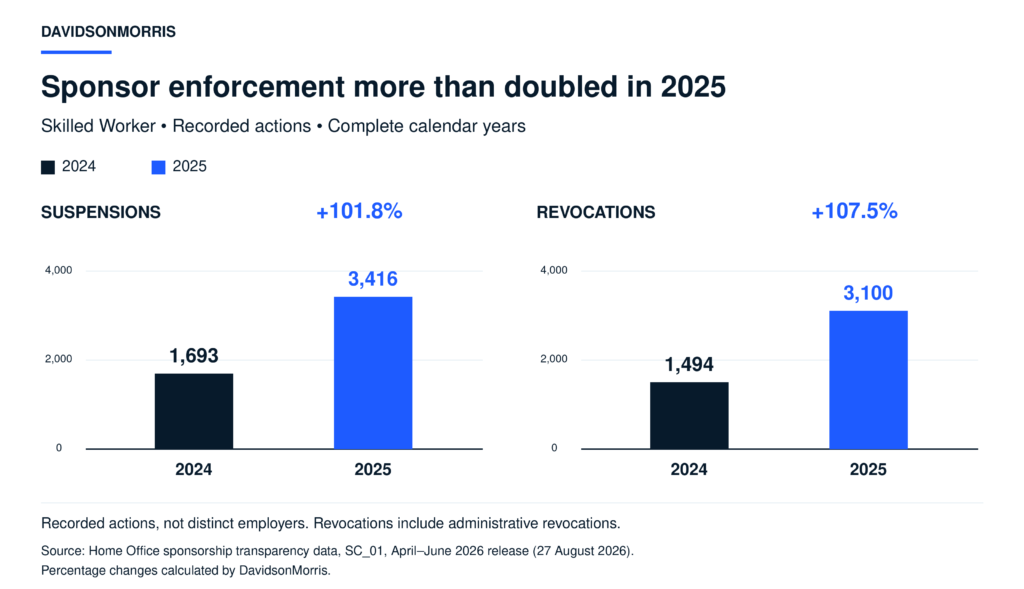
Revocations increased from 1,494 in 2024 to 3,100 in 2025, a rise of approximately 107.5%.
2. Sponsor licence suspensions also more than doubled.
The Home Office recorded 3,416 Skilled Worker sponsor licence suspensions in 2025, compared with 1,693 in 2024, an increase of approximately 101.8%.
3. Enforcement remained high during the first half of 2026.
Between January and June 2026, the Home Office recorded 2,346 Skilled Worker sponsor licence revocations and 2,632 suspensions.
These are six-month figures and should not be compared directly with full-year totals without identifying the different reporting periods.
4. The increase is substantial when compared with earlier years.
In 2022, the Home Office recorded 273 Skilled Worker sponsor licence revocations. By 2025, the annual figure had increased to 3,100 – more than eleven times the 2022 total.
5. Quarterly figures reveal a particularly sharp concentration of enforcement activity.
In the first quarter of 2026 alone, the Home Office recorded 1,545 Skilled Worker sponsor licence revocations and 1,712 suspensions.
The quarterly revocation total exceeded the 1,494 revocations recorded throughout the entire 2024 calendar year. This illustrates the scale of enforcement activity during the opening months of 2026.
6. Suspension and revocation statistics are not necessarily counts of different employers.
A sponsor licence may be suspended before being revoked. Consequently, adding suspension and revocation figures together does not establish the number of individual employers affected by enforcement.
7. Enforcement volumes should not be confused with enforcement rates.
An increase in the number of revoked licences does not, by itself, establish an increase in the proportion of sponsors subject to enforcement. Calculating an enforcement rate requires an appropriate and consistently defined sponsor population.
8. Sponsorship categories must be analysed separately.
The Home Office reports enforcement across different sponsorship categories. Where a licence covers multiple categories, an enforcement action may appear in more than one category’s statistics. Combining categories without accounting for this can result in double counting.
The Student sponsorship statistics also use different terminology for certain enforcement measures, including intention to revoke. These figures should not be treated as directly equivalent to Skilled Worker sponsor licence suspensions.
9. The October 2026 right to work reforms introduce additional compliance considerations.
Changes to the statutory right to work framework effective from 1 October 2026 are relevant to employers, including licensed sponsors. However, right to work civil penalties and sponsor licence enforcement are distinct regulatory measures.
The historical sponsor licence enforcement figures presented in this report end on 30 June 2026 and cannot establish the impact of the October 2026 reforms.
Section B: What Do the Home Office Sponsor Licence Enforcement Statistics Measure?
The Home Office publishes information about regulatory action taken against organisations licensed to sponsor overseas nationals under the UK’s immigration system.
The sponsorship transparency dataset includes information about sponsor licence suspensions and revocations, alongside data relating to the wider sponsorship system.
Interpreting the statistics requires a clear understanding of the enforcement measures, the organisations affected and how the Home Office records its actions.
1. Sponsor Licence Suspensions
A sponsor licence suspension is an enforcement measure through which the Home Office temporarily suspends an organisation’s sponsorship authorisation while concerns about its compliance are considered.
Suspension may arise where the Home Office identifies potential breaches of sponsorship duties or other concerns about whether the organisation continues to satisfy the requirements of its licence.
During suspension, the sponsor cannot assign any Certificates of Sponsorship. The organisation remains subject to its applicable sponsorship obligations while the Home Office considers the case.
A suspension does not necessarily result in revocation. Depending on the circumstances and the outcome of the Home Office’s consideration, the licence may be reinstated or revoked.
Suspension should not automatically be treated as a final determination that the sponsor has breached immigration law or its sponsorship obligations.
The published suspension figures follow the Home Office’s statistical definition, which also records a suspension when an immediate revocation is completed. They do not establish that every case involved a separate period of suspension pending investigation.
2. Sponsor Licence Revocations
Sponsor licence revocation is the withdrawal of an organisation’s authorisation to sponsor workers or students under the relevant sponsorship arrangements.
Revocation is generally a more serious and consequential regulatory outcome than suspension because the organisation loses the relevant sponsorship authorisation.
Depending on the circumstances, revocation may follow a period of suspension or may be imposed without a preceding suspension.
The grounds for revocation are set out in the applicable Home Office sponsorship guidance. These include circumstances in which revocation is mandatory under the guidance and circumstances in which the Home Office has discretion to revoke a licence.
Revocation can have significant consequences for the sponsoring organisation and its sponsored workers. The employer cannot continue sponsoring workers under the revoked licence, and the Home Office will normally cancel or shorten sponsored workers’ permission.
For workers already in the UK who were not complicit in the reasons for revocation, the Home Office will normally shorten permission to 60 calendar days. It will not normally shorten permission where no more than 60 days already remain. Where a worker was complicit, the Home Office will normally cancel all remaining permission. Entry clearance granted to a worker who has not yet travelled to the UK will be cancelled. These periods depend on the Home Office’s action on the individual’s permission; a universal 60-day period does not start automatically when the sponsor licence is revoked.
However, revocation statistics do not establish how many sponsored workers ultimately lost their permission to remain in the UK, how many employers challenged the decision or how many decisions were subsequently overturned.
Those outcomes require separate evidence.
3. Enforcement Actions Versus Unique Sponsors
The Home Office statistics record enforcement actions, which may differ from the number of individual organisations affected.
For example, a licence could be suspended during one reporting period and revoked during another. Both actions may appear in the relevant statistical series.
Similarly, a sponsor authorised under more than one sponsorship category may be represented in multiple categories.
For these reasons, DavidsonMorris treats suspension and revocation figures as separate statistical measures.
The report does not combine them to produce an unsupported estimate of the number of unique employers subject to enforcement.
Annual totals also require care. The number of suspension actions recorded in a calendar year cannot be assumed to represent the same group of organisations as the number of revocations recorded during that year.
4. Sponsorship Categories and Historical Terminology
The Home Office publishes enforcement statistics for different sponsorship categories, including Skilled Worker, Temporary Worker and Student sponsorship.
The categories are not necessarily directly comparable because the applicable sponsorship requirements, regulatory arrangements and enforcement measures may differ.
The principal statistical analysis in this report concerns the Home Office category Skilled Worker (previously Tier 2).
This terminology reflects the historical development of the UK’s employer sponsorship system. The Skilled Worker route replaced the former Tier 2 (General) route in December 2020, while the Home Office’s statistical series includes earlier periods under the previous sponsorship framework.
Historical figures should therefore be interpreted according to the Home Office’s published statistical classifications rather than assuming that the present Skilled Worker route existed throughout the entire reporting period.
The Student sponsorship category also requires particular care. The Home Office’s enforcement table includes intention to revoke figures for Student sponsors, rather than an equivalent suspension measure.
An intention to revoke is not the same statistical outcome as a Skilled Worker sponsor licence suspension. The figures should therefore not be combined or compared as though they measure identical enforcement actions.
5. Sponsor Licence Enforcement and Right to Work Enforcement
Sponsor licence enforcement should also be distinguished from enforcement of the UK’s statutory right to work requirements.
The sponsor licensing regime governs organisations authorised to sponsor overseas nationals under specified immigration routes. The statutory right to work framework concerns the obligations of employers and other persons within its scope to undertake prescribed checks and prevent illegal working.
Although the regimes are legally distinct, they can overlap.
A licensed sponsor may be subject to statutory right to work obligations as well as the separate requirements imposed by its sponsorship authorisation.
Failures involving illegal working or required right to work checks may also have consequences for a sponsor licence. The applicable Home Office guidance identifies circumstances in which such failures can lead to revocation.
However, a civil penalty for illegal working is not itself a sponsor licence suspension or revocation.
The sponsorship transparency statistics analysed in this report should therefore not be presented as a measure of the total number of illegal working civil penalties issued by the Home Office.
The two measures remain separate following the changes to the statutory right to work framework effective from 1 October 2026, which are considered in the employer compliance section of this report.
Section C: Data Sources, Reporting Periods and Methodology
The primary source for this report is the Home Office’s Migration transparency data collection, specifically the sponsorship transparency dataset and the table covering action taken against sponsors.
The analysis uses Sponsorship transparency data: April to June 2026, published by the Home Office on 27 August 2026.
The relevant statistical table is SC_01: Action taken against Sponsors.
The dataset provides quarterly enforcement figures extending back to 2012, enabling analysis of longer-term changes as well as recent developments.
The Home Office changed the reporting definition from Q2 2016. Figures from that point include administrative revocations and record a suspension when an immediate revocation is completed. Comparisons across that definition change require care. The annual and quarterly comparisons presented in this report concern periods after the change.
For this report, annual figures are calculated by aggregating the four calendar quarters within the relevant year. The 2026 figures currently cover January to June only.
The statistical reporting period ends on 30 June 2026. The article has been reviewed as at 22 October 2026.
1. Consistent Reporting Periods
Full calendar years are compared with full calendar years wherever possible.
For example, the 2025 annual totals are calculated from the four quarters covering January to December 2025 and compared with the corresponding four quarters of 2024.
Partial-year figures are identified separately.
The figures for January to June 2026 represent the first two quarters of that year and should not be presented as a complete annual total.
Although partial-year figures can be compared with equivalent periods in previous years, they should not be compared directly with full-year totals without explaining the different reporting periods.
The report does not automatically annualise partial-year figures because doing so would introduce a projection rather than report an observed Home Office statistic.
2. Separate Enforcement Measures
Sponsor licence suspensions and revocations are presented independently.
The two measures represent different regulatory actions and may relate to the same licence at different stages of an enforcement case.
The report does not add suspension and revocation totals together to estimate the number of individual sponsors affected.
It also does not calculate a suspension-to-revocation conversion rate from annual aggregate figures.
Such a calculation would require information about the outcomes of individual suspension cases or a defined cohort of suspended licences.
3. Separate Sponsorship Categories
The principal analysis concerns Skilled Worker sponsorship, using the Home Office’s historical category previously associated with Tier 2 sponsorship.
Temporary Worker and Student sponsorship data are considered separately where relevant.
Where a sponsor licence covers multiple sponsorship categories, enforcement action may be reflected in more than one category’s statistics.
Combining category totals without accounting for this overlap may therefore result in double counting.
Unless the Home Office provides a deduplicated measure, the report does not present combined category totals as the number of unique licences or sponsoring organisations affected.
4. Calculating Annual Changes
Year-on-year percentage changes are calculated by subtracting the previous year’s total from the current year’s total, dividing the difference by the previous year’s total and multiplying by 100.
For example, Skilled Worker sponsor licence revocations increased from 1,494 in 2024 to 3,100 in 2025.
The percentage change is calculated as follows:
((3,100 − 1,494) ÷ 1,494) × 100 = approximately 107.5%.
Percentage changes are rounded to one decimal place in statistical tables where appropriate. Rounded whole percentages may be used in explanatory text.
All calculations use the underlying Home Office figures rather than previously rounded percentages.
5. Enforcement Volumes Versus Enforcement Rates
The report distinguishes between the number of recorded enforcement actions and the proportion of sponsors subject to enforcement.
An enforcement volume measures the number of specified actions recorded during a reporting period.
An enforcement rate requires a corresponding and appropriately defined sponsor population.
For example, calculating the proportion of sponsors whose licences were revoked would require a reliable measure of the relevant sponsor population and careful consideration of how licences entering or leaving the system during the period are treated.
Simply dividing annual revocations by the number of sponsors registered at the end of the year may produce a misleading result.
The report therefore does not calculate unsupported enforcement rates or present national enforcement totals as the probability that an individual employer will face revocation.
6. Limitations of Aggregate Enforcement Data
The published aggregate statistics provide information about the scale and timing of recorded enforcement action, but they do not establish every aspect of the underlying cases.
In particular, the figures do not necessarily identify:
- The number of unique organisations affected across multiple enforcement categories.
- The number of sponsored workers associated with each suspended or revoked licence.
- The specific compliance issues underlying every enforcement decision.
- The number of suspensions that subsequently resulted in reinstatement.
- The proportion of revocation decisions successfully challenged or overturned.
- The financial or operational consequences of enforcement for individual employers.
- The relative likelihood of enforcement for particular industries or types of organisation.
These questions would require additional Home Office disclosures, case-level information or appropriately designed research.
Where such evidence is unavailable, the report explains the gaps in the data and avoids presenting assumptions as established statistical findings.
7. Interpretation and Causation
The report does not treat an increase in enforcement actions as direct proof that employers have become less compliant.
Recorded enforcement activity can be influenced by several factors, including changes in the licensed sponsor population, Home Office enforcement priorities, intelligence gathering and the identification of potential breaches.
The aggregate statistics do not establish the relative contribution of these factors.
The report therefore distinguishes between recorded changes in enforcement volumes and possible explanations for those changes.
Where a causal explanation is not supported by the available evidence, it is not presented as an established finding.
8. Statistical Cut-Off and Subsequent Legal Changes
The enforcement statistics analysed in this report cover the period up to 30 June 2026.
Changes to the UK’s right to work framework effective from 1 October 2026 are relevant to the wider regulatory environment in which licensed sponsors operate.
However, those changes occurred after the statistical reporting period.
Consequently, the historical enforcement figures cannot establish whether the October 2026 reforms increased or decreased sponsor licence suspensions, revocations or other regulatory interventions.
The report considers the October reforms separately when examining the practical implications of the current compliance framework for employers.
9. Data Revisions and Future Updates
Home Office statistical publications may be updated or revised as additional information becomes available.
Where revised figures are published, the latest official dataset should be used and the article’s statistical cut-off and review date updated accordingly.
Future releases should also be checked for changes in category definitions, table structure or reporting methodology before new figures are incorporated into the historical series.
This is particularly important where the Home Office introduces new sponsorship routes, changes existing categories or revises the way enforcement outcomes are recorded.
This report provides a historical statistical reference, distinguishing between recorded enforcement outcomes and wider developments in immigration law and policy.
Section D: Sponsor Licence Revocations by Year
Home Office statistics show a substantial increase in Skilled Worker sponsor licence revocations between 2022 and 2025.
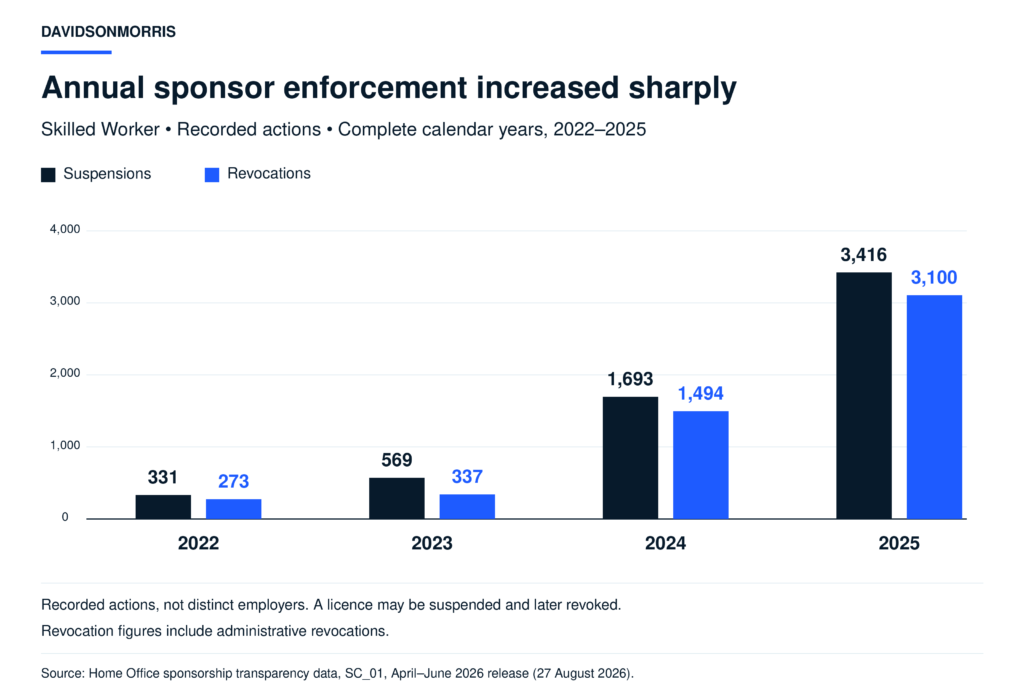
In 2022, the Home Office recorded 273 revocations. This increased to 337 in 2023, before rising sharply to 1,494 in 2024 and 3,100 in 2025.
The increase was particularly pronounced from 2023 onwards. Between 2023 and 2024, the number of recorded revocations increased by approximately 343%. A further increase of approximately 107% followed between 2024 and 2025.
The figures indicate a marked change in the volume of enforcement action against Skilled Worker sponsors. However, they do not establish whether the increase resulted primarily from greater levels of sponsor non-compliance, more intensive enforcement, changes in the sponsor population or a combination of factors.
1. Annual Skilled Worker Sponsor Licence Revocations
The following table shows the number of Skilled Worker sponsor licence revocations recorded by the Home Office from 2022 to June 2026.
| Calendar Year | Revocations | Year-on-Year Change |
|---|---|---|
| 2022 | 273 | — |
| 2023 | 337 | +23.4% |
| 2024 | 1,494 | +343.3% |
| 2025 | 3,100 | +107.5% |
| 2026 (January–June) | 2,346 | Not comparable – partial year |
Source: Home Office, Sponsorship transparency data: April to June 2026, table SC_01, Skilled Worker (previously Tier 2). Annual figures represent calendar-year totals. The 2026 figure covers January to June only.
The figures demonstrate that revocation activity accelerated sharply in 2024 and remained elevated throughout 2025.
The 2025 total was approximately 11.4 times the number recorded in 2022.
For employers, this comparison shows the scale of recent Home Office intervention, although it should not be interpreted as a direct measure of the probability that any particular sponsor will lose its licence.
The historical category is identified by the Home Office as Skilled Worker (previously Tier 2). Earlier observations in the wider statistical series relate to the predecessor sponsorship framework and should be interpreted accordingly.
2. Year-on-Year Growth in Sponsor Licence Revocations
The annual figures reveal three distinct phases in recent revocation activity.
2022 to 2023: Moderate growth.
Revocations increased from 273 to 337, a rise of approximately 23.4%.
Although this represented an increase, the absolute number of recorded revocations remained substantially below the levels subsequently observed in 2024 and 2025.
2023 to 2024: Sharp acceleration.
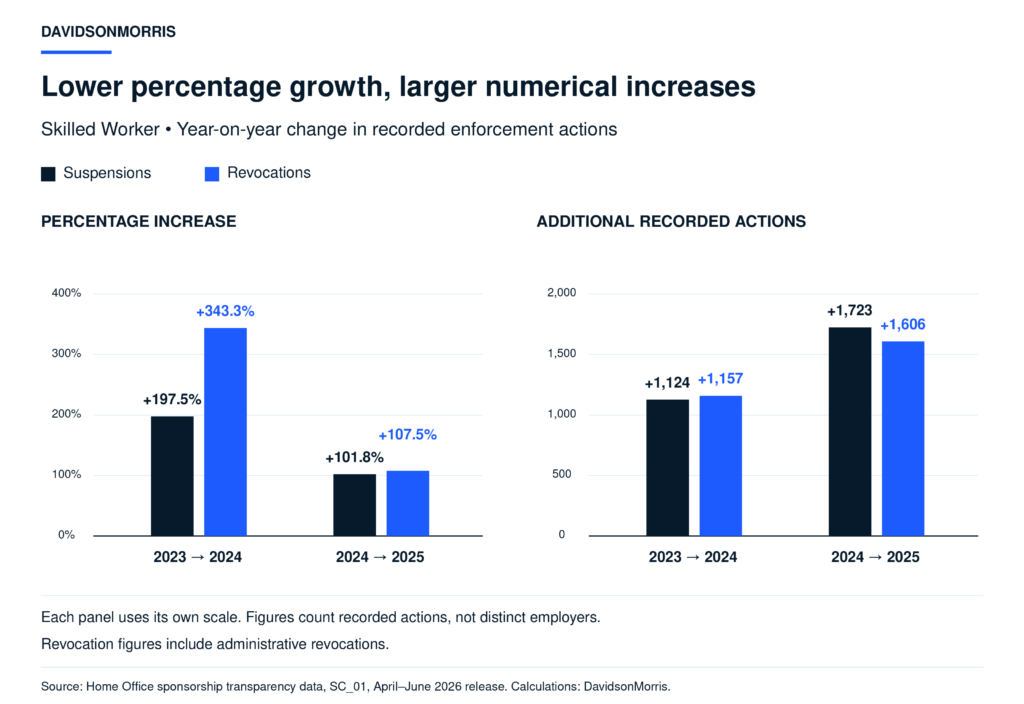
Revocations increased from 337 to 1,494, a rise of approximately 343.3%.
This was the largest annual percentage increase within the four complete calendar years examined in this section.
2024 to 2025: Further substantial growth.
Revocations increased from 1,494 to 3,100, a rise of approximately 107.5%.
Although the percentage increase was lower than in the preceding year, the absolute increase was larger.
The Home Office recorded 1,606 more revocations in 2025 than in 2024, compared with an increase of 1,157 between 2023 and 2024.
Percentage changes and absolute changes therefore both need to be considered when analysing enforcement trends.
The figures establish that the number of recorded revocations increased significantly. They do not establish the reasons for the increase or whether the proportion of licensed sponsors affected also increased.
3. Sponsor Licence Revocations in the First Half of 2026
Between January and June 2026, the Home Office recorded 2,346 Skilled Worker sponsor licence revocations.
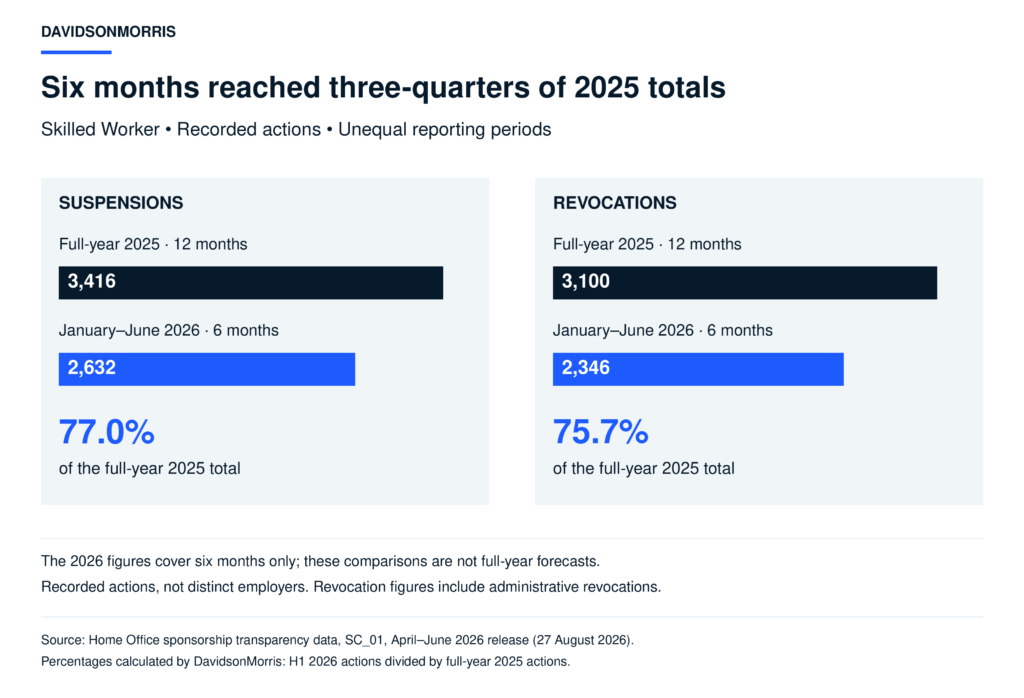
The six-month figure was approximately 76% of the total recorded during the whole of 2025.
The figure indicates that revocation activity remained substantial during the first half of 2026.
However, the first-half total should not be presented as a forecast of full-year revocations.
Enforcement activity may fluctuate between quarters, and the final annual total will depend on the number of actions recorded during the second half of the year.
The available 2026 figures show continued high enforcement volumes. The full-year outcome remains unknown.
Changes to immigration policy and employer compliance requirements must also be assessed against the reporting period.
In particular, the right to work reforms effective from 1 October 2026 occurred after the period covered by these figures and cannot be used to explain the revocations recorded during the first half of the year.
4. Quarterly Sponsor Licence Revocation Trends: 2025–2026
Quarterly Home Office figures show when recent sponsor licence enforcement activity was recorded.
Quarterly data shows how enforcement volumes changed within and between calendar years in more detail than annual totals.
The following table presents the recorded Skilled Worker sponsor licence revocations for the final two quarters of 2025 and the first two quarters of 2026.
| Reporting Quarter | Revocations |
|---|---|
| 2025 Q3 (July–September) | 541 |
| 2025 Q4 (October–December) | 1,516 |
| 2026 Q1 (January–March) | 1,545 |
| 2026 Q2 (April–June) | 801 |
Source: Home Office, Sponsorship transparency data: April to June 2026, table SC_01.
The figures show a particularly pronounced increase between the third and fourth quarters of 2025.
Revocations rose from 541 in 2025 Q3 to 1,516 in 2025 Q4.
The quarterly total remained at a similar level during the first quarter of 2026, when 1,545 revocations were recorded.
This was an exceptionally high quarterly figure in the context of the recent annual series.
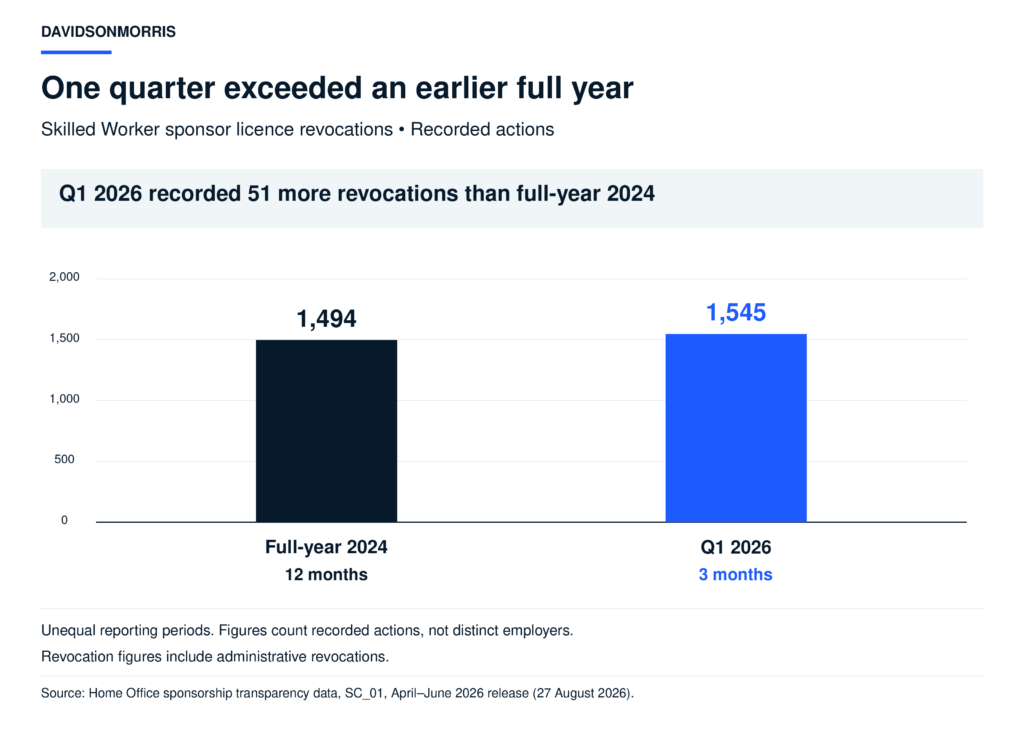
The 1,545 revocations recorded in 2026 Q1 exceeded the 1,494 revocations recorded throughout the entire 2024 calendar year.
Revocations subsequently declined to 801 in 2026 Q2.
Although this was a substantial reduction from the preceding quarter, the Q2 figure remained above the 541 revocations recorded in 2025 Q3.
The quarterly figures therefore demonstrate both the concentration of enforcement activity during late 2025 and early 2026 and the potential for substantial fluctuations between reporting periods.
They do not establish why enforcement activity increased or decreased in particular quarters.
Without additional evidence about Home Office operational activity, case processing, enforcement priorities and the underlying sponsor population, the observed changes should not be attributed to a specific cause.
Section E: Sponsor Licence Suspensions by Year
Sponsor licence suspension statistics show a similar pattern of growth to the revocation figures.
The Home Office recorded 331 Skilled Worker sponsor licence suspensions in 2022. This increased to 569 in 2023, 1,693 in 2024 and 3,416 in 2025.
The increase between 2023 and 2024 was approximately 198%, followed by a further increase of approximately 102% in 2025.
As with revocations, the figures demonstrate the scale of recorded enforcement activity rather than the proportion of licensed employers found to be non-compliant.
Suspension is also a distinct regulatory measure. It should not automatically be treated as evidence of a concluded breach or as confirmation that the licence will subsequently be revoked.
1. Annual Skilled Worker Sponsor Licence Suspensions
The following table shows the annual number of Skilled Worker sponsor licence suspensions recorded between 2022 and June 2026.
| Calendar Year | Suspensions | Year-on-Year Change |
|---|---|---|
| 2022 | 331 | — |
| 2023 | 569 | +71.9% |
| 2024 | 1,693 | +197.5% |
| 2025 | 3,416 | +101.8% |
| 2026 (January–June) | 2,632 | Not comparable – partial year |
Source: Home Office, Sponsorship transparency data: April to June 2026, table SC_01, Skilled Worker (previously Tier 2).
The 2025 suspension total was more than ten times the number recorded in 2022.
Suspension can have immediate operational consequences for a sponsoring organisation, even where the licence is subsequently reinstated.
A suspension prevents an employer from assigning any Certificates of Sponsorship while its licence remains suspended.
Employers may therefore experience recruitment disruption before any final revocation decision is made.
The statistics do not show how long individual suspensions lasted, how many resulted in reinstatement or how many ultimately led to revocation.
Those outcomes cannot be established simply by comparing annual suspension and revocation totals.
2. Year-on-Year Growth in Sponsor Licence Suspensions
The annual suspension series shows that the increase in recorded enforcement activity was not confined to revocation decisions.
2022 to 2023: Increasing suspension activity.
Suspensions increased from 331 to 569, representing growth of approximately 71.9%.
2023 to 2024: Substantial acceleration.
Suspensions increased from 569 to 1,693, representing growth of approximately 197.5%.
The Home Office therefore recorded almost three times as many suspensions in 2024 as in 2023.
2024 to 2025: A further doubling.
Suspensions increased from 1,693 to 3,416, representing growth of approximately 101.8%.
In absolute terms, the Home Office recorded 1,723 more suspensions in 2025 than in 2024.
The figures demonstrate a sustained increase in suspension activity across successive calendar years.
However, they do not establish how many of the suspended sponsors were subsequently reinstated, how many were revoked or whether the same organisations appeared in enforcement statistics during more than one reporting period.
3. Sponsor Licence Suspensions in the First Half of 2026
The Home Office recorded 2,632 Skilled Worker sponsor licence suspensions between January and June 2026.
This is equivalent to approximately 77% of the full-year 2025 total.
The figure provides further evidence that sponsor enforcement remained active during the first half of 2026.
However, a suspension is not necessarily evidence of a concluded breach.
The Home Office’s decision to suspend a licence is separate from its subsequent determination of whether revocation or reinstatement is appropriate.
The first-half 2026 total should also not be treated as a forecast of the number of suspensions that will be recorded during the complete calendar year.
Quarterly enforcement volumes may fluctuate, and the Home Office’s subsequent activity will determine the final annual figure.
4. Quarterly Sponsor Licence Suspension Trends: 2025–2026
The quarterly suspension figures show a pattern broadly similar to the revocation series.
The following table presents Skilled Worker sponsor licence suspensions for the final two quarters of 2025 and the first two quarters of 2026.
| Reporting Quarter | Suspensions |
|---|---|
| 2025 Q3 (July–September) | 608 |
| 2025 Q4 (October–December) | 1,600 |
| 2026 Q1 (January–March) | 1,712 |
| 2026 Q2 (April–June) | 920 |
Source: Home Office, Sponsorship transparency data: April to June 2026, table SC_01.
Suspensions increased sharply between 2025 Q3 and 2025 Q4, rising from 608 to 1,600.
The total increased further to 1,712 during the first quarter of 2026.
Suspensions then declined to 920 during the second quarter of 2026.
Despite this reduction, the Q2 total remained higher than the number recorded during 2025 Q3.
The quarterly series demonstrates that recent enforcement activity was not evenly distributed throughout the reporting period.
Particularly high suspension volumes were recorded during the final quarter of 2025 and the opening quarter of 2026.
However, the figures do not establish whether the concentration resulted from increased compliance investigations, changes in Home Office case processing, operational priorities or other factors.
These potential explanations would require further supporting evidence.
5. What the Suspension Figures Mean for Employers
The growth in suspension activity is particularly relevant because suspension can disrupt sponsorship operations even where the Home Office ultimately decides not to revoke the licence.
An employer whose licence is suspended cannot assign any Certificates of Sponsorship during the suspension period.
This can affect recruitment plans, the timing of sponsored appointments and the organisation’s ability to respond to workforce requirements.
Suspension may also require the employer to review its sponsorship records, investigate potential compliance issues and respond to Home Office concerns within the applicable timescales.
However, the national statistics do not establish the average duration of a suspension, the financial cost to affected organisations or the likelihood of reinstatement.
Employers should therefore avoid using the aggregate figures as a prediction of the likely outcome of an individual suspension case.
The statistics show the scale of recorded regulatory intervention within the Skilled Worker sponsorship system.
Further information about the applicable procedures and consequences is available in DavidsonMorris’s sponsor licence suspension guidance.
Section F: Comparing Sponsor Licence Suspensions and Revocations
The Home Office’s suspension and revocation statistics show broadly similar patterns of growth between 2022 and 2025.
Both enforcement measures increased substantially over the period, with particularly pronounced growth during 2024 and 2025.
However, suspensions and revocations represent different regulatory actions. They should not be treated as interchangeable measures or combined to establish the number of individual employers affected.
1. Annual Comparison of Suspensions and Revocations
The following table compares recorded Skilled Worker sponsor licence suspensions and revocations across four complete calendar years and the first half of 2026.
| Reporting Period | Suspensions | Revocations |
|---|---|---|
| 2022 | 331 | 273 |
| 2023 | 569 | 337 |
| 2024 | 1,693 | 1,494 |
| 2025 | 3,416 | 3,100 |
| 2026 (January–June) | 2,632 | 2,346 |
Source: Home Office, Sponsorship transparency data: April to June 2026, table SC_01, Skilled Worker (previously Tier 2). The 2026 figures cover January to June only.
The figures demonstrate that both forms of enforcement increased significantly during the same period.
In 2022, the Home Office recorded 331 suspensions and 273 revocations. By 2025, the corresponding figures had increased to 3,416 suspensions and 3,100 revocations.
The increase was not confined to one enforcement outcome.
The data shows a substantial increase in the recorded volume of both suspension and revocation activity within the Skilled Worker sponsorship category.
However, the figures do not establish whether the same employers were responsible for the increases in both measures. Nor do they demonstrate that an increase in suspensions necessarily caused a corresponding increase in revocations.
2. Why Suspensions and Revocations Cannot Be Added Together
A sponsor licence may be suspended before it is revoked.
Where this occurs, the suspension and subsequent revocation may both appear in the Home Office’s enforcement statistics.
Adding the two totals together could therefore count the same sponsor licence more than once.
For example, the Home Office recorded 3,416 Skilled Worker sponsor licence suspensions and 3,100 revocations in 2025.
Although these figures can be reported separately, adding them together to produce 6,516 and describing that number as the total of individual employers sanctioned would be misleading.
The published aggregate figures do not establish how many unique organisations were affected by one or both enforcement measures.
Some organisations may have experienced suspension without revocation, while others may have had their licences revoked following an earlier suspension.
There may also be cases in which the Home Office proceeded directly to revocation without first suspending the licence.
Without information linking individual enforcement actions to particular licences, a deduplicated total cannot be established from the aggregate figures alone.
3. Can the Statistics Show What Percentage of Suspended Licences Are Revoked?
The published annual suspension and revocation totals cannot be used to calculate a reliable suspension-to-revocation conversion rate.
The Home Office also records a suspension when an immediate revocation is completed. A recorded suspension therefore need not represent a separate period of investigation.
A conversion rate would measure the proportion of suspended licences that subsequently progress to revocation.
Calculating this would require information about the eventual outcomes of a defined group of suspended licences.
For example, a licence suspended during December 2025 might not be reinstated or revoked until 2026.
Its suspension would therefore appear in one reporting period, while a subsequent revocation could appear in another.
Similarly, some revocations recorded during 2025 may relate to licences that were originally suspended during 2024.
Dividing the 3,100 revocations recorded in 2025 by the 3,416 suspensions recorded during the same year would not establish the proportion of suspensions that resulted in revocation.
The two annual totals are not necessarily drawn from the same group of licences.
A reliable conversion rate would require case-level information or a cohort-based dataset tracking suspended licences through to their final outcomes.
Until such evidence is available, DavidsonMorris does not present an estimated suspension-to-revocation conversion rate.
4. Quarterly Comparison of Recent Enforcement Activity
Quarterly figures provide further evidence of the relationship between the two enforcement series.
The following table compares Skilled Worker sponsor licence suspensions and revocations during the final two quarters of 2025 and the first two quarters of 2026.
| Reporting Quarter | Suspensions | Revocations |
|---|---|---|
| 2025 Q3 (July–September) | 608 | 541 |
| 2025 Q4 (October–December) | 1,600 | 1,516 |
| 2026 Q1 (January–March) | 1,712 | 1,545 |
| 2026 Q2 (April–June) | 920 | 801 |
Source: Home Office, Sponsorship transparency data: April to June 2026, table SC_01.
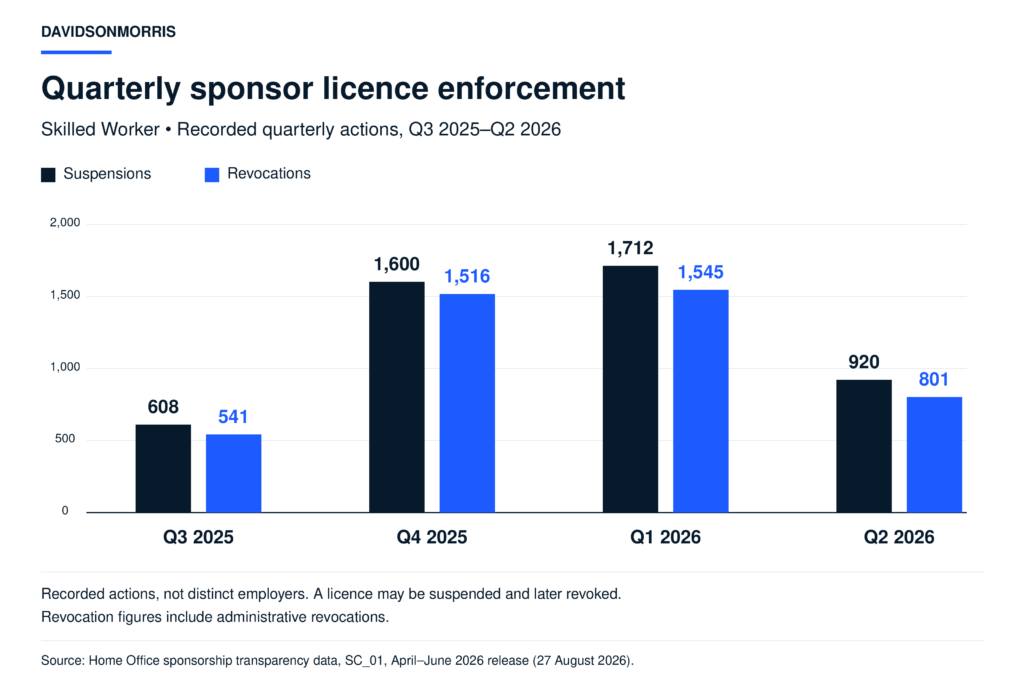
The quarterly figures show that suspension and revocation volumes increased sharply during the final quarter of 2025.
Both measures remained elevated during the first quarter of 2026 before declining during the second quarter.
In 2025 Q4, the Home Office recorded 1,600 suspensions and 1,516 revocations.
During 2026 Q1, these figures increased to 1,712 suspensions and 1,545 revocations.
The corresponding figures declined to 920 suspensions and 801 revocations in 2026 Q2.
This broadly similar quarterly pattern is consistent with an increase in the volume of recorded enforcement activity affecting both measures.
However, the statistical relationship should not be interpreted as evidence that the same licences were suspended and revoked within each quarter.
The published figures do not identify individual cases or establish the sequence of enforcement decisions affecting particular organisations.
They also do not establish why the quarterly totals increased or decreased.
Changes in Home Office operational activity, case processing, compliance investigations and other factors could influence the timing of recorded enforcement outcomes, but their individual effects cannot be determined from the aggregate statistics.
5. What Does the Relationship Between Suspensions and Revocations Reveal?
The principal finding is that both suspension and revocation activity increased substantially between 2022 and 2025.
This demonstrates that the growth in recorded enforcement was not limited to one type of regulatory action.
The quarterly figures also show that both measures were particularly elevated during late 2025 and early 2026.
However, the available evidence does not establish the proportion of suspended licences subsequently revoked, the average duration of suspensions or the number of unique employers affected by both measures.
The two enforcement outcomes have different legal and operational consequences, which must be considered when using the figures.
A suspension prevents an organisation from assigning any Certificates of Sponsorship while the licence remains suspended.
Revocation removes the organisation’s sponsorship authorisation and may have significant consequences for its sponsored workforce.
Employers should therefore consider the measures separately when assessing their compliance responsibilities and potential business exposure.
Further information about the applicable procedures is available in DavidsonMorris’s sponsor licence suspension guidance and sponsor licence revocation guidance.
Section G: What Do the Historical Sponsor Licence Enforcement Statistics Show?
The Home Office’s historical statistics provide evidence of a substantial increase in recorded enforcement action against Skilled Worker sponsors.
The following findings and limitations emerge from the available data.
1. Enforcement Volumes Increased Significantly from 2023 Onwards
The annual figures demonstrate that the volume of Skilled Worker sponsor licence enforcement increased sharply from 2023 onwards.
Revocations rose from 337 in 2023 to 1,494 in 2024 and 3,100 in 2025.
Suspensions increased from 569 in 2023 to 1,693 in 2024 and 3,416 in 2025.
These changes represent substantial increases in the absolute number of recorded enforcement actions.
However, the statistics do not establish whether the proportion of licensed sponsors affected increased by the same amount.
Changes in the size and composition of the licensed sponsor population must also be considered when interpreting the figures.
2. Both Suspensions and Revocations Increased
The increase in recorded enforcement activity was not confined to revocation decisions.
Sponsor licence suspensions also rose significantly during the same period.
This indicates that the Home Office recorded higher volumes of both temporary suspension measures and final revocation outcomes.
Nevertheless, the two measures remain distinct.
Suspension figures should not automatically be interpreted as confirmed findings of non-compliance, while revocation figures should not be used to infer the outcome of every suspension.
The published aggregate statistics do not establish the relationship between individual suspension cases and subsequent revocation decisions.
3. Enforcement Remained Elevated During the First Half of 2026
Substantial Skilled Worker sponsor licence enforcement activity continued during the first six months of 2026.
Between January and June, the Home Office recorded 2,632 suspensions and 2,346 revocations.
The quarterly figures show particularly high enforcement volumes during the first quarter of the year, followed by lower totals during the second quarter.
Although the reduction in Q2 is notable, the first-half totals demonstrate that recorded enforcement remained substantial in comparison with earlier complete calendar years.
However, the 2026 figures cover only six months and should not be presented as the final annual outcome.
The Home Office’s subsequent enforcement activity will determine the full-year totals.
4. What the Historical Statistics Do Not Establish
Although the increase in recorded enforcement is clear, the available statistics do not answer every question about sponsor compliance and regulatory risk.
In particular, they do not establish:
- Whether the proportion of licensed sponsors subject to enforcement has increased.
- Whether employers have become more or less compliant with their sponsorship obligations.
- The precise reasons for the increase in suspensions and revocations.
- The number of unique employers affected across both enforcement measures.
- The proportion of suspended licences subsequently revoked.
- The average duration of sponsor licence suspensions.
- The number of sponsored workers affected by enforcement decisions.
- Whether particular industries have higher enforcement rates after accounting for their sponsor populations.
- The financial consequences of enforcement for affected organisations.
- The proportion of enforcement decisions subsequently challenged or overturned.
Answering these questions would require additional Home Office data, including appropriate sponsor population measures, case-level information or further disclosures.
Until such evidence is available, the historical statistics should be interpreted as measures of recorded enforcement activity rather than comprehensive indicators of employer compliance or individual regulatory risk.
5. Implications for the UK’s Sponsorship Enforcement Environment
The historical data supports the conclusion that sponsor licence enforcement has become a more prominent feature of the UK’s employer sponsorship system.
The substantial increases recorded during 2024 and 2025, together with the elevated figures for the first half of 2026, demonstrate the scale of recent Home Office regulatory intervention.
For employers, these findings reinforce the importance of maintaining effective sponsorship governance, accurate records and reliable procedures for identifying and reporting relevant changes.
However, the statistics should not be used to suggest that suspension or revocation is inevitable, or that a particular employer faces a quantifiable likelihood of enforcement based solely on national totals.
The appropriate interpretation is that the scale of recorded regulatory intervention has increased substantially, while the underlying causes and relative risks require further evidence.
The historical analysis covers a defined period.
The dataset ends on 30 June 2026. It therefore cannot establish the impact of subsequent changes to immigration law, policy or enforcement practice, including the right to work reforms effective from 1 October 2026.
Those developments are relevant to the current compliance environment but must be considered separately from the historical statistical findings.
Section H: Sponsor Licence Enforcement Trends Across Different Sponsorship Categories
The Home Office’s sponsorship enforcement statistics cover different categories of licensed sponsors. These include organisations authorised to sponsor workers and those authorised to sponsor international students.
Although these organisations operate within the same wider immigration sponsorship system, they are subject to different sponsorship requirements, compliance obligations and operational arrangements.
Enforcement statistics should therefore be analysed by sponsorship category.
The figures examined in the preceding sections relate specifically to Skilled Worker sponsorship, using the Home Office’s historical statistical category, Skilled Worker (previously Tier 2).
They should not be presented as the total number of sponsor licence suspensions or revocations across the entire UK sponsorship system.
The Home Office’s sponsorship transparency data provides the official basis for examining enforcement activity across different categories.
However, differences in statistical definitions and the possibility of overlapping sponsorship authorisations mean that category-level figures must be interpreted carefully.
1. Skilled Worker Sponsor Licence Enforcement
Skilled Worker sponsorship is particularly relevant to UK employers because it enables qualifying organisations to sponsor overseas nationals for eligible employment.
Licensed employers must comply with the requirements of their sponsorship authorisation, including relevant record-keeping, reporting, monitoring and immigration compliance duties.
These responsibilities continue throughout the period in which the organisation holds its licence and are not limited to the initial sponsor licence application process.
The historical data shows that Skilled Worker sponsor licence suspensions and revocations increased substantially between 2022 and 2025.
By 2025, the Home Office recorded 3,416 suspensions and 3,100 revocations within the Skilled Worker category.
During the first six months of 2026, a further 2,632 suspensions and 2,346 revocations were recorded.
These figures provide a direct measure of recorded enforcement activity within one of the principal employer sponsorship routes.
However, they do not identify the number of sponsored workers affected, the size of the organisations involved or the precise compliance failures associated with individual enforcement decisions.
They also do not establish that all Skilled Worker sponsors face the same level of regulatory exposure.
For example, an organisation sponsoring one overseas worker and a multinational employer sponsoring hundreds of workers may both hold sponsorship authorisation, but their operational arrangements and compliance risks can differ considerably.
The published aggregate enforcement totals do not distinguish between these circumstances.
Similarly, the figures do not establish whether particular employers have experienced repeated enforcement action or whether the organisations affected are concentrated within particular industries.
For employers, the data is therefore most useful as evidence of the scale and direction of Home Office enforcement activity, rather than as a direct measure of individual sponsor licence risk.
Further information about ongoing responsibilities is available in DavidsonMorris’s sponsor licence compliance guidance.
2. Temporary Worker Sponsor Licence Enforcement
Temporary Worker sponsorship covers a range of immigration routes that permit eligible organisations to sponsor individuals undertaking specified activities or temporary work in the UK.
These routes have their own eligibility criteria and sponsorship requirements.
Although they form part of the wider sponsorship system, the applicable duties and operational arrangements may differ from those governing Skilled Worker sponsorship.
The Home Office’s sponsorship transparency data includes enforcement information relating to Temporary Worker sponsorship.
However, care is required when interpreting these figures alongside Skilled Worker statistics.
An organisation may hold sponsorship authorisation covering more than one category.
Where enforcement affects a licence covering multiple categories, the action may be recorded within each relevant statistical category.
Consequently, adding the Skilled Worker and Temporary Worker revocation totals together may produce a figure that includes the same licence more than once.
For example, an organisation authorised to sponsor workers under both Skilled Worker and Temporary Worker routes may be affected by an enforcement decision concerning its sponsorship authorisation.
Depending on the scope of the decision and the Home Office’s statistical recording arrangements, the action may be reflected in more than one category.
Without a deduplicated dataset, it would be misleading to describe the combined category total as the number of individual employers whose licences were suspended or revoked.
The categories should be analysed separately unless the Home Office provides a measure of unique sponsor licences or organisations.
External reporting, research and commentary about the overall scale of immigration sponsorship enforcement must account for this overlap.
It is also relevant when comparing enforcement trends over time, because changes in the number of organisations holding authorisation under multiple categories may affect the interpretation of combined figures.
3. Student Sponsor Licence Enforcement
Student sponsorship operates under a different regulatory framework from employer sponsorship.
Licensed education providers are responsible for complying with requirements associated with sponsoring international students, including applicable monitoring and reporting duties.
The Home Office publishes sponsorship transparency information relating to Student sponsors.
However, Student sponsor enforcement should not be treated as interchangeable with Skilled Worker sponsor enforcement.
The underlying sponsorship populations, compliance requirements and regulatory risks are different.
The Home Office also uses different enforcement terminology for Student sponsors.
The relevant Student sponsor measure includes intention to revoke, which should not be presented as equivalent to a Skilled Worker sponsor licence suspension.
An intention to revoke concerns a stage in the Student sponsor enforcement process. It is not necessarily a final revocation decision.
Accordingly, an intention-to-revoke figure should not be described as the number of Student sponsor licences actually revoked.
Nor should it be combined with Skilled Worker suspension figures to produce an overall suspension total.
Combining the categories without accounting for these differences could misrepresent the recorded outcomes and produce conclusions that are not supported by the underlying data.
For an employer-focused report, Student sponsorship statistics are most useful as a separate comparative category rather than as part of the principal analysis of workforce sponsorship enforcement.
Any future expansion of this report to include detailed Student sponsor enforcement trends should preserve the Home Office’s original terminology and distinguish intentions to revoke from completed revocations.
4. Why Sponsorship Category Definitions Matter
Comparisons of enforcement activity over time require consistent statistical categories.
The UK’s immigration sponsorship framework has changed during the period covered by the Home Office’s historical data.
For example, the current Skilled Worker route replaced the former Tier 2 (General) route in December 2020.
The Home Office’s historical statistical series uses terminology that reflects this transition.
Earlier figures should therefore not be interpreted as though the present Skilled Worker immigration route existed in precisely the same form throughout the entire dataset.
Changes to immigration routes, sponsorship eligibility and the number of organisations participating in the system may also affect the comparability of historical enforcement figures.
Where the Home Office revises statistical classifications or introduces new sponsorship categories, researchers should establish whether the figures remain directly comparable before combining them into a continuous historical series.
For this report, the original Home Office category definitions are retained wherever possible.
The principal analysis is restricted to the Skilled Worker (previously Tier 2) category to maintain a clearly defined statistical scope.
5. Can Enforcement Statistics Be Compared Across Sponsorship Categories?
Enforcement statistics can provide useful comparisons between sponsorship categories, but the conclusions must reflect differences in the underlying populations and regulatory arrangements.
For example, comparing the number of Skilled Worker sponsor licence revocations with the number of Student sponsor revocations may show which category recorded more revocation decisions during a particular period.
However, the category recording more revocations does not necessarily have a higher enforcement rate.
A meaningful comparison would require information about the number of licensed sponsors within each category, the reporting periods and the relevant enforcement definitions.
It may also be necessary to consider differences in sponsorship activity, the size of sponsoring organisations and the number of individuals sponsored.
Where categories overlap, the analysis must also account for the possibility that the same organisation or licence is represented more than once.
These limitations mean that absolute enforcement totals should not be used to rank sponsorship categories by compliance risk without further evidence.
Report each category separately, explain its definitions and avoid drawing conclusions about relative enforcement risk without supporting data.
Section I: Why Sponsor Licence Enforcement Statistics Cannot Simply Be Added Together
A recurring difficulty in interpreting Home Office enforcement statistics is the difference between sponsorship categories, sponsor licences, individual sponsoring organisations and enforcement actions.
These terms are related, but they are not necessarily interchangeable for statistical purposes.
Combining figures without accounting for these differences can produce totals that appear precise but do not measure what they are claimed to represent.
A count of employers affected by Home Office enforcement must account for these differences.
1. One Organisation May Hold Multiple Sponsorship Authorisations
An organisation may be authorised to sponsor individuals under more than one immigration route.
Where the Home Office takes enforcement action affecting a licence covering multiple categories, the published statistics may reflect that action in more than one category.
This means that a combined total across categories may exceed the number of distinct licences affected.
For example, a sponsor holding authorisation under both Skilled Worker and Temporary Worker routes may appear in the enforcement statistics for each relevant category.
If those category totals are simply added together, the resulting figure may count the same enforcement decision more than once.
Without a deduplicated dataset, it would be misleading to describe such a combined figure as the number of individual employers whose licences were suspended or revoked.
A licence count does not necessarily represent the number of separate organisations.
Statistical reporting may concern sponsorship authorisations rather than unique legal entities or corporate groups.
Researchers should therefore avoid assuming that every recorded licence or enforcement action corresponds to a separate business.
2. Suspensions and Revocations Are Different Events
Suspension and revocation are separate regulatory actions.
A licence may be suspended and subsequently revoked, meaning that the same sponsor can appear in both statistical measures.
A licence may also be reinstated following suspension.
In some circumstances, the Home Office may proceed directly to revocation without first suspending the licence.
The published aggregate statistics do not provide a complete record of how individual suspension cases progressed.
It would therefore be incorrect to add annual suspensions and revocations together and present the result as the number of employers penalised.
For example, the 2025 figures of 3,416 suspensions and 3,100 revocations are valid separate measures of recorded enforcement activity.
However, their combined total of 6,516 should not be described as the number of unique employers affected.
Some organisations may appear in both measures, while the aggregate data does not establish the extent of that overlap.
3. Reporting Periods May Capture Different Stages of the Same Case
An enforcement case may extend across more than one reporting period.
For example, a licence suspended towards the end of one calendar year might not be revoked until the following year.
As a result, the suspension and revocation figures for a particular year do not necessarily relate to the same group of organisations.
This limits the conclusions that can be drawn from comparing the two totals.
A revocation recorded during 2026 may relate to a licence suspended during 2025, while a suspension recorded during 2026 may remain unresolved at the end of the statistical reporting period.
Consequently, the annual relationship between suspensions and revocations cannot be used to establish the percentage of suspensions resulting in revocation.
A reliable conversion rate would require case-level information or a cohort-based analysis tracking a defined group of suspended licences through to their final outcomes.
The Home Office also records a suspension when an immediate revocation is completed. A recorded suspension therefore need not represent a separate period of investigation.
4. Enforcement Statistics Do Not Measure All Compliance Activity
Suspensions and revocations represent particular forms of regulatory intervention.
They do not capture the entirety of the Home Office’s sponsorship compliance activity.
Other compliance measures and outcomes may include inspections, requests for information, sponsor licence downgrading and remedial action.
Some compliance concerns may be addressed without resulting in suspension or revocation.
Similarly, the number of compliance visits undertaken by the Home Office should not be assumed to correspond directly with the number of enforcement actions recorded.
A single compliance visit may identify several issues, while some enforcement decisions may arise from information obtained through other means.
The suspension and revocation series should therefore be understood as indicators of specified enforcement outcomes, rather than a comprehensive measure of every compliance intervention undertaken by the Home Office.
5. Sponsor Licence Enforcement Is Not the Same as Illegal Working Enforcement
The sponsor licensing regime and the statutory right to work framework have separate enforcement measures.
A sponsor licence suspension or revocation concerns an organisation’s authorisation to sponsor overseas nationals.
An illegal working civil penalty concerns liability under the statutory framework for preventing illegal working.
The two regimes may overlap in practice, particularly where a licensed sponsor has failed to undertake required checks or has employed individuals without the necessary permission to work.
Such failures may have consequences for the organisation’s sponsor licence as well as its potential exposure to civil penalties.
However, the enforcement measures remain legally and statistically distinct.
A civil penalty should not automatically be counted as a sponsor licence revocation, and a sponsor licence revocation should not automatically be described as an illegal working penalty.
The changes to the statutory right to work framework effective from 1 October 2026 do not merge these enforcement measures.
Those reforms affect the wider workforce compliance obligations of organisations within their scope, but they do not change the meaning of the historical sponsorship enforcement figures analysed in this report.
The dataset ends on 30 June 2026 and therefore cannot establish the effect of the October reforms on subsequent enforcement activity.
Employers should consider the separate legal requirements applicable to their workforce arrangements rather than assuming that compliance with one regime necessarily satisfies the other.
Further guidance is available in DavidsonMorris’s right to work checks guidance and sponsor licence compliance guidance.
6. Why Accurate Statistical Definitions Matter
Accurate reporting requires clear definitions of enforcement actions, licences, organisations and sponsorship categories.
Without it, the same underlying enforcement activity may be counted more than once or described using terminology that does not reflect the Home Office’s published measures.
For example, a combined total of suspensions and revocations cannot establish the number of unique employers affected.
Similarly, a combined total across sponsorship categories may include overlapping licences, while Student intention-to-revoke figures cannot be treated as equivalent to Skilled Worker suspensions.
These limitations do not undermine the significance of the recorded increase in Skilled Worker sponsor licence enforcement.
The annual and quarterly figures demonstrate a substantial rise in the volume of recorded suspensions and revocations.
However, accurate interpretation requires the measures to remain distinct.
Keeping these measures separate allows employers, researchers, policymakers and journalists to use the figures without overstating what they show.
Section J: Can Sponsor Licence Enforcement Statistics Be Broken Down by Industry?
Employers assessing the increase in sponsor licence enforcement may want to know whether particular industries are more likely to experience suspension or revocation.
This is particularly relevant to employers operating in sectors that depend on international recruitment, including health and social care, hospitality, construction, technology and professional services.
However, the published Home Office sponsorship transparency statistics do not provide a sufficiently detailed and consistently defined industry breakdown to establish reliable sector-specific sponsor licence enforcement rates.
Although additional information about individual enforcement cases may become available through Home Office disclosures, public reporting or freedom of information requests, this should not be confused with a comprehensive national dataset measuring enforcement risk by industry.
Consequently, the national Skilled Worker suspension and revocation totals examined in this report cannot, on their own, establish which industries have the highest proportion of sponsors subject to enforcement.
1. Why Industry-Level Enforcement Statistics Matter
Industry-level statistics would help employers, researchers and policymakers understand how sponsorship enforcement activity is distributed across different parts of the UK economy.
For example, a breakdown by industry could help establish whether enforcement actions are concentrated in sectors with large numbers of licensed sponsors or whether some sectors experience disproportionately high levels of regulatory intervention.
However, answering these questions requires more than the number of suspensions or revocations recorded in each industry.
It also requires an appropriate measure of the licensed sponsor population within that industry.
Without this information, a sector with a relatively large number of enforcement actions may simply be a sector with a relatively large number of sponsoring organisations.
Conversely, a sector with fewer enforcement actions could have a higher proportion of its sponsors affected if its overall sponsor population is much smaller.
For this reason, the number of enforcement actions and the rate of enforcement are different statistical measures.
2. Why Absolute Enforcement Numbers Can Be Misleading
Consider two hypothetical industries.
Industry A has 10,000 licensed sponsors and records 200 licence revocations during a reporting period.
Industry B has 500 licensed sponsors and records 50 licence revocations during the same period.
Industry A has more revocations in absolute terms.
However, if the figures represented distinct licences within consistently defined sponsor populations, the corresponding proportions would be 2% for Industry A and 10% for Industry B.
Under those assumptions, Industry B would have the higher proportion of licences revoked despite recording fewer revocations.
These figures are illustrative only. They are not Home Office statistics and do not describe actual enforcement outcomes in any UK industry.
The example demonstrates why sector comparisons require appropriate denominators and consistent definitions.
It also illustrates why a ranking based solely on the number of recorded enforcement actions may produce misleading conclusions about relative regulatory exposure.
3. What Data Would Be Needed to Calculate Industry Enforcement Rates?
A reliable assessment of sponsor licence enforcement rates by industry would require several categories of information.
These would include:
- The number of sponsor licence suspensions and revocations recorded within each industry during a defined reporting period.
- The number of licensed sponsors operating within each industry during the corresponding period.
- A consistent method of assigning sponsors to industries.
- Clear definitions distinguishing licences, sponsoring organisations and corporate groups.
- Information about licences covering multiple sponsorship categories.
- Consistent treatment of sponsors entering or leaving the licensed population during the reporting period.
- Appropriate treatment of repeat enforcement actions affecting the same licence.
- Comparable reporting periods and enforcement definitions.
Additional information about the size of sponsoring organisations, the number of sponsored workers and the nature of sponsorship activity could also improve the analysis.
For example, comparing an organisation sponsoring one worker with an organisation sponsoring several hundred workers may require consideration of the different scale and complexity of their sponsorship arrangements.
Even with detailed industry data, an observed difference in enforcement rates would not automatically establish why that difference existed.
Further analysis would be needed to distinguish the effects of compliance behaviour, enforcement priorities, sponsor population characteristics and other factors.
4. Can the Home Office Register of Sponsors Be Used?
The Home Office publishes a register of organisations licensed to sponsor workers.
This provides information about organisations holding relevant sponsorship authorisation and can be useful for understanding the composition of the licensed sponsor population.
However, the register is not, by itself, a complete historical dataset of sponsor licence enforcement outcomes.
A current register does not necessarily identify every organisation that held a licence during an earlier reporting period.
Organisations may have obtained licences, surrendered them, ceased trading or had their authorisation revoked between different publication dates.
Using a current register as the denominator for historical enforcement figures could therefore produce a misleading rate.
There are also potential difficulties in identifying industries consistently from the published register information.
For example, an organisation’s trading name or principal business activity may not provide a sufficiently precise basis for assigning it to a particular industry classification.
Large organisations may operate across multiple industries, while corporate groups may hold sponsorship authorisation through different legal entities.
Accordingly, the register can support research into the sponsorship system, but it should not be treated as a ready-made denominator for calculating historical industry enforcement rates without further methodological work.
5. Can Freedom of Information Disclosures Provide Sector Statistics?
Freedom of information requests may provide additional information about Home Office sponsorship enforcement activity.
Depending on the scope of a request and the information held by the Home Office, disclosures may include breakdowns by particular categories, reporting periods or other characteristics.
However, individual disclosures must be assessed according to their own definitions and limitations.
For example, a disclosure concerning enforcement action in a particular sector may not use the same sponsorship categories or reporting periods as the published sponsorship transparency dataset.
It may also cover only certain enforcement measures or exclude information that cannot be disclosed.
Consequently, figures obtained through separate disclosures should not automatically be combined into a national sector ranking.
Before using such information, researchers should establish whether the disclosed figures are comparable, whether the categories overlap and whether appropriate sponsor population data is available.
Where these conditions cannot be satisfied, the analysis should explain the limitations.
6. Can Employers Identify High-Risk Industries from the Available Statistics?
The available national enforcement statistics do not support a definitive ranking of industries by the likelihood of sponsor licence suspension or revocation.
They demonstrate a substantial increase in recorded Skilled Worker enforcement activity, but they do not establish how that activity is distributed relative to the number of sponsors in each sector.
It would therefore be misleading to claim that a particular industry has the highest sponsor licence revocation rate solely because it has attracted public attention or because individual enforcement cases have been reported.
For employers, the more useful approach is to assess the compliance risks arising from their own sponsorship arrangements.
These may include the accuracy of sponsored workers’ job descriptions, compliance with applicable salary requirements, record keeping, reporting, recruitment procedures and the organisation’s ability to identify relevant changes.
The nature of these risks will depend on the employer’s operations, workforce structure and sponsorship activities.
Further guidance is available in DavidsonMorris’s sponsor licence compliance guidance and sponsor licence audit guidance.
7. Limitations of Industry Enforcement Comparisons
Any future analysis of sponsor licence enforcement by industry should distinguish between three different questions.
First, which industries account for the largest number of recorded enforcement actions?
This concerns absolute enforcement volumes.
Second, which industries have the highest proportion of licensed sponsors affected?
This concerns enforcement rates and requires appropriate sponsor population data.
Third, why might enforcement activity differ between industries?
This concerns the causes of observed differences and requires further evidence beyond the aggregate enforcement statistics.
These questions should not be treated as interchangeable.
In particular, a high number of enforcement actions does not necessarily establish a high enforcement rate, while a high enforcement rate does not automatically establish the underlying reasons for regulatory intervention.
Until sufficiently detailed and comparable evidence is available, DavidsonMorris does not present unsupported industry rankings or sector-specific probabilities of sponsor licence enforcement.
Section K: Do Rising Sponsor Licence Revocations Mean Employers Are Becoming Less Compliant?
Higher sponsor licence suspension and revocation totals may suggest that employers are becoming less compliant.
The Home Office statistics establish that recorded enforcement actions have increased significantly.
However, they do not establish that employer compliance has deteriorated by the same amount, or that deterioration in compliance is the principal explanation for the increase.
Enforcement statistics measure regulatory actions. They are not a direct or comprehensive measure of the underlying level of compliance across the licensed sponsor population.
Several factors could influence the number of suspensions and revocations recorded during a particular period.
These factors must be distinguished from conclusions that can be established directly from the published data.
1. Changes in the Number of Licensed Sponsors
One possible influence on enforcement volumes is the size of the licensed sponsor population.
If the number of organisations holding sponsorship authorisation increases, the absolute number of enforcement actions could also increase even if the proportion of sponsors subject to enforcement remains unchanged.
For example, a system containing substantially more licensed sponsors may generate a larger number of compliance investigations and enforcement decisions than a smaller system.
However, this possibility does not establish that growth in the sponsor population caused the increase in revocations.
A reliable assessment would require appropriately defined sponsor population figures for the relevant reporting periods.
It would also require consideration of changes in the composition of the licensed sponsor population, including the number of new sponsors and the types of organisations entering the system.
The enforcement figures alone do not provide this information.
2. Changes in Home Office Enforcement Activity
Recorded enforcement volumes may also be influenced by the level and nature of Home Office compliance activity.
For example, an increase in compliance investigations, inspections or other forms of regulatory scrutiny could result in more potential breaches being identified.
This could increase the number of suspension or revocation decisions even where the underlying level of employer compliance had not changed proportionately.
However, the published suspension and revocation totals do not establish how many compliance investigations were undertaken or how the Home Office selected organisations for scrutiny.
They also do not demonstrate whether enforcement activity became more intensive across all sponsors or was concentrated on particular types of cases.
These questions require additional operational information.
Greater Home Office enforcement activity is therefore a possible explanation for higher recorded totals, but its contribution cannot be quantified from the aggregate figures examined in this report.
3. Changes in Enforcement Priorities
Government policy and Home Office operational priorities may influence the allocation of resources to sponsorship compliance and enforcement.
For example, the Home Office may place greater emphasis on particular forms of suspected abuse, compliance failures or sponsorship arrangements.
Changes in these priorities could affect the number and type of cases investigated and the timing of enforcement decisions.
However, the existence of a policy priority does not, by itself, establish that it caused a particular increase in recorded revocations.
To support such a conclusion, it would be necessary to examine relevant policy documents, operational evidence and the timing of enforcement activity.
The statistical series alone does not identify the contribution of individual enforcement priorities to the observed increase.
4. Improved Identification of Potential Compliance Breaches
The identification of potential sponsorship breaches may be influenced by the information available to the Home Office and the methods used to assess compliance.
Information may arise through sponsor reporting, compliance activity, intelligence or other sources available to the department.
Where more potential breaches are identified, the number of enforcement cases may increase.
However, the published statistics do not establish whether changes in detection methods contributed to the increase in suspensions or revocations.
Nor do they establish whether a greater number of detected breaches reflects a greater underlying prevalence of non-compliance.
These are separate questions.
Higher detection or enforcement volumes should therefore not be treated as direct proof of a corresponding increase in the underlying rate of sponsorship breaches.
5. Changes in the Nature of Sponsorship Activity
The composition of the licensed sponsor population may also influence the types of compliance issues encountered.
Organisations differ in their size, recruitment arrangements, number of sponsored workers and administrative resources.
Some employers have established immigration and HR compliance functions, while others may have more limited internal capacity.
Changes in the number or characteristics of sponsoring organisations could therefore affect the nature of compliance activity within the sponsorship system.
However, the aggregate enforcement statistics do not identify which organisational characteristics are associated with the recorded increase.
They also do not establish that any particular type of employer is inherently more likely to breach its sponsorship duties.
Such conclusions would require appropriately designed research using reliable information about the sponsor population and individual enforcement outcomes.
6. Changes in Immigration Rules and Sponsor Requirements
Changes to immigration law, sponsor guidance and administrative requirements may affect the obligations that licensed sponsors must satisfy.
For example, changes to eligibility requirements, salary thresholds, reporting duties or sponsorship processes may require employers to review their existing arrangements.
Failure to understand or implement applicable requirements can create compliance risks.
However, the fact that immigration rules changed during a particular period does not establish that those changes caused the observed increase in enforcement actions.
Any causal assessment would require evidence connecting particular regulatory changes with subsequent enforcement outcomes.
The historical statistics in this report should therefore not be used to attribute increased revocations to a particular change in immigration law without additional supporting evidence.
This is especially important when considering developments that occurred after the statistical reporting period.
The changes to the UK’s right to work framework effective from 1 October 2026 postdate the Home Office data analysed in this report, which ends on 30 June 2026.
Those reforms cannot explain the suspensions and revocations recorded before they took effect.
7. Does More Enforcement Mean More Non-Compliance?
Higher enforcement volumes may be consistent with an increase in detected non-compliance.
However, they are also consistent with other possibilities, including changes in the sponsor population, enforcement activity or the identification of potential breaches.
The published statistics do not allow these explanations to be separated reliably.
For example, an increase in revocations could reflect more organisations breaching their sponsorship obligations.
Alternatively, it could reflect more effective identification of existing breaches or an increase in the number of licensed sponsors.
More than one factor may be operating at the same time.
The available evidence does not establish their relative contribution.
It would therefore be inaccurate to conclude that employers have become less compliant solely because the number of recorded revocations has increased.
The Home Office has recorded substantially more sponsor licence suspensions and revocations, but the aggregate figures do not establish the underlying change in employer compliance rates.
8. What Can Employers Reasonably Conclude?
Although the statistics do not establish that employer compliance has deteriorated, they remain relevant to organisations holding sponsor licences.
The increase in recorded enforcement activity demonstrates that suspension and revocation are significant features of the current sponsorship regulatory environment.
Employers should therefore ensure that their sponsorship governance and operational procedures remain appropriate for the activities undertaken under their licences.
This includes maintaining accurate records, meeting reporting obligations, monitoring sponsored workers and ensuring that relevant immigration requirements are understood by those responsible for recruitment and sponsorship administration.
It also includes responding appropriately to changes in the immigration rules and Home Office guidance.
However, the statistics should not be used to suggest that every licensed sponsor faces the same level of risk or that revocation is an inevitable consequence of participation in the sponsorship system.
Employers should base compliance decisions on evidence about their own arrangements, with controls proportionate to their sponsorship activities.
Employers seeking to assess their own position should focus on their specific sponsorship arrangements, internal controls and exposure to potential compliance failures.
Further information is available in DavidsonMorris’s sponsor licence compliance guidance.
Section L: What Is Driving the Increase in Sponsor Licence Enforcement?
The substantial increase in Skilled Worker sponsor licence suspensions and revocations raises questions about the factors influencing Home Office enforcement activity.
Between 2023 and 2025, recorded revocations increased from 337 to 3,100, while suspensions increased from 569 to 3,416.
These figures demonstrate a significant change in enforcement volumes. However, the published sponsorship transparency data does not identify the precise causes of that change.
Understanding the possible drivers requires consideration of the wider sponsorship system, including Home Office enforcement priorities, the licensed sponsor population, regulatory requirements and the identification of potential compliance breaches.
These factors may influence enforcement activity, but their contribution cannot be quantified from the aggregate suspension and revocation figures alone.
1. Home Office Sponsorship Enforcement Priorities
The Home Office is responsible for overseeing the UK’s sponsorship system and taking action where licensed organisations fail to satisfy the applicable requirements.
Its enforcement activity may be influenced by government policy, operational priorities and concerns about the misuse of sponsorship arrangements.
Where greater attention is directed towards particular forms of suspected non-compliance, this may affect the number of investigations undertaken and the enforcement outcomes subsequently recorded.
However, the existence of an enforcement priority does not establish that it caused the increase in sponsor licence suspensions or revocations during a particular period.
To determine the contribution of enforcement priorities, additional evidence would be required about Home Office operational activity, the number of investigations undertaken and the reasons for individual decisions.
The published sponsorship transparency statistics do not provide that level of detail.
Changes in enforcement priorities remain a potential influence; they are not a confirmed explanation for the increase.
2. Growth and Changes in the Licensed Sponsor Population
The number and characteristics of organisations holding sponsor licences may influence the absolute volume of enforcement activity.
A larger licensed sponsor population creates a larger group of organisations subject to sponsorship compliance requirements.
Consequently, the number of enforcement actions could increase even if the proportion of licensed sponsors affected remained unchanged.
However, establishing whether this occurred requires consistent information about the sponsor population during the relevant reporting periods.
It is also necessary to consider changes in the composition of that population.
For example, organisations entering the sponsorship system may differ in their size, recruitment activity, administrative resources and previous experience of immigration compliance.
These characteristics may affect how sponsorship duties are managed, although the aggregate enforcement figures do not establish their relationship with individual enforcement outcomes.
The increase in recorded revocations should therefore not automatically be interpreted as an equivalent increase in the proportion of licensed employers losing their sponsorship authorisation.
3. Home Office Compliance Visits and Investigations
The Home Office may assess sponsor compliance through inspections, requests for information and other investigative activity.
A sponsor licence compliance visit may involve examining the organisation’s recruitment procedures, sponsored worker records, reporting arrangements and ability to comply with its sponsorship obligations.
Compliance activity may identify issues that result in further investigation or enforcement action.
However, a compliance visit does not necessarily result in suspension or revocation.
Equally, enforcement action may arise from information obtained through means other than an on-site visit.
The number of visits undertaken should therefore not be assumed to correspond directly with the number of suspension or revocation decisions recorded.
An increase in compliance investigations could contribute to higher enforcement volumes through the identification of more cases requiring regulatory intervention.
However, the published enforcement statistics do not establish whether the number of investigations increased proportionately or whether changes in investigative activity caused the observed increase in enforcement decisions.
These questions require separate Home Office operational evidence.
4. Sponsorship Record-Keeping and Reporting Failures
Licensed sponsors must comply with ongoing administrative and monitoring obligations.
These include retaining prescribed records, monitoring sponsored workers and reporting specified changes through the Sponsor Management System where required.
Failures involving these obligations can create compliance concerns and may expose the organisation to enforcement action.
Examples of potential issues include incomplete sponsorship records, failures to report relevant changes and inadequate procedures for identifying changes affecting sponsored employment.
However, the national suspension and revocation statistics do not provide a comprehensive breakdown of the compliance failures underlying every recorded decision.
It is therefore not possible to establish from the aggregate figures what proportion of recent revocations resulted from record-keeping failures or reporting breaches.
For employers, these obligations continue while the licence is held.
Obtaining a sponsor licence is not sufficient by itself. Organisations must maintain appropriate compliance arrangements throughout the period in which they hold sponsorship authorisation.
Further guidance is available in DavidsonMorris’s sponsor licence duties guidance.
5. Sponsored Employment and Immigration Compliance
Employers sponsoring overseas workers must ensure that the relevant sponsorship requirements continue to be satisfied.
These requirements may concern the sponsored role, salary, employment arrangements and other conditions applicable to the immigration route.
Changes affecting sponsored employment may require consideration of whether a report must be made to the Home Office or whether further immigration action is necessary.
Potential compliance concerns can arise where the work undertaken differs materially from the sponsored role, applicable salary requirements are not met or relevant changes are not reported.
The legal consequences depend on the circumstances and the requirements in force at the relevant time.
However, the published enforcement statistics do not establish how many suspensions or revocations resulted from particular types of sponsored employment breach.
It would therefore be misleading to attribute the increase in national enforcement totals to a specific category of employment-related non-compliance without additional evidence.
Employers should nevertheless ensure that sponsorship information accurately reflects their actual employment arrangements and that relevant changes are identified promptly.
6. Illegal Working and Wider Workforce Compliance
Illegal working compliance is another area in which the statutory obligations of employers and the requirements of the sponsor licensing system can overlap.
Licensed sponsors must ensure that sponsored workers have the necessary immigration permission for the employment undertaken and comply with the applicable sponsorship requirements.
Organisations within the scope of the statutory right to work framework must also satisfy the relevant requirements for preventing illegal working.
Failures involving illegal working or required right to work checks may have consequences for a sponsor licence as well as potential civil penalty liability.
However, illegal working civil penalties and sponsor licence suspensions or revocations are distinct enforcement measures.
The Home Office’s sponsorship transparency statistics do not establish how many revocations resulted specifically from illegal working concerns.
Nor should the statistics be interpreted as a measure of the total number of civil penalties issued for illegal working.
The changes to the right to work framework effective from 1 October 2026 introduce further considerations for organisations engaging workers under specified contractual arrangements.
Those reforms are addressed separately in Section N because they occurred after the statistical reporting period covered by this report.
7. Changes to Sponsorship Policy and Regulatory Requirements
The UK’s immigration sponsorship framework is subject to changes in legislation, Immigration Rules, Home Office guidance and administrative processes.
These changes may affect the requirements that licensed sponsors must satisfy when recruiting and employing overseas nationals.
For example, amendments to immigration routes, salary requirements or sponsorship procedures may require organisations to review their existing arrangements.
Employers that fail to identify or implement applicable changes may expose themselves to compliance risks.
However, a change in sponsorship policy should not automatically be treated as the cause of an increase in enforcement statistics.
Establishing such a relationship requires evidence connecting the regulatory change with subsequent enforcement decisions.
The historical suspension and revocation figures do not identify the contribution of individual policy changes.
Regulatory developments may influence the compliance environment. Establishing the causes of recorded enforcement trends requires separate analysis.
8. What Further Evidence Is Needed to Explain the Increase?
A more complete explanation of the rise in sponsor licence enforcement would require information beyond the aggregate sponsorship transparency statistics.
Relevant evidence could include:
- The number of licensed sponsors during each reporting period.
- The number of Home Office sponsor compliance investigations and visits undertaken.
- The reasons recorded for suspension and revocation decisions.
- The number of cases arising from different forms of suspected non-compliance.
- The distribution of enforcement activity across industries and organisation types.
- The number of sponsors subject to repeat enforcement action.
- The outcomes of suspension cases, including reinstatement and subsequent revocation.
- The timing and operational effects of changes in Home Office enforcement priorities.
- Information about changes in the composition of the licensed sponsor population.
Such evidence would allow a more detailed assessment of the factors associated with enforcement activity.
It could also help distinguish changes in underlying compliance behaviour from changes in detection, investigation and enforcement.
Until this information is available, the national figures support a clear conclusion about the increase in recorded enforcement volumes, but not a definitive explanation of the causes.
9. Interpreting Enforcement Trends Without Overstating the Evidence
The Home Office’s figures establish that Skilled Worker sponsor licence suspensions and revocations increased substantially between 2022 and 2025, with elevated activity continuing during the first half of 2026.
They also show particularly high quarterly totals during late 2025 and early 2026.
However, the statistics do not establish that a single policy change, industry or category of compliance failure was responsible for the increase.
Nor do they demonstrate that the underlying rate of employer non-compliance increased in direct proportion to enforcement volumes.
The most reliable interpretation is that the Home Office has recorded a substantial increase in sponsor licence enforcement actions, while the relative contribution of changes in sponsor populations, compliance behaviour and enforcement activity remains uncertain.
Employers should maintain effective compliance arrangements while the Home Office continues to record substantial volumes of enforcement action.
Section M: What the Sponsor Licence Enforcement Statistics Mean for UK Employers
The increase in recorded sponsor licence enforcement activity has practical implications for UK organisations that rely on overseas recruitment.
A sponsor licence creates continuing responsibilities that must be satisfied throughout the period in which the organisation holds sponsorship authorisation.
The consequences of suspension or revocation can extend beyond immigration administration, affecting recruitment, workforce planning, operational continuity and the organisation’s ability to retain sponsored employees.
However, the national statistics should not be used to predict the likelihood of enforcement against an individual employer.
Employers should assess their own sponsorship arrangements, identify potential weaknesses and maintain controls proportionate to the scale and complexity of their activities.
1. Sponsor Licence Compliance Is an Ongoing Responsibility
Organisations holding sponsor licences must continue to satisfy the applicable requirements after their licence has been granted.
These responsibilities include monitoring sponsored workers, retaining required documents, reporting relevant changes and maintaining appropriate arrangements for sponsorship administration.
Compliance must therefore be integrated into ordinary recruitment and workforce management processes.
For example, changes to a sponsored worker’s role, salary, work location or employment circumstances may require consideration of the applicable sponsorship reporting requirements.
Similarly, changes affecting the sponsoring organisation may create obligations to notify the Home Office or take other action.
Employers should not assume that compliance can be managed solely through the initial sponsor licence application or the assignment of Certificates of Sponsorship.
The sponsorship obligations continue throughout the period of authorisation.
Further information is available in DavidsonMorris’s sponsor licence duties guidance.
2. Sponsor Licence Suspension Can Disrupt Recruitment
A sponsor licence suspension prevents an organisation from assigning any Certificates of Sponsorship while the licence remains suspended.
This can create immediate difficulties where the employer is recruiting overseas workers or preparing to extend sponsorship arrangements.
For example, an organisation may have identified a suitable candidate, agreed a proposed start date and made operational plans based on the expectation that sponsorship will be available.
If the licence is suspended before the necessary Certificate of Sponsorship is assigned, those plans may be disrupted.
Suspension can also create uncertainty for recruitment teams, hiring managers and sponsored workers.
However, suspension does not necessarily mean that the Home Office will revoke the licence.
The eventual outcome depends on the circumstances, the applicable sponsor guidance and the Home Office’s assessment of the case.
Employers should therefore distinguish between the immediate restrictions arising from suspension and the longer-term consequences of a final revocation decision.
Further information is available in DavidsonMorris’s sponsor licence suspension guidance.
3. Sponsor Licence Revocation Can Affect Workforce Continuity
Revocation removes an organisation’s sponsorship authorisation and can have significant consequences for employers relying on sponsored workers.
Following revocation, the organisation cannot continue sponsoring workers under the revoked licence.
The Home Office will normally cancel or shorten sponsored workers’ immigration permission. The action taken depends on their individual circumstances, including whether they were complicit in the reasons for revocation and how much permission remains.
These consequences can create workforce planning difficulties where sponsored employees occupy roles that are important to the organisation’s operations.
Employers may need to consider the implications for recruitment, service delivery, contractual commitments and business continuity.
However, the national revocation statistics do not establish how many workers were affected by individual decisions or how many subsequently obtained alternative immigration permission.
They also do not establish the financial impact of revocation on affected employers.
Those consequences depend on the circumstances of each organisation and its sponsored workforce.
Further guidance is available in DavidsonMorris’s sponsor licence revocation guidance.
4. Employers Should Understand Their Sponsorship Exposure
The operational consequences of sponsor licence enforcement will vary between organisations.
An employer sponsoring a small number of workers may face different challenges from an organisation whose workforce strategy depends heavily on international recruitment.
Similarly, an employer operating from one location may have different compliance arrangements from a business with multiple sites, departments or legal entities.
Assessing sponsorship exposure therefore starts with the organisation’s own circumstances.
Relevant questions include:
- How many employees currently rely on sponsorship by the organisation?
- Which roles and business functions depend on sponsored workers?
- How many planned appointments require new Certificates of Sponsorship?
- Which individuals are responsible for sponsorship administration and reporting?
- How are changes to sponsored employment identified and assessed?
- What arrangements exist for maintaining sponsorship records?
- How would a suspension affect recruitment and operational planning?
- What contingency arrangements would be required if sponsorship authorisation were lost?
These questions can help employers identify the practical significance of their sponsor licence and the consequences of potential enforcement action.
The organisation should understand its regulatory responsibilities and how its operations depend on sponsorship, without assuming that enforcement is inevitable.
5. Sponsorship Governance Should Extend Beyond HR Administration
Sponsor licence compliance is often managed operationally by HR or recruitment personnel.
However, the consequences of serious compliance failures can extend across the wider organisation.
For this reason, employers should consider whether their sponsorship governance arrangements provide appropriate management oversight and accountability.
This may include clearly defined responsibilities for sponsorship administration, reporting, document retention and the escalation of potential compliance concerns.
Organisations should also consider how immigration compliance information is communicated between HR, recruitment, payroll, line management and senior decision-makers.
For example, a change to a sponsored worker’s salary or duties may be known to payroll or a departmental manager before it is communicated to the person responsible for sponsorship reporting.
Without appropriate internal procedures, relevant information may not reach the sponsorship function in time for the organisation to meet its obligations.
The appropriate governance structure will depend on the size and complexity of the employer.
However, sponsorship responsibilities should be sufficiently clear that relevant changes can be identified, assessed and addressed without unnecessary delay.
6. Internal Sponsor Licence Audits Can Identify Compliance Weaknesses
An internal sponsor licence audit can help employers assess whether their sponsorship arrangements satisfy the applicable requirements.
An audit may examine the organisation’s sponsorship records, reporting procedures, sponsored employment arrangements and the allocation of responsibilities among relevant personnel.
It may also identify inconsistencies between information recorded in the Sponsor Management System and the organisation’s actual employment arrangements.
Where weaknesses are identified, the employer can assess their significance and determine what corrective action is appropriate.
However, an internal audit does not guarantee that the Home Office will consider the organisation compliant or that enforcement action cannot occur.
An audit provides a structured opportunity to identify and address potential issues before they develop into more serious problems.
For organisations with substantial sponsored workforces or complex operating structures, periodic reviews may form part of a wider immigration compliance programme.
7. Sponsor Licence Training Supports Operational Compliance
Effective sponsorship compliance depends on the individuals responsible for implementing the organisation’s procedures.
These may include the Authorising Officer, Level 1 Users, HR personnel, recruitment teams and managers supervising sponsored workers.
Training can help relevant personnel understand the scope of their responsibilities and recognise circumstances requiring further consideration.
For example, line managers may need to understand when changes to a sponsored worker’s duties, salary or working arrangements should be referred to the sponsorship function.
Recruitment personnel may need to understand the relationship between sponsorship eligibility, right to work requirements and the assignment of Certificates of Sponsorship.
Individuals using the Sponsor Management System must also understand the limits of their permissions and the organisation’s reporting obligations.
Training should be appropriate to the person’s role and updated where relevant requirements change.
However, training alone is not sufficient. It should operate alongside reliable records, clear procedures and effective management oversight.
8. Sponsorship Compliance Should Be Integrated with Workforce Planning
Employers that rely on international recruitment should consider sponsorship compliance as part of their wider workforce planning.
This includes understanding the timing of sponsorship applications, Certificate of Sponsorship requirements, visa processes and changes affecting existing sponsored workers.
It also requires consideration of how a suspension or revocation could affect planned recruitment and the continuity of sponsored employment.
For example, an organisation may need to identify which planned appointments depend on its ability to assign further Certificates of Sponsorship.
It may also need to understand which operational functions depend on workers sponsored under its licence.
These considerations can inform contingency planning and management decisions.
However, contingency arrangements must remain consistent with immigration law and the employer’s obligations to its workers.
The purpose is to identify operational dependencies and ensure that sponsorship risks are considered within ordinary business planning.
9. Employers Should Respond to Compliance Concerns Promptly
Where a potential sponsorship compliance issue is identified, employers should assess the circumstances and determine whether action is required under the applicable Home Office guidance.
Depending on the issue, this may involve reviewing records, correcting internal procedures, making a required report or obtaining specialist advice.
Where the Home Office has raised concerns, the organisation should identify the applicable response requirements and timescales.
Failure to respond appropriately may create additional difficulties, particularly where the Home Office is considering suspension or revocation.
However, the correct response will depend on the nature of the issue and the legal requirements in force.
Employers should avoid assuming that every administrative discrepancy has the same consequences or that a single corrective measure will necessarily resolve a wider compliance concern.
Employers should assess the facts, relevant guidance and available evidence before deciding how to respond.
10. What Employers Should Take from the Enforcement Statistics
The Home Office’s enforcement statistics demonstrate a substantial increase in recorded Skilled Worker sponsor licence suspensions and revocations.
They do not establish that every employer faces the same likelihood of enforcement or that the underlying rate of sponsor non-compliance has increased proportionately.
For licensed sponsors, losing sponsorship authorisation or having it restricted can affect business operations.
Employers should therefore ensure that their compliance arrangements reflect the nature and scale of their sponsorship activities.
This includes maintaining appropriate governance, accurate records, effective reporting procedures and reliable processes for identifying changes affecting sponsored workers.
It also requires awareness of the wider immigration compliance obligations applicable to the organisation.
In particular, sponsor licence duties and statutory right to work requirements should be considered together where both apply, while recognising that they are legally distinct frameworks.
The changes to the right to work regime effective from 1 October 2026 are relevant to this wider compliance environment and are addressed in the following section.
Employers should use the figures as context for compliance planning, with decisions based on their own arrangements and evidence of how their controls work.
Section N: Sponsor Licence Compliance and Right to Work Obligations
For UK employers, sponsor licence compliance forms part of a wider framework of immigration and workforce obligations.
Licensed sponsors must satisfy the requirements attached to their sponsorship authorisation. Employers and other organisations within the scope of the statutory right to work framework must also comply with the applicable requirements for preventing illegal working.
Although these regimes are legally distinct, they can overlap in practice. A failure involving an individual’s permission to work may create exposure under the illegal working framework and may also raise concerns about the organisation’s suitability to retain its sponsor licence.
The difference between these regimes also affects how Home Office enforcement statistics should be interpreted. The sponsor licence suspensions and revocations analysed in this report are not equivalent to the number of illegal working civil penalties issued by the Home Office.
1. Sponsor Licence Duties and Right to Work Requirements
The sponsor licensing system regulates organisations authorised to sponsor overseas nationals under specified immigration routes.
Licensed sponsors must comply with ongoing duties, including prescribed record keeping, monitoring sponsored workers and reporting relevant changes to the Home Office.
These duties arise from the sponsor licensing framework and the conditions attached to the organisation’s sponsorship authorisation.
The statutory right to work framework serves a related but different purpose. It establishes requirements and potential liabilities concerning the engagement of individuals who do not have the necessary immigration permission to undertake the work in question.
Where the statutory scheme applies, carrying out a prescribed right to work check correctly may establish a statutory excuse against liability for a civil penalty for illegal working.
However, a statutory excuse is not the same as compliance with every sponsor licence obligation.
A licensed sponsor may need to retain additional documents, monitor sponsored employment and report relevant changes even where a right to work check has been completed correctly.
Conversely, holding a sponsor licence does not remove the organisation’s statutory right to work responsibilities.
Employers should therefore maintain procedures that address both regimes and identify where their requirements overlap.
Further information is available in DavidsonMorris’s right to work checks guidance and sponsor licence compliance guidance.
2. Illegal Working and Sponsor Licence Revocation
Failures involving illegal working can have consequences beyond civil penalty liability.
The Home Office’s sponsorship guidance identifies circumstances in which illegal working, failure to undertake required checks or related compliance failures can lead to sponsor licence enforcement action.
Depending on the circumstances and the applicable provisions of the guidance, the Home Office may suspend or revoke sponsorship authorisation.
The consequences are not necessarily identical in every case. The relevant grounds for enforcement, the evidence available and whether the guidance requires or permits revocation must be considered.
Employers should therefore avoid assuming either that every right to work irregularity automatically results in sponsor licence revocation or that an illegal working issue has no implications for sponsorship authorisation.
The Home Office’s Workers and Temporary Workers: guidance for sponsors, Part 3 sets out the applicable sponsor compliance and enforcement framework.
Where an organisation receives a civil penalty for illegal working or fails to carry out required checks, its sponsor licence may be at serious risk. The relevant guidance identifies such circumstances as grounds likely to lead to revocation.
However, civil penalties and sponsor licence revocations remain different legal and statistical outcomes.
The Home Office’s sponsorship transparency data does not establish how many of the recorded Skilled Worker revocations resulted specifically from illegal working concerns.
It would therefore be misleading to attribute the increase in sponsor licence revocations to illegal working breaches without further supporting evidence.
3. Right to Work Changes Effective from 1 October 2026
Changes to the UK’s statutory right to work framework took effect on 1 October 2026, extending relevant responsibilities to specified working arrangements beyond conventional employment contracts.
The reforms are relevant to organisations engaging individuals through worker contracts, certain individual subcontracting arrangements and specified online matching services.
The changes were introduced by section 48 of the Border Security, Asylum and Immigration Act 2025, brought into force by regulation 2 of the Commencement No. 4 Regulations 2026.
The Home Office’s final guidance states that civil penalties under the newly covered worker, individual subcontractor and online matching arrangements apply where the employment commenced on or after 1 October 2026. For extended liability, the relevant contractual arrangements must have been entered into on or after that date. An earlier arrangement is not brought within scope solely because the work continues afterwards. A renewal, extension or variation must be assessed to determine whether it creates a new contractual arrangement.
The precise obligations depend on the contractual relationship, the nature of the work and whether the arrangement falls within the statutory provisions.
Employers should therefore avoid assuming that all independent contractors or all commercial service arrangements are automatically subject to identical right to work checking requirements.
Equally, organisations should not assume that the absence of a traditional contract of employment necessarily places an engagement outside the statutory framework.
Where the extended provisions apply, an organisation may have responsibilities concerning the immigration status of individuals undertaking work under the relevant arrangements.
This creates an additional consideration for businesses using flexible workforce models, individual subcontractors or third-party arrangements.
Licensed sponsors should assess the reforms against their statutory right to work responsibilities and continue to meet their separate sponsor licence duties.
Both may apply to the same organisation, but the requirements and consequences must be assessed under their respective legal frameworks.
The Home Office’s Employer’s guide to right to work checks provides guidance on the statutory checking requirements.
4. Digital Verification and Right to Work Checks
The right to work framework provides different methods of establishing an individual’s permission to work, depending on the person’s immigration status and the documents or digital records available.
These may include prescribed manual document checks, Home Office online checks and, where permitted, checks using an approved digital identity verification process.
The applicable method must be selected according to the individual’s circumstances and the requirements in force at the time of the check.
Digital verification services are subject to specific requirements where they are used to establish a statutory excuse under the relevant arrangements.
Organisations using a Digital Verification Service Provider should ensure that the provider satisfies the applicable certification and registration requirements and that the check is undertaken in accordance with the prescribed process.
However, digital verification is not compulsory for every worker.
Nor can a digital verification service be assumed to replace the Home Office online checking process where that is the prescribed method for the individual concerned.
Employers should therefore avoid adopting a single checking method for their entire workforce without considering whether it is legally appropriate for each individual.
Further information is available in the Home Office’s right to work guidance for employers.
5. Right to Work Responsibilities in Contracting Arrangements
The October 2026 changes are particularly relevant to organisations using contractual arrangements that do not follow the traditional employer-employee model.
Businesses may engage individuals directly as workers or subcontractors, or obtain services through intermediaries and other workforce supply arrangements.
Whether statutory right to work obligations apply will depend on the legal and factual characteristics of the arrangement.
Relevant considerations may include who contracts with the individual, who receives the work, whether the individual is personally required to perform it and whether the arrangement falls within the extended statutory provisions.
Employers should also consider how substitution arrangements operate in practice.
For example, where an individual is replaced by another person performing the work, the organisation may need to establish whether the applicable right to work requirements have been satisfied in relation to the person actually undertaking the work.
The existence of a substitution clause should not be assumed to remove all statutory responsibilities.
Equally, the use of an intermediary does not automatically establish that every organisation within the contractual chain has identical obligations.
The correct position depends on the applicable statutory provisions and the facts of the engagement.
Businesses should therefore review relevant workforce arrangements and establish where responsibility for checks, evidence retention and escalation sits.
Where extended liability applies, establishing a statutory excuse requires the prescribed safeguards relevant to the arrangement. These concern a written statement of contractual terms, substitution controls and proportionate identity verification systems and processes. Ordinary supplier warranties or an unverified assurance that checks have been completed do not, by themselves, establish the defence.
The Home Office’s Code of practice on preventing illegal working sets out these requirements. The direct employer remains responsible for the prescribed check; an upstream party must satisfy the requirements applicable to its own position in the contractual arrangements.
6. Right to Work Records and the Statutory Excuse
Where the statutory right to work scheme applies, a statutory excuse provides a defence against civil penalty liability when the applicable prescribed requirements have been met.
For a direct engagement, the statutory excuse depends on the prescribed right to work check and applicable record-retention and follow-up requirements. A defence against extended liability depends on compliance with the separate prescribed requirements relevant to the contractual arrangement.
Where permission to work is time-limited, further checks may be necessary in accordance with the statutory framework.
However, employers should not confuse the statutory excuse with an unrestricted guarantee that every aspect of an individual’s employment complies with immigration law.
Licensed sponsors may also have additional obligations concerning the sponsored worker’s immigration permission, employment conditions and sponsorship records.
The Home Office’s Appendix D: keeping records for sponsorship sets out the document-retention requirements applicable to sponsors.
Employers should therefore ensure that their record-keeping procedures satisfy both the statutory right to work requirements and any additional obligations arising from sponsorship.
Where the same document or check is relevant to both regimes, the organisation should still consider the different purposes and retention requirements involved.
7. How the October 2026 Changes Affect Sponsor Licence Enforcement
The October 2026 reforms are relevant to the wider compliance environment in which licensed sponsors operate.
They extend statutory right to work responsibilities to specified working arrangements and introduce additional considerations concerning digital verification and contractual workforce structures.
However, they do not mean that every breach of the statutory right to work framework automatically results in sponsor licence revocation.
The consequences for sponsorship authorisation depend on the applicable sponsor guidance and the circumstances of the case.
The October reforms must also be considered separately from the historical enforcement statistics examined in this report.
The Home Office sponsorship transparency dataset used for this analysis ends on 30 June 2026.
Accordingly, the recorded suspensions and revocations cannot demonstrate the effects of changes that took effect on 1 October 2026.
Any assessment of the reforms’ impact on subsequent sponsor licence enforcement would require later statistical releases and additional evidence connecting the changes with enforcement outcomes.
Employers should check whether their current workforce arrangements and compliance procedures satisfy the requirements now applicable to them.
8. Integrating Right to Work and Sponsor Licence Compliance
Employers should consider how statutory right to work checks and sponsorship compliance processes operate together.
Although the legal requirements differ, both depend on reliable information about individuals undertaking work and the immigration conditions applicable to their activities.
For example, an organisation may need to establish whether a worker has permission to undertake a particular role, whether sponsorship is required and whether the proposed employment satisfies the relevant immigration requirements.
Where the individual is sponsored, the employer must also consider the duties arising from its sponsorship authorisation.
Effective procedures may therefore involve coordination between recruitment, HR, immigration compliance, payroll, procurement and the managers responsible for engaging workers.
This is particularly important where an organisation uses a combination of employees, sponsored workers, individual contractors and externally supplied personnel.
Employers should identify which statutory and sponsorship obligations apply to each arrangement, who is responsible for satisfying them and how compliance evidence will be retained.
However, combining administrative processes should not obscure the legal differences between the two regimes.
A statutory right to work check does not replace every sponsor licence duty, while sponsor licence authorisation does not remove the need to comply with applicable illegal working legislation.
Employers should coordinate the two processes while retaining the separate checks and records required by each regime.
Section O: Preparing for Home Office Sponsor Licence Compliance Scrutiny
The increase in recorded sponsor licence suspensions and revocations reinforces the importance of employers being able to demonstrate that their sponsorship arrangements comply with the applicable requirements.
However, the national statistics do not establish that any particular organisation is likely to receive a Home Office compliance visit or face enforcement action.
Preparation should therefore be based on the employer’s actual sponsorship activities, the requirements of its licence and the effectiveness of its internal controls.
For licensed sponsors, compliance scrutiny may involve examination of sponsorship records, recruitment procedures, reporting arrangements and the employment conditions of sponsored workers.
Employers should ensure that relevant information is accurate, accessible and consistent with the organisation’s actual practices.
1. Understanding the Scope of Home Office Compliance Checks
The Home Office may assess whether an organisation continues to satisfy the requirements of its sponsorship authorisation.
This may involve reviewing records, interviewing relevant personnel, examining sponsored employment arrangements and considering whether the organisation has complied with its reporting obligations.
The precise scope of a compliance visit or investigation will depend on the circumstances.
Employers should not assume that every compliance assessment will follow an identical process or focus on the same issues.
However, organisations should be able to explain how their sponsorship procedures operate and provide the records required under the applicable guidance.
Further information is available in DavidsonMorris’s sponsor licence compliance visit guidance.
2. Maintaining Accurate Sponsored Worker Records
Accurate record keeping is a central element of sponsor licence compliance.
The Home Office requires sponsors to retain prescribed documents and information relating to sponsored workers.
The applicable requirements are set out in Appendix D: keeping records for sponsorship.
Employers should ensure that records are complete, current and capable of being produced where required.
They should also establish how records are maintained when sponsored workers change roles, move between locations or experience other changes affecting their employment.
Where information is held across different systems or departments, the organisation should be able to identify the authoritative record and reconcile inconsistencies.
Incomplete or inaccurate records may make it more difficult to demonstrate compliance during Home Office scrutiny.
3. Reviewing Sponsor Management System Reporting
Licensed sponsors must report specified changes through the Sponsor Management System within the applicable timescales.
These may concern sponsored workers or changes affecting the sponsoring organisation itself.
Employers should ensure that relevant personnel understand which events require reporting and how those events are identified.
For example, changes to sponsored employment may be communicated initially to a line manager, payroll team or HR business partner rather than directly to the person responsible for sponsorship reporting.
Without clear internal procedures, reportable changes may not be identified promptly.
Employers should therefore establish reliable communication arrangements between those managing sponsored workers and those responsible for the Sponsor Management System.
Periodic reviews may also help identify discrepancies between information recorded with the Home Office and the organisation’s actual circumstances.
4. Checking Sponsored Employment Arrangements
Employers should ensure that the actual employment arrangements of sponsored workers remain consistent with the applicable immigration and sponsorship requirements.
This may involve reviewing job duties, salary, work locations, working arrangements and other relevant conditions.
Where changes have occurred, the organisation should consider whether reporting or further immigration action is required.
For example, a change in duties may require assessment of whether the worker continues to undertake the role for which sponsorship was granted.
Similarly, changes to salary or working hours may affect compliance with the requirements applicable to the sponsored route.
These matters should be assessed according to the rules and guidance in force at the relevant time.
Employers should not assume that a change is immaterial simply because it has been approved internally for employment or commercial purposes.
5. Ensuring Key Personnel Understand Their Responsibilities
Sponsor licence compliance depends on the organisation maintaining appropriate arrangements for its designated sponsorship personnel.
These include the Authorising Officer, Key Contact and relevant Sponsor Management System users.
Employers should ensure that designated personnel understand their responsibilities and that the organisation continues to satisfy the applicable requirements concerning these roles.
Changes affecting key personnel may require action through the Sponsor Management System.
Organisations should also consider whether their procedures remain effective during staff absence, turnover or restructuring.
For example, reliance on one individual for all sponsorship administration may create operational difficulties if that person becomes unavailable.
The appropriate arrangements will depend on the organisation’s size and sponsorship activities, but responsibilities should remain clear and adequately supported.
6. Conducting a Sponsor Licence Compliance Audit
A structured internal audit can help employers assess their sponsorship arrangements against the applicable Home Office requirements.
The review may include:
- The accuracy and completeness of sponsored worker records.
- Compliance with Sponsor Management System reporting obligations.
- The organisation’s procedures for monitoring sponsored workers.
- The accuracy of sponsored job descriptions and employment information.
- Compliance with relevant salary and sponsorship requirements.
- The responsibilities and suitability of designated sponsorship personnel.
- Right to work checking procedures and relevant record retention.
- Processes for identifying changes affecting the sponsoring organisation.
- Internal escalation arrangements for potential compliance concerns.
- Procedures for responding to Home Office requests and investigations.
An audit may identify gaps between documented procedures and actual operational practices.
Where weaknesses are identified, the employer can assess their significance and determine whether corrective action, reporting or further advice is required.
However, an internal audit does not guarantee that the Home Office will consider the organisation compliant.
The audit helps management oversee compliance and identify potential issues.
Further information is available in DavidsonMorris’s sponsor licence audit guidance.
7. Preparing for an Unannounced Compliance Visit
Home Office compliance activity may include visits undertaken without advance notice.
Employers should therefore ensure that their ability to demonstrate compliance does not depend entirely on receiving prior notification of an inspection.
Relevant records should be maintained as part of ordinary business operations rather than assembled only when a visit is anticipated.
Organisations should also consider how staff would respond if Home Office officials attended their premises.
This may include identifying who should be contacted, where sponsorship records are held and which personnel can explain the organisation’s sponsorship procedures.
Employees should understand the importance of providing accurate information and avoiding speculation about matters outside their knowledge.
Preparation should focus on maintaining genuine compliance and reliable procedures rather than attempting to anticipate particular questions or inspection methods.
8. Responding to Home Office Compliance Concerns
Where the Home Office identifies potential sponsorship compliance concerns, the organisation should assess the issues raised and determine the appropriate response.
This may involve examining the relevant records, investigating the underlying circumstances and preparing evidence addressing the Home Office’s concerns.
The applicable procedures and timescales will depend on the nature of the action being considered.
Where a licence has been suspended, the sponsor may have an opportunity to make representations in accordance with the relevant guidance.
However, employers should not assume that every enforcement process provides identical opportunities for response or challenge.
Some circumstances may permit the Home Office to proceed directly to revocation.
Organisations should therefore identify the applicable legal and procedural position promptly.
Further guidance is available in DavidsonMorris’s sponsor licence suspension guidance and sponsor licence revocation guidance.
9. Maintaining Evidence of Compliance Improvements
Where an employer identifies compliance weaknesses and implements corrective measures, it should consider how those measures will be documented.
Relevant evidence may include updated procedures, training records, internal audit findings and records demonstrating that identified issues have been addressed.
However, the existence of corrective action does not necessarily remove liability for earlier breaches or prevent Home Office enforcement.
The significance of remedial action will depend on the circumstances and the applicable guidance.
Employers should therefore distinguish between improving future compliance and resolving the legal consequences of past non-compliance.
Both may require attention.
10. Establishing an Ongoing Compliance Review Programme
For organisations that depend on international recruitment, sponsorship compliance should be treated as an ongoing management responsibility.
This may involve periodic reviews of sponsored worker records, reporting arrangements, relevant immigration requirements and the effectiveness of internal controls.
The frequency and scope of reviews should reflect the size and complexity of the organisation’s sponsorship activities.
Employers should also consider how changes in immigration law and Home Office guidance are identified and incorporated into operational procedures.
This includes changes affecting statutory right to work obligations where they apply.
The October 2026 reforms provide an example of why workforce compliance procedures may need to be reviewed even where the organisation’s sponsor licence arrangements have not otherwise changed.
However, the statutory right to work framework and the sponsor licensing regime must continue to be assessed according to their separate requirements.
The objective is to maintain accurate information, clear accountability and effective procedures throughout the period of sponsorship authorisation.
11. What Employers Should Prioritise
The increase in recorded sponsor licence enforcement activity does not establish that every licensed employer faces the same level of regulatory risk.
However, it demonstrates the importance of being able to satisfy the applicable sponsorship requirements and respond appropriately where compliance concerns arise.
For employers, the principal priorities are to maintain accurate records, ensure timely reporting, monitor sponsored employment and establish clear responsibility for immigration compliance.
Organisations should also understand the relationship between sponsorship duties and wider right to work obligations, particularly following the changes effective from 1 October 2026.
These responsibilities should be supported by proportionate governance, training and periodic review.
Sponsorship compliance should be maintained as part of ordinary workforce management, with records and procedures ready for a Home Office inspection.
Section P: Managing Sponsor Licence Enforcement Risk and Business Continuity
The substantial increase in recorded sponsor licence suspensions and revocations highlights the potential consequences of enforcement for organisations relying on international recruitment.
However, the national statistics do not establish the likelihood that an individual employer will face suspension or revocation.
Employers should understand their own sponsorship exposure, maintain effective compliance arrangements and consider how enforcement could affect business operations.
Risk management should therefore extend beyond the administrative requirements of holding a sponsor licence.
It should also address the organisation’s dependence on sponsored workers, the continuity of recruitment activities and the ability to respond to regulatory concerns.
1. Identifying Business Dependence on Sponsorship
The consequences of sponsor licence enforcement will depend partly on the extent to which an organisation relies on overseas recruitment.
For some employers, sponsorship may support a relatively small number of specialist appointments.
For others, sponsored workers may form an important part of the organisation’s workforce strategy or operational capacity.
Employers should therefore understand which roles, departments and business activities depend on sponsorship authorisation.
This may involve reviewing the number of sponsored workers currently employed, the immigration routes under which they are sponsored and the timing of relevant immigration permission expiry dates.
Organisations should also identify planned recruitment that depends on the ability to assign new Certificates of Sponsorship.
For example, a sponsor licence suspension may disrupt the recruitment of new overseas workers even where existing sponsored employees remain in their roles during the Home Office’s consideration of the case.
Revocation may create more extensive consequences because the organisation loses its sponsorship authorisation.
Understanding these dependencies can help employers assess the operational significance of potential enforcement action.
2. Assessing the Consequences of Sponsor Licence Suspension
Suspension can create immediate operational difficulties for a sponsoring organisation.
During suspension, the employer cannot assign any Certificates of Sponsorship.
This may affect overseas recruitment, planned appointments and sponsorship arrangements requiring further action.
However, suspension does not necessarily mean that the licence will ultimately be revoked.
The Home Office may reinstate the licence following consideration of the relevant circumstances, or it may proceed to revocation.
The organisation should therefore distinguish between the temporary restrictions arising from suspension and the consequences of a final revocation decision.
Where suspension occurs, employers should identify the applicable Home Office procedures, review the concerns raised and assess the evidence available to address them.
They should also consider which recruitment and workforce activities may be affected while the licence remains suspended.
Further information is available in DavidsonMorris’s sponsor licence suspension guidance.
3. Assessing the Consequences of Sponsor Licence Revocation
Revocation removes an organisation’s sponsorship authorisation and can have significant consequences for its ability to employ sponsored workers.
The employer cannot continue sponsoring workers under the revoked licence.
The Home Office will normally cancel or shorten sponsored workers’ immigration permission. The action taken depends on their individual circumstances, including whether they were complicit in the reasons for revocation and how much permission remains.
This can create workforce continuity risks, particularly where sponsored employees occupy roles that are difficult to replace or are important to core business operations.
Employers may need to consider the implications for recruitment, service delivery, contractual commitments and the organisation’s wider workforce strategy.
However, the national enforcement statistics do not establish how many workers were affected by individual revocations or the financial consequences for particular employers.
Those outcomes depend on the circumstances of each case.
Employers should also avoid assuming that revocation automatically produces the same immigration outcome for every sponsored worker.
The consequences for individuals depend on their immigration circumstances and the applicable Home Office procedures.
Further information is available in DavidsonMorris’s sponsor licence revocation guidance.
4. Developing Sponsorship Business Continuity Arrangements
Employers that rely significantly on international recruitment should consider how sponsor licence enforcement could affect their business continuity arrangements.
Planning should allow for the possibility of suspension or revocation without assuming either is inevitable.
It should identify the operational consequences of losing access to sponsorship authorisation and how the organisation would respond.
Relevant considerations may include:
- The number of employees currently sponsored by the organisation.
- The business functions that depend on sponsored workers.
- Planned recruitment requiring new Certificates of Sponsorship.
- Upcoming immigration permission expiry dates.
- The potential effect of sponsorship restrictions on contractual commitments.
- Internal responsibility for responding to Home Office enforcement correspondence.
- The availability of accurate sponsorship records and supporting evidence.
- Communication arrangements involving HR, management and affected workers.
- The need for specialist immigration advice where enforcement concerns arise.
Contingency planning should remain consistent with immigration law and the organisation’s legal obligations to its workers.
Employers should not assume that sponsored workers can simply be transferred between organisations or immigration arrangements without satisfying the applicable requirements.
Any alternative sponsorship or immigration arrangements would need to be assessed according to the relevant rules and individual circumstances.
5. Managing Sponsor Licence Compliance Across Multiple Locations
Organisations operating across multiple sites or departments may face additional challenges in maintaining consistent sponsorship compliance procedures.
Relevant information about sponsored workers may be held by different managers, HR teams or operational functions.
For example, a change to a sponsored worker’s duties or work location may be agreed locally without being communicated promptly to the personnel responsible for sponsorship reporting.
Similarly, changes affecting payroll, working arrangements or organisational structure may create immigration compliance considerations.
Employers should therefore establish clear procedures for identifying and communicating relevant changes across the organisation.
These procedures should specify who is responsible for assessing sponsorship implications and ensuring that required action is taken.
For larger organisations, periodic reconciliation between sponsorship records and operational workforce information may help identify inconsistencies.
However, the appropriate arrangements will depend on the organisation’s size, structure and sponsorship activities.
Sponsorship responsibilities should be managed effectively across the whole organisation, including the teams that hold relevant workforce information.
6. Corporate Changes and Sponsor Licence Risk
Corporate changes may have significant implications for sponsorship authorisation.
Transactions and restructuring involving changes in ownership, mergers, acquisitions, transfers of business or changes to legal entities may require consideration of the applicable Home Office sponsorship requirements.
The correct approach will depend on the nature of the transaction and the legal structure of the organisations involved.
Employers should not assume that a sponsor licence automatically transfers with a business or remains unaffected by every corporate change.
Some changes may require reporting, while others may have more substantial consequences for existing sponsorship arrangements.
Where a transaction involves sponsored workers, immigration compliance should therefore form part of the relevant planning and due diligence process.
This may include establishing which entity holds the sponsor licence, which workers are sponsored and whether changes to sponsorship authorisation or immigration arrangements are required.
Failure to consider these matters can create regulatory and operational difficulties.
However, the national suspension and revocation statistics do not identify how many enforcement decisions resulted from corporate restructuring or transaction-related compliance failures.
7. Governance and Senior Management Accountability
Sponsor licence compliance should be supported by appropriate governance and management accountability.
Although day-to-day sponsorship administration may be undertaken by HR or immigration personnel, serious compliance failures can have consequences for the wider organisation.
Employers should therefore ensure that responsibility for sponsorship compliance is clearly allocated and that relevant issues can be escalated appropriately.
This may involve regular reporting to senior management on sponsorship activity, compliance findings, significant workforce changes and emerging regulatory requirements.
The level of oversight should be proportionate to the organisation’s sponsorship activities and operational dependence on sponsored workers.
For example, an employer with a substantial sponsored workforce may require more formal governance arrangements than an organisation sponsoring a small number of specialist employees.
However, all licensed sponsors remain responsible for complying with the requirements applicable to their authorisation.
Effective governance should therefore ensure that the organisation can identify relevant issues, make informed decisions and demonstrate appropriate oversight.
8. Monitoring Changes in Immigration Law and Sponsor Guidance
The requirements applicable to licensed sponsors may change through amendments to legislation, Immigration Rules and Home Office guidance.
Employers should therefore maintain arrangements for identifying relevant changes and assessing their implications for existing procedures.
This may include changes affecting sponsored employment, salary requirements, reporting obligations, record keeping and the administration of sponsorship authorisation.
Changes to the wider statutory right to work framework may also be relevant where the organisation falls within their scope.
For example, the reforms effective from 1 October 2026 introduced additional considerations for specified working arrangements beyond conventional employment contracts.
However, these changes should not be confused with the historical enforcement statistics analysed in this report.
The statistical series ends on 30 June 2026 and cannot establish the effect of the October reforms on subsequent suspension or revocation decisions.
Employers should distinguish between historical evidence about enforcement activity and current legal requirements governing their operations.
The relevant official guidance includes the Home Office’s sponsor duties and compliance guidance and right to work guidance for employers.
9. Using Enforcement Statistics in Compliance Risk Assessments
National enforcement statistics can provide useful context for an employer’s assessment of sponsorship risk.
They demonstrate the scale of recorded Home Office regulatory intervention and the substantial increase in suspensions and revocations during recent years.
However, they should not be used as a substitute for an assessment of the organisation’s own compliance arrangements.
The figures do not establish the likelihood that a particular employer will face enforcement.
Nor do they provide a reliable sector-specific enforcement rate or identify the compliance failures underlying every decision.
An effective risk assessment should therefore focus on the organisation’s actual sponsorship activities, internal controls and exposure to potential breaches.
Relevant considerations include the accuracy of sponsorship records, the effectiveness of reporting procedures, compliance with sponsored employment requirements and the organisation’s ability to identify changes affecting its workforce.
Where weaknesses are identified, the employer should assess their significance and determine the appropriate response.
National enforcement statistics provide context; operational decisions should be based on the organisation’s own circumstances.
10. Establishing a Proportionate Sponsor Licence Risk Management Programme
Employers can reduce avoidable sponsorship compliance risks by establishing procedures appropriate to the scale and complexity of their operations.
A proportionate programme may include:
- Clearly allocated responsibility for sponsorship compliance and reporting.
- Accurate and accessible records for sponsored workers.
- Procedures for identifying changes requiring Home Office notification.
- Regular checks of sponsored employment arrangements.
- Appropriate training for personnel involved in sponsorship administration.
- Periodic internal sponsor licence compliance audits.
- Management oversight of significant sponsorship risks.
- Procedures for responding to Home Office requests and enforcement concerns.
- Business continuity planning where operations depend on sponsored workers.
- Arrangements for identifying and implementing relevant changes in immigration requirements.
These measures do not guarantee that an organisation will avoid Home Office enforcement.
However, they can support the identification of potential compliance weaknesses and help ensure that relevant responsibilities are understood and managed.
Employers should also consider how sponsorship compliance interacts with wider workforce obligations, including statutory right to work requirements where applicable.
Further information is available in DavidsonMorris’s sponsor licence audit guidance and sponsor licence compliance guidance.
11. What Employers Should Learn from the Enforcement Trends
The Home Office’s statistics demonstrate a substantial increase in recorded Skilled Worker sponsor licence enforcement activity.
Revocations increased from 273 in 2022 to 3,100 in 2025, while suspensions increased from 331 to 3,416 over the same period.
The first half of 2026 also recorded substantial enforcement volumes.
However, these figures do not establish that the underlying rate of employer non-compliance has increased proportionately or that every sponsor faces the same likelihood of enforcement.
For employers, suspension or revocation can affect recruitment, sponsored employment and operational continuity.
Organisations should therefore understand their sponsorship exposure and maintain appropriate arrangements for compliance governance, reporting, record keeping and workforce planning.
Sponsorship compliance should be managed as an ongoing organisational responsibility, with the potential consequences of enforcement considered as part of wider business risk management.
Section Q: Conclusion: Sponsor Licence Enforcement Statistics and Employer Compliance
The Home Office’s sponsorship transparency statistics demonstrate a substantial increase in recorded Skilled Worker sponsor licence suspensions and revocations during recent years.
Revocations increased from 273 in 2022 to 3,100 in 2025, while suspensions increased from 331 to 3,416 over the same period.
The annual increase was particularly pronounced during 2024 and 2025.
Between 2024 and 2025, Skilled Worker sponsor licence revocations increased by approximately 107.5%, while suspensions increased by approximately 101.8%.
Enforcement activity remained substantial during the first half of 2026, with 2,346 revocations and 2,632 suspensions recorded between January and June.
The quarterly figures reveal a particularly significant concentration of enforcement activity during late 2025 and early 2026.
In the first quarter of 2026 alone, the Home Office recorded 1,545 Skilled Worker sponsor licence revocations, exceeding the 1,494 revocations recorded throughout the entire 2024 calendar year.
These figures establish a substantial increase in the volume of recorded regulatory intervention.
However, they require careful interpretation.
Suspensions and revocations are different enforcement measures and may relate to the same licence at different stages of a case.
Similarly, enforcement figures across different sponsorship categories may overlap and should not automatically be added together to calculate the number of unique organisations affected.
The Student sponsorship statistics also use different terminology for certain measures, including intention to revoke, which should not be treated as equivalent to Skilled Worker sponsor licence suspension.
The national figures do not establish the proportion of licensed sponsors affected, the likelihood of enforcement against an individual employer or the reasons underlying every suspension or revocation decision.
They also do not support a definitive ranking of industries by sponsor licence enforcement risk without appropriate sector-specific population data.
Although the increase in enforcement volumes is clear, the available statistics do not establish whether it resulted primarily from changes in employer compliance, Home Office enforcement activity, the licensed sponsor population or a combination of factors.
For employers, the figures draw attention to the potential consequences of enforcement for sponsorship authorisation, international recruitment and workforce continuity.
A sponsor licence creates continuing obligations. Organisations must maintain appropriate arrangements for monitoring sponsored workers, retaining prescribed records, reporting relevant changes and complying with the requirements of their sponsorship authorisation.
These responsibilities should be supported by effective governance, training, internal review and clear management accountability.
Employers should also understand the relationship between sponsor licence duties and wider statutory right to work obligations.
Although the regimes are legally distinct, failures involving illegal working or required checks may have consequences for sponsorship authorisation as well as potential civil penalty liability.
The changes to the right to work framework effective from 1 October 2026 introduce additional considerations for organisations engaging individuals through specified contractual arrangements.
However, those reforms occurred after the statistical period examined in this report.
The Home Office data ends on 30 June 2026 and cannot establish the impact of the October 2026 reforms on sponsor licence enforcement.
Any assessment of their effect would require subsequent enforcement data and further supporting evidence.
Recorded sponsor licence enforcement activity has increased substantially, but national enforcement totals should not be confused with individual employer risk or treated as proof of a corresponding deterioration in sponsor compliance.
Licensed sponsors should maintain proportionate, evidence-based compliance arrangements and understand the operational consequences that suspension or revocation could have for their organisation.
This report is based on the Home Office’s Sponsorship transparency data: April to June 2026, table SC_01, published on 27 August 2026.
The statistical analysis covers enforcement activity up to 30 June 2026. The legal and regulatory commentary has been reviewed as at 22 October 2026.
Section R: Sponsor Licence Enforcement Statistics: Frequently Asked Questions
How many sponsor licences were revoked in the UK in 2025?
The Home Office recorded 3,100 Skilled Worker sponsor licence revocations during 2025, according to its sponsorship transparency statistics.
This compares with 1,494 revocations in 2024 and 337 in 2023.
The 2025 figure represents an increase of approximately 107.5% compared with 2024.
However, it relates specifically to the Home Office’s Skilled Worker (previously Tier 2) statistical category. It should not be described as the total number of unique employers whose licences were revoked across every sponsorship category.
How many sponsor licences were suspended in 2025?
The Home Office recorded 3,416 Skilled Worker sponsor licence suspensions during 2025.
This compares with 1,693 suspensions in 2024 and 569 in 2023.
The annual increase between 2024 and 2025 was approximately 101.8%.
Suspension is different from revocation. A suspended licence may subsequently be reinstated or revoked, depending on the circumstances and the Home Office’s decision.
The suspension total should therefore not be added to the revocation total to calculate the number of unique employers affected by enforcement.
How many sponsor licences have been revoked in 2026?
The Home Office recorded 2,346 Skilled Worker sponsor licence revocations between January and June 2026.
The quarterly figures were 1,545 revocations during January to March and 801 during April to June.
These figures are taken from the sponsorship transparency dataset published on 27 August 2026.
They cover only the first six months of 2026 and should not be presented as a full-year total.
Nor should they be extrapolated automatically to predict the number of revocations for the entire calendar year.
How many sponsor licences were suspended during the first half of 2026?
The Home Office recorded 2,632 Skilled Worker sponsor licence suspensions between January and June 2026.
This comprised 1,712 suspensions in the first quarter and 920 in the second quarter.
The figures demonstrate substantial enforcement activity during the first half of the year.
However, they do not establish how many suspended licences were subsequently reinstated or revoked.
Those outcomes would require information tracking individual enforcement cases.
Are sponsor licence revocations increasing?
Yes. The Home Office’s Skilled Worker sponsorship statistics show a substantial increase in recorded revocations between 2022 and 2025.
Annual revocations increased from 273 in 2022 to 337 in 2023, 1,494 in 2024 and 3,100 in 2025.
Elevated enforcement activity continued during the first half of 2026.
However, the figures establish an increase in the number of recorded revocation decisions, not necessarily an equivalent increase in the proportion of licensed sponsors losing their licences.
Calculating an enforcement rate would require an appropriate measure of the licensed sponsor population.
Why is the Home Office revoking more sponsor licences?
The published enforcement statistics do not establish a single cause for the increase in sponsor licence revocations.
Potential influences include changes in the licensed sponsor population, Home Office enforcement activity, regulatory requirements and the identification of potential compliance breaches.
However, the aggregate figures do not establish the relative contribution of these factors.
It would therefore be misleading to attribute the increase to a particular industry, immigration policy or type of employer non-compliance without further evidence.
Recorded enforcement activity has increased substantially, while the underlying causes require additional investigation.
What is the difference between sponsor licence suspension and revocation?
Suspension restricts an organisation’s sponsorship authorisation while the Home Office considers compliance concerns.
A suspended sponsor cannot assign any Certificates of Sponsorship during the suspension period.
Revocation removes the organisation’s sponsorship authorisation.
Revocation can affect the employer’s ability to sponsor workers and may have consequences for the immigration permission of individuals sponsored by the organisation.
A licence may be suspended and subsequently revoked, but not every suspension results in revocation.
Further information is available in DavidsonMorris’s sponsor licence suspension guidance and sponsor licence revocation guidance.
What percentage of sponsor licence suspensions result in revocation?
The published aggregate sponsorship enforcement statistics do not establish a reliable percentage of suspensions that result in revocation.
Suspensions and revocations are recorded as separate enforcement measures.
The Home Office also records a suspension when an immediate revocation is completed. A recorded suspension therefore need not represent a separate period of investigation.
A licence suspended during one reporting period may be revoked during a later period, while other suspended licences may be reinstated.
Some revocations may also occur without a preceding suspension.
Consequently, dividing the number of revocations by the number of suspensions in a particular year does not provide a reliable conversion rate.
A valid calculation would require case-level or cohort-based data tracking suspended licences through to their final outcomes.
Which industries have the most sponsor licence revocations?
The national sponsorship transparency figures examined in this report do not provide a sufficiently detailed and consistently defined industry breakdown to establish reliable sector-specific enforcement rates.
Individual enforcement cases or separate Home Office disclosures may provide information about particular sectors.
However, such information should not automatically be used to rank industries by enforcement risk.
A meaningful comparison would require both the number of revocations and an appropriate measure of the licensed sponsor population within each industry.
Without this information, a sector with more revocations may simply have more licensed sponsors.
The published national totals therefore do not establish which industry has the highest probability of sponsor licence revocation.
Can sponsor licence suspension and revocation figures be added together?
The figures can be added arithmetically to describe the combined number of recorded suspension and revocation actions, provided that the measure is labelled accurately.
However, the resulting total should not be described as the number of unique employers affected.
The same licence may be suspended and subsequently revoked, meaning that it can appear in both measures.
For example, the 2025 Skilled Worker figures comprise 3,416 suspensions and 3,100 revocations.
The combined figure of 6,516 represents the sum of the two recorded action totals, not 6,516 distinct employers.
Similarly, enforcement figures from different sponsorship categories may overlap where an organisation holds authorisation under multiple routes.
Accurate reporting must distinguish between enforcement actions, licences and individual sponsoring organisations.
Does a sponsor licence revocation affect sponsored workers?
Yes. Sponsor licence revocation can have significant consequences for workers sponsored by the affected organisation.
The employer loses its ability to continue sponsoring workers under the revoked licence.
The Home Office will normally cancel or shorten sponsored workers’ immigration permission. The action taken depends on their individual circumstances, including whether they were complicit in the reasons for revocation and how much permission remains.
However, the precise consequences are not necessarily identical for every worker.
They depend on the person’s immigration position, the relevant sponsorship arrangements and the applicable Home Office procedures.
The national revocation statistics do not establish how many sponsored workers were affected by each enforcement decision.
Where can employers find official sponsor licence enforcement statistics?
The Home Office publishes sponsorship enforcement information within its migration transparency data.
The principal source used in this report is the Sponsorship transparency data: April to June 2026 release, published on 27 August 2026.
The relevant enforcement figures appear in table SC_01, Action taken against Sponsors.
The data provides historical information about sponsor licence suspensions and revocations across specified sponsorship categories.
Researchers should retain the original category definitions, reporting periods and distinctions between enforcement measures when using the statistics.
The dataset analysed in this report covers enforcement activity up to 30 June 2026.
Do the October 2026 right to work changes affect sponsor licence enforcement?
The changes to the statutory right to work framework effective from 1 October 2026 are relevant to the wider immigration compliance responsibilities of organisations within their scope.
The reforms extend relevant obligations to specified worker contracts, individual subcontracting arrangements and certain online matching arrangements.
The final Home Office guidance limits civil penalties in these newly covered engagements to employment commencing on or after 1 October 2026. For extended liability, the relevant contractual arrangements must have been entered into on or after that date. The applicable statutory-excuse requirements differ between direct engagements and extended liability.
They also create additional considerations concerning digital verification services and the prescribed methods of establishing permission to work.
However, the statutory right to work framework and the sponsor licensing regime remain legally distinct.
A failure involving illegal working or required right to work checks may have implications for a sponsor licence, but the consequences depend on the applicable law, sponsor guidance and circumstances.
The October 2026 changes cannot explain the historical enforcement figures analysed in this report because the dataset ends on 30 June 2026.
Any assessment of the reforms’ effect on sponsor licence enforcement would require later statistics and additional evidence.
Employers should review their current workforce arrangements and follow the applicable Home Office right to work guidance.
Section S: Sponsor Licence Enforcement Statistics: Glossary
| Term | Meaning |
|---|---|
| Sponsor Licence | Home Office authorisation permitting an eligible organisation to sponsor individuals under specified UK immigration routes, subject to the applicable sponsorship requirements. |
| Licensed Sponsor | An organisation holding Home Office authorisation to sponsor individuals under one or more eligible immigration routes. |
| Skilled Worker Sponsorship | The sponsorship framework associated with the Skilled Worker immigration route. The Home Office’s historical enforcement statistics use the category description Skilled Worker (previously Tier 2). |
| Temporary Worker Sponsorship | Sponsorship authorisation covering specified temporary work immigration routes, subject to the requirements applicable to each route. |
| Student Sponsor | An eligible education provider authorised by the Home Office to sponsor international students under the applicable immigration framework. |
| Sponsor Licence Suspension | A Home Office enforcement measure restricting sponsorship authorisation while compliance concerns are considered. A suspended sponsor cannot assign any Certificates of Sponsorship while its licence is suspended. |
| Sponsor Licence Revocation | A Home Office decision removing an organisation’s sponsorship authorisation. The organisation cannot continue sponsoring workers under the revoked licence, and the Home Office will normally cancel or shorten its sponsored workers’ permission, subject to their individual circumstances. |
| Intention to Revoke | A term used within the Student sponsor enforcement framework concerning a proposed revocation. It should not be treated as equivalent to a completed revocation or a Skilled Worker sponsor licence suspension. |
| Sponsor Management System (SMS) | The Home Office’s online system used by licensed sponsors to administer relevant sponsorship functions, including specified reporting activities and Certificate of Sponsorship processes. |
| Certificate of Sponsorship (CoS) | An electronic sponsorship record assigned by an authorised sponsor to an eligible worker for use in the relevant immigration application. |
| Sponsor Compliance Visit | A Home Office assessment of an organisation’s compliance with the requirements applicable to its sponsorship authorisation. A visit may involve reviewing records, procedures and sponsored employment arrangements. |
| Sponsor Licence Audit | A structured review of an organisation’s sponsorship arrangements against applicable Home Office requirements. An audit may be undertaken internally or with external professional assistance. |
| Enforcement Action | A regulatory measure taken by the Home Office in response to circumstances engaging its enforcement powers. In this report, the principal statistical measures are sponsor licence suspension and revocation. |
| Enforcement Rate | A measure expressing enforcement activity relative to an appropriately defined population, such as the proportion of licensed sponsors subject to a specified enforcement outcome during a particular period. |
| Enforcement Volume | The absolute number of enforcement actions recorded during a specified reporting period. Enforcement volume should not be confused with the proportion of sponsors affected. |
| Statistical Denominator | The population against which a statistical measure is calculated. For sponsor licence enforcement rates, an appropriate denominator may require information about the number of relevant licensed sponsors during the reporting period. |
| Double Counting | A statistical problem arising where the same underlying licence, organisation or enforcement case is included more than once in a combined total. |
| Deduplicated Data | Data processed to identify and remove duplicate records according to a defined unit of analysis, such as unique licences or sponsoring organisations. |
| Reporting Period | The period covered by a statistical release, such as a calendar quarter or year. The latest dataset analysed in this report covers the period ending 30 June 2026. |
| Cohort Analysis | A method of following a defined group of cases over time. In sponsorship enforcement, cohort analysis could be used to establish how many suspended licences were subsequently reinstated or revoked. |
| Illegal Working Civil Penalty | A financial penalty that may be imposed under the statutory framework for preventing illegal working. It is legally distinct from sponsor licence suspension or revocation. |
| Statutory Excuse | A defence against liability for a civil penalty for illegal working. For a direct engagement, it depends on prescribed right to work checks and applicable retention and follow-up requirements. For extended liability, it depends on the prescribed requirements relevant to the contractual arrangements. It does not replace the separate obligations of licensed sponsors. |
| Right to Work Check | A check undertaken using an applicable prescribed method to establish an individual’s permission to perform work in the UK and, where the statutory scheme applies, potentially establish a statutory excuse against civil penalty liability. |
| Digital Verification Service Provider (DVSP) | A provider offering digital identity verification services. Where such services are used for prescribed right to work checks, the applicable certification, registration and checking requirements must be satisfied. |
| Extended Right to Work Liability | Civil penalty liability under section 15A of the Immigration, Asylum and Nationality Act 2006, which can treat a person as employing the individual who actually performs work or services in specified contractual chains, online matching or substitution arrangements, including where there is no direct contract with that individual. It is distinct from the broader definition of employment under section 14A. |
| Home Office Sponsorship Transparency Data | Official statistical information published by the Home Office concerning aspects of the UK immigration sponsorship system, including recorded enforcement activity against sponsors. |
Section T: Sponsor Licence Enforcement Statistics: Useful Links
| Description | URL |
|---|---|
| Home Office: Migration Transparency Data Official statistical releases covering immigration sponsorship and related administrative information. The sponsorship enforcement figures used in this report are drawn from the April to June 2026 release, table SC_01. |
https://www.gov.uk/government/statistical-data-sets/migration-transparency-data |
| Home Office: Register of Licensed Sponsors (Workers) Published information about organisations authorised to sponsor workers under relevant immigration routes. |
https://www.gov.uk/government/publications/register-of-licensed-sponsors-workers |
| Home Office: Workers and Temporary Workers – Sponsor Duties and Compliance Official guidance covering ongoing sponsor responsibilities, compliance requirements and enforcement consequences. |
https://www.gov.uk/government/publications/workers-and-temporary-workers-guidance-for-sponsors-part-3-sponsor-duties-and-compliance |
| Home Office: Appendix D – Keeping Records for Sponsorship Official document-retention requirements for licensed sponsors. |
https://www.gov.uk/government/publications/keep-records-for-sponsorship-appendix-d |
| Home Office: Employer’s Guide to Right to Work Checks Official guidance on prescribed checking methods, statutory excuses and employer responsibilities. |
https://www.gov.uk/government/publications/right-to-work-checks-employers-guide |
| Home Office: Code of Practice on Preventing Illegal Working Official guidance on prescribed checks, extended liability, statutory excuses and civil penalty assessment. |
https://www.gov.uk/government/publications/illegal-working-penalties-codes-of-practice-for-employers |
| Sponsor Licence Compliance Employer responsibilities and ongoing sponsorship requirements. |
/sponsor-licence-compliance/ |
| Sponsor Licence Duties Record keeping, reporting and monitoring obligations. |
/sponsor-licence-duties/ |
| Sponsor Licence Suspension Home Office suspension procedures and employer implications. |
/sponsor-licence-suspension/ |
| Sponsor Licence Revocation Grounds for revocation and consequences for employers and sponsored workers. |
/sponsor-licence-revocation/ |
| Sponsor Licence Compliance Visits Preparing for and responding to Home Office compliance scrutiny. |
/sponsor-licence-compliance-visit/ |
| Sponsor Licence Audit Reviewing sponsorship arrangements and identifying compliance weaknesses. |
/sponsor-licence-compliance-audit/ |
| Right to Work Checks Employer checking obligations and the statutory right to work framework. |
/sponsor-licence-right-to-work/ |
Statistical Source and Review Information
Primary statistical source: Home Office, Sponsorship transparency data: April to June 2026, table SC_01, Action taken against Sponsors.
Publication date: 27 August 2026.
Statistical coverage: Historical enforcement activity up to 30 June 2026.
Principal category analysed: Skilled Worker (previously Tier 2).
Legal and regulatory review date: 22 October 2026.
Statistical interpretation: Suspension and revocation figures are reported separately. They should not be combined to estimate unique employers affected. Figures from different sponsorship categories may overlap, and Student intention-to-revoke measures are not equivalent to Skilled Worker suspensions. Since Q2 2016, the series includes administrative revocations and records a suspension when an immediate revocation is completed.
2026 reporting limitation: The 2026 enforcement figures cover January to June only and are not full-year totals.
October 2026 regulatory changes: The right to work reforms effective from 1 October 2026 postdate the statistical period and cannot explain enforcement activity recorded up to 30 June 2026.