


Sponsor Licence Suspension & Revocation Statistics: At a Glance
- Skilled Worker sponsor licence suspensions increased from 1,693 in 2024 to 3,416 in 2025.
- Skilled Worker sponsor licence revocations increased from 1,494 in 2024 to 3,100 in 2025.
- In the first half of 2026, the Home Office recorded 2,632 suspensions and 2,346 revocations.
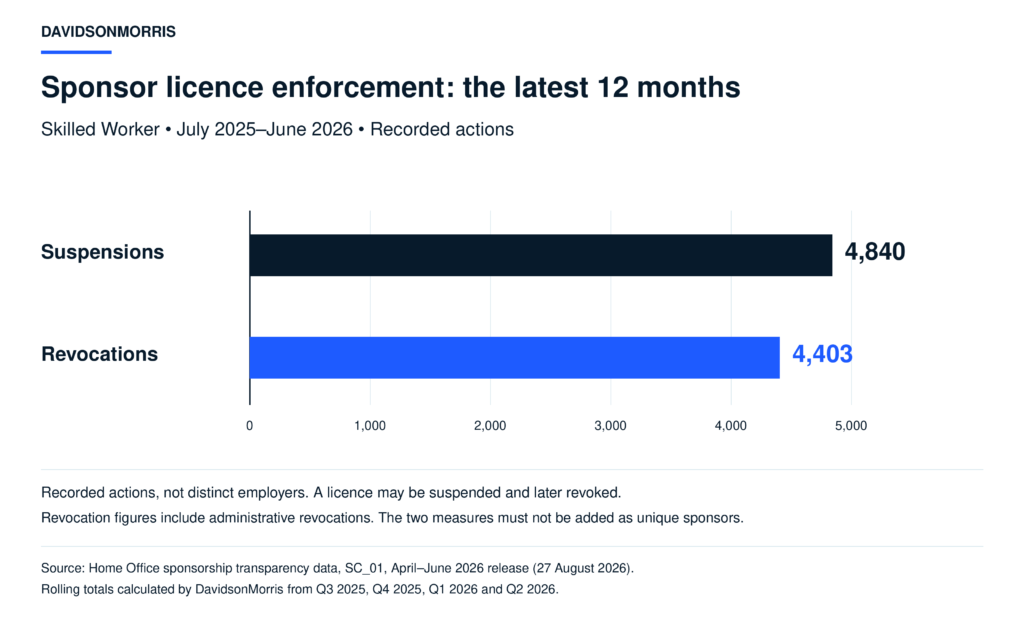
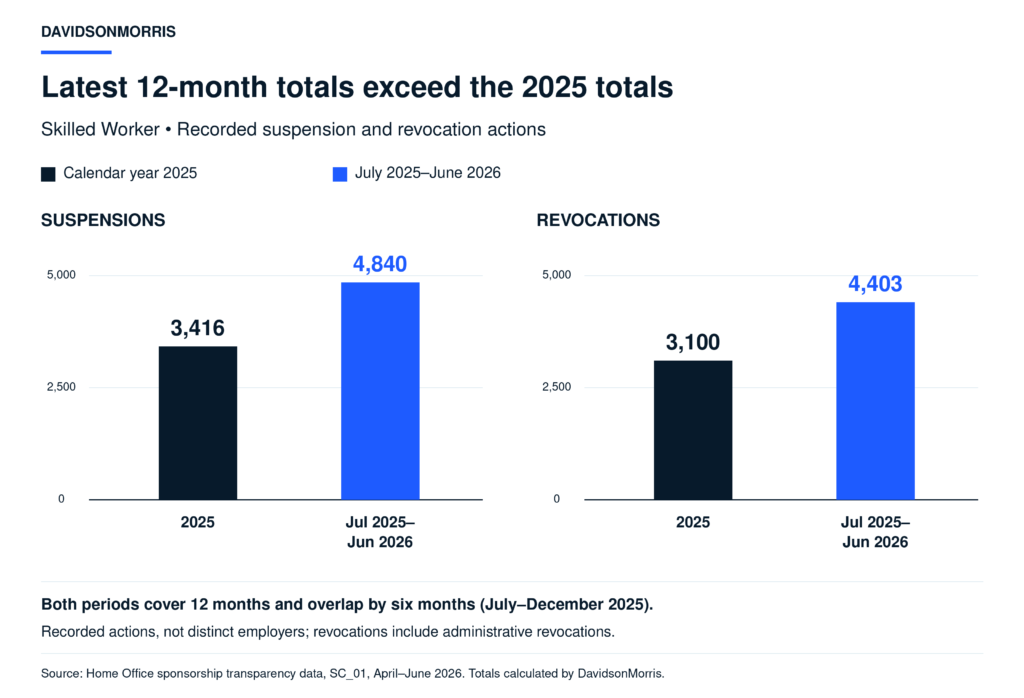
- The rolling 12-month period from July 2025 to June 2026 recorded 4,840 suspensions and 4,403 revocations.
- Suspension and revocation totals can overlap and do not represent unique employers affected.
- The published figures show the scale of enforcement activity, but do not establish a national reinstatement rate or an individual employer’s likelihood of enforcement.
UK sponsor licence suspension and revocation statistics show a sharp increase in recorded Home Office enforcement against Skilled Worker sponsors during 2025 and the first half of 2026.
In 2025, the Home Office recorded 3,416 Skilled Worker sponsor licence suspensions and 3,100 revocations, compared with 1,693 suspensions and 1,494 revocations in 2024. This represents annual increases of approximately 101.8% and 107.5% respectively.1
Enforcement remained high into 2026. During the first six months of the year, the Home Office recorded 2,632 Skilled Worker sponsor licence suspensions and 2,346 revocations. The latest rolling 12-month period, from July 2025 to June 2026, records 4,840 suspensions and 4,403 revocations.
The figures show the scale of recent Home Office intervention, but they need to be read within the reporting methodology. A licence can appear in both suspension and revocation statistics, while licences covering more than one sponsorship category may also be recorded in more than one category. The totals therefore measure enforcement actions rather than a verified number of individual employers affected.
Higher enforcement volumes also do not establish that the proportion of non-compliant sponsors has increased by the same amount. Changes in the number of licensed sponsors, Home Office investigation activity, intelligence sharing and enforcement priorities can all affect the recorded totals.
This article examines the latest UK sponsor licence suspension and revocation statistics, recent quarterly and annual trends, rolling 12-month figures and the limits of the available data. It also considers what the increase in enforcement means for employers managing sponsorship compliance, recruitment and workforce continuity.
The analysis draws primarily on the Home Office’s official sponsorship transparency dataset, Table SC_01, published on 27 August 2026, together with relevant sponsor compliance guidance.
Section A: Latest UK Sponsor Licence Suspension and Revocation Statistics
The latest Home Office data shows sustained high levels of sponsor licence enforcement across the Skilled Worker category, with significant quarterly variation during the first half of 2026.
1. How many sponsor licences have been suspended or revoked in 2026?
The latest Home Office sponsorship transparency statistics cover January to June 2026.
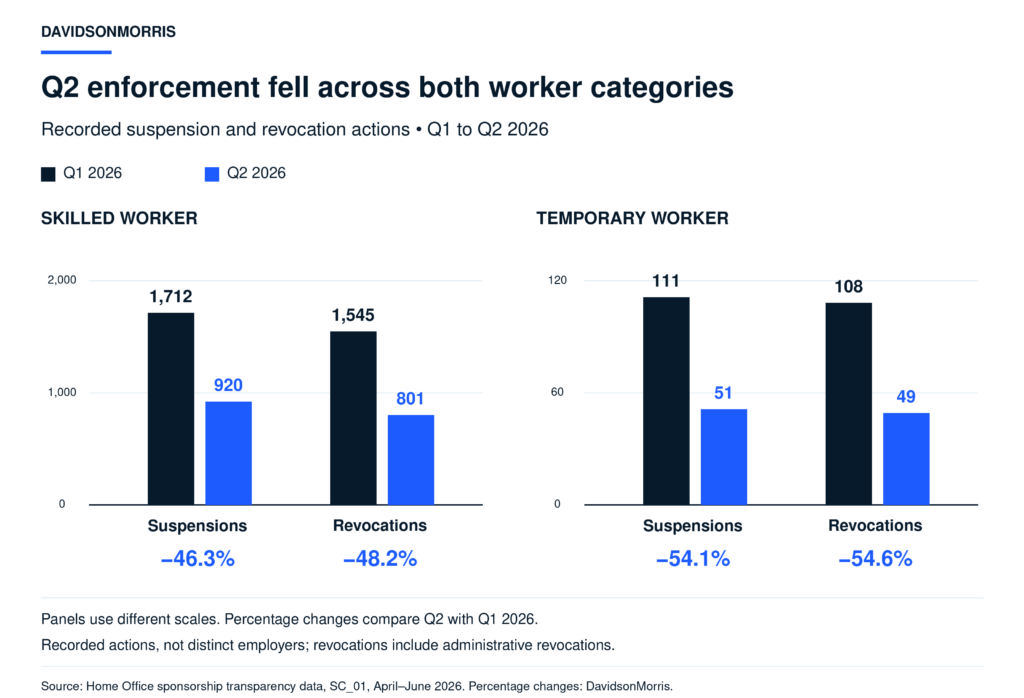
During that six-month period, the Home Office recorded 2,632 Skilled Worker sponsor licence suspensions and 2,346 revocations. The first quarter accounted for 1,712 suspensions and 1,545 revocations, followed by 920 suspensions and 801 revocations in Q2.
Temporary Worker sponsor licence enforcement is reported separately, with 162 suspensions and 157 revocations recorded across the first half of 2026.
| Enforcement measure | Q1 2026 | Q2 2026 | First half of 2026 |
|---|---|---|---|
| Skilled Worker suspensions | 1,712 | 920 | 2,632 |
| Skilled Worker revocations | 1,545 | 801 | 2,346 |
| Temporary Worker suspensions | 111 | 51 | 162 |
| Temporary Worker revocations | 108 | 49 | 157 |
Source: Home Office, Sponsorship transparency data: April to June 2026, Table SC_01. First-half totals calculated by DavidsonMorris from the published quarterly figures.
Between Q1 and Q2 2026, Skilled Worker suspensions fell by approximately 46.3% and revocations by approximately 48.2%. Temporary Worker suspensions and revocations also fell by more than half.
The Q2 reduction should be read against the unusually high enforcement levels recorded in late 2025 and Q1 2026. It does not, by itself, establish that Home Office enforcement is entering a sustained decline.
Skilled Worker and Temporary Worker totals should also remain separate when considering the number of organisations affected. The Home Office notes that licences covering multiple sponsorship categories can be counted within each applicable category.
2. How many sponsor licences were suspended and revoked in 2025?
Recorded sponsor licence enforcement increased substantially during 2025.
The Home Office recorded 3,416 Skilled Worker sponsor licence suspensions and 3,100 revocations during the calendar year, compared with 1,693 suspensions and 1,494 revocations in 2024.
| Enforcement measure | 2024 | 2025 | Annual change |
|---|---|---|---|
| Skilled Worker suspensions | 1,693 | 3,416 | +101.8% |
| Skilled Worker revocations | 1,494 | 3,100 | +107.5% |
Source: Home Office, Table SC_01. Calendar-year totals and percentage changes calculated by DavidsonMorris from the quarterly data.
Both measures approximately doubled between 2024 and 2025. In absolute terms, the Home Office recorded 1,723 more Skilled Worker suspensions and 1,606 more revocations than in the preceding year.
These figures establish a substantial increase in recorded regulatory action. They do not establish that 6,516 separate employers were affected, because the same licence may appear in both suspension and revocation statistics and the Home Office reporting definitions can capture more than one action relating to the same licence.
3. What are the latest rolling 12-month sponsor licence enforcement figures?
The rolling 12-month period from July 2025 to June 2026 captures the latest four published quarters and provides a useful measure of recent enforcement activity beyond the calendar-year totals.
Across that period, the Home Office recorded 4,840 Skilled Worker sponsor licence suspensions and 4,403 revocations.
| Reporting quarter | Skilled Worker suspensions | Skilled Worker revocations |
|---|---|---|
| Q3 2025 | 608 | 541 |
| Q4 2025 | 1,600 | 1,516 |
| Q1 2026 | 1,712 | 1,545 |
| Q2 2026 | 920 | 801 |
| Rolling 12-month total | 4,840 | 4,403 |
Source: Home Office, Table SC_01. Rolling 12-month totals calculated by DavidsonMorris.
The rolling totals capture the particularly high enforcement levels recorded in Q4 2025 and Q1 2026. The 4,403 revocations recorded across the period exceed the 3,100 revocations recorded during the 2025 calendar year, although the two periods overlap and should not be treated as separate annual comparisons.
Future quarterly releases will show whether the lower totals recorded in Q2 2026 develop into a broader trend or whether enforcement remains at historically high levels.
4. What is the difference between sponsor licence suspension and revocation statistics?
Sponsor licence suspension and revocation are different enforcement measures and the figures should be interpreted separately.
A suspension generally restricts the sponsor’s ability to use its licence while the Home Office considers compliance concerns.2 Revocation removes the organisation’s sponsorship authorisation.
A suspension may end in reinstatement or revocation, while the Home Office can also move directly to revocation where the applicable grounds are met. A suspension recorded in one quarter may therefore relate to a revocation recorded in a later reporting period.
The Home Office also changed its reporting definitions from Q2 2016 to include administrative revocations and suspensions recorded where an immediate revocation is completed. As a result, suspension and revocation totals cannot be treated as independent counts of employers.
The published aggregate data also cannot establish what proportion of suspended licences are ultimately revoked. A reliable reinstatement or suspension-to-revocation rate would require case-level data linking individual enforcement actions to their outcomes.
Employers seeking information about the legal procedure should refer to DavidsonMorris’s dedicated sponsor licence suspension guidance and the applicable Home Office sponsor compliance rules.
5. What is the official source of the latest statistics?
The principal official source is the Home Office Migration transparency data collection, specifically the sponsorship transparency dataset.
Table SC_01, ‘Action taken against Sponsors’, provides quarterly statistics covering suspensions and revocations within the Skilled Worker and Temporary Worker sponsorship categories, together with separate enforcement measures for Student sponsors.
The latest release used in this analysis covers April to June 2026 and was published on 27 August 2026. The dataset contains historical quarterly figures dating back to 2012.
The Home Office changed its reporting methodology from Q2 2016, so figures produced under the revised definitions are not directly comparable with the earlier series. DavidsonMorris therefore distinguishes between the historical record, the more directly comparable recent data and separate government enforcement announcements.
The source data is available from the Home Office Migration transparency data collection.
All DavidsonMorris calculations in this article are based on the published quarterly values unless otherwise stated.
Section B: Historical Sponsor Licence Suspensions and Revocations by Year
1. Historical UK sponsor licence enforcement statistics: 2012 to 2026
The Home Office has published quarterly statistics on sponsor licence suspensions and revocations since 2012, providing a historical record of enforcement activity against organisations licensed to sponsor overseas workers.
The data shows considerable variation in the number of suspensions and revocations over time, with particularly substantial increases recorded from 2023 onwards.
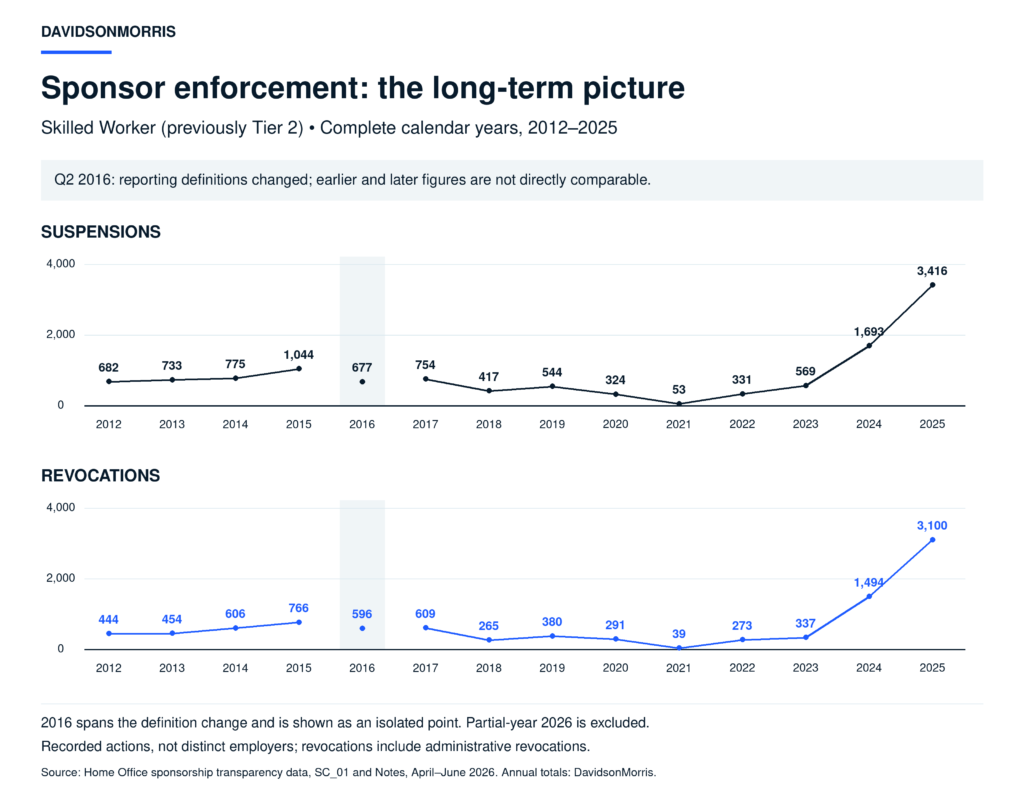
For the Skilled Worker sponsorship category, which includes the historical Tier 2 classification, recorded suspensions increased from 569 in 2023 to 1,693 in 2024 and 3,416 in 2025.
Revocations followed a similar pattern, increasing from 337 in 2023 to 1,494 in 2024 and 3,100 in 2025.
During the first six months of 2026, a further 2,632 suspensions and 2,346 revocations were recorded, showing that enforcement activity remained substantial after the increases during 2024 and 2025.
The following table presents the historical annual figures calculated from the Home Office’s quarterly sponsorship transparency data.
| Year | Skilled Worker suspensions | Skilled Worker revocations |
|---|---|---|
| 2012 | 682 | 444 |
| 2013 | 733 | 454 |
| 2014 | 775 | 606 |
| 2015 | 1,044 | 766 |
| 2016 | 677 | 596 |
| 2017 | 754 | 609 |
| 2018 | 417 | 265 |
| 2019 | 544 | 380 |
| 2020 | 324 | 291 |
| 2021 | 53 | 39 |
| 2022 | 331 | 273 |
| 2023 | 569 | 337 |
| 2024 | 1,693 | 1,494 |
| 2025 | 3,416 | 3,100 |
| 2026 (January to June only) | 2,632 | 2,346 |
Source: Home Office, Sponsorship transparency data: April to June 2026, Table SC_01. Calendar-year totals calculated by DavidsonMorris from the published quarterly figures. The 2026 figures cover only the first two quarters and are not full-year totals.
The historical figures demonstrate that the scale of enforcement activity has changed substantially over time.
Comparisons across the entire series must account for a change in the Home Office’s reporting definitions from the second quarter of 2016, which brought additional administrative actions within the published suspension and revocation figures.
Consequently, figures before and after that change are not directly comparable on an identical statistical basis.
The more recent period, particularly from 2019 onwards, provides a more consistent basis for examining the scale of the latest enforcement increases.
2. How have sponsor licence suspensions changed over time?
Historical sponsor licence suspension figures show several distinct periods of enforcement activity.
Between 2012 and 2015, annual Skilled Worker suspension totals ranged from 682 to 1,044. The highest recorded total during this period was 1,044 suspensions in 2015.
Following the reporting-definition change in 2016, annual suspension figures generally remained below the 2015 level until the substantial increases recorded during 2024 and 2025.
In 2018, the Home Office recorded 417 Skilled Worker suspensions, followed by 544 in 2019 and 324 in 2020.
The number fell to 53 in 2021 before increasing to 331 in 2022 and 569 in 2023.
Suspensions then rose sharply.
Recorded suspensions rose to 1,693 in 2024, representing an increase of approximately 197.5% compared with 2023.
They then increased to 3,416 in 2025, approximately 101.8% higher than the previous year.
| Year | Suspensions | Annual change |
|---|---|---|
| 2021 | 53 | — |
| 2022 | 331 | +524.5% |
| 2023 | 569 | +71.9% |
| 2024 | 1,693 | +197.5% |
| 2025 | 3,416 | +101.8% |
Source: Home Office, Table SC_01. Percentage changes calculated by DavidsonMorris. The percentage change for 2021 is omitted because the table does not include the preceding year.
Suspension activity increased substantially over several consecutive years.
However, a rise in suspensions does not necessarily indicate that a corresponding number of additional employers were found to be non-compliant.
Suspension is a regulatory action that may be taken while the Home Office considers compliance concerns. The outcome of that process may include reinstatement or revocation, depending on the circumstances.
Furthermore, the Home Office’s reporting definitions mean that certain immediate revocations may also generate recorded suspension actions.
Annual suspension totals therefore measure recorded regulatory activity. They do not count distinct employers ultimately found to have breached their sponsorship obligations.
3. How have sponsor licence revocations changed over time?
Historical sponsor licence revocation statistics show a similarly substantial increase in enforcement activity, particularly from 2023 onwards.
Between 2012 and 2017, annual Skilled Worker revocations ranged from 444 to 766.
The highest recorded total during this earlier period was 766 revocations in 2015.
Revocations subsequently decreased to 265 in 2018, before increasing to 380 in 2019.
During 2020 and 2021, recorded revocations fell to 291 and 39 respectively.
The Home Office recorded 273 revocations in 2022 and 337 in 2023.
The most substantial increase in the recent series occurred during 2024, when revocations rose to 1,494.
This represented an increase of approximately 343.3% compared with the 337 revocations recorded in 2023.
The number then increased to 3,100 in 2025, approximately 107.5% higher than in 2024.
| Year | Revocations | Annual change |
|---|---|---|
| 2021 | 39 | — |
| 2022 | 273 | +600.0% |
| 2023 | 337 | +23.4% |
| 2024 | 1,494 | +343.3% |
| 2025 | 3,100 | +107.5% |
Source: Home Office, Table SC_01. Percentage changes calculated by DavidsonMorris.
In absolute terms, the Home Office recorded 2,763 more Skilled Worker revocations in 2025 than in 2023.
The 2025 total was approximately 9.2 times the number recorded in 2023.
Substantially more sponsor licence revocations were recorded over a relatively short period.
However, the figures do not independently establish whether the increase resulted from more widespread sponsor non-compliance, improvements in detection and investigation, changes in enforcement priorities or a combination of factors.
The Home Office has identified improvements in intelligence sharing and enforcement capability as contributing to increased revocation activity.3
The historical data therefore shows higher volumes of regulatory intervention, but does not fully explain the causes of that increase.
4. When did sponsor licence enforcement begin to increase?
Recorded sponsor licence enforcement began rising particularly sharply during 2023 and increased substantially during 2024 and 2025.
Although suspension and revocation figures increased during 2022, the scale of the subsequent changes was substantially greater.
Between 2023 and 2024, recorded Skilled Worker suspensions increased from 569 to 1,693, while revocations increased from 337 to 1,494.
Both measures increased again during 2025, reaching 3,416 suspensions and 3,100 revocations.
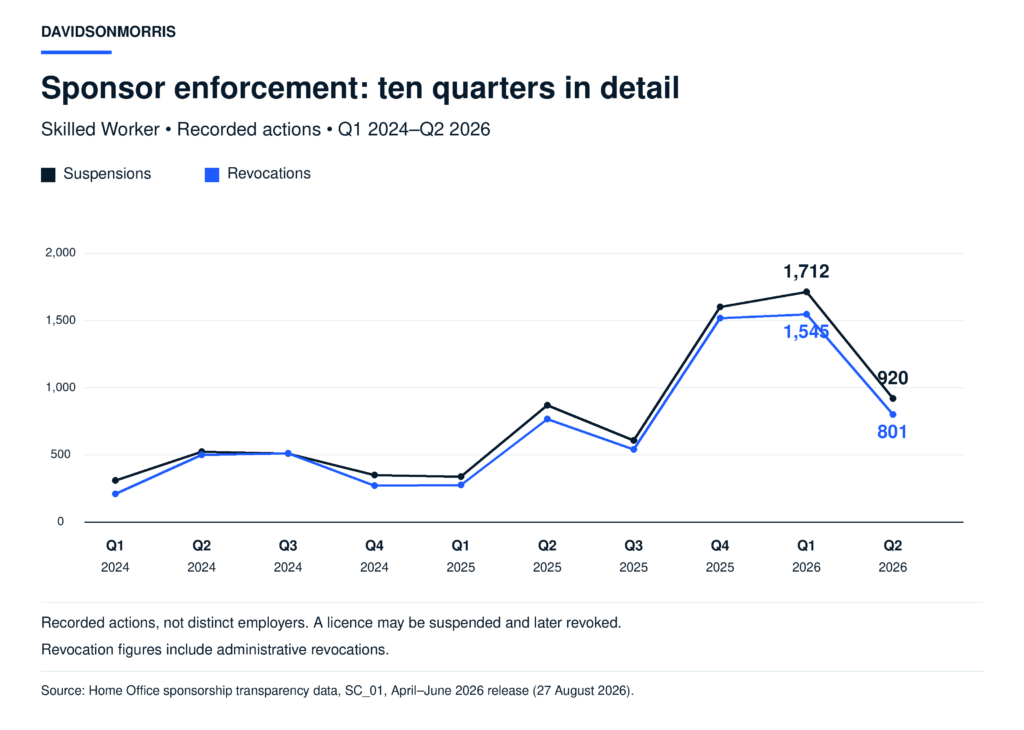
The quarterly figures show when those increases occurred.
| Quarter | Suspensions | Revocations |
|---|---|---|
| Q1 2024 | 309 | 210 |
| Q2 2024 | 524 | 499 |
| Q3 2024 | 509 | 513 |
| Q4 2024 | 351 | 272 |
| Q1 2025 | 339 | 276 |
| Q2 2025 | 869 | 767 |
| Q3 2025 | 608 | 541 |
| Q4 2025 | 1,600 | 1,516 |
| Q1 2026 | 1,712 | 1,545 |
| Q2 2026 | 920 | 801 |
Source: Home Office, Table SC_01, Skilled Worker sponsorship category.
The quarterly series shows that enforcement activity did not increase at a uniform rate.
There were substantial increases during Q2 and Q3 2024, followed by lower figures during Q4 2024 and Q1 2025.
A further increase occurred during Q2 2025. The highest quarterly totals in the available recent series occurred during Q4 2025 and Q1 2026.
In Q1 2026, the Home Office recorded 1,712 Skilled Worker suspensions and 1,545 revocations, the highest quarterly totals in the published series through June 2026.
Although the figures decreased during Q2 2026, they remained above the quarterly levels recorded throughout 2024 and during the first three quarters of 2025.
Annual and rolling 12-month comparisons help place these individual quarterly movements in context.
A decline from an exceptionally high quarter does not necessarily establish that the broader enforcement trend has reversed.
5. Why did sponsor licence enforcement figures fall during 2020 and 2021?
The historical statistics show a marked reduction in sponsor licence enforcement activity during 2020 and 2021.
Skilled Worker suspensions decreased from 544 in 2019 to 324 in 2020 and 53 in 2021.
Revocations decreased from 380 in 2019 to 291 in 2020 and 39 in 2021.
These reductions coincided with the COVID-19 pandemic and significant disruption to immigration administration, international recruitment and business operations.
However, the statistical series alone does not establish the causes of the decline.
Changes in compliance visit arrangements, operational priorities, the number of active sponsors and the volume of enforcement investigations may all have influenced the recorded figures.
Without additional official evidence quantifying the effect of those factors, the decline should not be attributed exclusively to the pandemic.
Equally, the subsequent increases in 2022 and 2023 should not automatically be characterised as a return to normal enforcement levels.
The figures show changes in recorded activity. Further evidence is needed to identify the operational factors responsible.
6. Are sponsor licence revocations increasing faster than suspensions?
During 2024 and 2025, both sponsor licence suspensions and revocations increased substantially.
In 2024, Skilled Worker suspensions increased by approximately 197.5% compared with 2023, while revocations increased by approximately 343.3%.
In 2025, suspensions increased by approximately 101.8%, while revocations increased by approximately 107.5%.
These comparisons show that recorded revocations increased at a faster percentage rate than suspensions during both years.
The growth rates also need to be read against how the two series are recorded.
Suspension and revocation totals do not necessarily represent separate groups of employers or consecutive stages within the same reporting period.
Some revocations may follow suspensions recorded in earlier quarters, while others may occur without a preceding suspension.
The Home Office’s reporting definitions also include suspensions recorded in connection with immediate revocations.
Consequently, the relative growth rates do not establish that the Home Office became more likely to revoke a suspended sponsor’s licence.
Determining whether the probability of revocation following suspension has changed would require linked case-level information identifying the outcomes of individual suspension decisions.
The available statistics show that recorded revocations increased faster than recorded suspensions during the specified periods, without establishing a change in the outcomes of individual suspension cases.
7. What do the historical figures indicate about future enforcement?
The historical statistics demonstrate that sponsor licence enforcement activity has increased substantially in recent years, reaching particularly high levels during 2025 and the first half of 2026.
However, historical trends cannot establish the number of suspensions or revocations that will occur in future reporting periods.
Enforcement activity may be affected by changes in Home Office priorities, intelligence gathering, immigration policy, the number of licensed sponsors and the prevalence of identified breaches.
The reduction recorded during Q2 2026 illustrates the difficulty of extrapolating future outcomes from individual quarters.
Although the quarterly totals were lower than those recorded in Q1 2026, they remained substantial in historical terms.
Employers should account for sponsor compliance enforcement in their operational risk planning, with effective governance and oversight.
The figures do not establish that any particular employer is likely to face suspension or revocation.
Individual enforcement exposure depends on the organisation’s compliance position, the nature of any breaches and the applicable Home Office requirements.
The historical statistics help employers understand the scale and direction of enforcement activity. They cannot predict the outcome of an individual sponsor’s case.
Section C: What the Historical Statistics Reveal About Home Office Enforcement
1. Sponsor licence enforcement has intensified substantially
The Home Office’s historical sponsor licence statistics show a sharp increase in recorded enforcement activity between 2023 and the first half of 2026.
Skilled Worker sponsor licence revocations increased from 337 in 2023 to 1,494 in 2024 and 3,100 in 2025. Over the same period, suspensions increased from 569 to 1,693 and subsequently to 3,416.
The increases continued into 2026, with 2,632 suspensions and 2,346 revocations recorded during the first six months of the year.
The latest rolling 12-month figures, covering July 2025 to June 2026, show 4,840 Skilled Worker suspensions and 4,403 revocations.
Substantially more regulatory actions were recorded against licensed sponsors.
However, increased enforcement activity does not necessarily mean that the proportion of sponsors failing to comply with their obligations has increased by an equivalent amount.
The number of recorded enforcement actions is influenced by several factors, including the identification of potential breaches, the Home Office’s investigative capabilities, the number and composition of licensed sponsors and the regulatory response to established non-compliance.
The statistics establish that more suspension and revocation actions were recorded. They do not independently establish why the increase occurred or whether the underlying prevalence of non-compliance changed.
2. The Home Office is increasingly using intelligence-led enforcement
The Home Office has linked the increase in sponsor licence revocations to improvements in intelligence sharing and the identification of sponsorship breaches.
In its September 2025 announcement on record numbers of sponsor licence revocations, the government referred to greater cooperation between public authorities and the use of intelligence to identify organisations abusing the sponsorship system.
Sponsor compliance enforcement can draw on information obtained beyond physical inspections of an employer’s premises.
The Home Office may identify concerns through information supplied by licensed sponsors, government-held records, intelligence obtained from other agencies and inconsistencies identified during regulatory activity.
Information reported through the Sponsor Management System, including changes relating to sponsored workers and organisational circumstances, forms part of the wider sponsorship compliance framework.
Where information held by the Home Office raises concerns about whether an employer continues to meet its obligations, those concerns may lead to further enquiries or compliance action.
Employers should maintain compliance continuously, with records and procedures that can be examined whenever concerns arise.
However, the published suspension and revocation statistics do not identify how many enforcement outcomes resulted from intelligence-led investigations, physical compliance visits or other investigative methods.
The government’s explanation provides context for the increase in enforcement activity, but it does not establish the precise contribution of individual enforcement methods to the overall figures.
3. Enforcement statistics are not the same as non-compliance statistics
Enforcement figures count regulatory actions but cannot directly measure how widespread employer non-compliance is.
Revocation statistics record licences withdrawn by the Home Office during a specified period. Suspension statistics record suspension actions taken during that period.
Neither measure directly establishes the proportion of all licensed sponsors that have breached their obligations.
For example, an increase in revocations could reflect improvements in the detection of existing breaches rather than a corresponding increase in the number of employers acting unlawfully.
Changes in enforcement resources, regulatory priorities and the size of the licensed sponsor population may also affect the number of recorded outcomes.
Year-to-year comparisons therefore need to separate enforcement volumes from changes in underlying compliance.
The increase from 337 Skilled Worker revocations in 2023 to 3,100 in 2025 establishes that the number of recorded revocations increased substantially.
It does not establish that an individual licensed sponsor was approximately nine times more likely to breach its obligations or have its licence revoked.
Those conclusions would require additional evidence, including consistent information about the licensed sponsor population, the number of investigations and the circumstances leading to enforcement decisions.
Recorded regulatory intervention increased substantially. The reasons for that increase and its implications for individual sponsors require separate assessment.
4. Can the probability of sponsor licence revocation be calculated?
The published figures can be used to calculate the number of revocations during a defined period, but they do not automatically establish the probability that an individual sponsor will lose its licence.
A population-based revocation rate would require the number of licences revoked to be compared with an appropriately defined population of licensed sponsors over the same reporting period.
For example, a rate expressed as revocations per 1,000 licensed sponsors would require a consistent numerator and denominator.
Several methodological issues would need to be resolved before presenting such a calculation.
First, the population of licensed sponsors changes as organisations obtain licences, cease sponsorship activity or have their licences withdrawn.
Second, some organisations are authorised under more than one sponsorship category. The Home Office’s transparency data may count enforcement actions against these organisations within each applicable category.
Third, a snapshot of the sponsor register at the end of a reporting period does not necessarily represent the population of sponsors exposed to enforcement throughout that period.
Fourth, the number of recorded revocation actions may not be identical to the number of distinct organisations affected.
Finally, national enforcement rates do not account for differences in individual compliance circumstances, sponsorship activity or regulatory exposure.
For these reasons, DavidsonMorris does not use a single sponsor register snapshot to calculate an unqualified national revocation probability.
The available data supports analysis of enforcement volumes and historical trends. Estimating revocation risk within a defined sponsor population would require a statistical model that addresses these issues.
5. What does the decline in Q2 2026 enforcement figures mean?
The Home Office recorded a substantial reduction in Skilled Worker sponsor licence suspensions and revocations between the first and second quarters of 2026.
Suspensions decreased from 1,712 in Q1 to 920 in Q2, a reduction of approximately 46.3%.
Revocations decreased from 1,545 to 801, a reduction of approximately 48.2%.
These were substantial quarterly reductions after the exceptionally high enforcement totals recorded during Q4 2025 and Q1 2026.
The earlier quarterly totals provide context for the reduction.
The 920 Skilled Worker suspensions recorded in Q2 2026 exceeded the total recorded during any individual quarter of 2024 or 2025, apart from Q4 2025.
Similarly, the 801 revocations recorded during Q2 2026 exceeded the figures recorded in individual quarters of 2024 and the first three quarters of 2025.
The reduction therefore occurred from an exceptionally high starting point.
It does not, by itself, demonstrate that the Home Office has reduced its enforcement priorities or adopted a less interventionist approach to sponsor compliance.
Further quarterly releases will be needed to establish whether the decline represents a sustained change in enforcement activity or a temporary fluctuation.
The latest rolling 12-month figures help put those quarterly movements in context by combining the most recent four quarters.
6. What the enforcement statistics cannot establish
The Home Office’s sponsorship transparency data provides a substantial historical record, with gaps that limit what can be concluded from it.
The figures do not establish the total number of sponsor compliance investigations initiated during each period or the proportion of investigations resulting in enforcement action.
They do not identify the final outcome of every suspension or the number of licences reinstated following suspension.
They also do not establish the average time taken to resolve a suspension, the number of distinct employers affected by multiple enforcement actions or the proportion of revocations subsequently challenged successfully.
In addition, the standard published statistics do not provide a complete, consistently classified industry-level breakdown capable of supporting reliable comparisons of revocation rates across every sector of the economy.
The figures therefore cannot establish that a particular industry has the highest probability of sponsor licence revocation simply because it accounts for a substantial number of enforcement actions.
Nor do they demonstrate that every suspension involves a proven breach of sponsorship obligations.
The increase in recorded enforcement activity remains substantial despite these gaps in the data.
Any conclusions drawn from the statistics need to stay within what the data can support.
The Home Office has recorded substantially more sponsor licence suspension and revocation actions in recent years. The published data does not fully measure how widespread sponsor non-compliance is or explain its causes.
Section D: Sponsor Licence Revocations by Industry and Sector
1. Which industries are affected by sponsor licence enforcement?
Sponsor licence enforcement applies across the UK economy to organisations authorised to sponsor overseas nationals under relevant immigration routes.
Employers in healthcare, adult social care, hospitality, construction, manufacturing, retail, technology, professional services and other industries may be subject to Home Office scrutiny where concerns arise about their compliance with sponsorship obligations.
The Home Office has identified particular concerns about abuse of the sponsorship system in sectors including adult social care, hospitality, retail and construction.
However, the presence of enforcement activity in a particular industry does not necessarily establish that employers in that industry face a higher probability of licence revocation.
The number of enforcement actions recorded within a sector may be influenced by the number of licensed sponsors, the volume of sponsored employment, the nature of recruitment arrangements and the Home Office’s investigative priorities.
For example, an industry containing a large number of licensed sponsors may account for more revocations than a smaller industry without having a higher revocation rate.
A meaningful comparison would require consistent information about the number of licences revoked and the population of licensed sponsors operating within each sector during the same reporting period.
The Home Office’s standard sponsorship transparency data does not provide a complete sector-by-sector revocation rate using that methodology.
Sector-specific findings should therefore be drawn from separately identified official publications rather than inferred from the national totals.
2. Sponsor licence revocations in the adult social care sector
Adult social care has been a prominent focus of Home Office sponsor licence enforcement, particularly following concerns about the treatment of internationally recruited care workers and compliance with sponsorship requirements.
In March 2025, the government reported that more than 470 care-sector sponsor licences had been revoked between July 2022 and December 2024.4
The figure was published alongside measures intended to strengthen protections for internationally recruited care workers and address non-compliance within the sector.
The government identified concerns including exploitation, inappropriate recruitment practices, workers being charged substantial fees and circumstances in which sponsored employees did not receive the employment opportunities they had been promised.
Sponsors are responsible for the work undertaken by sponsored employees and the accuracy of information provided to the Home Office, so those recruitment and employment concerns can also raise sponsorship compliance issues.
Where a sponsor fails to meet its obligations, enforcement action may have consequences for both the organisation and its sponsored workforce.
The figure of more than 470 care-sector revocations demonstrates the scale of enforcement activity within the sector during the specified period.
However, it is not a calendar-year figure and should not be compared directly with annual national totals without recognising the different reporting periods.
Nor does it establish the proportion of all care-sector sponsors whose licences were revoked.
The statistic shows the scale of Home Office enforcement attention in adult social care during the period. It does not provide a complete measure of the sector’s compliance performance.
3. Why has the care sector received particular enforcement attention?
The government’s focus on adult social care has developed alongside wider concerns about international recruitment practices and the vulnerability of some sponsored care workers.
Official announcements have identified cases involving workers who incurred substantial recruitment debts, experienced exploitation or arrived in the UK to find that the employment arrangements described during recruitment were not available.
These circumstances can create serious difficulties for sponsored workers, whose immigration permission may depend on their relationship with a licensed sponsor.
Where a care provider’s sponsor licence is revoked, affected workers may need to find alternative sponsorship or take other steps to regularise their immigration position.
The government has introduced support arrangements for displaced international care workers in England, including regional initiatives intended to assist individuals affected by sponsor licence revocations.5
Support for affected workers also reflects the workforce consequences that can follow enforcement action against an employer.
However, the existence of support arrangements does not establish the number of additional care-sector revocations occurring during a particular reporting period.
Such figures must be obtained from appropriately defined official statistical releases or government statements.
Adult social care employers should check that recruitment practices, employment arrangements and sponsorship records accurately reflect sponsored workers’ circumstances.
Sponsor compliance should also be considered alongside workforce governance and worker protection arrangements.
4. Are care-sector sponsors more likely to lose their licences?
The available official statistics do not establish a reliable national probability of sponsor licence revocation for care-sector employers compared with other industries.
Although the government has reported substantial numbers of care-sector revocations, the figures need to be considered alongside the number of licensed sponsors operating within the sector.
A meaningful sector-specific revocation rate would require a consistent definition of care-sector sponsorship, an appropriate licensed sponsor population and enforcement figures covering the same period.
The calculation would also need to address changes in the number of licensed care providers and any differences between organisations, licences and sponsorship categories.
Without those controls, a higher number of revocations in one sector cannot reliably establish a higher probability of enforcement against an individual employer.
It would therefore be misleading to use the published care-sector totals to claim that care providers are more likely than all other employers to have their sponsor licences revoked.
The evidence shows that adult social care has been a focus of Home Office enforcement activity and that the government has identified serious compliance concerns within parts of the sector.
5. Can sponsor licence revocation statistics be compared across industries?
Industry-level comparisons are possible only where the underlying data supports a consistent methodology.
For each sector, the analysis would need to establish the number of licensed sponsors, the number of licences revoked and the reporting period covered by those figures.
It would also need to account for organisations operating across multiple industries, differences in sponsorship routes and changes in the number of licensed sponsors over time.
Sector classification presents an additional challenge.
An organisation’s registered industry classification may not fully reflect the nature of its sponsored workforce or the activities giving rise to a particular compliance concern.
Furthermore, the Home Office may focus enforcement resources on particular industries in response to intelligence about suspected abuse, influencing the number of actions recorded within those sectors.
Raw enforcement counts cannot account for these factors and are insufficient to rank industries reliably by revocation risk.
Where sector-specific official statistics are available, they can provide useful evidence of the scale of enforcement activity.
Comparisons should identify the relevant population, reporting period and limitations. Enforcement volume alone cannot directly measure underlying compliance standards.
6. What do sector-specific enforcement figures mean for employers?
Sector-specific enforcement statistics can help employers understand areas of regulatory attention, but they should not be used as a substitute for assessing their own sponsorship compliance arrangements.
An employer operating in a sector that has received particular Home Office scrutiny should consider whether its recruitment practices, sponsorship records and governance arrangements adequately address the relevant compliance risks.
However, employers in sectors with fewer reported enforcement actions remain subject to the same underlying sponsorship framework where they hold equivalent licences.
Home Office enforcement powers are not restricted to industries identified in government announcements.
For individual organisations, the relevant considerations include whether sponsored workers are employed in accordance with applicable requirements, whether reportable changes are notified, whether required records are maintained and whether the sponsor continues to meet its wider duties.
The historical figures demonstrate that enforcement activity has increased substantially across the sponsorship system.
The sector-specific evidence provides additional context, particularly in adult social care, but does not establish a reliable probability of revocation for any particular employer.
Employers should use the statistics as context for assessing compliance risks against their own circumstances and obligations.
Section E: What Happens After a Sponsor Licence Suspension?
1. Does every sponsor licence suspension result in revocation?
Not every sponsor licence suspension results in revocation.
Suspension and revocation are distinct Home Office regulatory actions, and a suspension does not necessarily mean that an employer will permanently lose its authority to sponsor overseas workers.
Where the Home Office suspends a sponsor licence, it will generally notify the organisation of the concerns identified and provide an opportunity to respond in accordance with the applicable sponsor guidance.
The Home Office will then consider the available information and determine the appropriate regulatory outcome.
Depending on the circumstances, a suspended licence may be reinstated, potentially with a downgraded rating, or revoked.
However, the Home Office is not required to suspend a sponsor licence before revoking it where the relevant grounds for immediate revocation apply.
Cases that proceed directly to revocation also affect how the published statistics should be read.
The Home Office’s sponsorship transparency data records suspension and revocation actions within specified reporting periods. It does not provide a complete record linking every suspension to its eventual outcome.
Furthermore, the Home Office’s reporting definitions include suspension records associated with immediate revocation decisions.
Consequently, the suspension and revocation totals cannot be treated as separate populations of employers or as consecutive stages within a single enforcement process.
For example, the 3,416 Skilled Worker suspensions and 3,100 revocations recorded in 2025 do not establish that 3,100 of the 3,416 suspended licences were subsequently revoked.
Some revocations may have followed suspensions initiated during earlier periods, while others may have occurred without a preceding suspension.
Determining the proportion of suspended licences ultimately revoked would require case-level information linking individual suspension decisions to their final outcomes.
The published statistics therefore demonstrate the volume of enforcement actions but do not establish the probability that a suspended sponsor will lose its licence.
2. How many suspended sponsor licences are reinstated?
The Home Office’s standard sponsorship transparency dataset does not provide a complete, consistently published series identifying the number of sponsor licences reinstated following suspension.
Table SC_01 reports suspension and revocation actions, but it does not identify the final outcome of every suspension or provide a corresponding national reinstatement rate.
As a result, it is not possible to calculate reliably what proportion of suspended sponsor licences are subsequently reinstated using the published suspension and revocation totals alone.
For example, subtracting the number of revocations recorded during a calendar year from the number of suspensions recorded during the same year would not establish the number of licences reinstated.
The calculation would be unreliable because suspension and revocation decisions may occur in different reporting periods, some revocations may occur without prior suspension, and the published figures may include related administrative actions.
Nor would the resulting difference necessarily account for suspensions that remained unresolved at the end of the reporting period.
Reliable reinstatement statistics would require information identifying each suspension, its final outcome and the date on which that outcome occurred.
Without those data, the published totals cannot support claims about the percentage of suspended sponsor licences reinstated.
An employer facing suspension needs to assess whether it can address the Home Office’s concerns and demonstrate that it continues to meet the applicable sponsorship requirements. A national reinstatement percentage cannot answer that question.
The outcome will depend on the circumstances of the individual case and the Home Office’s assessment of the evidence.
3. How long does a sponsor licence suspension last?
The published sponsorship transparency statistics do not establish the average duration of a sponsor licence suspension.
Table SC_01 records the number of suspension and revocation actions but does not provide a national series showing the time taken to resolve individual suspension cases.
The duration of a suspension may depend on the nature and complexity of the Home Office’s concerns, the information requested from the sponsor and whether further enquiries are considered necessary.
Under the sponsor guidance, an organisation has 20 working days from the written suspension notification to respond with representations and evidence; extra time may be allowed in exceptional circumstances.
The Home Office may consider that response alongside information already held and any additional material obtained during its investigation.
The Home Office normally gives its final decision within 20 working days of receiving the response, but exceptionally complex cases or outstanding third-party information can delay this; the sponsor should be notified of the delay.
There is no reliable basis in the published SC_01 statistics for calculating a national average suspension duration or predicting how long an individual case will take.
The suspension itself can have significant operational consequences for an employer.
A suspended sponsor cannot assign any new Certificates of Sponsorship, affecting recruitment and extensions requiring a new CoS.
Existing sponsored workers with valid permission are not affected by the suspension itself unless or until the licence is revoked, although pending applications can be held while the suspension is resolved.
Employers should therefore treat a suspension as an urgent regulatory matter and consider both the response required by the Home Office and the potential consequences for their workforce.
4. What are the possible outcomes of a sponsor licence suspension?
A sponsor licence suspension may lead to different outcomes depending on the Home Office’s findings and the applicable sponsor guidance.
Reinstatement with an A-rating
Where the Home Office is satisfied that the concerns do not justify continued regulatory restrictions, the sponsor licence may be reinstated with its A-rating.
The organisation can then resume sponsorship activity in accordance with the conditions of its licence and the relevant immigration rules.
Reinstatement with a B-rating
In some circumstances, the Home Office may reinstate a licence with a B-rating, requiring a paid action plan and preventing sponsorship of new workers until the A-rating is restored.
The availability of this outcome depends on the nature of the concerns and the applicable sponsor guidance. A Provisional UK Expansion Worker licence cannot be downgraded to a B-rating. It should not be assumed that an action plan will be offered where grounds for revocation apply.
Sponsor licence revocation
The Home Office will revoke where mandatory grounds apply; other grounds permit revocation subject to the qualifications in the sponsor guidance.
Revocation removes the organisation’s authority to sponsor workers under the affected licence and may have serious consequences for its existing sponsored workforce.
Further enquiries before a decision
The Home Office may also require further information or undertake additional enquiries before reaching a final decision.
The published statistics do not provide a complete breakdown showing how frequently each of these outcomes occurs following suspension.
The list of possible outcomes therefore gives no statistical indication of how often each occurs or which decision is most likely.
5. Can the Home Office revoke a sponsor licence without suspending it first?
Yes. The Home Office can revoke a sponsor licence without first suspending it where the applicable grounds for immediate revocation are established.
Suspension is not a mandatory preliminary stage in every sponsor licence revocation case.
The relevant sponsor guidance distinguishes between circumstances in which the Home Office may suspend a licence while investigating concerns and circumstances in which revocation may be appropriate without a preceding suspension.
These circumstances can include serious failures to comply with sponsorship requirements, depending on the specific facts and the applicable grounds for revocation.
Revocations cannot be assumed to be the final outcomes of suspensions recorded during the same reporting period, since cases may follow different processes.
The Home Office’s statistical definitions also recognise administrative recording practices associated with immediate revocations.
As a result, the published suspension and revocation figures cannot be used to reconstruct the sequence of enforcement decisions in individual cases.
Serious compliance failures may therefore result in the loss of a sponsor licence without an earlier suspension providing an opportunity to address the concerns through a separate suspension process.
Employers need effective compliance arrangements in place before regulatory intervention occurs.
6. What happens to sponsored workers if a licence is revoked?
Sponsor licence revocation can have significant consequences for workers whose immigration permission depends on sponsorship by the affected organisation.
Where a sponsor’s licence is revoked, the organisation generally loses its authority to continue sponsoring workers under the relevant routes.
The Home Office normally cancels or shortens affected sponsored workers’ immigration permission, subject to the applicable Immigration Rules and individual circumstances.
Workers may need to obtain alternative sponsorship, qualify for another immigration route or make arrangements to leave the UK.
The timing and consequences will depend on the worker’s immigration position and any applicable exceptions or protections.
Revocation may also affect the employer’s ability to fulfil contractual commitments, maintain staffing levels and continue recruitment plans involving overseas workers.
The potential business consequences make sponsor licence enforcement statistics relevant to employers, even though they cannot establish an individual organisation’s probability of enforcement.
Revocation can affect workforce continuity, operational planning and organisational reputation, beyond the administrative loss of the licence.
7. Why are suspension outcome statistics important?
Statistics on suspension outcomes would show more about how the Home Office exercises its enforcement powers.
For example, a consistent national series showing the number of suspensions resulting in reinstatement, downgrading or revocation would help distinguish investigative intervention from final regulatory sanctions.
Information about the duration of suspension cases would also assist employers in understanding the potential operational consequences of enforcement proceedings.
However, the currently published SC_01 series does not provide sufficient information to calculate these measures reliably.
The absence of those statistics should not be filled with estimates derived from unrelated annual suspension and revocation totals.
Doing so could create a misleading impression of the likelihood of reinstatement or revocation.
The available evidence supports analysis of the number of enforcement actions recorded and the changes in those numbers over time.
It does not establish a national suspension-to-revocation conversion rate, reinstatement rate or average case duration.
The published figures must therefore be used to describe recorded actions, with any claims about case outcomes supported by separate evidence.
Section F: What the Statistics Reveal About Home Office Enforcement Decisions
1. Home Office enforcement activity has reached historically elevated levels
The Home Office’s sponsorship transparency statistics show that the volume of sponsor licence suspension and revocation actions increased substantially during 2024 and 2025 and remained elevated during the first half of 2026.
The increase is particularly apparent in the Skilled Worker sponsorship category.
Annual revocations increased from 337 in 2023 to 1,494 in 2024 and 3,100 in 2025.
During the first six months of 2026, the Home Office recorded a further 2,346 Skilled Worker revocations.
The latest rolling 12-month period, from July 2025 to June 2026, recorded 4,403 revocations and 4,840 suspensions.
These figures show a substantial increase in recorded enforcement activity.
However, they do not establish that the Home Office has adopted a uniform approach to every compliance concern or that individual sponsors face identical enforcement risks.
The appropriate regulatory response depends on the relevant sponsor guidance, the circumstances of the case and the Home Office’s findings.
The statistics show the scale of enforcement intervention. They cannot establish the outcome to expect in a particular case.
2. Enforcement decisions may reflect intelligence and compliance investigations
The Home Office has attributed part of the increase in sponsor licence revocations to improved intelligence sharing and enforcement methods.
Sponsorship breaches may therefore be identified through information from several regulatory and investigative sources.
Compliance visits remain an important part of the sponsorship enforcement framework, but they are not the only means through which concerns may be identified.
The Home Office may also consider information held across government systems, reports submitted by sponsors and intelligence relevant to suspected breaches.
Where concerns arise, the Home Office may undertake further enquiries and determine whether regulatory action is justified.
However, the published suspension and revocation statistics do not identify the investigative method used in each case.
They therefore cannot establish what proportion of revocations resulted from compliance visits, intelligence sharing, document checks or other forms of investigation.
The evidence identifies intelligence-led enforcement as an important feature of the government’s approach, without quantifying which methods led to individual enforcement outcomes.
3. A rise in revocations does not establish a corresponding rise in sponsor non-compliance
The increase in sponsor licence revocations should not be interpreted automatically as evidence that the proportion of non-compliant sponsors has increased by the same amount.
Enforcement statistics measure regulatory actions taken, not the underlying prevalence of sponsorship breaches across the entire licensed sponsor population.
Several factors may influence the number of recorded revocations.
These include changes in the number of licensed sponsors, improvements in the detection of breaches, increased investigative resources and changes in Home Office enforcement priorities.
The characteristics of organisations holding sponsor licences may also change over time as sponsorship becomes more widely used across different industries.
Without consistent information about the number of sponsors investigated, the nature of the breaches identified and the population exposed to enforcement, the published totals cannot establish whether non-compliance itself has become more prevalent.
The figures nevertheless demonstrate that a substantially greater number of revocation actions were recorded during the latest reporting periods.
Employers can use the figures to understand the regulatory environment, but cannot derive an individual probability of enforcement from them.
4. Sponsor licence enforcement is not limited to immigration paperwork
Sponsor licence compliance extends beyond submitting immigration applications and assigning Certificates of Sponsorship.
Licensed sponsors are subject to ongoing obligations relating to sponsored employment, record keeping, reporting, organisational circumstances and compliance with applicable immigration requirements.
Concerns about whether sponsored workers are undertaking appropriate work, receiving the required remuneration or working in accordance with their sponsorship arrangements may have implications for the sponsor’s licence.
Failures relating to wider employment and immigration compliance can also be relevant where the sponsor guidance identifies them as grounds for regulatory action.
Right to work compliance can also affect a sponsor’s position.
From 1 October 2026, changes to the statutory right to work checking framework extend relevant responsibilities beyond conventional employment contracts to specified working arrangements, including certain worker’s contracts, individual subcontracting arrangements and online matching services, subject to the legislation and applicable guidance.6, 7, 8, 9
These changes must be distinguished from the separate duties imposed on organisations holding sponsor licences.
The statutory right to work checking framework concerns the steps required to establish a statutory excuse against liability for an illegal working civil penalty where that protection is available.
Sponsor licence duties arise separately under the immigration sponsorship system and may require additional records, monitoring and reporting.
An employer’s compliance with one framework does not automatically establish compliance with the other.
Where illegal working or failures to conduct required checks give rise to grounds for sponsor licence action under the applicable guidance, the Home Office may consider suspension or revocation.
However, the right to work changes introduced on 1 October 2026 cannot explain the historical increase in sponsor licence enforcement recorded during 2023, 2024 or 2025.
Those earlier figures predate the changes and must be analysed in their own regulatory context.
5. Enforcement statistics do not determine the outcome of an individual case
National suspension and revocation statistics provide evidence of the scale of Home Office enforcement activity, but they cannot determine whether a particular employer will face regulatory action.
The outcome of an individual sponsor compliance matter depends on the relevant facts, the applicable sponsor guidance and the Home Office’s assessment of the evidence.
Relevant considerations may include the nature and seriousness of any breach, whether the sponsor continues to satisfy the requirements of its licence and whether the circumstances fall within grounds for suspension, downgrading or revocation.
The number of enforcement actions recorded nationally does not establish that all licensed sponsors face the same level of regulatory exposure.
Nor does it establish that a particular employer is more likely than not to lose its licence following an investigation.
Employers should therefore avoid using national enforcement statistics as a substitute for assessing their own compliance arrangements.
The statistics provide context for employers reviewing sponsorship governance and the broader enforcement environment.
6. What do the latest figures suggest about Home Office enforcement priorities?
The substantial increase in sponsor licence suspensions and revocations is consistent with the government’s stated emphasis on identifying and addressing abuse of the immigration sponsorship system.
Official announcements have highlighted concerns about non-compliant sponsors, exploitation of sponsored workers and the misuse of immigration routes.
The recorded increase shows the scale of regulatory action concerning sponsor compliance.
However, the quarterly statistics do not identify every operational priority influencing Home Office decisions.
Nor do they establish that the same enforcement priorities will apply indefinitely.
Changes in government policy, immigration rules, investigative resources and intelligence may influence future activity.
The reduction in recorded suspensions and revocations during Q2 2026 also shows how individual quarters can differ from the longer-term trend.
Further statistical releases will be needed to determine whether the latest quarterly decline develops into a sustained change.
Employers should maintain effective compliance arrangements. A reduction in quarterly enforcement figures does not establish that regulatory expectations have been relaxed.
Section G: Sources, Definitions and Research Methodology
1. Primary statistical source: Home Office Table SC_01
The principal statistical source for this article is the Home Office’s Sponsorship transparency data, published as part of the Migration transparency data collection.
The analysis uses Table SC_01, titled ‘Action taken against Sponsors’, from the April to June 2026 release published on 27 August 2026.
The table provides quarterly figures for sponsor licence suspensions and revocations, including the Skilled Worker and Temporary Worker sponsorship categories.
It also includes separate information relating to Student sponsor enforcement.
The dataset contains quarterly observations dating back to 2012, allowing recorded sponsor licence enforcement activity to be compared over time.
DavidsonMorris has used the published quarterly values to calculate calendar-year totals, changes between reporting periods and rolling 12-month figures.
Where figures are derived from the underlying quarterly data rather than reproduced directly from an official announcement, they are identified as DavidsonMorris calculations.
The primary source is available from the Home Office Migration transparency data collection.
2. What is counted as a sponsor licence suspension or revocation?
The Home Office’s sponsorship transparency statistics report regulatory actions recorded against sponsors during specified reporting periods.
A suspension is a regulatory action affecting the operation of a sponsor licence while the Home Office considers relevant compliance concerns.
A revocation is the withdrawal of a sponsor licence, removing the organisation’s authority to sponsor workers under the affected licence.
Although the two measures are reported separately, they should not be treated as entirely independent populations of employers.
A licence may be suspended and subsequently revoked, with the relevant actions recorded in different reporting periods.
In other circumstances, the Home Office may revoke a licence without first undertaking a separate suspension process.
The Home Office’s statistical definitions also include suspensions recorded in connection with immediate revocation decisions.
Consequently, the figures should be interpreted as counts of recorded enforcement actions within the relevant sponsorship categories.
They do not necessarily identify the number of distinct employers affected, the number of separate investigations or the number of cases in which a suspension resulted in revocation.
3. The 2016 change in Home Office reporting definitions
The Home Office changed its statistical reporting definitions from the second quarter of 2016, limiting comparisons across that point in the series.
The Home Office notes that the revised definitions include administrative revocations and suspensions recorded when an immediate revocation is completed.
This affects the comparability of figures published before and after the change.
Figures in the historical series from 2012 onwards were therefore not all produced using identical reporting definitions.
The earlier figures remain useful for understanding the historical record, but comparisons spanning the definition change require particular caution.
For this reason, the principal analysis of recent enforcement trends focuses on periods reported under the revised definitions.
The article also distinguishes changes in recorded enforcement activity from changes in the underlying prevalence of sponsor non-compliance.
A statistical increase may reflect changes in the recording of regulatory actions, the identification of breaches, enforcement resources or other factors.
The Home Office’s methodological notes need to be read alongside the published figures.
4. Why Skilled Worker and Temporary Worker figures are reported separately
The Home Office publishes suspension and revocation figures for different sponsorship categories.
In this article, Skilled Worker and Temporary Worker statistics are reported separately to preserve the distinctions used in the official dataset.
The Home Office notes that licences covering multiple sponsorship categories are counted within each applicable category.
Consequently, adding the Skilled Worker and Temporary Worker figures together would not necessarily produce the number of distinct organisations affected by enforcement action.
An organisation authorised under more than one sponsorship category may be represented in multiple category-level totals.
National enforcement totals and comparisons across sponsorship routes must account for this overlap.
The Skilled Worker figures are used as the principal statistical series because they provide a consistent category-specific basis for examining the recent increase in work sponsorship enforcement.
They should not, however, be described as the total number of distinct UK employers whose sponsor licences were suspended or revoked.
Similarly, the separate Student sponsor statistics should not be combined with worker sponsorship figures without addressing differences in categories, definitions and potential duplication.
5. Calendar years, quarters and rolling 12-month periods
The Home Office’s SC_01 dataset provides quarterly observations.
DavidsonMorris has calculated calendar-year totals by adding the four quarters from January to December of the relevant year.
For example, the 2025 Skilled Worker revocation total of 3,100 represents the sum of the four quarters from January to December 2025.
The latest available 2026 data covers January to June only. It therefore represents the first six months of the year rather than a completed annual total.
The article also uses a rolling 12-month period covering July 2025 to June 2026.
This measure combines Q3 2025, Q4 2025, Q1 2026 and Q2 2026.
The resulting totals are 4,840 Skilled Worker suspensions and 4,403 revocations.
Rolling 12-month figures cover the latest four quarters, so the reporting window can include more recent data than the last completed calendar year.
However, they must be distinguished from completed calendar-year figures and from government announcements using different reporting periods.
For example, the government’s previously announced revocation totals for July-to-June periods should not be treated as directly equivalent to January-to-December totals.
Comparisons must identify the reporting period and sponsorship category to avoid presenting overlapping or differently defined figures as independent observations.
6. Statistical cut-off date and future revisions
The statistical cut-off for this article is 30 June 2026, corresponding to the end of the latest reporting quarter included in the Home Office’s sponsorship transparency release available at the time of preparation.
The underlying dataset was published on 27 August 2026.
Although the article also discusses relevant legal and policy developments effective from 1 October 2026, those developments fall outside the period covered by the statistical analysis.
They must therefore not be presented as causes of suspension or revocation figures recorded during 2023, 2024, 2025 or the first half of 2026.
Future Home Office releases may provide additional quarters, revise earlier figures or amend methodological notes.
When updating this article, DavidsonMorris will distinguish newly published observations from changes to previously reported data.
Any subsequent calculations should be reconciled against the relevant version of the official SC_01 dataset.
Separating new observations from revisions helps readers assess changes in sponsor licence enforcement over time.
7. How percentage changes have been calculated
Percentage changes in this article are calculated by comparing the difference between two reporting-period totals with the total recorded during the earlier period.
The calculation is expressed as:
Percentage change = ((Later period total − Earlier period total) ÷ Earlier period total) × 100.
For example, Skilled Worker revocations increased from 1,494 in 2024 to 3,100 in 2025.
The increase of 1,606 revocations represents approximately 107.5% of the 2024 total.
Similarly, Skilled Worker suspensions increased from 1,693 in 2024 to 3,416 in 2025, representing an increase of approximately 101.8%.
Percentage changes are generally rounded to one decimal place.
These calculations describe changes in the number of recorded enforcement actions.
They should not be interpreted as changes in the probability of revocation for an individual sponsor or as evidence that the underlying rate of sponsor non-compliance increased by the same percentage.
8. Why the statistics cannot establish a suspension-to-revocation rate
The published SC_01 data does not provide a reliable basis for calculating the proportion of suspended sponsor licences that are subsequently revoked.
Suspensions and revocations are reported as separate quarterly totals rather than as linked outcomes for individual cases.
A suspension recorded in one quarter may result in a revocation during a later reporting period.
Some revocations may occur without a preceding suspension, while certain immediate revocations may also generate recorded suspension actions under the Home Office’s reporting definitions.
Dividing the number of revocations by the number of suspensions during the same period would therefore produce a ratio between two aggregate totals, not a verified suspension-to-revocation conversion rate.
Similarly, subtracting revocations from suspensions would not establish the number of licences reinstated.
Reliable outcome statistics would require linked case-level information identifying individual suspensions, subsequent decisions and the dates on which those decisions occurred.
DavidsonMorris therefore does not present an estimated national reinstatement rate or suspension-to-revocation probability derived from the published aggregate figures.
9. Why national revocation risk cannot be calculated from a single sponsor register snapshot
The Home Office publishes information about organisations licensed to sponsor overseas workers, but a register snapshot is not necessarily an appropriate denominator for calculating an annual revocation rate.
The number of licensed sponsors changes throughout the year as organisations obtain licences, cease sponsorship activity or have licences withdrawn.
A snapshot taken at the end of a reporting period may therefore differ substantially from the population of sponsors exposed to enforcement during that period.
There are also potential complications arising from organisations holding licences across multiple sponsorship categories.
A reliable population-based enforcement rate would require consistent definitions, an appropriate measure of the sponsor population over time and an enforcement numerator that corresponds to that population.
Without those controls, dividing annual revocations by the number of organisations appearing on the register at a particular date could produce a misleading result.
The article therefore reports verified enforcement volumes and changes over time without presenting an unsupported probability that a particular sponsor will have its licence revoked.
10. Limitations of sector-specific enforcement comparisons
The standard SC_01 dataset does not provide a complete and consistently classified breakdown of sponsor licence suspensions and revocations across every industry.
Sector-specific figures published in government announcements may use different reporting periods, definitions or categories.
For example, the government’s statement that more than 470 care-sector sponsor licences were revoked between July 2022 and December 2024 provides evidence of enforcement activity within adult social care.
However, it does not establish the proportion of all care-sector sponsors whose licences were revoked during that period.
Nor can the figure be used to calculate a reliable comparison with other industries without corresponding data about licensed sponsor populations and enforcement outcomes.
For this reason, sector-specific evidence is presented separately from the national Skilled Worker statistical series.
Figures drawn from government announcements are identified separately from those taken from Table SC_01.
Section H: What the Statistics Mean for UK Employers
1. Sponsor licence compliance is an ongoing business risk
Employers need to manage sponsor licence compliance as an ongoing business responsibility against the background of substantially higher recorded suspension and revocation totals.
Employers holding sponsor licences are required to comply with the conditions of their sponsorship arrangements throughout the period in which they are authorised to sponsor overseas workers.
Compliance is therefore not limited to the initial licence application or the assignment of Certificates of Sponsorship.
It includes maintaining appropriate records, reporting relevant changes, monitoring sponsored workers and ensuring that sponsored employment continues to meet the applicable immigration requirements.
The Home Office’s enforcement statistics do not establish that every licensed sponsor faces the same probability of suspension or revocation.
Failures within the sponsorship framework can have significant consequences, even though the national figures cannot predict an individual employer’s risk.
For employers relying on international recruitment, the consequences of losing a sponsor licence may extend beyond the immediate immigration issue.
They can affect workforce availability, recruitment planning, operational continuity and the organisation’s ability to meet commercial commitments.
Sponsor compliance should therefore be managed through wider organisational governance, including the teams responsible for recruitment and employment arrangements.
2. Employers should review their sponsorship governance arrangements
Employers should assess whether their sponsorship compliance arrangements remain effective and appropriate for the scale of their operations.
A sponsor’s responsibilities may involve HR teams, recruitment personnel, payroll, operational managers and the individuals appointed to key sponsorship roles.
Weaknesses in communication between these functions can create risks where changes affecting sponsored workers are not identified or reported correctly.
Employers should consider whether responsibilities are clearly allocated, whether relevant personnel understand their obligations and whether systems exist to identify potential compliance failures.
Particular attention may be required where organisations have expanded their sponsored workforce, changed their corporate structure or introduced new recruitment arrangements.
Internal compliance reviews can help identify inconsistencies between sponsorship records and actual employment arrangements.
However, the appropriate scope of any review will depend on the organisation’s circumstances, sponsorship routes and regulatory obligations.
The historical statistics do not establish that a particular compliance measure will prevent Home Office enforcement action.
Employers still need accurate information and effective oversight throughout the period in which they sponsor workers.
Further guidance is available in DavidsonMorris’s sponsor licence compliance guidance.
3. Right to work reforms from 1 October 2026 increase the importance of workforce compliance
Employers assessing workforce compliance arrangements need to consider the right to work changes effective from 1 October 2026.
The reforms extend the statutory illegal working framework beyond conventional employment contracts to specified working arrangements, including certain worker’s contracts, individual subcontracting arrangements and operators of online matching services.
The precise obligations depend on the legislation, the nature and date of the working arrangement and the applicable Home Office guidance. The guidance applies the new categories to relevant employment commencing on or after 1 October 2026 and the extended-liability requirements to relevant contractual arrangements entered into on or after that date. Continuing pre-existing arrangements are not brought within scope solely because work continues after commencement.
Employers and other organisations within scope must therefore consider whether their existing checking procedures adequately cover the individuals and arrangements for which they are responsible.
The changes are particularly relevant where businesses use contractors, flexible labour arrangements or platforms through which individuals are matched with work. They do not bring every independent business supplying services directly to its clients within scope. Where extended liability applies, prescribed contractual and identity-verification requirements, rather than duplicate checks on every worker, govern the statutory excuse.
However, the statutory right to work framework must be distinguished from sponsor licence compliance.
Right to work checks concern the legal requirements for establishing a statutory excuse against liability for an illegal working civil penalty, where the relevant statutory protection is available.
Sponsor licence obligations arise separately under the immigration sponsorship framework and may impose additional monitoring, reporting and record-keeping requirements.
An organisation may therefore need to satisfy both sets of obligations.
The Home Office’s sponsor guidance identifies circumstances in which illegal working or failures to conduct required right to work checks may have consequences for an organisation’s sponsor licence, including revocation where the applicable grounds are established.
The October 2026 reforms postdate the statistical reporting period.
They cannot explain the increase in sponsor licence suspensions and revocations recorded during earlier years or during the first half of 2026.
Employers need to assess the additional compliance requirements arising after the statistical period covered by this article.
Organisations should review the current Home Office employer’s guide to right to work checks and the relevant statutory guidance when assessing their obligations.
4. Digital right to work checks and non-discrimination requirements
Digital right to work checking arrangements form part of the current employer compliance framework.
Depending on the individual’s immigration status and the applicable checking route, an organisation may be required to use the Home Office online right to work checking service or may be able to use another permitted checking method.
Where Digital Verification Services are used for eligible checks, the provider must be registered on the Office for Digital Identities and Attributes register as permitted to provide right to work checks. The employer remains responsible for meeting the prescribed requirements.
Using a digital verification provider does not remove the need to comply with the relevant statutory framework or to ensure that the correct checking method is used for the individual concerned.
Employers should also consider the Home Office’s requirements concerning the retention of evidence and the timing of checks.
The applicable checking method may differ according to whether the individual holds digital immigration status, has eligible identity documents or requires verification through another Home Office process.
In addition, right to work checking procedures must be implemented consistently and without unlawful discrimination.10
Employers should not make assumptions about a person’s right to work based on nationality, ethnicity, appearance or other protected characteristics.
The Home Office’s discrimination code provides guidance on avoiding discriminatory practices when conducting right to work checks.
For organisations holding sponsor licences, effective right to work procedures form part of wider workforce compliance governance.
However, right to work checking obligations and sponsorship duties remain legally distinct, and compliance with one does not automatically satisfy the other.
Employers should consult the latest Home Office code of practice on avoiding unlawful discrimination while preventing illegal working when reviewing their procedures.
5. Employers should consider the consequences of suspension before enforcement occurs
A sponsor licence suspension prevents an employer from assigning any new Certificates of Sponsorship while the Home Office considers compliance concerns.
For organisations relying on international recruitment, this can create immediate operational difficulties.
Recruitment processes may be delayed, planned appointments may be affected and the organisation may be unable to sponsor additional workers until the suspension is resolved.
If the licence is subsequently revoked, the consequences may be substantially more serious.
Existing sponsored workers may be affected by Home Office action concerning their immigration permission, and the employer may lose its ability to continue sponsorship activity.
The financial and operational consequences will depend on the organisation’s circumstances, including the size of its sponsored workforce and its reliance on international recruitment.
The national enforcement statistics cannot quantify those consequences for an individual employer.
Employers should account for sponsor compliance in workforce continuity and business risk planning, given the potential consequences of suspension and revocation.
Employers should understand how enforcement could affect operations before an issue arises.
6. Compliance arrangements should reflect corporate changes and workforce growth
Sponsor compliance risks may change as an organisation develops.
Businesses may expand their sponsored workforce, establish additional premises, restructure their operations or undergo changes in ownership.
These developments can affect the information that must be reported to the Home Office and the arrangements required to maintain sponsorship compliance.
Corporate transactions, including mergers and acquisitions, may create particular issues where sponsorship responsibilities or the identity of the employing organisation change.
Employers should therefore consider sponsor licence implications as part of corporate planning rather than only after a transaction or restructuring has completed.
Similarly, organisations increasing their use of sponsored workers should ensure that their HR systems, management responsibilities and record-keeping arrangements remain suitable for the scale of sponsorship activity.
The Home Office’s enforcement statistics do not provide a separate national measure of revocations attributable to corporate changes or workforce expansion.
Employers should check that organisational developments are reflected in their sponsorship compliance arrangements, so that changes do not create unmanaged risks.
7. Sponsor licence statistics should inform risk management, not create unsupported predictions
The latest Home Office figures demonstrate that sponsor licence enforcement activity has increased substantially.
They do not establish that any particular employer will be investigated, suspended or have its licence revoked.
Nor do they provide a reliable national probability of revocation or a verified percentage of suspensions that result in reinstatement.
Employers should therefore avoid treating aggregate enforcement statistics as a prediction of their own regulatory outcome.
Employers should assess their actual compliance position with the scale of Home Office intervention in mind.
This involves considering the sponsorship obligations that apply to the business, the adequacy of its internal controls and whether its records accurately reflect its employment arrangements.
The appropriate compliance measures will depend on the organisation’s activities, sponsorship routes, workforce structure and exposure to specific regulatory requirements.
Businesses that rely on sponsored workers should maintain oversight of sponsorship governance because of the potential consequences of enforcement.
The statistics support that conclusion without establishing an individual enforcement probability or implying that every sponsor faces the same level of risk.
Section I: Conclusion: What the Latest Sponsor Licence Enforcement Statistics Show
The latest Home Office statistics demonstrate a substantial increase in UK sponsor licence suspension and revocation activity during 2024 and 2025, with historically elevated enforcement volumes continuing into the first half of 2026.
In the Skilled Worker sponsorship category, the Home Office recorded 3,416 suspensions and 3,100 revocations during the 2025 calendar year. These represented increases of approximately 101.8% and 107.5% respectively compared with 2024.
During the first six months of 2026, a further 2,632 suspensions and 2,346 revocations were recorded.
The latest rolling 12-month period, covering July 2025 to June 2026, recorded 4,840 Skilled Worker suspensions and 4,403 revocations.
Although quarterly enforcement figures declined during Q2 2026, the recorded volumes remained substantial compared with earlier years. The reduction does not, by itself, establish that the Home Office has reduced its enforcement priorities or that the longer-term increase has reversed.
The historical data records enforcement activity, which must be assessed separately from the underlying prevalence of sponsor non-compliance.
Suspensions and revocations are different regulatory actions, and the published totals do not necessarily represent distinct employers or independent enforcement cases.
Nor do the statistics establish a national suspension-to-revocation conversion rate, reinstatement rate or probability that an individual sponsor will lose its licence.
The Home Office’s reporting definitions, including changes introduced from Q2 2016, must also be considered when interpreting historical comparisons.
Employers need to consider the scale of regulatory intervention and the potential consequences of sponsorship compliance failures.
Maintaining a sponsor licence requires ongoing attention to sponsored employment, record keeping, reporting, organisational changes and the applicable immigration requirements.
Employers should also assess their workforce compliance arrangements against the right to work developments from 1 October 2026, which fall outside the statistical period examined in this article.
Employers should manage sponsor compliance as an ongoing governance responsibility, beyond obtaining a licence or assigning Certificates of Sponsorship.
The Home Office’s quarterly transparency releases will provide further evidence of whether the elevated enforcement levels recorded during 2025 and the first half of 2026 continue, stabilise or decline.
DavidsonMorris will continue to assess these developments against the official statistical series, relevant sponsor guidance and changes in the wider immigration compliance framework.
Section J: Frequently Asked Questions About Sponsor Licence Suspension and Revocation Statistics
How many UK sponsor licences were revoked in 2025?
The Home Office recorded 3,100 Skilled Worker sponsor licence revocations during the 2025 calendar year, according to Table SC_01 of its sponsorship transparency data.
This represented an increase of approximately 107.5% compared with the 1,494 revocations recorded during 2024.
The figure relates to the Skilled Worker sponsorship category and should not be described as the total number of distinct UK organisations whose licences were revoked across all sponsorship categories.
How many sponsor licences have been revoked in 2026?
The latest available Home Office data records 2,346 Skilled Worker sponsor licence revocations during the first six months of 2026.
This comprises 1,545 revocations in Q1 2026 and 801 in Q2 2026.
The figures cover January to June 2026 only and are not full-year totals.
How many UK sponsor licences were suspended in 2025?
The Home Office recorded 3,416 Skilled Worker sponsor licence suspensions during the 2025 calendar year.
This compares with 1,693 suspensions during 2024, representing an increase of approximately 101.8%.
The statistics record suspension actions within the Skilled Worker category rather than necessarily identifying 3,416 distinct employers.
How many sponsor licences have been suspended in 2026?
The Home Office recorded 2,632 Skilled Worker sponsor licence suspensions during the first six months of 2026.
The total comprises 1,712 suspensions during Q1 and 920 during Q2.
The Q2 figure was approximately 46.3% lower than the preceding quarter, although enforcement volumes remained historically elevated.
Are sponsor licence revocations increasing?
Yes. Annual Skilled Worker sponsor licence revocations increased substantially between 2023 and 2025.
The Home Office recorded 337 revocations in 2023, 1,494 in 2024 and 3,100 in 2025.
The first six months of 2026 recorded a further 2,346 revocations.
However, revocations decreased between Q1 and Q2 2026, demonstrating that the longer-term increase has not been uniform across every quarter.
Further releases will be needed to determine whether the latest quarterly decline represents a sustained change.
What are the latest rolling 12-month sponsor licence revocation figures?
For the period from July 2025 to June 2026, the Home Office recorded 4,403 Skilled Worker sponsor licence revocations.
During the same period, 4,840 Skilled Worker suspensions were recorded.
These totals are calculated from four consecutive quarters in Table SC_01 and provide a more current annual reporting window than the completed 2025 calendar year.
What percentage of suspended sponsor licences are revoked?
The Home Office’s published sponsorship transparency statistics do not establish a reliable national percentage of suspended sponsor licences that are subsequently revoked.
Suspensions and revocations are reported as separate quarterly totals rather than linked outcomes for individual cases.
Some revocations may follow suspensions recorded during earlier periods, while others may occur without a preceding suspension.
Consequently, dividing revocations by suspensions during the same quarter or year would not produce a verified suspension-to-revocation rate.
Can a suspended sponsor licence be reinstated?
Yes. A suspended sponsor licence may be reinstated where the Home Office determines that revocation is not justified.
Depending on the circumstances and applicable guidance, reinstatement may occur with an A-rating or a B-rating requiring further compliance measures.
However, the standard published statistics do not provide a complete national reinstatement rate.
The outcome of an individual suspension depends on the relevant facts, the sponsor’s response and the Home Office’s assessment.
Can the Home Office revoke a sponsor licence without suspending it?
Yes. The Home Office may revoke a sponsor licence without a preceding suspension where the applicable grounds for immediate revocation are established.
Suspension is not a mandatory preliminary stage in every revocation case.
Revocations cannot automatically be treated as the final outcomes of suspensions recorded during the same reporting period.
Which industries have the most sponsor licence revocations?
The standard Home Office sponsorship transparency dataset does not provide a complete, consistently classified industry-level breakdown capable of establishing a reliable ranking of revocations across every sector.
The government has identified particular concerns in sectors including adult social care and has published separate information about enforcement activity within those industries.
For example, in March 2025, the government reported that more than 470 care-sector sponsor licences had been revoked between July 2022 and December 2024.
However, sector-specific enforcement counts do not necessarily establish which industries have the highest probability of sponsor licence revocation.
What percentage of UK sponsors have their licences revoked?
The published revocation totals do not, by themselves, establish the proportion of all licensed UK sponsors whose licences are revoked.
A reliable rate would require a consistently defined population of licensed sponsors over the relevant reporting period and a corresponding measure of distinct revocations.
The number of licensed sponsors changes throughout the year, and organisations may hold authorisation across multiple sponsorship categories.
Using a single sponsor register snapshot as the denominator could therefore produce a misleading result.
Where can employers find official sponsor licence suspension and revocation statistics?
The principal official source is the Home Office’s Migration transparency data collection.
The Sponsorship transparency data includes Table SC_01, ‘Action taken against Sponsors’, which reports quarterly suspension and revocation figures.
The latest release used in this article covers April to June 2026 and was published on 27 August 2026.
Employers should also consult the current Home Office sponsor guidance for the legal and procedural requirements governing sponsor licence enforcement.
Section K: Glossary of Sponsor Licence Enforcement Statistics
| Term | Meaning |
|---|---|
| Sponsor Licence |
Home Office authorisation allowing an organisation to sponsor eligible overseas nationals under specified UK immigration routes, subject to the applicable sponsorship requirements. |
| Sponsor Licence Suspension |
A regulatory action temporarily restricting a sponsor’s ability to use its licence while the Home Office considers compliance concerns or determines the appropriate enforcement outcome. |
| Sponsor Licence Revocation |
The withdrawal of a sponsor licence by the Home Office, removing the organisation’s authority to sponsor workers under the affected licence. |
| Skilled Worker Sponsor |
An organisation authorised to sponsor eligible overseas workers under the Skilled Worker immigration route, subject to the applicable immigration rules and sponsorship requirements. |
| Temporary Worker Sponsor |
An organisation authorised to sponsor individuals under one or more applicable Temporary Worker immigration routes. |
| Sponsor Management System (SMS) |
The Home Office’s online system used by licensed sponsors to administer relevant sponsorship functions, including assigning Certificates of Sponsorship and reporting specified changes. |
| Certificate of Sponsorship (CoS) |
An electronic sponsorship record assigned by an authorised sponsor to an eligible worker in connection with an application under a relevant immigration route. |
| A-Rating |
The rating generally assigned to a sponsor licence where the organisation meets the applicable sponsorship requirements and is permitted to undertake the sponsorship functions available to an A-rated sponsor. |
| B-Rating |
A sponsor licence rating associated with identified compliance deficiencies and, where permitted under the applicable guidance, requirements to complete a Home Office action plan. |
| Compliance Visit |
A Home Office assessment of an organisation’s compliance with sponsorship requirements, which may involve examining records, interviewing relevant personnel and reviewing employment arrangements. |
| Enforcement Action |
Regulatory intervention taken by the Home Office in response to identified or suspected compliance concerns. Depending on the circumstances, this may include suspension, downgrading or revocation. |
| Calendar-Year Total |
A statistical total covering the period from 1 January to 31 December, calculated in this article by combining the four relevant quarterly observations. |
| Rolling 12-Month Total |
A statistical total covering four consecutive quarters, regardless of whether the period corresponds to a calendar year. For this article, the latest rolling period is July 2025 to June 2026. |
| Year-on-Year Change |
The percentage increase or decrease in a statistical measure between corresponding annual reporting periods. In this article, year-on-year comparisons are calculated using consistent calendar-year totals unless otherwise stated. |
| Revocation Rate |
A measure expressing the number of revocations relative to an appropriately defined population of licensed sponsors over a specified period. The published enforcement totals alone do not establish a reliable national revocation rate. |
| Suspension-to-Revocation Conversion Rate |
The proportion of individual sponsor licence suspensions that subsequently result in revocation. This measure requires linked case-level outcome data and cannot reliably be calculated by dividing aggregate revocations by suspensions recorded during the same period. |
| Statistical Reporting Definition |
The rules used by a statistical publisher to determine which events are included within a particular measure. The Home Office changed its sponsor enforcement reporting definitions from Q2 2016, affecting the comparability of earlier and later observations. |
| Right to Work Check |
A check conducted in accordance with the applicable statutory framework and Home Office guidance to establish whether an individual has permission to undertake the relevant work in the UK. Where the statutory requirements are satisfied, an appropriate check may establish a statutory excuse against liability for an illegal working civil penalty. |
| Statutory Excuse |
A legal protection against liability for an illegal working civil penalty where an organisation has complied with the applicable statutory right to work checking requirements. The availability of this protection depends on the relevant legislation and the circumstances of the working arrangement, including prescribed contractual and identity-verification requirements where extended liability applies. |
| Digital Verification Service (DVS) |
A service used to conduct permitted digital identity verification checks within the applicable right to work framework. A provider used for digital right to work checks must be registered on the Office for Digital Identities and Attributes register as permitted to provide those checks; employers remain responsible for complying with the prescribed requirements. |
Section L: Useful Links and Official Sources
| Resource | URL |
|---|---|
| Migration transparency data — Home Office The principal statistical source for sponsor licence suspension and revocation figures, including Table SC_01, ‘Action taken against Sponsors’. |
https://www.gov.uk/government/statistical-data-sets/migration-transparency-data |
| Sponsorship transparency data: April to June 2026 (ODS) The underlying spreadsheet used for the historical annual totals, 2026 quarterly figures and latest rolling 12-month calculations in this article. |
https://assets.publishing.service.gov.uk/media/6a8c3bc8d166fab554a3c3fe/sponsorship-transparency-data-apr-to-jun-2026.ods |
| Sponsorship information for employers and educators — GOV.UK The Home Office collection of sponsor guidance covering sponsorship requirements, compliance obligations, sponsor management and enforcement. |
https://www.gov.uk/government/collections/sponsorship-information-for-employers-and-educators |
| Workers and Temporary Workers: Guidance for Sponsors, Part 3 — Sponsor Duties and Compliance Official guidance on sponsor duties, compliance arrangements and the circumstances in which the Home Office may take regulatory action against a sponsor. |
https://www.gov.uk/government/publications/workers-and-temporary-workers-guidance-for-sponsors-part-3-sponsor-duties-and-compliance |
| Workers and Temporary Workers: Guidance for Sponsors, Part 2 — Sponsor a Worker Official guidance on sponsorship arrangements and the requirements relevant to sponsoring workers. |
https://www.gov.uk/government/publications/workers-and-temporary-workers-guidance-for-sponsors-part-2-sponsor-a-worker |
| Employer’s Guide to Right to Work Checks — Home Office Official guidance on conducting right to work checks and establishing a statutory excuse against liability for an illegal working civil penalty where applicable. |
https://www.gov.uk/government/publications/right-to-work-checks-employers-guide |
| Code of Practice on Avoiding Unlawful Discrimination While Preventing Illegal Working Official guidance on conducting right to work checks without unlawful discrimination. |
https://www.gov.uk/government/publications/right-to-work-checks-code-of-practice-on-avoiding-discrimination |
| Illegal Working Penalties: Codes of Practice for Employers Home Office materials concerning civil penalties and the statutory illegal working framework. |
https://www.gov.uk/government/collections/illegal-working-penalties-codes-of-practice-for-employers |
| Sponsor Licence: Employer Guide Guidance on UK sponsor licence requirements, applications and ongoing employer responsibilities. |
https://www.davidsonmorris.com/sponsor-licence/ |
| Sponsor Licence Suspension Guidance on Home Office suspension procedures, employer responses and potential outcomes. |
https://www.davidsonmorris.com/sponsor-licence-suspension/ |
| Sponsor Licence Revocation Guidance on sponsor licence revocation, consequences for employers and sponsored workers, and the available response options. |
https://www.davidsonmorris.com/sponsor-licence-revocation/ |
| Sponsor Licence Compliance Guidance on sponsor duties, compliance systems and the management of sponsorship risks. |
https://www.davidsonmorris.com/sponsor-licence-compliance/ |
Statistical Notes and Publication Information
Principal dataset: Home Office, Sponsorship transparency data: April to June 2026, Table SC_01, ‘Action taken against Sponsors’.
Dataset publication date: 27 August 2026.
Latest statistical reporting period: 1 April to 30 June 2026.
Historical coverage: Quarterly observations from 2012 to Q2 2026.
Principal statistical category: Skilled Worker sponsorship, including the historical Tier 2 classification where applicable.
Calculation methodology: Calendar-year totals, rolling 12-month totals and percentage changes calculated by DavidsonMorris from the published quarterly figures.
Important qualification: The Home Office changed its reporting definitions from Q2 2016. Figures before and after this change are not directly comparable on an identical basis.
Category qualification: Organisations authorised under multiple sponsorship categories may be counted within each applicable category. Category-level totals should not automatically be treated as counts of distinct employers.
Outcome qualification: The published data does not establish a reliable suspension-to-revocation conversion rate, reinstatement rate or individual sponsor revocation probability.
Legal developments: The article reflects relevant right to work developments effective from 1 October 2026. These developments postdate the statistical reporting period and are not attributed as causes of earlier enforcement activity.
Future updates: Subsequent Home Office quarterly releases may introduce additional observations or revisions to the historical data. Figures should be checked against the relevant version of the official dataset when updated.
Section M: Source References / Legal Sources
| Source | URL |
|---|---|
| 1. Home Office, Sponsorship transparency data: April to June 2026, published 27 August 2026. Table SC_01 and Notes, Sponsor Compliance notes 1–2. DavidsonMorris calculations from the quarterly data. | https://assets.publishing.service.gov.uk/media/6a8c3bc8d166fab554a3c3fe/sponsorship-transparency-data-apr-to-jun-2026.ods |
| 2. Home Office, Workers and Temporary Workers: guidance for sponsors, Part 3: sponsor duties and compliance, version 08/26, valid from 28 August 2026. C1–C4, C7–C10 and Annexes C1–C3; particularly C8.3–C8.4, C9.2–C9.4, C9.11–C9.25 and C10.2–C10.13. | https://www.gov.uk/government/publications/workers-and-temporary-workers-guidance-for-sponsors-part-3-sponsor-duties-and-compliance/workers-and-temporary-workers-guidance-for-sponsors-part-3-sponsor-duties-and-compliance-accessible |
| 3. Home Office, Record numbers of visa sponsor licences revoked for rule breaking, 11 September 2025. Reporting period, sector concerns and data and intelligence sharing. | https://www.gov.uk/government/news/record-numbers-of-visa-sponsor-licences-revoked-for-rule-breaking |
| 4. Home Office and Department of Health and Social Care, New rules to prioritise recruiting care workers in England, 12 March 2025. More than 470 care-sector revocations between July 2022 and December 2024; historical announcement. | https://www.gov.uk/government/news/new-rules-to-prioritise-recruiting-care-workers-in-england |
| 5. Department of Health and Social Care, Support offer to international ASC workers whose employer’s sponsor licence has been revoked, updated 12 May 2025. Background and regional support; applies to England. | https://www.gov.uk/government/publications/support-offer-to-international-asc-workers-whose-employers-sponsor-licence-has-been-revoked/support-offer-to-international-asc-workers-whose-employers-sponsor-licence-has-been-revoked |
| 6. Border Security, Asylum and Immigration Act 2025, section 48, inserting sections 14A and 15A into the Immigration, Asylum and Nationality Act 2006: other working arrangements and extended civil-penalty liability. | https://www.legislation.gov.uk/ukpga/2025/31/section/48 |
| 7. Border Security, Asylum and Immigration Act 2025 (Commencement No. 4) Regulations 2026, SI 2026/683, regulation 2: section 48 in force from 1 October 2026. | https://www.legislation.gov.uk/uksi/2026/683/pdfs/uksi_20260683_en.pdf |
| 8. Immigration (Restrictions on Employment and Residential Accommodation) (Prescribed Requirements and Codes of Practice) (Amendment) Regulations 2026, SI 2026/700, regulations 1–2: commencement, digital verification, extended-liability prescribed requirements and codes of practice. | https://www.legislation.gov.uk/uksi/2026/700/pdfs/uksi_20260700_en.pdf |
| 9. Home Office, Employer’s guide to right to work checks: 1 October 2026. Pages 13–16 (scope and dates), 30–34 (digital verification), and 75–81 (contractual arrangements, substitution, extended liability and commencement). | https://www.gov.uk/government/publications/right-to-work-checks-employers-guide |
| 10. Home Office, Code of practice for employers: avoiding unlawful discrimination while preventing illegal working, October 2026. Scope and territorial application; consistent checks, equal treatment and digital alternatives. | https://www.gov.uk/government/publications/right-to-work-checks-code-of-practice-on-avoiding-discrimination |