Sponsor Licence Immigration Rules: At a Glance
The UK sponsor licence system is governed by several legal and regulatory sources. The Immigration Rules determine whether an overseas worker qualifies for immigration permission under a sponsored route, while Home Office sponsor guidance governs an organisation’s authority to sponsor and its continuing responsibilities as a licence holder.
For employers, those frameworks need to be applied together. Holding a valid sponsor licence does not make every role or worker eligible for sponsorship, and assigning a Certificate of Sponsorship does not guarantee that the worker will be granted immigration permission.
The applicable requirements depend on the immigration route, the proposed role, salary, worker circumstances and the version of the Rules in force at the relevant time. Employers also need to account for sponsor duties covering Certificates of Sponsorship, reporting, monitoring, record keeping and Home Office compliance.
Separate right to work obligations may also apply. From 1 October 2026, the statutory checking framework extends to specified working arrangements beyond conventional employment, while licensed sponsors remain subject to their own right to work responsibilities under sponsor guidance.
This guide explains how the Immigration Rules, sponsor licence requirements and right to work framework interact, which rules apply to sponsored workers and how employers should approach sponsorship decisions, regulatory changes and Home Office compliance.
Section A: What Are the Sponsor Licence Immigration Rules?
The expression “Sponsor Licence Immigration Rules” is commonly used to describe the requirements affecting UK employers that sponsor overseas workers. There is, however, no single set of Immigration Rules containing every requirement that governs sponsorship.
The system operates through several connected sources, principally the Immigration Rules, immigration legislation and Home Office sponsor guidance. Each performs a different function and can create separate obligations for the worker and sponsoring organisation.
Employers therefore need to identify which framework governs the decision they are making. A valid sponsor licence authorises specified sponsorship activity, but it does not establish that a particular worker, role or employment arrangement satisfies the Immigration Rules.
1. What Do the Immigration Rules Govern?
The Immigration Rules govern entry to and permission to stay in the UK. They are laid before Parliament under section 3(2) of the Immigration Act 1971 and form part of the wider statutory immigration framework.
For sponsored workers, the Rules determine whether the individual qualifies under the relevant immigration route. Depending on the route, the assessment can include:
- Whether the worker has a valid Certificate of Sponsorship from an appropriately authorised sponsor.
- Whether the proposed occupation or activity is eligible.
- Whether the salary or remuneration requirements are met.
- Whether applicable English language, financial or other eligibility requirements are satisfied.
- Whether any suitability requirements apply.
- Whether an exception or transitional provision is available.
- Whether the worker qualifies for entry clearance, permission to stay or further immigration permission.
The requirements vary between routes. Appendix Skilled Worker governs Skilled Worker applications, while Global Business Mobility and Temporary Work categories have their own route-specific provisions.
Route-specific appendices may also incorporate requirements from elsewhere in the Immigration Rules. Employers should therefore follow relevant cross-references and apply the provisions governing the particular worker and application.
2. What Do the Immigration Rules Mean for Sponsor Licence Holders?
The Immigration Rules principally determine the worker’s immigration eligibility, but they directly affect employer sponsorship decisions.
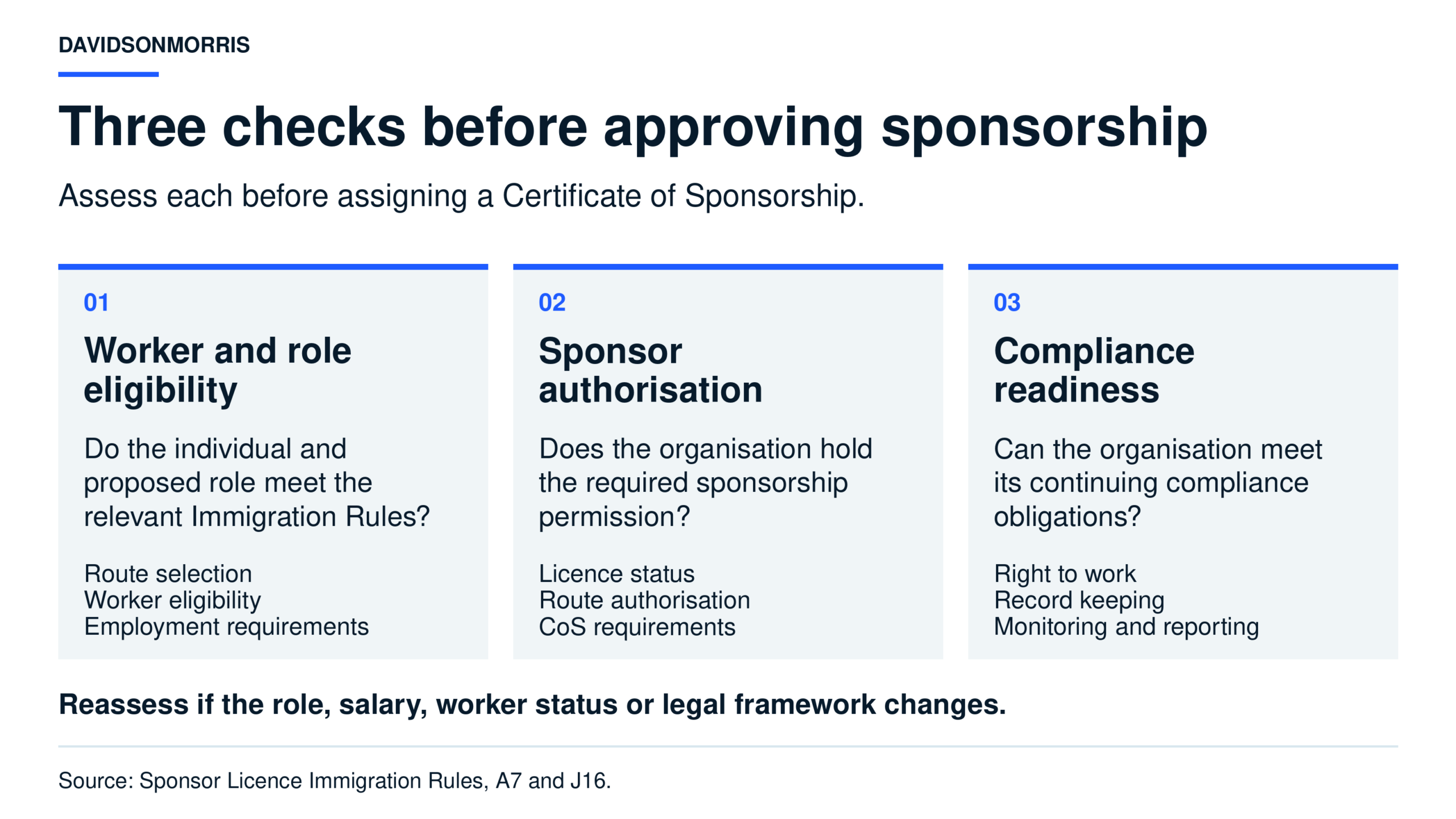
Before assigning sponsorship, the employer should establish that the proposed worker and employment arrangement are capable of meeting the requirements of the intended route. That assessment is relevant when recruiting an overseas worker, selecting the immigration route, confirming job eligibility, assigning a Certificate of Sponsorship, extending sponsorship or changing a sponsored worker’s role or salary.
A previous successful sponsorship does not establish that a later case will qualify. The worker’s circumstances, proposed employment or applicable Immigration Rules may have changed.
Likewise, the ability to assign a Certificate of Sponsorship through the Sponsor Management System does not confirm that the worker will be granted immigration permission. The Home Office will determine the application against the Rules in force for that case.
3. Where Are Sponsor Licence Requirements Set Out?
Many requirements governing the employer are found in Home Office sponsor guidance rather than the Immigration Rules.
The sponsor guidance covers the organisation’s authority to sponsor and its continuing responsibilities, including:
- Eligibility and suitability to hold a sponsor licence.
- The immigration routes the organisation is authorised to sponsor under.
- Requirements concerning sponsor licence key personnel.
- The allocation and assignment of Certificates of Sponsorship.
- Monitoring sponsored workers.
- Reporting specified changes and events.
- Maintaining sponsorship records.
- Cooperating with Home Office compliance activity.
- The circumstances in which the Home Office may downgrade, suspend or revoke a sponsor licence.
These requirements are central to the sponsor licensing framework even where they are not reproduced in a route-specific Immigration Rules appendix. Failure to comply can result in licensing action under the applicable Home Office guidance.
For a detailed explanation of the separate guidance framework, see the DavidsonMorris guide to Home Office sponsor guidance.
4. How Do Immigration Permission and Sponsorship Authorisation Differ?
Immigration permission concerns the individual’s entitlement to enter or remain in the UK and undertake permitted activities.
Sponsorship authorisation concerns the organisation’s authority to sponsor eligible individuals under specified immigration routes and the obligations attached to that authority.
Both may be required for sponsored employment, but they involve different decisions and different consequences.
| Issue | Immigration Rules | Sponsor Licensing Framework |
|---|---|---|
| Principal subject | Individual immigration eligibility and permission | Employer sponsorship authorisation and responsibilities |
| Main sources | Immigration Rules and applicable legislation | Home Office sponsor guidance and applicable legal framework |
| Relevant decision | Whether the individual qualifies for immigration permission | Whether the organisation may obtain, use or retain sponsorship authorisation |
| Typical requirements | Route eligibility, sponsorship, salary and other immigration conditions | Licence eligibility, CoS administration, reporting, monitoring and record keeping |
| Potential adverse outcome | Refusal or cancellation of immigration permission | Licence refusal, downgrading, suspension or revocation |
The same facts can engage both frameworks. Inaccurate information about a sponsored role, for example, may affect the worker’s immigration application and raise separate concerns about the sponsor’s compliance.
Employers should therefore assess worker eligibility and sponsor compliance independently, even where both arise from the same employment arrangement.
5. How Do Right to Work Requirements Fit Into the Sponsorship Framework?
Right to work obligations form a separate statutory compliance framework. They determine when organisations need to carry out prescribed checks and, where applicable, establish a statutory excuse against liability for illegal working.
Changes effective from 1 October 2026 extended the statutory framework to specified working arrangements beyond conventional employment, including certain worker contracts, individual subcontracting arrangements and qualifying online matching arrangements.
The expanded regime does not mean that every individual working under one of these arrangements requires sponsorship. Employers need to establish separately:
- Whether the individual has permission to undertake the proposed work.
- Whether the arrangement falls within the statutory right to work framework.
- Whether immigration sponsorship is required.
- Whether the organisation holds the necessary sponsorship authorisation.
- What separate sponsor duties apply.
Licensed sponsors are also required under sponsor guidance to undertake appropriate right to work checks in relation to sponsored workers. Failures can therefore create exposure under both the statutory right to work regime and the sponsor licensing framework.
Employers should consult the current Home Office right to work guidance and the applicable statutory code of practice when assessing the required checks.
Section B: Where Are Sponsor Licence Requirements Set Out?
UK sponsor licence requirements are not contained in a single piece of legislation or one section of the Immigration Rules. Instead, the legal and regulatory framework for employer sponsorship is distributed across immigration legislation, the Immigration Rules, Home Office sponsor guidance and other statutory requirements affecting the employment of overseas workers.
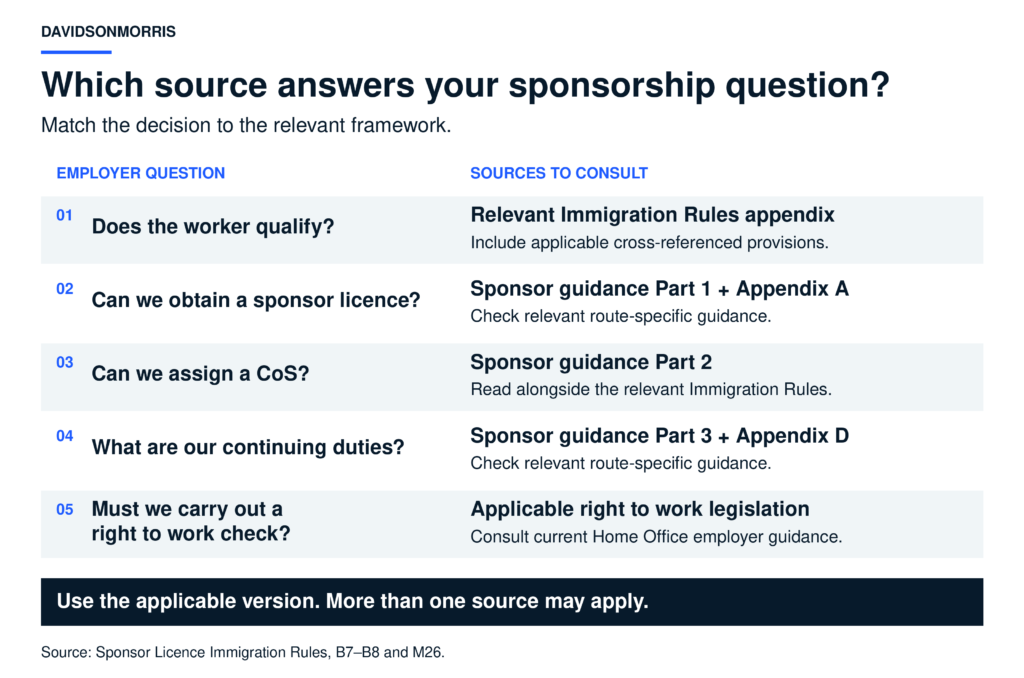
Employers must identify which source governs the particular decision they are making. The requirements for obtaining a sponsor licence, assigning a Certificate of Sponsorship, establishing a worker’s immigration eligibility and maintaining compliance are related, but they do not all arise from the same legal authority.
The principal distinction is between the statutory and Immigration Rules framework governing immigration permission and the Home Office licensing framework governing an organisation’s authorisation to sponsor workers.
Understanding where these requirements are located allows employers to determine which provisions apply, how they interact and what legal consequences may follow from non-compliance.
1. Immigration Act 1971: The Statutory Foundation
The Immigration Act 1971 provides a principal statutory foundation for the UK’s immigration control system.
Section 3(2) establishes the framework under which the Secretary of State lays statements of the Immigration Rules before Parliament. These Rules govern the practice to be followed in regulating entry into and stay in the United Kingdom.
The Immigration Rules therefore have a statutory basis, but they should not be described as primary legislation or treated as legally identical to an Act of Parliament.
The distinction is important because immigration law operates through several different sources of authority, including Acts of Parliament, the Immigration Rules and published Home Office policies.
For employers, the Immigration Act 1971 is relevant because it underpins the system through which overseas workers obtain immigration permission.
However, the Act does not itself provide a comprehensive operational manual for sponsor licence applications, Certificate of Sponsorship administration or ongoing sponsor compliance.
Those requirements must be identified through the wider sponsorship framework.
Employers seeking to understand the statutory foundation can consult the Immigration Act 1971.
2. Immigration Rules: Requirements Governing Sponsored Workers
The Immigration Rules contain the requirements against which individual immigration applications are assessed.
For sponsored work routes, these requirements are principally located in the relevant route-specific appendices, together with any applicable cross-referenced provisions.
The Immigration Rules may determine:
- Whether the proposed immigration route is available to the applicant.
- Whether the individual has been sponsored by an appropriately authorised organisation.
- Whether the proposed employment or activity satisfies the relevant route requirements.
- Whether applicable salary, occupation or other eligibility conditions are met.
- Whether the applicant satisfies any relevant English language or financial requirements.
- Whether general or route-specific suitability requirements apply.
- Whether the applicant qualifies for an exception or transitional provision.
- Whether entry clearance or permission to stay should be granted or refused.
The applicable requirements depend on the particular immigration route and the circumstances of the applicant.
An employer should not assume that every sponsored work route is governed by the same provisions.
For example, Appendix Skilled Worker governs Skilled Worker applications, while Global Business Mobility and Temporary Work categories have their own route-specific requirements.
The official collection is available through the UK Immigration Rules.
3. Route-Specific Appendices
Much of the substantive law governing sponsored work immigration applications is contained in route-specific appendices to the Immigration Rules.
These appendices establish the requirements applicable to particular categories of immigration permission.
Relevant sponsored work provisions include:
| Immigration Rules appendix | Principal purpose | Employer relevance |
|---|---|---|
| Appendix Skilled Worker | Governs immigration applications under the Skilled Worker route. | Determines whether the proposed worker and employment satisfy the applicable Skilled Worker requirements. |
| Appendix Global Business Mobility – Senior or Specialist Worker | Governs qualifying senior or specialist international assignments. | Relevant to organisations transferring eligible personnel under the route. |
| Appendix Global Business Mobility – Graduate Trainee | Governs qualifying graduate training assignments. | Relevant to international businesses operating eligible graduate training programmes. |
| Appendix Global Business Mobility – UK Expansion Worker | Governs qualifying assignments connected with establishing a UK business presence. | Relevant to overseas businesses undertaking eligible UK expansion activity. |
| Appendix Global Business Mobility – Service Supplier | Governs qualifying service provision arrangements. | Relevant to specified contractual service arrangements meeting the route requirements. |
| Appendix Global Business Mobility – Secondment Worker | Governs qualifying secondments connected with specified commercial arrangements. | Relevant to eligible international secondment arrangements. |
| Temporary Work route appendices | Govern specified temporary work and activity categories. | Relevant where the proposed activity falls within an eligible temporary sponsorship route. |
The presence of a route within the Immigration Rules does not mean that every employer is authorised to sponsor workers under that route.
The organisation must separately establish that it holds the necessary sponsor licence permission.
Likewise, holding the relevant sponsor permission does not remove the need to satisfy the route-specific Immigration Rules.
4. Cross-Referenced Immigration Rules Appendices
Route-specific appendices do not necessarily contain every requirement relevant to an immigration application.
They may incorporate provisions from other parts of the Immigration Rules.
Employers assessing sponsored work eligibility may therefore need to examine additional appendices, including those concerning occupations, English language, financial requirements and other relevant matters.
For example, Appendix Skilled Worker must be read alongside applicable occupation and salary provisions and other cross-referenced requirements.
The legal effect of a cross-reference depends on the wording of the relevant Rules.
Employers should not assume that a provision appearing elsewhere in the Immigration Rules applies automatically to every sponsored work route.
Instead, the employer should establish whether the relevant route expressly incorporates that requirement or whether it otherwise applies under the Rules.
This is particularly important where similar concepts, such as sponsorship, salary or employment eligibility, are treated differently across immigration categories.
5. Part Suitability and Suitability Grounds
In addition to route-specific eligibility requirements, immigration applications may be subject to suitability requirements.
Part Suitability of the Immigration Rules contains general suitability provisions applying to most immigration routes, subject to its scope and specified exceptions.
These provisions can result in mandatory or discretionary refusal or cancellation for reasons that are not necessarily confined to the proposed employment.
Employers should distinguish between a worker satisfying the principal requirements of a sponsored work route and satisfying all other applicable immigration requirements.
For example, an individual may have an eligible job offer and a valid Certificate of Sponsorship but nevertheless encounter an issue under an applicable suitability or refusal provision.
The existence of a valid sponsorship arrangement therefore does not guarantee the grant of immigration permission.
The relevant provisions can be found in Immigration Rules: Part Suitability.
6. Home Office Sponsor Guidance: Licensing Requirements
The detailed requirements governing sponsor licence applications and ongoing sponsorship responsibilities are principally contained in Home Office sponsor guidance.
This guidance is separate from the Immigration Rules and serves a different regulatory function.
It explains the conditions under which organisations may obtain, exercise and retain permission to sponsor overseas workers.
For employers sponsoring workers, the principal guidance is published within the Home Office’s Workers and Temporary Workers sponsorship framework.
The guidance addresses matters including:
- Eligibility and suitability to hold a sponsor licence.
- The sponsorship routes for which an organisation may obtain authorisation.
- Key personnel and sponsor licence administration.
- Certificate of Sponsorship allocation and assignment.
- Responsibilities concerning sponsored workers.
- Reporting and record-keeping requirements.
- Home Office compliance assessments and visits.
- Licence ratings and applicable enforcement measures.
- Suspension, downgrading and revocation of sponsorship authorisation.
Employers should treat the applicable sponsor guidance as a central source of their licensing obligations.
However, sponsor guidance should not be described as having the same legal status as the Immigration Rules or primary legislation.
Its application must be considered within the legal framework governing the Home Office’s licensing powers and public law obligations.
For further explanation, see Home Office Sponsor Guidance.
7. Sponsor Guidance Parts 1, 2 and 3
The Home Office’s principal Workers and Temporary Workers sponsor guidance is organised into separate parts dealing with different aspects of sponsorship.
| Guidance | Principal subject | When employers should consult it |
|---|---|---|
| Part 1: Apply for a Licence | Requirements and procedures for obtaining sponsorship authorisation. | When applying for a licence, assessing eligibility or considering additional sponsorship routes. |
| Part 2: Sponsor a Worker | Requirements associated with sponsoring workers and assigning Certificates of Sponsorship. | When assessing proposed sponsorship arrangements and undertaking relevant sponsorship actions. |
| Part 3: Sponsor Duties and Compliance | Continuing sponsor responsibilities, compliance and licensing consequences. | When managing sponsored workers, assessing reporting obligations or responding to compliance concerns. |
The guidance must be read in the version applicable to the relevant circumstances.
Employers should also examine any additional route-specific guidance or supporting appendices that apply.
A requirement concerning the assignment of a Certificate of Sponsorship may need to be considered alongside the relevant Immigration Rules and the organisation’s continuing sponsor duties.
The division of the guidance into separate parts should not lead employers to assess those requirements in isolation.
8. Sponsor Guidance Appendices A and D
The Home Office publishes supporting appendices addressing particular aspects of sponsor licensing.
Two especially important documents are Appendix A and Appendix D.
Appendix A: Supporting Documents for Sponsor Licence Applications identifies documentary requirements relevant to organisations seeking sponsorship authorisation.
Its purpose is to support the Home Office’s assessment of sponsor licence applications.
Appendix D: Keeping Records for Sponsorship sets out record-keeping requirements relevant to licensed sponsors.
It identifies categories of information and evidence that organisations must retain in connection with their sponsorship responsibilities.
Employers should distinguish these sponsor guidance appendices from appendices to the Immigration Rules.
Although both use the term “appendix”, they belong to different sources and serve different purposes.
Confusing them can result in an employer consulting the wrong requirements or incorrectly describing the legal basis for a sponsorship obligation.
9. Right to Work Legislation and the 1 October 2026 Changes
The statutory right to work framework is another important source of obligations for organisations engaging overseas nationals.
It operates separately from the Immigration Rules governing sponsored work applications and from the Home Office sponsor licensing framework.
The Immigration, Asylum and Nationality Act 2006 provides a principal statutory basis for the employer civil penalty regime concerning illegal working. Section 48 of the Border Security, Asylum and Immigration Act 2025 inserted sections 14A and 15A into the 2006 Act, extending the framework to specified working arrangements and providing for extended civil penalty liability.
The associated legislation, codes of practice and Home Office guidance establish requirements for prescribed right to work checks and the circumstances in which an organisation may establish a statutory excuse against civil penalty liability.
From 1 October 2026, changes to the statutory right to work framework extended its application to specified working arrangements beyond conventional employment contracts.
Depending on the applicable statutory definitions, these arrangements can include specified worker contracts, individual subcontracting arrangements and qualifying online matching arrangements.
This extension is important for businesses using flexible workforce models, contractors or other non-standard engagement structures.
However, employers must not confuse the scope of the statutory right to work framework with the circumstances in which immigration sponsorship is required.
An arrangement may fall within the statutory checking regime without necessarily requiring the individual to hold sponsored immigration permission.
Conversely, an organisation sponsoring a worker must satisfy applicable sponsor duties, including the right to work checking requirements imposed by sponsor guidance.
Part 2 of the Home Office sponsor guidance, paragraphs S1.40 to S1.43, and Appendix D, section 1.1, updated on 8 October 2026, emphasise the importance of these checks regardless of the nature of the sponsored worker’s working arrangement.
The guidance also identifies serious potential licensing consequences for failures to undertake required checks or where a civil penalty for illegal working is imposed.
Employers should therefore assess three distinct matters:
- Whether the individual has permission to undertake the proposed work.
- Whether the arrangement falls within the statutory right to work checking framework.
- Whether the organisation has separate sponsorship responsibilities arising from its sponsor licence.
The statutory right to work regime should not be treated as merely another appendix to the Immigration Rules.
Employers should consult the Home Office employer right to work guidance and the applicable statutory code of practice when determining the correct checking requirements.
10. Other Legislation Relevant to Employer Sponsorship
Immigration sponsorship can also engage legal requirements outside the Immigration Rules and sponsor guidance.
Depending on the circumstances, these may include employment legislation, equality law, data protection requirements and other statutory obligations affecting the organisation’s workforce.
For example, an employer must not assume that compliance with immigration sponsorship requirements removes its responsibilities under applicable employment law.
Similarly, sponsorship record-keeping requirements must be implemented alongside relevant data protection obligations.
These additional requirements do not necessarily determine whether a worker qualifies for immigration permission.
However, they may affect how the organisation lawfully implements and manages its sponsorship arrangements.
Employers should therefore distinguish between immigration eligibility, sponsor licensing compliance and other legal obligations arising from the employment relationship.
11. How Do the Different Legal Sources Interact?
The legal sources governing sponsorship should be understood as an interconnected framework rather than a single hierarchy in which every requirement performs the same function.
Primary legislation establishes relevant statutory powers and obligations.
The Immigration Rules set out requirements governing immigration permission within their scope.
Home Office sponsor guidance establishes and explains the requirements of the sponsorship licensing system, subject to the applicable legal framework.
Separate statutory regimes, including right to work legislation, impose additional obligations where their conditions are met.
| Source | Legal or regulatory function | Typical employer question |
|---|---|---|
| Immigration Act 1971 | Statutory foundation for immigration control and the Immigration Rules. | What is the statutory basis for the immigration framework? |
| Immigration Rules | Requirements governing individual immigration applications and permission. | Does the proposed worker qualify under the relevant route? |
| Statements of Changes | Formal amendments to the Immigration Rules, including commencement and transitional provisions. | Which version of the requirements applies? |
| Home Office sponsor guidance | Requirements and conditions governing sponsorship authorisation and compliance. | Can the organisation undertake and maintain the proposed sponsorship? |
| Right to work legislation and codes | Statutory obligations concerning specified work arrangements and illegal working liability. | What checks are required, and can the organisation establish a statutory excuse? |
| Other applicable legislation | Additional legal obligations affecting the workforce and business operations. | What other statutory responsibilities apply to the arrangement? |
Where provisions appear inconsistent, the employer should first determine whether they govern the same legal question.
An apparent conflict may arise because one source concerns the worker’s immigration eligibility while another concerns the employer’s licensing obligations.
Where a genuine legal inconsistency remains, the employer should examine the relevant statutory authority, precise wording and applicable public law principles rather than assume that one document can simply override another.
Section C: Immigration Rules vs Home Office Sponsor Guidance
The Immigration Rules and Home Office sponsor guidance are two of the principal sources governing the sponsorship of overseas workers in the UK. Although they operate together, they have different legal characteristics, address different regulatory questions and can produce different consequences where their requirements are not met.
For employers, the distinction is fundamental. The Immigration Rules principally govern whether an individual qualifies for immigration permission under a sponsored work route. Home Office sponsor guidance governs the requirements and conditions under which an organisation may obtain, exercise and retain sponsorship authorisation.
Compliance with the Immigration Rules does not automatically establish compliance with sponsor guidance, and compliance with sponsor guidance does not guarantee that a worker will qualify for immigration permission.
Employers must therefore understand the function of each source, identify where their requirements overlap and determine which provisions govern the particular sponsorship decision.
1. What Is the Legal Status of the Immigration Rules?
The Immigration Rules are laid before Parliament under section 3(2) of the Immigration Act 1971.
They establish the requirements and procedures governing immigration applications within their scope, including applications under sponsored work routes.
The Rules have a statutory foundation and are central to the Home Office’s determination of immigration applications. However, they are not primary legislation and should not be described as having precisely the same legal status as an Act of Parliament.
They operate within the wider immigration law framework and must be interpreted consistently with applicable legislation and relevant legal principles.
For employers, the Immigration Rules are particularly important when determining:
- Whether a proposed worker qualifies under the intended immigration route.
- Whether the proposed occupation or employment arrangement satisfies the relevant requirements.
- Whether the applicable salary or remuneration conditions are met.
- Whether a valid Certificate of Sponsorship is required and satisfies the relevant provisions.
- Whether the worker meets applicable personal eligibility and suitability requirements.
- Whether a further immigration application is required following a change in circumstances.
- Whether an exception or transitional provision applies.
The applicable provisions must be identified by reference to the particular route, circumstances and relevant dates.
An employer should not assume that a requirement found in one immigration appendix applies to every sponsored work category.
2. What Is the Legal Status of Home Office Sponsor Guidance?
Home Office sponsor guidance is published by the Secretary of State to establish and explain the requirements of the sponsorship licensing system.
It is not itself an Act of Parliament or part of the Immigration Rules.
Nevertheless, it has substantial regulatory significance because the Home Office uses the sponsorship framework to determine whether organisations are eligible to hold licences and whether they are meeting the requirements associated with their authorisation.
Licensed sponsors are expected to comply with the applicable sponsorship requirements, and failure to do so can result in Home Office licensing action.
The guidance addresses matters including:
- Sponsor licence eligibility and suitability.
- Requirements concerning the organisation’s sponsorship arrangements.
- Appointment and responsibilities of sponsor licence key personnel.
- Certificate of Sponsorship allocation and assignment.
- Monitoring sponsored workers.
- Reporting specified changes and events.
- Maintaining required records and evidence.
- Cooperating with Home Office compliance activity.
- Licence ratings and enforcement action.
The fact that a requirement appears in sponsor guidance rather than the Immigration Rules does not make it optional.
However, the Home Office must exercise its licensing powers lawfully. Published guidance must be considered in the context of the relevant legal authority, its wording and applicable public law principles.
For a detailed examination of the guidance framework, see Home Office Sponsor Guidance.
3. How Do the Immigration Rules and Sponsor Guidance Differ?
The principal differences concern their legal basis, purpose, subject matter and consequences.
| Issue | Immigration Rules | Home Office Sponsor Guidance |
|---|---|---|
| Legal character | Rules laid before Parliament under section 3(2) of the Immigration Act 1971. | Published regulatory and policy guidance governing the sponsorship licensing system. |
| Principal purpose | Determining requirements for immigration permission. | Establishing and explaining requirements for sponsorship authorisation and compliance. |
| Primary subject | Individual immigration applicants. | Organisations seeking or holding sponsor licences. |
| Typical requirements | Immigration route eligibility, sponsorship, employment conditions and suitability. | Licence eligibility, CoS administration, monitoring, reporting and record keeping. |
| Relevant decisions | Grant, refusal or cancellation of immigration permission. | Grant, refusal, management, downgrading, suspension or revocation of sponsor licences. |
| How requirements change | Through formal Statements of Changes to the Immigration Rules. | Through publication or amendment of Home Office sponsor guidance, subject to applicable legal requirements. |
| Potential consequences of non-compliance | Adverse immigration decisions, depending on the applicable provisions. | Adverse sponsor licensing action, depending on the applicable requirements and circumstances. |
These distinctions should not be interpreted as meaning that the two frameworks operate independently.
The Immigration Rules may require sponsorship by an appropriately authorised organisation, while sponsor guidance may require the employer to ensure that its sponsorship activity is consistent with applicable immigration requirements.
The same factual circumstances may therefore be relevant to both frameworks.
4. Can Sponsor Guidance Impose Requirements Not Expressly Set Out in the Immigration Rules?
Yes. Sponsor guidance contains detailed licensing requirements that are not necessarily reproduced in the Immigration Rules.
For example, sponsor guidance sets out obligations concerning monitoring sponsored workers, reporting specified changes and retaining particular records.
These obligations relate to the organisation’s continuing sponsorship authorisation.
The Immigration Rules do not need to repeat every sponsor licensing requirement for the Home Office to assess compliance with the applicable licensing framework.
However, an important legal distinction remains.
Home Office guidance cannot independently create statutory powers that do not exist or lawfully override applicable legislation.
Where the Home Office relies on a particular licensing requirement, the requirement and its application must be considered within the relevant legal framework.
Employers should therefore avoid two opposite errors:
- Assuming that sponsor guidance is unenforceable because it is not part of the Immigration Rules.
- Assuming that every statement in sponsor guidance has precisely the same legal status as a statutory provision.
The correct approach is to identify the requirement, understand its function and assess how it applies to the organisation’s circumstances.
5. Can Sponsor Guidance Override the Immigration Rules?
Home Office sponsor guidance cannot lawfully displace requirements established by the Immigration Rules where those Rules govern the relevant immigration decision.
However, apparent inconsistencies should be examined carefully before concluding that a genuine legal conflict exists.
A provision in the Immigration Rules may concern whether an individual qualifies for immigration permission, while a provision in sponsor guidance may concern whether an employer is authorised to undertake the proposed sponsorship.
Those provisions can impose different requirements without necessarily conflicting.
For example, the Immigration Rules may establish the eligibility conditions for a particular sponsored work route.
Sponsor guidance may separately require the employer to hold the appropriate sponsorship authorisation, assign the CoS correctly and comply with relevant licensing conditions.
Both sets of requirements may apply to the same arrangement.
Where an apparent conflict remains, employers should examine:
- The precise wording of the Immigration Rules provision.
- The wording and scope of the relevant sponsor guidance.
- The legal or regulatory question each provision addresses.
- The version of each source applicable at the relevant time.
- Any relevant legislation, exceptions or transitional provisions.
- Whether specialist legal interpretation is required.
Employers should not resolve a material legal inconsistency merely by selecting whichever interpretation is administratively easier or commercially preferable.
6. Can the Home Office Change Sponsor Guidance Without Changing the Immigration Rules?
Yes. Home Office sponsor guidance can be updated independently of a formal amendment to the Immigration Rules.
The Home Office may revise the guidance to clarify existing requirements, amend administrative procedures or change aspects of its sponsorship licensing policy.
Such updates can have significant consequences for employers even where the relevant immigration route requirements remain unchanged.
For example, changes to sponsor guidance may affect:
- The procedures for undertaking sponsorship actions.
- Requirements concerning sponsor licence administration.
- Evidence that organisations are expected to retain.
- Reporting or monitoring responsibilities.
- The Home Office’s approach to particular compliance failures.
- Requirements concerning sponsor licence key personnel.
Employers should therefore monitor both Immigration Rules amendments and sponsor guidance updates.
Reviewing only Statements of Changes will not necessarily identify every development affecting sponsorship compliance.
The relevant effective dates must also be distinguished. A sponsor guidance update and an Immigration Rules amendment may take effect on different dates.
7. How Do the October 2026 Right to Work Changes Affect Sponsor Guidance?
The right to work changes effective from 1 October 2026 illustrate why employers must distinguish between statutory requirements, Immigration Rules and sponsor guidance.
The changes extended the statutory right to work framework to specified working arrangements beyond traditional employment contracts, including specified worker contracts, individual subcontracting arrangements and qualifying online matching arrangements, subject to the applicable statutory definitions.
These developments concern the statutory right to work regime rather than simply changing the eligibility requirements of every sponsored work route.
However, they also have implications for licensed sponsors because the Home Office’s sponsor guidance requires sponsors to undertake appropriate right to work checks in relation to their sponsored workers.
The sponsor guidance updated in October 2026 makes clear that this obligation applies regardless of the nature of the working arrangement.
It also identifies serious licensing consequences where a sponsor fails to undertake required checks or incurs a civil penalty for illegal working.
Employers should therefore distinguish between:
- The statutory requirements governing right to work checks and civil penalty liability.
- The Immigration Rules governing whether a worker qualifies for immigration permission.
- The sponsor guidance requirements governing the organisation’s conduct as a licensed sponsor.
An organisation may have obligations under more than one framework in relation to the same individual.
However, the extension of the statutory checking regime does not mean that every individual engaged through a contractor or commercial arrangement must be sponsored.
Whether sponsorship is required depends on the individual’s immigration status, the proposed activity and the applicable immigration requirements.
Employers should consult the current Home Office right to work guidance and the relevant sponsor guidance when assessing these obligations.
8. What Happens When a Worker Meets the Immigration Rules but the Sponsor Breaches Its Duties?
A worker may satisfy the substantive eligibility requirements of a sponsored immigration route while the sponsoring organisation fails to comply with a separate licensing obligation.
For example, an employer may have sponsored an eligible worker but subsequently fail to retain required records or report a relevant change.
The worker’s immigration eligibility and the employer’s sponsor compliance position must be assessed separately.
A sponsor duty breach may expose the organisation to Home Office licensing action.
Depending on the circumstances and applicable guidance, this may include downgrading, suspension or revocation.
However, the existence of a sponsor duty breach does not automatically establish that the worker has personally breached the Immigration Rules.
Nor should the employer assume that every sponsor compliance failure necessarily results in the same enforcement outcome.
The relevant guidance may identify circumstances in which particular action is required, normally taken or available at the Home Office’s discretion.
For certain serious failures, including specified right to work breaches, the current guidance indicates that licence revocation is likely.
The employer should identify the precise obligation, the facts of the alleged breach and the applicable enforcement provisions before assessing the consequences.
9. What Happens When the Sponsor Complies but the Worker Does Not Meet the Immigration Rules?
An employer may maintain appropriate sponsor licence systems and comply with its administrative obligations while a proposed worker fails to satisfy an immigration eligibility requirement.
For example, a worker may fail to meet a relevant personal eligibility or suitability condition despite the employer having assigned a Certificate of Sponsorship correctly.
The Home Office may refuse the worker’s application under the applicable Immigration Rules.
That refusal does not automatically establish that the employer has breached its sponsor duties.
However, the circumstances should still be examined to determine whether the employer has complied with its own obligations.
If the employer assigned sponsorship based on inaccurate information or failed to meet an applicable licensing requirement, separate compliance concerns may arise.
The distinction is therefore between:
- The legal basis for refusing the individual’s immigration application.
- Whether the employer has complied with the requirements associated with its sponsorship authorisation.
Employers should avoid treating every adverse immigration decision as evidence of sponsor misconduct.
10. How Are the Immigration Rules and Sponsor Guidance Enforced?
The Immigration Rules and sponsor guidance operate through different decision-making processes.
Individual immigration applications are assessed against the relevant Immigration Rules and wider legal framework.
Where an applicant fails to satisfy an applicable requirement, the Home Office may refuse the application or take other action permitted by law.
Sponsor licensing compliance is assessed through the Home Office’s sponsorship framework.
The Home Office may examine the organisation’s conduct, records, systems and sponsorship arrangements to determine whether the applicable licensing requirements are being met.
Potential licensing outcomes include refusal of an application for sponsorship authorisation, changes to the organisation’s rating, suspension or revocation.
The grounds, procedures and available responses depend on the applicable guidance and legal framework.
Importantly, a sponsor licensing decision is not necessarily subject to the same statutory appeal arrangements as an individual immigration decision.
Where an adverse licensing decision is alleged to be unlawful, judicial review may be relevant in appropriate circumstances.
Judicial review concerns the lawfulness of the decision-making process and exercise of public powers, rather than providing a general reconsideration of the merits.
Employers facing significant licensing action should obtain advice on the applicable procedures, grounds and time limits.
11. Can Employers Rely on Home Office Guidance When Making Sponsorship Decisions?
Employers should use the relevant Home Office guidance when assessing their sponsorship responsibilities.
However, reliance on guidance should be informed by the precise legal question.
Where the question concerns whether a worker qualifies for immigration permission, the applicable Immigration Rules remain essential.
Where the question concerns whether the organisation may assign sponsorship or has complied with its licence conditions, sponsor guidance will ordinarily be central to the assessment.
Employers should also ensure that they are consulting the correct version of the guidance.
An internal procedure based on earlier guidance may no longer reflect the Home Office’s current requirements.
Conversely, where the Home Office is assessing conduct that occurred before a guidance update, the version applicable to the historical circumstances may be relevant.
The employer should therefore record the source and version relied upon for material decisions.
This is particularly important where the decision depends on an exception, a transitional arrangement or an interpretation that may subsequently be questioned.
Section D: Which Immigration Rules Apply to Sponsored Workers?
The Immigration Rules applicable to a sponsored worker depend on the immigration route under which the individual is seeking permission to enter or remain in the UK. There is no single set of eligibility requirements that applies uniformly to every sponsored work category.
Each route has its own legal provisions, reflecting the purpose of the immigration category, the nature of the permitted employment or activity and the conditions under which sponsorship is allowed.
For employers, identifying the correct route is the starting point for determining which Immigration Rules apply.
The organisation must establish both that it is authorised to sponsor under the intended route and that the proposed worker and employment arrangement satisfy the Immigration Rules governing that route.
These are separate assessments. Holding a sponsor licence does not establish eligibility under every sponsored work category, and a worker’s apparent eligibility does not establish that the employer holds the necessary sponsorship authorisation.
1. How Do Employers Identify the Applicable Immigration Rules?
The relevant Immigration Rules should be identified by reference to the actual purpose and circumstances of the proposed employment or assignment.
Employers should not select an immigration route solely because it is familiar, administratively convenient or already covered by their existing sponsor licence.
The assessment should consider:
- The nature of the proposed work or activity.
- The relationship between the worker and the sponsoring organisation.
- Whether the arrangement involves UK recruitment, an international assignment or another qualifying activity.
- The proposed duration and circumstances of the work.
- Whether the employer holds the relevant sponsorship authorisation.
- The worker’s existing immigration status, where relevant.
- Any route-specific conditions affecting the proposed arrangement.
Once the route has been identified, the employer should examine the relevant Immigration Rules appendix and any provisions incorporated by reference.
The applicable requirements should be verified against the version of the Rules governing the particular application or sponsorship event.
This is especially important where the worker has previously held immigration permission under an earlier version of the Rules.
2. Appendix Skilled Worker
Appendix Skilled Worker governs immigration applications under the Skilled Worker route.
It is one of the principal Immigration Rules appendices relevant to UK employers recruiting overseas nationals into eligible positions.
The appendix establishes requirements concerning sponsorship, the proposed employment and other conditions that an applicant must satisfy.
Depending on the circumstances, these include:
- A valid Certificate of Sponsorship assigned by an appropriately authorised sponsor.
- Eligibility of the proposed occupation.
- Applicable salary requirements.
- Requirements concerning the proposed employment and sponsorship arrangement.
- English language requirements.
- Relevant financial requirements.
- Other applicable eligibility and suitability conditions.
The requirements must be considered alongside relevant cross-referenced provisions, including occupation-related appendices.
Employers should also establish whether any exceptions or transitional provisions apply to the particular worker.
For example, the requirements applicable to a new applicant may differ from those governing an existing Skilled Worker seeking further permission under specified transitional arrangements.
However, an employer should not assume that a worker qualifies for transitional treatment simply because they previously held Skilled Worker permission.
The applicable provision and its conditions must be identified.
The official legal source is Appendix Skilled Worker.
3. Health and Care Worker Sponsorship
The Health and Care Worker visa operates within the Skilled Worker immigration framework rather than as an entirely separate sponsored work route.
Qualifying applicants must satisfy the relevant Skilled Worker requirements, together with the additional conditions applicable to Health and Care Worker arrangements.
Employers should not assume that every healthcare-related position qualifies for these arrangements.
Eligibility depends on the applicable occupation, the sponsoring organisation, the proposed employment and the relevant Immigration Rules.
Additional restrictions or requirements may apply to particular healthcare and care-related occupations.
These requirements have been subject to significant policy changes, making it particularly important to verify the applicable Rules and commencement provisions.
Employers should distinguish between:
- Eligibility for sponsorship under the Skilled Worker route.
- Eligibility for the specific Health and Care Worker arrangements.
- Any additional regulatory or sponsor licensing requirements affecting the organisation.
A role should not be treated as eligible for Health and Care Worker arrangements solely because the employer operates in the health or social care sector.
4. Global Business Mobility Immigration Rules
The Global Business Mobility framework comprises several immigration routes designed for specified international business activities and assignments.
These routes have distinct eligibility requirements and should not be treated as interchangeable.
The principal categories include:
| Route | Principal purpose | Employer consideration |
|---|---|---|
| Senior or Specialist Worker | Qualifying assignments involving senior or specialist personnel within international business arrangements. | Whether the worker, overseas employment relationship and proposed UK assignment satisfy the route requirements. |
| Graduate Trainee | Qualifying assignments forming part of structured graduate training arrangements. | Whether the programme and worker satisfy the specific graduate trainee conditions. |
| UK Expansion Worker | Qualifying assignments connected with establishing a UK business presence. | Whether the overseas business and proposed UK expansion activity meet the applicable requirements. |
| Service Supplier | Qualifying service provision arrangements under relevant international commitments. | Whether the contractual arrangement, worker and proposed activity satisfy the route conditions. |
| Secondment Worker | Qualifying secondments connected with specified commercial arrangements. | Whether the relevant contract, business relationship and assignment meet the route requirements. |
Employers should identify the correct Global Business Mobility route before assessing eligibility.
For example, the existence of a relationship between a UK business and an overseas organisation does not automatically establish that an individual qualifies for a Senior or Specialist Worker visa.
The relevant Immigration Rules may impose specific requirements concerning the overseas employment relationship, assignment, remuneration or other circumstances.
Similarly, an employer authorised to sponsor workers under one Global Business Mobility category should not assume that its licence automatically covers every other category.
The relevant route appendix and sponsor guidance must both be checked.
5. Temporary Work Immigration Rules
Temporary Work routes permit specified forms of temporary employment or activity in the UK.
They are governed by their own Immigration Rules requirements and are not simply shorter versions of the Skilled Worker route.
Relevant categories include:
- Creative Worker.
- Charity Worker.
- Religious Worker.
- Government Authorised Exchange.
- International Agreement.
- Seasonal Worker.
Each category serves a particular purpose and has its own eligibility conditions.
Employers should not assume that work qualifies under a Temporary Work route merely because the proposed engagement is short-term.
The nature of the activity, sponsorship arrangements and route-specific requirements must be examined.
Some Temporary Work categories also involve sponsorship arrangements or restrictions that differ materially from those applying under Skilled Worker.
The employer should therefore identify the relevant route appendix and applicable sponsor guidance before proceeding.
Other sponsored work routes include T2 Minister of Religion, International Sportsperson and Scale-up. Each is governed by its own Immigration Rules and sponsor guidance, and employers should not apply Skilled Worker requirements to those routes without checking the relevant provisions.
6. Appendix Skilled Occupations and Occupation Codes
Occupation classification is an important aspect of eligibility under several sponsored work routes.
Appendix Skilled Occupations contains occupation-related provisions relevant to specified immigration categories.
Employers may need to identify the appropriate occupation code and establish whether the proposed employment meets the requirements associated with that classification.
However, the presence of an occupation in Appendix Skilled Occupations does not automatically establish that every role falling within that broad occupational area is eligible for sponsorship.
The employer must consider the relevant route requirements and the actual duties of the proposed position.
Occupation classification should reflect the substance of the work rather than an artificially selected job title.
Where eligibility depends on an occupation code, the employer should be able to explain why that code accurately describes the proposed employment.
The correct classification may also affect other applicable requirements, including salary provisions.
Employers should consult Appendix Skilled Occupations alongside the relevant route appendix.
7. Salary and Remuneration Requirements
Several sponsored work routes impose salary or remuneration requirements.
However, these requirements differ between routes and may be affected by the worker’s circumstances, the proposed occupation and any applicable exceptions or transitional provisions.
Employers should not assume that the salary threshold applicable to one immigration route governs every other sponsored work category.
Likewise, the employer should not assume that satisfying a general salary figure establishes compliance with every remuneration requirement.
The relevant provisions may require consideration of the occupation, working hours, permitted salary components or other specified factors.
The precise assessment depends on the applicable Immigration Rules.
Where a worker is relying on transitional treatment, the employer must establish whether the relevant salary provisions apply to that individual and proposed application.
For the purposes of interpreting the Sponsor Licence Immigration Rules, the essential requirement is to identify the correct salary provisions rather than apply a figure taken from another route or an outdated summary.
8. English Language and Financial Requirements
Some sponsored work routes impose English language or financial requirements.
These requirements may be contained in the route-specific appendix or incorporated through cross-references to other provisions of the Immigration Rules.
Employers should not assume that every sponsored worker is subject to identical English language requirements.
Nor should they assume that an individual who previously satisfied a requirement will necessarily be assessed in the same way in every subsequent application.
The relevant Rules may contain provisions concerning how a requirement can be satisfied, exemptions or recognition of previously established eligibility.
Financial requirements may also vary according to the route and circumstances.
For example, the relevant provisions may address whether an applicant must demonstrate access to specified funds or whether an authorised sponsor can certify maintenance where permitted.
These matters should be assessed under the applicable Immigration Rules rather than inferred from the employer’s general sponsorship status.
9. Suitability Requirements and General Grounds for Refusal
Meeting the substantive requirements of a sponsored work route does not necessarily establish that an individual qualifies for immigration permission.
Applicants may also be subject to suitability requirements or general grounds for refusal.
Part Suitability of the Immigration Rules contains general suitability provisions applying to most immigration routes, subject to its scope and specified exceptions.
Route-specific suitability provisions may also be relevant.
These requirements concern matters that may be separate from the proposed job or sponsorship arrangement.
For example, an individual may have an eligible job offer and a valid Certificate of Sponsorship but still encounter a refusal issue under an applicable suitability provision.
Employers should therefore distinguish between:
- Whether the proposed employment satisfies the route requirements.
- Whether the worker meets other applicable eligibility conditions.
- Whether any relevant suitability or refusal grounds apply.
The employer may be able to assess some aspects of the proposed employment directly, while other matters concern the worker’s personal immigration circumstances.
The Home Office remains responsible for determining the immigration application under the applicable legal framework.
10. Existing Sponsored Workers and Further Applications
Employers should take particular care when assessing the Immigration Rules applicable to workers who already hold sponsored immigration permission.
The requirements governing a further application may differ from those that applied when the worker was first sponsored.
This can arise where the worker is:
- Applying to extend existing immigration permission.
- Changing sponsor or employment.
- Moving into a different eligible occupation.
- Changing immigration route.
- Applying following an amendment to the Immigration Rules.
The fact that a worker previously qualified under a particular route does not guarantee eligibility for a subsequent application.
Equally, a change to the Immigration Rules does not necessarily mean that every existing sponsored worker immediately loses permission or becomes ineligible.
The applicable commencement and transitional provisions must be examined.
Where transitional treatment is relevant, the employer should identify the precise provision and verify that the worker meets its conditions.
The employer should also consider whether the proposed change engages separate sponsor reporting obligations or requires a new Certificate of Sponsorship.
These questions should be assessed separately from the worker’s substantive immigration eligibility.
11. How Do the 1 October 2026 Right to Work Changes Affect Route Eligibility?
The extension of the statutory right to work framework from 1 October 2026 does not, by itself, establish new eligibility requirements for every sponsored work route.
The changes concern the scope and operation of statutory right to work obligations, including specified working arrangements beyond conventional employment contracts.
Employers should therefore avoid assuming that an individual engaged through a contractor or other non-standard arrangement automatically requires sponsorship because the arrangement falls within the expanded checking regime.
Whether sponsorship is required depends on the individual’s immigration status, the nature of the proposed activity and the applicable Immigration Rules.
However, where an organisation is sponsoring the individual, the employer must also comply with the relevant sponsor guidance requirements.
These include appropriate right to work checks in relation to sponsored workers, regardless of the nature of the working arrangement.
The distinction is particularly important for organisations operating international assignments, flexible workforce structures or arrangements involving several commercial entities.
The employer should identify which organisation has the relevant statutory checking obligations and which organisation, if any, is responsible for immigration sponsorship.
Those responsibilities should not be assumed to rest with the same entity in every arrangement.
Employers should consult the current Home Office right to work guidance when assessing the statutory checking requirements.
12. Can More Than One Immigration Rules Appendix Apply?
Yes. A sponsored work application may require consideration of several provisions within the Immigration Rules.
The route-specific appendix establishes the principal eligibility framework, but additional requirements may arise through cross-references or generally applicable provisions.
For example, an employer assessing a Skilled Worker application may need to consider Appendix Skilled Worker, relevant occupation provisions and other applicable requirements.
The correct analysis depends on the structure and wording of the Rules.
Employers should avoid treating the route-specific appendix as necessarily exhaustive.
However, they should also avoid importing requirements from unrelated appendices without identifying a proper legal basis for doing so.
The assessment should establish:
- Which route-specific appendix governs the application.
- Which additional provisions are incorporated or otherwise applicable.
- Whether any general requirements or refusal grounds apply.
- Whether exceptions or transitional provisions modify the relevant requirements.
- Which version of each provision governs the decision.
This approach reduces the risk of overlooking a material requirement or applying one that does not govern the application.
Section E: How Immigration Rules Affect Sponsor Licence Decisions
The Immigration Rules influence decisions throughout the sponsorship lifecycle, from an organisation’s initial application for a sponsor licence to the assignment of Certificates of Sponsorship, changes in sponsored employment and the assessment of continuing eligibility.
Although sponsor licensing decisions are principally governed by the Home Office’s sponsorship framework, the Immigration Rules remain relevant because the organisation must be capable of sponsoring workers in accordance with the requirements of the applicable immigration routes.
For employers, the relationship is particularly important where a proposed sponsorship arrangement involves an occupation, salary, employment structure or immigration status that may not satisfy the relevant Rules.
A sponsor licence authorises an organisation to undertake specified sponsorship activities. It does not provide advance approval of every proposed worker, role or immigration application.
Employers should therefore distinguish between the Home Office’s assessment of their suitability to hold sponsorship authorisation and its assessment of whether an individual qualifies for immigration permission.
These decisions are connected, but they are not legally identical.
1. Sponsor Licence Applications and the Immigration Rules
When an organisation applies for a sponsor licence, the Home Office assesses whether it meets the requirements of the relevant sponsorship licensing framework.
The assessment is principally governed by Home Office sponsor guidance and may include consideration of the organisation’s business activities, proposed sponsorship arrangements, relevant personnel and ability to comply with sponsor duties.
The Immigration Rules are relevant because the organisation must be seeking authorisation for legitimate sponsorship activity under an available immigration route.
For example, an employer applying for permission to sponsor Skilled Workers should understand whether the type of employment it proposes to offer is capable of satisfying the Skilled Worker requirements.
However, the sponsor licence application should not be confused with an individual worker’s visa application.
The Home Office does not grant immigration permission to a proposed worker merely by approving the organisation’s sponsor licence.
Nor does the existence of a genuine business need necessarily establish that every proposed position will be eligible for sponsorship.
The employer should therefore assess its proposed sponsorship activity against the relevant immigration route requirements before applying for authorisation.
For detailed application requirements, see the DavidsonMorris Sponsor Licence Guide.
2. Eligibility to Hold a Licence vs Eligibility to Sponsor a Particular Worker
Employers should distinguish between organisational eligibility and individual sponsorship eligibility.
Organisational eligibility concerns whether the business satisfies the conditions for obtaining or retaining a sponsor licence.
Individual sponsorship eligibility concerns whether the proposed worker and employment arrangement satisfy the Immigration Rules governing the intended route.
An organisation may meet the requirements for a sponsor licence but subsequently propose employment that is ineligible under the relevant Immigration Rules.
Conversely, a worker may appear capable of satisfying the requirements of a sponsored work route, but the proposed employer may lack the necessary sponsorship authorisation.
| Assessment | Principal question | Relevant framework |
|---|---|---|
| Organisation eligibility | Can the organisation obtain or retain permission to sponsor workers? | Home Office sponsor licensing framework |
| Route authorisation | Does the organisation hold permission to sponsor under the intended immigration route? | Sponsor licence conditions and guidance |
| Employment eligibility | Does the proposed role or activity satisfy the applicable immigration requirements? | Relevant Immigration Rules |
| Worker eligibility | Does the individual satisfy the requirements for immigration permission? | Immigration Rules and applicable legislation |
| Continuing compliance | Can the organisation meet its ongoing sponsorship obligations? | Sponsor guidance and other applicable legal requirements |
The employer should be able to establish each element before undertaking the relevant sponsorship action.
A positive assessment under one heading does not automatically resolve the others.
3. How Immigration Rules Affect Certificate of Sponsorship Assignments
Assigning a Certificate of Sponsorship is one of the most significant actions undertaken by a licensed sponsor.
A CoS is an electronic sponsorship record containing information relevant to the proposed worker and employment arrangement.
It is not immigration permission, and its assignment does not guarantee that the worker will qualify for a visa.
Before assigning a CoS, the employer should establish that the proposed sponsorship is consistent with the applicable Immigration Rules and sponsor guidance.
This may require consideration of:
- The correct immigration route.
- The organisation’s authorisation to sponsor under that route.
- The proposed occupation or activity.
- The applicable salary or remuneration requirements.
- The proposed employment terms and circumstances.
- Any relevant route-specific restrictions.
- Whether the correct category of CoS is being used.
- Any applicable transitional provisions.
The ability to assign a CoS through the Sponsor Management System should not be treated as confirmation that the proposed arrangement meets every legal requirement.
The Home Office may examine the information supplied in connection with an immigration application or during sponsor compliance activity.
Inaccurate or inappropriate CoS assignments may have consequences for both the worker’s application and the organisation’s sponsorship authorisation, depending on the circumstances.
4. Defined and Undefined Certificates of Sponsorship
Employers sponsoring Skilled Workers must distinguish between Defined and Undefined Certificates of Sponsorship.
The applicable sponsor guidance determines which category is required for the proposed application.
Defined CoS are generally associated with relevant Skilled Worker entry clearance applications made from outside the UK, while Undefined CoS are used for specified other sponsorship circumstances.
The distinction should not be reduced to the worker’s physical location alone without checking the applicable guidance.
Employers should establish the correct CoS category by reference to the proposed immigration application and the relevant sponsorship requirements.
Using the wrong category or providing inaccurate information may affect the sponsorship arrangement and subsequent immigration application.
The employer should also distinguish between obtaining or allocating a CoS and establishing the worker’s substantive immigration eligibility.
Neither the availability of a CoS nor its assignment removes the need to satisfy the applicable Immigration Rules.
5. How Immigration Rules Affect Job Eligibility Decisions
One of the most common points of interaction between the Immigration Rules and sponsor licensing is the assessment of whether a proposed job is eligible for sponsorship.
An employer may have a genuine vacancy, a legitimate commercial need to recruit and a valid sponsor licence but still be unable to sponsor a worker for the proposed position.
Eligibility depends on the requirements of the relevant immigration route.
For example, under the Skilled Worker route, the proposed employment must satisfy the applicable occupation and salary requirements, together with other relevant conditions.
Employers should not assume that a job is eligible merely because:
- The organisation has sponsored similar roles previously.
- The vacancy is difficult to fill through domestic recruitment.
- The proposed candidate has substantial experience.
- The employer is willing to pay the relevant sponsorship fees.
- The job title resembles an occupation appearing in official guidance.
- The Sponsor Management System permits the employer to enter the proposed role details.
The assessment must be based on the actual duties, employment terms and applicable Immigration Rules.
Where the eligibility of a role is uncertain, the employer should resolve the issue before assigning sponsorship.
6. How Immigration Rules Affect Salary Decisions
Salary requirements can materially affect whether a proposed employment arrangement qualifies for sponsorship.
However, employers should not treat sponsored work salary requirements as a single universal threshold.
The relevant conditions depend on the immigration route, occupation, worker’s circumstances and applicable version of the Immigration Rules.
In some circumstances, different requirements may apply because of specific exceptions or transitional provisions.
The employer should therefore establish:
- Which immigration route governs the proposed employment.
- Which salary provisions apply under that route.
- Whether occupation-specific requirements are relevant.
- How the proposed remuneration must be calculated under the applicable Rules.
- Whether any permitted exception or transitional arrangement applies.
- Whether the proposed employment satisfies all relevant requirements.
An employer should not assume that a salary previously accepted for another sponsored worker remains sufficient for a new application.
Likewise, a general salary threshold should not be considered in isolation where the Rules impose additional occupation-related or other conditions.
The precise salary assessment belongs within the relevant route-specific eligibility analysis.
7. Changes to Sponsored Employment
Changes to a sponsored worker’s employment can engage both the Immigration Rules and the employer’s sponsor duties.
Depending on the circumstances, a proposed change may require a new immigration application, further sponsorship action, a report to the Home Office or a combination of these steps.
Relevant changes may include:
- A change of employer or sponsor.
- A material change to the worker’s occupation or duties.
- A change in salary or remuneration.
- A change to the employment arrangement or working pattern.
- A transfer connected with corporate restructuring.
- Other changes affecting the basis on which the worker was sponsored.
Not every employment change necessarily requires a new immigration application.
Equally, an employer should not assume that a change is permitted without further action merely because the worker already holds valid immigration permission.
The correct response depends on the relevant Immigration Rules and sponsor guidance.
Employers should assess the proposed change before implementing it, particularly where the change could affect the worker’s continuing eligibility or the organisation’s licensing obligations.
8. Extensions and Further Immigration Applications
Where an employer intends to continue sponsoring a worker who already holds immigration permission, it must identify the requirements governing the proposed further application.
The fact that the worker was previously granted permission does not establish that an extension will automatically be approved.
The applicable Immigration Rules may have changed since the original application.
Different requirements may also apply depending on the worker’s immigration history and whether any transitional provisions are available.
For example, an employer should not assume that a salary or occupation requirement accepted for an earlier application will necessarily apply to a subsequent extension.
However, it should also avoid assuming that every change to the Immigration Rules immediately removes eligibility for existing sponsored workers.
The relevant commencement and transitional provisions must be examined.
Employers should record the legal basis for any reliance on transitional treatment, particularly where it materially affects the eligibility assessment.
9. Immigration Rules Changes and Existing Sponsorship Arrangements
Changes to the Immigration Rules can affect recruitment planning, proposed sponsorship assignments and future immigration applications.
However, the consequences depend on the wording and commencement of the relevant amendments.
Some changes may apply to applications made on or after a specified date.
Others may contain transitional provisions addressing particular categories of existing workers or applications.
Employers should not assume that a government announcement has immediate legal effect.
The operative requirements must be established through the relevant Statement of Changes and its commencement provisions.
Similarly, the assignment of a CoS before a change does not automatically preserve the previous requirements.
Whether a particular date is legally significant depends on the wording of the relevant amendment.
Employers should therefore review the potential effect of confirmed changes on:
- Recruitment decisions that have not yet resulted in sponsorship.
- Certificates of Sponsorship that have been assigned but not yet used.
- Pending immigration applications.
- Existing sponsored workers approaching an extension.
- Proposed changes of employment.
- Longer-term workforce and immigration planning.
The assessment should distinguish requirements already in force from those scheduled to commence at a future date.
The formal amendments can be reviewed through the Statements of Changes to the Immigration Rules.
10. Sponsor Licence Decisions Following Immigration Application Refusals
A refusal of a sponsored worker’s immigration application does not automatically establish that the employer has breached its sponsor duties.
The refusal may arise from circumstances specific to the applicant, including an unmet personal eligibility or suitability requirement.
However, the employer should examine the reasons for refusal to determine whether the decision identifies any issue concerning the sponsorship arrangement.
For example, concerns about the proposed employment, inaccurate CoS information or the employer’s sponsorship authorisation may require separate consideration.
The employer should distinguish between:
- The legal basis for the worker’s immigration refusal.
- Whether the sponsorship information was accurate.
- Whether the employer complied with applicable sponsor guidance.
- Whether any corrective action or further immigration application is appropriate.
The organisation should not automatically treat every visa refusal as a sponsor compliance breach.
Equally, it should not disregard a refusal that raises material concerns about its sponsorship practices.
The appropriate response depends on the particular reasons for the decision.
11. How Do Right to Work Requirements Affect Sponsorship Decisions After 1 October 2026?
The statutory right to work changes effective from 1 October 2026 require employers and other organisations to consider whether their working arrangements fall within the expanded checking framework.
The revised regime extends to specified arrangements beyond conventional employment contracts, subject to the applicable statutory definitions and conditions.
These changes are distinct from the Immigration Rules governing eligibility under sponsored work routes.
However, they may affect the compliance assessment associated with a proposed sponsorship arrangement.
For example, an organisation using contractors, international assignments or other non-standard working structures should identify which entities have statutory right to work obligations and whether immigration sponsorship is required.
The employer should not assume that every individual falling within the expanded statutory checking framework must be sponsored.
Nor should a licensed sponsor assume that a non-standard working arrangement removes its sponsor duties.
The Home Office sponsor guidance updated in October 2026 requires sponsors to undertake appropriate right to work checks in relation to sponsored workers regardless of the nature of the working arrangement.
Failures to undertake required checks can have serious licensing consequences, including circumstances in which revocation is likely under the applicable guidance.
Before authorising sponsorship, the organisation should therefore establish:
- Whether the worker has or requires immigration permission for the proposed activity.
- Whether the proposed role and worker satisfy the applicable Immigration Rules.
- Whether the organisation holds the necessary sponsor permission.
- Whether the working arrangement engages statutory right to work obligations.
- Which entity is responsible for the relevant checks.
- Whether the sponsor can satisfy its separate licensing responsibilities.
Where a statutory excuse is relevant, the prescribed checking requirements must be followed. Employers should not assume that simply retaining a copy of an identity document will necessarily establish the required statutory protection.
The current requirements should be verified against the Home Office employer right to work guidance and applicable code of practice.
12. How Immigration Rules Affect Home Office Sponsor Compliance Assessments
The Home Office may examine whether an organisation’s sponsorship activity is consistent with the applicable Immigration Rules when assessing its compliance with sponsor licensing requirements.
For example, a compliance assessment may involve consideration of the accuracy of CoS information, the nature of sponsored employment or whether the organisation has complied with relevant sponsorship conditions.
However, an employer should distinguish between an alleged breach of a sponsor duty and a separate question concerning a worker’s immigration eligibility.
The Home Office’s licensing response must be assessed under the applicable sponsorship framework.
Potential consequences may include downgrading, suspension or revocation, depending on the relevant requirements and circumstances.
Some provisions identify particularly serious failures for which revocation is required or normally expected.
Employers should therefore avoid assuming that every compliance concern will result in the same enforcement outcome.
They should also avoid assuming that a matter is insignificant simply because it originated from an administrative or operational error.
The correct assessment requires identification of the precise requirement, the relevant facts and the applicable licensing consequences.
For a detailed examination of ongoing responsibilities, see Sponsor Licence Compliance.
Section F: Sponsor Duties, Compliance and Enforcement
Holding a sponsor licence places continuing responsibilities on an organisation. These responsibilities extend beyond obtaining sponsorship authorisation and assigning Certificates of Sponsorship. Licensed sponsors must maintain appropriate systems, monitor sponsored workers, report specified changes, retain required evidence and comply with the conditions of their sponsorship authorisation.
The Immigration Rules and Home Office sponsor guidance operate together in this context, but they perform different functions. The Immigration Rules establish requirements governing an individual’s immigration permission, while sponsor guidance sets out the obligations associated with obtaining, using and retaining sponsorship authorisation.
Employers must also comply with separate statutory obligations where applicable, including the right to work framework and the prevention of illegal working.
A sponsor may face licensing action even where an individual worker continues to hold valid immigration permission. Equally, a worker’s immigration difficulty does not automatically establish that the sponsor has breached its duties.
These distinctions are particularly important following the extension of the statutory right to work scheme from 1 October 2026 and the related updates to Home Office sponsor guidance.
The following analysis explains how the different requirements interact, the circumstances in which compliance concerns may arise and the potential consequences for an organisation’s sponsorship authorisation.
1. Where Are Sponsor Duties Established?
The principal duties of organisations holding Worker and Temporary Worker sponsor licences are set out in the Home Office’s Workers and Temporary Workers sponsor guidance.
Part 3, Sponsor Duties and Compliance, addresses the continuing obligations of licensed sponsors and the action the Home Office may take where those obligations are breached or suspected to have been breached.
Additional requirements appear in other parts of the sponsor guidance, route-specific guidance and supporting appendices.
Employers should therefore not assume that every sponsor duty appears in one document.
The principal sources include:
- Part 1: Apply for a Licence, including requirements concerning sponsor suitability and licence administration.
- Part 2: Sponsor a Worker, including the requirements associated with sponsorship arrangements and Certificates of Sponsorship.
- Part 3: Sponsor Duties and Compliance, including continuing responsibilities and licensing action.
- Appendix D, concerning the records and evidence sponsors must retain.
- Applicable route-specific sponsor guidance.
- Relevant immigration legislation, Immigration Rules and other statutory obligations.
The Home Office expects sponsors to understand and comply with the relevant guidance throughout the period for which they hold sponsorship authorisation.
Guidance updates should therefore be considered as part of the organisation’s continuing compliance arrangements, rather than only when a new licence application is submitted.
Employers can consult the official Workers and Temporary Workers: Sponsor Duties and Compliance guidance.
2. What Are the Principal Sponsor Duties?
Sponsor duties are intended to support the integrity of the sponsorship system and enable the Home Office to assess whether sponsored employment is taking place in accordance with the applicable requirements.
Although the precise obligations depend on the immigration route and circumstances, the principal categories include:
- Record keeping: retaining prescribed documents and information relating to sponsored workers.
- Reporting: notifying the Home Office of specified worker and organisational changes within the applicable deadlines.
- Monitoring: maintaining arrangements to identify relevant changes in sponsored workers’ attendance, employment and circumstances.
- Compliance with immigration requirements: ensuring sponsorship activity is consistent with the relevant Immigration Rules and sponsor guidance.
- Cooperation: providing information and assisting the Home Office with lawful compliance enquiries and inspections.
- Wider legal compliance: meeting applicable employment, right to work and other legal responsibilities.
These obligations are continuing requirements.
An organisation does not discharge them simply by demonstrating that it was eligible when its sponsor licence was originally granted.
Employers should maintain arrangements proportionate to their sponsorship activities, while ensuring that all mandatory requirements are met.
Where responsibility is distributed between HR, recruitment, payroll, immigration advisers and operational managers, the organisation should establish who is accountable for identifying and escalating reportable events.
3. Sponsor Record-Keeping Duties
Licensed sponsors must retain records specified in the applicable Home Office guidance.
Appendix D sets out documentary requirements relating to sponsored workers and sponsorship arrangements.
Depending on the relevant circumstances, these may include evidence concerning:
- The worker’s identity and immigration permission.
- Appropriate right to work checks.
- The sponsored employment or activity.
- Relevant contact details.
- Attendance and absence records.
- Salary and remuneration.
- Recruitment and other records required under the applicable guidance.
- Additional documents required for particular immigration routes.
Employers should consult the current Appendix D to establish the precise records required and applicable retention periods.
It is not sufficient to assume that a standard personnel file will necessarily contain all the evidence required by the sponsorship framework.
Nor should employers assume that retaining information indefinitely is appropriate. Sponsorship record-keeping requirements must be implemented alongside applicable data protection obligations.
Where evidence is held by another organisation, the sponsor should establish whether the relevant guidance permits reliance on that evidence and what records the sponsor must itself retain.
This is particularly important for non-standard sponsorship arrangements involving host organisations or other entities.
The official requirements are contained in Sponsor Guidance Appendix D: Keeping Records for Sponsorship.
4. Sponsor Reporting Duties
Licensed sponsors must report specified changes and events to the Home Office in accordance with the applicable sponsor guidance.
Reporting obligations can concern individual sponsored workers or the sponsoring organisation itself.
Worker-related events may include specified changes in employment circumstances, absence, non-attendance or the termination of sponsored employment.
Organisational reporting obligations may arise in connection with relevant business changes, changes to sponsor licence information or other circumstances identified in the guidance.
The precise event and applicable deadline must be determined by reference to the relevant provisions.
Employers should not assume that every change has the same reporting deadline or that every employment change is reportable.
Equally, a change that does not require a new immigration application may still trigger a separate sponsor reporting obligation.
For example, an employer considering a change to a sponsored worker’s employment should assess both:
- Whether the Immigration Rules require further immigration permission or a new sponsorship arrangement.
- Whether sponsor guidance requires the employer to report the change or take another administrative action.
These are related but distinct questions.
Employers should maintain procedures for identifying reportable events before the relevant deadlines expire.
5. Monitoring Sponsored Workers
Sponsor guidance requires organisations to maintain appropriate arrangements for monitoring sponsored workers and identifying matters relevant to their sponsorship.
The employer should be able to establish whether the sponsored worker is undertaking the relevant employment or activity and whether circumstances have arisen that require action.
Monitoring arrangements may involve HR records, attendance systems, payroll information, line management reporting and other relevant controls.
However, the existence of an HR system does not automatically establish compliance.
The employer should consider whether its arrangements are capable of identifying the events specified in the applicable sponsor guidance.
Particular attention may be required where:
- Sponsored workers operate across several locations.
- Line managers are responsible for reporting employment changes.
- The organisation uses hybrid or remote working arrangements.
- Sponsored workers are assigned to permitted third-party locations.
- Several departments share responsibility for workforce administration.
- The organisation has undergone restructuring or operational changes.
Employers should not assume that an unusual working arrangement is prohibited merely because it differs from a conventional office-based employment model.
However, they must establish that the arrangement is permitted under the relevant route and sponsor guidance and that the organisation can continue to meet its duties.
6. Sponsor Duties and the Immigration Rules
The Immigration Rules and sponsor duties overlap where the employer’s conduct affects the basis on which an individual is sponsored.
For example, the Immigration Rules may establish the requirements for the proposed occupation and remuneration, while sponsor guidance imposes obligations concerning the accuracy of sponsorship information and the management of the sponsored employment.
An employer that provides inaccurate information about a sponsored role may therefore raise issues under more than one framework.
However, the legal basis for each potential consequence should be considered separately.
The Home Office may need to determine whether:
- The worker satisfies the relevant Immigration Rules.
- The information supplied in connection with sponsorship is accurate.
- The organisation has complied with the applicable sponsor guidance.
- Any breach justifies or requires licensing action.
- Separate action concerning the worker’s immigration permission is legally appropriate.
The same facts may be relevant to several questions without producing identical legal outcomes.
Employers should therefore avoid describing every Immigration Rules issue as a sponsor duty breach or every sponsor duty breach as an automatic breach of the worker’s immigration conditions.
7. Statutory Right to Work Duties from 1 October 2026
The statutory right to work framework changed materially from 1 October 2026, when regulation 2 of S.I. 2026/683 brought section 48 of the Border Security, Asylum and Immigration Act 2025 into force.
Before the extension, the employer civil penalty scheme principally focused on employment under contracts of employment. The revised framework extends the relevant right to work obligations to specified additional working arrangements.
Subject to the applicable statutory definitions and conditions, these include:
- Individuals employed under contracts of employment, including relevant apprenticeships.
- Individuals engaged under specified worker contracts.
- Individuals engaged as individual subcontractors.
- Specified online matching services providing details of individual service providers to potential clients or customers.
The extension is particularly relevant to organisations using flexible workforce models, personal service arrangements, individual contractors or digital platforms.
However, the statutory definitions must be applied carefully.
Not every commercial contract or business-to-business service arrangement necessarily falls within the extended regime.
Employers should examine the substance of the arrangement, the identity of the individual undertaking the work and the relevant statutory conditions.
The extension of the right to work regime does not mean that every individual engaged under one of these arrangements requires immigration sponsorship.
Whether sponsorship is required remains a separate question determined by the individual’s immigration status, proposed activity and applicable Immigration Rules.
The commencement position depends on the applicable provision. For the newly covered direct working arrangements, the guidance addresses employment commencing on or after 1 October 2026. For extended liability under section 15A, the relevant date is when the contractual arrangements were entered into; an arrangement entered into before 1 October 2026 is not brought within scope solely because work continues afterwards. The applicable rules also address required repeat checks undertaken from that date.
Organisations should consult the Home Office Employers’ Right to Work Checklist and the current Right to Work Checks: An Employer’s Guide.
8. Right to Work Checks as a Separate Sponsor Duty
Licensed sponsors must distinguish between the statutory right to work scheme and their separate obligations under sponsor guidance.
The statutory framework determines when an organisation is required to undertake prescribed checks to establish a statutory excuse against civil penalty liability.
Sponsor guidance separately requires appropriate right to work checks in relation to sponsored workers.
These sponsor obligations can apply even where the sponsoring organisation is not itself required to establish a statutory excuse under the relevant working arrangement.
For example, certain immigration routes permit arrangements involving a sponsoring organisation and a separate host or employing organisation.
Where a sponsored worker is employed or engaged by another organisation, that organisation will normally be responsible for its own applicable statutory right to work checks.
However, the sponsor must still satisfy the requirements imposed by sponsor guidance.
Under Appendix D, section 1.1, updated on 8 October 2026, where permitted arrangements involve a worker employed or engaged by another organisation, the sponsor must either:
- Obtain and retain evidence of the right to work check undertaken by that organisation; or
- Carry out its own separate right to work check.
Employers should not assume that a contractual allocation of checking responsibilities removes their own sponsor obligations.
Equally, the existence of a sponsor licence does not automatically transfer every statutory right to work obligation from one organisation to another.
The relevant responsibilities must be identified under each framework.
9. How Should Right to Work Checks Be Carried Out?
The prescribed method of conducting a right to work check depends on the individual’s circumstances and the applicable Home Office requirements.
Depending on the worker’s immigration status and available evidence, the relevant method may involve:
- A Home Office online right to work check.
- A prescribed manual document check where permitted.
- An eligible digital verification process.
- The Home Office Employer Checking Service in circumstances where that service is required or appropriate.
Employers should not assume that every worker can be checked using the same method.
For workers holding eVisas, the Home Office online right to work service will commonly be relevant.
Where a worker provides a share code for an online check, the employer must use the appropriate Home Office right to work checking service rather than an unrelated immigration status service.
The organisation must also consider whether the worker has permission to undertake the particular work in question.
A right to work check should not be reduced to establishing that the individual has some form of immigration permission.
The relevant conditions and restrictions must be considered.
Where a worker has time-limited permission, the employer should establish whether and when a follow-up check is required to maintain the applicable statutory excuse.
Evidence must be retained in accordance with the relevant checking and record-keeping requirements.
The detailed procedures should be verified against current Home Office guidance rather than reconstructed from an earlier internal checklist.
10. Digital Verification and the October 2026 Framework
Digital verification forms part of the statutory right to work checking framework, but it should not be confused with the Home Office’s own online immigration status checking service.
Different checking methods operate under different conditions.
Where an organisation uses an eligible digital verification service to establish a statutory excuse, it must ensure that the service and process satisfy the applicable requirements.
The October 2026 changes under S.I. 2026/700 affect aspects of the digital verification framework, including the conditions under which qualifying services may undertake checks.
However, the availability of digital verification does not mean that every worker must be checked through a commercial digital verification provider.
Employers should distinguish between:
- Home Office online right to work checks for individuals whose status can be verified through that service.
- Digital verification services operating under the applicable statutory framework.
- Prescribed manual checks where permitted.
- Employer Checking Service enquiries where required.
The organisation remains responsible for ensuring that the correct checking process is followed.
Using a third-party verification provider does not automatically establish a statutory excuse where the prescribed conditions have not been satisfied.
Employers should retain appropriate evidence and ensure that the result confirms the individual’s entitlement to undertake the proposed work.
11. What Is a Statutory Excuse?
A statutory excuse is a protection against liability for a civil penalty for illegal working where the organisation has complied with the prescribed right to work checking requirements.
Its availability depends on the applicable statutory framework and the circumstances of the working arrangement.
For relevant employment arrangements, establishing a statutory excuse ordinarily requires the appropriate prescribed check to be completed before the individual commences work.
Where the worker has time-limited permission, further checks may be necessary to retain that protection.
The extended right to work framework also contains provisions addressing liability and prescribed protections in relevant additional contractual arrangements.
Employers should therefore identify the statutory basis of their potential liability rather than assume that every arrangement is governed by precisely the same checking conditions.
Importantly, a statutory excuse is not equivalent to immigration sponsorship authorisation.
It does not establish that the employer holds a sponsor licence, that a role is eligible for sponsorship or that the worker satisfies every condition of a sponsored immigration route.
Similarly, holding a sponsor licence does not automatically establish a statutory excuse.
The two frameworks require separate compliance assessments.
12. Illegal Working and Sponsor Licence Consequences
Illegal working can have serious consequences for organisations holding sponsor licences.
Potential consequences may arise under the statutory right to work framework and separately under the Home Office sponsorship licensing framework.
The Immigration, Asylum and Nationality Act 2006 provides for civil penalty liability in relevant illegal working circumstances, subject to the applicable statutory requirements and available protections.
Other legal consequences may arise where the relevant statutory conditions are met.
For licensed sponsors, Home Office guidance also identifies illegal working and failures to undertake required right to work checks as serious compliance matters.
Part 2 of the sponsor guidance, paragraph S1.43, indicates that where a sponsor incurs a civil penalty for illegal working or fails to carry out checks required by that guidance, licence revocation is likely.
Employers should not treat a failure to undertake required right to work checks as merely a minor administrative error.
However, it remains necessary to distinguish between:
- Whether an individual was working without the required immigration permission.
- Whether the organisation was subject to the relevant statutory checking obligation.
- Whether the organisation established a statutory excuse.
- Whether a separate sponsor duty was breached.
- Which licensing consequence applies under the relevant guidance.
The legal consequences must be determined by reference to the facts and applicable provisions.
Employers should not assume that every allegation of illegal working automatically establishes all of these elements.
13. Home Office Sponsor Compliance Visits
The Home Office may undertake compliance activity to assess whether an organisation is meeting the requirements of the sponsorship system.
Compliance activity may take place in connection with an application for sponsorship authorisation or after a licence has been granted.
Depending on the circumstances, the Home Office may examine the organisation’s systems, records, personnel and sponsored employment arrangements.
Relevant enquiries may concern:
- Whether sponsored workers are undertaking the employment or activity described in sponsorship records.
- Whether the organisation maintains the required documentation.
- Whether relevant reporting obligations have been met.
- Whether sponsored workers are appropriately monitored.
- Whether the organisation has undertaken required right to work checks.
- Whether sponsorship arrangements comply with the applicable route requirements.
- Whether the organisation continues to meet the conditions of its sponsorship authorisation.
Employers should ensure that the information held by different departments is accurate and consistent.
For example, discrepancies between CoS records, payroll information, employment contracts and operational records may require explanation.
However, the existence of a discrepancy does not necessarily establish a breach without consideration of the underlying facts and applicable requirements.
The employer should be able to identify the reason for any difference and provide appropriate supporting evidence.
For further information on the wider compliance framework, see Sponsor Licence Compliance.
14. What Happens When the Home Office Identifies a Sponsor Duty Breach?
The Home Office’s response to an identified or suspected sponsor duty breach depends on the applicable guidance, the nature of the concern and the relevant circumstances.
Potential licensing outcomes include:
- Further enquiries or compliance investigation.
- Downgrading of a licence where the applicable framework permits.
- Suspension of sponsorship authorisation.
- Revocation of the sponsor licence.
- Other action available under the relevant sponsorship framework.
Not every sponsor duty breach automatically results in revocation.
However, employers should not infer that the Home Office always has an unrestricted choice between different enforcement responses.
The sponsor guidance identifies circumstances in which particular action may be required, normally taken or considered appropriate.
Some failures are treated as sufficiently serious to justify revocation without a prior period of suspension.
The current guidance also makes clear that the Home Office may act where it reasonably suspects relevant non-compliance, subject to the applicable legal framework.
The employer should therefore identify the specific provision relied upon by the Home Office rather than assess enforcement risk solely by reference to the general seriousness of the alleged conduct.
15. Sponsor Licence Downgrading
Where the applicable sponsor licensing framework permits, the Home Office may downgrade an organisation’s licence from an A-rating to a B-rating.
Downgrading is a licensing consequence and should not be confused with refusal or cancellation of an individual worker’s immigration permission.
The circumstances in which downgrading is available, and the requirements imposed on the sponsor, depend on the relevant guidance.
Employers should not assume that downgrading is available for every breach or every sponsorship route.
Nor should they assume that the Home Office must downgrade a licence before considering revocation.
Where a sponsor is downgraded, it should establish the precise restrictions, corrective requirements and deadlines applicable to its licence.
The organisation should also assess whether any related immigration or right to work issues require separate action.
16. Sponsor Licence Suspension
The Home Office may suspend a sponsor licence where the applicable guidance permits suspension while compliance concerns are investigated or considered.
Suspension is distinct from revocation.
It does not necessarily represent a final determination that every alleged breach has been established.
However, suspension can have significant operational consequences for the organisation’s sponsorship activities.
While the licence is suspended, the sponsor cannot assign any Certificates of Sponsorship. Existing sponsored workers with valid permission are generally unaffected unless and until further Home Office action is taken.
Where the Home Office provides an opportunity to respond to allegations, the organisation should address the specific concerns and supporting evidence.
Responses should distinguish factual inaccuracies, legal interpretation issues and any genuine compliance failures requiring corrective action.
The applicable procedures and deadlines should be checked carefully.
Employers should not assume that suspension is a mandatory preliminary step before revocation.
The Home Office guidance identifies circumstances in which revocation may occur without prior suspension.
17. Sponsor Licence Revocation
Revocation removes an organisation’s sponsorship authorisation.
It is one of the most serious outcomes under the sponsor licensing framework and may have substantial consequences for the employer and its sponsored workforce.
The grounds for revocation are set out in the applicable sponsor guidance.
They include specified serious failures concerning the organisation’s sponsorship conduct, suitability or compliance responsibilities.
Revocation should not be described as the automatic consequence of every sponsor duty breach.
However, the employer must recognise that certain failures are treated particularly seriously.
For example, the current guidance identifies circumstances involving illegal working and failures to undertake required right to work checks in which revocation is likely.
The Home Office may also revoke a licence without first suspending it where the relevant provisions permit.
Employers should distinguish between the revocation decision itself and any subsequent decisions concerning individual sponsored workers.
The removal of sponsorship authorisation can affect workers’ immigration circumstances, but the legal treatment of their permission must be assessed under the applicable immigration framework.
It should not be assumed that every sponsored worker’s permission is automatically cancelled at the exact moment of licence revocation.
18. What Happens to Sponsored Workers Following Enforcement Action?
Home Office enforcement action against a sponsor may have consequences for workers sponsored by that organisation.
However, the effect depends on the nature of the licensing action, the worker’s immigration circumstances and the applicable legal provisions.
A licence suspension, downgrading or revocation should not be treated as having identical consequences.
Where a licence is revoked, a worker who is not implicated in the reason for revocation will normally have permission shortened to 60 days where more than 60 days remain. Where 60 days or less remain, permission will normally not be shortened further. Different treatment can apply where the worker was involved in the reason for revocation.
Assigned Certificates of Sponsorship under the revoked licence cease to provide valid sponsorship, and pending applications relying on them can be refused. Entry clearance already granted but not yet used can also be cancelled.
Workers may need to consider whether they can obtain alternative sponsorship, qualify under another immigration route or take other steps permitted by law.
Employers should therefore avoid making categorical statements that all sponsored workers immediately become unlawful residents or lose their right to work upon the sponsor’s licence being revoked.
Equally, they should not assume that existing immigration permission guarantees the continuation of sponsorship following revocation.
The legal status of the organisation’s licence and the immigration status of each worker must be assessed separately.
19. Can Sponsor Licence Enforcement Decisions Be Challenged?
Adverse sponsor licensing decisions may be capable of legal challenge in appropriate circumstances.
However, employers should not assume that sponsor licence decisions carry the same statutory appeal rights as certain individual immigration decisions.
Depending on the decision and circumstances, judicial review may provide a route for challenging unlawful Home Office action.
Judicial review generally concerns the lawfulness of the decision-making process and exercise of public powers rather than providing a full merits appeal.
Potential issues may include whether the Home Office:
- Applied the correct legal framework.
- Relied on materially inaccurate facts.
- Misinterpreted an applicable requirement.
- Failed to consider relevant evidence.
- Acted inconsistently with applicable procedural requirements.
- Reached a decision affected by another recognised public law error.
The availability and prospects of a challenge depend on the particular decision and facts.
Employers should also consider any applicable administrative processes, procedural requirements and time limits.
Where enforcement action threatens the organisation’s ability to sponsor workers, specialist legal advice should be obtained promptly.
20. How Should Employers Assess Compliance Following Changes to the Rules or Guidance?
Changes to the Immigration Rules, sponsor guidance or related legislation can affect an organisation’s continuing compliance arrangements.
However, employers should not assume that every change operates in the same way.
An amendment to the Immigration Rules may alter eligibility for future immigration applications.
A sponsor guidance update may change or clarify licensing requirements.
A statutory amendment may introduce separate legal obligations affecting the organisation’s workforce arrangements.
The October 2026 right to work changes provide an example of the third category, with related updates to sponsor guidance.
Employers should assess:
- What legal or regulatory source has changed.
- When the change takes effect.
- Which workers, arrangements or decisions fall within its scope.
- Whether transitional provisions or other exceptions apply.
- Whether existing policies and systems remain compliant.
- Whether affected personnel require updated instructions or training.
- Whether any current sponsorship arrangements require review.
Where the change affects right to work checks, employers should establish whether it applies to new working arrangements, required follow-up checks or other specified circumstances.
They should not assume that the introduction of a new requirement automatically invalidates every previously completed check.
The applicable commencement and transitional provisions must be examined.
21. Employer Compliance Risk Matrix
The following matrix illustrates how different sponsorship and right to work issues may engage separate legal frameworks.
| Scenario | Primary legal or regulatory issue | Potential consequence | Employer response |
|---|---|---|---|
| A proposed worker does not meet the applicable immigration route requirements. | Immigration Rules eligibility. | Refusal of immigration permission; separate sponsor concerns may arise depending on the facts. | Review the relevant Rules before sponsorship is assigned. |
| The employer fails to report a specified change. | Sponsor reporting duties. | Potential licensing action under sponsor guidance. | Identify the reporting obligation, deadline and corrective steps. |
| Required sponsorship records are missing. | Sponsor record-keeping duties. | Potential compliance findings and licensing consequences. | Assess Appendix D requirements and evidence retention controls. |
| A required right to work check has not been undertaken. | Statutory right to work requirements and potentially separate sponsor duties. | Possible statutory liability and serious sponsor licensing consequences, depending on the circumstances. | Determine the applicable checking obligation, statutory excuse position and sponsor guidance requirements. |
| A contractor arrangement falls within the expanded right to work scheme. | Statutory obligations applying from 1 October 2026. | Potential liability if applicable prescribed requirements are not met. | Identify the working arrangement, responsible organisation and required checking process. |
| A sponsored worker’s employment circumstances change. | Immigration Rules and sponsor guidance. | Possible need for further immigration or sponsor action. | Assess the change before implementation. |
| The Home Office suspends a sponsor licence. | Sponsor licensing enforcement. | Restrictions on sponsorship activity and possible further action. | Review the allegations, applicable guidance and response procedure. |
| The Home Office revokes a sponsor licence. | Loss of sponsorship authorisation. | Serious organisational consequences and potential effects on sponsored workers. | Assess the licensing decision and each worker’s immigration position separately. |
The matrix is a framework for identifying the relevant issues, not a substitute for applying the precise legal requirements to the facts.
Employers should avoid assuming that similar factual circumstances necessarily produce identical outcomes.
Section G: What Happens When Immigration Rules Change?
The UK Immigration Rules are amended regularly to reflect changes in immigration policy, eligibility requirements and the operation of individual immigration routes. These amendments can have significant consequences for employers sponsoring overseas workers, particularly where recruitment decisions, Certificates of Sponsorship or immigration applications are already in progress.
However, a change to the Immigration Rules does not necessarily affect every sponsored worker or every sponsorship arrangement in the same way.
The legal effect depends on the wording of the amendment, its commencement provisions, any applicable transitional arrangements and the circumstances of the individual worker.
Employers should not assume that a government announcement immediately changes the law, that every new requirement applies retrospectively or that existing sponsored workers are automatically protected from subsequent changes.
The correct approach is to identify the formal legal amendment, establish when it takes effect and determine which applications, workers and sponsorship decisions fall within its scope.
Employers must also distinguish between amendments to the Immigration Rules, updates to Home Office sponsor guidance and changes to separate legislation. These developments can occur independently and may have different consequences for sponsorship compliance.
1. How Are the Immigration Rules Changed?
The Immigration Rules are amended through formal Statements of Changes laid before Parliament under the framework established by section 3(2) of the Immigration Act 1971.
A Statement of Changes identifies amendments to the existing Rules and specifies when the relevant provisions are to take effect.
Amendments may introduce new eligibility requirements, alter existing conditions, remove provisions or establish transitional arrangements for particular categories of applicants.
Changes may affect matters such as:
- Eligibility for particular sponsored work routes.
- Occupation and skill requirements.
- Salary and remuneration conditions.
- English language requirements.
- Requirements concerning sponsorship and Certificates of Sponsorship.
- Eligibility for extensions or changes of immigration permission.
- Suitability and refusal provisions.
- Exceptions and transitional arrangements.
The legal significance of an amendment depends on its precise wording.
Employers should therefore examine the relevant Statement of Changes rather than rely exclusively on government announcements, press releases or summaries of the proposed policy.
The official collection is available through Statements of Changes to the Immigration Rules.
2. What Is a Statement of Changes?
A Statement of Changes is the formal document used to amend the Immigration Rules.
It identifies the provisions being inserted, amended or removed and normally includes commencement provisions specifying when the amendments take effect.
A single Statement of Changes may amend several immigration routes and introduce different commencement dates for different provisions.
Employers should therefore avoid treating the publication date of a Statement of Changes as the effective date of every amendment it contains.
The relevant analysis should identify:
- The Statement of Changes containing the amendment.
- The specific provisions affecting the relevant immigration route.
- The commencement date applicable to those provisions.
- Any transitional or saving provisions.
- Whether the amendment applies to the proposed immigration application.
- Whether the amendment affects any separate sponsorship action.
The Statement of Changes may also be accompanied by an explanatory memorandum.
Explanatory material can assist employers in understanding the purpose and intended operation of an amendment, but it should not be treated as a substitute for the operative wording of the Immigration Rules.
Where the explanatory material and the formal provisions appear inconsistent, the legal effect must be assessed by reference to the applicable legal framework.
3. When Does an Immigration Rules Change Take Effect?
An Immigration Rules amendment takes effect in accordance with its commencement provisions.
These provisions may specify a particular date or establish different commencement arrangements for different changes.
The date on which the government announces a policy change is not necessarily the date on which the new requirements become legally operative.
Similarly, publication of a Statement of Changes does not mean that every provision within it immediately applies.
Employers should distinguish between:
- Announcement date: when the government communicates an intended policy change.
- Publication date: when the formal Statement of Changes is published or laid before Parliament.
- Commencement date: when the relevant amendment takes legal effect.
- Application date: the date used by the applicable provisions to determine which requirements govern a particular application.
- Transitional cut-off date: any date specified for determining whether an individual or application qualifies for transitional treatment.
These dates may differ.
For example, a Statement of Changes may be published in advance of the date on which a new salary or eligibility requirement becomes applicable.
Where an employer is preparing an immigration application during this period, the correct requirements must be identified by reference to the commencement provisions and any transitional arrangements.
The employer should not assume that the Rules in force when recruitment began will necessarily govern the subsequent application.
4. Do Immigration Rules Changes Apply to Pending Applications?
The treatment of pending immigration applications depends on the relevant amendment and its commencement or transitional provisions.
There is no universal rule that every application submitted before a change must be decided under the previous requirements.
Equally, employers should not assume that every application awaiting a Home Office decision becomes subject to all newly introduced requirements.
The applicable provisions must be examined.
Some amendments distinguish applications made before and after a specified date.
Others may contain different arrangements or exceptions.
Employers should identify the legally relevant date and establish whether the applicant satisfies any conditions for continued assessment under earlier provisions.
This is particularly important where an application has been prepared but not yet submitted.
Preparatory work, recruitment approval or the issue of an employment offer does not necessarily establish that the applicant is entitled to rely on an earlier version of the Immigration Rules.
The relevant legal protection, if any, must be found in the applicable commencement or transitional provisions.
5. What Are Transitional Provisions?
Transitional provisions are arrangements that determine how changes to the Immigration Rules affect specified individuals, applications or circumstances.
They may preserve access to earlier requirements, modify the application of new requirements or establish special conditions for particular categories of applicants.
Transitional arrangements are especially relevant where an employer is sponsoring a worker who obtained immigration permission under an earlier version of the Rules.
However, transitional protection should not be assumed.
The employer must establish that the relevant provision applies to the particular individual and proposed application.
This may require consideration of:
- The worker’s immigration route and history.
- The date on which earlier immigration permission was granted or applied for.
- Whether the worker has maintained the required immigration status.
- Whether the proposed application falls within the protected category.
- Whether the transitional provision contains additional conditions.
- Whether the protection continues to apply following a change of sponsor, occupation or other circumstances.
The existence of transitional provisions for one requirement does not necessarily mean that every other requirement is also preserved.
Employers should therefore identify precisely which provisions are modified and which current requirements remain applicable.
6. How Do Changes Affect Existing Sponsored Workers?
Changes to the Immigration Rules may affect existing sponsored workers differently from new applicants.
A worker who already holds valid immigration permission does not necessarily lose that permission simply because the eligibility requirements for new applications change.
However, the new Rules may become relevant when the worker seeks further immigration permission, changes employment or undertakes another action requiring an immigration application.
The effect depends on the relevant amendment and the worker’s circumstances.
Employers should distinguish between:
- The worker’s existing immigration permission and its conditions.
- The requirements governing a future extension application.
- The requirements governing a change of employment or sponsor.
- Any transitional provisions applicable to the worker.
- Separate sponsor duties that continue during the period of sponsorship.
A worker’s previous eligibility should not be treated as conclusive evidence of future eligibility.
Equally, the introduction of a higher threshold or new condition should not automatically be interpreted as invalidating existing permission.
The employer should examine the relevant legal provisions before making decisions about continued employment or future sponsorship.
7. Do Changes Affect Certificates of Sponsorship Already Assigned?
A Certificate of Sponsorship may have been assigned before an amendment to the Immigration Rules takes effect.
However, the assignment date does not automatically determine which Immigration Rules apply to the worker’s subsequent application.
The relevant commencement and transitional provisions must be examined.
Some changes may include arrangements addressing Certificates of Sponsorship assigned before a specified date.
Others may determine the applicable requirements by reference to the date of the immigration application or another specified event.
Employers should therefore avoid assuming that assigning a CoS before a new requirement commences will necessarily preserve the previous eligibility conditions.
Where a Statement of Changes has been published but has not yet taken effect, the organisation should assess the consequences for:
- Certificates of Sponsorship awaiting assignment.
- Certificates of Sponsorship already assigned.
- Workers preparing immigration applications.
- Applications already submitted.
- Workers seeking extensions or changes of employment.
The correct analysis should be recorded before the employer relies on a particular set of requirements.
Where the legal position is uncertain, specialist advice may be appropriate before further sponsorship action is taken.
8. What Happens When Salary or Occupation Requirements Change?
Amendments affecting salary or occupation requirements can have significant consequences for employers sponsoring workers under routes such as Skilled Worker.
However, the effect depends on the precise amendment, the relevant immigration route and the worker’s circumstances.
A change may alter the requirements for new applications while preserving different arrangements for certain existing workers.
It may also affect occupation eligibility, applicable salary calculations or the conditions under which an exception can be claimed.
Employers should not assume that a single published salary figure applies to every worker or every sponsored work route.
When salary or occupation requirements change, the organisation should establish:
- Which immigration routes are affected.
- Which occupation codes or employment categories are relevant.
- When the amendments commence.
- Whether the changes apply to new applications, extensions or changes of employment.
- Whether any transitional provisions apply.
- Whether existing recruitment or sponsorship plans remain viable.
Where the proposed employment no longer satisfies the applicable requirements, the employer should consider whether a lawful alternative arrangement is available.
However, the organisation should not assume that altering a job title or occupation code will resolve an eligibility problem.
The actual duties and employment circumstances must support the classification and satisfy the applicable Rules.
9. Immigration Rules Changes vs Sponsor Guidance Updates
Employers must distinguish amendments to the Immigration Rules from updates to Home Office sponsor guidance.
Both may affect sponsorship activity, but they arise through different mechanisms and may have different legal consequences.
An Immigration Rules amendment changes the requirements governing immigration applications within its scope.
A sponsor guidance update may change or clarify the requirements associated with obtaining, using or retaining sponsorship authorisation.
The Home Office can update sponsor guidance without simultaneously amending the Immigration Rules.
For example, sponsor guidance updates may concern:
- Sponsor licence administration.
- Key personnel requirements.
- Certificate of Sponsorship procedures.
- Monitoring and reporting responsibilities.
- Record-keeping obligations.
- Compliance assessments and enforcement policy.
Employers should therefore maintain separate arrangements for monitoring Immigration Rules amendments and sponsor guidance updates.
Reviewing only Statements of Changes may result in important licensing developments being overlooked.
Similarly, a change to sponsor guidance should not automatically be described as an amendment to the Immigration Rules.
10. How Do Statutory Right to Work Changes Differ?
The changes to the statutory right to work framework effective from 1 October 2026 illustrate the importance of identifying the correct legal source.
These reforms concern the statutory framework governing illegal working liability and prescribed right to work checks.
They are not simply amendments to the eligibility requirements of every sponsored immigration route.
The extended framework applies to specified working arrangements beyond conventional employment contracts under section 14A of the Immigration, Asylum and Nationality Act 2006, with extended civil penalty liability addressed by section 15A, subject to the relevant statutory definitions and conditions.
Depending on the circumstances, this can include specified worker contracts, individual subcontracting arrangements and qualifying online matching arrangements.
Organisations must therefore consider whether their working arrangements fall within the expanded statutory regime.
However, an individual does not automatically require immigration sponsorship merely because the arrangement is subject to right to work checking requirements.
The need for sponsorship remains a separate question determined by the individual’s immigration status, proposed activity and applicable Immigration Rules.
For licensed sponsors, the Home Office’s October 2026 guidance updates also reinforce the importance of undertaking appropriate right to work checks in relation to sponsored workers, regardless of the nature of the working arrangement.
Employers should therefore distinguish between:
- Changes to immigration route eligibility under the Immigration Rules.
- Changes to the statutory right to work framework.
- Changes to the obligations imposed through sponsor guidance.
The same government policy development may involve more than one category, but the applicable legal requirements must still be identified separately.
Employers should consult the Home Office Right to Work Checks: An Employer’s Guide and relevant sponsor guidance when assessing the October 2026 changes.
11. How Should Employers Treat Future Immigration Rules Changes?
Employers may become aware of proposed Immigration Rules amendments before they take effect.
Government announcements, policy papers and published Statements of Changes can provide advance notice of forthcoming requirements.
However, employers should distinguish between proposals, formally published amendments and provisions already in force.
For example, where an Immigration Rules amendment is scheduled to commence on 29 October 2026, it should not be treated as an operative requirement on 16 October 2026 unless the relevant provision has an earlier commencement date.
The employer should identify the precise commencement arrangements and any transitional provisions.
Future changes may nevertheless be relevant to recruitment and workforce planning.
Where an organisation anticipates submitting an immigration application after a new requirement takes effect, it should assess the proposed arrangement against the requirements expected to govern that application.
However, the employer should avoid presenting proposed or future requirements as if they already apply.
Internal advice should distinguish clearly between:
- Current legal requirements.
- Published amendments awaiting commencement.
- Government proposals that have not yet been formally implemented.
- Possible future policy developments.
This distinction is particularly important where recruitment decisions involve substantial commercial commitments.
12. Can Home Office Guidance Apply Retrospectively?
The effect of a sponsor guidance update on earlier conduct requires careful consideration.
Employers should not assume that a newly published requirement automatically applies retrospectively to every historical sponsorship action.
Equally, they should not assume that the version of guidance in force when a licence was granted continues to govern all future sponsorship activity.
The correct position depends on the nature of the requirement, the wording of the guidance and the applicable legal framework.
Where the Home Office is assessing a historical event, the employer should identify the requirements that applied at the relevant time.
Where the organisation is undertaking a new sponsorship action, it should establish the current requirements governing that action.
Some obligations are continuing in nature, meaning that a change to the applicable framework may affect the organisation’s responsibilities going forward.
Employers should therefore retain records of material guidance versions relied upon for significant decisions.
Where an enforcement allegation depends on applying a later requirement to earlier conduct, the legal basis for doing so should be examined carefully.
13. What Should Employers Do When Immigration Rules Change?
Employers should adopt a structured process for assessing and implementing material Immigration Rules changes.
The process should begin with the official legal source rather than a secondary summary.
A practical approach involves the following stages.
| Stage | Employer action | Purpose |
|---|---|---|
| 1. Identify the amendment | Locate the relevant Statement of Changes or other official legal instrument. | Establishes the formal source of the change. |
| 2. Confirm commencement | Identify when each relevant provision takes effect. | Prevents future requirements being applied prematurely. |
| 3. Review transitional provisions | Determine whether particular applications or workers receive different treatment. | Identifies the correct requirements for existing and new cases. |
| 4. Map affected workers | Identify proposed recruits, pending applications and existing sponsored workers potentially affected. | Establishes the practical scope of the change. |
| 5. Review sponsorship actions | Assess CoS assignments, extensions and proposed employment changes. | Prevents reliance on outdated eligibility assumptions. |
| 6. Check sponsor guidance | Identify any related changes to licensing obligations. | Separates immigration eligibility from sponsor compliance. |
| 7. Update procedures | Revise relevant recruitment, HR and sponsorship controls. | Supports consistent implementation. |
| 8. Document decisions | Record the legal sources, relevant dates and conclusions. | Provides an auditable basis for material decisions. |
The appropriate level of review depends on the significance of the amendment and the organisation’s sponsorship activities.
For employers with substantial sponsored workforces, changes may need to be assessed across multiple recruitment pipelines, immigration routes and existing worker populations.
The organisation should also ensure that operational teams receive clear instructions about which requirements apply and from what date.
14. Common Mistakes When Applying Immigration Rules Changes
Employers can create unnecessary immigration and licensing risks by misunderstanding how amendments take effect.
Common mistakes include:
- Confusing announcement and commencement: treating a proposed or announced requirement as legally operative before its effective date.
- Ignoring transitional provisions: applying new requirements to workers who may qualify for specified transitional treatment.
- Assuming universal protection: treating every existing sponsored worker as automatically exempt from new requirements.
- Relying on CoS assignment dates: assuming that assigning sponsorship before a change necessarily preserves earlier Rules.
- Using outdated summaries: relying on previous salary, occupation or eligibility guidance without checking the operative provisions.
- Confusing legal sources: treating a sponsor guidance update as an Immigration Rules amendment or vice versa.
- Applying one route’s requirements to another: assuming that changes affecting Skilled Worker automatically apply to every sponsored work route.
- Overlooking future applications: failing to assess whether existing sponsored workers will meet the requirements governing extensions or changes of employment.
- Ignoring separate statutory changes: failing to consider right to work obligations because no corresponding change has been made to the relevant immigration route.
These errors can affect recruitment decisions, immigration applications and continuing sponsor compliance.
The appropriate safeguard is a source-led assessment that identifies the precise amendment, applicable dates and affected circumstances.
Section H: How Employers Should Interpret and Apply the Immigration Rules
Applying the Immigration Rules to employer sponsorship requires more than identifying an immigration route and checking whether a proposed worker appears to satisfy its headline requirements.
The Rules contain route-specific provisions, cross-references, definitions, exceptions and transitional arrangements. Their application can depend on the worker’s immigration history, the proposed employment, the timing of an application and the precise wording of the relevant provisions.
Employers must also distinguish between the legal requirements governing an individual’s immigration permission and the separate obligations imposed through Home Office sponsor guidance.
An incorrect interpretation can affect recruitment decisions, Certificate of Sponsorship assignments, immigration applications and the organisation’s continuing sponsorship compliance.
The appropriate approach is to identify the relevant legal question, locate the operative provisions, establish which version applies and document the basis for the employer’s decision.
This is particularly important where the proposed sponsorship arrangement involves a complex employment structure, a change to existing immigration permission or reliance on an exception or transitional provision.
1. Start with the Legal Question, Not the Immigration Route Name
Employers should begin by identifying the precise question requiring an answer.
For example, an organisation considering the recruitment of an overseas worker may need to determine whether:
- The proposed role qualifies under a sponsored work route.
- The organisation holds the appropriate sponsorship authorisation.
- The worker satisfies the relevant immigration eligibility requirements.
- A Certificate of Sponsorship can lawfully be assigned.
- A change in employment requires further immigration permission.
- A particular event must be reported to the Home Office.
- A statutory right to work check is required.
These questions may concern different legal or regulatory sources.
The eligibility of a worker under the Skilled Worker route is principally determined by the applicable Immigration Rules.
Whether the organisation is authorised to assign sponsorship and has complied with its licensing obligations is principally assessed under sponsor guidance.
Whether a particular working arrangement engages statutory right to work obligations is determined by the relevant legislation and prescribed checking framework.
Employers should therefore avoid searching for a general answer to a broad question such as whether a worker can be sponsored without first identifying the particular requirements that must be satisfied.
The legal question determines which sources need to be examined.
2. Identify the Correct Immigration Rules Appendix
Once the relevant immigration question has been identified, the employer should locate the Immigration Rules appendix governing the proposed route.
For example, an application under the Skilled Worker route requires consideration of Appendix Skilled Worker and other applicable provisions.
An application under a Global Business Mobility category requires examination of the appendix governing that particular category.
Temporary Work routes have their own eligibility frameworks.
The employer should not assume that the requirements of one sponsored work category can be applied to another.
For example, an organisation familiar with Skilled Worker sponsorship should not automatically use the same eligibility checklist for a Senior or Specialist Worker application.
The routes may differ in purpose, sponsorship requirements, employment conditions and other eligibility provisions.
The relevant legal source should be established before the employer assesses the proposed arrangement.
The official collection of UK Immigration Rules provides access to the current route-specific appendices and other applicable provisions.
3. Read the Immigration Rules in Context
Individual provisions should not be interpreted in isolation where their meaning depends on other parts of the Immigration Rules.
A route-specific appendix may incorporate requirements contained in another appendix or refer to definitions and conditions elsewhere in the Rules.
Employers should therefore examine the structure of the relevant provisions and follow material cross-references.
For example, an assessment of a Skilled Worker application may require consideration of:
- Appendix Skilled Worker.
- Relevant provisions of Appendix Skilled Occupations.
- Applicable English language requirements.
- Relevant financial requirements.
- Part Suitability and any route-specific suitability provisions, where applicable.
- Any relevant definitions, exceptions or transitional provisions.
The precise combination depends on the proposed application.
Employers should avoid assuming that every appendix applies to every applicant.
Equally, they should not assume that the route-specific appendix contains every requirement relevant to the decision.
The objective is to identify all applicable provisions without importing requirements that do not govern the circumstances.
4. Distinguish Mandatory Requirements from Discretionary Provisions
The wording of the Immigration Rules is important because different provisions may establish different legal consequences.
Some requirements are expressed in mandatory terms.
Others may provide for discretion, exceptions or alternative ways of satisfying a condition.
Employers should pay attention to the operative language used in the relevant provision.
For example, a requirement expressed as a condition that an applicant must satisfy should not be treated as optional merely because the employer considers the proposed employment commercially important.
Conversely, where the Rules expressly provide an exception or alternative, the employer should examine whether the applicant qualifies rather than assuming that only the general requirement is available.
Interpretation should be based on the wording and legal context of the provision.
Employers should not infer the existence of Home Office discretion simply because an adverse decision would create commercial difficulties.
Nor should they assume that every apparently strict requirement is incapable of qualification without examining the relevant Rules and wider legal framework.
5. Understand the Difference Between Eligibility and Suitability
The Immigration Rules distinguish between requirements concerning an applicant’s eligibility for a particular route and provisions addressing suitability or grounds for refusal.
Eligibility requirements may concern matters such as sponsorship, the proposed occupation, salary, English language ability and other route-specific conditions.
Suitability provisions may concern separate circumstances relevant to whether immigration permission should be granted or refused.
Employers should not assume that satisfying the employment-related requirements establishes that the worker meets every condition for immigration permission.
For example, an organisation may have an eligible vacancy, hold the necessary sponsorship authorisation and assign a valid Certificate of Sponsorship, while the applicant encounters a separate suitability issue.
That issue may affect the immigration application without necessarily establishing that the employer has breached its sponsor duties.
Conversely, where the employer provides inaccurate sponsorship information or fails to comply with relevant licensing conditions, separate sponsor compliance concerns may arise.
The correct approach is to assess worker eligibility, worker suitability and sponsor compliance as distinct matters.
6. Verify the Applicable Version of the Immigration Rules
The Immigration Rules are amended regularly, and the current published version may not necessarily be the version governing every historical application or event.
Employers should establish which provisions apply to the particular circumstances.
This may require examination of:
- The date of the relevant immigration application.
- The commencement provisions of a Statement of Changes.
- Any applicable transitional arrangements.
- The worker’s existing immigration permission and history.
- The date of a proposed employment change.
- Any other date specified in the relevant legal provisions.
The relevant date should not be assumed.
For example, the date on which a worker accepts a job offer may not determine which salary requirements govern a subsequent immigration application.
Similarly, the date on which a Certificate of Sponsorship is assigned does not automatically preserve the Immigration Rules in force on that date.
The applicable legal position depends on the relevant commencement and transitional provisions.
Employers should retain a record of the version relied upon where the timing of a change materially affects the decision.
7. Apply Transitional Provisions Precisely
Transitional provisions can materially affect the requirements applicable to an existing sponsored worker.
However, employers should not treat transitional arrangements as a general exemption from future changes to the Immigration Rules.
The precise wording determines who qualifies and which requirements are modified.
For example, a transitional provision may apply only to applicants who meet specified conditions concerning their immigration history, the date of an earlier application or their continuing immigration status.
It may also apply to one requirement without modifying every other condition governing the route.
Employers should therefore establish:
- The provision creating the transitional arrangement.
- The category of applicants to which it applies.
- The relevant dates and immigration history requirements.
- Any conditions concerning continuity of permission.
- Which substantive requirements are modified.
- Whether the proposed application falls within the provision.
The employer should document the basis for relying on transitional treatment.
Previous sponsorship under the same route should not be treated as sufficient evidence without confirming that the particular transitional conditions are satisfied.
8. Distinguish the Immigration Rules from Home Office Caseworker Guidance
In addition to the Immigration Rules, the Home Office publishes caseworker guidance explaining how officials should approach particular immigration decisions.
This guidance can provide important information about the Home Office’s interpretation and administration of the Rules.
However, it should not be confused with the Immigration Rules themselves.
Caseworker guidance may explain the evidence expected, the operation of particular requirements and the approach to specific factual circumstances.
Employers should use it to understand how the Home Office is likely to assess an application, while recognising that the underlying legal requirements must be established from the applicable Rules and legislation.
Where guidance appears to introduce a requirement that is not supported by the relevant legal framework, the issue may require closer legal analysis.
Employers should not automatically assume that every statement in caseworker guidance has the same legal status as the Immigration Rules.
Equally, they should not disregard published guidance merely because it is not itself part of the Rules.
The guidance may be highly relevant to the practical assessment of an application and the evidence the Home Office expects.
9. Distinguish Caseworker Guidance from Sponsor Guidance
Home Office caseworker guidance and sponsor guidance perform different functions.
Caseworker guidance principally assists officials in assessing immigration applications and related decisions.
Sponsor guidance establishes and explains the requirements of the sponsorship licensing system.
The two sources may address related matters but should not be treated as interchangeable.
| Source | Principal function | Employer relevance |
|---|---|---|
| Immigration Rules | Establishing the applicable requirements for immigration permission. | Determining whether the worker qualifies under the relevant route. |
| Caseworker guidance | Explaining the Home Office’s approach to assessing immigration applications and related decisions. | Understanding the expected application process, evidence and interpretation. |
| Sponsor guidance | Establishing and explaining sponsorship licensing requirements. | Determining the organisation’s authorisation, duties and compliance obligations. |
| Right to work legislation and guidance | Establishing statutory checking requirements and explaining prescribed procedures. | Determining checking obligations and the availability of a statutory excuse. |
Employers should identify the relevant source before relying on a particular statement.
A requirement concerning the evidence needed for a worker’s immigration application should not automatically be treated as a sponsor licensing obligation.
Likewise, a requirement concerning sponsor record keeping should not automatically be described as an individual immigration eligibility condition.
10. How Should Employers Interpret Definitions?
Definitions are particularly important where the Immigration Rules use terms with a specific legal meaning.
A term used in an immigration provision may not have precisely the same meaning as it does in an employment contract, commercial agreement or ordinary business communication.
Employers should therefore examine any applicable definition before applying the requirement.
This is especially important where the relevant Rules distinguish between different types of employment, business relationships or immigration status.
For example, an organisation should not assume that describing an individual as a contractor, secondee or employee in a commercial document determines how the arrangement is treated under the Immigration Rules.
The applicable legal requirements must be assessed by reference to the actual circumstances and relevant definitions.
Where a provision uses a defined term, the employer should establish:
- Where the definition appears.
- Whether the definition applies generally or only to a particular route.
- Whether the definition contains exceptions or qualifications.
- Whether the actual circumstances satisfy the definition.
- Whether another legal framework uses the same term differently.
Careful attention to definitions can prevent errors in route selection, sponsorship eligibility and compliance assessments.
11. How Should Employers Deal with Ambiguous Requirements?
Some immigration provisions may be difficult to apply to unusual or complex factual circumstances.
Ambiguity can arise from the wording of a provision, its relationship with another requirement or uncertainty about how a particular employment arrangement should be classified.
Employers should not resolve material ambiguity solely by selecting the interpretation that produces the preferred commercial outcome.
A structured approach should involve:
- Identifying the precise wording requiring interpretation.
- Reading the provision in its legal and structural context.
- Examining relevant definitions and cross-references.
- Checking the applicable version and commencement provisions.
- Reviewing relevant official explanatory or caseworker guidance.
- Considering whether applicable legislation or case law assists interpretation.
- Documenting the competing interpretations and reasons for the preferred conclusion.
Where the ambiguity could materially affect immigration eligibility, sponsorship authorisation or enforcement exposure, specialist legal advice may be appropriate.
The employer should avoid presenting an uncertain interpretation as an established legal requirement.
It should also avoid assuming that previous Home Office acceptance of a similar arrangement necessarily resolves the issue for future cases.
12. What Evidence Should Support an Employer’s Interpretation?
Employers should retain appropriate evidence supporting material sponsorship decisions.
The evidence required depends on the legal question and the relevant framework.
For example, an assessment of a proposed Skilled Worker role may require evidence concerning the actual duties, occupation classification, employment terms and remuneration.
An assessment of transitional eligibility may require evidence concerning the worker’s immigration history and relevant dates.
A sponsor compliance assessment may require records prescribed by Appendix D or other applicable guidance.
The organisation should distinguish between evidence required by law or guidance and additional records retained as part of its internal governance arrangements.
A practical decision record may include:
- The decision being made.
- The relevant facts.
- The applicable immigration route.
- The legal provisions relied upon.
- The version and effective date of those provisions.
- Relevant guidance and cross-references.
- Supporting employment or immigration evidence.
- Any exceptions or transitional provisions considered.
- The conclusion reached.
- The person responsible for approving the decision.
Documenting the legal basis for a decision does not guarantee that the Home Office will agree with the employer’s interpretation.
However, it can assist the organisation in demonstrating that the relevant requirements were identified and considered before sponsorship action was undertaken.
13. How Should Employers Interpret Right to Work Requirements?
Right to work requirements must be interpreted within their own statutory framework rather than treated as an extension of the Immigration Rules governing sponsored work eligibility.
The statutory changes effective from 1 October 2026 are particularly important because the relevant checking framework now extends to specified additional working arrangements.
Employers should therefore examine whether an arrangement falls within the applicable statutory definitions.
For example, describing an individual as self-employed does not necessarily determine whether the arrangement is outside the statutory right to work framework.
Equally, the existence of a commercial contract does not automatically establish that every individual undertaking work under that contract falls within the expanded regime.
The organisation should consider the actual arrangement and the applicable legal requirements.
Where a statutory checking obligation applies, the prescribed process must be followed to establish the relevant protection against civil penalty liability.
For licensed sponsors, separate sponsor guidance requirements may also apply to the same worker.
Employers should therefore identify:
- Whether the working arrangement falls within the statutory checking framework.
- Which organisation is subject to the relevant obligation.
- Which prescribed checking method applies.
- Whether follow-up checks are required.
- Which records must be retained.
- Whether separate sponsor duties apply.
The analysis should not assume that statutory right to work responsibility and sponsorship responsibility always rest with the same organisation.
Employers should consult the current Home Office Right to Work Checks: An Employer’s Guide.
14. Worked Example: A Skilled Worker Extension Following a Rules Change
Consider an employer sponsoring a worker who was granted Skilled Worker permission under an earlier version of the Immigration Rules.
The worker is approaching the expiry of their immigration permission, and the employer wishes to continue the employment.
Since the original grant, the applicable salary requirements have changed.
The employer should not assume that the worker must automatically satisfy every requirement applicable to a completely new applicant.
Equally, it should not assume that the earlier salary requirements continue to apply simply because the worker has remained with the same organisation.
The correct assessment requires examination of:
- The current Skilled Worker provisions governing the proposed extension.
- The worker’s immigration history.
- Any relevant transitional arrangements.
- The conditions for relying on those arrangements.
- The applicable occupation and salary requirements.
- Any separate sponsor actions required for the extension.
The employer should retain evidence supporting the conclusion.
The decisive issue is not whether the worker was previously sponsored successfully, but whether the proposed application satisfies the requirements legally applicable to that worker.
15. Worked Example: A Corporate Assignment Involving Several Organisations
Consider an international business proposing to assign an overseas employee to work in the UK.
The arrangement involves an overseas employing entity, a UK group company and a separate organisation at whose premises the individual may undertake work.
The employer must first identify the appropriate immigration route.
It should not assume that every international assignment qualifies under a Global Business Mobility category merely because the businesses are commercially connected.
The relevant Immigration Rules may contain requirements concerning the relationship between the organisations, the proposed activity and the worker’s circumstances.
The organisation must then determine which entity is authorised to sponsor the worker and which sponsor duties apply.
Separate statutory right to work obligations may also need to be considered.
The correct analysis therefore involves three distinct questions:
- Does the proposed worker and assignment satisfy the applicable Immigration Rules?
- Does the relevant organisation hold the necessary sponsorship authorisation and meet its licensing obligations?
- Which organisations have statutory right to work responsibilities under the actual working arrangement?
Contractual labels alone should not determine the answers.
The legal requirements must be applied to the substance of the arrangement.
16. Worked Example: A Certificate of Sponsorship Assigned Before a Change
Consider an employer that assigns a Certificate of Sponsorship shortly before an announced amendment to the Immigration Rules takes effect.
The worker intends to submit an immigration application after the amendment’s commencement date.
The employer should not assume that the CoS assignment date automatically preserves the earlier eligibility requirements.
Instead, it must examine the relevant Statement of Changes and determine whether the commencement or transitional provisions provide for the application to be assessed under the previous requirements.
The assessment should consider:
- The date on which the relevant amendment takes effect.
- The date on which the immigration application will be made.
- Whether the amendment contains provisions concerning previously assigned Certificates of Sponsorship.
- Whether any other transitional arrangements apply.
- Whether the worker satisfies the requirements governing the proposed application.
If the earlier requirements do not apply, the employer should assess whether the proposed sponsorship remains viable under the new provisions.
The fact that a CoS has already been assigned does not remove the need for the worker to satisfy the applicable Immigration Rules.
17. Employer Immigration Rules Interpretation Checklist
The following checklist provides a practical framework for reviewing material sponsorship decisions.
| Review question | Required assessment |
|---|---|
| What decision is being made? | Identify whether the issue concerns immigration eligibility, sponsor authorisation, compliance or statutory right to work obligations. |
| Which immigration route applies? | Identify the route governing the proposed work or activity. |
| Which Rules are relevant? | Locate the applicable route appendix and relevant cross-references. |
| Which version applies? | Verify commencement dates and transitional provisions. |
| Are definitions important? | Identify and apply relevant defined terms. |
| Are there exceptions? | Examine any applicable alternative requirements or transitional arrangements. |
| Does guidance affect the assessment? | Review relevant caseworker guidance and sponsor guidance according to their respective functions. |
| What evidence is required? | Identify the documents needed to establish the relevant facts and satisfy applicable record-keeping requirements. |
| Are separate statutory duties engaged? | Consider right to work and other relevant legal obligations independently. |
| Is the conclusion documented? | Record the sources, analysis, evidence and approval. |
The checklist should be adapted to the complexity and significance of the proposed sponsorship action.
Where a decision depends on a disputed interpretation, a complex corporate structure or a transitional provision, the employer should consider whether specialist legal review is necessary.
Section I: Common Misinterpretations of the Sponsor Licence Immigration Rules
The relationship between the Immigration Rules and the Home Office sponsorship licensing framework is frequently misunderstood by employers. Many compliance problems arise not because an organisation has deliberately disregarded a requirement, but because it has applied the wrong legal framework, relied on an outdated provision or assumed that an approval under one part of the immigration system establishes compliance with another.
These misunderstandings can affect recruitment decisions, Certificates of Sponsorship, immigration applications and the organisation’s continuing ability to hold a sponsor licence.
Some errors concern the interpretation of the Immigration Rules themselves. Others arise from confusing the Rules with Home Office sponsor guidance or separate statutory requirements, including right to work legislation.
Employers should not treat immigration eligibility, sponsorship authorisation and statutory right to work compliance as interchangeable legal concepts.
The following misconceptions illustrate where employers commonly encounter difficulties and how the applicable requirements should be approached.
1. Misconception: All Sponsor Licence Requirements Are Contained in the Immigration Rules
The Immigration Rules do not contain every requirement governing the sponsor licensing system.
They establish the conditions for immigration permission under relevant routes, including requirements concerning sponsorship and the proposed employment.
However, many obligations imposed on licensed sponsors are established and explained through Home Office sponsor guidance.
These include requirements concerning:
- Sponsor licence administration.
- Key personnel.
- Certificates of Sponsorship.
- Monitoring sponsored workers.
- Reporting specified changes.
- Retaining required records.
- Cooperating with Home Office compliance activity.
An employer that reviews only the Immigration Rules may therefore overlook important licensing obligations.
Equally, an organisation that relies only on sponsor guidance may fail to identify the precise eligibility requirements governing a worker’s immigration application.
Correct approach: Identify whether the question concerns immigration permission, sponsorship authorisation or both. Consult the applicable Immigration Rules and sponsor guidance accordingly.
2. Misconception: Sponsor Guidance Is Optional Because It Is Not Legislation
Home Office sponsor guidance is not primary legislation and does not have precisely the same legal status as the Immigration Rules.
However, it is central to the operation of the sponsorship licensing system.
The Home Office uses the applicable guidance to establish and assess the requirements associated with sponsorship authorisation.
Licensed sponsors are expected to comply with the relevant conditions and duties.
Failure to do so may result in licensing action, including downgrading, suspension or revocation where the applicable provisions permit or require that outcome.
Employers should therefore avoid assuming that a requirement can be disregarded simply because it appears in sponsor guidance rather than the Immigration Rules.
At the same time, the Home Office must exercise its licensing powers lawfully, and the legal basis for a disputed requirement or enforcement decision may require examination.
Correct approach: Treat applicable sponsor guidance requirements as substantive licensing obligations while distinguishing their legal character from statutory provisions and the Immigration Rules.
3. Misconception: Holding a Sponsor Licence Means Every Proposed Worker Can Be Sponsored
A sponsor licence authorises an organisation to undertake specified sponsorship activities.
It does not provide advance approval of every proposed role, worker or immigration application.
The employer must still establish that the proposed employment and individual satisfy the requirements of the relevant immigration route.
For example, a business may hold a valid Skilled Worker sponsor licence but propose a role that does not satisfy the applicable occupation or salary requirements.
The existence of the licence does not resolve that eligibility problem.
Similarly, an organisation authorised to sponsor under one immigration category should not assume that it is automatically authorised under every other sponsored work route.
Correct approach: Assess organisational sponsorship authorisation and individual route eligibility separately before assigning sponsorship.
4. Misconception: A Certificate of Sponsorship Guarantees a Visa
A Certificate of Sponsorship is an electronic record used in the sponsorship process.
It is not a visa or a grant of immigration permission.
Assigning a CoS does not establish that the worker satisfies every requirement of the applicable Immigration Rules.
The Home Office must still determine the immigration application under the relevant legal framework.
A worker may encounter a refusal issue concerning eligibility, suitability or another applicable requirement despite having been assigned a CoS.
Employers should also recognise that inaccurate or inappropriate CoS assignments may create separate sponsor compliance concerns.
The ability to complete an action through the Sponsor Management System should not be treated as confirmation that the underlying sponsorship arrangement is legally compliant.
Correct approach: Complete the relevant eligibility assessment before assigning the CoS and distinguish the sponsorship action from the Home Office’s subsequent immigration decision.
5. Misconception: An Eligible Occupation Code Makes the Entire Job Eligible
Occupation classification is an important part of eligibility under several sponsored work routes, but it is not necessarily the only requirement.
The employer must establish that the occupation code accurately reflects the actual duties and that the proposed employment satisfies the other applicable route conditions.
A job title alone is not conclusive.
Nor does the appearance of an occupation in Appendix Skilled Occupations automatically establish that every proposed position associated with that occupation qualifies for sponsorship.
Additional requirements may concern salary, the nature of the employment or other route-specific conditions.
Employers should not select an occupation code simply because it produces a more favourable immigration outcome.
The classification must be supportable by reference to the actual employment.
Correct approach: Assess the substantive duties, appropriate occupation classification and all other applicable immigration requirements together.
6. Misconception: There Is One Salary Threshold for All Sponsored Workers
Salary and remuneration requirements differ between sponsored work routes and may vary according to the worker’s circumstances, occupation and applicable transitional provisions.
Employers should not assume that a headline salary figure governs every sponsorship arrangement.
For example, the relevant Immigration Rules may contain occupation-specific requirements or provisions affecting how remuneration is assessed.
Some applicants may qualify under specified exceptions or transitional arrangements, while others must satisfy the requirements applicable to new applications.
The employer should also avoid assuming that a salary previously accepted for one worker will necessarily satisfy the requirements governing another worker.
Correct approach: Identify the precise salary provisions applicable to the immigration route, occupation, individual circumstances and relevant application date.
7. Misconception: Existing Sponsored Workers Are Automatically Exempt from New Rules
Changes to the Immigration Rules do not necessarily apply identically to new applicants and existing sponsored workers.
However, the existence of previous immigration permission does not automatically establish permanent exemption from subsequent changes.
Transitional provisions may preserve or modify particular requirements for specified applicants.
The employer must establish whether the worker qualifies for the relevant transitional treatment and which requirements it affects.
For example, a worker may qualify for a particular transitional salary provision without being exempt from every other current requirement.
Likewise, an existing worker may be subject to different requirements when applying for an extension or changing employment.
Correct approach: Examine the worker’s immigration history and the exact wording of the applicable commencement and transitional provisions.
8. Misconception: Assigning a CoS Before a Rules Change Preserves the Old Requirements
Employers sometimes assume that assigning a Certificate of Sponsorship before an announced Immigration Rules change will automatically protect the worker from the new requirements.
This is not a general legal rule.
The applicable requirements depend on the relevant Statement of Changes and its commencement or transitional provisions.
Some amendments may contain specific arrangements concerning previously assigned Certificates of Sponsorship.
Others may determine the applicable requirements by reference to the date of the immigration application or another specified event.
Employers should therefore not treat the CoS assignment date as universally decisive.
Correct approach: Identify the legally relevant date and any express transitional protection before relying on an earlier version of the Immigration Rules.
9. Misconception: A Worker with Immigration Permission Can Undertake Any Work
The existence of immigration permission does not necessarily mean that an individual is authorised to undertake every form of employment or activity.
Immigration permission may be subject to conditions or restrictions affecting the work that can lawfully be undertaken.
Employers must therefore establish whether the individual has permission to undertake the particular work in question.
This is especially important where an individual proposes to undertake additional employment, change roles or work under an arrangement different from the one originally contemplated.
For sponsored workers, the applicable Immigration Rules and conditions of permission may restrict changes in employment or additional work.
The employer should not assume that valid immigration status alone establishes unrestricted permission to work.
Similarly, a worker’s immigration permission does not remove the need for the organisation to undertake any applicable prescribed right to work check.
Correct approach: Verify the individual’s permission and any relevant work conditions, then separately determine the organisation’s statutory checking and sponsor compliance responsibilities.
10. Misconception: Contractors and Self-Employed Workers Are Outside Right to Work Requirements
The statutory right to work changes effective from 1 October 2026 make this assumption particularly problematic.
The extended framework covers specified working arrangements beyond conventional employment contracts, subject to the applicable statutory definitions and conditions.
These can include specified worker contracts, individual subcontracting arrangements and qualifying online matching arrangements.
Employers should therefore not assume that describing an individual as self-employed or a contractor automatically removes the arrangement from the statutory right to work framework.
However, the opposite assumption is also incorrect.
Not every commercial contracting arrangement necessarily falls within the extended scheme.
The legal assessment depends on the actual arrangement and the relevant statutory provisions.
Furthermore, an arrangement falling within the statutory checking framework does not automatically mean that the individual requires immigration sponsorship.
For licensed sponsors, separate sponsor guidance requirements may apply to sponsored workers regardless of the nature of the working arrangement.
Correct approach: Assess the statutory right to work obligations, immigration permission requirements and any sponsor duties separately, using the actual contractual and working circumstances.
11. Misconception: Right to Work Checks and Sponsor Compliance Checks Are the Same
Right to work checks and sponsor compliance requirements are related but distinct.
The statutory right to work framework determines the prescribed checks required to establish a statutory excuse against civil penalty liability in relevant circumstances.
Sponsor guidance imposes separate obligations on licensed sponsors concerning sponsored workers and their sponsorship arrangements.
These obligations may overlap, but compliance with one framework does not automatically establish compliance with the other.
For example, a sponsor may be required to obtain and retain evidence of a right to work check undertaken by another organisation or conduct its own check under the applicable sponsor guidance.
The organisation should not assume that the contractual allocation of checking responsibilities removes its separate licensing obligations.
Equally, holding a sponsor licence does not automatically establish a statutory excuse against civil penalty liability.
Correct approach: Identify the applicable statutory checking obligation and the sponsor’s separate responsibilities under the relevant guidance.
12. Misconception: Every Right to Work Check Must Be Digital
Digital verification is an important part of the right to work checking framework, but employers should not assume that every individual must be checked through the same digital process.
The prescribed checking method depends on the individual’s circumstances and the applicable Home Office requirements.
Depending on the case, the relevant process may involve:
- A Home Office online right to work check.
- A permitted manual document check.
- An eligible digital verification process.
- The Home Office Employer Checking Service.
The Home Office online checking service should not be confused with commercial digital verification services operating under the applicable framework.
Where a digital verification service is used to establish a statutory excuse, the service and process must satisfy the prescribed requirements.
The October 2026 changes also affect aspects of the digital verification framework, but they do not remove every other permitted checking method.
Employers should not assume that retaining a scanned identity document or using an uncertified verification provider necessarily establishes the required statutory protection.
Correct approach: Select the checking method prescribed for the individual and circumstances, complete the required process and retain the appropriate evidence.
13. Misconception: Every Sponsor Duty Breach Automatically Results in Revocation
Not every breach of sponsor guidance automatically results in sponsor licence revocation.
The Home Office’s response depends on the applicable guidance, the nature of the breach and the relevant circumstances.
Potential outcomes may include downgrading, suspension or revocation where the framework permits or requires the relevant action.
However, employers should not assume that the Home Office always has unrestricted discretion to impose a lesser consequence.
The sponsor guidance identifies circumstances in which revocation is required, normally expected or otherwise available.
Some serious failures may result in revocation without a prior period of suspension.
For example, the October 2026 sponsor guidance identifies failures involving required right to work checks and civil penalties for illegal working as matters for which licence revocation is likely.
Employers should therefore avoid both understating and overstating the consequences of non-compliance.
Correct approach: Identify the precise sponsor duty, the relevant facts and the enforcement provisions applicable to the alleged breach.
14. Misconception: The Home Office Must Suspend a Licence Before Revoking It
Sponsor licence suspension is not a mandatory preliminary step in every revocation case.
The applicable sponsor guidance permits the Home Office to revoke a licence without first suspending it in specified circumstances.
Employers should therefore not assume that they will necessarily receive a suspension period in which to resolve every compliance concern before revocation becomes possible.
Likewise, a decision to suspend a licence does not necessarily establish that revocation will follow.
The legal and procedural consequences depend on the particular decision and the applicable guidance.
Where the Home Office raises compliance concerns, the employer should establish the nature of the allegations, the relevant enforcement provisions and any available opportunity to respond.
Correct approach: Assess the enforcement procedure applicable to the particular alleged breach rather than assuming that all cases follow the same sequence.
15. Misconception: A Visa Refusal Proves That the Sponsor Has Breached Its Duties
A sponsored worker’s immigration application may be refused for reasons that do not establish misconduct or non-compliance by the sponsoring organisation.
For example, the refusal may concern a personal eligibility or suitability requirement.
The employer’s sponsorship arrangements may nevertheless have been properly administered.
However, where the refusal identifies inaccurate sponsorship information or concerns about the proposed employment, the organisation should consider whether separate sponsor compliance issues arise.
The correct distinction is between the legal basis for refusing the worker’s application and the question of whether the employer has breached a licensing requirement.
These assessments may involve overlapping facts but do not necessarily produce the same outcome.
Correct approach: Review the actual reasons for refusal and determine whether they identify a separate issue concerning the sponsor’s conduct or authorisation.
16. Misconception: Sponsor Licence Revocation Automatically Cancels Every Worker’s Permission Immediately
Revocation removes the organisation’s sponsorship authorisation and can have serious consequences for sponsored workers.
However, the effect on individual immigration permission must be assessed under the applicable legal framework.
Employers should not assume that every sponsored worker’s permission is automatically cancelled at the exact moment of licence revocation.
A worker who is not implicated in the reason for revocation will normally have permission shortened to 60 days where more than 60 days remain; where 60 days or less remain, permission will normally not be shortened further. Different treatment can apply where the worker was involved in the reason for revocation.
Equally, the employer should not assume that workers can continue indefinitely under the same sponsorship arrangements following revocation.
Workers may need to consider alternative sponsorship, another immigration route or other lawful options.
Correct approach: Assess the licensing decision and each affected worker’s immigration position separately, including any relevant Home Office action and applicable time limits.
17. Misconception: A Government Announcement Is the Same as a Change in the Immigration Rules
Government announcements and policy statements may indicate that immigration requirements are expected to change.
However, they should not automatically be treated as operative amendments to the Immigration Rules.
Formal amendments are introduced through Statements of Changes, with commencement provisions identifying when the relevant requirements take effect.
A published Statement of Changes may also contain provisions scheduled to commence on different dates.
For example, an amendment scheduled to take effect on 29 October 2026 should not be treated as an operative requirement on 16 October 2026 unless its particular commencement provisions specify otherwise.
Employers should distinguish current requirements from formally published future changes and proposals that have not yet been implemented.
Correct approach: Verify the formal amendment, commencement date and transitional provisions before changing the legal basis of a sponsorship decision.
18. Misconception: The Current Published Rules Always Govern Historical Decisions
The current version of the Immigration Rules may not be the version applicable to every historical immigration application or sponsorship event.
Employers assessing an earlier decision should establish which requirements applied at the relevant time.
Similarly, where the Home Office raises concerns about historical sponsor conduct, the organisation should examine the guidance and legal framework applicable to the relevant circumstances.
However, this does not mean that employers can continue relying indefinitely on earlier requirements.
Continuing obligations and new sponsorship actions may be governed by updated provisions.
The correct approach depends on the relevant dates, wording and legal framework.
Correct approach: Maintain records of material legal and guidance versions and identify the requirements governing the specific decision or conduct under review.
19. Misconception: Previous Home Office Approval Guarantees Future Compliance
Previous Home Office approval may be relevant background, but it does not necessarily establish that an identical approach will remain compliant in future.
The Immigration Rules, sponsor guidance or underlying circumstances may have changed.
For example, a worker’s previous successful application does not automatically establish eligibility for a later extension.
Similarly, an occupation code accepted in an earlier sponsorship arrangement should not be treated as conclusive where the proposed duties or applicable requirements differ.
The employer should also avoid assuming that a previous compliance visit establishes permanent approval of every organisational process.
Sponsor duties are continuing obligations.
Correct approach: Reassess material sponsorship decisions against the requirements and facts applicable at the time of the new action.
20. Employer Misinterpretation Risk Matrix
The following matrix summarises common errors and the principal legal or regulatory issues they create.
| Incorrect assumption | Actual legal issue | Potential risk | Recommended control |
|---|---|---|---|
| A sponsor licence authorises every proposed role. | Route-specific immigration eligibility. | Ineligible sponsorship and possible visa refusal. | Pre-assignment eligibility assessment. |
| A CoS guarantees immigration permission. | Individual immigration application requirements. | Refusal and possible separate sponsorship concerns. | Worker eligibility and suitability review. |
| All sponsored workers use the same salary threshold. | Route, occupation and individual requirements. | Incorrect remuneration assessment. | Route-specific salary verification. |
| Existing workers are exempt from all new requirements. | Commencement and transitional provisions. | Incorrect extension or employment change decisions. | Individual transitional eligibility review. |
| Contractors are automatically outside right to work checks. | Statutory scope of the working arrangement. | Potential illegal working liability and sponsor compliance exposure. | Contractual and statutory classification review. |
| A right to work check satisfies every sponsor duty. | Separate licensing requirements. | Reporting, monitoring or record-keeping failures. | Independent sponsor compliance controls. |
| Every sponsor breach leads to automatic revocation. | Applicable sponsor enforcement provisions. | Incorrect risk assessment or response. | Provision-specific enforcement analysis. |
| The Home Office must suspend before revocation. | Grounds and procedures for licensing action. | Failure to respond promptly to serious concerns. | Decision-specific legal review. |
| An announcement immediately changes the Rules. | Formal amendment and commencement. | Premature or incorrect application of requirements. | Statement of Changes verification. |
| Previous approval establishes future eligibility. | Current Rules and changed circumstances. | Reliance on outdated assumptions. | Fresh assessment for material decisions. |
The matrix is intended to help employers identify the correct framework. The actual consequences of any error depend on the applicable provisions and circumstances.
Section J: Employer Checklist: Applying the Sponsor Licence Immigration Rules
Employers should apply the Immigration Rules through a structured decision-making process that distinguishes immigration eligibility, sponsor licensing requirements and statutory right to work obligations.
A sponsor licence does not remove the need to assess the proposed worker and employment arrangement against the relevant Immigration Rules. Similarly, a worker’s immigration permission does not establish that the sponsoring organisation has satisfied every licensing or statutory compliance requirement.
The following checklist provides a practical framework for employers recruiting, sponsoring and managing overseas workers.
It is designed to support internal recruitment approval, Certificate of Sponsorship assignments, immigration applications, changes of employment and continuing sponsor compliance.
The checklist should be applied to the particular immigration route and circumstances. It does not replace the detailed requirements contained in the relevant Immigration Rules, sponsor guidance or legislation.
1. Confirm the Organisation’s Sponsorship Authorisation
Before proceeding with a proposed sponsorship arrangement, the employer should establish whether it holds the appropriate authorisation.
- Confirm that the organisation holds a valid sponsor licence.
- Check that the licence covers the intended immigration route.
- Confirm the organisation’s current licence status and any applicable restrictions.
- Identify the legal entity responsible for sponsorship.
- Establish whether the proposed working arrangement is permitted under the relevant sponsor guidance.
- Check whether any corporate changes affect the organisation’s sponsorship authorisation.
- Confirm that appropriate personnel are authorised to undertake the relevant sponsorship actions.
Where the organisation does not hold the required authorisation, it should not assume that the proposed worker can be sponsored merely because the role satisfies the Immigration Rules.
The employer may need to obtain the relevant sponsorship authorisation before proceeding.
For further information, see the DavidsonMorris Sponsor Licence Guide.
2. Identify the Correct Immigration Route
The employer should establish which immigration route is appropriate for the proposed employment or activity.
- Identify the purpose of the proposed UK employment or assignment.
- Determine which sponsored work route may be available.
- Confirm that the proposed activity falls within the route’s scope.
- Identify any restrictions concerning the worker, employer or employment arrangement.
- Check whether the organisation is authorised to sponsor under the selected route.
- Consider whether another immigration route may be more appropriate.
Employers should not assume that Skilled Worker is the appropriate route for every international recruitment or assignment.
Other sponsored routes may apply to particular categories of workers or business activities.
The correct route must be established before the employer assesses the substantive eligibility requirements.
3. Verify the Applicable Immigration Rules
Once the route has been identified, the employer should locate the relevant Immigration Rules and establish which version governs the proposed application.
- Identify the route-specific Immigration Rules appendix.
- Follow any relevant cross-references to other appendices.
- Check applicable definitions and exceptions.
- Verify the commencement dates of relevant amendments.
- Identify any transitional provisions.
- Confirm whether the requirements differ for new applicants, extensions or changes of employment.
- Record the legal provisions relied upon for material decisions.
The employer should not rely exclusively on an earlier immigration application, a general guidance summary or a previously used internal checklist.
Where the Rules have changed, the organisation should establish whether the new requirements apply to the proposed application.
The official source is the UK Immigration Rules.
4. Assess the Proposed Employment
The employer should establish that the proposed role or activity satisfies the requirements of the selected immigration route.
- Confirm that the actual duties are consistent with the proposed occupation classification.
- Check whether the occupation is eligible under the relevant route.
- Verify any applicable skill or qualification requirements.
- Assess the proposed salary or remuneration against the relevant provisions.
- Check whether occupation-specific thresholds or other conditions apply.
- Identify any relevant exceptions or transitional arrangements.
- Confirm that the proposed employment structure is permitted.
- Ensure the sponsorship information accurately reflects the proposed employment.
The employer should not assume that a genuine vacancy automatically qualifies for sponsorship.
Nor should it select an occupation code solely because the classification would produce a more favourable immigration outcome.
The proposed employment must be assessed against the substantive route requirements.
5. Assess the Worker’s Immigration Eligibility
The employer should distinguish between the eligibility of the proposed employment and the eligibility of the individual worker.
Depending on the route and circumstances, relevant matters may include:
- The worker’s existing immigration status.
- Whether the worker can apply under the proposed route.
- Any relevant immigration history requirements.
- Applicable English language requirements.
- Relevant financial requirements.
- Any route-specific personal eligibility conditions.
- Potential suitability issues.
- Whether the worker qualifies for any relevant transitional provisions.
The employer should not assume that assigning a Certificate of Sponsorship establishes that the individual satisfies every requirement for immigration permission.
Where a worker’s personal circumstances raise material immigration concerns, the issue should be assessed before the organisation relies on the proposed sponsorship arrangement.
6. Check the Certificate of Sponsorship Requirements
Before assigning a Certificate of Sponsorship, the employer should confirm that the proposed action satisfies the relevant sponsor guidance.
- Confirm that the organisation is authorised to sponsor under the relevant route.
- Identify the correct CoS category.
- Confirm that the proposed role and worker satisfy the applicable requirements.
- Check that the sponsorship information is accurate.
- Verify the relevant employment dates and details.
- Ensure that any required supporting information is available.
- Confirm that the assignment is approved through the organisation’s internal sponsorship process.
- Identify any subsequent immigration application deadlines or other relevant requirements.
For Skilled Worker sponsorship, employers should distinguish between Defined and Undefined Certificates of Sponsorship and apply the relevant guidance to the proposed application.
The availability of a CoS allocation or the ability to assign sponsorship through the Sponsor Management System does not establish that every legal requirement has been satisfied.
The CoS should be assigned only after the organisation has completed the relevant eligibility and sponsorship checks.
7. Confirm the Worker’s Permission Before Work Begins
The employer should establish whether the individual has the immigration permission required to undertake the proposed work.
The assignment of a CoS does not itself authorise the worker to commence employment.
Where immigration permission is required, the organisation should establish that the relevant permission has been granted and that its conditions permit the proposed activity.
The employer should also identify and complete any applicable statutory right to work checks.
- Confirm the worker’s immigration permission.
- Check any conditions restricting the work that may be undertaken.
- Identify the prescribed right to work checking method.
- Complete the required check at the appropriate time.
- Retain the prescribed evidence.
- Record any relevant permission expiry date.
- Identify whether a follow-up check will be required.
- Ensure that any separate sponsor guidance requirements are satisfied.
The employer should not assume that possession of an immigration document automatically establishes permission to undertake the particular work.
The relevant conditions must be considered.
8. Apply the Right to Work Framework Effective from 1 October 2026
Employers and other organisations should assess whether their working arrangements fall within the statutory right to work framework as extended from 1 October 2026.
The revised regime applies to specified arrangements beyond conventional employment contracts, subject to the relevant statutory definitions and conditions.
The assessment should include:
- Identifying whether the individual is employed under a contract of employment.
- Considering whether a specified worker contract is involved.
- Assessing whether an individual subcontracting arrangement falls within the statutory framework.
- Considering whether any qualifying online matching arrangement obligations apply.
- Identifying the organisation responsible for the relevant statutory check.
- Determining which prescribed checking method applies.
- Establishing whether the organisation can obtain or retain a statutory excuse.
- Checking whether separate sponsor guidance duties apply.
Employers should not assume that every contractor falls outside the statutory scheme.
Equally, they should not assume that every commercial contracting arrangement automatically falls within it.
The actual working arrangement must be assessed against the relevant statutory provisions.
Where a statutory excuse is required, the organisation should follow the prescribed checking procedure.
Depending on the individual’s circumstances, this may involve a Home Office online check, a permitted manual check, an eligible digital verification process or the Employer Checking Service.
Employers should use the current Home Office Right to Work Checks: An Employer’s Guide.
9. Confirm Separate Sponsor Right to Work Duties
Licensed sponsors should not assume that satisfying a statutory right to work obligation automatically establishes compliance with the sponsorship framework.
Sponsor guidance imposes separate obligations concerning sponsored workers.
These requirements may apply regardless of the nature of the working arrangement.
Where a permitted sponsorship arrangement involves another employing or engaging organisation, the sponsor should establish what evidence it must obtain or what checks it must undertake itself.
- Identify the sponsor’s obligations under the applicable guidance.
- Confirm which organisation has undertaken any relevant statutory check.
- Determine whether the sponsor must obtain evidence of that check.
- Establish whether the sponsor must undertake its own check.
- Retain the required records.
- Review whether the arrangement continues to satisfy the sponsorship conditions.
Failures to undertake required right to work checks can have serious sponsor licensing consequences.
The current sponsor guidance identifies circumstances in which licence revocation is likely following such failures or the imposition of a civil penalty for illegal working.
Employers should therefore treat these obligations as material compliance requirements.
10. Establish Ongoing Sponsor Monitoring and Reporting
Before sponsorship begins, the organisation should establish how it will meet its continuing sponsor duties.
The relevant controls should reflect the organisation’s size, workforce arrangements and sponsorship activities while satisfying all applicable mandatory requirements.
- Identify the personnel responsible for sponsor compliance.
- Establish arrangements for monitoring sponsored workers.
- Maintain appropriate attendance and absence records.
- Identify reportable employment changes.
- Establish procedures for reporting relevant events within the applicable deadlines.
- Monitor changes in salary, occupation and employment circumstances.
- Maintain required worker contact information.
- Ensure that relevant managers understand when to escalate changes.
- Review whether sponsorship records remain accurate.
The employer should not assume that a general HR system automatically satisfies every sponsor monitoring requirement.
The relevant controls must be capable of identifying the events specified in sponsor guidance.
11. Maintain the Required Sponsorship Records
The organisation should identify and retain the documents required by the applicable sponsor guidance.
Appendix D is a principal source for sponsorship record-keeping requirements.
Depending on the circumstances, records may concern:
- Identity and immigration permission.
- Appropriate right to work checks.
- Employment and sponsorship arrangements.
- Salary and remuneration.
- Contact information.
- Attendance and absence.
- Relevant recruitment evidence.
- Additional route-specific requirements.
The employer should confirm the precise requirements and retention periods applicable to its sponsorship arrangements.
It should also ensure that records can be located and provided where lawfully required during Home Office compliance activity.
The official requirements are contained in Sponsor Guidance Appendix D.
12. Assess Changes Before Implementing Them
Changes to a sponsored worker’s employment can affect immigration eligibility, sponsor reporting duties or both.
Employers should therefore establish the legal consequences before implementing material changes.
Relevant changes may include:
- A change of sponsor or employer.
- A material change to occupation or duties.
- A change in salary or remuneration.
- A change in working arrangements.
- A change in the worker’s immigration circumstances.
- A relevant corporate restructuring.
- The termination of sponsored employment.
The employer should determine whether the proposed change requires:
- A new immigration application.
- A new or amended sponsorship arrangement.
- A report through the Sponsor Management System.
- Updated records or checks.
- Another action required by the applicable framework.
Not every employment change requires all of these steps.
The relevant requirements must be assessed according to the circumstances.
13. Monitor Immigration Rules and Sponsor Guidance Changes
Employers should maintain a process for identifying material changes affecting sponsorship activity.
The process should distinguish between Immigration Rules amendments, sponsor guidance updates and separate statutory developments.
- Monitor relevant Statements of Changes to the Immigration Rules.
- Identify commencement dates and transitional provisions.
- Review changes to route-specific eligibility requirements.
- Monitor updates to sponsor guidance.
- Identify changes affecting right to work obligations.
- Review affected recruitment and sponsorship arrangements.
- Update internal procedures where necessary.
- Communicate material changes to relevant personnel.
- Record the legal basis for implementation decisions.
Where amendments have been published but are not yet operative, the organisation should distinguish future requirements from those currently in force.
For example, provisions scheduled to commence on 29 October 2026 should not be treated as already operative on 16 October 2026 unless their specific commencement arrangements provide otherwise.
The official Statements of Changes collection should be used to establish the formal amendments and relevant dates.
14. Prepare for Home Office Compliance Activity
Licensed sponsors should maintain systems and records that allow them to demonstrate compliance with the applicable sponsorship requirements.
The organisation should be able to explain the basis for its sponsorship decisions and provide relevant evidence where lawfully required.
- Maintain accurate sponsorship records.
- Ensure relevant personnel understand their responsibilities.
- Confirm that reporting procedures are operating effectively.
- Review the accuracy of CoS information.
- Check that sponsored employment reflects the relevant sponsorship arrangements.
- Maintain evidence of required right to work checks.
- Identify and address material discrepancies.
- Review changes in business structure or sponsorship arrangements.
- Establish a process for responding to Home Office enquiries.
Where compliance concerns are identified, the organisation should assess the relevant legal requirements and take appropriate corrective action.
Employers should not assume that every compliance issue will result in the same enforcement outcome.
However, serious failures may result in suspension or revocation, including circumstances where revocation can occur without prior suspension.
For detailed information, see Sponsor Licence Compliance.
15. Employer Sponsorship Decision Checklist
The following table consolidates the principal checks that should be considered before and during sponsorship.
| Decision stage | Key employer question | Principal source | Required control |
|---|---|---|---|
| 1. Organisation authorisation | Does the organisation hold the required sponsor licence? | Sponsor guidance. | Licence and route authorisation verification. |
| 2. Route selection | Which immigration route permits the proposed work? | Immigration Rules. | Route eligibility assessment. |
| 3. Employment eligibility | Does the proposed role or activity satisfy the relevant requirements? | Immigration Rules. | Occupation, salary and employment review. |
| 4. Worker eligibility | Does the individual satisfy the applicable immigration requirements? | Immigration Rules. | Individual eligibility and suitability review. |
| 5. CoS assignment | Can sponsorship be assigned in accordance with the relevant requirements? | Immigration Rules and sponsor guidance. | Pre-assignment approval. |
| 6. Immigration permission | Does the worker have permission to undertake the proposed activity? | Immigration Rules and conditions of permission. | Immigration status verification. |
| 7. Right to work | Does the arrangement engage statutory checking obligations? | Right to work legislation and guidance. | Prescribed checks and evidence retention. |
| 8. Sponsor right to work duties | Has the sponsor satisfied its separate checking obligations? | Sponsor guidance and Appendix D. | Sponsor-specific evidence and checking controls. |
| 9. Ongoing compliance | Can the organisation monitor and report relevant events? | Sponsor guidance. | Monitoring, reporting and record-keeping procedures. |
| 10. Employment changes | Does a proposed change require further immigration or sponsor action? | Immigration Rules and sponsor guidance. | Pre-change legal and compliance review. |
| 11. Regulatory changes | Have the applicable requirements changed? | Statements of Changes, legislation and guidance. | Regulatory change control process. |
| 12. Enforcement readiness | Can the organisation demonstrate compliance if questioned? | Applicable legal and sponsorship framework. | Documented decisions and supporting evidence. |
The checklist should be adapted to the relevant immigration route and the organisation’s sponsorship arrangements.
Where a proposed decision involves unusual circumstances, material uncertainty or significant compliance exposure, specialist legal advice may be appropriate.
Section K: Sponsor Licence Immigration Rules: Frequently Asked Questions
The following frequently asked questions address how the UK Immigration Rules interact with sponsor licence requirements, the sponsorship of overseas workers and employers’ continuing compliance obligations.
Answers distinguish between the Immigration Rules governing individual immigration permission, the Home Office guidance governing sponsorship authorisation and separate statutory requirements such as right to work checks.
What are the sponsor licence Immigration Rules?
The term “sponsor licence Immigration Rules” is commonly used to describe the legal requirements affecting employers that sponsor overseas workers in the UK.
However, there is no single section of the Immigration Rules containing every sponsor licence requirement.
The Immigration Rules establish the conditions governing immigration permission under sponsored work routes, while Home Office sponsor guidance sets out the requirements associated with obtaining, using and retaining sponsorship authorisation.
Employers must identify which framework applies to the particular decision.
Is a sponsor licence governed by the Immigration Rules?
The Immigration Rules are relevant to the sponsorship system, but sponsor licensing is principally administered under the Home Office’s sponsorship framework.
The Immigration Rules determine whether an individual qualifies for immigration permission under a sponsored route.
Sponsor guidance establishes the conditions under which an organisation may obtain and retain authorisation to sponsor workers.
The two frameworks operate together but should not be treated as legally identical.
Where can employers find the official sponsor licence requirements?
Employers should consult the Home Office’s Workers and Temporary Workers sponsor guidance, including the parts concerning licence applications, sponsoring workers and sponsor duties.
Relevant appendices address matters such as supporting documents and record keeping.
Employers must also consult the Immigration Rules governing the intended sponsored work route.
The official sources include the UK Immigration Rules and the Home Office sponsorship guidance collection.
Are the Immigration Rules legally binding?
The Immigration Rules have a distinct legal status within the framework established by the Immigration Act 1971.
They are laid before Parliament under section 3(2) of that Act and establish requirements relevant to immigration decisions.
They are not themselves primary legislation.
Employers should distinguish the Immigration Rules from legislation, sponsor guidance and Home Office caseworker guidance, while recognising that each may be relevant to a particular immigration or sponsorship decision.
Is Home Office sponsor guidance legally binding?
Sponsor guidance is not primary legislation and does not have precisely the same legal status as the Immigration Rules.
However, it establishes and explains the requirements of the Home Office sponsorship licensing framework.
Licensed sponsors are expected to comply with the applicable guidance and conditions of their authorisation.
Failure to meet those requirements may result in licensing action, including downgrading, suspension or revocation where the relevant provisions permit or require that outcome.
Employers should not treat sponsor guidance as optional.
Can sponsor guidance impose requirements that are not in the Immigration Rules?
Yes. Sponsor guidance can establish licensing requirements that are not separately expressed as individual immigration eligibility conditions in the Immigration Rules.
Examples include specified reporting, monitoring and record-keeping responsibilities.
These obligations concern the organisation’s authorisation to sponsor workers rather than solely the worker’s eligibility for immigration permission.
However, sponsor guidance must operate within the applicable legal framework and cannot lawfully override statutory requirements or the Immigration Rules.
Does a sponsor licence guarantee that a worker will receive a visa?
No. A sponsor licence authorises an organisation to sponsor workers under specified immigration routes.
It does not guarantee that an individual worker will qualify for immigration permission.
The worker must satisfy the relevant Immigration Rules, including applicable eligibility and suitability requirements.
The employer must also ensure that the proposed sponsorship arrangement satisfies the relevant sponsor guidance.
Does a Certificate of Sponsorship guarantee visa approval?
No. A Certificate of Sponsorship is an electronic sponsorship record, not immigration permission.
The Home Office must still assess the worker’s immigration application against the applicable Rules.
A visa may be refused despite the assignment of a CoS if the applicant does not satisfy a relevant requirement.
Employers should therefore assess eligibility before assigning sponsorship rather than assume that the CoS itself establishes compliance.
Can an employer sponsor any job if it holds a sponsor licence?
No. The proposed employment must satisfy the requirements of the relevant sponsored work route.
For example, Skilled Worker sponsorship is subject to applicable occupation, salary and other eligibility requirements.
A genuine vacancy does not automatically qualify for sponsorship.
The employer must also hold authorisation for the relevant immigration route.
Job eligibility should be established before a Certificate of Sponsorship is assigned.
Which Immigration Rules apply to Skilled Worker sponsorship?
Skilled Worker applications are principally governed by Appendix Skilled Worker.
Other relevant provisions may include Appendix Skilled Occupations, applicable English language requirements, financial requirements and suitability provisions.
The precise requirements depend on the proposed application and the worker’s circumstances.
Employers should also consult the relevant sponsor guidance when assigning sponsorship and managing sponsored employment.
Are the same Immigration Rules used for every sponsored work route?
No. Different sponsored work routes have their own eligibility requirements.
Skilled Worker, Global Business Mobility and Temporary Work categories are governed by different route-specific provisions.
Requirements concerning the proposed activity, sponsorship arrangements, remuneration and individual eligibility may differ.
Employers should identify the correct route before applying the relevant Immigration Rules.
Can an employer sponsor a worker who does not meet the salary requirements?
An employer cannot assume that a worker qualifies for sponsorship where the applicable salary requirements are not satisfied.
However, the relevant requirements depend on the immigration route, occupation, individual circumstances and any applicable exceptions or transitional provisions.
There is no single salary threshold governing every sponsored worker.
Employers should assess the proposed remuneration against the precise requirements applicable to the worker’s immigration application.
A general willingness to increase salary at a later date does not itself establish that the requirements for the proposed application have been met.
Can existing sponsored workers use different Immigration Rules?
Existing sponsored workers may qualify for particular transitional provisions following amendments to the Immigration Rules.
However, transitional protection is not automatic.
The employer must establish that the worker satisfies the conditions of the relevant provision.
Different requirements may apply to extensions, changes of employment or new applications, depending on the applicable Rules.
Previous sponsorship does not necessarily establish eligibility for every future application.
What happens when the Immigration Rules change?
The effect depends on the formal amendment, its commencement provisions and any transitional arrangements.
Changes may affect new applications, pending applications, extensions or other specified circumstances.
Employers should not assume that a government announcement immediately changes the operative requirements.
They should examine the relevant Statement of Changes and identify the provisions applicable to the proposed sponsorship decision.
Do new Immigration Rules apply to applications already submitted?
The treatment of pending applications depends on the relevant amendment and its commencement or transitional provisions.
Some changes distinguish applications made before and after a specified date.
Others may contain different arrangements.
There is no universal rule that every pending application must be decided under either the previous or the newly amended requirements.
The employer should examine the relevant provisions before reaching a conclusion.
Does assigning a CoS before a Rules change protect the worker?
Not necessarily.
The assignment date does not automatically determine which Immigration Rules govern the subsequent immigration application.
Some amendments may contain specific provisions concerning Certificates of Sponsorship assigned before a particular date.
Others may determine the applicable requirements by reference to the immigration application date or another specified event.
Employers should check the relevant Statement of Changes and any transitional arrangements before relying on earlier requirements.
Can a sponsored worker change jobs without making a new immigration application?
The answer depends on the nature of the proposed change and the Immigration Rules governing the worker’s permission.
Some changes may require a new immigration application or further sponsorship action.
Others may not require new immigration permission but may trigger a separate sponsor reporting obligation.
Employers should assess material changes to occupation, duties, sponsor or other relevant employment circumstances before implementing them.
The absence of a new immigration application requirement does not necessarily mean that no sponsor action is required.
Do sponsor licence holders have to conduct right to work checks?
Licensed sponsors must satisfy the applicable right to work requirements and their separate obligations under sponsor guidance.
The statutory right to work framework determines when prescribed checks are required to establish a statutory excuse against civil penalty liability.
Sponsor guidance separately requires appropriate right to work checks in relation to sponsored workers, including where the working arrangement involves another organisation.
Employers should identify the obligations arising under each framework.
Failure to undertake required checks can have serious consequences, including potential statutory liability and sponsor licensing action.
Did the right to work rules change on 1 October 2026?
Yes. The statutory right to work framework was extended from 1 October 2026 to specified working arrangements beyond conventional employment contracts.
Subject to the relevant statutory definitions and conditions, the expanded framework includes specified worker contracts, individual subcontracting arrangements and qualifying online matching arrangements.
Organisations should assess the substance of their working arrangements rather than rely solely on contractual labels.
However, the extension does not mean that every contractor requires immigration sponsorship or that every commercial contract falls within the statutory scheme.
Whether sponsorship is required remains a separate question determined by the individual’s immigration status, proposed activity and applicable Immigration Rules.
Are self-employed workers and contractors subject to right to work checks?
Some arrangements involving self-employed individuals or contractors may fall within the statutory right to work framework following the changes effective from 1 October 2026.
However, the position depends on the relevant statutory definitions and the actual contractual arrangement.
The description of an individual as self-employed is not necessarily conclusive.
Equally, not every business-to-business service arrangement automatically falls within the expanded scheme.
Organisations should identify the relevant legal obligations before deciding whether a prescribed check is required.
Do employers have to use digital right to work checks?
Not in every case.
The appropriate right to work checking method depends on the individual’s circumstances and the applicable Home Office requirements.
Depending on the case, a prescribed check may involve the Home Office online service, a permitted manual check, an eligible digital verification process or the Employer Checking Service.
Employers should distinguish the Home Office online checking service from commercial digital verification services.
Where digital verification is used to establish a statutory excuse, the applicable service and process requirements must be satisfied.
The correct method should be confirmed using current Home Office guidance.
What happens if an employer fails to conduct a required right to work check?
The consequences depend on the applicable statutory and sponsorship requirements.
Failure to undertake a prescribed check may affect the organisation’s ability to establish a statutory excuse against civil penalty liability for illegal working.
For licensed sponsors, failure to undertake required checks may also constitute a serious sponsor compliance issue.
The current sponsor guidance identifies circumstances involving failures to conduct required checks or civil penalties for illegal working in which licence revocation is likely.
Employers should therefore assess both the statutory position and their separate sponsor licensing obligations.
Can the Home Office revoke a sponsor licence for breaching the Immigration Rules?
The Home Office may take sponsor licensing action where the applicable framework permits or requires it, including where the organisation’s sponsorship conduct raises concerns involving immigration requirements.
However, the legal basis for revocation should be identified precisely.
A worker’s failure to satisfy an individual immigration requirement does not automatically establish that the employer has breached its sponsor duties.
Equally, a sponsor may breach its licensing obligations even where a worker continues to hold valid immigration permission.
The relevant facts and enforcement provisions must be assessed separately.
Does every sponsor licence breach result in revocation?
No. The consequences of a sponsor duty breach depend on the applicable guidance and circumstances.
Potential outcomes may include downgrading, suspension or revocation where permitted or required.
However, certain serious failures are treated particularly severely, and the Home Office may revoke a licence without prior suspension where the relevant provisions allow.
Employers should not assume that every breach attracts the same outcome or that a warning or suspension must always precede revocation.
Can the Home Office revoke a sponsor licence without suspending it first?
Yes. Sponsor guidance provides for revocation without prior suspension in specified circumstances.
Suspension is not a mandatory preliminary stage in every case.
The employer should identify the particular grounds relied upon by the Home Office and the relevant procedural requirements.
Where serious compliance concerns arise, the organisation should not assume that it will necessarily receive an opportunity to remedy every issue before revocation becomes possible.
What happens to sponsored workers if their employer loses its sponsor licence?
Revocation removes the employer’s sponsorship authorisation and can have significant consequences for sponsored workers.
However, the effect on individual immigration permission depends on the applicable legal framework and the worker’s circumstances.
Employers should not assume that every worker’s permission is automatically cancelled at the exact moment of revocation.
A worker who is not implicated in the reason for revocation will normally have permission shortened to 60 days where more than 60 days remain; where 60 days or less remain, permission will normally not be shortened further. Different treatment can apply where the worker was involved in the reason for revocation.
Affected workers may need to consider alternative sponsorship or other lawful immigration options.
The employer’s licensing position and each worker’s immigration status should be assessed separately.
Can employers challenge sponsor licence decisions?
Adverse sponsor licensing decisions may be capable of legal challenge in appropriate circumstances.
However, employers should not assume that the same statutory appeal rights apply as in certain individual immigration cases.
Depending on the decision and facts, judicial review may be available to challenge unlawful Home Office action.
The availability of a challenge, applicable procedures and time limits should be assessed promptly.
Specialist legal advice may be necessary where a decision threatens the organisation’s ability to sponsor workers.
How often should employers review the Immigration Rules?
Employers should monitor material changes on an ongoing basis and review the applicable requirements whenever undertaking a significant sponsorship decision.
Relevant developments may include Statements of Changes, sponsor guidance updates and amendments to separate legislation affecting workforce compliance.
Employers should also reassess the applicable requirements when extending sponsorship, changing employment arrangements or responding to material changes in a worker’s circumstances.
For organisations with substantial sponsored workforces, a documented regulatory change control process can help identify affected workers and required operational changes.
Which Immigration Rules apply to an application made in October 2026?
The applicable requirements depend on the date of the application, the relevant immigration route and the commencement or transitional provisions governing any amendments.
Employers should not assume that every provision announced or published during October 2026 applies throughout the month.
For example, a provision scheduled to commence on 29 October 2026 is not ordinarily operative on 16 October 2026 unless the relevant commencement arrangements specify otherwise.
The employer should identify the formal Statement of Changes and determine which requirements govern the particular application.
The official Statements of Changes to the Immigration Rules should be consulted.
What is the most important compliance principle for sponsor licence holders?
The most important principle is to distinguish between three separate legal and regulatory frameworks:
- Immigration Rules: whether the worker qualifies for the relevant immigration permission and proposed activity.
- Sponsor licensing: whether the organisation is authorised to sponsor and is complying with its continuing duties.
- Statutory right to work: whether the working arrangement engages prescribed checking obligations and whether those requirements have been satisfied.
These frameworks are connected but not interchangeable.
Employers should assess each one according to its own requirements and retain appropriate evidence supporting material decisions.
Approval under one framework should never be treated as automatic approval under another.
Section L: Sponsor Licence Immigration Rules: Glossary of Key Terms
The UK sponsorship system uses terminology drawn from immigration legislation, the Immigration Rules, Home Office sponsor guidance and the statutory right to work framework.
Understanding these terms is important because expressions that appear similar may have different legal meanings and consequences.
For example, a sponsor licence is not the same as a Certificate of Sponsorship, and neither constitutes a grant of immigration permission. Similarly, a statutory right to work check is not equivalent to a sponsor compliance assessment.
The following glossary explains the principal terms employers encounter when applying the sponsor licence Immigration Rules.
| Term | Meaning |
|---|---|
| Immigration Rules | The Immigration Rules establish requirements governing entry to and permission to stay in the United Kingdom.
They are laid before Parliament under section 3(2) of the Immigration Act 1971 and include provisions governing sponsored work routes. For employers, the Rules determine whether a proposed worker and employment arrangement satisfy the requirements for immigration permission. The Immigration Rules should be distinguished from Home Office sponsor guidance, which governs the administration and conditions of sponsorship authorisation. |
| Immigration Act 1971 | The Immigration Act 1971 provides a central statutory foundation for the UK’s immigration control framework.
Section 3(2) establishes the mechanism through which Statements of Changes to the Immigration Rules are laid before Parliament. The Act should not be confused with the Immigration Rules themselves or with the administrative guidance governing sponsor licences. |
| Statement of Changes | A Statement of Changes is the formal document used to amend the Immigration Rules.
It identifies the provisions being inserted, amended or removed and sets out relevant commencement arrangements. A Statement of Changes may contain several amendments with different effective dates. Employers should consult the relevant Statement of Changes when assessing whether new requirements apply to a proposed or pending immigration application. |
| Commencement Date | The commencement date is the date on which a particular legal provision or amendment takes effect.
It may differ from the date on which a government policy is announced or a Statement of Changes is published. Employers should identify the commencement date applicable to each relevant amendment before determining which requirements govern a sponsorship decision. |
| Transitional Provisions | Transitional provisions determine how changes to the Immigration Rules apply to specified applicants, immigration applications or circumstances.
They may preserve earlier requirements for certain individuals or modify the application of new requirements. Transitional protection is not automatic and must be established by reference to the wording of the relevant provisions. Employers should not assume that previous sponsorship provides a general exemption from subsequent changes. |
| Saving Provisions | Saving provisions preserve the operation of specified earlier legal requirements for particular circumstances notwithstanding a subsequent amendment.
They may be relevant where an immigration application was submitted before a change or where another event falls within a protected category. The scope of a saving provision depends on its precise wording. Employers should distinguish between an express saving provision and an informal assumption that the previous Rules continue to apply. |
| Sponsor Licence | A sponsor licence is Home Office authorisation allowing an eligible organisation to sponsor workers under specified immigration routes.
Holding a licence does not guarantee that every proposed role or worker qualifies for sponsorship. The organisation must continue to meet the requirements of the sponsorship licensing framework throughout the period of its authorisation. See the DavidsonMorris Sponsor Licence Guide. |
| Licensed Sponsor | A licensed sponsor is an organisation authorised by the Home Office to sponsor individuals under one or more relevant immigration routes.
The sponsor is responsible for complying with the conditions and duties applicable to its authorisation. Those responsibilities may include record keeping, reporting, monitoring and other requirements specified in sponsor guidance. The sponsor’s obligations are distinct from the individual worker’s immigration eligibility requirements. |
| Sponsor Guidance | Sponsor guidance comprises Home Office publications establishing and explaining the requirements associated with obtaining, using and retaining sponsorship authorisation.
For Worker and Temporary Worker routes, the principal guidance includes provisions concerning licence applications, sponsoring workers and sponsor duties. Additional requirements appear in route-specific guidance and supporting appendices. Sponsor guidance is not primary legislation, but compliance with applicable requirements is central to retaining sponsorship authorisation. |
| Sponsor Duties | Sponsor duties are the continuing responsibilities imposed on organisations holding sponsorship authorisation.
They include applicable obligations concerning record keeping, reporting, monitoring, compliance with immigration requirements and cooperation with Home Office enquiries. The precise duties depend on the sponsorship route and circumstances. Failure to comply may result in licensing action under the applicable sponsor guidance. |
| Certificate of Sponsorship (CoS) | A Certificate of Sponsorship is an electronic record assigned by a licensed sponsor to support an individual’s application under a relevant sponsored immigration route.
It contains information about the proposed sponsorship arrangement. A CoS is not a physical certificate, a visa or a grant of immigration permission. The worker must still satisfy the applicable Immigration Rules. |
| Defined Certificate of Sponsorship | A Defined Certificate of Sponsorship is a category of CoS used for relevant Skilled Worker applications made from outside the United Kingdom, subject to the applicable sponsor guidance.
The sponsor must follow the relevant process for obtaining and assigning a Defined CoS. Employers should not assume that the availability of a Defined CoS establishes that the proposed worker satisfies every immigration requirement. |
| Undefined Certificate of Sponsorship | An Undefined Certificate of Sponsorship is used for sponsorship circumstances covered by the relevant allocation-based process, including specified applications made from within the United Kingdom and other applicable sponsored work routes.
The precise requirements depend on the route and sponsorship circumstances. Employers should determine which CoS category applies before undertaking the assignment. |
| Sponsor Management System (SMS) | The Sponsor Management System is the Home Office’s online system used by licensed sponsors to administer specified sponsorship activities.
It enables authorised users to undertake relevant actions concerning Certificates of Sponsorship, sponsor information and reporting obligations. Use of the SMS does not itself establish that an underlying sponsorship action complies with the Immigration Rules or sponsor guidance. Employers must ensure that information entered into the system is accurate and that actions are undertaken in accordance with the applicable requirements. |
| Authorising Officer | The Authorising Officer is a key person designated within the sponsor licensing framework.
The role carries responsibility for oversight of the organisation’s sponsorship arrangements and compliance with the applicable requirements. The individual must satisfy the relevant eligibility conditions established by sponsor guidance. The appointment of an Authorising Officer does not remove the sponsoring organisation’s own compliance responsibilities. |
| Key Contact | The Key Contact is the person designated to act as a principal point of contact with the Home Office concerning the sponsor licence.
The role is governed by the applicable sponsor guidance. Employers should ensure that the designated individual meets the relevant requirements and that changes are managed in accordance with the applicable procedures. |
| Level 1 User | A Level 1 User is an authorised user of the Sponsor Management System with permissions defined by the applicable sponsor guidance.
The role is important to the administration of sponsorship activities, including specified CoS and reporting functions. Employers should ensure that individuals undertaking SMS actions hold the appropriate permissions and satisfy the relevant requirements. Access permissions and role requirements should be checked against the current guidance, particularly where changes to the SMS user framework have been announced. |
| Appendix A: Supporting Documents | Appendix A of the sponsor guidance identifies supporting documents relevant to sponsor licence applications.
The required evidence depends on the type of organisation and the circumstances of the application. Employers should not assume that every applicant must provide an identical set of documents. The current Appendix A requirements should be checked when preparing an application. |
| Appendix D: Record Keeping | Appendix D sets out record-keeping requirements for licensed sponsors.
These may include documents concerning sponsored workers’ identity, immigration permission, right to work checks, employment, contact details and other matters specified in the guidance. The precise records and retention requirements depend on the relevant provisions and circumstances. Following the October 2026 guidance updates, employers should pay particular attention to right to work evidence in arrangements involving another employing or engaging organisation. See the official Sponsor Guidance Appendix D. |
| Appendix Skilled Worker | Appendix Skilled Worker contains the principal Immigration Rules governing applications under the Skilled Worker route.
It includes requirements concerning sponsorship, eligibility and other matters relevant to applications under that route. Employers may also need to consult other applicable appendices and provisions. Appendix Skilled Worker should not be treated as the complete source of every sponsor licensing obligation. |
| Appendix Skilled Occupations | Appendix Skilled Occupations contains occupation-related information relevant to specified sponsored work routes.
It is used alongside the applicable route-specific Immigration Rules. Employers should establish that the proposed occupation classification accurately reflects the actual duties and satisfies the relevant eligibility requirements. The presence of an occupation code in the appendix does not automatically establish that every proposed role qualifies for sponsorship. |
| Occupation Code | An occupation code is a classification used to identify a particular type of work for relevant immigration purposes.
Occupation codes are important to the assessment of eligibility under sponsored work routes such as Skilled Worker. The correct code must reflect the substantive duties of the proposed employment. Employers should not select a code solely because it produces a more favourable immigration outcome. |
| Going Rate | The going rate is an occupation-related salary requirement used within the relevant sponsored work framework.
Its application depends on the immigration route, occupation and applicable Rules. Employers may need to consider both a general salary requirement and an occupation-specific going rate, subject to the provisions governing the particular application. The correct calculation and any applicable exceptions must be established from the relevant Immigration Rules. |
| Genuine Vacancy | The expression genuine vacancy is used in the sponsorship framework when assessing whether the proposed employment is legitimate and satisfies the applicable requirements.
Employers must ensure that sponsored employment accurately reflects the actual role and is not structured to circumvent immigration requirements. The relevant test and consequences must be established from the applicable Rules and sponsor guidance. The existence of a genuine commercial need for a worker does not automatically establish that the role satisfies every requirement for sponsorship. |
| Immigration Permission | Immigration permission is authorisation granted to an individual to enter or remain in the United Kingdom subject to the applicable conditions.
Permission may be granted under a sponsored work route or another immigration category. Its conditions may affect the work an individual is permitted to undertake. A sponsor licence or Certificate of Sponsorship does not itself constitute immigration permission. |
| Conditions of Permission | Conditions of permission are restrictions or requirements attached to an individual’s immigration permission.
They may affect employment, study or other activities depending on the immigration route. Employers should verify that the individual’s permission authorises the proposed work. The existence of valid immigration permission does not necessarily mean that the individual can undertake unrestricted employment. |
| Right to Work Check | A right to work check is a process used to establish whether an individual has permission to undertake particular work in the United Kingdom.
Under the statutory framework, prescribed checks may provide an organisation with a statutory excuse against civil penalty liability for illegal working. The correct method depends on the individual’s circumstances and the applicable requirements. Licensed sponsors may also have separate checking and evidence-retention obligations under sponsor guidance. A right to work check should not be confused with an assessment of whether an individual qualifies for sponsorship under a particular immigration route. |
| Statutory Excuse | A statutory excuse is protection against civil penalty liability for illegal working where the applicable prescribed right to work checking requirements have been satisfied.
Its availability depends on the relevant statutory framework and circumstances. The statutory right to work regime was extended from 1 October 2026 to specified additional working arrangements beyond conventional employment contracts. A statutory excuse does not establish that the organisation holds a sponsor licence or that a worker satisfies the Immigration Rules governing a sponsored work route. |
| Illegal Working | Illegal working concerns work undertaken in circumstances prohibited by the applicable immigration and statutory framework.
The relevant legal provisions determine when an individual is working unlawfully and when an organisation may incur liability. For licensed sponsors, illegal working and failures to undertake required right to work checks may also create serious sponsor compliance concerns. The statutory liability framework and sponsor licensing consequences must be assessed separately. |
| Civil Penalty for Illegal Working | A civil penalty for illegal working is a financial penalty that may be imposed where the relevant statutory conditions are satisfied.
The statutory right to work framework includes provisions governing liability, prescribed checks and the availability of a statutory excuse. For licensed sponsors, a civil penalty may also be relevant to the Home Office’s assessment of whether the organisation should retain sponsorship authorisation. The current sponsor guidance identifies circumstances involving civil penalties for illegal working in which licence revocation is likely. |
| Digital Verification Service | A digital verification service is a service used to verify identity or other prescribed information under an applicable digital checking framework.
In the right to work context, qualifying digital verification processes may be used in circumstances permitted by the relevant statutory requirements. Digital verification services should not be confused with the Home Office online right to work checking service. Employers should ensure that any digital verification process relied upon satisfies the applicable requirements. |
| Home Office Online Right to Work Check | A Home Office online right to work check is a prescribed process for verifying an individual’s right to work through the relevant government service.
It is particularly relevant to individuals whose immigration status is recorded digitally and can be verified through the Home Office system. The employer must use the appropriate service and follow the prescribed process. Merely viewing a worker’s immigration status information through an unrelated service does not necessarily constitute a compliant right to work check. |
| Employer Checking Service (ECS) | The Employer Checking Service is a Home Office service used to verify an individual’s right to work in specified circumstances.
It may be relevant where the individual cannot demonstrate their right to work through the usual prescribed checking methods and the applicable conditions for using the service are met. Employers should follow the current Home Office instructions concerning when and how to use the service. |
| Positive Verification Notice (PVN) | A Positive Verification Notice is confirmation issued through the Employer Checking Service that may establish a time-limited statutory excuse where the applicable requirements are satisfied.
The employer should retain the relevant evidence and undertake any required follow-up action. A PVN should not be confused with a Certificate of Sponsorship or a grant of immigration permission. |
| Worker’s Contract | A worker’s contract is defined in section 14A of the Immigration, Asylum and Nationality Act 2006. It is a contract other than a contract of service or apprenticeship under which an individual undertakes personally to perform work or services, subject to the statutory conditions and exclusions concerning clients or customers of the individual’s profession or business.
The applicable statutory definition determines whether a particular arrangement falls within the scheme. Employers should not assume that the label used in a commercial agreement conclusively determines the legal classification. The right to work obligations arising from a worker’s contract are distinct from the question of whether the individual requires immigration sponsorship. |
| Individual Subcontractor | An individual subcontractor is relevant to the statutory right to work framework where the arrangement satisfies the applicable statutory definition.
From 1 October 2026, specified individual subcontracting arrangements fall within the extended scheme. However, not every business-to-business contract or subcontracting arrangement is automatically covered. The legal assessment depends on the actual circumstances and relevant statutory conditions. |
| Online Matching Service | An online matching service is defined in section 14A of the Immigration, Asylum and Nationality Act 2006 as a person who, in the course of a business, keeps a register of service providers, provides an online service through which potential clients or customers can submit enquiries to be matched with suitable providers, and charges a fee or commission for making those matches.
The applicable provisions address specified services that connect individual service providers with potential clients or customers. Whether a particular platform falls within the statutory scheme depends on the relevant definitions and circumstances. Organisations should not assume that every digital marketplace or online business is automatically subject to identical obligations. |
| Sponsor Compliance Visit | A sponsor compliance visit is Home Office compliance activity undertaken to assess whether an organisation meets the applicable sponsorship requirements.
It may take place in connection with a sponsor licence application or during the period of sponsorship authorisation. The Home Office may examine relevant records, systems, personnel and employment arrangements. Employers should maintain accurate information and be able to demonstrate compliance with applicable duties. |
| Sponsor Licence Downgrading | Downgrading is a licensing action under which the Home Office changes a sponsor’s rating in circumstances permitted by the applicable guidance.
It may involve restrictions and corrective requirements. Downgrading is not available for every breach or necessarily required before more serious action is taken. The relevant consequences depend on the applicable sponsorship framework. |
| Sponsor Licence Suspension | Suspension is a Home Office licensing action that restricts an organisation’s sponsorship activities while relevant concerns are considered.
It is distinct from revocation. Suspension does not necessarily establish that every alleged breach has been finally determined. While the licence is suspended, the sponsor cannot assign any Certificates of Sponsorship. Existing sponsored workers with valid permission are generally unaffected unless and until further Home Office action is taken. |
| Sponsor Licence Revocation | Revocation is the removal of an organisation’s sponsorship authorisation by the Home Office.
It may occur where the applicable sponsor guidance permits or requires that outcome. Revocation can have serious consequences for the organisation and its sponsored workforce. However, the effect on individual workers’ immigration permission must be assessed separately under the relevant immigration framework. Employers should not assume that every worker’s permission is automatically cancelled at the exact moment of revocation. |
| Judicial Review | Judicial review is a legal procedure through which the lawfulness of certain decisions and exercises of public power may be challenged.
It may be relevant to adverse sponsor licensing decisions in appropriate circumstances. Judicial review generally concerns the lawfulness of the decision-making process rather than providing a full merits appeal. The availability of a challenge and applicable time limits depend on the circumstances. |
| Caseworker Guidance | Caseworker guidance comprises Home Office instructions and policy materials explaining how officials should approach particular immigration decisions.
It may assist employers and applicants in understanding the Home Office’s interpretation of requirements and expectations concerning evidence. However, it should not be confused with the Immigration Rules themselves. Caseworker guidance is also distinct from sponsor guidance governing the sponsorship licensing framework. |
| Immigration Compliance | Immigration compliance is a broad term describing adherence to applicable immigration laws, Rules and related obligations.
For employers, it may encompass worker immigration eligibility, sponsorship licensing duties, statutory right to work requirements and other relevant legal responsibilities. These requirements should not be treated as one undifferentiated legal framework. Different obligations may arise from different sources and carry different consequences. |
| Sponsor Compliance | Sponsor compliance concerns an organisation’s adherence to the requirements associated with holding and using a sponsor licence.
It includes applicable reporting, monitoring, record-keeping and other licensing obligations. Sponsor compliance is related to, but distinct from, the worker’s immigration eligibility and the organisation’s statutory right to work responsibilities. See Sponsor Licence Compliance for further guidance. |
Section M: Official Sources and Useful Links
Employers should use authoritative, current sources when interpreting the Immigration Rules and assessing their sponsorship obligations.
The relevant requirements are not contained in a single document. Depending on the issue, employers may need to consult primary legislation, the Immigration Rules, Home Office sponsor guidance, caseworker guidance or statutory right to work materials.
It is also important to check publication dates, commencement provisions and the version of guidance applicable to the circumstances.
The following resources provide a starting point for identifying the relevant legal and regulatory requirements.
| Description | URL |
|---|---|
| UK Immigration Rules Official source:The official Immigration Rules collection provides access to the provisions governing entry to and permission to stay in the United Kingdom.For employers, it is the principal source for identifying the requirements applicable to sponsored workers, including route eligibility, immigration conditions and relevant cross-references.Employers should use the specific appendix governing the proposed immigration route rather than assume that all sponsored workers are subject to identical requirements. |
https://www.gov.uk/guidance/immigration-rules |
| Immigration Act 1971 Official source:The Immigration Act 1971 provides a central statutory foundation for the UK’s immigration system.Section 3(2) establishes the framework under which Statements of Changes to the Immigration Rules are laid before Parliament.The Act is relevant to understanding the legal status of the Immigration Rules and the distinction between legislation, the Rules and Home Office guidance. |
https://www.legislation.gov.uk/ukpga/1971/77/section/3 |
| Statements of Changes to the Immigration Rules Official source:Statements of Changes formally amend the Immigration Rules.Employers should consult the relevant Statement of Changes to identify:
The publication date of a Statement of Changes should not automatically be treated as the commencement date of every amendment it contains. Statement of Changes HC 584, published on 3 September 2026, includes changes commencing on 8 and 29 October, 30 November and 9 December 2026. Its implementation provisions specify the commencement and saving arrangements for the relevant amendments. |
https://www.gov.uk/government/collections/immigration-rules-statement-of-changes |
| Workers and Temporary Workers: Sponsor Guidance Official source:The Home Office sponsorship guidance collection provides access to the requirements governing sponsor licensing and the sponsorship of workers.The relevant Workers and Temporary Workers guidance includes material concerning licence applications, sponsoring workers and continuing sponsor duties.Employers should consult the current guidance applicable to their immigration route and sponsorship circumstances.Changes to sponsor guidance may affect licensing obligations without requiring a simultaneous amendment to the Immigration Rules. |
https://www.gov.uk/government/collections/sponsorship-information-for-employers-and-educators |
| Sponsor Guidance Part 1: Apply for a Licence Official source:Part 1 of the Workers and Temporary Workers sponsor guidance addresses the requirements and procedures associated with applying for sponsorship authorisation.It is relevant to organisations considering whether they qualify for a sponsor licence and how the application process operates.Employers should distinguish these licensing requirements from the separate Immigration Rules governing individual sponsored workers. |
https://www.gov.uk/government/publications/workers-and-temporary-workers-guidance-for-sponsors-part-1-apply-for-a-licence |
| Sponsor Guidance Part 2: Sponsor a Worker Official source:Part 2 addresses the requirements associated with sponsoring workers, including the operation of Certificates of Sponsorship and relevant sponsorship arrangements.It should be read alongside the Immigration Rules governing the proposed route.Employers should not assume that the ability to assign a Certificate of Sponsorship establishes that the worker satisfies every immigration eligibility requirement. |
https://www.gov.uk/government/publications/workers-and-temporary-workers-guidance-for-sponsors-part-2-sponsor-a-worker |
| Sponsor Guidance Part 3: Sponsor Duties and Compliance Official source:Part 3 explains the duties associated with holding a sponsor licence and the consequences of non-compliance.It addresses matters including reporting, record keeping, monitoring and Home Office compliance action.Employers should consult the applicable provisions when assessing whether an organisational failure may result in downgrading, suspension or revocation.The precise consequences depend on the relevant guidance and circumstances. |
https://www.gov.uk/government/publications/workers-and-temporary-workers-guidance-for-sponsors-part-3-sponsor-duties-and-compliance |
| Sponsor Guidance Appendix A: Supporting Documents Official source:Appendix A identifies supporting documents required for relevant sponsor licence applications.The evidence required depends on the organisation and circumstances.Employers should check the current Appendix A provisions rather than rely on a previous application checklist. |
https://www.gov.uk/government/publications/supporting-documents-for-sponsor-applications-appendix-a |
| Sponsor Guidance Appendix D: Record Keeping Official source:Appendix D sets out the records licensed sponsors must retain. Section 1.1 addresses right to work checks and the evidence sponsors must retain, including where another organisation employs or engages the sponsored worker.These may include evidence relating to immigration permission, right to work checks, employment, contact details and other relevant matters.Employers should establish the precise record-keeping and retention requirements applicable to their sponsorship arrangements. |
https://www.gov.uk/government/publications/keep-records-for-sponsorship-appendix-d |
| Appendix Skilled Worker Official source:Appendix Skilled Worker contains the principal immigration eligibility requirements for applications under the Skilled Worker route.It should be read alongside other applicable appendices and relevant sponsor guidance.Employers should confirm which provisions apply to the worker’s circumstances, including any relevant transitional arrangements. |
https://www.gov.uk/guidance/immigration-rules/immigration-rules-appendix-skilled-worker |
| Appendix Skilled Occupations Official source:Appendix Skilled Occupations contains occupation-related provisions relevant to specified sponsored work routes.Employers should use it alongside the applicable route-specific Immigration Rules when assessing occupation eligibility and related requirements.Occupation classification must reflect the actual duties of the proposed employment. |
https://www.gov.uk/guidance/immigration-rules/immigration-rules-appendix-skilled-occupations |
| Global Business Mobility Immigration Rules Official source:The Global Business Mobility framework includes separate immigration categories for specified international business activities.Employers should identify the appendix governing the proposed assignment and assess the relevant requirements.The conditions should not be assumed to be identical to those applying under Skilled Worker. |
https://www.gov.uk/guidance/immigration-rules/immigration-rules-appendix-global-business-mobility-routes |
| Temporary Work Immigration Rules Official source:Temporary Work categories are governed by route-specific provisions.Route-specific sources: Creative Worker; Charity Worker; Religious Worker; Government Authorised Exchange; International Agreement; Seasonal Worker.Employers should establish whether the proposed activity falls within the relevant category and whether the organisation holds the necessary sponsorship authorisation.The eligibility and sponsorship requirements vary according to the route. |
https://www.gov.uk/guidance/immigration-rules |
| Immigration Rules: Part Suitability Official source:Part Suitability contains general suitability provisions applying to most immigration routes, including mandatory and discretionary grounds for refusal and cancellation, subject to its scope and specified exceptions.Its application depends on the relevant immigration route and circumstances.Employers should distinguish issues affecting an individual’s suitability from separate concerns involving the sponsoring organisation’s compliance. |
https://www.gov.uk/guidance/immigration-rules/immigration-rules-part-suitability |
| Home Office Immigration Caseworker Guidance Official source:Home Office caseworker guidance explains how officials are instructed to approach immigration applications and related decisions.It can assist employers in understanding evidential expectations and the Home Office’s interpretation of particular requirements.However, caseworker guidance should not be confused with the Immigration Rules or sponsor guidance. |
https://www.gov.uk/government/collections/working-in-the-uk-modernised-guidance |
| Right to Work Checks: Employer’s Guide Official source:This guidance explains the prescribed right to work checking framework, including relevant methods and evidence requirements.It is particularly important following the statutory changes effective from 1 October 2026, which extended the framework to specified additional working arrangements.Organisations should consult the current guidance to determine whether a statutory checking obligation applies and how the relevant check should be undertaken.Statutory codes: Code of practice on preventing illegal working: Right to Work Scheme for employers; Avoiding discrimination while preventing illegal working: code of practice, 2026. |
https://www.gov.uk/government/publications/right-to-work-checks-employers-guide |
| Home Office Online Right to Work Checking Service Official source:The Home Office online service enables employers to undertake prescribed checks in relevant circumstances.Employers should follow the applicable procedure and retain the required evidence.The service should not be confused with commercial digital verification services operating under a separate framework. |
https://www.gov.uk/view-right-to-work |
| Employer Checking Service Official source:The Employer Checking Service provides a mechanism for verifying right to work in specified circumstances.Where the relevant requirements are satisfied, a Positive Verification Notice may establish a time-limited statutory excuse.Employers should follow the current instructions concerning eligibility for the service and any required follow-up checks. |
https://www.gov.uk/employee-immigration-employment-status |
| Prevention of Illegal Working Legislation Official source:The Immigration, Asylum and Nationality Act 2006 forms an important part of the statutory framework governing illegal working liability.Employers should read the relevant provisions alongside applicable amendments, subordinate legislation and current Home Office guidance.
The statutory right to work framework must be distinguished from the Immigration Rules governing individual sponsored work applications. |
https://www.legislation.gov.uk/ukpga/2006/13/contents |
| Digital Identity and Verification Requirements Official source:The government’s digital verification services trust framework is relevant to the operation of qualifying digital verification services.However, compliance with a general digital identity framework should not automatically be treated as sufficient to establish a statutory excuse against illegal working liability.Employers must ensure that the particular verification service and process satisfy the prescribed right to work requirements.The current right to work guidance should be consulted to establish when digital verification is permitted and what conditions apply. The prescribed requirements are amended by S.I. 2026/700. The supplementary code for digital right to work checks (1.1) should be read subject to its version and commencement conditions. |
https://www.gov.uk/government/collections/uk-digital-verification-services-trust-framework |
| Sponsor Licence Compliance and Enforcement Guidance Official source:Employers facing Home Office compliance concerns should consult the relevant provisions of the current sponsor guidance.These provisions address the circumstances in which licensing action may be taken, including downgrading, suspension and revocation. Relevant provisions include sections C8 to C10 and Annexes C1 to C3. Part 2, paragraph S1.43, addresses likely revocation following a civil penalty for illegal working or a failure to carry out required right to work checks.The applicable enforcement provisions should be identified precisely rather than assuming that every breach attracts the same consequence. |
https://www.gov.uk/government/publications/workers-and-temporary-workers-guidance-for-sponsors-part-3-sponsor-duties-and-compliance |
| DavidsonMorris Sponsor Licence Guidance Further reading:This DavidsonMorris resource addresses the sponsor licensing framework and the requirements associated with obtaining sponsorship authorisation.It provides further context for employers seeking to understand the relationship between sponsor eligibility and the immigration requirements governing sponsored workers. |
https://www.davidsonmorris.com/sponsor-licence/ |
| DavidsonMorris Sponsor Guidance Further reading:This resource addresses the Home Office guidance governing sponsor licence holders.It is relevant to employers seeking further information about the licensing framework, sponsor obligations and the practical administration of sponsorship.Employers should distinguish these matters from the route-specific eligibility requirements established by the Immigration Rules. |
https://www.davidsonmorris.com/sponsor-guidance/ |
| DavidsonMorris Sponsor Licence Compliance Further reading:This resource provides further information about the obligations associated with holding a sponsor licence and the risks arising from non-compliance.It is relevant to employers reviewing reporting, monitoring, record keeping and Home Office enforcement exposure. |
https://www.davidsonmorris.com/sponsor-licence-compliance/ |
| DavidsonMorris Right to Work Guidance Further reading:This resource addresses employer right to work checking obligations and the processes used to establish statutory protection against illegal working liability.Employers should also consult the current Home Office guidance, particularly in relation to the statutory changes effective from 1 October 2026. |
https://www.davidsonmorris.com/right-to-work-check/ |
1. How Employers Should Use These Sources
The correct source depends on the legal or regulatory question being considered.
| Employer question | Principal source | Additional material |
|---|---|---|
| Does the worker qualify for a sponsored immigration route? | Relevant Immigration Rules appendix. | Cross-referenced appendices and caseworker guidance. |
| Can the organisation obtain a sponsor licence? | Sponsor guidance Part 1. | Appendix A and relevant route guidance. |
| Can the organisation assign a Certificate of Sponsorship? | Sponsor guidance Part 2. | Relevant Immigration Rules. |
| What duties apply to the sponsor? | Sponsor guidance Part 3. | Appendix D and route-specific guidance. |
| Which Rules apply after a regulatory change? | Statement of Changes and applicable Immigration Rules. | Commencement and transitional provisions. |
| Must a right to work check be undertaken? | Applicable right to work legislation. | Current Home Office employer guidance. |
| Which right to work checking method is permitted? | Prescribed checking framework. | Home Office online services and current guidance. |
| What are the consequences of sponsor non-compliance? | Applicable sponsor enforcement guidance. | Relevant legislation and legal advice where appropriate. |
| Can an adverse sponsor licensing decision be challenged? | Relevant legal framework and decision-specific provisions. | Applicable procedural rules and specialist legal advice. |
Employers should use the operative version of the relevant source and retain appropriate evidence of material decisions.
Where a requirement is unclear or several frameworks overlap, the organisation should identify the precise legal issue before determining which provisions apply.
Section N: Need Assistance with Sponsor Licence Immigration Rules?
The UK Immigration Rules and sponsor licensing framework impose overlapping but legally distinct requirements on employers recruiting and managing overseas workers.
Organisations must establish whether the proposed worker and employment satisfy the relevant Immigration Rules, whether the business holds the necessary sponsorship authorisation and whether its arrangements comply with Home Office sponsor guidance.
Employers must also address applicable statutory right to work obligations, which operate separately from the immigration eligibility and sponsor licensing frameworks.
These distinctions become particularly important where an organisation is dealing with changes to immigration requirements, complex employment arrangements, sponsorship compliance concerns or Home Office scrutiny.
DavidsonMorris is a UK immigration law firm advising employers on business immigration, sponsor licensing and workforce compliance.
Our solicitors support organisations with the legal interpretation and practical application of immigration requirements, helping employers make informed sponsorship decisions, maintain compliant systems and respond to regulatory risks.
1. Advice on Immigration Rules and Sponsorship Eligibility
Employers may require specialist advice where the eligibility of a proposed worker, occupation or employment arrangement is uncertain.
DavidsonMorris advises organisations on the Immigration Rules applicable to sponsored work routes, including the interaction between route-specific requirements and Home Office sponsor guidance.
Our advice can address:
- Identifying the appropriate immigration route for a proposed worker or assignment.
- Interpreting route-specific eligibility requirements.
- Assessing occupation classification and job eligibility.
- Reviewing applicable salary and remuneration requirements.
- Considering eligibility for transitional provisions.
- Assessing the implications of changes to the Immigration Rules.
- Identifying potential issues before Certificates of Sponsorship are assigned.
- Reviewing complex or unusual sponsorship arrangements.
The objective is to establish a defensible legal basis for the proposed sponsorship decision before the employer commits to the arrangement.
2. Sponsor Licence Applications and Authorisation
Employers seeking to recruit overseas workers may need to obtain sponsorship authorisation before assigning a Certificate of Sponsorship.
DavidsonMorris advises businesses on sponsor licence eligibility, application requirements and the supporting evidence required under the relevant Home Office guidance.
Our services include:
- Assessing organisational eligibility for a sponsor licence.
- Identifying the appropriate sponsorship routes.
- Advising on sponsor licence application requirements.
- Reviewing supporting documentation.
- Advising on key personnel requirements.
- Preparing organisations for potential Home Office compliance enquiries.
- Addressing issues arising during the application process.
For further information, see our Sponsor Licence Guide.
3. Sponsor Compliance and Ongoing Licence Management
Obtaining a sponsor licence is only the beginning of an employer’s sponsorship responsibilities.
Licensed sponsors must continue to satisfy the requirements applicable to their authorisation, including relevant reporting, monitoring and record-keeping obligations.
DavidsonMorris advises employers on the design, implementation and review of sponsorship compliance arrangements.
Our services include:
- Reviewing sponsor duties under current Home Office guidance.
- Assessing sponsor compliance policies and procedures.
- Advising on Sponsor Management System reporting obligations.
- Reviewing sponsored worker monitoring arrangements.
- Assessing record-keeping requirements under Appendix D.
- Reviewing sponsorship arrangements following employment or organisational changes.
- Advising on the immigration implications of corporate restructuring.
- Identifying and addressing material sponsorship compliance risks.
We also advise employers on the distinction between immigration eligibility requirements and the separate conditions attached to sponsorship authorisation.
See our Sponsor Licence Compliance Guide.
4. Right to Work and Workforce Compliance
Employers must distinguish between their statutory right to work obligations and the separate requirements imposed on licensed sponsors.
This is particularly important following the extension of the statutory right to work framework from 1 October 2026 to specified working arrangements beyond conventional employment contracts.
DavidsonMorris advises organisations on the legal requirements affecting workforce immigration compliance, including:
- Identifying when statutory right to work checks are required.
- Assessing the treatment of relevant contractor and worker arrangements.
- Advising on prescribed checking methods.
- Reviewing digital verification and evidence-retention procedures.
- Assessing the availability of a statutory excuse.
- Identifying separate right to work duties imposed by sponsor guidance.
- Reviewing potential exposure to civil penalties for illegal working.
- Addressing the sponsor licensing implications of right to work compliance failures.
Organisations should not assume that compliance with the statutory right to work framework automatically satisfies their sponsorship duties, or vice versa.
For further guidance, see Right to Work Checks.
5. Home Office Compliance Visits and Enforcement
Home Office scrutiny can create significant operational and legal risks for organisations that depend on sponsorship to recruit and retain workers.
Compliance concerns may involve the organisation’s licensing arrangements, the accuracy of sponsorship information, the performance of sponsor duties or potential breaches of immigration requirements.
DavidsonMorris advises employers on preparing for and responding to Home Office compliance activity.
Our services include:
- Preparing for sponsor compliance visits.
- Reviewing concerns identified by the Home Office.
- Assessing alleged breaches against the applicable sponsor guidance.
- Advising on the consequences of sponsor licence downgrading.
- Responding to sponsor licence suspension.
- Advising on sponsor licence revocation risks.
- Assessing the immigration implications for sponsored workers.
- Considering available legal challenges to adverse licensing decisions.
The appropriate response depends on the legal basis of the Home Office’s concerns and the relevant circumstances.
Employers should not assume that every breach attracts the same enforcement outcome or that suspension must always precede revocation.
Early legal assessment can help an organisation understand the allegations, identify the applicable requirements and determine its available options.
6. Immigration Rules Changes and Employer Risk Management
Changes to the Immigration Rules can affect recruitment planning, sponsorship eligibility, employment arrangements and the immigration position of existing workers.
Employers must also monitor changes to sponsor guidance and separate statutory requirements affecting workforce compliance.
DavidsonMorris advises organisations on the practical implications of regulatory developments, including:
- Identifying the operative requirements following a Statement of Changes.
- Assessing commencement and transitional provisions.
- Reviewing the impact on planned recruitment.
- Considering implications for existing sponsored workers.
- Identifying affected Certificates of Sponsorship and immigration applications.
- Reviewing employment arrangements against revised requirements.
- Updating sponsorship compliance policies and procedures.
- Supporting internal regulatory change management.
Employers should distinguish between announced proposals, formally published future changes and requirements already in force.
Where changes are scheduled to commence on a future date, the organisation should identify the applicable commencement provisions before altering the legal basis of its decisions.
7. Speak to DavidsonMorris
Whether your organisation is applying for a sponsor licence, assessing the eligibility of a proposed worker, reviewing existing sponsorship arrangements or responding to Home Office compliance concerns, DavidsonMorris can provide specialist legal advice.
Our employer-focused immigration services help businesses understand their obligations, make informed decisions and manage the legal risks associated with recruiting and employing overseas workers.
For advice on the Immigration Rules, sponsor licence requirements or workforce compliance, contact DavidsonMorris to discuss your organisation’s circumstances.