

UK Sponsor Licence Statistics: At a Glance
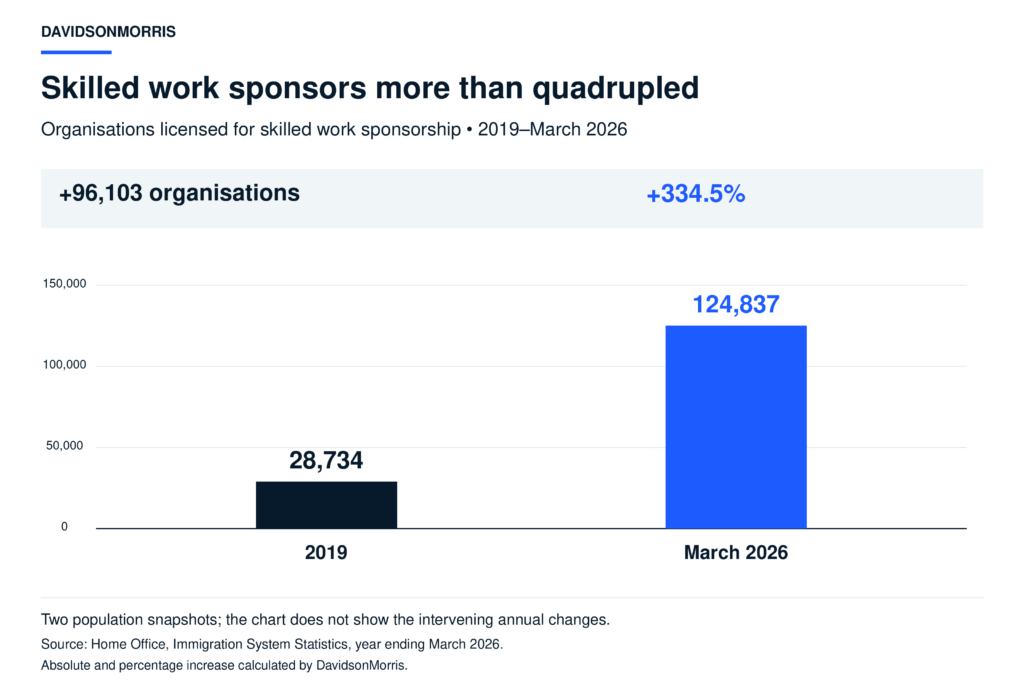
UK sponsor licence statistics show how far employer sponsorship has expanded since the post-Brexit immigration system was introduced. The number of organisations licensed for skilled work sponsorship increased from 28,734 in 2019 to 124,837 in March 2026, an increase of approximately 334.5%.
The growth in licence holding has not been matched by continuous growth in sponsored work immigration. Work visa grants have fallen from their 2023 peak, particularly under the Health and Care Worker route, showing that the number of licensed sponsors and the volume of active international recruitment can move in different directions.
The Home Office also recorded 32,301 work sponsor licence decisions in the year ending March 2026, of which 17,200 resulted in a grant. These figures measure a different stage of the system from the number of licensed sponsors, Certificates of Sponsorship and visa grants.
For employers, the data is most useful when each measure is kept within its proper context. Licence population indicates access to sponsorship, licence decisions record administrative outcomes, CoS data reflects stages of sponsorship activity and visa grants record immigration decisions affecting individuals.
This guide examines UK sponsor licence numbers, historical growth, licence decisions, Certificates of Sponsorship, sponsored work visa trends and the immigration routes and industries associated with international recruitment. It also explains the limits of the available data and what employers can reasonably conclude from national sponsorship statistics.
Section A: UK Sponsor Licence Statistics: Key Figures
The Home Office publishes several statistical measures covering different stages of the sponsorship system. Read together, they show the scale of sponsor licensing, the volume of licence decision-making and the immigration outcomes associated with sponsored work routes.
The figures should not be treated as interchangeable. An organisation can hold a sponsor licence without assigning a Certificate of Sponsorship during a particular period, while an active sponsor may assign certificates to multiple workers. Visa grants measure a later stage again and do not establish the number of organisations actively recruiting.
1. UK Sponsorship Statistics at a Glance
| Statistical measure | Official figure | Reference period |
|---|---|---|
| Organisations licensed for skilled work sponsorship | 124,837 | March 2026 |
| Organisations licensed for temporary work sponsorship | 4,909 | March 2026 |
| Work sponsor licence decisions | 32,301 | Year ending March 2026 |
| Work sponsor licences granted | 17,200 | Year ending March 2026 |
| Work sponsor licence applications not granted | 15,101 | Year ending March 2026 |
| Worker-category entry clearance visas granted to main applicants | 49,205 | Year ending June 2026 |
| Skilled Worker entry clearance visas granted to main applicants | 26,894 | Year ending June 2026 |
| Health and Care Worker entry clearance visas granted to main applicants | 7,228 | Year ending June 2026 |
Sources: Home Office, Immigration System Statistics, year ending March 2026 and year ending June 2026. The skilled work and temporary work sponsor populations overlap and should not be added together. Applications not granted include withdrawn and rejected applications and are not equivalent to formal refusals.
Official source: Home Office sponsorship licensing statistics, March 2026.
Official source: Home Office work immigration statistics, June 2026.
The figures show a sponsorship system with a large licensed employer population alongside lower recent volumes of new sponsored work entry clearance grants than at the earlier peak.
They also show why the underlying measure matters. Licence decisions concern organisations seeking or changing sponsorship permission, while visa grants concern immigration applications made by individuals.
2. What Do the Latest Sponsorship Figures Tell Us?
Three findings stand out from the latest Home Office data.
First, the licensed sponsor population has expanded substantially. The number of organisations registered for skilled work sponsorship increased from 28,734 in 2019 to 124,837 in March 2026. This is an increase of 96,103 organisations, or approximately 334.5%.
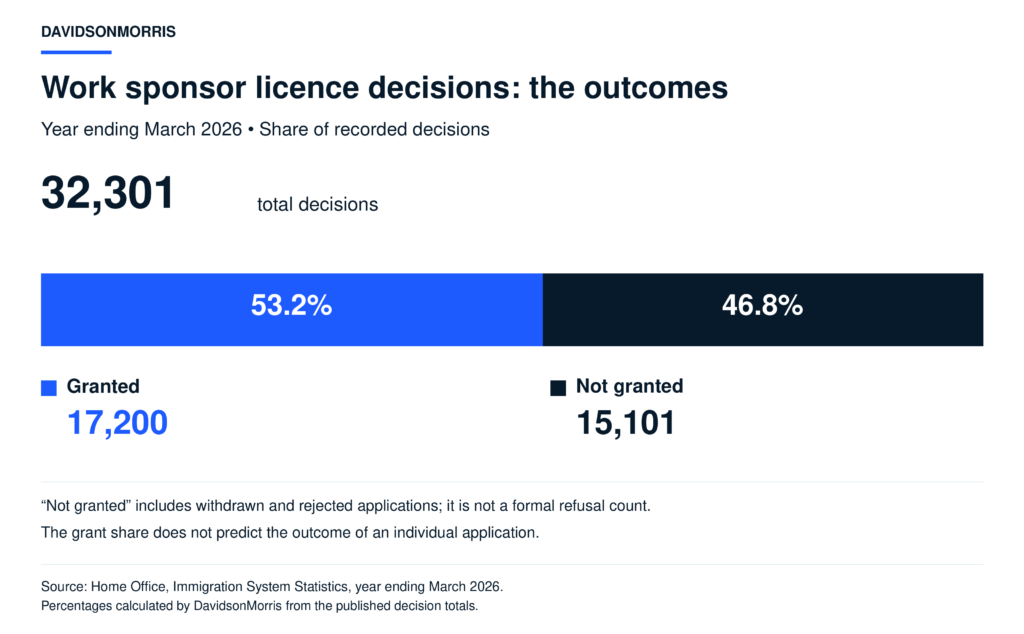
Second, sponsor licence decision volumes remain significant. In the year ending March 2026, the Home Office decided 32,301 work sponsor licence applications and granted 17,200 licences. The remaining 15,101 did not result in a grant, including applications withdrawn or rejected. Around 53.2% of recorded decisions resulted in a grant, but this should not be used as a forecast of the outcome of an individual application.
Third, growth in the sponsor population has not produced continuous growth in sponsored work visa grants. Work-related visa grants have fallen substantially from their 2023 peak, with the most pronounced change under the Health and Care Worker route. The number of organisations holding sponsorship permission can therefore remain high or continue to grow while new overseas recruitment declines.
For employers, the practical point is that licence holding and active sponsorship are different things. A sponsor licence creates the capability to recruit eligible overseas workers, but its existence does not show how often that capability is being used or how many sponsored workers an organisation employs.
Section B: How Many UK Employers Hold Sponsor Licences?
The Home Office’s published figures show that 124,837 organisations were registered as licensed sponsors for skilled work in March 2026. A further 4,909 organisations were registered for temporary work sponsorship.
These figures should not be added together to produce a total number of licensed employers. An organisation may hold sponsorship permission under both categories, meaning the populations overlap.
The number of licensed sponsors also differs from the number of employers actively using sponsorship. An organisation can retain its licence even when it is not assigning new Certificates of Sponsorship.
1. Latest Number of Licensed Sponsors in the UK
Home Office statistics provide the following comparison between the pre-Brexit sponsor population and the position in March 2026.
| Sponsorship category | 2019 | March 2026 | Increase | Percentage increase |
|---|---|---|---|---|
| Skilled work licensed sponsors | 28,734 | 124,837 | 96,103 | 334.5% |
| Temporary work licensed sponsors | 3,952 | 4,909 | 957 | 24.2% |
Source: Home Office, Immigration System Statistics, year ending March 2026. Absolute and percentage increases calculated by DavidsonMorris from the published figures.
The contrast between the two categories is substantial. The population licensed for skilled work sponsorship has increased more than fourfold, while the number licensed for temporary work has grown more modestly.
This reflects the much greater expansion of skilled work sponsorship authorisation over the period. However, the figures do not establish how many workers were sponsored by those organisations or how frequently the licences were used.
The Home Office also publishes a regularly updated register of licensed sponsors. The register identifies organisations authorised to sponsor workers, including their sponsorship routes and licence ratings.
Because the register changes over time, any numerical analysis based on it must identify the version or reference date used.
2. What Counts as a Licensed Sponsor?
A licensed sponsor is an organisation authorised by the Home Office to sponsor eligible individuals under one or more immigration routes.
Licensed sponsors include private companies, charities, public sector organisations and other eligible institutions. The term should not therefore be treated as synonymous with commercial companies.
Organisations may hold permission under several routes, depending on their recruitment requirements and the authorisations granted by the Home Office.
This creates important distinctions when interpreting sponsor licence statistics.
- Licensed organisations are not necessarily separate register entries. The structure of the published register and the presence of multiple sponsorship permissions can affect record counts.
- A licence does not confirm active sponsorship. Organisations may hold permission without assigning certificates during a particular reporting period.
- A licence does not establish the number of sponsored workers. A single sponsor may employ numerous sponsored workers, while another may employ none.
- The register is a point-in-time record. It does not provide a complete list of every organisation that held sponsorship permission at any point during a year.
- Licensing and compliance are separate questions. An organisation’s appearance on the register does not establish that it has satisfied every sponsorship obligation at all times.
These distinctions matter when comparing sponsor populations, calculating growth rates and assessing the wider significance of employer sponsorship.
3. How Many UK Businesses Are Licensed to Sponsor Workers?
Although sponsor licensing has become substantially more widespread, the proportion of UK businesses holding sponsorship permission cannot reliably be calculated simply by dividing the number of sponsor register entries by the total number of businesses operating in the UK.
The two populations are not directly equivalent.
The sponsor population includes organisations that are not necessarily commercial businesses, including charities and public bodies. UK business population statistics, meanwhile, include businesses without employees and organisations that may have no practical requirement to recruit workers through immigration sponsorship.
Multiple sponsorship permissions and differences in organisational records can also affect the calculation.
A meaningful comparison would need to use an appropriately defined sponsor population and a comparable UK business population, taking account of organisational type, reporting dates and duplicate records.
Even where such a comparison can be made, it would measure the prevalence of sponsorship permission rather than the proportion of employers actively recruiting sponsored workers.
For businesses assessing whether to obtain a sponsor licence, national licensing prevalence is therefore contextual information. The relevant decision depends on the organisation’s recruitment requirements, the eligibility of the proposed roles and its ability to comply with sponsorship duties.
Section C: UK Sponsor Licence Numbers by Year
Historical Home Office figures show a substantial expansion in the population of organisations and institutions licensed for work and study sponsorship since 2019.
However, the broader work-and-study sponsor population is not identical to the skilled work sponsor population reported in Section B. The two measures must remain separate when analysing historical growth.
For this reason, the following historical comparison uses the Home Office’s published work-and-study measure, rather than combining it with the March 2026 skilled work figures.
1. Historical UK Sponsor Licence Statistics
The Home Office reported 31,899 organisations and institutions licensed for work and study in 2019. By the end of September 2025, the equivalent published population had reached 124,697.
| Reference period | Licensed sponsors for work and study | Statistical basis |
|---|---|---|
| 2019 | 31,899 | Home Office historical baseline |
| September 2025 | 124,697 | Home Office published sponsor population |
Source: Home Office, Immigration System Statistics, year ending September 2025. Both observations relate to the published work-and-study sponsor population, not exclusively skilled work sponsors.
The increase between these observations was 92,798 organisations and institutions, equivalent to approximately 290.9%.
Put another way, the reported work-and-study sponsor population was approximately 3.9 times its 2019 level by September 2025.
These figures demonstrate the scale of the expansion, but they do not establish how many new licences were granted during the intervening period. A comparison between two population snapshots measures the net difference between the observations, rather than every licensing decision made between them.
Official source: Home Office work and study sponsor population statistics, September 2025.
2. How Many Sponsor Licences Are Granted Each Year?
Home Office statistics distinguish between the number of organisations holding sponsorship permission and the number of sponsor licence applications decided during a reporting period.
In the year ending March 2026, the Home Office decided 32,301 work sponsor licence applications, compared with 37,233 during the preceding 12 months.
Of the decisions recorded in the latest period, 17,200 resulted in licences being granted and 15,101 were not granted.
| Work sponsor licence decision measure | Year ending March 2026 |
|---|---|
| Total decisions | 32,301 |
| Licences granted | 17,200 |
| Applications not granted | 15,101 |
| Share of decisions resulting in a grant | 53.2% |
| Share of decisions not resulting in a grant | 46.8% |
Source: Home Office, Immigration System Statistics, year ending March 2026. Percentages calculated from the published decision totals. The not-granted category includes applications withdrawn and rejected and must not be described as a formal refusal rate.
The Home Office reported that the number of work sponsor licences granted was 24% lower than in the preceding year.
This indicates a reduction in licence grants during the reporting period, but it does not establish that employer demand for sponsorship fell by an equivalent percentage.
Changes in the number of applications, withdrawals, eligibility assessments and administrative outcomes can all affect the number of licences granted.
Nor should the 53.2% grant share be used as a forecast of the outcome of an individual sponsor licence application. The prospects of an application depend on the applicant’s circumstances, eligibility, supporting evidence and compliance arrangements.
3. When Did UK Sponsor Licence Numbers Change Most?
The expansion in sponsor licensing followed significant changes to the UK immigration system.
The end of free movement increased the importance of sponsor licences for employers recruiting many EU nationals who did not already hold an immigration status permitting them to work without sponsorship.
The introduction of the Skilled Worker framework also changed the range of occupations and recruitment circumstances in which employers could use sponsorship.
Subsequent developments, including the expansion of Health and Care Worker eligibility and later restrictions affecting overseas care recruitment, contributed to changes in the composition of sponsored work immigration.
However, growth in the licensed sponsor population should not be attributed to any single policy development without supporting evidence.
Immigration rules, employer recruitment demand, labour market conditions and the availability of alternative recruitment arrangements may all influence whether an organisation seeks or maintains sponsorship permission.
The historical population figures demonstrate substantial long-term expansion. They do not, by themselves, identify which individual year produced the greatest number of new sponsor licence grants or the precise cause of changes in licensing activity.
4. Long-Term Growth in the Sponsor Population
Long-term sponsor population growth provides an indication of how widely sponsorship permission has become established within the UK immigration system.
The increase from 31,899 work-and-study sponsors in 2019 to 124,697 by September 2025 demonstrates that substantially more organisations held sponsorship permission at the later reference date.
However, the number of licensed sponsors and the volume of sponsored work immigration have not followed identical trends.
Work-related visa grants rose substantially during the earlier years of the post-Brexit system, particularly during the expansion of recruitment through the Health and Care Worker route. They subsequently declined from their 2023 peak.
This means that the licensed sponsor population can remain large or continue growing while the number of new sponsored work visas granted falls.
Several explanations are possible. Organisations may retain sponsorship permission despite reduced recruitment, obtain licences in anticipation of future vacancies or assign relatively few certificates during a particular year.
However, national aggregate statistics cannot establish which of these explanations applies to an individual employer.
For businesses, the long-term figures demonstrate that sponsorship has become a more widely held organisational capability. They do not establish that every licensed organisation is actively recruiting overseas workers or that sponsorship is necessary for every employer.
Section D: How Has UK Employer Sponsorship Changed?
UK employer sponsorship has changed substantially since the introduction of the post-Brexit immigration system in January 2021. The number of organisations authorised to sponsor overseas workers has expanded, while the volume and composition of sponsored recruitment have fluctuated in response to immigration policy, labour market conditions and employer demand.
The Home Office’s statistics show that growth in the licensed sponsor population has not been accompanied by continuous growth in work visa grants. This distinction is important because holding a sponsor licence and actively recruiting sponsored workers are different measures of participation in the immigration system.
The number of licensed sponsors indicates how many organisations hold sponsorship permission. Certificates of Sponsorship provide information about sponsorship activity, while visa applications and grants record subsequent stages in the immigration process.
These measures should be considered together when assessing how employer sponsorship has developed, but they should not be treated as interchangeable.
1. Sponsor Licence Growth Versus Actual Sponsorship Activity
One of the most significant features of recent UK sponsorship trends is the divergence between the number of organisations holding sponsor licences and the volume of new sponsored work immigration.
Home Office statistics show that the number of organisations licensed for skilled work increased from 28,734 in 2019 to 124,837 in March 2026, an increase of approximately 334.5%.
However, work visa grants have not followed a continuously upward trajectory.
Work-related immigration increased substantially following the introduction of the new immigration system, with particularly strong growth in the Health and Care Worker route during 2022 and 2023. This was followed by a marked reduction in entry clearance grants.
In calendar year 2024, the Home Office recorded 210,098 work visas granted to main applicants across all work categories, 37% fewer than in 2023.
The distinction between these measures is fundamental. The licensed sponsor population represents organisations authorised to participate in sponsorship, while work visa grants measure immigration outcomes for individuals.
Moreover, not all work immigration routes require employer sponsorship. Figures covering all work visa categories therefore cannot automatically be described as sponsored work visa totals.
Several factors can explain why sponsor licence numbers may continue increasing while visa grants decline.
- Licences may be retained without active recruitment. Employers can maintain sponsorship permission even where they do not assign new Certificates of Sponsorship during a particular period.
- Organisations may obtain licences for future recruitment. Businesses may seek sponsorship permission before identifying or appointing an individual overseas worker.
- Existing sponsors may reduce recruitment volumes. An organisation may remain licensed while sponsoring fewer workers than in previous years.
- Changes in immigration eligibility may affect applications. Salary thresholds, occupation requirements and route restrictions can influence whether prospective workers qualify for sponsorship.
- Economic and labour market conditions may change. Employers may defer recruitment, reduce vacancies or rely on alternative sources of labour.
These factors can operate simultaneously. National aggregate statistics cannot establish how much each contributed to a particular movement in visa grants.
For employers, the practical implication is that sponsor licence growth should not be interpreted as evidence that international recruitment volumes are increasing at the same rate.
2. Changes in Employer Demand for Overseas Workers
The development of employer sponsorship since 2021 reflects changes in immigration eligibility as well as employers’ requirements for internationally recruited workers.
Before the end of free movement, many EU nationals could take employment in the UK without their employer requiring sponsorship permission.
Following the introduction of the new immigration system, employers recruiting EU nationals who did not already hold immigration status permitting them to work generally became subject to the sponsorship framework applying to other overseas nationals.
This increased the relevance of sponsor licensing to businesses that had previously recruited from the European labour market without requiring Home Office sponsorship permission.
The introduction of the Skilled Worker route also changed the range of occupations potentially eligible for sponsorship, bringing additional employers within the sponsorship system.
A further significant development was the expansion of overseas recruitment into health and social care.
Care workers and home carers became eligible for the Health and Care Worker route in February 2022. This was followed by substantial growth in visa grants associated with the route during 2022 and 2023.
The Home Office’s revised historical series records a peak of 145,823 Health and Care Worker entry clearance grants to main applicants in the year ending December 2023.
By the year ending June 2026, the equivalent published figure had fallen to 7,228, representing a reduction of approximately 95.0% between those two rolling annual periods.
This decline demonstrates the scale of the change in new overseas recruitment through the route. It does not establish that an equivalent proportion of existing sponsored care workers left the UK or that the same proportion of care providers surrendered their sponsor licences.
Changes in immigration policy formed an important part of the context, including restrictions affecting care worker dependants in March 2024 and the closure of new overseas applications for care worker and senior care worker occupations from July 2025, subject to applicable transitional arrangements.
However, the statistics do not establish the independent contribution of each policy measure to the decline in visa grants.
For employers, the figures demonstrate that the availability and practical use of international recruitment routes can change substantially over relatively short periods.
3. What Has Driven Changes in Sponsorship?
Changes in UK sponsorship activity reflect a combination of immigration policy, employer recruitment requirements and wider economic conditions.
The end of free movement increased the importance of sponsorship permission for employers recruiting many new EU workers without an existing right to work in the UK.
The introduction of the Skilled Worker route established a revised framework for sponsored employment, including changes to occupation eligibility and salary requirements compared with the previous Tier 2 (General) arrangements.
The expansion of Health and Care Worker eligibility supported a substantial increase in overseas recruitment into qualifying health and social care occupations during 2022 and 2023.
Immigration reforms introduced during 2024 and 2025 subsequently changed salary thresholds, skill requirements and the availability of sponsorship for certain occupations.
Labour market and economic conditions also influence recruitment decisions, including whether employers expand their workforce, replace departing employees or postpone vacancies.
The effects of these developments are not necessarily reflected immediately in immigration statistics.
An employer may obtain a sponsor licence before assigning a Certificate of Sponsorship. A certificate may be assigned before a visa application is submitted, and an application may be decided in a later reporting period.
Consequently, changes in sponsor licence applications, CoS activity and visa grants may occur at different times.
The most reliable interpretation of sponsorship trends therefore considers the relevant reporting periods and the precise administrative event measured by each dataset.
For employers, the statistics reinforce the importance of monitoring both recruitment conditions and immigration eligibility rather than assuming that historical sponsorship patterns will continue unchanged.
Section E: Certificates of Sponsorship Statistics
Certificates of Sponsorship are a central component of the UK’s employer sponsorship system. A Certificate of Sponsorship, commonly referred to as a CoS, is an electronic record assigned by a licensed sponsor to an eligible worker for use in an immigration application.
CoS statistics can provide a more direct indication of sponsorship activity than the number of organisations holding licences. However, the precise statistical measure is important.
A certificate allocated to an employer is not necessarily assigned to a worker. An assigned certificate may not subsequently be used in an immigration application, and a certificate used in an application does not establish that immigration permission was granted.
The Home Office has historically published detailed datasets covering Certificates of Sponsorship used in visa and extension applications. These datasets are distinct from a comprehensive count of all certificates assigned by sponsors.
The published historical series also has limitations. The detailed CoS datasets covering certificates used in applications by industry and nationality were discontinued following the year ending December 2024.
As a result, those historical datasets cannot provide a current 2026 total of all CoS assignments.
1. How Many Certificates of Sponsorship Are Assigned in the UK?
The number of Certificates of Sponsorship assigned during a reporting period measures the volume of sponsorship certificates allocated to individual workers by licensed sponsors.
This is different from the number of certificates allocated to employers for potential future assignment.
It is also different from the number of certificates used in immigration applications, because not every assigned certificate necessarily results in an application.
For this reason, the number of certificates assigned cannot reliably be calculated from visa grants or from the number of organisations holding sponsor licences.
The Home Office’s historical CoS datasets provide information about certificates used in visa and extension applications, including breakdowns by industry and nationality.
However, the detailed published series was discontinued following the year ending December 2024. It should not be presented as a current measure of all certificates assigned in 2026.
Official historical data is available through the Immigration System Statistics data tables.
The Home Office also publishes Migration Transparency Data, containing administrative information about sponsor licensing and other immigration operations.
However, these collections do not provide a single continuous, directly comparable public series covering all current CoS assignments and the historical certificates-used measure.
Accordingly, historical CoS activity and current visa grant statistics must be reported separately.
2. Historical Certificates of Sponsorship Trends
The Home Office’s historical CoS datasets provide evidence of certificates used in immigration applications rather than a complete record of every certificate assigned.
The distinction matters because the use of a certificate in an application represents a later stage in the sponsorship process.
Historically, the Home Office published two relevant datasets:
- CoS_D01: Certificates of Sponsorship used in visa or extension applications, broken down by industry.
- CoS_D02: Certificates of Sponsorship used in visa or extension applications, broken down by nationality.
These datasets can support historical analysis of sponsorship activity, including the distribution of certificates used in applications across industries and nationalities.
However, their coverage and definitions must be preserved when interpreting the figures.
A certificate used in an extension application, for example, does not necessarily represent a new worker arriving in the UK. Similarly, a certificate used in an entry clearance application does not establish that the application was granted.
The historical series should therefore not be described as a count of newly recruited overseas workers.
Nor should changes in certificates used in applications be treated as equivalent to changes in the number of active licensed sponsors.
The discontinuation of the detailed series also limits the extent to which historical CoS trends can be compared directly with more recent sponsorship activity.
Current immigration statistics remain useful for analysing work visa applications and grants, but they measure different events and cannot simply be appended to the historical CoS series.
3. Current Sponsored Work Visa Statistics
Although the discontinued historical CoS datasets do not establish current assignment totals, the Home Office continues to publish statistics on work visa applications and grants.
These provide evidence of immigration outcomes associated with relevant work routes, including Skilled Worker and Health and Care Worker.
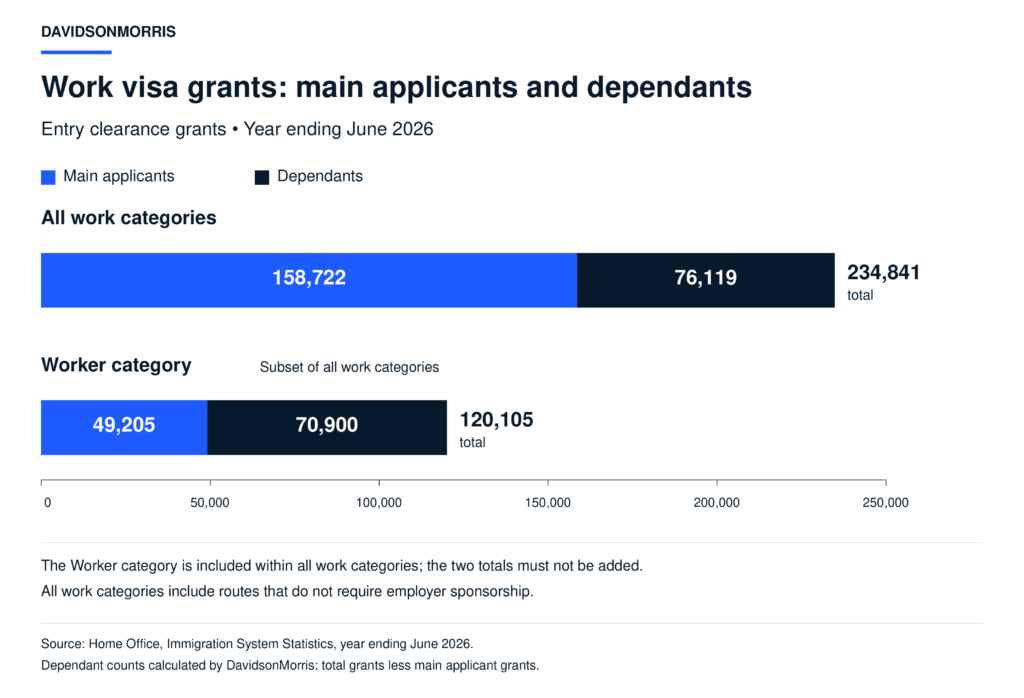
For the year ending June 2026, the Home Office reported the following entry clearance visa grants.
| Immigration measure | Year ending June 2026 |
|---|---|
| All work-category visa grants, including dependants | 234,841 |
| All work-category visa grants to main applicants | 158,722 |
| Worker-category visa grants, including dependants | 120,105 |
| Worker-category visa grants to main applicants | 49,205 |
| Skilled Worker visa grants to main applicants | 26,894 |
| Health and Care Worker visa grants to main applicants | 7,228 |
Source: Home Office, Immigration System Statistics, year ending June 2026. These figures measure entry clearance visa grants, not Certificates of Sponsorship assigned or used in applications.
The figures demonstrate the importance of distinguishing between the different immigration categories.
The total of 158,722 work-category grants to main applicants includes immigration routes that do not necessarily require employer sponsorship.
The narrower Worker category recorded 49,205 main applicant grants, including 26,894 under Skilled Worker and 7,228 under Health and Care Worker.
These figures provide information about new entry clearance decisions, but they do not capture every instance of sponsorship activity.
For example, employers may assign Certificates of Sponsorship to eligible individuals already in the UK who are applying to extend their permission or change sponsored employment.
Such activity is not equivalent to new entry clearance grants.
Furthermore, a visa grant does not necessarily establish that the worker commenced the proposed employment.
For employers assessing sponsorship trends, visa grant statistics are therefore useful evidence of immigration outcomes, but they should not be described as CoS assignment totals or as a direct count of sponsored workers entering employment.
4. Defined and Undefined CoS Statistics
The Skilled Worker sponsorship system distinguishes between Defined and Undefined Certificates of Sponsorship.
A Defined CoS is generally required where a Skilled Worker is applying for entry clearance from outside the UK. The sponsor must request the certificate through the Sponsor Management System and obtain approval before assigning it to the worker.
An Undefined CoS is used for eligible sponsored applications where a Defined CoS is not required, including relevant in-country Skilled Worker applications.
The distinction is important for both sponsorship administration and statistical interpretation.
An employer’s annual allocation of Undefined CoS represents permission to assign certificates up to the authorised number. It does not establish that every allocated certificate has been assigned.
Similarly, approval of a Defined CoS request does not necessarily mean that the certificate was subsequently assigned or used in a successful immigration application.
Consequently, statistics concerning CoS requests, allocations, approvals and assignments should be reported as separate measures.
They should not be combined into a single total without establishing that the underlying data is mutually exclusive and uses a consistent definition.
The operational requirements are explained in the Home Office’s Certificates of Sponsorship guidance.
5. What Do CoS Statistics Reveal About Employer Sponsorship?
CoS statistics can provide valuable information about how sponsorship permissions are used, particularly where the data distinguishes between immigration routes, industries and reporting periods.
However, the interpretation depends on whether the published measure concerns certificates allocated, assigned or used in applications.
Historical statistics covering certificates used in applications can help identify patterns in sponsorship activity, but they do not establish the number of unique workers recruited or the number of employers actively sponsoring workers.
There are several reasons for this.
- One worker may receive more than one CoS. This can occur where a worker changes sponsored employment or requires a new certificate for another eligible application.
- Not every assigned CoS results in an immigration application. A proposed recruitment may not proceed after assignment.
- Not every application results in a visa grant. Applications may be refused, withdrawn or otherwise concluded.
- Not every certificate relates to a new arrival. Some certificates are used in applications made by workers already in the UK.
- Administrative records do not necessarily establish employment outcomes. Assignment or use of a certificate does not confirm that the worker subsequently commenced employment.
The distinction between sponsorship activity and immigration outcomes is particularly important when analysing changes in the licensed sponsor population.
A larger population of licensed sponsors may coexist with a lower volume of certificates used in applications or fewer entry clearance grants.
This does not necessarily indicate that employers have stopped using sponsorship. It may reflect reduced recruitment volumes, greater use of existing sponsored workers, changes in immigration eligibility or differences in the timing of applications.
For employers, the most useful approach is to consider sponsor licensing statistics, historical CoS evidence and current visa statistics as related but separate indicators.
Together, they provide context for understanding the development of UK employer sponsorship without implying that any single measure captures the entire sponsored workforce.
Section F: UK Sponsorship Statistics by Immigration Route
UK employer sponsorship operates across several immigration routes, each with different eligibility requirements, permitted activities and sponsorship arrangements. The Skilled Worker route is the principal route for employers recruiting overseas nationals into eligible skilled employment, while other sponsored routes support temporary work, international business transfers and specialist assignments.
Home Office statistics show substantial differences in the volume of immigration activity across these routes. However, the available data must be interpreted according to the precise immigration categories used in official publications.
In particular, the Home Office’s Worker category is broader than the Skilled Worker route alone. It includes several immigration routes, and its totals should not be presented as if every grant related to a Skilled Worker application.
Similarly, visa grants to main applicants should be distinguished from grants to dependants. A dependant visa does not represent an additional worker sponsored by an employer.
The figures below concern entry clearance visa grants during the year ending June 2026. They do not represent the number of Certificates of Sponsorship assigned, the total number of sponsored workers already living in the UK or the number of workers who commenced employment during that period.
1. Sponsored Work Visa Statistics by Route
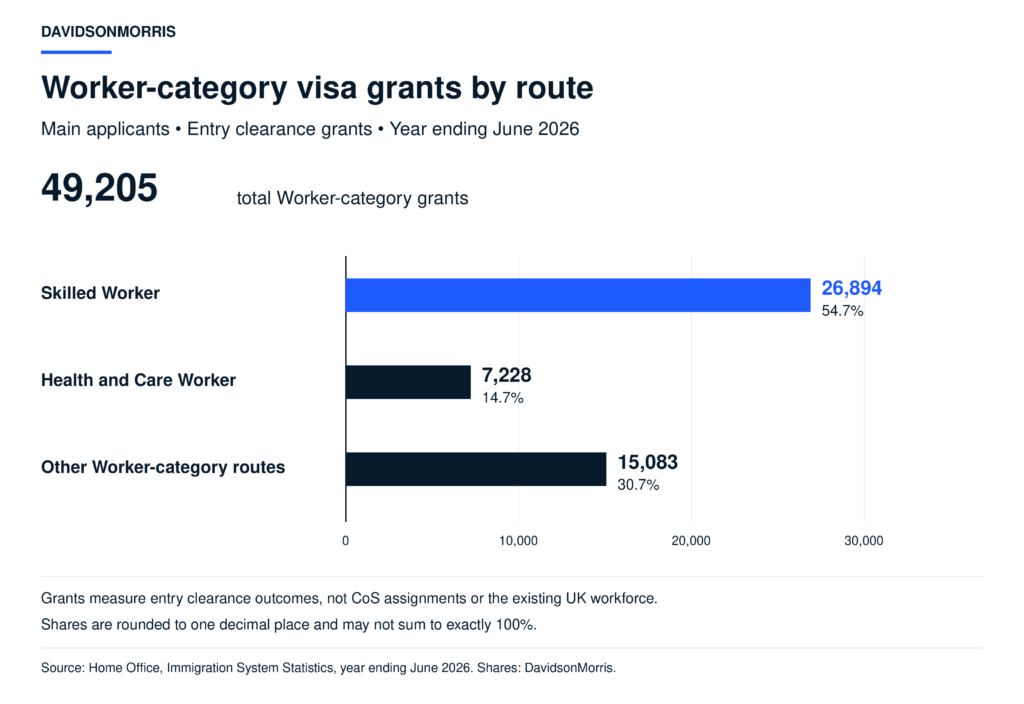
The Home Office recorded 49,205 entry clearance visa grants to main applicants within the Worker category in the year ending June 2026.
Of these, 26,894 were recorded under the Skilled Worker route and 7,228 under the Health and Care Worker route.
The remaining 15,083 grants fell within other routes included in the published Worker category.
Source: Home Office, Immigration System Statistics, year ending June 2026. Percentages calculated from the published main applicant totals and rounded to one decimal place. The individual rounded percentages may not sum exactly to 100%.
The figures show that Skilled Worker accounted for more than half of Worker-category entry clearance grants to main applicants during the reporting period.
Health and Care Worker accounted for a substantially smaller share than during the earlier expansion of overseas health and social care recruitment.
The residual category is a calculated difference between the published Worker-category total and the two separately identified routes. It should not be interpreted as a single immigration route or attributed entirely to Global Business Mobility or another individual category.
Official source: Home Office Immigration System Statistics.
2. Skilled Worker Visa Statistics
The Skilled Worker route allows eligible UK employers holding the appropriate sponsor licence to recruit overseas nationals into qualifying employment.
Applicants must meet the relevant immigration requirements, including those concerning the sponsoring employer, occupation, salary, English language ability and other applicable conditions.
The Home Office recorded 26,894 Skilled Worker entry clearance grants to main applicants in the year ending June 2026.
This represented approximately 54.7% of main applicant grants within the published Worker category during that period.
However, this percentage should not be interpreted as the proportion of all sponsored workers employed under Skilled Worker permission.
The figure measures entry clearance grants during a particular 12-month period. It excludes workers who already held relevant permission in the UK and were applying for an extension or a change of sponsored employment.
It also does not establish how many Skilled Worker visa holders were employed in the UK at the end of the reporting period.
Changes in Skilled Worker visa grants may reflect several developments, including changes in occupation eligibility, salary requirements, recruitment demand and the availability of other immigration routes.
For employers, the figures provide an indication of the scale of new overseas recruitment through the route, but they do not replace an assessment of whether a proposed vacancy satisfies the current Skilled Worker requirements.
3. Health and Care Worker Visa Statistics
The Health and Care Worker route has experienced some of the most substantial changes in immigration activity since the introduction of the post-Brexit sponsorship system.
The route supports eligible healthcare professionals and other qualifying workers taking up sponsored employment in the UK.
Its expansion during 2022 and 2023 was particularly significant following the addition of care workers and home carers to the occupations eligible for sponsorship in February 2022.
Home Office statistics subsequently recorded a substantial increase in Health and Care Worker entry clearance grants, followed by a marked decline.
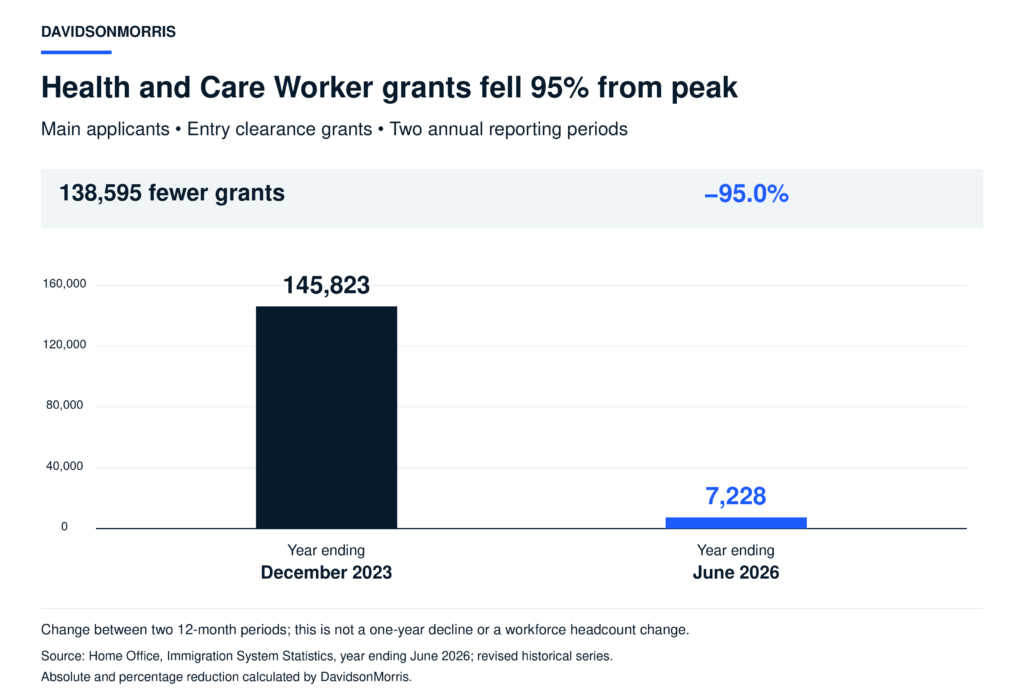
Source: Home Office Immigration System Statistics, using the revised historical peak reported in the year ending June 2026 publication. The figures concern entry clearance grants to main applicants in two different rolling annual periods.
The difference between these observations is 138,595 grants, representing a reduction of approximately 95.0% from the earlier peak.
This is a comparison between two rolling 12-month periods ending at different dates. It should not be described as a single-year decline or an annual percentage change.
The reduction is substantial, but its interpretation requires care.
First, the figures measure new entry clearance grants, not the number of Health and Care Worker visa holders already living or working in the UK.
Second, they do not establish the number of care providers retaining sponsor licences or the number of sponsored workers remaining in employment.
Third, changes in the eligibility of particular occupations and restrictions on overseas recruitment affect the types of applications that can be made.
From 11 March 2024, care workers and senior care workers became subject to restrictions on bringing dependants under the route, subject to applicable transitional provisions.
Further changes took effect on 22 July 2025, closing the route to new overseas applications for care workers and senior care workers, while retaining specified transitional arrangements for eligible applicants already in the UK.
These transitional arrangements are conditional. They should not be interpreted as a general entitlement for anyone already in the UK to switch into care work sponsorship.
The statistics are consistent with a period of substantial immigration policy change, but they do not independently establish the contribution of each individual reform to the reduction in grants.
For care sector employers, the figures underline the importance of distinguishing historical recruitment practices from the immigration options currently available.
4. Global Business Mobility Sponsorship Statistics
Global Business Mobility comprises sponsored immigration routes designed to facilitate specified international business assignments and transfers.
The routes include Senior or Specialist Worker, Graduate Trainee, UK Expansion Worker, Service Supplier and Secondment Worker.
They serve different purposes from the Skilled Worker route and are subject to route-specific eligibility requirements.
For example, the Senior or Specialist Worker route is principally concerned with qualifying transfers involving overseas businesses and their UK operations, rather than unrestricted recruitment from the international labour market.
Global Business Mobility sponsorship therefore forms part of the wider employer sponsorship system, but its activity should not be combined with Skilled Worker recruitment without identifying the relevant routes.
The published Worker-category total includes immigration activity beyond Skilled Worker and Health and Care Worker. However, the residual figure of 15,083 grants calculated in Section F1 cannot be presented as the number of Global Business Mobility grants.
A reliable Global Business Mobility total requires the relevant route-level Home Office dataset for the same reporting period.
For employers, the distinction is important because an organisation’s need for international assignments or intra-group transfers may be different from its requirement to recruit new employees into permanent UK vacancies.
The appropriate immigration route depends on the proposed activity, the relationship between the organisations involved and the applicable immigration requirements.
5. Temporary Worker Sponsorship Statistics
Temporary Worker sponsorship covers several immigration routes intended for specified forms of temporary employment or activity.
These include routes associated with seasonal work, creative work, charity work, religious work, international agreements and government-authorised exchange arrangements.
The requirements and permitted activities differ between routes, and the presence of a Temporary Worker sponsor licence does not establish that an organisation is authorised to sponsor workers under every temporary work category.
Home Office figures recorded 4,909 organisations licensed for temporary work sponsorship in March 2026, compared with 3,952 in 2019.
This represents an increase of 957 organisations, or approximately 24.2%.
The increase is considerably smaller than the growth recorded in the skilled work sponsor population over the same reference period.
However, this does not necessarily indicate that Temporary Worker routes have experienced correspondingly limited changes in immigration activity.
The number of licensed organisations is not equivalent to the number of certificates assigned or visas granted.
Furthermore, temporary work routes differ substantially in their recruitment models, sponsoring arrangements and seasonal patterns.
Some routes may involve concentrated periods of recruitment or sponsorship arrangements that are not directly comparable with ordinary employer recruitment under Skilled Worker.
Accordingly, Temporary Worker sponsor population statistics should be analysed separately from route-specific visa grants and sponsorship activity.
6. What Do Route-Level Statistics Mean for Employers?
Route-level statistics help demonstrate how international recruitment is distributed across different parts of the immigration system.
They can also indicate where changes in immigration policy have coincided with substantial changes in new visa grants.
However, national route-level statistics do not establish whether a particular employer can sponsor a proposed worker.
Eligibility depends on the relevant immigration rules and sponsor guidance, including the proposed occupation, salary, employment arrangements, organisational relationships and other route-specific requirements.
Employers should also distinguish between obtaining sponsorship permission and using that permission.
A sponsor licence may authorise an organisation to sponsor under specified routes, but each proposed assignment must satisfy the requirements applicable to the worker and the sponsored role.
For workforce planning, the most useful interpretation of route-level statistics is therefore contextual.
The figures can inform an employer’s understanding of broader recruitment patterns and immigration policy developments, but they cannot substitute for a route-specific eligibility assessment or compliance review.
Section G: Which UK Industries Use Sponsorship Most?
Employer sponsorship is used across a wide range of UK industries, including health and social care, technology, engineering, professional services, manufacturing, education and other sectors requiring access to eligible international workers.
However, identifying which industries use sponsorship most requires careful selection of the statistical measure.
The number of licensed sponsors operating in an industry is not necessarily equivalent to the number of workers sponsored by that industry.
Likewise, the number of sponsored work visas granted to individuals associated with a particular industry is not the same as the number of organisations holding sponsorship permission.
The Home Office publishes sponsored work entry clearance statistics with occupation and industry breakdowns. These provide a more appropriate basis for analysing the distribution of new sponsored work visa grants than simply counting organisations appearing on the public sponsor register.
Nevertheless, industry classifications, occupational classifications and reporting periods must be considered before drawing conclusions about sector rankings.
1. Sponsorship by Industry: What the Home Office Data Measures
The Home Office publishes detailed sponsored work visa statistics by occupation and industry, including the Occ_D02 dataset.
This dataset provides information about sponsored work entry clearance grants associated with occupational and industry classifications.
It is important to distinguish the two dimensions.
Occupation concerns the type of work undertaken by an individual, such as software development, nursing or engineering.
Industry concerns the economic activity of the sponsoring organisation, such as information technology, healthcare or manufacturing.
The two are related but not interchangeable.
For example, an information technology professional may work for a technology business, a bank, a retailer or a professional services organisation.
Consequently, the number of visas granted to workers in an IT occupation cannot automatically be described as the number of visas sponsored by the IT industry.
The Home Office’s industry data also has methodological limitations.
Industry classifications are based on information reported by sponsors and may not perfectly reflect every organisation’s economic activity.
Some immigration records may not be matched to the relevant occupation data, while changes in occupational classification systems can affect historical comparisons.
In particular, comparisons spanning the transition from SOC 2010 to SOC 2020 classifications require care because occupational categories are not necessarily directly equivalent.
These limitations do not make the official statistics unsuitable for analysis. They mean that any industry ranking or trend comparison should identify the underlying measure and its limitations.
Official source: Home Office Immigration System Statistics data tables.
2. Health and Social Care Sponsorship
Health and social care has been particularly important to the development of UK employer sponsorship since 2021.
The Health and Care Worker route supports eligible healthcare professionals and other qualifying workers, while the addition of care workers and home carers to the sponsorship system in February 2022 significantly expanded the potential use of the route.
The subsequent increase in Health and Care Worker entry clearance grants demonstrates the scale of overseas recruitment through this immigration category during 2022 and 2023.
However, Health and Care Worker visa statistics should not be treated as an exact measure of the health and social care industry’s total sponsorship activity.
Immigration routes and industrial classifications measure different characteristics. The route identifies the immigration permission granted, while the industry classification concerns the sponsor’s economic activity.
Some organisations operating in healthcare or social care may sponsor workers under Skilled Worker rather than Health and Care Worker, depending on the occupation and eligibility requirements.
Equally, the Health and Care Worker route is not a direct statistical measure of the total workforce employed across the NHS, private healthcare providers and adult social care organisations.
The substantial reduction in Health and Care Worker entry clearance grants by June 2026 therefore demonstrates a change in new immigration grants under the route, not a corresponding reduction in the existing health and social care workforce.
For employers in the sector, the figures reinforce the importance of considering the immigration route, the sponsored occupation and the applicable recruitment restrictions separately.
3. Technology and IT Sponsorship
Technology-related occupations remain a significant component of Skilled Worker immigration.
According to the Home Office, IT professionals accounted for 4,674 Skilled Worker entry clearance grants to main applicants in the year ending June 2026.
This represented a reduction of approximately 7% compared with the preceding year.
The Home Office identified IT professionals as the largest occupational group for Skilled Worker main applicant grants during the reporting period.
These figures provide evidence of the continuing importance of technology-related skills within the Skilled Worker route.
However, they measure an occupational group rather than the information technology industry as a whole.
IT professionals may be sponsored by employers operating across financial services, manufacturing, retail, healthcare, professional services and other industries.
It would therefore be incorrect to describe the 4,674 grants as the total number of workers sponsored by UK technology companies.
Similarly, the 7% reduction relates to the specified occupational measure and reporting period. It does not establish that all technology industry sponsorship declined by the same percentage.
For employers, the figures indicate that technology-related occupations continue to feature prominently in new Skilled Worker entry clearance grants, while illustrating the need to distinguish occupational demand from industry-level sponsorship.
4. Engineering, Manufacturing and Professional Services
Engineering, manufacturing and professional services employers may use sponsorship to recruit workers into eligible specialist, technical, managerial and professional occupations.
However, these broad industry descriptions do not correspond to a single immigration route or occupational classification.
Engineering professionals, for example, may work in manufacturing, construction, energy, infrastructure, technology or professional consultancy businesses.
Similarly, professional services organisations may sponsor workers across legal, financial, technical, analytical, administrative and other eligible occupational categories.
Reliable analysis therefore requires a distinction between the industry in which the sponsoring organisation operates and the occupation undertaken by the sponsored worker.
The Home Office’s occupation-and-industry data provides a basis for such analysis, but the underlying categories must be examined before making numerical comparisons or identifying the industries with the highest number of grants.
Without a verified aggregation of those industry records, it would be misleading to publish a ranked table implying that one industry sponsors more workers than another.
The absence of a published ranking in this guide should not be interpreted as evidence that the industries concerned make limited use of sponsorship.
It reflects the need to avoid unsupported numerical comparisons.
For employers operating in these sectors, sponsorship eligibility depends on the particular occupation and employment arrangements rather than the industry’s general level of international recruitment.
5. Does the Sponsor Register Show Which Industries Sponsor Most Workers?
The public register of licensed sponsors is useful for identifying organisations authorised to sponsor workers, but it is not a comprehensive dataset of sponsored employment by industry.
The register contains information about licensed organisations and their sponsorship permissions.
It does not provide a complete count of the workers sponsored by each organisation.
Consequently, counting the number of sponsor register entries associated with an industry would not establish the number of workers recruited through sponsorship by that industry.
There are several additional methodological difficulties.
- Organisational size varies. A large employer may sponsor substantially more workers than several smaller organisations combined.
- Licence holding does not establish activity. An organisation may remain on the register without assigning new certificates during the reporting period.
- Multiple permissions may affect records. Organisations can hold sponsorship permission under more than one immigration route.
- Industry classification requires a consistent methodology. Organisation names alone do not reliably establish their economic activity.
- Register snapshots measure a point in time. They do not capture every licence held or every sponsorship event during a year.
For these reasons, the register should not be used as the sole basis for ranking industries by sponsored worker numbers.
Where the objective is to examine new sponsored work visa grants by industry, the Home Office’s relevant immigration statistics are a more suitable source.
Where the objective is to identify the number of licensed organisations within an industry, a separate analysis of the sponsor population may be appropriate, provided the organisational classification and counting method are transparent.
6. How Should Employers Interpret Industry Sponsorship Statistics?
Industry sponsorship statistics can provide useful context for workforce planning, particularly where employers are assessing the availability of international recruitment within their sector.
However, national industry trends cannot establish whether a particular employer needs a sponsor licence or whether an individual vacancy qualifies for sponsorship.
An industry with substantial sponsored work immigration may include organisations with very different recruitment requirements, salary structures and compliance capabilities.
Equally, an employer operating in an industry with relatively limited sponsorship activity may have a legitimate need to recruit an eligible specialist worker from overseas.
The relevant considerations include the nature of the proposed role, the applicable occupation code, salary requirements, the worker’s immigration circumstances and the employer’s ability to satisfy sponsor licence and compliance obligations.
Industry statistics may also be affected by policy changes that apply to particular occupations or immigration routes rather than to an entire sector.
For example, restrictions affecting care worker sponsorship do not necessarily apply in the same way to every healthcare occupation or every organisation operating in the wider health sector.
For employers, industry statistics are therefore best used as contextual evidence rather than a substitute for an assessment of sponsorship eligibility.
The most reliable analysis combines industry information with route-level immigration data, occupation requirements and current Home Office sponsor guidance.
Section H: Sponsor Licence Statistics and Immigration Policy Changes
Changes in UK sponsor licence statistics must be considered in the context of immigration policy developments. Since the introduction of the post-Brexit immigration system, the Government has made substantial changes to sponsored work routes, occupation eligibility, salary thresholds and employer sponsorship requirements.
These reforms have affected the circumstances in which employers can recruit overseas workers and the types of immigration applications that prospective employees can make.
However, changes in immigration statistics cannot automatically be attributed to a particular policy decision. Sponsorship activity is also influenced by employer demand, labour market conditions, economic developments and the timing of immigration applications.
Furthermore, policy changes may affect different statistical measures at different times. An employer may retain a sponsor licence after becoming unable to sponsor workers for a particular occupation, while visa applications submitted before a rule change may be decided during a later reporting period.
For these reasons, the relationship between immigration policy and sponsor licence statistics requires careful interpretation.
1. The End of Free Movement and the Introduction of the Skilled Worker Route
The end of EU free movement and the introduction of the UK’s post-Brexit immigration system represented a fundamental change in the role of employer sponsorship.
From 1 January 2021, the Skilled Worker route replaced Tier 2 (General) as the principal immigration route for employers sponsoring eligible overseas workers.
The new framework generally applied to EU and non-EU nationals who required immigration permission to undertake sponsored employment in the UK.
Before the end of free movement, many EU nationals could work in the UK without their employer holding a sponsor licence. The new system therefore increased the importance of sponsorship permission for employers recruiting workers who did not already hold an immigration status allowing them to work without sponsorship.
The Skilled Worker framework also changed the occupation and salary requirements applying to sponsored employment compared with the previous Tier 2 (General) arrangements.
These developments expanded the range of employers for whom obtaining a sponsor licence became a relevant recruitment consideration.
The Home Office’s historical statistics demonstrate substantial growth in the licensed sponsor population following the introduction of the new immigration system.
However, the figures do not establish that the end of free movement was the sole cause of the increase.
Changes in occupation eligibility, recruitment demand and other immigration policy developments also formed part of the wider context.
For employers, the significance of the reform was that sponsor licensing became an increasingly important mechanism for accessing international recruitment, particularly where prospective workers did not already hold immigration permission allowing them to undertake the proposed employment.
2. Health and Care Worker Sponsorship Expansion in 2022 and 2023
The Health and Care Worker route played a major role in the development of UK sponsored work immigration following the introduction of the post-Brexit system.
In February 2022, care workers and home carers became eligible for sponsorship under the Health and Care Worker arrangements.
This increased the availability of overseas recruitment for eligible adult social care roles and contributed to a period of substantial growth in immigration activity through the route.
Home Office statistics subsequently recorded a marked increase in Health and Care Worker entry clearance grants during 2022 and 2023.
The revised historical series identifies 145,823 main applicant grants in the year ending December 2023, representing the peak reported in the subsequent Home Office analysis.
This figure demonstrates the scale of new entry clearance activity under the route during that period.
However, it does not establish the number of individual care providers holding sponsor licences or the number of sponsored care workers employed in the UK at the end of 2023.
Nor should every Health and Care Worker visa grant be attributed to adult social care. The route also covers eligible healthcare occupations.
The expansion of sponsorship eligibility therefore provides important context for the increase in immigration activity, but the route-level statistics should not be treated as a complete measure of recruitment across the entire health and social care industry.
3. Immigration Reforms Introduced in 2024
During 2024, the Government introduced significant changes affecting sponsored work immigration, including higher Skilled Worker salary requirements and restrictions relating to care worker dependants.
From 11 March 2024, new applicants sponsored as care workers or senior care workers became subject to restrictions on bringing dependants, subject to applicable transitional arrangements.
Further changes took effect in April 2024, including an increase in the standard Skilled Worker general salary threshold to £38,700 for relevant applications.
Different salary requirements continued to apply in specified circumstances, including eligible healthcare and education occupations, certain discounted categories and transitional cases.
The £38,700 threshold should therefore not be interpreted as the minimum salary applying to every sponsored worker during that period.
The changes altered the eligibility framework for employers seeking to sponsor workers and for individuals applying under the relevant immigration routes.
Home Office statistics recorded 210,098 work-category visa grants to main applicants in calendar year 2024, representing a reduction of approximately 37% compared with 2023.
However, that total covers work immigration categories more broadly and is not confined to employer-sponsored Skilled Worker applications.
It would therefore be misleading to attribute the entire reduction to the April 2024 Skilled Worker salary changes or the March 2024 care worker dependant restrictions.
Changes in the volume of applications, route eligibility, recruitment demand and other immigration categories may also affect the overall figures.
For employers, the reforms demonstrate that sponsorship eligibility can change independently of whether an organisation continues to hold a valid sponsor licence.
4. Skilled Worker and Care Worker Changes in July 2025
Further substantial reforms to sponsored work immigration took effect on 22 July 2025.
These included changes to the general skill threshold for Skilled Worker sponsorship, increases to relevant salary requirements and restrictions affecting overseas recruitment into care worker and senior care worker occupations.
Under the revised Skilled Worker framework, the general occupational skill threshold was raised to RQF level 6, subject to specified exceptions and transitional provisions.
The standard general salary threshold also increased to £41,700 for relevant applications.
However, these requirements did not apply identically to every applicant. The Immigration Rules retained provisions for specified occupations, salary categories and workers qualifying under transitional arrangements.
Accordingly, neither the RQF level 6 requirement nor the £41,700 threshold should be presented as an absolute rule applying to every sponsored worker.
The July 2025 changes also closed the Health and Care Worker route to new overseas applications for care worker and senior care worker occupations.
Specified transitional arrangements remained available for eligible applicants already in the UK, subject to the relevant conditions and deadlines.
These arrangements did not create an unrestricted entitlement for all individuals already in the UK to switch into care worker sponsorship.
The reforms significantly changed the immigration options available to employers recruiting into affected occupations.
However, the impact on published statistics must be interpreted with reference to the relevant reporting periods.
Applications made before the changes may have been decided afterwards, while employers could continue holding sponsor licences even where the reforms reduced their ability to sponsor new workers for particular roles.
For this reason, changes in visa grants following July 2025 cannot be treated as a direct measure of the number of sponsor licences lost or the number of employers withdrawing from international recruitment.
5. Can Changes in Sponsor Licence Statistics Be Attributed to Immigration Policy?
Immigration policy can influence both the demand for sponsorship permission and the number of sponsored work visa applications made.
However, identifying a statistical change after a policy announcement does not establish that the policy caused the entire change.
Several factors may affect sponsorship statistics simultaneously.
- Changes in eligibility: New salary thresholds, occupation requirements or route restrictions can affect whether proposed workers qualify for sponsorship.
- Employer recruitment decisions: Organisations may increase, reduce or postpone recruitment in response to commercial conditions.
- Labour market developments: Changes in domestic labour availability and demand for particular skills can influence international recruitment.
- Administrative timing: Licence applications, CoS assignments and visa decisions may fall into different reporting periods.
- Existing sponsorship arrangements: Employers may retain licences and continue employing sponsored workers without making new overseas recruitment applications.
- Changes in application composition: The relative volume of main applicant, dependant, entry clearance and in-country applications can affect published totals.
These considerations are particularly important when comparing the substantial growth in the licensed sponsor population with the more recent decline in work visa grants.
The figures demonstrate that sponsorship authorisation has become more widespread while the volume of new work immigration has changed considerably.
They do not establish a single explanation for that divergence.
For employers, immigration statistics are most useful when considered alongside the current legal requirements and the organisation’s own recruitment and workforce circumstances.
Section I: What Do Sponsor Licence Statistics Mean for UK Employers?
UK sponsor licence statistics provide valuable context for employers considering international recruitment, maintaining sponsorship permission or reviewing their workforce compliance arrangements.
The substantial expansion of the licensed sponsor population demonstrates that sponsorship has become a more widely used organisational capability since the introduction of the post-Brexit immigration system.
However, the decline in recent sponsored work visa grants also illustrates how recruitment activity can change even where the number of organisations holding licences remains comparatively high.
For employers, the practical significance of these trends depends on their individual recruitment requirements, the occupations involved and the immigration routes available.
National statistics cannot determine whether a particular business requires a sponsor licence or whether an individual worker qualifies for sponsorship.
They can nevertheless help employers understand the wider environment in which sponsorship decisions are made.
1. Sponsor Licensing as a Workforce Planning Consideration
For employers that recruit internationally, sponsor licensing may form part of medium- and long-term workforce planning.
A sponsor licence provides the organisation with permission to sponsor eligible workers under the routes for which it is authorised.
However, holding a licence does not guarantee that a particular worker or vacancy will qualify for sponsorship.
Employers must consider the relevant occupation requirements, salary thresholds, employment arrangements and other conditions applying to the proposed recruitment.
The expansion in sponsor licence numbers indicates that more organisations have obtained sponsorship permission, but it does not establish that sponsorship is necessary or commercially appropriate for every employer.
Some businesses may recruit entirely from workers who already hold unrestricted permission to work in the UK.
Others may require sponsorship only occasionally, while organisations with continuing international recruitment needs may use their licences more regularly.
The decision to obtain or maintain sponsorship permission should therefore be based on the employer’s recruitment requirements rather than the overall number of licensed sponsors.
2. The Importance of Monitoring Immigration Policy
The changes introduced during 2024 and 2025 demonstrate the importance of monitoring immigration policy when planning international recruitment.
Employers may retain valid sponsor licences even where changes to the Immigration Rules affect their ability to sponsor workers for particular occupations.
For example, an increase in the relevant salary threshold may affect whether a proposed vacancy qualifies for sponsorship, even though the organisation’s sponsor licence remains valid.
Similarly, restrictions affecting particular immigration routes may change the recruitment options available to employers without necessarily changing the number of organisations appearing on the sponsor register.
National sponsor licence statistics therefore cannot establish whether the sponsorship requirements applying to a particular business have remained unchanged.
Employers should monitor the Immigration Rules and Home Office sponsor guidance, particularly where they rely on sponsorship for occupations affected by policy reform.
They should also review recruitment processes when relevant changes take effect, including the assessment of occupation codes, salary requirements and worker eligibility.
3. Sponsor Compliance and Home Office Enforcement
Holding a sponsor licence creates continuing responsibilities under the Home Office sponsorship system.
These include maintaining appropriate records, reporting specified changes, monitoring sponsored workers and ensuring that sponsored employment complies with the applicable immigration requirements.
Employers must also maintain appropriate arrangements for fulfilling their sponsorship duties through the Sponsor Management System and relevant internal processes.
The substantial increase in the number of licensed sponsors means that more organisations are subject to the obligations associated with sponsorship permission.
However, growth in the licensed sponsor population does not establish that sponsor compliance breaches have increased at the same rate.
Nor does the number of sponsor licences granted indicate how many organisations are compliant or non-compliant.
Home Office enforcement statistics, including information about licence suspensions and revocations where published, measure different administrative outcomes.
These should be examined separately from the number of organisations holding licences or the number of visa grants.
For employers, the practical priority is to ensure that sponsorship compliance arrangements remain appropriate to the organisation’s activities and the requirements applying to its sponsored workers.
4. What Can Employers Learn from Changes in Visa Grants?
Changes in sponsored work visa grants may provide an indication of wider developments in international recruitment.
For example, the substantial decline in Health and Care Worker entry clearance grants from the 2023 peak demonstrates a significant change in new immigration outcomes under that route.
However, it does not establish that the same proportion of employers ceased recruiting or that an equivalent number of sponsored workers left employment.
Visa grant statistics do not measure every stage of the recruitment process.
They also do not necessarily identify whether a worker commenced employment, remained in the role or subsequently changed employer.
Employers should therefore avoid using national visa grant figures as a direct forecast of their own recruitment prospects.
Instead, the figures may be considered alongside occupation-specific eligibility requirements, labour market conditions, recruitment costs and the availability of suitable candidates.
Where an employer relies on international recruitment for business-critical roles, changes in immigration policy and visa activity may justify a review of workforce planning assumptions.
5. Using Sponsorship Statistics in Business Decisions
Sponsorship statistics can support employer decision-making when their limitations are understood.
For organisations considering a sponsor licence application, the statistics provide context about the scale of participation in the sponsorship system.
For existing sponsors, changes in immigration routes and visa grants may highlight developments relevant to recruitment planning.
For employers reviewing compliance arrangements, licensing and enforcement statistics may help illustrate the importance of maintaining appropriate sponsorship governance.
However, national statistics should not be used to determine the eligibility of an individual sponsor licence application or a proposed worker.
Those decisions depend on the relevant legal requirements and the facts of the particular case.
The most useful approach is to combine statistical context with an assessment of the employer’s recruitment requirements, sponsorship permissions, workforce arrangements and compliance obligations.
Section J: Understanding UK Sponsor Licence Data and Its Limitations
UK sponsor licence statistics are published across several Home Office datasets, each measuring different aspects of the sponsorship and immigration systems.
The principal sources include the register of licensed sponsors, sponsorship licensing statistics, historical Certificates of Sponsorship datasets and immigration statistics covering visa applications and grants.
Although these sources are related, they should not be treated as a single continuous statistical series.
Accurate analysis requires attention to the population measured, the administrative event recorded, the reporting period and the methodology used to compile the figures.
These distinctions are particularly important when calculating historical growth, comparing industries or assessing the relationship between sponsorship permission and actual recruitment activity.
1. Licensed Sponsors Versus Sponsor Licence Applications
The number of licensed sponsors is a population measure showing how many organisations hold sponsorship permission at a particular reference date.
Sponsor licence application statistics, by contrast, measure administrative activity during a reporting period.
These may include applications received, decisions made, licences granted and applications that did not result in a grant.
The two measures should not be confused.
For example, the increase in skilled work licensed sponsors between 2019 and March 2026 does not establish how many licence applications were granted during the intervening years.
The change in the licensed sponsor population reflects the net result of additions, removals and other relevant changes affecting the population.
Likewise, the 17,200 licences granted in the year ending March 2026 should not be interpreted as the net increase in the number of licensed sponsors during that period.
Some organisations may have left the sponsor population, while others may have changed their sponsorship permissions.
A reliable analysis must therefore distinguish between licence grant activity and the number of organisations holding licences at a specified date.
2. Skilled Work, Temporary Work and Work-and-Study Sponsor Populations
Home Office publications use different measures of the licensed sponsor population.
These include organisations licensed for skilled work, organisations licensed for temporary work and broader historical measures covering organisations and institutions licensed for work and study.
These populations are not necessarily mutually exclusive.
An organisation may hold sponsorship permission under more than one category.
Consequently, the number of skilled work sponsors and the number of temporary work sponsors should not simply be added together to produce a unique count of licensed organisations.
Similarly, the historical work-and-study sponsor population should not be combined with a later skilled-work-only observation to calculate a growth rate.
Such a calculation would compare different populations and could produce a misleading result even if the arithmetic were correct.
The historical analysis in this guide therefore distinguishes between the broader work-and-study series and the separate skilled work sponsor figures.
Any future statistical comparison should retain the same distinction.
3. CoS Allocations, Assignments and Certificates Used in Applications
Certificates of Sponsorship can be measured at several different administrative stages.
A CoS allocation represents the number of certificates an employer is authorised to assign under the relevant arrangements.
A CoS assignment occurs when the sponsor assigns an individual certificate to a proposed worker.
A certificate used in an immigration application represents a later stage, where the assigned certificate has been used in connection with a visa or extension application.
These measures are not equivalent.
Not every allocated certificate is assigned, and not every assigned certificate is necessarily used in an immigration application.
Furthermore, the use of a certificate in an application does not establish that the application was successful.
The Home Office’s historical CoS_D01 and CoS_D02 datasets measure certificates used in visa or extension applications, including breakdowns by industry and nationality.
These datasets were discontinued following the year ending December 2024.
They should therefore not be presented as a current 2026 measure of all certificates assigned by sponsors.
Current visa grant statistics remain available, but they measure immigration outcomes and cannot be substituted for CoS assignment totals.
4. Visa Applications, Grants and Sponsored Employment
Visa application and grant statistics provide information about immigration activity and decisions, but they do not directly measure the number of workers employed under sponsorship.
An application may be refused, withdrawn or otherwise concluded without a grant.
A visa grant does not necessarily establish that the individual subsequently commenced the proposed employment.
Furthermore, immigration statistics may include different application types, including entry clearance applications made from outside the UK and applications made by individuals already in the UK.
These categories should be distinguished when analysing new overseas recruitment.
Main applicant figures should also be separated from dependant grants.
Dependants accompanying sponsored workers are not equivalent to additional employees sponsored by the employer.
For this reason, visa grant totals including dependants should not be described as the number of workers recruited through sponsorship.
Similarly, the number of entry clearance grants during a particular year does not establish the total stock of sponsored workers employed in the UK at the end of that year.
A reliable assessment of the existing sponsored workforce would require a different statistical measure.
5. Reporting Periods and Historical Comparisons
Home Office statistics may be reported by calendar year, quarter, year ending a specified month or point-in-time reference date.
These reporting arrangements are not interchangeable.
For example, a figure for calendar year 2023 covers January to December 2023, while a figure for the year ending June 2026 covers July 2025 to June 2026.
Both periods contain 12 months, but they end at different points in the year.
A comparison between them may be useful for examining longer-term changes, provided the periods are identified accurately.
However, the resulting percentage change should not be described as a single-year decline.
Point-in-time sponsor population figures require separate treatment because they measure the position at a particular date rather than activity accumulated during a period.
Where historical statistics have been revised, comparisons should preferably use a consistent published series.
Figures taken from different releases may differ because of subsequent revisions or changes in methodology.
These differences should be resolved before calculating growth rates or presenting historical trends.
6. Percentage Changes and Statistical Calculations
Percentage changes in this guide are calculated using the difference between the later and earlier observations, divided by the earlier observation and multiplied by 100.
For example, the number of skilled work licensed sponsors increased from 28,734 in 2019 to 124,837 in March 2026.
The absolute increase was 96,103.
Dividing that increase by the 2019 baseline produces growth of approximately 334.5%.
This calculation is valid because it uses the two observations identified by the Home Office as skilled work sponsor figures.
However, the same calculation would not be appropriate if the earlier figure measured work-and-study sponsors and the later figure measured only skilled work sponsors.
Arithmetic accuracy does not compensate for differences in statistical definitions.
Percentages in the guide are rounded where appropriate, meaning that individually rounded categories may not sum to exactly 100%.
Calculated percentages should also be distinguished from percentages expressly reported by the Home Office.
7. Industry and Occupational Classification Limitations
Industry and occupation statistics provide valuable information about sponsored work immigration, but the two classifications measure different characteristics.
Occupation concerns the work undertaken by the individual, while industry concerns the economic activity of the sponsoring organisation.
Workers in the same occupation may be employed across several industries.
For example, IT professionals may work in financial services, manufacturing, healthcare, retail or technology businesses.
Consequently, occupational statistics should not be presented as industry totals.
The Home Office’s industry classifications are also based on sponsor-reported information and may contain classification limitations.
Some records may not be matched to occupational information, while changes between SOC 2010 and SOC 2020 occupational classifications can affect historical comparisons.
Any industry ranking should therefore identify the underlying dataset, reporting period and classification method.
Where the necessary industry-level figures have not been independently verified, a numerical ranking should not be presented as established fact.
8. What Sponsor Licence Statistics Cannot Establish
Although sponsor licence statistics provide valuable information about the immigration system, they cannot independently answer every question concerning employer sponsorship.
In particular, the published sponsor population does not establish:
- How many sponsored workers are currently employed by each licensed organisation.
- How many licensed employers assigned Certificates of Sponsorship during a particular year.
- Whether every organisation appearing on the sponsor register is actively recruiting internationally.
- Whether a visa holder commenced or remained in the sponsored employment.
- Whether a particular employer is fully compliant with its sponsorship duties.
- Whether an individual sponsor licence application is likely to be granted.
- Whether a proposed vacancy or worker meets current sponsorship requirements.
- Whether a change in immigration policy caused a particular statistical movement.
These questions require different evidence, including employer-specific records, current immigration requirements and, where appropriate, additional administrative data.
For employers, the most reliable use of national sponsorship statistics is to understand the wider context of immigration and recruitment activity while assessing individual sponsorship decisions against the applicable legal requirements.
Section K: UK Sponsor Licence Statistics: Sources and Downloads
UK sponsor licence statistics are published across several official Home Office datasets rather than through a single comprehensive statistical series.
The principal sources include the register of licensed sponsors, immigration system statistics, migration transparency data and historical datasets relating to Certificates of Sponsorship.
Each source measures a different aspect of the immigration and sponsorship systems.
The register of licensed sponsors identifies organisations holding sponsorship permission. Sponsorship licensing statistics provide information about licence applications and decisions. Historical CoS datasets provide evidence of certificates used in immigration applications, while visa statistics record applications and immigration outcomes.
These sources can be considered together to understand changes in employer sponsorship, but they should not be combined without accounting for differences in their definitions, coverage and reporting periods.
1. Home Office Register of Licensed Sponsors
The Home Office publishes a register of organisations licensed to sponsor workers under the UK’s immigration system.
The register identifies organisations authorised to sponsor under specified immigration routes and includes information about their sponsorship permissions and licence ratings.
It is the principal public source for checking whether an organisation appears on the register of licensed worker sponsors at the relevant date.
The register is updated periodically to reflect changes in sponsorship permission, including the addition and removal of organisations.
However, it is a point-in-time record rather than a complete historical account of every sponsor licence issued or withdrawn.
It also does not establish how many workers each organisation sponsors.
For statistical analysis, the register is most useful when the reference date is identified and the counting method distinguishes between organisations and any multiple sponsorship permissions.
Official source: Register of licensed sponsors: workers.
2. Home Office Immigration System Statistics
The Home Office publishes regular immigration statistics covering visa applications, decisions, grants and other immigration outcomes.
These statistics include information about work-related immigration routes, allowing changes in Skilled Worker, Health and Care Worker and other work visa categories to be examined over time.
The publications distinguish between main applicants and dependants and, where relevant, between entry clearance applications and applications made by individuals already in the UK.
These distinctions are essential when analysing employer sponsorship.
Not every work visa requires employer sponsorship, and a dependant visa does not represent an additional worker sponsored by an employer.
Accordingly, statistics covering all work-category visas should not be presented as the number of workers recruited through sponsorship.
The Home Office’s work visa statistics provide valuable evidence of immigration outcomes, but they should be interpreted alongside sponsor licensing and CoS data.
Official source: Immigration System Statistics.
3. Sponsorship Licensing and Migration Transparency Data
The Home Office publishes administrative information about sponsorship licensing through its immigration statistics and migration transparency data collections.
Depending on the dataset and reporting period, the available measures may include sponsor licence applications, decisions, grants, registered sponsors and other administrative outcomes.
These records are particularly useful for distinguishing the number of organisations holding sponsorship permission from the number of licence applications decided during a specified period.
For example, the Home Office reported 32,301 work sponsor licence decisions in the year ending March 2026, of which 17,200 resulted in a grant.
The remaining 15,101 applications did not result in a grant, including applications withdrawn or rejected.
This not-granted category should not be described as a formal refusal total.
Nor should the number of licences granted be treated as the net increase in the licensed sponsor population.
Some organisations may leave the sponsor population during the same period, while others may change their sponsorship permissions.
Official source: Migration Transparency Data.
4. Historical Certificates of Sponsorship Datasets
The Home Office previously published detailed datasets relating to Certificates of Sponsorship used in immigration applications.
These included the CoS_D01 dataset, covering certificates used in visa or extension applications by industry, and CoS_D02, covering certificates used in applications by nationality.
The detailed historical series was discontinued following the year ending December 2024.
These datasets therefore cannot provide a current 2026 total of all Certificates of Sponsorship assigned by employers.
It is also important to preserve the historical definition.
A certificate used in a visa or extension application is not necessarily equivalent to a newly assigned certificate during the same period.
Similarly, the use of a certificate in an immigration application does not establish that the application was granted or that the worker commenced employment.
Where historical CoS statistics are used, the relevant dataset, reporting period and administrative measure should therefore be identified.
Official source: Immigration System Statistics data tables.
5. Sponsored Work Statistics by Occupation and Industry
The Home Office also publishes statistical tables concerning sponsored work immigration by occupation and industry.
These include the Occ_D02 dataset, which provides information about sponsored work entry clearance grants associated with occupational and industry classifications.
This evidence is more appropriate for examining the distribution of new sponsored work visa grants across industries than counting organisations appearing on the public sponsor register.
However, occupation and industry must remain distinct.
An occupational category identifies the type of work undertaken by the individual, while an industry category identifies the economic activity of the sponsoring organisation.
For example, an IT professional may be sponsored by an organisation operating in financial services, manufacturing, healthcare or another industry.
The Home Office’s industry data also contains methodological limitations, including reliance on sponsor-reported classifications and the possibility that some immigration records cannot be matched to occupational information.
Changes between SOC 2010 and SOC 2020 occupational classifications may also affect historical comparisons.
Accordingly, industry rankings should be based on verified figures from the relevant dataset rather than inferred from occupation totals or sponsor register entries.
Official source: Home Office occupation and industry data tables.
6. Statistical Calculations and Reference Periods
Where this guide presents calculations derived from official Home Office figures, the underlying observations and reporting periods are identified.
Percentage growth is calculated by subtracting the earlier observation from the later observation, dividing the difference by the earlier observation and multiplying by 100.
For example, the increase from 28,734 skilled work licensed sponsors in 2019 to 124,837 in March 2026 represents an absolute increase of 96,103 and percentage growth of approximately 334.5%.
Similarly, the increase from 31,899 work-and-study sponsors in 2019 to 124,697 in September 2025 represents an absolute increase of 92,798, or approximately 290.9%.
These calculations concern different published sponsor populations and should not be combined into a single continuous series.
Comparisons between visa grant figures must also identify whether the observations relate to calendar years, quarters or rolling 12-month periods.
For example, the Health and Care Worker comparison between the year ending December 2023 and the year ending June 2026 measures the difference between two rolling annual periods. It is not a single-year percentage decline.
Percentages are rounded where appropriate, and individually rounded categories may not sum exactly to 100%.
Published statistics may also be revised by the Home Office. Comparisons should therefore use a consistent statistical series wherever possible.
7. How Frequently Are Sponsor Licence Statistics Updated?
The Home Office’s statistical sources follow different publication schedules.
The register of licensed sponsors is updated periodically to reflect changes in sponsorship permission.
Immigration System Statistics are generally published quarterly, while administrative transparency datasets may follow separate publication schedules.
Historical datasets may also be discontinued, revised or replaced.
Consequently, the publication date of a statistical release is not necessarily the same as the reference date of the observations contained within it.
For example, a publication released during 2026 may include historical comparisons relating to 2019 or earlier periods.
Readers should therefore distinguish between the date on which statistics were published and the period to which the figures relate.
For employers, current sponsorship eligibility and compliance requirements should always be checked against the Immigration Rules and Home Office guidance in force at the relevant time.
Section L: Conclusion
UK sponsor licence statistics demonstrate the substantial expansion of employer sponsorship since the introduction of the post-Brexit immigration system.
The Home Office recorded 124,837 organisations licensed for skilled work sponsorship in March 2026, compared with 28,734 in 2019. This represents growth of approximately 334.5%.
However, the expansion of the licensed sponsor population has not been accompanied by continuous growth in new sponsored work immigration.
Work visa grants increased substantially during the earlier years of the new immigration system, particularly through the Health and Care Worker route, before declining from their 2023 peak.
The Home Office’s revised historical series recorded 145,823 Health and Care Worker entry clearance grants to main applicants in the year ending December 2023, compared with 7,228 in the year ending June 2026.
These contrasting developments illustrate why sponsor licence numbers, Certificates of Sponsorship and visa grants must be interpreted separately.
The number of licensed sponsors measures organisations holding sponsorship permission. Licence decisions measure administrative outcomes. Certificates of Sponsorship provide evidence of different stages of sponsorship activity, while visa grants record immigration decisions affecting individuals.
None of these measures independently establishes the total number of sponsored workers currently employed in the UK.
For employers, the statistics demonstrate that international recruitment has become an established part of the UK immigration framework, but that the practical availability of sponsorship can change significantly in response to immigration policy.
Holding a sponsor licence provides access to eligible sponsorship routes, but it also creates continuing compliance responsibilities.
The suitability of sponsorship for any particular organisation depends on its recruitment requirements, the eligibility of the proposed employment and its ability to meet Home Office sponsorship duties.
National sponsorship statistics provide valuable context for these decisions, but they cannot replace an assessment of an individual employer’s circumstances or the immigration requirements applying to a proposed worker.
Section M: Sponsor Licence Statistics FAQs
How Many UK Employers Have Sponsor Licences?
The Home Office recorded 124,837 organisations licensed for skilled work sponsorship in March 2026, together with 4,909 organisations licensed for temporary work sponsorship.
These figures should not be added together because organisations may hold sponsorship permission under more than one category.
The number of licensed sponsors also differs from the number of employers actively assigning Certificates of Sponsorship or employing sponsored workers.
How Many Sponsor Licences Are Granted Each Year?
In the year ending March 2026, the Home Office recorded 32,301 work sponsor licence decisions, of which 17,200 resulted in licences being granted.
The remaining 15,101 applications did not result in a grant, including applications withdrawn or rejected.
The proportion of decisions resulting in a grant was approximately 53.2%. However, this should not be interpreted as the likelihood of success for an individual sponsor licence application.
Has the Number of UK Licensed Sponsors Increased?
Yes. The number of organisations licensed for skilled work sponsorship increased from 28,734 in 2019 to 124,837 in March 2026, representing growth of approximately 334.5%.
A separate Home Office historical series recorded an increase in organisations and institutions licensed for work and study from 31,899 in 2019 to 124,697 in September 2025.
These are different sponsor populations and should not be combined into a single statistical series.
How Many Certificates of Sponsorship Are Assigned Each Year?
The number varies by immigration route and reporting period.
The Home Office historically published detailed datasets covering Certificates of Sponsorship used in visa and extension applications, but those datasets were discontinued following the year ending December 2024.
Certificates used in applications are not equivalent to all certificates assigned by employers.
Current visa grant statistics should therefore not be presented as current CoS assignment totals.
Which UK Industries Sponsor the Most Overseas Workers?
Employer sponsorship is used across industries including health and social care, technology, engineering, manufacturing, professional services and education.
However, a reliable numerical industry ranking requires a consistent statistical measure.
The Home Office publishes sponsored work entry clearance statistics by occupation and industry, but the public sponsor register alone does not establish how many workers each industry sponsors.
Occupation statistics should also not be treated as equivalent to industry totals.
What Percentage of UK Businesses Hold Sponsor Licences?
A reliable percentage cannot be calculated simply by dividing the number of sponsor register entries by the total number of UK businesses.
The sponsor population includes organisations such as charities and public bodies, while UK business population statistics include businesses without employees.
Multiple sponsorship permissions and differences in organisational records may also affect the calculation.
A meaningful comparison requires consistent definitions and appropriate treatment of these differences.
Where Can I Find Official Sponsor Licence Statistics?
The Home Office publishes the register of licensed sponsors, Immigration System Statistics and Migration Transparency Data on GOV.UK.
The sponsor register identifies organisations holding sponsorship permission, while immigration statistics and transparency data provide information about licence decisions, visa outcomes and other aspects of sponsorship activity.
The relevant official sources are listed in Section O below.
How Often Are UK Sponsorship Statistics Updated?
Different datasets follow different publication schedules.
The Home Office updates the register of licensed sponsors periodically, while its principal immigration statistics are generally published quarterly.
Administrative transparency datasets may follow separate schedules.
The reference date and publication date of each dataset should be checked before using or comparing figures.
Are Sponsor Licence Numbers the Same as Sponsored Worker Numbers?
No. Sponsor licence numbers indicate how many organisations hold sponsorship permission within the relevant statistical population.
A licensed organisation may sponsor several workers, one worker or no workers during a particular reporting period.
The number of licensed sponsors therefore cannot be used as a direct measure of the sponsored workforce.
Does the Sponsor Register Show How Many Workers Each Employer Sponsors?
No. The public register identifies organisations authorised to sponsor workers but does not provide a comprehensive count of sponsored employees for each organisation.
An employer’s appearance on the register confirms the sponsorship permissions recorded for that organisation at the relevant date.
It does not establish the volume of its recruitment activity or the number of sponsored workers currently employed.
Why Have Sponsored Work Visa Grants Declined?
Sponsored work visa grants have changed substantially following immigration policy reforms and changes in recruitment conditions.
Developments affecting salary thresholds, occupation eligibility, care worker recruitment and dependant applications have formed part of the wider context.
However, immigration statistics do not establish the precise contribution of each reform to the decline in grants.
Employer demand, labour market conditions and administrative timing may also influence the figures.
Do Fewer Sponsored Work Visas Mean Fewer Licensed Sponsors?
Not necessarily. The number of licensed sponsors and the number of sponsored work visa grants measure different aspects of the immigration system.
An organisation may retain its sponsor licence while reducing recruitment or temporarily assigning no new Certificates of Sponsorship.
Consequently, the licensed sponsor population can remain large even where new visa grants decline.
Section N: Glossary
| Term | Meaning |
|---|---|
| Sponsor licence | Home Office permission allowing an eligible organisation to sponsor workers under specified immigration routes. |
| Licensed sponsor | An organisation authorised by the Home Office to sponsor eligible individuals. |
| Sponsor register | The Home Office’s published list of organisations holding sponsorship permission under relevant routes. |
| Skilled Worker visa | An immigration route allowing eligible workers to undertake qualifying employment with an approved sponsor. |
| Health and Care Worker visa | A sponsored work route for eligible healthcare professionals and other qualifying workers. |
| Certificate of Sponsorship (CoS) | An electronic sponsorship record assigned by a licensed sponsor to an eligible worker for use in an immigration application. |
| Defined CoS | A category of CoS generally required for Skilled Worker applicants applying for entry clearance from outside the UK. |
| Undefined CoS | A category of CoS used for eligible sponsored applications where a Defined CoS is not required. |
| CoS allocation | The number of certificates an employer is authorised to assign under the relevant sponsorship arrangements. |
| CoS assignment | The act of assigning a specific sponsorship certificate to an individual worker. |
| CoS used in an application | A sponsorship certificate used in connection with a visa or extension application. |
| Main applicant | The individual applying for immigration permission in their own right, rather than as a dependant. |
| Dependant | An eligible family member applying for immigration permission in connection with a main applicant. |
| Entry clearance | Immigration permission granted following an application made from outside the UK. |
| Visa grant | A positive decision on an immigration application. |
| Sponsor population | The organisations or sponsor records included within a defined statistical measure at a particular date. |
| Snapshot | A record of a dataset at a specified point in time. |
| Net change | The difference between two observations after additions and removals have affected the measured population. |
| Absolute change | The numerical difference between an earlier and later observation. |
| Percentage change | The difference between two observations expressed as a percentage of the earlier figure. |
| Reporting period | The period covered by a statistical observation, such as a calendar year, quarter or rolling 12 months. |
| RQF level | A level within the Regulated Qualifications Framework, used in immigration rules to help define the skill level associated with eligible occupations. |
| SOC code | A Standard Occupational Classification code used to categorise occupations, including for immigration eligibility and statistical analysis. |
| Industry classification | A statistical categorisation of the economic activity undertaken by an organisation. |
| Rolling annual period | A consecutive 12-month period ending at a specified reference date. |
Section O: Useful Links
The following official resources provide further information about UK sponsor licensing, immigration statistics and employer sponsorship requirements.
| Description | URL |
|---|---|
| Register of Licensed Sponsors: Workers Current register of organisations authorised to sponsor workers. |
https://www.gov.uk/government/publications/register-of-licensed-sponsors-workers |
| Immigration System Statistics Official immigration statistics, including work visa applications and grants. |
https://www.gov.uk/government/collections/immigration-system-statistics |
| Immigration System Statistics Data Tables Detailed statistical datasets supporting Home Office immigration releases. |
https://www.gov.uk/government/statistical-data-sets/immigration-system-statistics-data-tables |
| Migration Transparency Data Administrative information relating to immigration operations and sponsorship. |
https://www.gov.uk/government/collections/migration-transparency-data |
| UK Visa Sponsorship for Employers Official guidance on obtaining and using a sponsor licence. |
https://www.gov.uk/uk-visa-sponsorship-employers |
| Certificates of Sponsorship Government guidance on CoS requirements and administration. |
https://www.gov.uk/uk-visa-sponsorship-employers/certificates-of-sponsorship |
| Sponsorship Information for Employers and Educators Home Office sponsor guidance, duties and compliance requirements. |
https://www.gov.uk/government/collections/sponsorship-information-for-employers-and-educators |
| ONS Business Statistics UK business population and economic statistics relevant to wider comparisons. |
https://www.ons.gov.uk/businessindustryandtrade/business |